Background
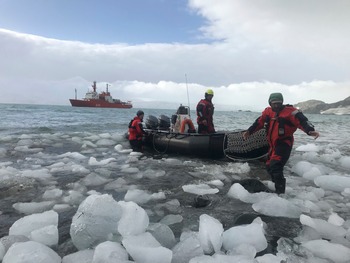
The Antarctic continent is a hostile environment with freezing temperatures, fierce winds, and icy surfaces that pose a danger to scientific research teams due to its isolation. Despite the harsh climate, there are nearly 50 permanent research stations on the continent and over 30 seasonal summer camps, some in the Antarctic Islands. The stations supported by countries signatories of the Antarctic Treaty develop vital research projects related to geology, permafrost, glaciology, and climate change, as well as greenhouse effects, and more. Reference Iserson1–3 Access to most stations requires cruises on inflatable boats (Zodiacs) in freezing waters (Figure 1). Zodiac operations in the Antarctic continent are commonly performed for ship-to-shore and shore-to-ship transport, excursions in the coastal or maritime environments, and search, and rescue operations. The harsh weather conditions in these frigid waters make Zodiac cruises dangerous due to the risk of boat capsizing, hypothermia, injuries from sharp ice, and potential encounters with marine predators. Leopard seals (Hydruga leptonyx) can make punctures on the side of inflatable boats. They are also a potential threat during Zodiac cruises, particularly during the Antarctic summer, and near research stations. Reference Muir, Barnes and Reid4 For all these reasons, Zodiac cruises require planning, precaution, and specialized crew, as well as equipment, including AES and First Aid Kits (FAK). AES are an essential part of the safety equipment for Zodiac crew members in icy waters; they reduce death risk by cold shock response (CSR) through accidental immersion in icy waters. Reference Golden and Tipton5 CSR is the body’s initial response to cold-water immersion. It includes a gasp response, tachycardia, and hyperventilation. Reference Tipton6 These respiratory and cardiovascular responses can lead to death in minutes, even before the onset of hypothermia. Reference Tipton, Collier and Massey7 Cold-water AES increases the chances of survival, providing thermal protection and buoyancy in accidental immersions, and minimizing the risk of CSR and drowning. Reference Brooks8
Brash ice and extreme weather conditions encountered during a Zodiac shore landing at the BAE of the research team members and their essential equipment. All the Zodiac crew members wear individually fitted Viking® cold-water AES as part of their standard protective equipment. The suit protection does not cover the hands.

Despite its thermal protection and innovative design, AES does not protect against extremity lacerations, crush injuries, or penetrating injuries from pinniped attacks. Reference Rutty9,Reference Kornblith, Budak and Simeone10 Floating masses of sharp-edged ice, accidental injuries loading and unloading heavy equipment, and even leopard seal attacks can produce deep penetrating extremity wounds, and profuse external bleeding. Reference Muir, Barnes and Reid4,Reference Rutty9 Early application of an extremity tourniquet (ET) for external bleeding injuries has proven effective in military and civilian settings. Even though most of the documented information with these commercial devices comes from military experience during pre-hospital emergency care and civilian trauma in large urban areas, Reference Goodwin, Moore and Pasley11–Reference Teixeira, Brown and Emigh13 they also advocated for outdoor activities in the isolated wilderness and are included in most FAK. Reference Kragh and Dubick14–Reference Schauer, Naylor and Uhaa18 However, to our knowledge, the ET self-application (SA) in the Antarctic cold using AES overgarments has yet to be studied. This is important since cold can affect isotonic strength as well as muscles’ mechanical and contractile properties. Reference Castellani and Tipton19 Additionally, skin cooling is rapidly induced if hands get exposed to cold Antarctic weather (low temperature, icy winds, or cold-water immersion), reducing manual dexterity, and performance. This phenomenon had been described following accidental short-term cold-water immersions, leading to rapid impairment to both fine and sometimes gross manual dexterity. Reference Cheung, Montie and White20 Besides the extreme cold, the thickness of the AES may complicate survival equipment manipulation. These elements added together can hamper even simple survival tasks like ET-SA. There is a knowledge gap regarding the ability to SA commercial ET when donned with AES. Our study aimed to fill this gap by assessing the self-application abilities of 5 different commercial ET types while wearing extreme cold-water AESs. Additionally, the study attempted to evaluate the perception of SA ease, tolerance, and preference among the 5 commercial ETs among Antarctica’s Zodiac Spanish research crew. We hypothesized that the crew members could successfully apply the ETs to their upper and lower extremities while wearing AESs.
Methods
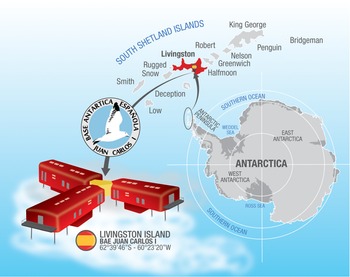
A descriptive observational study was performed among members of the research expedition party to the Spanish Antarctic Base (BAE) for 2 months. The study compared participants’ ability to self-apply 5 commercial ETs, SA easiness on both upper and lower extremities, tourniquet tolerance, and device preference among Zodiac crew members and polar researchers while donned in a Viking® model PS4170 cold water AES overgarment. The study was performed on-site at the BAE, located at located at 62°39′46″S 60°23′20″W, on Hurd Peninsula, Livingston Island, South Shetland Archipelago, during the Antarctic summer (Figure 2).
“Juan Carlos I” Spanish Antarctic Base (BAE). The elevated, modular summer research facility is located at 62°39′46″S 60°23′20″W, on the Hurd Peninsula, Livingston Island, South Shetland Archipelago.

The study was part of BAE personnel and research team’s survival training which covered basic hemorrhage physiology, indications for ET use, tourniquet dynamics, and principles of the ET-SA technique. The physician in charge of the expedition was responsible for issuing and overseeing all the lectures and SA instructions. A post-lecture ET-SA demonstration was given, and the participants could practice with all the devices to be tested before performing the actual drills. The population studied consisted of 15 volunteers who underwent a mandatory medical examination before being mobilized. None of them had a history of clotting or circulation abnormalities. Consent was obtained from each participant, and drills on upper and lower extremities were carried out donned in a personally fitted Viking® model PS4170 cold water AES. The one-handed application technique (OHAT) used the dominant hand at the non-dominant arm’s mid-brachium level (upper extremity). Despite the low environmental temperature, it was performed gloveless to optimize device manipulation. Lower extremity SA was performed with a two-handed application technique (THAT) at mid-thigh (lower extremity) on the dominant side; protective gloving was optional. ET-SA was performed onboard Zodiacs and at the island shoreline. To minimize any potential bias, the application of tourniquets was randomized. The dominant hand secured the non-dominant upper extremity and right lower extremity with tourniquets. All the procedures were done under the supervision of the expedition’s physician. However, participants were not given additional application instructions during the drill. Three significant factors were considered to ensure that the ET was correctly self-applied. First, the tourniquet had to be placed in the correct position, mid-brachium for the upper extremity and mid-thigh for the lower extremity. Secondly, the device had to be tightened sufficiently to reach the desired compression level. Lastly, the tourniquet had to be secured in a compressed and locked position without help. The expedition research physician supervised all 3 aspects to ensure the ET-SA steps were carried out accurately.
Five commercial ETs were tested with 3 different mechanisms: windlass (1 ET), ratcheting (2 ETs), and elastic (2 ETs). The windlass model selected was the Combat Application Tourniquet® Gen -7 (CAT [CAT Resources, LLC, RockHill, SC, USA]); the ratcheting models were the Ratcheting Medical Tourniquet® (RMT [m2® Inc., Colchester, VT, USA]), and the OMNA Marine Tourniquet® (OMNA Inc., Saint Petersburg, FL, USA); and the elastic models were the Stretch-Wrap-And-Tuck Tourniquet (SWAT-T™ [H&H Med Corp., Williamsburg, VA, USA]) and the Rapid Application Tourniquet System® Gen -2 (RATS [Rapid Medical, Yokneam, Israel]).
All activities were carried out during the Antarctic summer characterized by 24-hour daylight, and temperature ranges from -2 to 3 degrees Celsius. Reference Pedrero21 However, since the study was conducted on the shorelines, the authors used wind chill tables to estimate the effects of cold wind on exposed body surfaces. This corresponded to a perceived temperature of -10ºC to -20 degrees C. Reference Lankford and Fox22 After drill completion on both Zodiac and shoreline, an anonymous survey queried participants’ age, gender, and role within the expedition, as well as tourniquet tolerance, and preference among the devices tested. Ease of application and tolerance level were measured using a 10-point Likert scale (1 for the least easy or least tolerable, and 10 for the easiest or most tolerable). The tolerability level was ranked based on the pain the device inflicted when adequately applied and secured. Tourniquet preference was measured by frequency count, with only 1 device to be selected as preferred. Descriptive statistics were applied to the demographical data. The mean values were compared using the ANOVA test with repeated measures, Tukey post-hoc, and Friedman test with a 5% statistical significance threshold. All statistical analyses were performed using the JAMOVI 1.6.3 Open statistical platform (The Jamovi project, Sydney, Australia). 23
Results
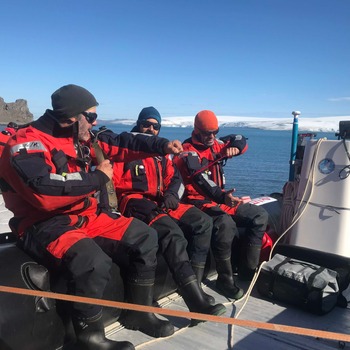
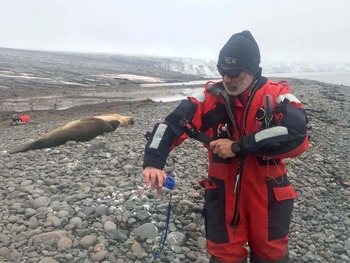
Fifteen volunteers participated in the study (n = 15): 13 (87%) males and 2 (13%) females; and the mean age was 42 (SD: 6.8). All the ET-SA drills were executed wearing an adequately fitted Viking® model PS4170 AES in the 2 different scenarios: aboard the Zodiac (Figure 3), and on the shoreline (Figure 4). Six participants were high mountain-related technicians; 6 were BAE technical personnel, 2 were research scientists, and 1 was a navigation specialist.
Zodiac tourniquet self-application while wearing the Viking® AES. From left to right RMT, gloveless OHAT on the upper extremity, gloved THAT CAT application, and far-right gloveless OHAT of the RATS; notice the index finger pulse oximetry control in the orange capped Zodiac crew member.

Gloveless shoreline drill using the OMNA tourniquet on the Viking® cold-water AES, with pulse oximetry control of the index finger.

SA capability
All devices were self-applied in the upper extremity with a OHAT except for the SWAT-T, which could not be applied single-handed on the Zodiac. For the lower extremity application employing a THAT, all the devices were adequately self-applied and deemed suitable by the supervising physician, both on the Zodiac and shoreline. No gender differences were observed for the effectiveness of the tested ET-SA on either upper or lower extremities.
Ease of application
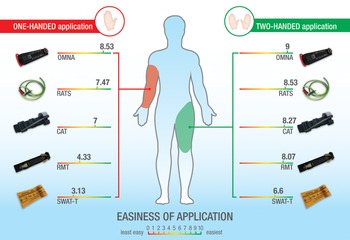
Ease of OHAT for the upper extremity ranked highest for the ratcheting OMNA model with a mean of 8.53 (SD: 0.99), followed by the elastic RATS (Gen-2) (mean of 7.47; SD: 1.6), and the windlass CAT (Gen-7) (mean of 7.00; SD: 0.76). For the ratcheting RMT and elastic SWAT-T models, the means were 4.33 (SD: 1.6) and 3.13 (SD: 1.8). Both models were found to be significantly more complex than the windlass and ratcheting models based on a Friedman test with the Durbin-Conover post hoc test (P < 0.001) (Figure 5).
Easiness mean values for the 5 devices tested on upper and lower extremity self-application while wearing a cold-water AES.

For THAT on the lower extremity, the OMNA was also ranked as the easiest of all 5 models with a mean of 9.0 (SD: 0.99), followed by the RATS (Gen-2) with a mean of 8.53 (SD: 0.51), the CAT (Gen-7) with a mean of 8.27 (SD: 0.88),and the RMT with a mean of 8.07 (SD: 0.70). The SWAT-T model was found to be significantly inferior based on a Friedman test with the Durbin-Conover post hoc test (P < 0.001) and had a mean of 6.60 (SD: 1.88) (Figure 5).
Tourniquet tolerance
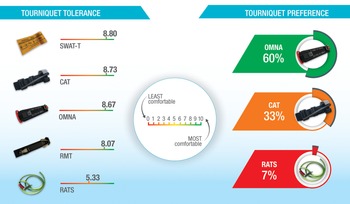
Results for tourniquet tolerance revealed that the SWAT was tolerated best with a mean of 8.80 (SD: 0.78), followed by the CAT (Gen-7) with a mean of 8.73 (SD: 0.70), the OMNA with a mean of 8.67 (SD: 0.98), and the RMT with 8.07 (SD: 0.70). The Gen-2 elastic RATS model had the lowest tolerance rating with a mean of 5.33 (SD: 1.18). This difference was statistically significant compared to the other models, as determined by a repeated measures ANOVA with Tukey post hoc test (P < 0.01) (Figure 6).
Tolerance mean values for the 5 devices tested wearing a cold-water AES and ET preference.

Tourniquet preference
Among the 5 extremity tourniquets assessed, 9 (60%) participants preferred the ratcheting OMNA model, 5 (33%) favored the windlass CAT (Gen-7) model, and 1 (7%) preferred the elastic RATS (Gen- 2) ET. No one selected the ratcheting RMT or the elastic SWAT-T models (Figure 6).
Discussion
Our study aimed to verify the participants’ ET-SA abilities on the upper and lower extremities on the Zodiacs and the Antarctic shoreline while donned in AES. It is of utmost importance to underscore the demanding nature of conducting research studies in the field. Even though various scholars have executed ET application studies, most of these have been conducted in laboratory settings or at ambient temperatures. Reference Wall, Buising and Hingtgen24–Reference Hingtgen, Wall and Buising29 The Antarctic field conditions of humidity levels, windchill impact, Zodiac movements, and cold weather conditions present a considerable obstacle when striving to replicate experimental outcomes. Reference Lankford and Fox22,23 Despite these challenges, the participants could SA most of the ET in the upper and lower extremities donned in the AES. It was observed that the thickness of the cold-water multilayered AES and the severe weather conditions prevalent in the polar region did not impact the ET-SA. However, the elastic SWAT-T upper extremity OHAT was deemed complex, and participants had difficulty securing it around the arm with only 1 hand. This finding was reported mainly in the Zodiac scenario.
Other authors have reported similar results with this device type and model for different OHAT scenarios. Reference Wall, Sahr and Buising30 The authors suggest that the non-autolocking design of the device is the main factor contributing to this finding, rather than the texture of the AES or weather conditions. THAT on the lower extremity was achieved by all the participants with all the devices tested. Many studies have focused on applying ET to bare skin or military uniforms, but there is a lack of research on self-applying ET over technical suits. Reference Wall, Buising and Hingtgen24,Reference Hingtgen, Wall and Buising29 This gap in knowledge highlights the need for further investigation into the potential impact of ET-SA on individuals wearing various types of protective clothing. Wall et al. compared clothing effects on both pressure and application process, finding little effect on tourniquet vascular occluding pressure’ They however, mentioned differences in the ease of strap sliding of several commercial devices, depending on the type of fabric over which the tourniquet was applied (bare, scrubs, and military uniform). Reference Wall, Buising and Hingtgen24 Two studies have evaluated the efficacy of the windlass CAT model ET with the hazmat (hazardous material) suits used in chemical, biological, radiological, or nuclear (CBRN) threats. Reference Beaven, Sellon and Ballard26,Reference Peponis, Ramly and Roth31 The components of the new generation of hazmat suits like the Joint Service Lightweight Integrated Suit Technology (JSLIST), are made of thin, lightweight, and stretchable fabric, which are laminated to activate carbon spheres that absorb chemical agents. Reference Peponis, Ramly and Roth31 However, AESs are much thicker, multilayered, and heavily insulated. The Viking® AES model PS4170 has 3 external layers of GORE-TEX® Pazifik™ (290g/m2) and 2 layers of inner lining: 1 of thin polyester (120g/m2) and a second of quilted polyester (150g/m2). No prior studies testing different ET models with cold-water AES in Antarctica were found. Our study revealed that the multilayered thickness of the Viking® model PS4170 cold water AES did not impede proper ET self-application.
In their publication, Lechner et al. confidently presented the successful application of ET to multilayered winter clothing using a HapmedTM Tourniquet Trainer. Their study demonstrated the achievable vascular occlusion pressure, proving the feasibility of this technique. Reference Lechner, Beres and Oberst27 The authors acknowledge the difficulties in measuring the effectiveness of ETs for vascular occlusion pressure in the Antarctic field conditions of the study. Such challenges may include but are not limited to environmental variables, individual differences, and technical limitations. Despite the limitations, the authors successfully conducted a registry of pulse oximetry (PO) and measured PO waveform loss on the upper extremity using a Choice Med Fingertip MD300C2 PO sensor with a dual-color OLED display. However, it should be noted that these measurements were mostly carried out on the shoreline, as illustrated in Figure 4. Although the authors have evaluated the occlusion of upper extremity blood vessels, they acknowledge that the assessment method they used may not be considered reliable by some researchers. This is due to reports of inaccurate PO readings caused by various factors such as excessive movement, being in a highly lit environment, experiencing severe vasoconstriction, and hypothermia, as well as low perfusion states, and temperatures below 15 degrees C. Reference Chan, Chan and Chan32 The authors suggest that a handheld Doppler registry would have been a more reliable alternative, but it was not feasible due to technical and logistic limitations during the Antarctic expedition. Therefore, the authors refrained from making definitive statements about the effectiveness of ETs for vascular occlusion when applied over AESs.
It is essential to highlight that the ease of ET-SA can be influenced by various factors such as the ET design, weather conditions, and the use of technical suits. The authors suggest considering these elements when evaluating the performance of ET-SA. Our study found that the upper extremity OHAT has a broader range of outcomes for SA ease compared to the lower extremity THAT. It is worth noting that using a two-handed approach for SA is significantly more manageable than using just 1 hand. This discovery underscores the insufficiency of relying solely on one-handed SA across all devices. Moreover, the SWAT-T elastic model was found to be significantly more complex (P < 0.001) in SA to the upper and lower extremities compared to the windlass and ratcheting models. These findings could be attributable to its elastic mechanism and its securing system design, which lacks an auto-locking buckle. When self-applying the SWAT-T elastic tourniquet model, it is imperative that 1 possesses the necessary expertise to achieve adequate tension and accuracy during each successive wrap. Additionally, it is crucial to be proficient in securely tucking the end under the final wrap for optimal self-application. These abilities require extensive training and can prove to be quite challenging to master. The ratcheting OMNA model was statistically easier to self-apply than the rest (P < 0.01) using a OHAT but not with the THAT (Figure 5). The RATS type was deemed more challenging than OMNA, but it was rated much better than the other elastic type (SWAT-T). We recognize that these differences between the different ET models could be explained by the strap design, configuration, and locking mechanism. Considering all the tested devices for OHAT and THAT, the ratcheting OMNA tourniquet ranked the easiest for SA in both the upper and lower extremities. It is convenient to note that OMNA was explicitly designed for the marine environment. This marine ET has a slim neoprene-like surface under the ladder portion, a 5.1cm-wide strap, a redirect buckle with a hoop-and-loop secured system that can be pulled with both hands in two-handed applications, and one-handed applications are simplified. Reference Hingtgen, Wall and Buising29 In addition, its ratcheting locking system requires little effort and requires little manual dexterity. Since freezing weather can seriously affect manual skill, which is essential for ET application, the OMNA ratcheting mechanism and strap design might have been the critical factor in Antarctic conditions, making it much more manageable than the other models tested.
When navigating in colder environments, it is crucial for Zodiac crew members to account for the potential decrease in manual dexterity. Completing tasks that demand precision, such as ET-SA, can prove to be challenging in cold environments. The low temperature can hinder maintaining a steady grip and executing movements with the same level of accuracy as in warmer conditions. As such, crew teams must remain vigilant and take appropriate measures to minimize the impact of these environmental factors on their performance and safety. Cheung et al. report on the rapid loss of fine and gross manual dexterity with short periods of hand and forearm immersion in water at 10 degrees Celsius and emphasize the need for hand and forearm insulation protection, as well as the use of survival equipment that will require little skill. Reference Cheung, Montie and White20 Hingtgen et al. recent study on SA effectiveness stated that the OMNA Marine Tourniquet could be applied effectively, even with a single-handed non-dominant hand. Reference Hingtgen, Wall and Buising33 The maritime conditions, the extreme cold, and the freezing winds must be considered when selecting polar regions’ survival equipment. ETs with an easy-running strap design and effortless securing systems should be selected. However, the ease of application should not be attributed exclusively to the ratcheting securing mechanism. The perception of the easiness of SA was not reproduced with the other ratcheting model (RMT), in part due to the different strap routed design, which generated friction pressure that interfered with a speedy adjustment of the strap over the extremity. It is important to note that despite being ranked highest for application ease, the OMNA model was the bulkiest among those tested. This could cause issues when equipment space is limited during expeditions to extremely isolated environments. It is crucial to consider this factor before selecting equipment for such trips.
ET tolerance is associated with the user’s lack of comfort and pain level experienced when the device is secured. Wall et al. attributed the discomfort to ET’s sharp corner design, pressures generated by the device’s width, and the tightening system that can cause skin bunching or pinching produced by friction pressure. Reference Wall, Sahr and Buising30 Our results reveal that most of the devices tested were well tolerated and ranked above 8; only the RATS resulted lower (5.31), with statistical significance (P < 0.01). The thinner profile of the elastic RATS model and the multiple turns around the extremity caused a pinching effect when effectively secured, causing pain even with the AES. Of all the devices studied, the SWAT-T ranked the highest for tolerance. Generally, the wider the design, the lower the pressure required for effective vascular occlusion. Reference Wall, Sahr and Buising30,Reference Graham, Breault and McEwen34 The SWAT-T has no sharp corners, and the tested model’s width is 10.4 cm, the widest of the types and models tested. Its width allows for vascular occlusion with lower pressure because it exerts pressure more evenly and in an ampler surface and could explain why it was rated the best for tolerance. Tourniquet preference was based on the participants’ overall experience with the shoreline and Zodiac SAs. The results showed that the OMNA Marine Tourniquet was the preferred device among all the tested ETs in these harsh conditions. These results could be explained by its specific maritime environment design, perceived superior ease for OHAT and THAT, and a simple locking ratcheting mechanism. The study reveals that ET-SA is feasible, donned with an AES in cold weather marine conditions. As a result of these findings, the authors consider that specifically designed ETs for the maritime environment should be included in the FAK when performing Zodiac cruises in the Antarctic region, or during search rescue operations in extreme cold weather conditions when donned with AES.
It is crucial to acknowledge the existing limitations which encompass a smaller sample size, such as erratic evaluation of vascular occlusion with ET application, challenges in assessing pulse oximetry in low temperatures, and lack of assessment over time for ET-SA effectiveness, as well as limited attempts made solely on the dominant hand for upper extremity usage, subjectivity in gauging ease of use and device tolerance, and personal preference among different ET models. Additionally, the study’s findings are inconclusive regarding gender due to the overwhelmingly male population. However, our study confirms the feasibility and effectiveness of commercial ET-SA donned with a cold-water AES in Antarctic weather, even with these limitations. Furthermore, a self-application technique is feasible both on Zodiacs and at shorelines despite the constraints posed by using this technical garment. Future research could assess ET in other technical suits and study the effect of prolonged ET application effectiveness wearing cold-water immersion suits. Additionally, researchers should improve ET designs to require as little manual dexterity as possible in extreme cold weather conditions.
Conclusion
Extremity tourniquet self-application donned with cold-water anti-exposure suits in extreme cold weather conditions is feasible for temporary extremity vascular occlusion in both upper and lower extremities. Of all the extremity tourniquets tested, the marine ratcheting model was the easiest to apply in both the upper and lower extremities and was the most favored device regarding preference.
Data availability statement
The data supporting this study’s findings are not publicly available. However, data are available from the authors upon reasonable request and permission of the BAE scientific coordinators.
Acknowledgments
The authors acknowledge the Spanish Antarctic Base (BAE) members’ support and approval for this activity. Likewise, the Spanish polar research program of the Marine Technology Unit (UTM), part of the Scientific Research Council (CSIC), for supporting the research expedition. Our thanks to Mercedes Muñoz and Visitación Ortega Riba, information specialists, for their assistance with the literature search; Carlos Yánez Sr. PhD, for his proofreading and suggestions; and Ilaria Biondi, the medical illustrator.
Author contribution
All authors meet the authorship criteria for this manuscript. CY, AG, and TLA conceived the study. IL, IS, and TLA conducted the field study. CY, AG, KM, and MR, as well as MB, and TL performed the literature search. CY, AG, and TL wrote the manuscript draft. CY, AG, MR, and KM, as well as TL revised the final manuscript. All authors reviewed and approved the final manuscript.
Funding
No funding or grant support was received for this manuscript.
Competing interests
The authors have no competing interests to declare.
Ethical standards
This study was conducted during a Spanish research expedition to the Juan Carlos I Spanish Antarctic base (BAE). All the activities related to the study formed part of the survival training program of the research crew. The study was authorized by the Spanish Polar Committee, which is a member of the Council of Managers of National Antarctic Programs (COMNAP) under Spain’s Ministry of Science and Education. The medical and research coordinators of the council and the research base exempted the study from ethical approval since it did not involve human or animal experimentation and focused on survival training.
Consent for publication
The identifiable images are of the research team members who have issued consent for its publication.
Abbreviations
AES, Anti-Exposure Suits; BAE, Spanish Antarctic Base; CAT, Combat Application Tourniquet; CSR, Cold Shock Response; ET, Extremity tourniquets; ET-SA, Extremity tourniquet self-application; FAK, First Aid Kits; OHAT, One-handed application technique; OMNA, OMNA Marine Tourniquet; RATS, Rapid Application Tourniquet System; RMT, Ratcheting Medical Tourniquet; SA, Self-application; SWAT-T, Shecht Wrap and Tuck Tourniquet; THAT, Two-handed application technique; PO, Pulse oximetry.