Introduction
Family homelessness is a context of multisystemic risk that threatens child outcomes. Even so, sizable percentages of children who experience homelessness manifest resilience, showing developmental competence. High-quality early childhood programs offer important support for many families with young children, though relatively little is known about whether families staying in shelters enroll in these programs, what factors might influence enrollment, and whether enrollment relates to meaningful differences in subsequent family outcomes. Capitalizing on administrative records from public agencies and local efforts in a large city to support early childhood program enrollment for children experiencing homelessness, we defined three aims. First, we documented the prevalence of risks and some resources in the lives of young children (birth through five years old) residing in family shelters, including rates of early childhood program enrollment. This occurred in the context of an ongoing multi-system intervention designed to promote early childhood program participation and support early development for young children staying in family shelter. Second, we applied a multisystem perspective on developmental resilience and risk to further understand the complex processes of risk and adaptation for young children who experience homelessness. Specifically, with a person-centered approach, we considered whether multisystem indicators across early childhood development and prior to shelter corresponded with high-quality early childhood program enrollment while in shelter, a potentially important resource to support child- and family-level resilience. Our multi-system perspective also allowed us to contextualize factors from different systems in light of each other, thereby influencing their meaning and implications. Third, we then tested whether profiles of early childhood program use and other multisystem factors predicted subsequent episodes of homelessness or child welfare placements. Our goal was to surpass single-factor, variable-focused accounts of homelessness-as-risk and incorporate multisystem developmental contexts of both risks and resources. Importantly, as a research-practice partnership, we aim for our findings to be readily actionable: We are attempting to discern profiles that suggest actions to remove barriers and facilitate access to early childhood programs as a resource to promote resilience among families experiencing homelessness.
Family homelessness in early childhood
Roughly half of all U.S. children who stay in emergency shelters for families are under 6 years old (Haskett & Armstrong, Reference Haskett and Armstrong2019). Poor outcomes for U.S. children experiencing family homelessness have been documented across developmental domains of physical health, mental health, social-emotional development, and academic achievement (Bassuk et al., Reference Bassuk, Hart and Donovan2020; Haskett & Armstrong, Reference Haskett and Armstrong2019; Herbers, Cutuli, Keane, et al., Reference Herbers, Cutuli, Fugo, Nordeen and Hartman2020; Masten et al., Reference Masten, Cutuli, Herbers, Hinz, Obradovic and Wenzel2014). Less is known about the well-being of young children specifically (birth through age 5 years) with the largest knowledge gaps for infants and toddlers who stay in family shelter (Fanning, Reference Fanning2021; Haskett et al., Reference Haskett, Armstrong and Tisdale2016; Herbers, Cutuli, Fugo, et al., Reference Herbers, Cutuli, Fugo, Nordeen and Hartman2020).
For the purposes of this paper, we focus on families with young children who stayed in emergency or transitional shelters for homelessness. We refer to this situation as “family homelessness” for simplicity; however, we acknowledge that the vast majority of children and families who experience homelessness do not stay in shelters but rather stay “doubled-up” (sharing accommodations with friends or family), stay in substandard housing, or are unsheltered (National Center for Homeless Education (NCHE), 2022).
Multisystem resilience and risk in child development
Despite varied and considerable challenges, many young children in families who experience homelessness demonstrate resilience (Herbers, Cutuli, Keane, et al., Reference Herbers, Cutuli, Keane and Leonard2020; Masten & Palmer, Reference Masten, Palmer and Bornstein2019). Resilience is the capacity of a system to adapt successfully to disturbances that threaten the viability, function, or development of the system (Masten, Reference Masten2014).
Resilience in development is inherently a multisystem concept (Masten et al., Reference Masten, Lucke, Nelson and Stallworthy2021), though it can be interrogated at different systems levels, such as the level of a child, family, neighborhood, or a larger community. As a special case of development, resilience is the product of multiple interconnected, dynamic systems that together support positive development despite the experience of one or more risks that threaten developmental competence (Yates et al., Reference Yates, Egeland, Sroufe and Luthar2003). Applied to family homelessness, young children who stay in family shelter are embedded within social-ecological contexts, which constitute dynamic systems, such as immediate family, shelter, extended family, early childhood programs, religious communities, neighborhoods, race/ethnicity and broader culture, and municipal, state, and federal health and human service practice and policy contexts (Cutuli & Willard, Reference Cutuli and Willard2019). These systems are dynamic in that their characteristics change, and they are interrelated because the characteristics of individual systems can influence the characteristics of other systems over time and often through complex processes. Furthermore, individual child functioning actively influences, and is influenced by, the ecological systems in which the child exists (Blair & Raver, Reference Blair and Raver2012; Gottlieb, Reference Gottlieb1991).
Developmental status and change result from complex interactions, coactions, and transactions among these multiple systems over time. When one or more systems contain risk, the systems that constitute the child and their ecology can respond through complex processes that either adapt and support positive development, leading to resilience, or maladapt, leading to negative outcomes and impairment (Masten et al., Reference Masten, Lucke, Nelson and Stallworthy2021).
The developmental literature on resilience refers to promotive or protective factors (sometimes referred to simply as “resilience factors”) as measurable characteristics of child and ecological systems that encourage resilience. Powerful resilience factors can occur in systems and be distributed across systems at every level, such as individual characteristics, family-system characteristics, community resources such as high-quality early childhood programs that provide nurturing, structured environments, and health and human service systems that are sufficiently resourced and informed by the developmental needs of young children and their families.
Both risk and resilience factors can exist within systems and present themselves at different times in various ways. These factors can also “cascade” across development, as risk contributes to impairment or maladaptation in one system or domain at one point in time and contributes to impairment or maladaptation in other systems or domains later (Masten & Cicchetti, Reference Masten and Cicchetti2010). Positive cascades also occur when positive processes in one system contribute to positive characteristics in other systems over time (Doty et al., Reference Doty, Davis and Arditti2017). While resilience-in-development frameworks emphasize the complex interplay among systems over time, the empirical literature has generally emphasized isolating the influence of a single or very small number of factors – often risks exclusively – at one point in time or over relatively short durations (Evans et al., Reference Evans, Li and Whipple2013). Both recent and longstanding multisystem accounts of resilience and risk encourage empirical investigations of factors that not only directly contribute to child-level functioning but also investigations that elucidate the processes through which systems influence the characteristics of other systems with implications for positive or negative outcomes (Masten et al., Reference Masten, Lucke, Nelson and Stallworthy2021).
Chronic and acute multisystem risks of homelessness for young children
Family homelessness involves a conglomeration of both acute and chronic adversities or risks (Cutuli & Herbers, Reference Cutuli and Herbers2014). Acute risks of homeless episodes can include family separations, loss of employment, eviction, intimate partner violence, or exposure to natural disaster, to name a few (Haskett & Armstrong, Reference Haskett and Armstrong2019; Herbers & Cutuli, Reference Herbers, Cutuli, Bornstein and Shahin press). In conjunction with these acute risks, families who experience homelessness also often contend with chronic poverty-related risks of their low socioeconomic status, such as limited parental education, low-quality educational opportunities, substance abuse or mental health problems, incarceration, and child maltreatment (Haskett & Armstrong, Reference Haskett and Armstrong2019). Families experiencing homelessness disproportionately include those from minoritized racial and ethnic groups, including African American and Hispanic/Latino backgrounds ([NCHE], 2021). Family homelessness occurs repeatedly for some children, with different degrees of housing instability and other adverse experiences occurring between episodes. The majority of families who use shelter do so for brief periods and do not return, though meaningful percentages have longer stays or leave and return to shelter. Older findings have linked returning to shelter with varied intensive service interventions applied to families (e.g., intensive behavioral health treatment; child foster care placement) and with caregiver disability and unemployment (Culhane et al., Reference Culhane, Metraux, Park, Schretzman and Valente2007). The risk of poor academic, social, and mental health outcomes for children is particularly potent when accumulating risk factors arise from a combination of limited resources due to poverty and aspects of family dysfunction (Herbers, Cutuli, Keane, et al., Reference Herbers, Cutuli, Keane and Leonard2020).
Environmental conditions of poverty, homelessness, and emergency housing can impact children’s growth, health, and early development both directly and indirectly through their influence on other ecological systems. Children experiencing homelessness are at risk for poor nutrition, food insecurity, exposure to infectious diseases, and inflammatory health conditions such as asthma that can compromise physical health (Clark et al., Reference Clark, Weinreb, Flahive and Seifert2018; Cutts et al., Reference Cutts, Meyers, Black, Casey, Chilton, Cook and Coleman2011; Cutuli et al., Reference Cutuli, Ahumada, Herbers, Lafavor, Masten and Oberg2017; Gultekin et al., Reference Gultekin, Brush, Ginier, Cordom and Dowdell2020; Lippert & Lee, Reference Lippert and Lee2021; Sandel et al., Reference Sandel, Sheward, Ettinger de Cuba, Coleman, Heeren, Black and Frank2018). Risks often extend back to the perinatal and prenatal periods since homelessness – even homelessness that occurs later in early childhood – has been associated with lower rates of adequate prenatal care and higher rates of poor birth outcomes including premature birth and low birthweight (Brumley et al., Reference Brumley, Fantuzzo, Perlman and Zager2015; Shaw et al., Reference Shaw, Herbers and Cutuli2019).
Environmental exposure to lead and its neurotoxic effects warrants particular consideration. Children who stay in homeless shelters have shown high rates of lead exposure and elevated blood lead levels in studies spanning the past 35 years (e.g., Alperstein et al., Reference Alperstein, Rappaport and Flanigan1988; Brumley et al., Reference Brumley, Fantuzzo, Perlman and Zager2015; Volk et al., Reference Volk, DeCandia and Unick2023). In general, young children are at high risk for ingesting lead, which is especially detrimental to rapidly occurring neural development during early childhood with consequences for impaired cognitive, behavioral, and academic abilities (Brumley et al., Reference Brumley, Fantuzzo, Perlman and Zager2015; Rouse et al., Reference Rouse, Fantuzzo and LeBoeuf2011; Zhang et al., Reference Zhang, Baker, Tufts, Raymond, Salihu and Elliott2013). Links between elevated blood lead levels and early academic skills have been found among children who experience homelessness in early life (Brumley et al., Reference Brumley, Fantuzzo, Perlman and Zager2015). The risk for lead toxicity associated with homelessness is thought to mainly operate through exposure to substandard housing before or between shelter stays, as children who live in substandard housing and very low-income neighborhoods are at high risk (Ahrens et al., Reference Ahrens, Haley, Rossen, Lloyd and Aoki2016; Coulton et al., Reference Coulton, Richter, Kim, Fischer and Cho2016). Most lead poisoning occurs through ingesting lead dust, such as from lead-based paint in older, undermaintained housing, though lead contamination can also occur in soil, water pipe soldering, and other avenues (ATSDR, 2020; Gómez et al., Reference Gómez, Borgialli, Sharman, Shah, Scolpino, Oleske and Bogden2018). Universal blood lead level screening is a healthcare standard and is required at ages 12 and 24 months and by age 5 years for children enrolled in Medicaid, and recommended for all children at high risk based on behavior, background, or neighborhood (Centers for Disease Control and Prevention, 2023). Public health monitoring of blood lead level screens is important to guide remediation of the physical environment, while providers can deploy various interventions with individual families, including referrals for developmental assessments and any needed supports (e.g., Early Intervention services).
Child and family functioning is embedded in broader systems including shelters, neighborhoods, communities, health and human services, and socio-political contexts. Ongoing racial discrimination, stigma, and historical trauma of systemic racism further limit opportunities and degrade a sense of belongingness and self-efficacy for people of color who are overrepresented among those experiencing homelessness (Hampton-Anderson et al., Reference Hampton-Anderson, Carter, Fani, Gillespie, Henry, Holmes and Powers2021; Paat et al., Reference Paat, Morales, Escajeda and Tullius2021). Because social and cultural structures impact where people live and seek housing-related services, people with disadvantaged backgrounds often live in impoverished neighborhoods with lower-quality schools, less access to nutritious foods, and social service systems that are overwhelmed and understaffed (Bassuk et al., Reference Bassuk, Hart and Donovan2020; Evangelist & Shaefer, Reference Evangelist and Shaefer2020). The move to a shelter or other emergency housing arrangement can also disconnect families from the services, local resources, and essential relationships that previously served as support (Cronley et al., Reference Cronley, Nahar and Hohn2020; Gultekin et al., Reference Gultekin, Brush, Ginier, Cordom and Dowdell2020; Nayak et al., Reference Nayak, Carpenito, Zamechek, Roper, Méndez-Peñate, Arty, Moulin, Mirand and Molnar2022). Relatedly, both formal and/or informal childcare in particular may be lost when homelessness occurs (Cutuli & Willard, Reference Cutuli and Willard2019).
Early childhood programs and social services as resources for families
High-quality early childhood programs are a well-documented resource for young children and their families because they can promote developmental competence across socioeconomic strata and facilitate resilience for those who experience risk (Burchinal et al., Reference Burchinal, Whitaker and Jenkins2022; Green et al., Reference Green, Ayoub, Bartlett, Furrer, Cohen, Buttita and Sanders2018; Heckman, Reference Heckman2006). We refer to early childhood programs broadly to encompass a range of formal program types, including center-based, childcare homes, home visiting programs, therapeutic and specific programs such as early intervention, and other programs that aim to provide care and/or support to young children.
Specialized programs designed for families with low income – such as Head Start and Early Head Start – often involve child-directed and family-directed components with two-generation models designed to counteract multisystem risk related to poverty and adverse experiences. These models support the functioning of the child, family, and broader ecologies (Green et al., Reference Green, Ayoub, Bartlett, Furrer, Cohen, Buttita and Sanders2018; Kane et al., Reference Kane, Bailey, Wheat and Halle2020). Early Head Start in particular improves outcomes for eligible children in part by working with parents to bolster supportive home environments and reduce instances of child maltreatment and other child welfare involvement (Bartlett et al., Reference Bartlett, Smith and Bringewatt2017; Green et al., Reference Green, Ayoub, Bartlett, Von Ende, Furrer, Chazan-Cohen and Klevens2014, Reference Green, Ayoub, Bartlett, Furrer, Chazan-Cohen, Buttitta and Regalbuto2020; Kane et al., Reference Kane, Bailey, Wheat and Halle2020). Early childhood programs and providers including home visiting services have potential to support children experiencing adversity in numerous ways – through screening, offering nurturing environments to offset or buffer from instability, and supporting the child’s family in other ways (Bartlett et al., Reference Bartlett, Smith and Bringewatt2017).
Favorable child outcomes most strongly associated with use of high quality childhood programs include reduction in special education placement, less grade retention, and increased high school graduation rates (Burchinal et al., Reference Burchinal, Whitaker and Jenkins2022; McCoy et al., Reference McCoy, Yoshikawa, Ziol-Guest, Duncan, Schindler, Magnuson and Shonkoff2017). Evidence for the benefits of early childhood programs to social-emotional and behavioral outcomes is mixed, and these domains may depend more intensively on the type and timing of early childhood programs as well as quality of subsequent school experiences and support (Ansari et al., Reference Ansari, Pianta, Whittaker, Vitiello and Ruzek2019). Investigations of “fade-out” in positive effects of early childhood programs have also pointed to child- and family-level factors that may moderate associations with academic outcomes (Burchinal et al., Reference Burchinal, Whitaker and Jenkins2022; Duncan & Magnuson, Reference Duncan and Magnuson2013). High-quality, center-based early childhood care, in particular, has been shown to predict better academic and behavioral outcomes for high school students when controlling for extensive measures of family background (Vandell et al., Reference Vandell, Burchinal and Pierce2016).
Center-based programs and others may especially support children experiencing homelessness by offsetting a lack of safe play spaces, books, and quality toys or other learning materials in shelter contexts that limit children’s opportunities to engage in learning through play (Volk & Abo-Zena, Reference Volk and Abo-Zena2022; Vrabic et al., Reference Vrabic, Herbers, Davis and Thomas2022). Early childhood programs may also support positive, multisystem cascades by providing important education, direct services, and referrals to help stabilize caregivers and families as they adapt to both acute stressors (e.g., recent exposure to domestic violence and other trauma) and chronic risks (e.g., low educational opportunities and attainment; substance use problems). The potential benefits of early childhood programs for promoting family housing stability have yet to be tested or demonstrated with rigorous empirical evidence. With regard to early childhood education, reports suggest limited utilization for children in families experiencing homelessness. In 2019, only 10% of children under age 6 experiencing homelessness (including shelter, doubled-up, and other contexts) were served by a federally funded early childhood program (Yamashiro & McLaughlin, Reference Yamashiro and McLaughlin2021), a finding generally echoed in a recent report estimating low rates of utilizing childcare programs, Early Head Start, and home visiting services (SchoolHouse Connection, 2022). However, these efforts relied on counts of homelessness among young children and their early childhood program participation that were likely to be gross misestimates (e.g., Government Accountability Office, 2014).
Even so, there are other reasons to believe that few families who experience homelessness utilize early childhood programs. Families experiencing homelessness likely face more barriers in accessing early childhood programs due to high mobility, lack of transportation, stigma related to homelessness status, delays in approval for childcare subsidy, difficulty documenting eligibility, the need for nonstandard care hours, and lack of awareness of early childhood programs (Hurd & Kieffer, Reference Hurd and Kieffer2016; Wright et al., Reference Wright, Ochrach, Blaydes and Fetter2021). The range and extent of these barriers reflect the numerous adversities that tend to aggregate when families experience residential instability and homelessness.
Due to the limited research on young children in families experiencing homelessness, relatively little is known about their experiences of developmental risk factors, connections to social services, and experiences in early childhood programs. The value of health and human services to families in shelter is widely recognized (Bassuk & Geller, Reference Bassuk and Geller2006). Nevertheless, some reports suggest that families staying in homeless shelters tend to have lower enrollment rates and participation in basic support services (e.g., Burt et al., Reference Burt, Khadduri and Gubits2016) and there is a general lack of rigorous tests of efficacy or effectiveness for interventions applied to families in shelter (Herbers & Cutuli, Reference Herbers, Cutuli, Haskett, Perlman and Cowan2014).
Homelessness also has been linked to involvement with child protective and welfare services, herein referred to as “child welfare services” for simplicity (Bai et al., Reference Bai, Collins, Fischer, Groza and Yang2020; Palmer et al., Reference Palmer, Piescher, Berry, Dupuis, Heinz-Amborn and Masten2023). Child welfare service involvements are indicators of complicated multisystem risk and support. These services are often risk-activated, meaning that they are designed to proactively support children and parents when risk – especially within the family system – is identified. Care, nurturance, and support from parents and caregivers are extremely powerful resilience factors as families navigate developmental challenges (Masten & Palmer, Reference Masten, Palmer and Bornstein2019). These resilience factors are threatened as parents in families experiencing homelessness report elevated rates of mental health problems including depression, posttraumatic stress, and substance abuse linked to histories of stressful and traumatic life experiences including maltreatment, interpersonal violence, and loss, all of which are linked to lower levels of warm, structured, and responsive caregiver behavior that support resilience in early childhood (Bassuk et al., Reference Bassuk, Richard and Tsertsvadze2015; Corman et al., Reference Corman, Curtis, Noonan and Reichman2016; DeCandia et al., Reference DeCandia, Herbers, Volk and Unick2023). In more extreme circumstances, these negative parent experiences can also contribute to harsh parenting behaviors and maltreatment that represent additional risks for poor child outcomes (Herbers et al., Reference Herbers, Tabachnick, Hayes, Tebepah, Wallace and Cutuli2023; Masarik & Conger, Reference Masarik and Conger2017; Narayan et al., Reference Narayan, Lieberman and Masten2021) and would make child welfare service receipt more likely.
Child welfare services are a range of supports, such as developmental and parenting education, referrals and varied direct social services, and, when necessary, out-of-home placements to address safety concerns. Despite this range of services, past findings on homelessness and child welfare services largely have focused on foster care and other out-of-home placements. Analyses suggest high rates of homelessness and housing instability among families with a child placed in foster care, ranging from 30 to 97% (Courtney et al., Reference Courtney, McMurtry and Zinn2004; Fantuzzo & Perlman, Reference Fantuzzo and Perlman2007). Furthermore, emergency shelter use predicts higher likelihood of child welfare service involvement (Palmer et al., Reference Palmer, Piescher, Berry, Dupuis, Heinz-Amborn and Masten2023) and out-of-home placement independent of other risk factors, but the interaction of substantiated child maltreatment and emergency shelter use predicted lower likelihood of out-of-home placement, at least in one study (Perlman & Fantuzzo, Reference Perlman and Fantuzzo2013). These findings suggest that services related to emergency shelter use specifically for families with a history of maltreatment might help divert children from foster care, though there is little rigorous evidence on the specific services and processes that contribute to this phenomenon nor whether positive services during emergency shelter use can improve caregiving for families (Haskett & Armstrong, Reference Haskett and Armstrong2019; Herbers et al., Reference Herbers, Tabachnick, Hayes, Tebepah, Wallace and Cutuli2023).
The Building Early Links for Learning program
The Building Early Links for Learning (BELL) program is specific to Philadelphia and is rooted in multisystem accounts of resilience for young children experiencing homelessness (Cutuli & Willard, Reference Cutuli and Willard2019). The program acts on multiple systems relevant to young children in family shelter. Key activities include directly supporting developmentally informed and responsive physical, practice, and policy environments for young children in general family shelters across Philadelphia. BELL also engages municipal, state, and federal policies and service-system practices through advocacy. Locally, it works to facilitate connections between the shelter and early childhood program systems to share expertise and facilitate supports for young children in family shelter. Most relevant to the current study, the program works directly with shelter staff to prepare them to help families who wish to participate in early childhood programs, including sharing information on different early childhood program models, the benefits of high-quality programs, recognizing high quality programs, locating specific high-quality programs, applying for subsidies, and enrolling. The BELL program encourages shelter staff to routinely discuss early childhood programs with each caregiver of a young child in shelter for the purpose of learning their wishes, assisting them, and following up. BELL staff routinely coordinate meetings and events that bring staff from nearby early childhood programs onsite at each shelter with several goals: sharing information with parents about different high-quality early childhood programs that are nearby and how they could benefit their child, answering parent questions to help determine if that early childhood program is a good fit for their family, and giving parents the opportunity to immediately enroll their child. Additional information on the BELL model is available at (Cutuli & Willard, Reference Cutuli and Willard2019), and detailed activities and periodic metrics at (Cutuli & Baye, Reference Cutuli and Baye2023; Cutuli, Reference Cutuli2020).
The current study
The current study describes profiles based on a panel of publicly monitored risks, services, and early childhood program enrollment for all children who stayed in any general family homeless shelter in Philadelphia from September 2018, through February 2020. We consider three questions: First, what are the rates of various child characteristics and multisystem factors among young children who stay in family shelter? We contextualize rates of multisystem risks and resources from birth with corresponding city-wide statistics. Second, what profiles of characteristics relate to whether a family will enroll in early childhood education programs? Additional data include whether a family enrolls in early childhood programs (high quality or not-high quality) while in shelter. We view early childhood programs – especially high-quality programs – as systems that generally support positive adaptation at multiple levels of the child and other levels of their ecology, through both formal and informal support. We interpret the co-occurrence of multisystem risks and resources as profiles, allowing us to contextualize the meaning of factors in light of the presence or absence of others in each profile. Results from the first two questions will help inform how experiences, formal social service contacts, and other factors might index multisystem characteristics that either encourage or discourage families from engaging resilience factors available through early childhood programs. Findings will also be actionable, suggesting avenues to better support families while in shelter who have had various experiences. For our third question, we tested whether early childhood program participation reduced future risk experiences. We tested whether multisystem factor profiles including early childhood program participation predicted subsequent reentry into shelter or later child welfare out-of-home placement through November 5, 2022.
Method
Data came from the integrated data system (IDS) maintained by the Philadelphia Office of Integrated Data for Evidence and Action. This IDS combines birth and administrative records from Philadelphia public agencies. Included agencies oversee Early Intervention, municipally funded preschool, emergency and transitional housing programs (homeless shelters), child welfare services, and public health citywide. For this project, we added information from the BELL program reflecting caregiver-reported early childhood program participation while staying in shelter. The current analyses focus on children born during 2013 through 2020 with a shelter stay meeting inclusion criteria (see below). City-agency data were matched across all records, and match rates for BELL data to identifiers across the integrated data warehouse were high (98%) for this study. We limited BELL data to the period from September 1, 2018 (program start) through February 29, 2020, before the COVID-19 pandemic interfered with collecting reliable BELL program data. City-agency data remained available. We consider outcomes (re-entry into shelter; child welfare placements) through November 5, 2022. Also, for context, we provide city-wide rates for all possible study variables through the 2019 birth cohorts and through February 29, 2020.
Variables
We describe indicators organized by their contributions to key variables and provide additional details below.
Shelter utilization
Administrative data included start and end date of every stay in emergency or transitional housing programs in Philadelphia-funded shelters from January 1, 2013, through November 5, 2022, in the relevant birth cohorts. Identified data do not exist for children who stayed in specialized domestic violence shelters to help protect families’ safety.
Focal shelter episode. For each child from these data, we identified a focal shelter episode that coincided with the BELL program logic model: lasting at least 30 days in a standard stay during the period in which BELL was operating (beginning September 1, 2018) and through February 29, 2020.
Previous shelter episodes. As a preceding risk indicator, we created a dichotomized variable for whether each child had a distinct shelter episode experienced from birth until the start of the focal shelter episode, including any sort of emergency or transitional shelter stay of any length. We required at least 7 days between shelter episodes to ensure episodes are distinct in the administrative data.
Child welfare placements
Philadelphia Department of Human Services data included all child welfare placements and respite episodes for children in the relevant birth cohorts. We constructed a variable indicating child welfare placement episodes that occurred before the focal shelter episode, and a second variable reflecting any placement following the focal shelter episode.
Perinatal records
Pennsylvania birth records are available through the Philadelphia Department of Public Health and contain information on perinatal risk factors and birth outcomes. Birth records were available on the population of children who were born in Pennsylvania to a mother with an address in Philadelphia or who were born in Philadelphia regardless of mother’s address. Birth data informed the following variables: (a) teenage mother: whether the mother was a teenager when the child was born, (b) adequate prenatal care: multiple indicators of prenatal care were combined to reflect whether prenatal care was adequate or intensive (both coded as ‘adequate’) following Kotelchuck’s adequacy of prenatal care utilization standard (Alexander & Kotelchuck, Reference Alexander and Kotelchuck1996; Rowe et al., Reference Rowe, Karkhaneh, MacDonald, Chambers, Amjad, Osornio-Vargas and Ospina2020), (c) low maternal education: whether the mother had a high school diploma or equivalent at the time of the child’s birth, (d) poor birth outcome: whether the child was born prematurely (before 37 weeks gestation) or with low birth weight (<2500 g), and (e) some child demographic factors (e.g., birth year, year of kindergarten eligibility).
Elevated blood lead level
The Philadelphia Department of Public Health maintains records of all capillary and venous blood lead level screening for children in the city. We categorized any value above 3.5 μg/dl as a positive screen for results that occurred before the focal shelter episode for each child. This is the blood lead reference value adopted by the CDC in 2021 to correspond to the 97.5th percentile among 1- to 5-year-old American children in 2015–16 and 2017–18 (Ruckart et al., Reference Ruckart, Jones, Courtney, LeBlanc, Jackson, Karwowski and Breysse2021).
Early childhood program participation
We combined records from three sources to index early childhood participation, which we considered for children until they were eligible for public kindergarten in Philadelphia (5 years old on or before September 1).
Early Intervention (EI) services
First, Philadelphia Department of Behavioral Health and Intellectual Disability Services records included start and end dates for all EI services for children age birth to three years. In Pennsylvania, Early Intervention services for infants and toddlers are similar to Early Intervention for preschoolers. Children and families are eligible following a multidisciplinary evaluation and the identification of a developmental delay or disability. Specific services vary with the needs and strengths of each child and family, typically including education and supports designed to promote development in multiple domains (physical, cognitive, communication, social/emotional, and adaptive functioning). State mandates require providers to offer screening and tracking to every child experiencing homelessness in this age range, and services are offered if assessment identifies a developmental concern. EI data included start and end dates and services provided, allowing us to identify children who received EI services during the focal shelter stay. Among infants and toddlers (birth to three years) in shelter in the current data, 159 received Early Intervention services.
PHLpreK municipal subsidy
PHLpreK is a municipal preschool subsidy program for 3- and 4-year-old children in Philadelphia. PHLpreK data includes the dates that the child attended a program and the program name, allowing us to identify children who attended an early childhood program using this subsidy. We also linked specific early childhood programs to the state quality rating and improvement system (QRIS) to indicate quality (see below).
BELL data
As part of the BELL program, shelter staff routinely discussed children’s enrollment status and caregivers’ preferences when it came to participating in any early childhood program. A small number of cases were recorded by BELL staff through direct interactions with families. Consistent with the BELL model and staff’s and families’ guidance (Cutuli & Willard, Reference Cutuli and Willard2019), we limited consideration to any early childhood programs that involved a child-directed component. These could include center-based programs, group childcare home programs, family childcare home programs, early intervention services, therapeutic preschool programs, or home visiting programs with a child-directed component. BELL staff routinely encouraged and supported shelter staff to ask caregivers whether each young child (birth to age 5 years) was currently attending any early childhood education program and, if so, the name of the program and its address. Each record also contained the date of the conversation with each caregiver. Shelter staff then sent these records to BELL staff where they were used to support the program’s operations.
Early childhood program quality
We defined high-quality early childhood programs as those with a structured curriculum and external oversight that is regular and rigorous. Primarily, we relied on Keystone STARS, which is Pennsylvania’s quality rating and improvement system assessing licensed early childhood programs on a range of indicators to assign a rating of quality. Keystone STARS is a program of Pennsylvania’s Office of Child Development and Early Learning (OCDEL). Detailed information on the Keystone STARS rating system is available elsewhere (OCDEL, 2022). We considered programs to be of high quality if they received either of the two highest ratings on the QRIS four-point scale. BELL staff collected Keystone STARS ratings regularly (e.g., monthly) for all licensed childcare programs in Pennsylvania and were sensitive to changes in rating over time. These ratings were linked to early childhood program data from other sources (BELL data, PHLpreK data) to form the primary indicator of program quality.
When an early childhood program did not have a Keystone STARS rating, BELL staff investigated to determine if the program met our definition of quality in other ways. Often high-quality programs of this sort were federally-funded Head Start or Early Head Start programs, therapeutic preschool programs, Early Intervention programs, or Early Childhood Special Education programs. When a program was known but could not be identified as high quality, it was considered not-high quality. We considered quality to be missing data when a program name or location could not be identified (e.g., if the parent declined to provide the information) or in the rare case of families using early childhood programs out of state.
Demographic variables
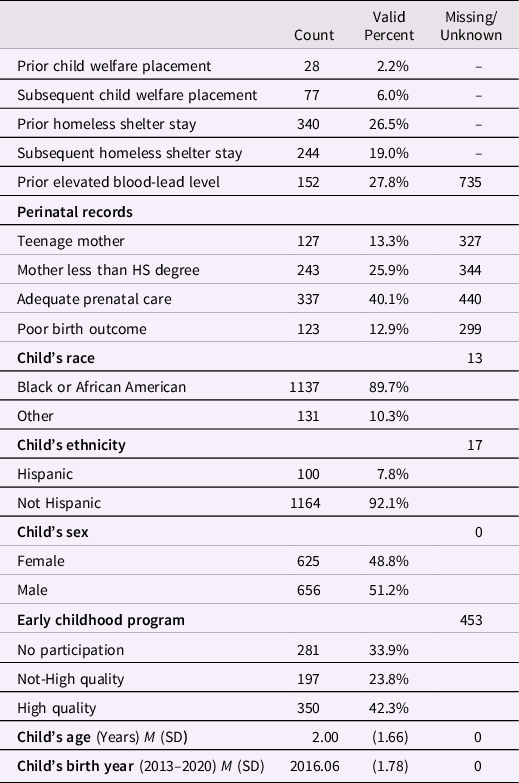
Child’s birth year, sex, race, and ethnicity were constructed in a best-fit manner across birth and agency administrative records. Table 1 lists specific categories that are most common across different agency records and across years in the available data, in some cases, simplified for analysis and reporting (e.g., to avoid low cell counts requiring suppression). We acknowledge that these categories fall short in representing many individuals’ racial, ethnic, and gender identities, but we retain these categorizations, which denote the information available in the data and used in analyses.
Study variables for children with a focal shelter stay

Analyses
We modeled the data in two steps to answer each research question. First, we applied multilevel latent class analysis (LCA) to model ordinal ECE enrollment (none, not high quality, high quality) with ten factors that were present before the focal shelter stay: a prior stay in homeless shelter, prior child welfare/out-of-home placement, child elevated blood-lead level, mother less than age 18 when the child was born, low maternal education at childbirth, adequate prenatal care, poor birth outcome, child sex, Black or African American race, and Hispanic ethnicity. We also included child age at the focal shelter stay as well as birth year to respectively account for differences based on the age of the child as well as differences in ecological contexts at different points in time (e.g., changes in policy, health, and human services). The child race variable was reduced from a four-level factor to a dichotomous factor reflecting whether the child was Black or African American or not. This was because of two reasons: (1) the available data does not distinguish between different identities and backgrounds more specifically than very general categorizations such as ‘Black or African American’ nor any ethnicity beyond ‘Hispanic’ or ‘not Hispanic,’ and (2) Black or African American children are extremely overrepresented among those who stay in Philadelphia emergency and transitional family shelters. As some families included more than one child, the variances of children’s data were not independent. To account for this dependency, random effects of family were estimated at level-2 with a latent factor for random means by level-1 latent class in the LCA. Our goal was to understand whether there were discernible profiles of demographic characteristics, previously-established risk factors, and service agency involvements.
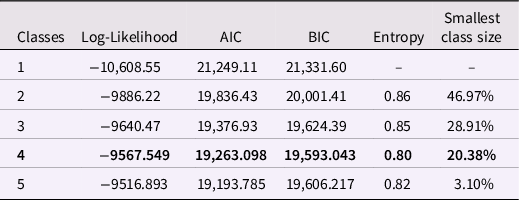
We used Mplus version 8.9 to conduct the LCA, using maximum likelihood estimator as the estimation method. We tested models with 1 through 5 classes and compared their fit statistics including BIC and entropy (Collins & Lanza, Reference Collins and Lanza2009; Masyn, Reference Masyn2013; Nylund et al., Reference Nylund, Asparouhov and Muthén2007; Nylund-Gibson & Masyn, Reference Nylund-Gibson and Masyn2016). A prior, we favored solutions where the smallest class size was greater than 5%. After selecting the multilevel LCA with the best fit, we used posterior latent class probabilities in two separate binary logistic regression models to predict the likelihood of subsequent shelter stays and likelihood of later child welfare/out-of-home placements.
Some data were missing for several study variables, as reported in Table 1. Missing data appeared to conform to assumptions of Missing at Random and were accounted for using full information maximum likelihood estimation (Collins & Lanza, Reference Collins and Lanza2009).
Results
Overall, 1,281 children had a focal shelter stay meeting our inclusion criteria for analyses (described previously) and were included in the multilevel LCA. Children tended to be slightly younger at the focal shelter episode, with a modal age of 0 years (infancy) and a distribution that was slightly positively skewed and platykurtic. Most families (n = 1,086) had only one child in the age range with them in shelter, while 172 children had exactly one sibling in the age range, and 23 had two or three young siblings with them. On average, the focal shelter stay lasted 271.67 days with much variability (SD = 214.18 days).
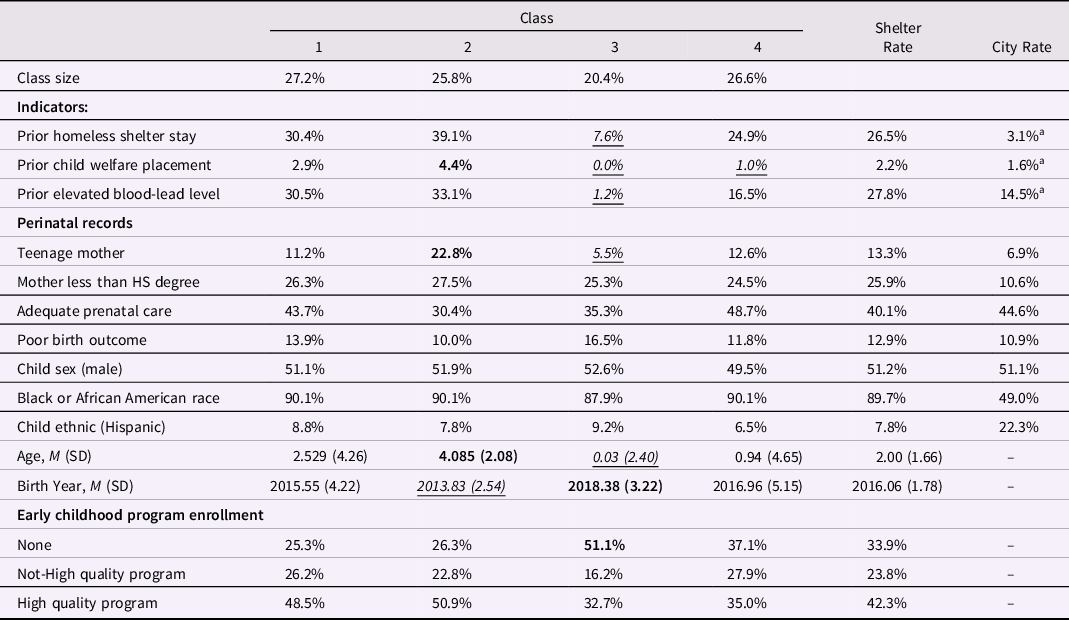
We present rates of study variables for both our group of children who were staying in shelter and overall city rates for comparison in Table 3. Young children staying in family shelters had considerable rates of factors representing risks in different systems and low resources relative to overall city rates. In particular, the shelter group had lower rates of adequate prenatal care (40% compared to 49%), high rates of elevated blood lead levels (27.8% compared to 14.5%), teen motherhood (13.3% compared to 6.9%), and low maternal education (25.9% compared to 13.7%). Black or African American race described 89.7% of the shelter group compared to 49.0% of overall city rate. Hispanic ethnicity was underrepresented in the shelter group, with only 7.9% compared to 22.3% in citywide rates. Rates for prior child welfare placements were 2.2% in the shelter group compared to 1.3% in citywide data. The rate of prior shelter stays was elevated over 800% in the shelter group, with 26.5% compared to 3.1% citywide. For the vast majority (73.5%) of young children in the shelter group, the shelter stay in the focal timeframe of the study was their first shelter stay. Some (21.2%) had exactly one prior shelter stay, 4.2% had two prior stays, and 1.1% had three or four prior stays.
Multilevel latent class analysis
We report fit statistics for multilevel latent class models ranging from 1-class to 5-classes in Table 2. We accepted as best-fitting the multilevel model with four latent classes. The 4-class model had the lowest BIC value and adequate entropy = .80.
Latent class analysis fit statistics

We considered the estimated proportions of each variable to identify defining features of each class, using the criteria of over 150% or under 50% of the sample-wide rate for each factor and above or below one standard deviation for age and birth year (Shaw et al., Reference Shaw, Herbers and Cutuli2019). We report detailed defining features in Table 3. The first class was the largest (containing 27.2% of children) and contained no defining indicators based on our criteria, meaning that the estimated proportion defined by each variable roughly approximated the sample rate for young children in shelter (though could deviate from the city-wide rate). Class 2 contained 25.8% of children and was defined by a higher rate of prior child welfare placements, higher rate of teenage mothers at the time of the child’s birth, older child age on average, and belonging to an earlier birth cohort. Class 3 was the smallest (20.4% of children) and had defining features of young age, later birth cohort, and lower rates of each: prior shelter stay, elevated blood lead level, and no prior child welfare placement. This class also had the highest rates of not being enrolled in any early childhood program. Class 4 contained 26.6% of children and had low rates of child welfare placement prior to the focal shelter episode.
Statistics for 4-class solution and sample and city rates

Note. Defining features of each class are noted in boldface when above the sample rate or in italics, underlined when below.
aRefers to the city-wide rate for children in birth cohorts 2013 through 2019 from birth through February 29, 2020.
Logistic regression analysis
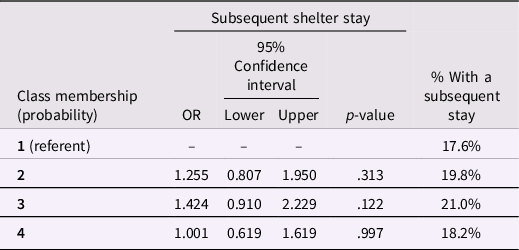
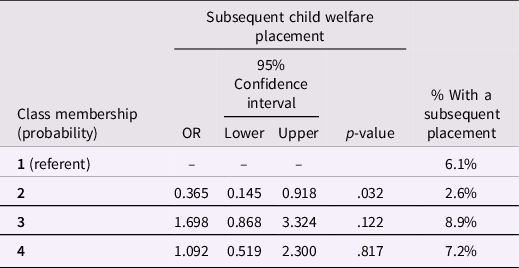
In Tables 4 and 5 we present odds ratios from binary logistic regression models predicting subsequent stays in shelter and subsequent child welfare placements from probabilities of latent class membership in class 2, class 3, and class 4. In the model predicting subsequent shelter stays, none of the classes were significant. In the model predicting child welfare placements, there was a significant odds ratio for class 2 (OR = .365, p = .032) indicating that children in class 2 were less likely than those in class 1 to experience child welfare placements for the duration of the study following their focal shelter stay. Additional analyses (coefficients not reported) repeated the logistic regression analyses, varying the referent group to each profile. This confirmed that no new statistically significant effects were apparent. The second group significantly predicted lower rates of subsequent out-of-home child welfare placements compared to other groups. No other differences emerged between groups predicting subsequent out-of-home child welfare placements or predicting subsequent stays in shelter.
Logistic regression results predicting any subsequent shelter stay

Logistic regression results predicting any subsequent child welfare placement

Discussion
Young children (birth to 5 years old) staying in family emergency and transitional shelters have high rates of factors suggestive of complex, multisystem risks and relatively fewer resources. This is consistent with the view that children who experience homelessness are at the high end of a continuum of developmental risk, beyond the risk of poverty alone (Masten et al., Reference Masten, Miliotis, Graham-Bermann, Ramirez and Neemann1993). The current findings help to illustrate how this continuum of risk operates with profiles of interrelated, multisystem risks and resources. Results from our LCA affirm that there are distinct profiles reflecting differences in child characteristics, risk factors, and patterns of health and human service involvement. Furthermore, multisystem factors embodied in these profiles appear to play a role in families’ involvement in early childhood programs while in shelter, partially explaining the likelihood that families will participate in any program. In this way, profiles of multisystem risk and child characteristics may predict whether families are likely to successfully engage high-quality early childhood programs while staying in shelters. Furthermore, the profiles have implications for whether children experience a child welfare placement subsequent to the family’s shelter stay.
Multisystem resources and risk exposure
As a group, young children who stay in family shelters for at least 30 days already have considerable rates of varied developmental risk factors compared to young children across the city. These risks include indicators suggestive of serious concerns related to parenting and other family system distress (about 36% greater risk of child welfare placement), poor birth outcomes and toxic physical environments with implications for child health and development (almost 20% greater rate of low birth weight or preterm birth; nearly twice the rate of elevated blood lead levels), and a high rate of prior stays in family shelters (over 8.5 times the overall city rate for any emergency or transitional shelter stay), which likely represent problems across any of a host of caregiver factors interacting with broader systems (e.g., state and federal policy contexts relevant to social services and affordable housing; broad economic factors; e.g., Lee et al., Reference Lee, Shinn and Culhane2021). Black and African American children are overrepresented (180% of the city-wide rate) while Hispanic children are underrepresented (35% of the city-wide rate). Furthermore, other indicators suggest low levels of resources in multiple systems, including family-related resources (nearly 200% the rate of teenage mothers; almost 250% the rate of low maternal education) and maternal and child health systems (10% lower rate of adequate prenatal care). These findings are some of the most comprehensive longitudinal accounts of risk and other factors for young children experiencing homelessness that did not rely exclusively on parent-report methods.
High rates of early childhood program enrollment
The current findings are among the first to document rates of early childhood program enrollment while staying in shelters, though we have no reliable and comprehensive source of city-wide rates of early childhood program enrollment for comparison. In the current study, about two out of three (66.1%) children were enrolled in an early childhood program while staying in shelter, based on those for whom we have early childhood enrollment data. For those children enrolled in an early childhood program, they were much more likely to enroll in a high quality one (42.3% of all children) than one that was not of high quality (23.8%).
These rates contrast with other estimates of early childhood program participation for children experiencing homelessness, which are lower (around 7–10%; SchoolHouse Connection, 2022; Yamashiro & McLaughlin, Reference Yamashiro and McLaughlin2021). The reasons for these differences likely span population, methodology, and location. First, past efforts considered children experiencing homelessness under the definition used by the U.S. Department of Education, which includes children in situations other than family shelters, most notably those staying with friends and family out of financial necessity. Families in yet other homeless contexts (e.g., staying in motels or unsheltered) may be less likely to enroll in formal early childhood programs because their situation represents greater challenges and fewer supports than shelter, or their context might afford more opportunities for informal childcare arrangements, such as other available adults in doubled-up situations. Additional research should test and better understand these differences.
Second, previous research exploring early childhood program participation considered families identified as homeless by federally funded early childhood programs (Early Head Start / Head Start; Yamashiro & McLaughlin, Reference Yamashiro and McLaughlin2021) or by a small number of programs (SchoolHouse Connection, 2022), meaning that these estimates commonly left out many state and local programs that families may have been using. Those estimates also relied on programs being aware of families’ homelessness, which is an approach that is widely recognized as resulting in gross underestimates when applied to older children (Government Accountability Office, 2014; Hatchimonji et al., Reference Hatchimonji, Flatley, Treglia and Cutuli2021). The current study addresses these issues by beginning with children known to be staying in shelter through administrative records and then linking available enrollment records from two local early childhood programs – a municipal subsidy program and early intervention – and parent self-report of early childhood program enrollment. Within the bounds of our approach’s limitations (discussed further below), we believe our enrollment rate is more accurate for the subset of children who stay in family shelters for 30 days or longer.
The relatively high rate of early childhood program enrollment occurred in the context of the BELL program, a philanthropy-funded initiative conceived to support early development for young children staying in shelter through multisystem efforts (Cutuli & Willard, Reference Cutuli and Willard2019). A major component of the program is to support family emergency and transitional shelter staff in building relationships with early childhood program staff in the service of increasing access and removing barriers for families who wish to enroll in early childhood programs. The design of the current study prevents any strong claims about the efficacy of the initiative, though preliminary reports suggest at least an initial positive impact on early childhood program enrollment (Cutuli & Baye, Reference Cutuli and Baye2023; Cutuli, Reference Cutuli2020). The current results are also in line with past qualitative findings that parents with young children staying in family shelters generally desire high-quality early childhood programs, especially for 3- and 4-year-old children, and called for shelter staff to provide information and assistance to help them enroll (Hurd & Kieffer, Reference Hurd and Kieffer2016). The BELL program may have equipped shelter staff with these needed resources, resulting in a high early childhood program enrollment rate. Furthermore, Philadelphia has a publicly funded municipal preschool subsidy, which, though relatively small compared to need, is rare among cities and is in addition to state- and federal-funded programs. The high rate of early childhood program enrollment among children residing in family shelters may be specific to Philadelphia. Future research is needed in other municipalities.
Considering resources and risk through a multisystem perspective
A multisystem perspective on resilience and risk encourages us to consider how these factors reflect within-system characteristics as well as complex interactions and transactions between systems. The current findings present four profiles of co-occurring ecological, developmental, and demographic factors through LCA in the service of a person-centered approach. Considering profiles allows us to contextualize the children and families’ status across multiple systems, infer possible transactions between systems, and unveil likely developmental processes that contribute to child- and family-level resilience. Below we interpret each profile to better understand multisystem contexts of young children in family shelter, to discern possible approaches to promote access for families who wish to enroll in early childhood programs, and to test whether profiles reflecting multisystem risks and resources – especially early childhood program enrollment – predict subsequent returns to shelter or future child welfare out-of-home placements.
The first profile (Class 1) roughly approximated the sample-wide rates of each variable, including rates of early childhood program participation. For more than a quarter (27.2%) of young children in shelter, rates of multiple risk factors were higher than the general population of young children in Philadelphia. This interpretation is consistent with the body of variable-focused studies documenting high rates of co-occurring risks associated with childhood homelessness (e.g., see Herbers & Cutuli, Reference Herbers, Cutuli, Bornstein and Shahin press). As the profile most aligned with overall sample rates, Class 1 served as a helpful referent in comparison to the other profiles.
The second profile (Class 2) described about a quarter of young children in shelter. This group was older, on average, and was more likely to belong to earlier birth cohorts, as might be expected. This profile involves higher rates of mothers who were teenagers when the child was born and also has a relatively higher rate of child welfare placements (4.4%) prior to the shelter stay. Considering the profile holistically, mothers in these families were at-risk for being under-resourced, both with respect to socioeconomic as well as parenting resources, on account of their young age around the time the child was born (Letourneau et al., Reference Letourneau, Stewart and Barnfather2004). This risk may have manifested in some cases, contributing to a rate of prior child welfare placements that were twice the sample rate and indicative of problems in the family system.
Most (50.9%) children in this second profile were enrolled in high-quality early childhood education programs, which, along with child welfare services, represent formal service systems designed to stabilize children’s caregiving context, support families, and promote positive development. While we are unable to access specifics about the transactions between these systems (e.g., specific services provided; the outcome of child welfare placements), this profile was also related to a significantly lower likelihood of child welfare placement after the shelter stay had ended. In this case, involvement with these two systems may have helped bolster the child’s family system (Green et al., Reference Green, Ayoub, Bartlett, Furrer, Cohen, Buttita and Sanders2018), an effect that might be more pronounced with older children since the first profile (Class 1) had similar rates of early childhood program enrollment.
The third profile (Class 3) accounted for 20.4% of the sample and described extremely young children, on average. Children in this profile tended to be from later birth cohorts, and relatively few were born to teenage mothers. This profile had low rates of prior risk events (homelessness, elevated blood-lead levels, no child welfare placement). Most of these children (51.1%) were not enrolled in any early childhood program, which was a defining feature of the profile. The low rates of prior risk experiences and service involvement are contextualized by the children’s very young age: It is likely that sizable proportions of these children were born while the family was already staying in shelter, or moved to shelter soon after birth. As a result, we should discount the value of these variables when it comes to inferring anything about the risk in ecological systems. Put differently, there had not been enough time before the shelter stay for these indicators to reflect the status of the child’s ecological systems. Consonant with this ambiguity, this group did not differ on the likelihood of subsequent child welfare placement when compared to the first class. Understanding the multisystem contexts of infants in shelter will require future research using different approaches.
Other indicators in this profile, however, are informative and carry implications for practice and policy with respect to very young infants in shelter. In particular, most were not enrolled in any early childhood program. The reasons for this are likely complex and varied between families. Starting with broad federal policy and local early childhood program systems, there was (and is) both a general local shortage for early childhood programs to serve infants and toddlers as well as relatively little center-based Early Head Start capacity, a program model that, along with Head Start, tends to be used by parents with low-income (Coley et al., Reference Coley, Votruba-Drzal, Collins and Miller2014). As a result, families who need center-based care (e.g., for when caregivers are working) are unlikely to find availability in a federally-funded Early Head Start center and are forced to navigate the process of applying for and receiving state subsidies. This represents an additional challenge for families with a new baby.
Caregivers staying in shelter also report other reasons for not enrolling very young children in early childhood programs (Hurd & Kieffer, Reference Hurd and Kieffer2016). Some hold beliefs based on family culture about keeping young children with family caregivers. Others may hold mistrust of formal service systems and child welfare agencies. Related, some parents hold trauma-related beliefs and feelings of mistrust related to potential victimization, preferring to keep children under family care until they are old enough to talk and inform their parents of troublesome and traumatic events. Still, others do not seek out and enroll in programs out of personal preference, perhaps valuing time with their young child over employment in the short term. Practical and logistical considerations may also contribute to some parents not enrolling their infant in care immediately following the major life event of the birth and transitions that come with a new baby. Competing demands are in play for many families in shelter, who are often simultaneously navigating the move to shelter, unemployment and searching for work, seeking permanent housing and related subsidies, applying for and participating in other needed health and human services, and a host of other important demands on their time and energies.
As a result, shelters should be prepared to work with parents of infants who wish to enroll in early childhood programs using a trauma-informed approach and a very high level of sensitivity to their beliefs, feelings, and preferences. Given the breadth of possible contributors to parents’ reservations about early childhood programs for infants, spanning multiple ecological systems (family system, culture, local, state, and federal policy), parents may have varied and valid reasons to decline enrolling their infants in some or all sorts of early childhood programs while in shelter. Efforts to educate parents about out-of-home care options should always be delivered with respect to the parent’s autonomy, and service providers should be mindful of any tendency to presume they know what is the “right” choice for a given caregiver working to balance these numerous, complex, and very personal concerns.
A more fruitful approach to promoting infant development may be to infuse the shelter context with supports for parents with very young children. This could include partnering with an external agency knowledgeable about infant development to first appreciate the context of family homelessness and then regularly train shelter staff and advise on practices and policies to support families with an infant. Efforts might also involve altering physical shelter spaces and ensuring that play spaces are appropriate for parents with babies, families have round-the-clock access to needed resources, and residential areas have appropriate cribs, changing tables, and other furniture. Also, home visiting and similar models where the parent is present with the child may be better received, especially if the approach is specifically tailored to the experience of family homelessness and the context of family shelter (Hare et al., Reference Hare, Landis, Hernandez and Graziano2023; Herbers, Cutuli, Fugo, et al., Reference Herbers, Cutuli, Fugo, Nordeen and Hartman2020; Herbers & Henderson, Reference Herbers and Henderson2019). Again, home-visiting models are unlikely to meet the needs of all parents seeking childcare (e.g., while at work).
The fourth profile (Class 4) described over a quarter (26.6%) of children and was characterized by a low rate of prior child welfare placement. Though not defining the class, children had a relatively low average age in this profile (around 1-year-old), suggesting that they tended to be younger but with considerable variability, and were slightly less likely to be enrolled in any ECE program and marginally less likely to be enrolled in high-quality programs. This profile may indicate children whose parenting and the family system show relative strengths, reflected in the lower rate of prior child welfare placements in the context of other variable rates that generally approximated the rates for the shelter group as a whole. This conclusion may be tenuous given the lack of effect on subsequent child welfare placement in the logistic regression analyses, though the lower rate of high-quality early childhood enrollment may lend some credence as it suggests many of these families did not partake in this potentially powerful form of support.
None of these profiles related to differences in the likelihood of subsequent shelter stays. We offer two speculative explanations. First, it is possible that these multisystem risks and resources, including connecting to high-quality early childhood education, simply did not influence the likelihood of a subsequent shelter stay. We tested this possibility because many early childhood program models for families with low income include explicit resources to support family functioning, including their ability to engage other services and meet basic needs. For example, Head Start includes family service workers who provide case management to families. Future research interested in detecting such an effect may benefit from a more precise approach, demarcating children who attended Head Start, for example, or who specifically received case management services. This is not possible with the data available in the current study. Furthermore, we may not have attended to the right systems that govern repeated shelter stays, neglecting important indicators both in broader macro systems (e.g., those that contribute to and maintain income inequality and shortages in affordable housing) and micro personal forces more reflective of caregivers’ social support systems, mental/behavioral health supports, employment, and related resources (Lee et al., Reference Lee, Shinn and Culhane2021).
Second, most of the period subsequent to the focal shelter stay occurred during the COVID-19 pandemic, grossly changing the nature of society at large and human services in particular. Many families chose to avoid entering shelter out of fear of contagion. The municipal response to homelessness also shifted, with larger investments in preventing families’ need for shelter. Also, broad federal interventions such as the moratoria on evictions and the expanded child tax credit likely reduced homelessness. These factors corresponded to a large decline in the number of young children in Philadelphia family shelters (Cutuli & Baye, Reference Cutuli and Baye2023) and may have constrained or biased results in ways that make them less- or non-generalizable to other times. This comment is also relevant to analyses considering subsequent child welfare placements, which saw a decline in reports of suspected neglect and maltreatment (Shusterman et al., Reference Shusterman, Fluke, Nunez, Fettig and Kebede2022). This could be addressed by attempting to replicate the current findings as pandemic-related interventions end, or extending the current study to consider other epochs in the future.
Limitations
This study should be considered in light of several important limitations, in addition to those already discussed. We relied on administrative data from multiple agencies and programs integrated at the individual level. While these data have many strengths (e.g., longitudinal across the lifespan; close-to-population completeness; less reliant on parent report), they are far from ideal. First, for several key indicators – like homelessness and child welfare placement – we inferred that if a service record did not exist then the child did not receive the service. However, in some cases, the child may have been out of the city and receiving services elsewhere.
Second, we are missing birth records for children born and initially residing outside of the city, blood-lead level screening data for children not screened or screened while living elsewhere, and early childhood program data for families who did not use either of the two programs we have enrollment records for and also did not report their status to shelter staff. We used recommended missing data techniques to handle these cases.
Third and related, we lacked a comprehensive data source for children’s enrollment in early childhood programs in the city, causing us to partially rely on parent-report for this information. This approach may have reduced coverage of all formal early childhood programs, and we did not include reports of informal childcare arrangements. Future research should consider rates of relative care and other sorts of informal childcare arrangements that families might use. In addition, ours is only one definition of early childhood program quality. We were intentionally broad and inclusive to accommodate different quality rating standards and indicators specific to different program models. This may have resulted in imprecision and obscured some effects if a more detailed definition and measure of program quality were used.
Also relevant to missing data, we do not have any clear indication in the data that cases were systematically missing in a way that would bias results. This allowed us to use recommended missing data techniques. Though, the BELL program model asserts that families are more likely to enroll in early childhood programs when shelter staff asks about families’ current enrollment and their wishes about enrollment. These conversations were the basis of the parent-report data from the BELL administrative records. One source of missingness – of likely many – is when these conversations did not occur between parents and shelter staff. It might follow logically that these missing cases also represent missed opportunities for staff to support families and, therefore, might be more likely to involve children with no early childhood program enrollment in shelter. If this occurred, the observed high rates of early childhood program enrollment would be inflated. Future work should seek to further prevent missing data.
Next, we chose to only include children who stayed in emergency or transitional shelter programs for at least 30 days. This was an a priori decision to align the population with the logic model of the BELL program and, relatedly, reduce the amount of missing data on early childhood program participation. However, this excluded a considerable number of children who had shorter shelter stays, potentially ignoring important subpopulations. Finally, the current analyses did not include indicators of child functioning and cannot conceptualize resilience at the child level. Instead, we considered a circumscribed set of indicators of family-system wellbeing.
Conclusion and implications for intervention
As a group, young children who stay in family homeless shelters experience relatively high rates of varied risk factors and lower rates of some important resources. Understanding how children and families show resilience or problems requires a deeper appreciation of whether and how individual risks and resources co-occur in their lives, implying differences in how their individual and ecological systems either successfully adapt or fail to support early development. This approach is consistent with a multisystem account. Using population-wide, longitudinal individual-level, integrated administrative data is a powerful resource to inform such an account. The current findings underscore the likely importance of high-quality early childhood program enrollment and potentially other support services that contribute to improved family-system functioning, at least for older children in our age range. Membership in the profile with these features was associated with a lower rate of child welfare placement following the family’s shelter stay. Furthermore, a multisystem context changed the interpretation of several risk factors for very young children: while indicators of prior homelessness, child welfare placements, and blood-lead levels might be telling for older children, they do not seem informative for those belonging to a profile that describes 20% of the sample.
Increasingly, interventions focused on supporting families in shelter are acknowledging the complex nature of homelessness and families’ multisystem needs. Some also focus on connections between health and human service systems, thereby hoping to unlock certain multisystem resilience factors through increased coordination and collaboration between agencies. The BELL program is an example of how to both enhance key individual systems and the interconnections between them (Cutuli & Willard, Reference Cutuli and Willard2019). Like most programs described in the literature for children experiencing homelessness (Herbers & Cutuli, Reference Herbers, Cutuli, Haskett, Perlman and Cowan2014), the BELL program needs additional research that rigorously tests for efficacy. Nevertheless, this program may have contributed to the relatively high rates of early childhood program enrollment for this sample of young children in shelters. It directly bolsters the shelter and early childhood program systems by equipping them with information about early development and family homelessness, respectively, while also influencing higher-order systems (municipal, state, and federal policymakers) through advocacy. Importantly, a cornerstone of this program model is to catalyze relationships between the personnel who make up formal service systems so that they can share expertise and better collaborate to promote resilience, thereby encouraging helpful transactions between systems and positive cascades that allow for distributed resilience factors to operate for families with young children in shelters. As a systems-intervention, the BELL program is particularly ambitious in its scope and multisystem reach. Nevertheless, even interventions focused on a single system for young children in shelter have begun incorporating intentional components to address the multisystem contexts of family homelessness and the reality of the shelter as a system (Armstrong et al., Reference Armstrong, Owens and Haskett2021; Hare et al., Reference Hare, Landis, Hernandez and Graziano2023; Herbers, Cutuli, Fugo, et al., Reference Herbers, Cutuli, Fugo, Nordeen and Hartman2020; Herbers & Henderson, Reference Herbers and Henderson2019). Homelessness often threatens development through multisystem processes, and the success of interventions to promote child and family resilience rests in bolstering strengths and resources within key systems and the connections between them.
Acknowledgments
We express great gratitude to the Shelter and Early Childhood Program staff who support families experiencing homelessness every day, as well as the phenomenal parents and other caregivers of young children who help make resilience happen no matter the circumstances. We acknowledge and appreciate the cooperation of the City of Philadelphia, especially James Moore, Kristen Coe, Zheng Wen, and the Office of Integrated Data for Evidence and Action, Roberta Cancellier, Marybeth Gonzales, Kitchener Jones, Liz Hirsh, Fred Gigliotti and the Office of Homeless Services, the Department of Human Services and the Office of Children and Families, the Department of Behavioral Health and Intellectual Disability Services, the Department of Public Health, and Joe Willard and the BELL team at HopePHL™. This study was approved by the Institutional Review Boards of the Philadelphia Department of Public Health and Nemours Children’s Health.
Funding statement
Portions of this work were funded by grants to HopePHL™ from the Vanguard Foundation Strong Start for Kids Program and the United Way of Southeastern Pennsylvania and Southern New Jersey. The content is solely the responsibility of the authors and does not necessarily represent the official views of the Vanguard Foundation, The United Way, the City of Philadelphia, or HopePHL™.
Competing interests
J. J. Cutuli is a paid consultant with HopePHL™ and the BELL project. Janette Herbers’ spouse is a paid consultant with HopePHL™ and the BELL project. Sarah Vrabic and Omari Baye are both employes of HopePHL™.