


Introduction
Current cognitive models (Clark and Wells, Reference Clark, Wells, Heimberg, Liebowitz, Hope and Schneier1995; Hofmann, Reference Hofmann2007; Rapee and Heimberg, Reference Rapee and Heimberg1997) of social anxiety disorder (SAD) share the assumption that negative self-image is a key maintaining factor of the disorder whether they use the terminology of self-image or a mental representation of the self. Studies (Hirsch et al., Reference Hirsch, Clark, Mathews and Williams2003a; Hirsch et al., Reference Hirsch, Mathews, Clark, Williams and Morrison2003b; Hirsch et al., Reference Hirsch, Meynen and Clark2004) exploring the relationship between negative images and social anxiety found that, compared with controls, individuals induced with a negative self-image not only reported having higher anxiety and using more safety behaviours but also were rated as looking more anxious. In fact, experimental studies involving the manipulation of self-images showed not only the harmful effects of negative self-images but also the potential causal role of negative self-images in the maintenance of SAD. Compared with holding a neutral self-image in mind in social situations, holding a negative self-image in mind led to increased anxiety, self-focused attention, safety behaviours, negative inferential bias, and over-estimation of the visibility of their symptoms (Hirsch et al., Reference Hirsch, Clark, Mathews and Williams2003a; Hirsch et al., Reference Hirsch, Mathews, Clark, Williams and Morrison2003b; Hirsch et al., Reference Hirsch, Meynen and Clark2004; Makkar and Grisham, Reference Makkar and Grisham2011). Moreover, negative self-images are known to influence individuals’ concept of the working self, making it characterized by low self-esteem and uncertainty about the self (Hulme et al., Reference Hulme, Hirsch and Stopa2012). Collectively, negative self-images appear to contribute to the maintenance of SAD through their negative influence on anxiety, safety behaviours, and concepts of the working self.
Given the importance of negative self-image in the theoretical models, an increasing number of studies have investigated the nature of such images. Hackmann et al. (Reference Hackmann, Clark and McManus2000) found that all (100%) participants diagnosed with SAD had spontaneously occurring negative self-images, which were mostly visual and were linked to a specific episodic memory. Moscovitch et al. (Reference Moscovitch, Gavric, Merrifield, Bielak and Moscovitch2011) used the Waterloo Images and Memories Interview, a newly developed interview technique used to measure the accessibility and properties of mental images as well as the associated autobiographical memories, and found that most (76%), but not all, participants with high social anxiety had such negative images. Moscovitch et al. (Reference Moscovitch, Gavric, Merrifield, Bielak and Moscovitch2011) attributed the difference in the prevalence between their study and that of Hackmann et al. (Reference Hackmann, Clark and McManus2000) to the different methodological factors, such as different interview techniques and interviewer knowledge, and suggested that future studies should be replicated to develop a reliable estimate of the actual prevalence of these images in socially anxious individuals. It was also similarly reported that these negative images were found to be closely linked with an early negative memory of stressful social events, affecting how individuals view themselves, others, and the world internally. A more recent study by Homer et al. (Reference Homer, Deeprose and Andrade2016), in which individuals who were anxious of public speaking were interviewed, found that most (85%) individuals reported experiencing a negative self-image during the interview. Although the exact percentage of the negative self-images differs in these studies, they uniformly showed that most individuals with social anxiety recurrently experienced intrusive negative self-images.
As most of these studies were conducted in Western culture, we aimed to examine whether these findings apply to non-Western culture. No studies to our knowledge have studied negative self-images of socially anxious individuals in East Asian countries such as China, Korea and Japan. Self-images are closely tied to self-concepts, and some studies have highlighted cultural differences in the formation of self-concepts. Markus and Kitayama (Reference Markus and Kitayama1991) proposed an interdependent view of the self to explain other-oriented self-concepts in non-Western cultures. Compared with the independent self-view prevalent in Western cultures, the interdependent self-view considers social context to be a key component, thereby emphasizing the self in relation to, rather than distinct from, others (Yeh and Hwang, Reference Yeh and Hwang2000). Kim et al. (Reference Kim, Kasser and Lee2003) found that South Koreans scored higher in self-concept interdependence than Americans, and are more sensitive to socially oriented values. Another study found that, compared with North Americans, the Japanese were particularly sensitive and responsive to failure feedback from others, which negatively affected their self-evaluations even in domains unrelated to the feedback (Heine et al., Reference Heine, Kitayama and Lehman2001). These findings on the cultural differences in self-concept suggest that people in non-Western cultures may be more sensitive to the social context and therefore less focused on the self than Westerners. Consequently, the images that people with social anxiety disorder experience may differ across cultures.
We hypothesized that Koreans with interdependent self-views may contain more features related to social contexts in their self-images than those reported in Western cultures. As self-images spontaneously occurring in social situations reflect self-views, Koreans with interdependent view of self may contain more other-oriented features in their self-images. If this is the case, more attention should be paid to modifying negative images of others as well as negative self-images in the treatment of SAD. Thus, understanding how East Asian people with SAD experience spontaneously occurring images in social situations is needed to develop more culturally tailored interventions.
In the present study, we aimed to examine characteristics of spontaneous recurrent images (SRIs) in a Korean community sample with SAD and, more specifically, to investigate (a) the proportion of individuals who report having SRIs, (b) the content of SRIs, and (c) the relationship between features of SRIs and symptoms of SAD.
Method
Participants and procedure
This study was conducted as part of a 3-year outcome study that investigated the efficacy of enhanced CBT for SAD. Participants were recruited from among individuals who visited the Korea University treatment centre for social anxiety after being fully informed that interview data may be used for research purposes and providing informed consent. We used the Korean version of the Structured Clinical Interview for DSM-IV-TR (SCID-IV-TR) to diagnose the participants. Sixty-four individuals (27.00 ± 7.42 years, 64.1% female) who met the diagnosis for SAD were included in the study. Individuals with the following symptoms or disorders were excluded: schizophrenia or other psychotic disorders, neurodevelopmental disorders, substance-related disorder in the last 3 months, history of bipolar disorder, major depressive episode or other anxiety disorders requiring treatment before social anxiety. Participants were adults above 19 years old who were able to pay for the treatment.
An image interview was conducted after the SCID-IV-TR as an initial assessment of a treatment programme. The data were collected as part of a larger project; below, we address only the measures relevant to the current research questions. All procedures were approved by Korea University’s Institutional Review Board. This study focused on assessing the features of self-image.
Measures
All participants completed the following self-report questionnaires to assess social anxiety symptoms and anxiety sensitivity.
Liebowitz Social Anxiety Scale (LSAS)
To assess the participant’s level of avoidance in addition to their level of anxiety, we used the LSAS. The LSAS is a 24-item questionnaire that measures the range of social interaction and performance situations feared by an individual. Each item presents different social situations (e.g. ‘telephoning in public’, ‘going to a party’, ‘working while being observed’) for which participants rated the level of fear and avoidance on a 4-point scale. There are two subscales of LSAS: LSAS-Fear (LSAS-F) and LSAS-Avoidance (LSAS-A). LSAS-F assesses the level of anxiety one feels in social situations, and LSAS-A measures how often one avoids such situations. The LSAS has been shown to have high internal consistency with a Cronbach’s alpha value of .96 (Heimberg et al., Reference Heimberg, Horner, Juster, Safren, Brown, Schneier and Liebowitz1999). This study used the Korean version of the LSAS (K-LSAS), which has been shown to have high reliability and validity (Yu et al., Reference Yu, Ahn and Park2007; current sample Cronbach’s alpha = .96).
Social Interaction Anxiety Scale (SIAS) and Social Phobia Scale (SPS)
In addition to LSAS, SIAS and SPS were included in the 3-year study to compare the scores with those from previous studies. The SIAS is a 20-item questionnaire that measures the level of anxiety one experiences in general situations involving social interactions, particularly meeting and talking with others (e.g. ‘I have difficulty making eye contact with others’ and ‘I have difficulty talking with other people’). Items are rated from 0 (not at all) to 4 (extremely characteristic of or true to me). It has been shown to have both high internal consistency (Cronbach’s alpha = .94) and high test–retest reliability (r = .92; Mattick and Clarke, Reference Mattick and Clarke1998). The current study used the Korean version of the SIAS (K-SIAS), which was validated by Kim et al. (Reference Kim, Yoon and Kwon2013) to have high reliability (Cronbach’s alpha = .88; current sample Cronbach’s alpha = .78).
The SPS is a 20-item questionnaire that measures the level of fear experienced during daily routine activities, such as eating, drinking and writing (e.g. ‘I become anxious if I have to write in front of other people’ and ‘I get nervous that people are staring at me as I walk down the street’). This 5-point Likert scale has been shown to have high validity and reliability with an internal consistency of .94 and a test–retest reliability of .93 (Mattick and Clarke, Reference Mattick and Clarke1998). This study used the Korean version of the SPS (K-SPS), which was also validated in the study by Kim et al. (Reference Kim, Yoon and Kwon2013) to have high reliability (Cronbach’s alpha = .94; current sample Cronbach’s alpha = .91).
The Anxiety Sensitivity Index-3 (ASI-3)
The ASI-3 is an 18-item questionnaire that measures the fear of arousal-related sensations on a 5-point Likert scale ranging from 0 (very little) to 4 (very much). In particular, this scale can be divided into three subscales, each consisting of six items, focusing on three different factors – physical (e.g. ‘When I feel pain in my chest, I worry that I’m going to have a heart attack’), cognitive (e.g. ‘When I have trouble thinking clearly, I worry there is something wrong with me’), and social concerns (e.g. ‘When I tremble in the presence of others, I fear what people might think of me’) (Taylor et al., Reference Taylor, Zvolensky, Cox, Deacon, Heimberg, Ledley and Coles2007). The ASI-3 total score has high reliability with a Cronbach’s alpha of .89. The Cronbach’s alpha values for the physical, cognitive and social factors were .83, .86 and .79, respectively (Osman et al., Reference Osman, Gutierrez, Smith, Fang, Lozano and Devine2010). This study used the Korean version of the ASI-3 (K-ASI-3), which has high reliability with a Cronbach’s alpha of 0.87. Cronbach’s alpha values for the physical, cognitive and social subscales were .73, .86 and .83, respectively (Lim and Kim, Reference Lim and Kim2012).
Rosenberg Self-Esteem Scale (RSES)
The RSES is a 10-item questionnaire assessing general self-esteem (e.g. ‘I feel that I have a number of good qualities’ and ‘I feel I do not have much to be proud of’). Items are rated on a 5-point Likert scale ranging from 0 (strongly agree) to 4 (strongly disagree). The RSES has been shown to have significant convergent validity (r = .56–.83) and test–retest reliability (r = .85; Silber and Tippett, Reference Silber and Tippett1965). The RSES used in this study was translated and validated by Lee et al., (Reference Lee, Nam, Lee, Lee and Lee2009) with high reliability (Cronbach’s alpha = .89).
Subtle Avoidance Frequency Examination (SAFE)
The SAFE is a 32-item questionnaire that measures the frequency of safety-seeking or avoidance behaviours (e.g. ‘Position yourself so as not to be noticed’ and ‘Speak in short sentences’). On a 5-point scale, items are rated from 1 (never) to 5 (always). The SAFE has high internal consistency (Cronbach’s alpha = .91) and construct validity (Cuming et al., Reference Cuming, Rapee, Kemp, Abbott, Peters and Gaston2009). The Korean version of the RSES, translated and validated by Koo et al. (Reference Koo, Yang and Kwon2012), was used in the current study. The Korean version also has high internal consistency (Cronbach’s alpha = .89; current sample Cronbach’s alpha = .86).
Image interview
After completing the self-report questionnaires, trained clinical psychology graduate students conducted a modified version of the semi-structured interview of Hackmann et al. (Reference Hackmann, Clark and McManus2000) to assess the features (e.g. vividness, distress, frequency) and content of the individuals’ SRIs. The original semi-structured interview developed by Hackmann et al. (Reference Hackmann, Clark and McManus2000) was translated into Korean and used in the study by Lee and Kwon (Reference Lee and Kwon2013). However, the original interview asked participants to generate images at the moment of interview while thinking of any anxiety-provoking social situation, whether real or hypothetical. Meanwhile, in the current study, the interview was modified to investigate the prevalence of naturally occurring SRIs rather than induced images. First, the participants were asked, ‘Is there an image that repeatedly comes up in your head in social situations? If yes, please describe the image’. Participants who answered yes were asked to maintain this image in their minds while being asked the following additional questions about the image: ‘How vivid is this image? 0 – not vivid at all, 100 – very vivid’, ‘How distressful is this image? 0 – not distressful at all, 100 – very distressful’, ‘How many times did this image come up in the past week?’, and ‘In what percent of social situations did this image come up?’.
Data analysis
Data analysis was conducted using SPSS 24.0 statistics. To test the group differences between those with and without SRIs, χ2 analysis was conducted for discrete variables and independent samples t-test was conducted for continuous variables such as age. More independent samples t-test was conducted to compare social anxiety related scores between the two groups. Bivariate correlational analysis was conducted to investigate possible relationships among features of SRIs and self-report measures of social anxiety and anxiety sensitivity.
Thematic analyses were conducted following the guideline of Smith (Reference Smith, Reis and Judd2000). Three graduate level students identified the preliminary code of the data as the main subject of the images. Then, we identified the parts of images that had the strongest sensory aspects, as images are often defined as sensory perception without actual stimuli (Pearson et al., Reference Pearson, Naselaris, Holmes and Kosslyn2015). The themes of the SRIs were further analysed to see whether SRIs depicted the representation of the self as proposed by previous studies. Three major themes were derived: negative self-image, negative evaluations by others, and abstract images. Lastly, subthemes were divided by collating similar codes under the three major themes.
Results
Social anxiety characteristics of participants
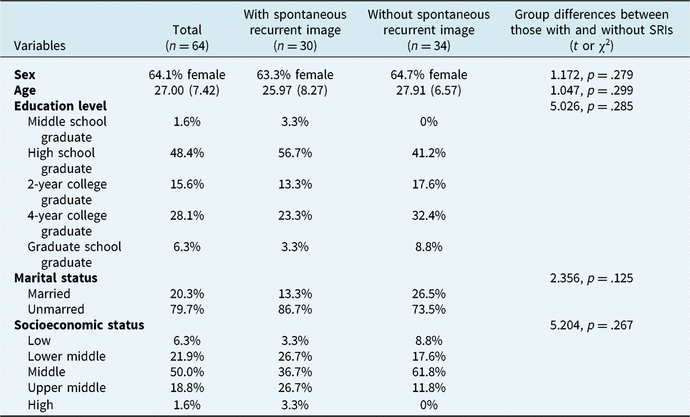
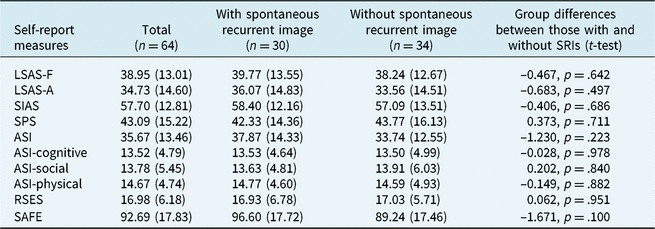
All participants met the DSM-IV-TR diagnostic criteria for SAD. Heimberg et al. (Reference Heimberg, Mueller, Holt, Hope and Liebowitz1992) suggested clinical cut-off scores of 34 for the SIAS and 24 for the SPS to distinguish individuals with SAD from individuals without social anxiety. The demographic characteristics of the participants are presented in Table 1. In the current study, participants reported a mean SIAS score of 57.70 (SD = 12.81) and a mean SPS score of 43.09 (SD = 15.22), both of which are greater than the suggested cut-off scores (Table 2).
Demographic characteristics of participants

SRI, spontaneous recurrent image.
Comparison of self-report measures of social anxiety between participants with SRI and participants without SRI

LSAS-F, Liebowitz Social Anxiety Scale-Fear; LSAS-A, Liebowitz Social Anxiety Scale-Avoidance; SIAS, Social Interaction Anxiety Scale; SPS, Social Phobia Scale; ASI, Anxiety Sensitivity Index; RSES, Rosenberg Self-Esteem Scale; SAFE, Subtle Avoidance Frequency Examination.
Prevalence and quality of SRIs
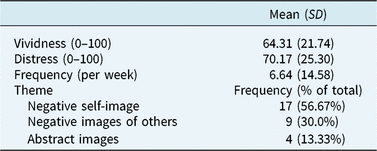
Among 64 participants, 30 (47%) reported experiencing SRIs in social situations. There were no significant group differences between individuals with and without SRIs (Table 1). For those with SRIs, the mean vividness and distress level of the SRIs were 64.31 (SD = 21.74) and 70.17 (SD = 25.30), respectively. These individuals reported experiencing SRIs an average of 6.64 times per week (Table 3).
Characteristics of spontaneous recurrent images (SRIs)

Relationship between features of SRIs and measures of social anxiety
There were significant correlations between the features of SRIs and some measures of social anxiety. The distress level of SRIs was significantly correlated with LSAS-A and ASI-physical scores. There were no significant correlations for ASI-cognitive factor. The frequency of SRIs was significantly correlated with SPS scores. There was no significant correlation between the vividness of SRIs and measures of social anxiety (Table 4).
Correlations between features of spontaneous recurrent images (SRIs) and self-report measures of social anxiety and anxiety sensitivity (n = 30)

LSAS-F, Liebowitz Social Anxiety Scale-Fear; LSAS-A, Liebowitz Social Anxiety Scale-Avoidance; SIAS, Social Interaction Anxiety Scale; SPS, Social Phobia Scale; ASI, Anxiety Sensitivity Index.
*p < .05.
Image theme analysis
Themes were divided depending on the main subject of these images. Three major themes were derived: negative self-image, negative images of others, and abstract images. The number of images belonging to each theme is shown in Table 3.
Theme 1
Negative self-image SRIs (17 images)
Twenty-one images featured the self as the main subject of the images. These images were related to how the participants believed they would appear in social situations. They were further divided into two sub-themes as some focused on the specific physical symptoms they feared, while others focused on broader negative self-views.
Physical symptoms (11 images)
This theme relates to physical symptoms of social anxiety experienced by the individual in social situations. Examples of physical symptoms include ‘image of myself looking nervous with twitching cheeks, avoiding eye contact, voice is shaking’; ‘image of my face turning red’; and ‘image of myself looking nervous, face turned red, can’t control my facial expression, voice is weird’.
Negative view of self (6 images)
This theme relates to the participants’ perceived view of the self, often related to how they think of themselves in social situations. Examples of negative self-view include ‘an image of myself embarrassed because I made mistakes. I look less confident, intimidated. I look like a loser’; ‘I look like a fool. Acting hastily in tough situations. Afraid of people noticing’; and ‘image of myself looking foolish while everyone else seems normal’.
Theme 2
Negative images of other people (9 images)
Nine images featured others as the main subject of the image. Other people were seen as evaluating the participant in a negative way. These negative images of others involved mostly the faces of others around the participant. They were further divided into two sub-themes as some featured others as having a generally negative facial expression towards the participant while others focused on the gaze of others.
Negative images of others (5 images)
This theme represents negative images of other people evaluating the participant negatively. Some were clearly negative (e.g. ‘People seem to laugh at me and say negative things about me behind my back’ and ‘People around me are turning their heads to stare at me’) while others were less evident (e.g. ‘people’s indifferent faces’).
Staring eyes (4 images)
This theme refers specifically to the gaze of others. Examples include ‘staring eyes’, ‘sharp gaze’ and ‘All eyes are on me’.
Theme 3
Abstract images (4 images)
Four images did not feature any specific objects and were categorized separately into Theme 3. Examples of abstract images include ‘Everything around is dark’, ‘grey and ambiguous letters spinning round and round’ and ‘tangled lines’.
Discussion
In the present study, only about half of the participants (47%) reported to have SRIs in social situations. Unlike previous studies which have reported that SRIs are predominantly negative self-images, our results showed that the content of the images also included negative images of others (30%) and abstract images (13.33%). While the vividness of SRIs did not show any significant correlations with measures of social anxiety, the distress level and frequency of SRIs were significantly associated with some features of SAD.
The prevalence rate of 47% differs from those of previous studies (Hackmann et al., Reference Hackmann, Clark and McManus2000; Moscovitch et al., Reference Moscovitch, Gavric, Merrifield, Bielak and Moscovitch2011), which reported that most patients with SAD experienced spontaneously occurring recurrent images. This indicates that fewer individuals with SAD experienced negative mental representation in the form of images in Korea.
The discrepancies in the prevalence of images have been explained by methodological differences in image interviews. The prevalence rate from the study of Moscovitch et al. (Reference Moscovitch, Gavric, Merrifield, Bielak and Moscovitch2011) (76% of participants high in social anxiety) was slightly lower than the prevalence rate in the study of Hackmann et al. (Reference Hackmann, Clark and McManus2000) (100%). Moscovitch et al. (Reference Moscovitch, Gavric, Merrifield, Bielak and Moscovitch2011) suggest that the 100% prevalence rate may be explained by a possibility that the study of Hackmann et al. (Reference Hackmann, Clark and McManus2000) included false-positive responses as the participants in their study were reflecting back on the images they may have had after completing 6 months of treatment. Although our study adopted the interview methodology directly from Hackmann et al. (Reference Hackmann, Clark and McManus2000), the participants in our study had not received any kind of treatment and, thus, were asked to think of images in their current state without any retrospective bias. This difference in samples may explain the different prevalence rates between Hackmann et al. (Reference Hackmann, Clark and McManus2000) and our study but does not explain the difference from the study of Moscovitch et al. (Reference Moscovitch, Gavric, Merrifield, Bielak and Moscovitch2011). The main difference between the interview technique used in the study of Moscovitch et al. (Reference Moscovitch, Gavric, Merrifield, Bielak and Moscovitch2011) and our study is the inclusion of an interview preamble, which explained the interview procedure and defined what a mental image is prior to asking participants about the images they may have in social situations. We provided participants with further explanation of what a mental image is only when the participants could not answer the image interview promptly. This suggests that our study may have had false-negative responses. Another explanation for the difference could be that other factors, such as cultural differences, may be responsible for the lower prevalence of mental images in the Korean community sample. While many prior studies have focused on studying individual differences in the use of images, no studies, to our knowledge, have studied the cultural differences in the use of images. Previous research studying cultural differences in emotion regulation choice has reported that cultures that value the maintenance of social order and embeddedness are associated with more use of suppression (Matsumoto et al., Reference Matsumoto, Yoo and Nakagawa2008). This suggests that individuals in these cultures suppress more emotion to avoid disrupting interpersonal relationships and social norms. Image has a strong emotional component as it is known to be correlated with more intense emotional experience compared with verbal thoughts (Mathews et al., Reference Mathews, Ridgeway and Holmes2013). In addition, image amplifies anxiety and elevated mood in bipolar disorder (Holmes et al., Reference Holmes, Geddes, Colom and Goodwin2008), indicating broader influence of image on increased emotion. Thus, we speculate that the difference in prevalence of images in our study and other studies could be due to the cultural difference in the tendency to suppress images, which are closely related to emotion.
In addition to the difference in the prevalence of SRIs, the content of these images differed with the findings from previous studies. Our theme analysis revealed that SRIs may involve people other than the self, contrary to the results of past studies, which have stated that SRIs are typically negative self-images. Seventeen (56.67%) images were categorized into Theme 1 (negative self-images) while nine images (30.0%) were categorized into Theme 2 (negative images of other people). Images in Theme 1 were similar to the images reported in past studies as they included content such as experiencing anxiety symptoms and how they would look when they received negative reactions from others (Hackmann et al., Reference Hackmann, Clark and McManus2000; Homer and Deeprose Reference Homer and Deeprose2017). All except one image in Theme 1 were from an observer perspective, consistent with previous studies (Hackmann et al., Reference Hackmann, Surawy and Clark1998; Wells et al., Reference Wells, Clark and Ahmad1998) and models (Clark and Wells, Reference Clark, Wells, Heimberg, Liebowitz, Hope and Schneier1995; Rapee and Heimberg, Reference Rapee and Heimberg1997; Hofmann, Reference Hofmann2007), which have stated that negative images are experienced mostly from an observer perspective. However, images in Theme 2 differed from the images reported in past studies as the focus of the images was on others rather than the self. Specifically, these images included other people laughing at the participant, bad facial expression of others, or staring eyes of others. Rather than focusing on how they would look in social situations, these images focused on how others would look in those situations. These images in Theme 2 were all experienced from the field perspective. Recent findings (Homer et al., Reference Homer, Deeprose and Andrade2016; Homer and Deeprose, Reference Homer and Deeprose2017; Moscovitch et al., Reference Moscovitch, Gavric, Merrifield, Bielak and Moscovitch2011) found that more images are experienced from the field perspective than previously thought. Homer and Deeprose (Reference Homer and Deeprose2017) suggested that the different focus of the image – that is, anxiety centred on self versus anxiety centred on others, depending on the kind of idiosyncratic beliefs the individuals hold – may explain why these images are in the field perspective. Koreans tend to gauge others’ thoughts, intentions and feelings to maintain harmony within the collectivistic culture (Kim et al., Reference Kim, Kasser and Lee2003). This tendency to be mindful of others may have shaped the image to be focused on others, thus resulting in field perspective.
It is speculated that the difference in cultural values may explain this difference in content. Although there have been few studies about cultural differences in the content of images in SAD, previous studies on the cultural differences have shown that East Asians and Westerners perceive the world very differently. In an experimental task in which participants from East Asia and Western culture were asked to categorize an object into a bigger category, it was found that East Asians categorized the target objects with regard to a broader context than Westerners (Norenzayan et al., Reference Norenzayan, Smith, Kim and Nisbett2002b). Another study (Norenzayan et al., Reference Norenzayan, Choi and Nisbett2002a) that directly compared Koreans and Americans in terms of social inference practices showed that Koreans and Americans both think in a dispositional manner when there is no situational information. However, when presented with salient situational information, Koreans made greater situational inferences. Although these studies were more focused on the difference between perception and attention, the results show that Koreans tend to perceive situations in a broader context and are more sensitive towards situational factors while Westerners tend to focus on a specific object.
In terms of self-concepts, people from non-Western collectivist cultures have been found to have interdependent views of the self (Kim et al., Reference Kim, Kasser and Lee2003), which regards relationships with others as a component of the self (Markus and Kitayama, Reference Markus and Kitayama1991). This finding emphasizes the inclusion of others regarding self-constructed beliefs about oneself and suggests that East Asians are more likely to evaluate the presence and opinion of others as more critical when it comes to self-image. In addition, a cross-cultural analysis (McCann and Honeycutt, Reference McCann and Honeycutt2006) comparing imagined interaction, a cognitively represented conversation experienced as internal dialogues, among participants from the United States, Thailand and Japan found that American participants were the most self-dominant in their imagined interaction while the Japanese participants had the widest range of imagined interaction partners. This result shows that, compared with Westerners, people in non-Western cultures were more sensitive towards others than to the self, even in imagined interactions. Therefore, we speculate that the high prevalence of the interdependent view of self in Korean culture is reflected by the relatively high frequency of images involving others negatively evaluating the participant in our study.
Interestingly, participants reported three images that did not contain any specific objects related to social anxiety. Therefore, these three images were categorized into Theme 3 (abstract images). To our knowledge, abstract images among individuals with SAD have not been explored, and this requires further research. If meanings of these abstract images had been explored, they could have reflected the felt sense of the participant. When affect is high, the content of consciousness is likely to be mixed and contribute to what Gendlin (Reference Gendlin1996) called the ‘felt sense’. This possibility should be examined in future studies.
Based on correlation analyses, the distress level associated with the SRIs was significantly correlated with the SPS and ASI-physical scores. Specifically, there was a positive correlation between the distress level and SPS scores, which measures the severity of anxiety while being observed by others. The positive correlation between SPS scores and the distress level during image indicates that images may involve sensations or thoughts evoked during socially observed situations. In addition, the ASI-physical score, which measures physical anxiety symptoms, increased with the distress level of the images. We assume that this sensitivity to physical anxiety symptoms may be influenced by self-focused attention, which increases awareness of body state information and detracts attention from the environment (Spurr and Stopa, Reference Spurr and Stopa2002). According to the process model (Gross, Reference Gross1998), which conceptualized emotion regulation, attention deployment induces cognitive change, which eventually modulates the emotional response to the situation. In social anxiety, self-focused attention increases sensitivity to physical anxiety symptoms, which may lead to negative appraisal of the situation and thus, produce negative responses, including distress. Further research should be conducted on the relationship between self-focused attention and emotion regulation.
In addition, the frequency of the SRIs was positively associated with LSAS-A scores. Because negative self-images often lead to distorted appraisal of the self and social situations (Anderson et al., Reference Anderson, Goldin, Kurita and Gross2008) and increase the likelihood of perceiving image content as true (Carroll, Reference Carroll1978), experiencing SRIs more frequently may further reinforce this distorted view and thus increase avoidance of social situations.
The vividness of the SRIs had no significant correlation with any of the measures of social anxiety. Previous research by Wild et al. (Reference Wild, Hackmann and Clark2007) found that decreased vividness after treatment compared with pre-treatment had correlations with decreased social anxiety symptoms. While these data suggest a significant relationship between vividness levels and treatment effect, the study did not investigate the direct relationship between the vividness and anxiety levels. Other studies that have included the vividness of image as a variable (Bywaters et al., Reference Bywaters, Andrade and Turpin2004; Osman et al., Reference Osman, Cooper, Hackmann and Veale2004) have not reported any correlational data between the image vividness and anxiety, suggesting that further research is needed to explore the relationship between the image vividness and social anxiety symptoms.
Our findings highlight the fact that there may be important cultural differences in the prevalence and content of the SRIs among individuals with SAD. The prevalence rate of the SRIs in the present study was lower than that reported in Western cultures. Furthermore, the content of the SRIs involved people other than the self, which was contrary to the findings from previous studies. Our study also extended investigations regarding the relationship between variables of social anxiety disorder and characteristics of SRIs. The distress level of SRIs was related to physical anxiety symptoms, and severity of anxiety while being observed by others. The frequency of SRIs was associated with avoidance scores, suggesting that experiencing SRIs more frequently increase avoidance of social situations. Our results indicate the need to explore the cultural differences between non-Western cultures and Western cultures regarding the prevalence and content of the SRIs, as well as their correlations with social anxiety symptoms.
There are several limitations of this study. First, the sample of this study was small, making it difficult for us to statistically compare the images based on the themes. Secondly, the cultural tendency of the participants as well as the modality and emotions of the images were not measured in our study. Although we assumed that the participants in our study are culturally representative of non-Western countries, assessing the participants’ level of cultural tendency would have allowed for a more accurate comparison of differences attributable to culture. It would be interesting to see whether different modalities or emotions associated with images result in different levels of social anxiety symptoms.
Acknowledgements
The authors gratefully acknowledge the participation of 64 individuals who were willing to share their images.
Financial support
This research received no specific grant from any funding agency, commercial or not-for-profit sectors.
Conflicts of interest
The authors have no conflicts of interest with respect to this publication.
Ethical statements
The authors have abided by the Ethical Principals of Psychologists and Code of Conduct. All procedures were approved by Korea University’s Institutional Review Board (1040548-KU-IRB-16-147-A-1).




Comments
No Comments have been published for this article.