Introduction
The Christmas tree industry in Canada generates ~$55 million (CAD) of farm cash receipts (Husband Reference Husband2014). Nova Scotia accounts for ~$12 million (CAD) of this value with exports generating $6.3 million (CAD). This puts Nova Scotia second in the country for both production and export, with Québec ranked first ($22 and $15.3 million (CAD), farm cash and exports, respectively) and New Brunswick third ($7.7 and $5.2 million (CAD), farm cash and exports, respectively). Approximately 450,000 trees are exported from Nova Scotia each year to the United States of America, Panama, and Bermuda (Husband Reference Husband2014). Canadian Christmas tree producers, including those in Nova Scotia, would benefit greatly from access to the European market. However, Europe does not allow the importation of Christmas trees from Canada because of the risk that they harbour pest species that could be transported with the product and cause damage to native species (Dwinell Reference Dwinell1997). One example of such a pest species is the pinewood nematode Bursaphelenchus xylophilus (Steiner and Buhrer) Nickle (Nematoda: Parasitaphelenchidae), the agent responsible for pine wilt disease (Akbulut and Stamps Reference Akbulut and Stamps2012), which is vectored by wood boring beetles in the genus Monochamus Dejean (Coleoptera: Cerambycidae). For wood products such as wood chips or lumber, heat treatment to 56 °C for 30 minutes is an accepted phytosanitary treatment for pinewood nematode. However, Christmas trees cannot be heat-treated without damaging them, hence there is currently no means to treat them and importation into Europe is banned. Most Christmas trees for export from Canada are balsam fir (Abies balsamea (Linnaeus) Miller; Pinaceae) (Shirley Brennan, International Market Access Committee of the Canadian Christmas Tree Growers Association, personal communication). A multi-year survey conducted in the late 1980s and early 1990s for B. xylophilus examined balsam fir trees across Canada. The survey isolated B. xylophilus from 84 of 693 trees. Of these 84 trees, 77 were categorised as “dead”, six were “moribound”, and one was “healthy”. In Nova Scotia, seven of 43 dead trees contained B. xylophilus compared with zero of 15 healthy trees (Bowers et al. Reference Bowers, Hudayk and Raske1992). Unfortunately, no details were provided on how old these trees were at the time of sampling, only that they were “mature”. Christmas trees would be suitable for maturation feeding but not oviposition because Monochamus adults use dying, weakened, stressed, or recently cut logs as brood hosts (Rose Reference Rose1957; Mamiya and Enda Reference Mamiya and Enda1972; Linit Reference Linit1988). There are no confirmed Christmas tree deaths from pine wilt disease in Nova Scotia. Knowledge of the abundance of Monochamus species in Nova Scotia Christmas tree plantations is the first step in estimating the risk of B. xylophilus in balsam fir Christmas trees and the possibility of their export to Europe.
Monochamus species can be found throughout the world including Canada (Rose Reference Rose1957; Bowers et al. Reference Bowers, Hudayk and Raske1992). Eight species of Monochamus are known to occur in Canada (Allison and Borden Reference Allison and Borden2001; Bousquet et al. Reference Bousquet, Bouchard, Davies and Sikes2013): M. carolinensis (Olivier), M. clamator latus (Casey), M. marmorator (Kirby), M. mutator (LeConte), M. notatus (Drury), M. obtusus Casey, M. scutellatus (Say), and M. titillator (Fabricius). Of these species, six are recognised as vectors of B. xylophilus: M. carolinensis, M. clamator, M. mutator, M. notatus M. scutellatus, and M. titillator (Wingfield and Blanchette Reference Wingfield and Blanchette1983). Details concerning the incidence of Monochamus in Nova Scotia Christmas tree plantations, their relative abundance inside plantations versus the surrounding forest, and the seasonality and duration of flight, are unknown. We hypothesised that Christmas tree plantations would contain fewer Monochamus adults than surrounding forests because the latter would have more suitable hosts for larval development, i.e., dead, dying, or recently felled conifers (Drooz Reference Drooz1985).
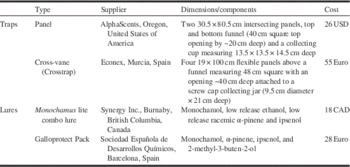
Traps used to monitor Monochamus species vary by continent. In North America, Lindgren multiple-funnel traps were developed and are used to capture bark beetles in a forestry setting (Lindgren Reference Lindgren1983). Recently, cross-vane and panel traps have been found to be as good, or better, than Lindgren multiple-funnel for the capture of Monochamus species (McIntosh et al. Reference McIntosh, Katinic, Allison, Borden and Downey2001; de Groot and Nott Reference de Groot and Nott2003; Miller and Crowe Reference Miller and Crowe2011). Furthermore, coating of traps with an aerosol lubricant such as Fluon® significantly increased captures of large woodborers such as Monochamus (Graham et al. Reference Graham, Mitchell, Reagel, Barbour, Millar and Hanks2010; Allison et al. Reference Allison, Johnson, Meeker, Strom and Butler2011, Reference Allison, Bhandari, McKenney and Millar2014, Reference Allison, Graham, Poland and Strom2016; Graham and Poland Reference Graham and Poland2012). In Europe, cross-vane traps are commercially available for monitoring Monochamus species (Jurc et al. Reference Jurc, Bojovic, Fernández and Jurc2012) but are constructed of different material and have different dimensions than those sold in North America (Table 1). Both traps have a similar profile but in our opinion the flexible black polyethylene material that, according to the manufacturer (Econex, Murcia, Spain), has been “treated with slippery product that greatly increases the number of insects captured” (http://www.e-econex.eu/insect-traps) is not as slippery as the panel traps coated in Fluon®, and we predicted the North American panel traps would be more effective than the European crossvane traps at catching Monochamus species.
Traps and lures used to capture Monochamus species in Nova Scotia.

Lures developed in North America to capture Monochamus and other cerambycids have been modelled after bark beetle lures, using host volatiles commonly associated with stressed or dying conifers, such as α-pinene and ethanol (Chénier and Philogène Reference Chénier and Philogène1989; Allison et al. Reference Allison, Borden, McIntosh, de Groot and Gries2001, Reference Allison, Morewood, Borden, Hein and Wilson2003; Pajares et al. Reference Pajares, Ibeas, Diez and Gallego2004; Sweeney et al. Reference Sweeney, de Groot, MacDonald, Smith, Cocquempot and Kenis2004, Reference Sweeney, Gutowski, Price and de Groot2006; Miller et al. Reference Miller, Asaro, Crowe and Duerr2011; Hanks et al. Reference Hanks, Millar, Mongold-Diers, Wong, Meier and Reagel2012) and pheromones from bark beetles, i.e., ipsenol (Allison et al. Reference Allison, Borden, McIntosh, de Groot and Gries2001, Reference Allison, Johnson, Meeker, Strom and Butler2011; de Groot and Nott Reference de Groot and Nott2004; Pajares et al. Reference Pajares, Ibeas, Diez and Gallego2004; Ibeas et al. Reference Ibeas, Gallego, Diez and Pajares2007). 2-undecyloxy-1-ethanol, also known as monochamol, is a male-produced aggregation pheromone first discovered in Monochamus galloprovincialis (Olivier) (Pajares et al. Reference Pajares, Ávarez, Ibeas, Gallego, Hall and Fahman2010) and as found to be produced by, and attractive to, M. alternatus (Teale et al. Reference Teale, Wickham, Zhang, Chen, Hanks and Millar2011), M. carolinensis, M. titillator (Allison et al. Reference Allison, McKenney, Millar, McElfresh, Mitchell and Hanks2012), M. scutellatus (Fierke et al. Reference Fierke, Skabeikis, Millar, Teale, McElfresh and Hanks2012), and M. sutor (Pajares et al. Reference Pajares, Alvarez, Hall, Douglas, Centeno and Ibarra2013). Monochamol increases trap captures of M. clamator, M. obtusus (Macias-Samano et al. Reference Macias-Samano, Wakarchuk, Millar and Hanks2012), M. notatus (Fierke et al. Reference Fierke, Skabeikis, Millar, Teale, McElfresh and Hanks2012; Ryall et al. Reference Ryall, Silk, Webster, Gutowski, Meng and Li2015), M. urussovi, and M. saltuarius (Ryall et al. Reference Ryall, Silk, Webster, Gutowski, Meng and Li2015); most of these studies as well as others (Álvarez et al. Reference Álvarez, Etxebeste, Gallego, David, Bonifacio and Jactel2015, Reference Álvarez, Gallego, Hall, Jactel and Pajares2016; Miller et al. Reference Miller, Allison, Crowe, Dickinson, Eglitis and Hofstetter2016) found that attraction to monochamol was enhanced or synergised by the addition of kairomones. This research has led to multi-component, commercially available lures that differ somewhat between Europe and North America. Because European countries use different traps and lures for monitoring Monochamus than those used in North America, we surveyed plantations using traps and lures from both continents. As lures from North America were developed with local Monochamus species as the target, we hypothesised they would be more attractive than the European lures to the Monochamus species present in Nova Scotia.
Our objectives were to determine the relative abundance of Monochamus species in Nova Scotia Christmas tree plantations versus the surrounding forests and to compare traps and lures from Europe and North America for efficacy of capturing Monochamus species present in Nova Scotia.
Materials and methods
Traps and lures
Specifications of the traps and lures used in the studies are presented in Table 1. Panel traps were made from corrugated plastic coated in Fluon® to decrease friction and increase captures (Allison et al. Reference Allison, Borden, McIntosh, de Groot and Gries2001, Reference Allison, Johnson, Meeker, Strom and Butler2011, Reference Allison, Bhandari, McKenney and Millar2014, Reference Allison, Graham, Poland and Strom2016; Graham et al. Reference Graham, Mitchell, Reagel, Barbour, Millar and Hanks2010). Cross-vane (Crosstrap) traps used in Europe are made from a flexible black polyethylene material (Econex). North American lures were the Monochamus Lite Combo Lure (Synergy Semiochemicals, Burnaby, British Columbia, Canada) while European lures (GalloProtect Pack) were obtained from the Sociedad Española de Desarrollos Químicos (Barcelona, Spain). Both lures were four-component blends of a pheromone and three kairomones. Three components were the same: monochamol (aggregation pheromone of Monochamus), α-pinene (kairomone), and ipsenol (bark beetle pheromone and kairomone of Monochamus). The fourth component was ethanol (North American lure) and 2-methyl-3-buten-2-ol (European lure). For all experiments, lures were suspended in the opening between panels of the North American panel traps and as recommended by Econex for the European trap (i.e., hung on the outer edges of the panels). In both plantation and surrounding forest, traps were hung ~2m above the ground between two trees using rope and metal hangers, between 2–3 m from the nearest tree.
Field sites
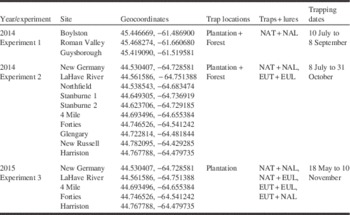
Thirteen sites located throughout Nova Scotia (Table 2) were surveyed in 2014. Five of these sites that contained the highest numbers of Monochamus were surveyed again in 2015. All sites were well-established commercial Christmas tree plantations, ranging in size from 5–61 ha and surrounded by forest (see below for details). Plantations were composed of naturally regenerated balsam fir up to 10 years of age, thinned as required to provide at least 3 m between trees and trees ranged up to 2.5 m in height. Forests surrounding most plantations contained a mixture of species consisting mainly of conifers (Picea rubens Sargent, Pinus strobus Linnaeus, A. balsamea (Linaeus) Miller; Pinacaea) intermixed with Acer rubrum Linnaeus (Sapindaceae), Populus tremuloides Michaux (Salicaceae), and Betula papyrifera Marshall (Betulaceae). Trees varied in age, ranging from new seedlings to 30–40-year-old trees, and measured from <1 m to ~15m in height.
Site, locations, traps, lures, and trapping dates used for panel trapping of Monochamus species in 2014 and 2015.

Note: NAT, North American style panel trap; EUT, European style panel trap; NAL=North American lure; EUL, European lure.
Experiment 1: effect of trap location
This experiment was conducted to compare the relative abundance of Monochamus species within Nova Scotian Christmas tree plantations versus surrounding forests. Four North American panel traps baited with the North American lure were placed at each of three sites in northeastern Nova Scotia in 2014. At each site, two traps were placed in the forest at least 30 m from the forest/plantation boundary, and two traps in the plantation, spaced 30 m apart and at least 30 m from the plantation boundary. Cups were filled with about 500 mL of saturated salt (NaCl) solution and a small amount of liquid dish detergent, and were checked bi-weekly from 10 July through 8 September 2014 with all Monochamus beetles identified to species and sexed.
Experiment 2: effect of trap location and trap-lure combination
Ten sites were used in this experiment (Table 2, experiment 2). North American panel traps baited with North American Monochamus lures were compared with European cross-vane traps baited with European Monochamus lures and placed within the Christmas tree plantation and the surrounding forest. We placed eight traps per site, in two lines of four traps, one line at least 30 m inside the plantation and the other line in the surrounding forest at least 30 m from the plantation boundary. Traps were spaced 30 m apart within each line with two North American and two European trap-lure combinations per line in random order. Traps were installed in early July 2014 and checked bi-weekly until 31 October 2014 when captures dropped to zero. All Monochamus beetles were identified to species and sexed.
Experiment 3: effect of trap type and lure
This experiment compared all four combinations of North American and European traps and lures and was conducted in five Christmas tree plantations in central Nova Scotia in 2015, and replicated three times in randomised blocks at each site for a total of 15 blocks. Three lines of traps were established in each Christmas tree plantation, spaced 30 m apart with the first line at least 30 m inside the plantation from the plantation/forest boundary. Traps were checked bi-weekly until trap captures dropped to zero (18 May to 10 November 2015) with all Monochamus beetles identified to species and sexed. Voucher specimens of each Monochamus species collected have been deposited in the collection at Agriculture and Agri-Food Canada, Kentville, Nova Scotia.
Data analysis
For each experiment, captures from each trap were pooled across collection dates. Paired t-tests were used to test the effects of location (forest versus plantation, experiments 1 and 2) and trap type (North American versus European, experiment 2) on mean catches of all Monochamus pooled (males, females, total), M. notatus, M. scutellatus, and M. marmorator (Zar Reference Zhang, Song, Ma, Han and Sun1999). The non-parametric Wilcoxan signed-rank test was used instead of paired t-tests when the distribution of differences departed significantly from normality (Shapiro–Wilk test, P<0.05) (Zar Reference Zhang, Song, Ma, Han and Sun1999). The Bonferroni correction was used to keep experiment-wise error at 0.05. Data from experiment 3 were subjected to ANOVA as a factorial experiment replicated in randomised blocks using the model: y=block+trap+lure+trap×lure+error. Post-hoc means comparisons were performed using Tukey’s honest significant difference at α=0.05. Data analysis for this paper was generated using SAS/STAT software, version 9.2 (SAS Institute 2008) or R software (R Core Team 2015). Residuals were tested for significant departure from normality using the Shapiro–Wilk test and for homogeneity of variance using Barlett’s test, and data were transformed using log(x+1) when required. Seasonal phenology of each species was examined by pooling trap captures from North American traps only across site and plotting over time for both 2014 and 2015.
Results
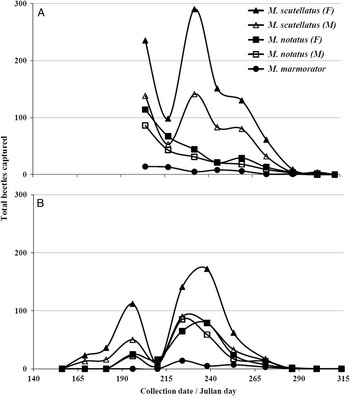
We captured 8691 Monochamus specimens representing three species during 2014 and 2015: M. marmorator, M. notatus, and M. scutellatus, each of which has been previously reported in Nova Scotia (Webster et al. Reference Webster, McCorquodale and Majka2009). The most abundant species was M. scutellatus (5336, 61.4%), followed by M. notatus (3207, 36.9%), and M. marmorator (139, 1.6%). Captures of M. scutellatus and M. notatus peaked in late August and continued into late October in both years (Fig. 1A–B). Traps were installed after the beginning of flight in 2014 (Fig. 1A) but trap catches in 2015 indicated the flight began in mid-June (Fig. 1B). Captures of M. marmorator were low in both years throughout the season with little difference between the sexes (Fig. 1). Monochamus scutellatus females were present in higher numbers than males, while M. notatus females and males were caught equally throughout the season. Trap catches dipped in mid-summer in both years on Julian day 217 (5 August) in 2014 and on Julian day 210 (29 July) in 2015. These periods of depressed trap catch are likely due to heavy rains and wind that caused the traps to swing and some of the catch to spill onto the ground. Captures of M. scutellatus and M. marmorator were not significantly different between years (P>0.05) but captures of M. notatus were greater in 2015 compared with 2014 (P<0.05).
Total number of Monochamus scutellatus and M. notatus, by sex, and total M. marmorator captured in 2014 (A) and 2015 (B) using North American traps and lures in 10 and five Christmas tree plantations, 2014 and 2015, respectively, in Nova Scotia. Date before first capture in both panels denotes trap installation date.

Experiments 1 and 2: effects of trap location and trap-lure combination
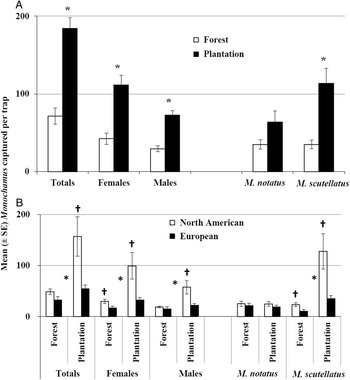
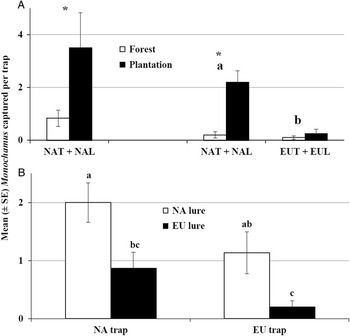
Mean trap catch of Monochamus specimens was greater in the plantation than the surrounding forest in both experiments 1 (Fig. 2A) and 2 (Fig. 2B). Catches of M. scutellatus were significantly greater in the plantations than the forests in experiment 1 (Fig. 2A) and 2 (Fig. 2B) whereas catches of M. notatus were not (Fig. 2A–B). Catches of M. marmorator were greater in the plantations than the forests but differences were significant only in experiment 2 (Fig. 3A).
Mean (±SE) numbers of Monochamus species (totals, females, males), M. notatus, and M. scutellatus captured in Christmas tree plantations and their surrounding forests at: (A) three sites in Nova Scotia using North American traps baited with North American lures (experiment 1), and (B) 10 sites in Nova Scotia in either North American traps and lures or European panel traps baited with European lures; July–October 2014 (experiment 2). Significant differences in mean catches between plantations and forests are denoted with asterisks (*) and those between trap-lure types are denoted with daggers (†) (paired t-tests with Bonferroni’s correction).

Mean (±SE) numbers of Monochamus marmorator captured in (A) Christmas tree plantations versus surrounding forests in Nova Scotia in 2014 (experiment 1 and 2), and (B) in North American traps (NAT) or European traps (EUT) baited with either North American lures (NAL) or European lures (EUL) (experiment 3). Significant differences between plantations and forests are denoted with asterisks (*) (Wilcoxan’s paired comparisons) and those between trap-lure treatments with different letters (ANOVA and Tukey’s honest significant difference at α=0.05).

The North American traps and lures captured greater numbers of Monochamus species, M. scutellatus (Fig. 2B) and M. marmorator (Fig. 3B) than did the European traps and lures but catches of M. notatus did not differ between trap-lure types (Fig. 2B).
Experiment 3: effect of trap type and lure
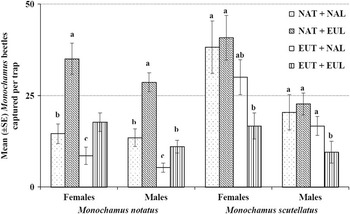
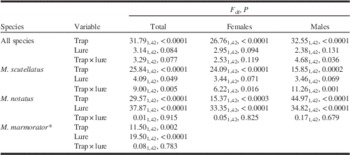
Trap type significantly affected mean catch of M. scutellatus females (F(1,54)=8.21, P=0.006) and males (F(1,54)=6.05, P=0.017) with the North American trap outperforming the European trap (Table 3, Fig. 4). Mean catch of M. scutellatus was not affected by lure type and there were no significant trap×lure interactions. The trend was the same when sexes were pooled with greatest mean catch in North American traps baited with the European lure and lowest catches in European traps baited with the European lure (Fig. 4).
Mean (±SE) Monochamus notatus and M. scutellatus (females and males) captured in two types of panel traps, North American (NAT) and European (EUT), baited with two different Monochamus lure formulations (North American lures (NAL) and European lures (EUL)) at five sites in Nova Scotia during 2015 from May to November (experiment 3). Letters above bars (within species and sex) denote significant differences between trap-lure combinations as determined by Tukey’s honest significant difference at α=0.05. Detailed statistics presented in Table 3.

ANOVA table for experiment 3 testing the effect of trap type and lure on catch of Monochamus scutellatus and M. notatus (total, females, and males at five sites in Nova Scotia during 2015 from 18 May to 10 November.

Notes: Model: catch=block+trap×lure+error.
* M. marmorator analysed as pooled sexes only due to low catch numbers.
Both trap type and lure significantly affected mean catch of M. notatus with the North American trap outperforming the European traps and the European lure outperforming the North American lure (Table 3, Fig. 4). The trap-lure combination with the greatest mean catch of male or female M. notatus was a North American trap baited with the European lure (F(1,54)=4.43, P=0.04, Fig. 4). Trap (F(1,42)=11.5, P=0.002) and lure (F(1,42)=19.5, P<0.001) significantly affected catch of M. marmorator with greatest catches in North American traps baited with European lures and lowest catches in the European traps baited with European lure (Fig. 3B).
Discussion
We collected three species of Monochamus in Nova Scotia Christmas tree plantations in 2014 and 2015: M. marmorator, M. notatus, and M. scutellatus, consistent with species previously recorded in Nova Scotia (Webster et al. Reference Webster, McCorquodale and Majka2009). Flight began in early June, peaked in early August and ended in late October for all species. All three species were captured more frequently in Christmas tree plantations than in the surrounding forest. Although we expected some Monochamus adults would be in the plantations for maturation feeding, our hypothesis that most would be captured in the surrounding forest was not supported. Captures within the plantations were about three times greater than in surrounding stands. Surrounding forests are predominantly older conifers providing more suitable hosts for oviposition and larval development than younger healthy Christmas trees. It is possible that the younger trees in the plantations are a preferred food source for adults and they move into the plantations for maturation feeding before moving back to the forest for oviposition. Trap captures in the plantation may also be higher due to the less complex stand architecture compared with the forests, allowing more open access to traps and less interference with dispersal of pheromone/kairomone plumes from the traps. Finally, it is likely that the traps, baited with kairomones to simulate a bark-beetle infested and susceptible host, would have had less competition from weakened and susceptible host trees in the plantations than in the surrounding forests. Although, the trap catches provide a rough index of relative abundance and activity of Monochamus, further study is required to determine how well trap catches reflects the relative amount of feeding by Monochamus adults in Christmas tree plantations versus the surrounding forest.
When baited with the same lure type, the European traps generally captured fewer beetles than did the North American traps. This may be due to the addition of Fluon® to the North American traps, consistent with previous studies that showed Fluon® treatment increased catches of longhorn beetles in traps (Graham et al. Reference Graham, Mitchell, Reagel, Barbour, Millar and Hanks2010; Allison et al. Reference Allison, Johnson, Meeker, Strom and Butler2011, Reference Allison, Bhandari, McKenney and Millar2014, Reference Allison, Graham, Poland and Strom2016). However, according to the manufacturer, the European traps are also treated with an unspecified slippery substance so differences in catch may also be due to other factors such as general trap design.
Response to the different lure types varied with species, sex, and trap type. For M. notatus, mean catches of both sexes were greater in North American traps than in European traps and greater when traps were baited with European lures than with North American lures, i.e., greatest mean catches were in North American traps baited with European lures. For M. scutellatus, mean catches of both sexes were also greater in North American traps than in European traps with no significant difference between lures; lowest mean catch of males and females was in European traps baited with European lures. Monochamol has been shown to be attractive to both M. notatus and M. scutellatus with both species showing increased capture when combined with kairomones and bark beetle pheromones (Fierke et al. Reference Fierke, Skabeikis, Millar, Teale, McElfresh and Hanks2012; Ryall et al. Reference Ryall, Silk, Webster, Gutowski, Meng and Li2015). As monochamol, α-pinene and ipsenol were common to both the European and North American lure, greater attraction of M. notatus to the European lure was likely due either to the presence of 2-methyl-3-buten-2-ol or the absence of ethanol, or both. Ethanol is recognised as a fermentation product in moribund trees (Graham Reference Graham1968) and synergises attraction of many bark and wood-boring beetles to host terpenes such as α-pinene (Bauer and Vité Reference Bauer and Vité1975; Borden Reference Borden1982; Chénier and Philogène Reference Chénier and Philogène1989; Allison et al. Reference Allison, Borden and Seybold2004; Sweeney et al. Reference Sweeney, de Groot, MacDonald, Smith, Cocquempot and Kenis2004). 2-methyl-3-buten-2-ol is a component of the aggregation pheromone of Ips typographus Linnaeus (Coleoptera: Curculionidae) (Bakke et al., Reference Bakke, Froyen and Skattebol1977), Ips shangrila Cognato and Sun (Zhang et al. Reference Zhang, Schlyter and Birgersson2009b), Ips nitidus Eggers (Zhang et al. Reference Zar2009a), and Ips avulsus Eichloff (Birgersson et al. Reference Birgersson, Dalusky, Espelie and Berisford2012). None of these Ips species are native to Canada. However, 2-methyl-3-buten-2-ol has also been reported as a minor pheromone component of Polygraphus rufipennis (Kirby) (Coleoptera: Curculionidae) (Werner and Holsten, Reference Werner and Holsten1995), a species that infests dead and dying Picea Miller, Larix Miller (Pinaceae), Pinus Linnaeus, and Abies Miller (Drooz Reference Drooz1985), so it is possible that it acts as a kairomone to M. notatus, indicating a suitably moribund host. 2-methyl-3-buten-2-ol is also a naturally occurring volatile emitted by North American pine species (Goldan et al. Reference Goldan, Kuster, Fehsenfeld and Montzka1993; Harley et al. Reference Harley, Fridd-Stroud, Greenburg, Guenther and Vasconcellos1998) as well as some European hardwoods (Populus tremula Linnaeus, Betula pendula Roth, B. alba pubescens (Ehrhart) Regel (as B. pubescens)) (Zhang et al. Reference Zhang, Ma, Zhao, Song and Sun2012). Monochamus notatus responded differently than M. scutellatus and M. marmorator to both traps and lures in 2014 and 2015, suggesting that further testing of the response of Monochamus species from other regions of North America to the European lure would provide insight into the results we obtained.
We have demonstrated that the three Monochamus species present in Nova Scotia are readily captured in Christmas tree plantations. North American panel traps coated with Fluon® and baited with the European lure were the most effective at catching both M. notatus and M. scutellatus and would be most effective for monitoring Monochamus activity in Nova Scotia Christmas tree plantations compared with European cross traps. Further sampling is required to determine the proportion of adult beetles and Christmas trees that may or may not be infected with the pinewood nematode to fully assess the risk that Nova Scotia Christmas trees pose for import to Europe.
Acknowledgements
The authors would like to thank the Christmas Tree Council of Nova Scotia and the Nova Scotia Department of Agriculture for funding this project through the Growing Forward 2 Innovation Theme Research Acceleration Programme. Thank you to Dan Miller, Krista Ryall, and two anonymous reviewers for helpful feedback on earlier versions of this manuscript. Special thanks to Mark Billard, Justine Blatt-Janmaat, Jeff Franklin, Kim Hiltz, Cory Hughes, Seth Newell, Garret Pearson, Lori Phinney, Natalie Silver, and Brendan Ward for support in the field and with beetle sorting in the laboratory.