Introduction
High-fidelity transitions of care (TOCs) between hospitals and nursing homes (NHs) are critical to the continuum of care, and TOCs between hospital and NH have been characterized as susceptible to errors. Reference Sinvani, Beizer and Akerman1–Reference King, Gilmore-Bykovskyi, Roiland, Polnaszek, Bowers and Kind3 Successful communication of medication treatment plans between facilities has been suggested to be especially challenging due to hospital and NH factors involving the lack of formal relationships between sending and receiving facilities as well as missing or conflicting documentation.Reference Coleman2 Failed or incomplete TOCs have been shown to delay NH resident care, to increase the risk of rehospitalization, and to unnecessarily increase NH staff workload.Reference King, Gilmore-Bykovskyi, Roiland, Polnaszek, Bowers and Kind3
Nearly one-quarter of patients discharged from hospitals to NHs are discharged on antibiotics.Reference Weber, Noble and Bearden4 Transitions of antibiotic treatment plans require attention to drug, dose, timing, and safety measures. Failed transitions of antibiotics may prevent the resolution of infection and increase the likelihood of adverse events upon transfer.
In this study, we aimed to characterize and quantify the failure of high-fidelity transitions of antibiotics among patients discharged from hospitals to NHs.
Methods
We conducted a descriptive study of patients discharged from hospitals to NHs on antibiotics between January 2011 and June 2014 within the context of the clinical trial “Changing Lives by Eradicating Antibiotic Resistance” that evaluated postdischarge decolonization and education compared to education alone among MRSA carriers discharged from healthcare facilities in Los Angeles County and Orange County, California.Reference Huang, Singh and McKinnell5
Individuals enrolled in the trial, hospitalized with an infection, and discharged to an NH on antibiotics were included. Few NH visits were reported by trial participants. Charts from participants with sufficiently complete medical records from both the discharging hospital and admitting NH were assessed using a standardized chart review instrument. Information regarding the continuity of the antibiotic plan of therapy was abstracted using a novel measurement tool deemed the CARDDS tool; it included the choice of antibiotic, route, dose, duration, and safety. The dose element included dose amount, frequency, and appropriateness of time between last administration in the hospital and first administration in the NH. Early or late administration was defined as a difference in hours from the scheduled time that exceeded half of the interval between doses. The safety element included the need for antibiotic levels for therapeutic assessment, drug–drug interaction monitoring, and hematologic or chemistry laboratory monitoring for side effects. Mismatches between the hospital’s antibiotic plan of therapy and the NH’s administration of therapy were assessed by a physician reviewer. Inappropriate mismatches without a documented explanation or suspected rationale were classified as transition errors and were reported as a proportion of total transitions. Information regarding the date and time of transfer and availability of the transferring physician’s contact information was collected.
Results
We evaluated 40 paired hospital and NH charts representing 37 patients discharged from 13 hospitals and transferred to 25 NHs. The NHs had an average of 116 beds, with an average resident age of 78 years and an average acuity index of 14. A description of the antibiotic therapy prescribed upon hospital discharge is available in Supplemental Table 1 online.
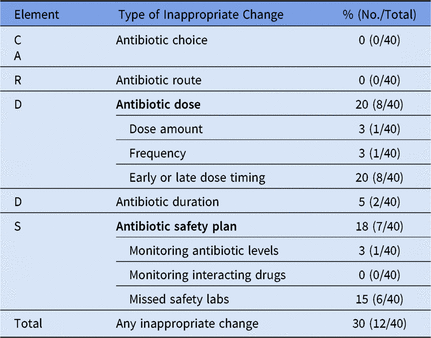
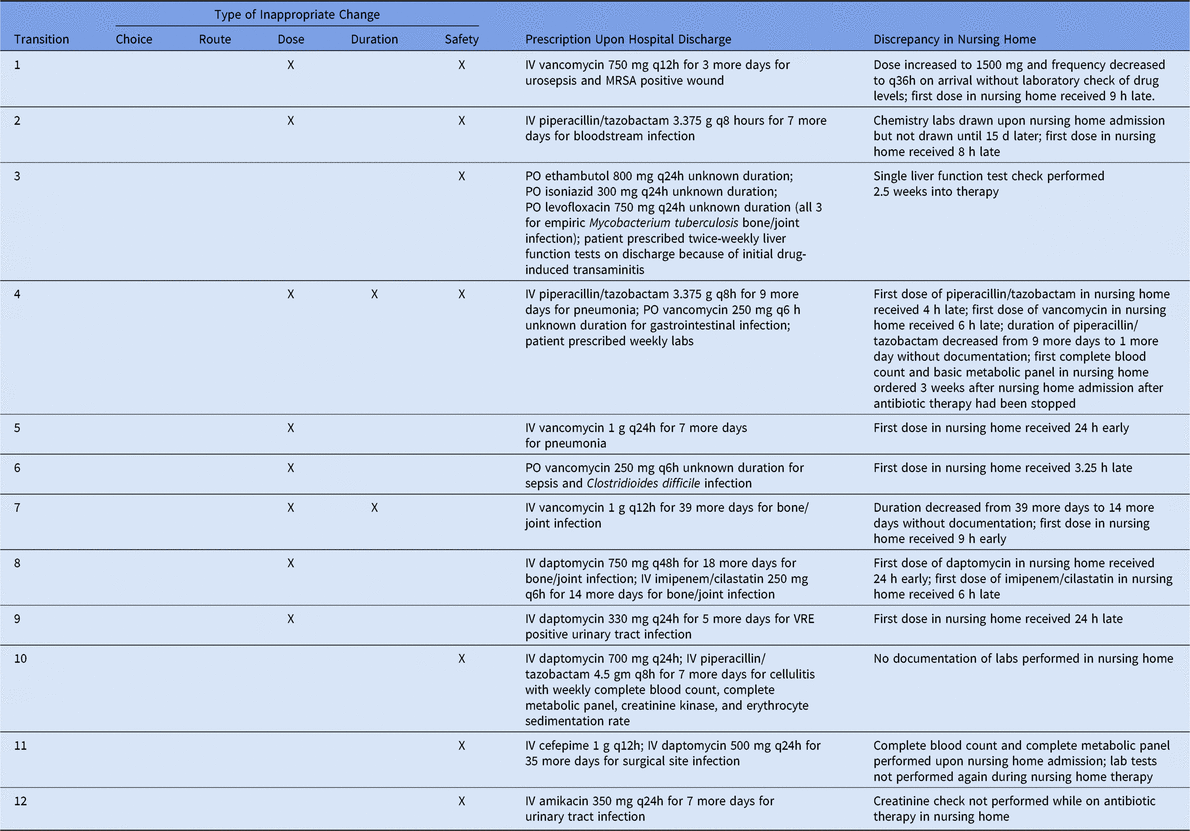
We found 21 unique instances of inappropriate changes to any one of the CARDDS elements involving 12 of 40 TOCs (30%) to 9 NHs. Among NHs with transition errors, these facilities had an average of 138 beds, an average resident age of 78 years, and an average acuity index of 13. On average, 1.75 errors occurred per failed antibiotic transition (Table 1). Overall, 8 TOCs included an inappropriate change in one CARDDS element, 3 TOCs included a change in 2 elements, and 1 TOC included a change in 3 elements (Table 2).
Proportion of All Transitions That Experienced an Inappropriate Change in the Antibiotic Plan of Care Upon Transfer From Hospital to Nursing Home

Description of All Inappropriate Antibiotic Changes

Note. IV, intravenous administration; q12h, given every 12 hours; MRSA, methicillin-resistant Staphylococcus aureus; PO, oral administration; VRE, vancomycin-resistant enterococci.
The greatest proportion of inappropriate changes occurred in the dose element: 12 errors in any component of the dose element occurred in 8 of 40 TOCs (20%). An early or late first dose upon TOC to an NH was the most common dosing error, with 10 of 12 of dose transition errors (83%) attributed to inappropriate dose timing. Of 10 inappropriate dose timing errors, 7 (70%) were antibiotics that were administered late upon TOC, compared to 3 of 10 (30%) that were administered early. Late doses were administered a mean of 9 hours (range, 4–24 hours) after scheduled dosing, and early doses were administered a mean of 19 hours (range, 9–24 hours) early.
Of 40 TOCs, 2 (5%) included an inappropriate change in duration of therapy upon transfer. Both instances involved shortening of therapy. Also, 7 (18%) included an error in antibiotic safety monitoring upon transfer. A missing safety laboratory report (ie, hematologic or chemistry panels) was the most common error; 6 of 7 safety monitoring errors (86%) involved a missed safety laboratory report. In all instances, safety laboratory tests were performed less frequently than ordered, were not performed before altering antibiotic therapy, or were performed long after antibiotic therapy had been discontinued. Of 7 safety monitoring errors, 1 (14%) involved failure to monitor antibiotic levels. No TOCs included an inappropriate change to antibiotic choice or route.
Regarding TOC documentation, 8 of 40 hospital records (20%) had missing information related to the frequency or duration of discharge antibiotics. Of 40 hospital discharge summaries, 20 (50%) contained missing or conflicting information with final progress notes in relation to discharge antibiotics. Within hospital information contained in the NH chart, 31 of 40 charts (78%) did not contain physician contact information in the event the NH had questions regarding the TOC. Lastly, for 29 charts where a time of transfer was recorded, 17 (59%) arrived after business hours and pharmacy support was no longer available.
Discussion
Nearly 1 in 3 antibiotic transitions from hospital to NH experienced an inappropriate change to, or lack of follow through on, the antibiotic plan of therapy. The most common changes were among dose and safety elements.
These data suggest the need for improvements in TOCs between facilities. A multitude of factors, including lapses in communication between the discharging hospital and receiving NH, have been implicated in contributing to errors during a TOC. Reference Coleman2,Reference King, Gilmore-Bykovskyi, Roiland, Polnaszek, Bowers and Kind3,Reference Shah, Burack and Boockvar6 These barriers can be remedied. The American Medical Directors Association encourages medication reconciliation at all points of TOC between facilities, calling for a dedicated process involving providers in both facilities, family members, and patients themselves.7 Multicomponent medication reconciliation upon hospital discharge and NH admission may be used in conjunction with stewardship to ensure safe and appropriate use of antibiotics upon transfer. Reference Schnipper, Hamann and Ndumele8,Reference Parente and Morton9 Nevertheless, this process may be difficult because physicians and pharmacists are rarely on site in NHs during overnight TOCs. Furthermore, family members of patients may not be present, and patients are often unaware of their medication list and dosing schedule. Additionally, many physicians prepopulate tentative discharge plans that may not be corrected prior to transfer. Therefore, fixed templates for antibiotics, similar to fixed templates for infection prevention, should be considered.10 For example, interfacility transfer forms should be expanded to include CARDDS elements.
Our study has several limitations. First, we reviewed paired charts from a limited number of TOCs. Second, the retrospective nature of this study introduced the possibility of missing data, such as missing laboratory reports not otherwise mentioned in notes. Lastly, we did not assess the impact of transition errors on infection resolution or adverse events.
In conclusion, nearly one-third of antibiotic transitions from hospital to NH involved a failed transition of at least 1 antibiotic care-plan element. Hospitals and NHs need structured processes and interfacility transfer forms to ensure cohesive and safe TOCs for patients discharged on antibiotics.
Acknowledgments
None.
Financial support
This work was supported by internal funds from the University of California Irvine School of Medicine and the Yale School of Public Health.
Conflicts of interest
All authors report no conflicts of interest relevant to this article.
Supplementary material
To view supplementary material for this article, please visit https://doi.org/10.1017/ice.2019.270