An ecological perspective on the emergence of psychopathology emphasizes the need to study developmental progressions as interplay between individual adaptation and biological and environmental constraints (Bronfenbrenner, Reference Bronfenbrenner and Vasta1989; Cicchetti, Reference Cicchetti, Beauchaine and Hinshaw2008; Dishion & Patterson, Reference Dishion, Patterson, Cicchetti and Cohen2006). In the study of the development of problem behavior, transactions between the individual child and the ecology have been described as potentiating stagelike progressions in problem behavior (Patterson, Reference Patterson, Bolger, Caspi, Downey and Moorehouse1988; Patterson, Reid, & Dishion, Reference Patterson, Reid and Dishion1992). The progression hypothesis proposed that minor deviations of normative development, such as noncompliance, lead to the development of a general disposition for antisocial behavior, school failure (academically and socially), associations with deviant peers, and ultimately, more serious forms of problem behavior. This study sought to empirically test this developmental progression from early adolescent problem behavior to serious violence by late adolescence in a sample of ethnically diverse males and females.
The focus on violence is important socially and scientifically. Violent acts seriously affect the quality of life of victims and their families, and they engender high economic costs for the victims (e.g., health care, property damage, loss in income) and for society (e.g., jails, prisons, and rehabilitation programs; Anderson, Reference Anderson1999; Macmillan, Reference Macmillan2000). Extreme antisocial behaviors such as assault, rape, and murder are most often committed by individuals who started off as disruptive children, yet not all disruptive children become violent and serious offenders (Loeber & Farrington, Reference Loeber and Farrington2000; Maughan & Rutter, Reference Maughan, Rutter, Hill and Maughan2001). Understanding the developmental progression leading to serious antisocial behavior is particularly helpful in that studying the transaction between the child and the environment may identify mediating processes that may serve as prevention targets.
In the context of sociological, anthropological, and psychological research, the peer domain is particularly salient to understanding the development of adolescent problem behavior (Dodge, Dishion, & Lansford, Reference Dodge, Dishion and Lansford2006; Schlegel & Barry, Reference Schlegel and Barry1991; Warr, Reference Warr1993). Patterson (Reference Patterson1993) conducted a latent growth analysis on a sample of 204 males and found that parental monitoring and discipline contributed to the average level of problem behavior in childhood through adolescence, whereas growth in adolescent misconduct was accounted for by unsupervised time with deviant peers. Thus, the peer group plays a central role in the progression from antisocial behavior to drug use and delinquency. Given the role of peers in this process, it becomes important to study and understand which children are more likely to cluster into deviant peer groups.
Sequelae of Problem Behavior and School Marginalization
Schools provide an organizing experience for the development and structure of child and adolescent adaptation. Success in the school context is perhaps the most significant milestone of childhood (Kellam, Reference Kellam and Patterson1990). Adaptation to the school environment constitutes (a) academic performance, including the growth of competence in reading, writing, and mathematics, as well as positive attitudes toward school; and (b) peer relationships and the development of friendships. An extensive literature confirms that children and adolescents who engage in problem behavior have significant trouble in both the academic and the peer domains (Cobb, Reference Cobb1972; Coie & Kupersmidt, Reference Coie and Kupersmidt1983; Dishion, Reference Dishion and Leone1990; Dishion, Loeber, Stouthamer-Loeber, & Patterson, Reference Dishion, Loeber, Stouthamer-Loeber and Patterson1984; Dodge, Reference Dodge1983; Hops & Greenwood, Reference Hops, Greenwood, Mash and Terdal1988; McWhirter, McWhirter, McWhirter, & McWhirter, Reference McWhirter, McWhirter, McWhirter and McWhirter2003; Patterson, Reference Patterson1982). Marginalization in the school context, in turn, increases the likelihood of deviant peer involvement.
Adaptation in the peer domain is critical to understanding progressions in antisocial behavior. Peer rejection is perhaps the most painful aspect of the human social experience (Eisenberger, Lieberman, & Williams, Reference Eisenberger, Lieberman and Williams2003). Children who engage in problem behavior in school are often rejected by peers, as revealed by the classic work of Coie and of Dodge (Coie & Kupersmidt, Reference Coie and Kupersmidt1983; Dodge, Reference Dodge1983). Unfortunately, peer rejection in the school context seems to have important developmental sequelae (Bierman, Reference Bierman2004).
Academic and peer domains are linked and most likely are reciprocally influential. For example, improved academic skills result in improved social preference among school peers (Coie & Krehbiel, Reference Coie and Krehbiel1984), and reduced problem behavior results in improved academic performance (Stormshak, Connell, & Dishion, Reference Stormshak, Connell and Dishion2009). Positive peer relationships are, in turn, longitudinally prognostic of growth in academic engagement and competence (Masten et al., Reference Masten, Roisman, Long, Burt, Obradović and Riley2005; Véronneau, Vitaro, Brendgen, Dishion, & Tremblay, Reference Véronneau, Vitaro, Brendgen, Dishion and Tremblayin press). Investigators working within the social development framework frame the process of marginalization in the school context as a lack of bonding to the school, which is easily assessed by youth report of disenchantment with schools and teachers (Hawkins & Lishner, Reference Hawkins, Lishner, Crowell, Evans and O'Donnell1987). The lack of school bonding is described as disaffection with teachers, lack of motivation to engage in learning tasks, dislike of school peers, and a general inclination to not attend school.
Adolescent Gangs and Deviancy Training
The cascade progression from antisocial behavior to school marginalization, to deviant peer clustering, and to escalations in problem behavior is a classic example of the “maladaptation” concept (Cicchetti, Reference Cicchetti1993; Hinde, Reference Hinde and Vasta1989; Sroufe & Rutter, Reference Sroufe and Rutter1984). When marginalized in the school setting, children “adapt” by clustering into deviant peer groups as early as the first grade and more intensely through early adolescence (Dishion, Patterson, Stoolmiller, & Skinner, Reference Dishion, Patterson, Stoolmiller and Skinner1991; Snyder et al., Reference Snyder, Schrepferman, Oeser, Patterson, Stoolmiller and Johnson2005). Deviant peer clustering is potentially detrimental to the youth's long-term social and emotional development in that it is a robust predictor of escalating patterns of problem behavior, including substance use and delinquency (e.g., Chassin, Presson, Sherman, Montello, & McGrew, Reference Chassin, Presson, Sherman, Montello and McGrew1986; Elliott, Ageton, & Canter, Reference Elliott, Ageton and Canter1979; Keenan, Loeber, Zhang, Stouthamer-Loeber, & van Kammen, Reference Keenan, Loeber, Zhang, Stouthamer-Loeber and van Kammen1995; Oetting & Beauvais, Reference Oetting and Beauvais1987; Short & Strodbeck, Reference Short and Strodbeck1965; Warr, Reference Warr1993).
Some adolescent deviant peer clusters with self-organized identities are best described as gangs, which are defined as groups of individuals who share values, gestures, dress, and behaviors that reflect a culture of deviance at the time and for that group in particular. Once the gang is reified, it is relatively intractable to interventions designed to break up the gang or reduce its influence (Klein, Reference Klein, Dodge, Dishion and Lansford2006). Most serious crimes by adolescents are committed in the context of gangs (Aultman, Reference Aultman1980; Reiss, Reference Reiss, Blumstein, Cohen, Roth and Visher1986; Short, Reference Short1990). Involvement in gangs amplifies serious problem behavior such as violence, drug trafficking, and robbery far beyond what would have been predicted relevant to a youth's history of problem behavior and association with delinquent friends (Battin, Hill, Abbott, Catalano, & Hawkins, Reference Battin, Hill, Abbott, Catalano and Hawkins1998; Thornberry, Reference Thornberry, Loeber and Farrington1998).
Youth gang involvement reflects the coalescence of multifarious factors and processes, including low parental monitoring, antisocial behaviors at an early age, and involvement with deviant peers in general (Craig, Vitaro, Gagnon, & Tremblay, Reference Craig, Vitaro, Gagnon and Tremblay2002; Dishion, Nelson, & Bullock, Reference Dishion, Nelson and Bullock2004; Dodge et al., Reference Dodge, Dishion and Lansford2006; Keenan et al., Reference Keenan, Loeber, Zhang, Stouthamer-Loeber and van Kammen1995; Lacourse et al., Reference Lacourse, Nagin, Vitaro, Coie, Arseneault and Tremblay2006; Laird, Jordan, Dodge, Pettit, & Bates, Reference Laird, Jordan, Dodge, Pettit and Bates2001). The probability of gang membership increases with the number of risk factors, including neighborhood deviance, poor adjustment to school, and the child's problem behavior (Hill, Howell, Hawkins, & Battin-Pearson, Reference Hill, Howell, Hawkins and Battin-Pearson1999).
A process model of the progression from problem behavior to violence provides insight into the functional mechanisms generating the escalation (Dishion & Patterson, Reference Dishion, Patterson, Cicchetti and Cohen2006; Granic & Patterson, Reference Granic and Patterson2006). The social augmentation hypothesis proposes that the reinforcing value of a peer relationship is augmented when rewarding experiences with other peers are limited in a specific social context (Dishion & Piehler, Reference Dishion, Piehler, Rubin, Bukowski and Laursen2008). Thus, peer rejection and isolation within the peer network sets the stage for vulnerability to deviant peer affiliation and influence. Studies on the association between peer rejection and later deviant peer clustering have yielded mixed findings (Bagwell, Coie, Terry, & Lockman, Reference Bagwell, Coie, Terry and Lockman2000; Laird et al., Reference Laird, Jordan, Dodge, Pettit and Bates2001; Vitaro, Pedersen, & Brendgen, Reference Vitaro, Pedersen and Brendgen2007), likely as a result of methodological limitations. Models based on the social augmentation hypothesis are often misspecified; for example, when variables such as academic failure are not entered into the prediction model. It is clear that academic skill deficit is a delimiting factor in terms of social opportunities for children and adolescents (e.g., Dishion et al., Reference Dishion, Patterson, Stoolmiller and Skinner1991; Véronneau et al., Reference Véronneau, Vitaro, Brendgen, Dishion and Tremblayin press), yet it is often neglected when predicting subsequent deviant peer clustering. Other aspects of marginalization in the school setting, such as demographic and ethnic status, might also be prognostic of deviant peer clustering, yet these factors also are often overlooked.
Another methodological limitation is that measurement strategies in this area of research are less than optimal. For example, social preference scores are most often derived by taking the algebraic sum of liking and disliking peer nominations. In theory, this strategy may seem optimal, but a difference score based on a standardized number of positive and negative peer nominations can obfuscate potential findings, in that a youth with a high score on both liking and disliking (i.e., controversial) would receive the same social preference score as one who had very low but equal scores on both (i.e., isolated or neglected). In addition, measurement of deviant peer clustering is often weak when it is assessed using a one- or two-item measure of youths' gang involvement, or when participants are asked to report on the deviant behavior occurring in their peer group, because they tend to overestimate the similarity between their own level of problem behaviors and that of their friends.
It is reasonable to assume that these methodological concerns are relevant to testing the social augmentation hypothesis. In a longitudinal study of early adolescent gang involvement that addressed such methodological issues, a multimethod measure of gang involvement was developed that asked counselors, peers at school, teachers, and the youths themselves to identify their involvement with gangs (Dishion, Nelson, & Kavanagh, Reference Dishion, Nelson and Kavanagh2003). This construct, measured at age 13–14, was predicted by peer nominations of liking, rejection, academic grades, and problem behavior at age 11–12 in a sample of African American and European American youths. For females, early problem behavior combined with peer rejection and poor grades predicted later gang involvement. For males, the same predictors, as well as peer liking, were found. That is, boys who were both liked and rejected in the sixth grade (i.e., controversial) tended to be involved with gangs 2 years later. These findings suggest that a social augmentation dynamic contributes to deviant peer clustering in early adolescence, and that involvement in gangs for males evolves from a central place in the peer social network, as reflected by high levels of positive nominations.
Deviant peer relationships also provide rich reinforcement for problem behavior in a process we refer to as deviancy training. Deviancy training appears to be a crucial mediator between previous problem behavior and marginalization and later violence, and it may help explain how gangs essentially provide a social interaction venue that turns adolescents into dangerous individuals. The process inherent in this transformation is important to consider.
Several decades ago, a process-oriented criminological theory described a mechanism called techniques of neutralization in which members of a peer group devalue the harm done by their criminal acts toward others and thereby encourage the development of each other's callousness (Sykes & Matza, Reference Sykes and Matza1957). Accordingly, youngsters learn how to minimize the consequence of their behavior on others. In psychology, the emergence and refinement of microsocial approaches to measurement of interpersonal relationships supported the neutralization hypothesis several years after its initial statement. Videotaped adolescent–peer social interactions coded in terms of the values inherent in their conversations (deviant, normative), including the peer's reaction (positive, neutral), clearly revealed a process of deviancy training defined initially as a high contingent probability of a positive reinforcement (e.g., laughter) to deviant talk (Dishion, Spracklen, Andrews, & Patterson, Reference Dishion, Spracklen, Andrews and Patterson1996). Although we did find that interactions within adolescents' friendships were associated with increases in positive attitudes toward problem behavior, the process was better described as mutual reinforcement embedded in laughter and humor.
Others have argued that adolescence is a developmental period of heightened responsivity to social reward (Dahl, Reference Dahl, Dahl and Spear2004; Dishion, Reference Dishion2009; Spear, Reference Spear2000). Thus, given that some youths lack rewarding social experiences in early adolescence, it is not surprising to find that reinforcement for deviancy in the peer group is highly prognostic of escalating problem behavior. One study revealed that the deviancy training process with male friends predicted increases in violence from early to late adolescence (Dishion, Eddy, Haas, Li, & Spracklen, Reference Dishion, Eddy, Haas, Li and Spracklen1997). Those youths were subsequently found to be the most maladjusted and to tend to get “stuck” in the deviancy training attractor: longer and longer deviant talk bouts occurred during a 30-min observation session. Another study showed that this pattern of interaction predicted increases in problem behavior during the next 2 years (Granic & Dishion, Reference Granic and Dishion2003). This finding stimulated further analysis of friendship interactions from a dynamic systems perspective. Studies that ensued revealed that adolescents whose relationships were organized around deviant attitudes and behaviors were the most likely to continue and to escalate antisocial behavior. Interpersonal organization was measured using a dynamic index of entropy, which pinpointed the predictability of the interaction sequence within a dyad from one second to the next (Dishion, Nelson, Winter, & Bullock, Reference Dishion, Nelson, Winter and Bullock2004). Youths whose friendship interactions were organized and predictable and predominantly deviant were significantly more likely to show high levels of antisocial behavior 10 years later, at age 24.
Engaging in friendships and relationships that are focused on deviant topics has been hypothesized to be a skill like any other, practiced daily in the company of friends, siblings, and parents (Bullock & Dishion, Reference Bullock and Dishion2002; Dishion, Owen, & Bullock, Reference Dishion, Owen and Bullock2004; Snyder et al., Reference Snyder, Schrepferman, Oeser, Patterson, Stoolmiller and Johnson2005; Stormshak, Comeau, & Shepard, Reference Stormshak, Comeau and Shepard2004). We hypothesize that this skill is heightened through a process of selection and socialization that transforms these individuals, creating a mindset that minimizes the consequence of their behavior on others and optimizes a sense of grandiosity and fearlessness associated with committing harmful and destructive acts (Barry et al., Reference Barry, Thompson, Barry, Lochman, Adler and Hill2007; Calvete, Reference Calvete2008). Gangs, unfortunately, amplify the deviancy training dynamic by defining themselves in terms of deviant values and actively discouraging competing prosocial or empathic tendencies. Young adolescents who identify with and commit to the deviant peer group are more likely to be influenced by those interactions (Kiesner, Cadinu, Poulin, & Bucci, Reference Kiesner, Cadinu, Poulin and Bucci2002). Thus, we hypothesize that individual differences in early adolescent gang involvement will be associated with the level of deviancy training later in adolescence.
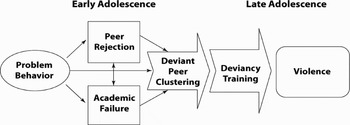
The social augmentation model that guided our study is summarized in Figure 1. In this model, early onset antisocial behavior is correlated with academic failure, peer rejection, and disaffection from the school context. School marginalization in turn increases the likelihood that youths become involved in deviant peer groups and gangs. In the context of deviant peer groups, interpersonal relationship styles then are developed that support problem behavior. As such, the social augmentation model may account for the escalation of problem behavior to more serious violence.
The cascading peer dynamics for problem behavior amplification in adolescence.

We assume that the social augmentation model summarized previously is invariant by ethnicity. That is, differences in levels of violence that may be apparent in a sample are accounted for by the process of social augmentation, which is equivalent across ethnic groups. This expectation fits for the majority of studies that systematically modeled adolescent problem behavior in ethnically diverse settings (Barrera, Castro, & Biglan, Reference Barrera, Castro and Biglan1999; Catalano, Morrison, Wells, & Gillmore, Reference Catalano, Morrison, Wells and Gillmore1992; McLoyd & Steinberg, Reference McLoyd and Steinberg1998). Although there are significant differences in the levels of violence for males and for females, efforts to model progressions by gender in antisocial behavior are few. Those studies that did model these progressions, failed to reveal gender differences in the process of mediation (e.g., Dodge, Greenberg, & Malone, Reference Dodge, Greenberg and Malone2008; Masten et al., Reference Masten, Roisman, Long, Burt, Obradović and Riley2005). However, in earlier analysis predicting gang involvement, we found that peer acceptance and rejection were each prognostic of gang involvement in males but not in females (Dishion, Nelson, & Yasui, Reference Dishion, Nelson and Yasui2005). Therefore, comparing the fit of the cascade model for males with the fit of the same model for females may reveal that school marginalization is less predictive of gang involvement for males than it is for females.
This Study
This cascading set of developmental events is testable with longitudinal data. Past efforts to test developmental cascade hypotheses have shown that a predictable series of events from childhood to adolescence can describe the progression from relatively trivial problem behavior to more serious delinquency in adolescence. For example, Dodge and colleagues (2008) used a structural modeling strategy to document a cascade of developmental events that represented both contextual and individual changes over time that were prognostic of adolescent violence.
To our knowledge, however, the role of deviancy training processes as a mediator of the association between gang involvement earlier in adolescence and violence in late adolescence has not yet been studied, especially with a sample of ethnically diverse males and females. In the analyses that follow, we focus exclusively on early adolescent problem behavior, school marginalization, and low academic performance as predictors of involvement in gangs, followed by deviancy training and adolescent violence as revealed by arrest data, youth report, and parent report.
Method
Participants
Study participants included 998 adolescents and their families, recruited in sixth grade from three middle schools in an ethnically diverse metropolitan community in the Northwest region of the United States. These participants formed a community-based sample: the schools involved in this study were representative of middle schools in this community and were not part of a high-risk neighborhood. Parents of all sixth grade students in two cohorts were approached for participation, and 90% consented to participate. The sample included 526 males (52.7%) and 472 females (47.3%). By youth self-report, the sample comprised 423 European Americans (42.4%), 291 African Americans (29.2%), 68 Latinos (6.8%), 52 Asian Americans (5.2%), and 164 (16.4%) youths of other ethnicities (including biracial). Parent reports revealed that 40.0% percent of participants lived with two parents (either biological or adoptive), 11.4% lived with one parent and one stepparent, 30.0% lived in a single-parent household, and 18.5% lived in other family configurations. The median range of gross annual household income was $30,000 to $39,999, with 25.3% of households earning less than $20,000 per year and 12.7% earning more than $90,000. Youths were randomly assigned at the individual level to either the control group (498 youths) or the intervention group (500 youths) in the spring of sixth grade. Public schools agreed to randomization of students to the intervention to increase the range of services available to students in their schools.
Because most participants remained in the same middle school from Wave 1 through Wave 3 and because data collection took place in the school setting, a high rate of retention was maintained across the two waves. Most participants were streamed into a few local high schools whose principals agreed to help us track participants, which greatly facilitated data collection in Wave 6. Such procedures, however, were not sufficient for participants who stopped attending the schools involved in our study and were not useful at Wave 7, after participants graduated from high school. Additional procedures were therefore put in place: at each wave of data collection, participants were asked to fill out a form with their current contact information (mailing address, phone numbers) and to provide the contact information of other people (e.g., friends, family members) who could eventually help us find them if they had moved before the next wave of data collection. Participants were also paid $5 for sending us their new contact information when they moved. Under those circumstances, questionnaires that were usually filled out in school could be filled out at home and mailed back to us. Together, these longitudinal retention procedures were very efficient, with approximately 80% of youths being retained across the study span (Wave 2, n = 857; Wave 3, n = 829; Wave 4, n = 820; Wave 6, n = 794; Wave 7, n = 807).
Intervention protocol
Half the study sample was randomly assigned to a family-centered intervention, the Ecological Approach to Family Intervention and Treatment. The intervention, described in greater detail elsewhere (Connell, Dishion, Yasui, & Kavanagh, Reference Connell, Dishion, Yasui and Kavanagh2007; Dishion & Kavanagh, Reference Dishion, Kavanagh, Reid, Snyder and Patterson2003; Dishion & Stormshak, Reference Dishion and Stormshak2007), is a multilevel (universal, selected, indicated), ecological approach to family engagement and intervention implemented in the context of the public school environment. The first level of the program, a universal intervention, established a family resource center staffed by a parent consultant in each of the three participating public middle schools; the consultants were available to the parents of participants in the entire intervention group. Teacher identification of risk was used to form a “selected” sample of students within the treatment group whose families were directly contacted to be offered more intensive family services. The selected intervention, the Family Check-Up (FCU), is a brief, three-session intervention heavily predicated on motivational interviewing (Miller & Rollnick, Reference Miller and Rollnick1991, Reference Miller and Rollnick2002). The FCU elicited a collaborative decision between parents and parent consultants about the indicated services most appropriate for each family. For the indicated level of services, that is, interventions that target family management practices, the Everyday Parenting curriculum (Dishion, Stormshak, & Kavanagh, Reference Dishion, Stormshak and Kavanagh2009) was used as a guide. The focus on family management was flexibly delivered and built on observed parenting strengths that were revealed in the FCU. This intervention stage emphasized key family management skills, such as parental monitoring, positive behavior support, limit setting, and relationship building. The empirically validated interventions were often delivered individually but were also delivered in parent groups. The parenting intervention is conceptually akin to other behavioral interventions with families (e.g., Forgatch & DeGarmo, Reference Forgatch and DeGarmo1999; Patterson, Reference Patterson1975; Patterson, Reid, Jones, & Conger, Reference Patterson, Reid, Jones and Conger1975; Sanders, Reference Sanders1999; Webster-Stratton & Reid, Reference Webster-Stratton, Reid, Kazdin and Weisz2003) and to multisystemic family therapy (Henggeler, Schoenwald, Borduin, Rowland, & Cunningham, Reference Henggeler, Schoenwald, Borduin, Rowland and Cunningham1998).
Assessment procedures
Questionnaires
During middle school (Waves 1 and 3), teacher ratings, school counselor ratings, peer nominations, and student self-report surveys were collected in the school context. Questionnaires to be completed by participants and their parents at Wave 7, when most participants were out of high school, were sent directly to their homes and were returned to our research office by mail.
The student self-report survey was an adaptation of the instrument developed and reported by colleagues at Oregon Research Institute (Metzler et al., Reference Metzler, Taylor, Gunn, Fowler, Biglan and Ary1998). If students moved out of their original schools, they were followed to their new location. Students were paid $20 for completing each assessment wave.
Peer nominations were also collected as part of the school-based assessment measures. In the nomination process taking place in sixth grade, students chose from a roster of classmates participating in the study: people they liked, people they disliked, and people who best fit some behavioral descriptions (e.g., hangs around with kids who get in trouble). In the eighth grade of middle school, students were also administered crowd nominations from a subsection of a roster that included a randomly selected group of participating classmates. They assigned each classmate to a particular crowd (e.g., crowd that is involved in music, crowd that is involved in gangs).
Each year, teachers completed the Teacher Risk Screening Index (Soberman, Reference Soberman1994; see also Dishion & Kavanagh, Reference Dishion, Kavanagh, Reid, Snyder and Patterson2003), a screening measure used to identify youths at risk for problem behavior in middle school. This measure included items such as dislikes school, disliked by other students, associates with troublemakers. School counselors completed a measure similar to the crowd nominations questionnaire administered to students, assigning students listed on a roster of names into particular crowds.
School records
Information about students' academic performance also was collected as part of the school-based assessment measures in the sixth grade. Students' computerized grade point averages (GPAs), which were based on their academic grades, were provided by the public school system.
Peer interaction task
All participants, at age 16–17 years, took part in a videotaped interaction task with a same-sex, self-nominated friend. Each participant was instructed to bring a friend to the research office who was between 14 and 21 years old and had no familial relationship to the participant. The parents of the participant's friend were contacted to obtain informed consent if the friend was younger than 18. Each participant brought the friend (i.e., “peer”) into the lab for a 45-min, videotaped discussion covering a wide range of topics. Both the participant and the peer provided informed consent and completed a variety of measures about their perceptions of the friendship, which are described later. Although all the peers brought into the lab participated willingly in the task, no direct evaluation was made of the reciprocity of the friendship. The peer interaction task was designed to elicit a wide range of interactive behaviors within the dyad; similar procedures were used in a study by Dishion et al. (Reference Dishion, Spracklen, Andrews and Patterson1996). Eight different topics were discussed for 5 min each, including (a) planning an activity together (something they could potentially do together in the next week), (b) a currently nominated problem of the participant, (c) a currently nominated problem of the peer, (d) drug and alcohol use, (e) goals for the next year, (f) friends and peer groups, (g) dating, and (h) planning a party. The first discussion, planning an activity, was considered a warm-up and was not included in analyses. An interviewer entered the room to end each topic of discussion and to provide the next topic. Both the participant and the peer were compensated for completing the task.
Coding
The videotapes were coded by undergraduate trained research assistants who were blind to information about the participant groupings and experiment hypotheses. Coders used the Conversation Topic Code (Piehler & Dishion, Reference Piehler and Dishion2005) and completed macro ratings of peer interaction dynamics following each observation task on the basis of their general impression of the interaction. Fifteen percent of the data were randomly sampled and coded by two separate coders for all codes to assess reliability and ensure that it remained at least at κ = 0.70, with an interrater agreement at 80% or more for individual conversation topic codes and 85% or more for macro codings.
Conversation Topic Code
The Conversation Topic Code is designed to identify the content in conversation between same-sex peers. It is a form of discourse analysis that focuses on all talk and behavior that contain any symbolic or overt content. Initially developed by Poe, Dishion, Griesler, and Andrews (Reference Poe, Dishion, Griesler and Andrews1990), the Topic Code was modified for this study to include three topic codes and two structure codes. All discussion and gestures by each member of the dyad were categorized into one of three topics: deviant, prosocial, or normative. Structure codes focused on the listening behaviors of nonspeaking and assenting that occurred during listening. All coding occurred in “real time” with the Observer Pro version 5.0 (2003) coding program run on a personal computer, which facilitated precise measurements of durations of each code. Coders could rewind and pause the videotapes to evaluate difficult sections. Coders maintained a minimum of reliability using the Conversation Topic Code, that is, the same code was indicated within a 6-s margin of error. With this approach, the coding software used did not allow for individual reliabilities to be computed for each code. The Conversation Topic Code was used to examine the several topics, including deviant, prosocial, and normative talk. The “deviant” category was the most relevant to this study. This category included all verbal and nonverbal behavior that was not appropriate to the setting or task (e.g., crude gestures or songs, talking about or doing gross activities) or that violated community or societal rules. Examples are being involved in illegal activities, including using drugs and alcohol (e.g., “Weed is always a good time”) or causing purposeful physical or emotional harm to someone else.
Although in past work the analysis of deviancy training included noting episodes of contingent laughter, we found that by far the most frequent dyadic response to deviant talk was reciprocated deviant talk. Previous research on the analysis of deviant talk revealed that duration of a deviant talk episode provided a normally distributed index for the deviancy training process (Dishion, Reference Dishion2000; Granic & Dishion, Reference Granic and Dishion2003). Therefore, we used an index of the percent duration of deviant talk, further described in the Measures Section.
Macroratings of the friendship interaction
Several dimensions of friendship interaction were rated using the macrorating system on a 9-point scale. Reliability was ensured for the coder macroratings by training to percent agreement. Further information for the “coercive banter” and the “deviant talk” dimensions that were used in this study is available in the Measures Section.
Measures
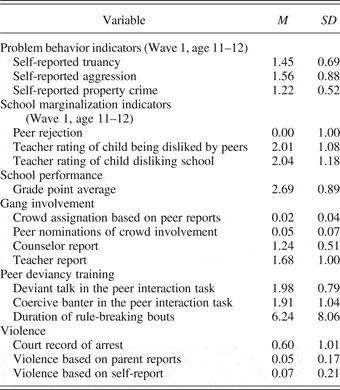
Most of the variables used in our model were latent variables based on three or more indicators. Means and standard deviations of all indicators appear in Table 1.
Descriptive statistics for each measure

Problem behavior (age 11–12, sixth grade)
Antisocial behavior was measured through a latent variable based on three subscales from the self-report survey that assessed dimensions of (a) truancy (three items, such as lied to parents about whereabouts or who you were with; α = 0.65), (b) property crime (two items, such as purposely damaged or tried to damage property; r = .43), and (c) aggressive behavior (three items, such as intentionally hit or threatened someone at school; α = 0.65). For each subscale, a mean score was computed based on individual items, all of which asked about the frequency of the behavior in the past month, ranging from 1 (never) to 6 (more than 20 times).
School marginalization (age 11–12, sixth grade)
School marginalization was a latent variable measured from a combination of peer and teacher reports. Peer relationships were assessed using peer nomination of disliked (rejected) classmates. Counts of these nominations for each youth provided scores of how disliked a youth was by school peers. These scores then were standardized to create a peer rejection indicator, with an average score of 0 and a standard deviation of 1. The lowest standardized scores were at −1.41 and the highest at 6.44. We also used as indicators two items from the teacher's report (other kids dislike him or her; student dislikes school). These items were scored on a scale ranging from 1 (never/almost never) to 5 (always/almost always).
School performance (age 11–12, sixth grade)
Each adolescent's GPA at sixth grade was reported on a continuous scale ranging from 0 (D or lower) to 4 (A− to A), based on official school records.
Gang involvement (age 13–14, eighth grade)
To meet the goal of improving the measurement of gang involvement from a simple self-report measure, gang involvement was measured using four separate indices. School counselors provided ratings for each student about whether the adolescent was perceived to be a part of gang-involved crowds (i.e., To what extent is [name] part of the crowd who likes gangs?), on a scale ranging from 1 (not at all) to 5 (completely). Peers provided two different indices of gang involvement. Crowd nominations supplied a measure of whether each youth was perceived as part of a gang by classmates (classmates rated, To what extent does [name] hang out with gang members?). Because the size of classroom populations differed, a proportion score was calculated on the basis of number of nominations of gang involvement and number of classmates, with a range of 0 (no nomination) to .50 (nominated by half of one's classmates). Peers also nominated classmates they perceived to be involved with deviant peers. Counts of nominations received by each youth were again transformed into a proportion score based on number of classmates, with a range of 0 to .39. In addition, teachers rated each student on three items asking about their perception of students' involvement with deviant peers (e.g., hangs around with troublemakers). A mean score was computed on the basis of individual items, all of which asked about the frequency of the behavior in the past month, ranging from 1 (never, almost never) to 5 (always, almost always).
Peer deviancy training (age 16–17, 11th grade)
This latent construct was based on three indicators from the peer interaction task described earlier in the discussion of assessment procedures. The “rule-breaking bouts” indicator refers to the percentage of the total time a dyad engaged in conversation about deviant topics as indexed by the Conversation Topic Code. Percent durations of rule-breaking bouts were computed for each task for each member of the dyad. These durations were then combined and averaged for overall percent durations of rule-breaking bouts across each task, with a range from 0% to 79.6% in this sample.
The coercive banter and deviant talk indicators were based on coders' macroratings of the friendship interaction task, and both ranged from 1 (not at all) to 9 (very much). The coercive banter score involves both friends' tendency to make negative or threatening gestures to one another using the following four items: used private code language or inside jokes, used aggressive gestures, showed aggressive verbal behavior toward others, and swore during the session. Internal consistency for this score was adequate (0.70 for target participant, 0.67 for the peer). The second score used from the coder macroratings, called deviant talk, describes the level of endorsement of deviant activities. The following 12 items were used for this score: made deviant or antisocial suggestions or solutions; mentioned antisocial or deviant goals; encouraged the friend's deviant goals or statements; indicated involvement with deviant peers or groups; mentioned or supported involvement in gang activity or deviant peer groups; boasted about connections with peers who engage in problem behavior; mentioned friends planning or engaging in deviant behaviors; suggested presence or possibility of physical violence at a party; mentioned people of another race in a derogatory way; made negative or biased statements about the opposite sex; made homophobic comments; and used prejudiced, biased, or racist statements about others. Internal consistency of the items comprising this score was high (0.82 for both the target participant and the peer).
Violence (age 18–19)
Participants' reports, parents' reports, and court records were combined to assess violence. The following three items from the Adult Behavior Checklist (Achenbach, Reference Achenbach2003), administered to participants and their parents, were combined to assess the extent to which participants engaged in violent behavior: gets in many fights, physically attacks people, threatens to hurt people. Separate mean scores based on individual items were computed using parent reports and self-reports. Each item asked about the frequency of the behavior in the past 6 months, with possible scores of 0 (not true), 1 (somewhat or sometimes true) or 2 (very true or often true). With the permission of participants and of their parents, court records were searched for every county where youths reported having resided until age 18. Arrest records included a range of potential offenses that were coded as follows: no offense (0); violations, statute offenses, misdemeanors (1); felony offenses (2); and violent offenses (3). Violent offenses included menacing, intimidating, stalking, assaulting (or attempting to do so), kidnapping, committing manslaughter, murdering (or attempting to do so), committing negligent homicide, and committing negligent wounding.
Child gender
Child gender was coded as 0 = male and 1 = female.
Child ethnicity
Youth-reported ethnicity was coded as 0 = European American and 1 = ethnic minority.
Analytic strategy
To test the developmental cascade model presented in Figure 1, and especially the hypothesized effect of gang involvement on violence by means of deviancy training, structural equation modeling was conducted using the maximum likelihood estimator in MPlus 5.21 (Muthén & Muthén, Reference Muthén and Muthén2009). We first describe the structure model for latent factors created in the overall model. Then, we present the path model among these latent factors and the hypothesized mediation effect of gang involvement in early adolescence contributing to deviancy training in middle adolescence, which in turn leads to increased violent behavior in early adulthood. Finally, we examine the generalizability of this model across gender, across majority and minority ethnic groups, and across the treatment and control group.
Results
Preliminary analyses
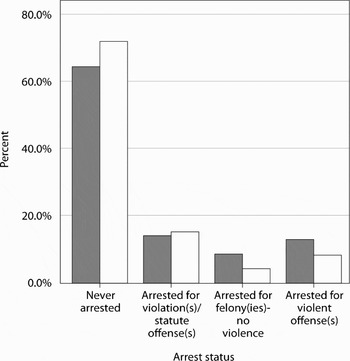
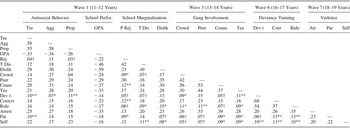
Table 2 presents correlations among all the measures (indicators) used in this model. Figure 2 shows that according to court records, 32.3% of participants had already been arrested during adolescence: 14.9% for violations or statute offenses, 6.6% for felonies, and 10.8% for violent offenses. At age 18, 14.4% of participants reported having engaged in violent behaviors, compared to 11.6% reported by parents.
The court records by age 18–19 by type of offense and by gender.

Correlations among all measures
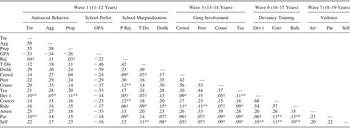
Note: Tru, self-reported truancy; Agg, self-reported aggression; Prop, self-reported property crime; GPA, grade point average; P Rej, peer rejection from “dislike” nominations; T Dis, teacher report of child being disliked by peers; Dislik, teacher report of the child disliking school; Crowd, crowd assignation based on peer reports; Peer, peer nominations of crowd involvement; Couns, counselor report; Tea, teacher report; Dev t, deviant talk in peer interaction task; Coer, coercive banter in peer interaction task; Rule, duration of rule-breaking bouts in peer interaction task; Arr, court record of arrest; Par, violence based on parent reports; Self, violence based on self-report. All correlations are significant at p < .001 except where otherwise specified.
†p > .05 (ns). *p < .05. **p < .01.
We used the full information maximum likelihood estimation method to account for missing data. This method has been shown to be very efficient when analyzing data from samples with moderate levels of missing values, and it is adequate even when data are not missing at random, as long as the predictors of missingness are included in the model (Widaman, Reference Widaman2006). When using full information maximum likelihood, the estimation of each parameter is done on the basis of all available information from each participant. Consequently, we can retain in the analysis participants with occasional missing data, so they contribute to model estimation.
Even in community-based samples such as the one presented here, some participants have to deal with a higher level of risk factors, which can be indexed with the measures used in this study (e.g., higher levels of problem behavior, lower school performance, more involvement in gangs). Facing such risk factors is likely to make it harder to participate consistently in the repeated data collections occurring over several years, or to engage in all components of the data collection in any given wave of data collection. To test for this hypothesis, we created an index of missing data representing the number of indicators in the model for which we had no valid data. (Because all indicators that were based on self-reports included several items, an occasional failure to answer one or a few items was not counted as missing data, which strengthens the validity of our missing data assessment.) Our data generally followed the predicted pattern, with a larger number of missing values in participants who had higher levels of problem behavior and school marginalization, lower academic performance, more gang affiliation (according to teachers' and counselors' reports), higher levels of deviancy training, and higher levels of violence. Boys also had a higher number of missing data than girls did, and minority students had a higher number of missing data than European American students did. Peers' reports of gang involvement and treatment conditions were unrelated to missing data. However, the correlations between the number of missing values and participants' maladjustment according to our own indicators tended to be small; most of them were lower than r < .20.
Examination of structure models
As part of the overall model, five latent factors were created to measure the following constructs: problem behavior (Wave 1), school marginalization (Wave 1), gang involvement (Wave 3), deviancy training (Wave 6), and violence (Wave 7). The only observed variable in the model was school performance, measured using GPA at Wave 1.
The problem behavior construct consisted of subscales assessing participants' self-reported truancy, aggression, and property crime. The truancy subscale loaded onto the factor at 0.74, the aggression subscale at 0.82, and the property crime subscale at 0.71. All three loadings were significant.
The school marginalization factor also consisted of three indicators: two teacher-rated items of how much each participant was disliked by peers and how much each participant disliked school, and one standardized score based on the number of “disliked” peer nominations. As expected, all three items significantly loaded on the school failure factor at 0.65, 0.77, and 0.37, respectively.
Gang involvement was measured using the following indicators: (a) classmates' ratings of the extent to which they thought other participants were involved with gangs, based on crowd nominations; (b) the number of classmates who reported that other participants were involved with deviant peers, based on peer nominations; (c) counselors' ratings of the extent to which they thought each participant was involved with gangs; and (d) a subscale of the teachers' report questionnaire about behaviors that may reflect gang involvement (e.g., bullying, threatening, ganging up on a peer, and hanging out with troublemakers). All of these indicators significantly loaded on the gang factor at 0.66, 0.73, 0.79, and 0.57, respectively.
The deviancy training factor consisted of coders' ratings of (a) the amount of deviant talk the participant and his or her peer engaged in during a 45-min conversation, (b) coders' average rating of coercive banter by the participant and his or her peer during the same conversation, and (c) the average duration of rule-breaking talk that occurred during this conversation. Again, all three items significantly loaded on the factor at 0.79, 0.87, and 0.67, respectively.
The last latent factor, violence, consisted of the following items: (a) any type of crime for which they had been arrested, (b) a score of participants' violent behavior in the past 6 months as reported by their parent, and (c) a score of participants' violent behavior in the past 6 months according to self-reports. All the indicators significantly loaded onto the violence factor at 0.70, 0.39, and 0.35, respectively.
Examination of path model
After confirming that the structure model fit the data well, we next examined the hypothesized cascade model by focusing on early gang involvement leading to higher levels of deviancy training, and ultimately, to higher levels of violence in early adulthood.
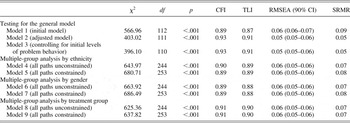
Table 3 presents the different models that were used to test our hypotheses, refine the fit of the initial model, and test for the generalizability of the results across groups. Several fit indices were used to assess the fit of each model. According to Kline (Reference Kline2005), a good model fit should yield a nonsignificant chi-square value, but this test tends to be too conservative with larger sample sizes. In that case, other fit indices are usually preferred to assess model fit. Comparative fit index (CFI) and Tucker–Lewis index values of 0.90 or more, root mean square error of approximation values of 0.05 or less, and standardized root mean square residual values of 0.10 or less indicate good model fit.
Goodness of fit statistics for each model
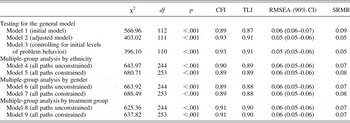
Note: Model 2 was considered to be the best model based on model fit and parsimony and was therefore used in the multiple-group analyses. The structure and path coefficients of Model 2 are presented in Figure 3. CFI, comparative fit index; TLI, Tucker–Lewis index; RMSEA, root mean square error of approximation; CI, confidence interval; SRMR, standardized root mean square residual.
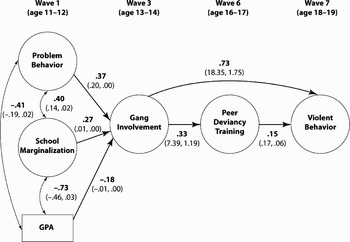
Our initial model (Model 1 in Table 3) did not fit the data very well according to most indices. Modification indices suggested that a residual path from gang involvement to violence should be modeled. Although the new chi-square statistic for the adjusted model (Model 2) was still significant, all other fit indices indicated a good fit. Because of the size of the sample, we used the change in CFI to test for the significance of the improvement in fit. According to Cheung and Rensvold (Reference Cheung and Rensvold2002), a change in CFI of 0.01 or greater indicates a significant improvement. The addition of this path yielded a significant change in CFI of 0.04. The results of Model 2 are summarized in Figure 3. As hypothesized, problem behavior, school marginalization, and low academic performance during middle school all significantly predicted an increase in gang involvement during early adolescence. Gang involvement next predicted high levels of deviancy training with a friend at age 16−17.
The final cascade model (Model 2, Table 3).

Both gang involvement in early adolescence and deviancy training in middle adolescence positively predicted violence in early adulthood. Despite the significant residual path from gang involvement to violence, the relationship between gang involvement and violence was partially mediated by deviancy training, as revealed by the significant Sobel test (Z = 2.76, p < .01; Sobel, Reference Sobel and Leinhardt1982). In further support of the significant mediator effect of deviancy training, we found that the percentage of explained variance in the violence construct increased from 61.5% to 63.3% after adding the “deviancy training” construct in the model.
Before definitely adopting Model 2 and moving on with multiple-group analyses, we ran one last analysis that included a direct path from problem behavior at age 11–12 to violent behavior at age 18–19 (Model 3 in Table 3). This model allowed us to test whether the significant relationship from gang involvement to violence and from peer deviancy training to violence were consistent with a cascade model in which consequences of a relatively benign state lead to increasingly severe outcomes, after controlling for the baseline level of problem behavior. Although the coefficient for the path from problem behavior in Wave 1 to violence in Wave 7 was significant (standardized coefficient = 0.17, unstandardized coefficient = 0.23, SE = 0.09, p < .01), the magnitude of this effect was small. Furthermore, this additional path did not contribute to a significant improvement in model fit compared with Model 2, based on the change in CFI, and the effect size for other direct predictors of violence stayed within the same range as they were in Model 2 (standardized path coefficients = 0.15 for deviancy training and 0.63 for gang involvement).
Group differences
Ethnicity
To verify whether the results of Model 2 presented in Figure 3 held across ethnic groups, we created a majority group that comprised European American participants, and a minority group that comprised all other ethnic groups. We first ran a multiple-group analysis, leaving all path coefficients free to vary across ethnic groups (Model 4, Table 3), and then we ran another model in which all path coefficients were constrained to equality across ethnic groups (Model 5). Both models still fit the data relatively well, and the change in CFI was slightly below the cutoff point of 0.01, thus suggesting that no significant difference in model fit existed between participants from the majority group compared with participants from ethnic minorities.
Gender
We also verified if the final model (Figure 3) held across genders. We first ran a multiple-group analysis, leaving all path coefficients free to vary across genders (Model 6), and then we ran another model in which all path coefficients were constrained to equality across genders (Model 7). Both models still fit the data relatively well, and the change in CFI was below the cutoff point of 0.01, thus suggesting that no significant difference in model fit existed between boys and girls.
Intervention status
We ran a multiple-group analysis to compare participants who were part of the treatment group with those who were part of the control group, leaving all path coefficients free to vary across groups (Model 8, Table 3). We then ran another model in which all path coefficients were constrained to equality across treatment conditions (Model 9). Both models still fit the data relatively well, and the change in CFI was below the cutoff point of 0.01, thus suggesting that no significant difference in model fit existed between participants from the treatment group and those from the control group.
Discussion
The cascade metaphor aptly describes the sequence of developmental events linking early adolescent antisocial behavior to more serious forms of violence in late adolescence. In early adolescence, antisocial behavior is associated with both academic failure and school marginalization. This association is likely contiguous to a history of problem behavior and school difficulties that co-occur in childhood. As hypothesized, antisocial behavior, academic failure, and school marginalization jointly contributed to adolescent gang involvement. It is not surprising that gang involvement at age 13–14 was prognostic of deviancy training dynamics at age 16–17. In turn, both deviancy training and gang involvement were prognostic of serious forms of violence, and the effect of gang involvement was particularly strong (standardized path coefficient = 0.73). This structural equation model, in general, strongly supports the role of peer dynamics as central to the progression from minor forms of antisocial behavior to dangerous forms of violence.
Although observations of friendship dynamics in middle adolescence enrich our understanding of interpersonal dynamics associated with escalating forms of problem behavior, our observation measure was limited by the fact that only two peers were included in the interaction task. In contrast, the gang construct, although more distant in time from our “violent behavior” outcome, had the advantage of capturing the overall quality of the entire peer network. We hypothesize that the inclusion of a larger number of peers in the interaction task would contribute to a more valid assessment of the deviancy training process occurring in the natural peer network, and we recommend that future studies include larger peer groups in the context of peer interaction tasks. The summation of direct and indirect effects in the model suggests, however, that gang involvement is by far the more pernicious developmental milestone in the escalation of problem behavior into violence. The finding that gang affiliation tends to amplify problem behavior is certainly not new (e.g., Thornberry Reference Thornberry, Loeber and Farrington1998); however, this is the first study that we know of that has measured gang involvement so intensively, including peer, teacher, counselor, and self-reports in a multiagent and multimethod construct at age 14. Controlling for later deviancy training, gang involvement had a strong predictive effect that held across gender and ethnicity.
Perhaps the lessons of the past and data such as these underscore the nonrandom nature of the formation of problematic peer groups and their consequences. For example, the killings at Columbine High School fit the model summarized in Figure 1. Youths who engaged in relatively minor forms of problem behavior, had serious difficulties with peers at school, and were doing poorly academically, formed a peer group. Unfortunately, this peer group may have provided short-term benefits such as solidarity and mutual support, and the end of loneliness. The long-term consequences were tragic and devastating to their victims, themselves, and families (Vail, Reference Vail2009), and the violence spread by example to other US high schools (Moore, Petrie, Braga, & McLaughlin, Reference Moore, Petrie, Braga and McLaughlin2003). The “trench coat” gang organized around the possibility of retaliation and harm to the school, peers, and teachers that they perceived to be the source of their troubles. In hindsight, their appearance and behavior preceding the Columbine violence may have been obvious to even the casual observer. Nonetheless, the young men were secretive and deceptive in their preparations, and certainly would not have revealed the serious nature of their violent plans had they been involved in a direct observation study of friendships, so assessments relevant to the deviancy training construct would most likely not have been prognostic of the subsequent violence. Thus, observation of friendships may have limitations when applied to the prediction of more serious forms of problem behavior.
The study of gangs and deviant peer groups has traditionally been undertaken in the realm of sociological inquiry (e.g., Klein, Reference Klein, Dodge, Dishion and Lansford2006; Short, Reference Short1990; Short & Strodbeck, Reference Short and Strodbeck1965; Thornberry, Reference Thornberry, Loeber and Farrington1998; Warr, Reference Warr1993). More recently, psychologists have entered the empirical scene primarily by predicting gang involvement or by studying its consequences (e.g., Battin et al., Reference Battin, Hill, Abbott, Catalano and Hawkins1998; Craig et al., 1999; Lacourse et al., Reference Lacourse, Nagin, Vitaro, Coie, Arseneault and Tremblay2006). The development and psychopathology framework is uniquely suited to studying peer group influences as a psychological dynamic worthy of understanding. In a review of the literature, Harris (Reference Harris1995) suggested that the most compelling evidence for environment influence was found within the peer group, not the family. Although it is difficult to disentangle peer and family influences in childhood and adolescence, one of the most important influences of adults in general and parents specifically may be their involvement in their youth's life and their monitoring of peer group activities. Lack of attention to children's peer group experiences, manner of interacting, emerging values, and intentions may have disastrous consequences for youths themselves as well as for others.
The mechanisms and processes underlying peer group influence continue to require more research, and the study of pathogenic peer dynamics may shed light on patterns of normative development that are peer supported. For example, research by Kiesner and colleagues suggested that when young adolescents “identify” with a deviant peer group, the influence is much greater (Kiesner et al., Reference Kiesner, Cadinu, Poulin and Bucci2002). Using a dynamic systems framework, we have found that the degree to which adolescents organize their conversation around deviant topics, as indicated by quantitative indices of “attractors,” was associated with increased levels of problem behavior throughout the ensuing adolescent years (Dishion, Nelson, Winter, et al., 2004; Granic & Dishion, 2002). Thus, some level of “buy in” to the deviant norms seems to occur that is very likely predicted by a constellation of individual and community risk processes. The social augmentation model suggests that the value of peer group reactions and support is enhanced for individuals who are marginalized in the world of peers and of caregiving adults (Dishion, Nelson, & Bullock, Reference Dishion, Nelson and Bullock2004; Dodge et al., Reference Dodge, Greenberg and Malone2008). Early adolescence appears to be a time when peer group organization is especially critical for subsequent development. Previous research has shown deviant talk in friendships has a high level of stability from early to late adolescence (r = .53, df = 200, 5-year interval), even when new friends are brought into the peer interaction assessment (Dishion & Owen, Reference Dishion and Owen2002). In a study predicting long-term patterns of antisocial behavior from deviancy training observed at age 14, 16, and 18, it was deviancy training at age 14 that predicted antisocial behavior at age 24 (Dishion, Nelson, Winter, et al., 2004). These findings suggest that the negative effect of deviant interactions among friends is quite resistant to slight variations in a group's social composition and would require well-designed, intensive interactions to be eradicated.
The cascade model tested in this study is similar in concept yet different in focus from those models tested by previous researchers (e.g., Dodge et al., Reference Dodge, Greenberg and Malone2008; Masten et al., Reference Masten, Roisman, Long, Burt, Obradović and Riley2005). The key concept of a cascade model is that “symptoms” lead to adaptive failures, which further exacerbate symptoms, essentially describing a negative feedback loop. As with the longitudinal analysis presented by Dodge and colleagues (2008), we modeled individual differences in the levels of violence. However, unlike Dodge and colleagues, we focused more exclusively on the mechanism linking adaptive failure in school to the development of a gang identity, with a heavy emphasis on the measurement of that construct. Dodge and colleagues linked school failure with parental monitoring. Although parental monitoring is a central component of the developmental model guiding our study, in previous work it did not compete with deviant peer influences in accounting for individual differences in levels of violence; rather, it served as a predictor of affiliation with deviant peers in the first place. Theoretically, we hypothesize that growth in deviant peer involvement results in adolescents resisting parental monitoring until parents eventually give up, in a process we call premature autonomy (Dishion, Nelson, & Bullock, Reference Dishion, Nelson and Bullock2004). However, our study did not test that hypothesis, and future research is necessary to identify the mechanisms in the parent–peer mesosystem underlying growth in problem behavior.
The composition of our study sample enabled us to test the viability of the model in terms of two ethnic groups (African American and European American) and in terms of males and females. Despite the expected demographic mean-level differences in many of the constructs in this model, the model held for both males and females and for majority (European American) and minority participants. This pattern of results fits well with our previous research predicting adolescent gang involvement, in which demographic differences in gang involvement (which was more prevalent among males and ethnic minorities) were explained by mean-level differences in predictors such as school failure, peer rejection, and problem behavior (Dishion, et al., Reference Dishion, Nelson and Yasui2005). We suspect that mean-level differences in the risk processes are a function of community and cohort characteristics at the time the data were collected. In general, in research involving minority participants, it is especially important to consider a range of social science findings, including those from different cohorts and periods of time (McLoyd & Steinberg, Reference McLoyd and Steinberg1998). For example, research on crime and community dynamics in families from the 1930s shows that those who were considered minority in the Boston community were primarily White and of Irish descent, but were also found to have higher rates of crime and delinquency (Laub & Sampson, Reference Laub and Sampson1993). Thus, developmental cascade models would benefit from an ecological perspective in which findings about community dynamics and their links to outcomes such as gang involvement would add to the richness of the explanatory model.
Limitations
Although this study contributes to the empirical understanding of the cascading sequence of peer dynamics leading to violence in late adolescence, some limitations should be mentioned. First, developmental cascade models theoretically encompass a life span, starting in early childhood. This sample was recruited in early adolescence, so it was not possible to test for the full cascade, in which violence in early adulthood may be a distal consequence of compromised parenting and coercive family dynamics in early childhood (Patterson et al., Reference Patterson, Reid and Dishion1992). Strictly speaking, to show a cascading process, it is critical to show the same behavior at Time 1 as in the longitudinal follow-up. In this study, that would mean measuring violence at Time 1 as well as in late adolescence. Longitudinal studies have repeatedly shown that problem behavior changes its form and function over the course of adolescence. Patterson (Reference Patterson1993) referred to the prediction of the transformation from antisocial behavior to delinquency and substance abuse as a chimera model. A challenge inherent to cascade models is that they often involve qualitative changes in the phenomena under study, so that some of the outcome variables did not exist in the same form earlier in development. As a result, prognostic behavioral indicators must often be used, such as “problem behavior” at age 11 and 12, as we did in this study.
Second, the ecological framework guiding this study suggests that the general social context, including culture and subcultures, should moderate the likelihood of gang formation and its negative consequences. Very large samples recruited in various locations and followed over time will be needed to test for such moderator effects. In addition to diversity issues related to cultural differences, there also exists great variation in the timing of problem behavior onset, which may be early or late (Moffitt, Reference Moffitt1993). Our study focused on explaining how the relatively early onset of problem behavior escalates to serious violent offenses, but cascade models should also be used in future studies to understand the series of events leading to late-onset delinquency. Future research on the longitudinal development of violence must acknowledge that pathways to violent behavior, whether they start early or late, vary according to the principle of equifinality, in that the developmental chain supported by this study is only one among several possible paths toward violence. Data from this study suggest that peer dynamics are the proximal venue in which antisocial behavior escalates in form and function. The central role of peers in the development and progression of problem behavior is strongly supported in the literature (Dishion & Patterson, Reference Dishion, Patterson, Cicchetti and Cohen2006). Evidence suggests that peer dynamics are so powerful that if they are not appropriately addressed, as in the case of some interventions that aggregate deviant youths, iatrogenic effects may ensue (Dishion, McCord, & Poulin, Reference Dishion, McCord and Poulin1999; Dodge et al., Reference Dodge, Dishion and Lansford2006).
Third, although the key constructs of this model (gang involvement, deviancy training, and violence) were strongly measured using a multiagent, multimethod procedure, the measurement of problem behavior and school performance would have benefited from the use of more than one informant. In light of improving future research designs, other theoretical perspectives should also be considered to offer interesting possibilities for additional mediators that would work in concert with deviancy training to explain the association between gang involvement and violent behavior. One perspective might be the social–cognitive approach (Bandura, Reference Bandura and Vasta1989), which suggests that a portion of human learning occurs outside of interpersonal interactions by means of vicarious processes. For example, teenage gang members who are less extraverted, and therefore less involved in deviant conversations with their friends may still learn that their violent acts will be socially rewarded by their peers just by observing and listening to their peers' conversations. Being involved in a gang may also drive youngsters' attention to specific symbolic objects valued by their subculture, such as violent movies and music lyrics that also contribute to reinforcing increasingly violent behaviors, even when youths are not actively involved in peer interactions.
Intervention and policy implications
This study sample consisted of participants in a family-centered intervention trial. Previous analyses revealed that random assignment to the FCU resulted in reduced drug use, improved parental monitoring practices, and decreased early deviant peer involvement (Dishion, Bullock, & Granic, Reference Dishion, Bullock and Granic2002; Dishion, Kavanagh, Schneiger, Nelson, & Kaufman, Reference Dishion, Kavanagh, Schneiger, Nelson and Kaufman2002; Dishion, Nelson, & Kavanagh, 2004). More recently, we found that incorporating the measurement of engagement in the intervention program as a moderator variable (Jo, Reference Jo2002) increased effect sizes and extended those positive outcomes to include beneficial effects on antisocial behavior and number of arrests through adolescence (Connell et al., Reference Connell, Dishion, Yasui and Kavanagh2007). However, random assignment to the intervention did not directly affect the mediating peer cascade dynamic of central focus in this study. One of the current methodological limitations of statistical models that incorporate engagement as a moderator variable is that the simultaneous inclusion of mediation, as would be the case in a moderated mediation model (Preacher, Rucker, & Hayes, Reference Preacher, Rucker and Hayes2007), is not well developed. The cascade model used in this study would lend itself well to testing a moderated mediation model of intervention effects in future research.
Conclusion
The predictive strength of the peer dynamics cascade model nonetheless has implications for prevention and treatment of antisocial behavior. Although for the past 30 years empirically supported prevention and treatment strategies for antisocial behavior have been successfully developed and implemented (e.g., Dishion et al., Reference Dishion, Shaw, Connell, Gardner, Weaver and Wilson2008; Forgatch, DeGarmo, & Beldavs, Reference Forgatch, DeGarmo and Beldavs2005; Kazdin, Reference Kazdin, Nathan and Gorman2002; Sanders, Reference Sanders1999), the intervention armamentarium has inadequately addressed early adolescent peer clustering. Investigators who have spent their careers studying and intervening with gangs have clearly shown that prevention is likely to be more successful than treatment that follows gang formation (Klein, Reference Klein, Dodge, Dishion and Lansford2006). Future research focused on preventing deviant peer clustering would have a meaningful impact on the overall effectiveness of prevention strategies for adolescent problem behavior and would yield meaningful reductions in serious behaviors such as violence. It is likely that effective strategies will be those that focus on careful engineering of education environments within the public school system, where the peer network underpinnings emerge (Light & Dishion, Reference Light, Dishion, Rodkin and Hanish2007). A coordinated focus on academic progress, peer networks, and problem behavior in the public school context is a promising strategy for reducing the prevalence of violence in our more vulnerable communities.