


1. Introduction
The implications of financial frictions on business cycle fluctuations have been studied by a growing body of the macroeconomics literature (e.g., Bernanke et al. Reference Bernanke, Gertler and Gilchrist1999; Kiyotaki and Moore, Reference Kiyotaki and Moore1997; Christiano et al. Reference Christiano, Motto and Rostagno2014; Gertler and Karadi, Reference Gertler and Karadi2011; Gertler and Kiyotaki, Reference Gertler and Kiyotaki2015). The amplification mechanism generated by financial frictions has been shown to make business cycle fluctuations more volatile. For example, previous studies have considered a negative shock that decreases asset prices, which in turn deteriorates the borrowing capacity of firms and financial intermediaries. Accordingly, production declines further with financial frictions, intensifying a recession.
Several studies examine the implications of financial frictions on asset pricing. Gomes et al. (Reference Gomes, Yaron and Zhang2003) explore a model built on Carlstrom and Fuerst (Reference Carlstrom and Fuerst1997) to study the effect of firms’ borrowing constraints on asset pricing, while Nezafat and Slavík (Reference Nezafat and Slavík2015) and Bigio and Schneider (Reference Bigio and Schneider2017) investigate how firms’ liquidity constraints affect asset pricing using the model of Kiyotaki and Moore (Reference Kiyotaki and Moore2012).Footnote 1 These studies not only find that financial frictions produce a higher equity premium on average, but also show counterfactual movements in the equity price or the equity premium.Footnote 2
While the macro-finance literature has studied the implications of financial frictions on the equity premium, few studies have addressed its implications on the risk premiums for long-term bonds. To fill this gap, we investigate whether financial frictions that amplify the impact of structural shocks on macroeconomic and financial variables contribute to term premiums. We also explore how the transmission of monetary policy through financial intermediary balance sheets shapes the dynamics of consumption, inflation, and long-term bond prices and how it contributes to the term premium.
We consider a medium-scale New Keynesian dynamic stochastic general equilibrium (DSGE) model that incorporates financial frictions, following Gertler and Karadi (Reference Gertler and Karadi2011), in which financial intermediaries have limited borrowing capacity due to an agency problem between financial intermediaries and their private creditors. Monetary policy plays a crucial role in our model for determining not only borrowing costs of financial intermediaries but also their net worth and leverage. Our model also includes generalized recursive preferences, which enables us to separate risk aversion from the intertemporal elasticity of substitution.
Our findings are as follows. First, embedding financial frictions into the New Keynesian DSGE model increases the term premium under our baseline calibration, in which the monetary authority has a moderate anti-inflationary stance. This result arises from the fact that financial frictions magnify the responses of consumption, stochastic discount factor, inflation, and long-term bond prices to technology shock. In particular, a negative technology shock lowers long-term bond prices significantly in the presence of financial frictions, while driving down consumption sharply.Footnote 3 Second, the importance of financial frictions in generating the term premium depends on the stance of monetary policy on inflation and economic activity. The contribution of financial frictions to the term premium is larger when the monetary authority has less concern on inflation. A combination of the acceleration mechanism of financial frictions and a weak inflation targeting policy increases the inflation risk substantially. This necessitates greater caution when providing policy recommendations because our results implies that strong inflation targeting reduces the fluctuations of macroeconomic variables and the average term premium, leading to lower long-term interest rates. Finally, we show that technology shocks increase the term premium, while investment and financial shocks have a negligible impact on it.
The organization of the study is as follows. Section 2 briefly describes the baseline model with financial intermediaries and generalized recursive preferences. Section 3 studies the importance of financial frictions in accounting for the term premium. Section 4 presents the circumstances in which financial frictions play a crucial role for determining the term premium. Section 5 explores how financial shocks affect the term premium. Section 6 concludes.
1.1. Literature review
Backus et al. (Reference Backus, Gregory and Zin1989), Donaldson et al. (Reference Donaldson, Johnsen and Mehra1990), and den Haan (Reference den Haan1995) find that asset pricing models with power utility cannot account for the sign and magnitude of the average term premium. The macro-finance literature has been devoted to the development of an asset pricing model that can generate sizable bond risk premia without distorting the model’s ability to match financial or macroeconomic facts. An important contribution is made by Piazzesi and Schneider (Reference Piazzesi and Schneider2007), in which they show that a large positive term premium can be generated using a consumption-based asset pricing model featuring generalized recursive preferences and a reduced-form process for inflation and consumption. In their model, investors require a premium for holding a nominal bond when a positive inflation surprise is associated with a decline in future consumption and a bond’s price.Footnote 4 Using a similar framework, Bansal and Shaliastovich (Reference Bansal and Shaliastovich2013) study a link between the term premium and uncertainties regarding expected inflation and consumption.
Several recent studies show that production-based general equilibrium models can fit both the key macroeconomic moments and term premiums in the data. For example, Rudebusch and Swanson (Reference Rudebusch and Swanson2012) adopt a New Keynesian DSGE model featuring nominal rigidities and a production economy to evaluate its ability to match the empirical term premium. In their analysis, inflation and consumption are endogenously determined by both monetary policy and the optimizing behaviors of firms and households. They document evidence on how the model can explain the observed term premium, without compromising its ability to account for the second moments of basic macroeconomic variables. Andreasen (Reference Andreasen2012) also uses a small-scale New Keynesian DSGE model to study whether uncertainty shocks and rare disasters help explain the term premium and its volatility. Kung (Reference Kung2015) considers a medium-scale DSGE model, in which firms invest in R&D that affects the productivity of capital and labor. Cyclical R&D investment intensifies the effect of technology shock on consumption growth and inflation that are negatively correlated, generating a sizable positive term premium.Footnote 5 This study differs from the previous works in that we consider financial frictions in a DSGE model and study its importance in determining the term premium. We also investigate how the transmission of monetary policy through the balance sheets of financial intermediaries with borrowing constraints affects consumption, inflation, long-term bond prices, and the term premium.
Monetary policy has been shown to matter in understanding the behavior of bond yields. For instance, Ang and Piazzesi (Reference Ang and Piazzesi2003), and Piazzesi (Reference Piazzesi2005) point out that incorporating monetary policy rules in models for the yield curve helps matching bond yields. Wright (Reference Wright2011) documents empirical evidence that term premiums are positively related to inflation uncertainty and that they declined significantly in countries adopting inflation targeting policies in the 1990s. Using a DSGE model with nominal rigidities, Palomino (Reference Palomino2012) shows that credible monetary policy reduces inflation risk or uncertainty, leading to a lower term premium. Similarly, Kung (Reference Kung2015) shows that the monetary authority’s aggressive response to inflation can reduce the term premium. In this study, we further investigate the relation between monetary policy and term premiums using a DSGE model that incorporates financial intermediaries with borrowing constraints.Footnote 6
Our study is closest to Bluwstein and Yung (Reference Bluwstein and Yung2019). These authors study whether a DSGE model with retail and wholesale banks, as in Gerali et al. (Reference Gerali, Neri, Sessa and Signoretti2010), can match the empirical term premium. Their model includes banks, as does ours. However, Bluwstein and Yung (Reference Bluwstein and Yung2019) differ from this study for several reasons. First, our model illustrates the asymmetric information problem between financial intermediaries and their creditors, while Bluwstein and Yung (Reference Bluwstein and Yung2019) consider the quadratic adjustment costs of bank capital and monopolistic competition as frictions in the banking sector.Footnote 7 Second, they do not explore how much of the observed term premium can be explained by financial frictions. Instead, they focus on whether the model can match the empirical term premium. Third, they do not study the link between monetary policy, financial frictions, and the term premium. Finally, Bluwstein and Yung (Reference Bluwstein and Yung2019) focus on risk perception shock, while this study focuses on technology shocks as a key determinant of the term premium. Additionally, we study how financial shocks affect the term premium.
2. The baseline model
2.1. The model economy
We begin by briefly outlining a medium-scale New Keynesian DSGE model to use it to price bonds. The model has two important components: limited borrowing capacity of financial intermediaries (e.g., Gertler and Karadi, Reference Gertler and Karadi2011) and generalized recursive preferences (e.g., Tallarini, Reference Tallarini2000; and Rudebusch and Swanson, Reference Rudebusch and Swanson2012). Agency problems in financial intermediaries constrain the ability of financial intermediaries to obtain funds and allow the model to have the interaction between the financial market and the economy. Generalized recursive preferences separate risk aversion from intertemporal elasticity of substitution.
There are four types of agents in the model: households, financial intermediaries, non-financial firms, and capital producers. To produce output, non-financial firms purchase capital from capital producers and hire labor from households. Firms issue security claims to buy capital, and pay the gross rate of return to financial intermediaries. Households deposit funds in financial intermediaries and receive the risk-free return on deposits. Finally, the price of capital is endogenously determined by capital demand from non-financial firms and supply from capital producers. We consider four shocks: a technology shock, investment shock, monetary shock, and uncertainty shock. The model presented here is standard, except for household preferences and the banking sector, so we do not provide a complete description of the model. A detailed explanation of the model can be found in Online Appendix.
2.2. Households
There is a unit continuum of identical households. Each household is endowed with generalized recursive preferences as in Epstein and Zin (Reference Epstein and Zin1989) and Weil (Reference Weil1989). For simplicity, we employ the additive separability assumption for period utility, which is given byFootnote 8
 \begin{align} u\left (c_{t},\,l_{t}\right )\equiv \frac {c_{t}^{1-\gamma }}{1-\gamma }+\chi _{0}\frac {(l^{max}-l_{t})^{1-\chi }}{1-\chi }, \end{align}
where
 $c_{t}$
is household consumption,
 $l_{t}$
is labor in period t,
 $l^{max}$
is the household time endowment,
 $1/\gamma$
is the intertemporal elasticity of substitution,
 $\chi _{0}$
is the relative weight on labor in the utility function, and
 $\chi$
determines the elasticity of labor supply. Households make deposits in financial intermediaries to earn the continuously ompounded risk-free interest rate and provide labor to non-financial firms for wages.Footnote 9 The household’s budget constraint is given by
 \begin{align} P_{t}c_{t}+d_{t}=W_{t}l_{t}+e^{i_{t-1}}d_{t-1}+\Pi _{t}, \end{align}
where
 $d_{t}$
is deposits,
 $P_{t}$
is the aggregate price level,
 $w_{t}$
is the nominal wage,
 $e^{i_{t-1}}$
is the nominal gross risk-free return from deposits, and
 $\Pi _{t}$
is nominal exogenous transfers to the household.
Following Epstein and Zin (Reference Epstein and Zin1989), Weil (Reference Weil1989), and Rudebusch and Swanson (Reference Rudebusch and Swanson2012), we assume that the household has generalized recursive preferences. In every period, the household faces the budget constraint (2) and maximizes lifetime utility subject to the no-Ponzi game constraint. The household’s value function
 $V^{h}\left (d_{t-1};\Theta _{t}\right )$
satisfies the Bellman equation:
 \begin{align} V^{h}\left (d_{t-1};\Theta _{t}\right )=\max _{c_{t},\,l_{t}\in \Gamma }u\left (c_{t},\,l_{t}\right )+\beta \left (E_{t}V^{h}\left (d_{t};\,\Theta _{t+1}\right )^{1-\alpha }\right )^{\frac {1}{1-\alpha }}, \end{align}
where
 $\Gamma$
is the choice set for
 $c_{t}$
and
 $l_{t}$
,
 $\Theta _{t}$
is the state of the economy,
 $\beta$
is the household’s time discount factor, and
 $\alpha$
is the Epstein–Zin parameter. The intertemporal elasticity of substitution and the coefficient of risk aversion are nonreciprocal due to generalized recursive preferences. Risk aversion is closely related to the Epstein–Zin parameter
 $\alpha$
which amplifies risk aversion by including the additional risk for the lifetime utility of households. The parameter
 $\gamma$
only partially measures the household’s attitude toward risk. Following Rudebusch and Swanson (Reference Rudebusch and Swanson2012), we hold the coefficient of relative risk aversion
 $R^{c}=\frac {\gamma }{1+\frac {\gamma }{\chi }\frac {(l^{max}-l)}{l}}+\alpha \frac {1-\gamma }{1+\frac {1-\gamma }{1-\chi }\frac {l^{max}-l}{l}}$
for the case with period utility as (1).Footnote 10
The household’s stochastic discount factor is given byFootnote 11
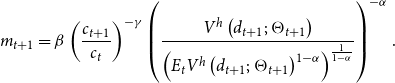 \begin{align} m_{t+1}=\beta \left (\frac {c_{t+1}}{c_{t}}\right )^{-\gamma }\left (\frac {V^{h}\left (d_{t+1};\,\Theta _{t+1}\right )}{\left (E_{t}V^{h}\left (d_{t+1};\,\Theta _{t+1}\right )^{1-\alpha }\right )^{\frac {1}{1-\alpha }}}\right )^{-\alpha }. \end{align}
The first order necessary conditions for deposit and labor are given by
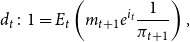 \begin{align} d_{t}\,:\:\:1=E_{t}\left (m_{t+1}e^{i_{t}}\frac {1}{\pi _{t+1}}\right ), \end{align}
 \begin{align} l_{t}\,:\:\:\chi _{0}(l^{max}-l_{t})^{-\chi }\left (\frac {1}{c_{t}}\right )^{-\gamma }=W_{t}, \\[6pt] \nonumber \end{align}
where
 $i_{t}$
is the net nominal interest rate, and
 $\pi _{t+1}\equiv P_{t+1}/P_{t}$
is the gross inflation rate. (5) can be written as
 $1=E_{t}\left (m_{t+1}e^{r_{t}}\right )$
where
 $r_{t}$
denotes the gross risk-free real interest rate.
2.3. Financial intermediaries
There is a unit continuum of risk neutral bankers, and each banker runs a financial intermediary. Following Gertler and Karadi (Reference Gertler and Karadi2011), the financial intermediaries lend funds to non-financial firms by using their own net worth and deposits from households, and the presence of agency problems between bankers and depositors constrains the ability of financial intermediaries to obtain deposits from households. It is assumed that only a fraction
 $\sigma$
of bankers remain in the financial industry until the next period, while the remaining fraction
 $(1-\sigma )$
retire and consume their net worth when they leave. This assumption implies that financial intermediaries cannot accumulate enough equity to fully fund investment and thereby always require deposits from households.
The financial intermediary’s asset,
 $Q_{t}s_{t}$
, thus, is financed by equity capital (net worth) and deposits. The financial intermediary’s balance sheet constraint is given by
 \begin{align} Q_{t}s_{t}=n_{t}+d_{t}, \end{align}
where
 $Q_{t}$
is the nominal price of financial claims on firms,
 $s_{t}$
is the quantity of claims,
 $d_{t}$
is the deposits of households and
 $n_{t}$
is the intermediary’s net worth at the end of period
 $t$
.
To introduce the intermediary’s limited borrowing capacity, as in Gertler and Karadi (Reference Gertler and Karadi2011), we assume that there are moral hazard problems between the banker and depositors: the banker diverts a fraction
 $\vartheta$
of assets for personal use after deposits are collected. Accordingly, the following incentive constraint must hold for households not to withdraw their deposits from the financial intermediary:
 \begin{align} V_{t}^{b}\geq \vartheta Q_{t}s_{t}, \end{align}
where
 $V_{t}^{b}$
is the franchise value of the financial intermediary, which is the present discounted value of future gains from operating the financial intermediary. As long as the franchise value
 $V_{t}^{b}$
exceeds the gain from diverting a fraction of assets, households decide to keep their deposits in the financial intermediary.
The banker’s objective is to maximize its net worth at the exit period:
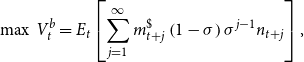 \begin{align} \max \,V_{t}^{b}=E_{t}\left [\sum _{j=1}^{\infty }m_{t+j}^{\$}\left (1-\sigma \right )\sigma ^{j-1}n_{t+j}\right ], \end{align}
where
 $m_{t+1}^{\$}\equiv m_{t+1}\frac {1}{\pi _{t+1}}$
denotes the nominal stochastic discount factor. The financial intermediary’s terminal wealth,
 $n_{t+j}$
, is consumed by the banker in the exit period. That is, the banker’s consumption,
 $c_{t+j}^{b}$
, is equal to
 $n_{t+j}$
when the banker exits the financial sector. Equation (9) can be written in a first-order recursive form:
 \begin{align} V_{t}^{b}=E_{t}m_{t+1}^{\$}\left [\left (1-\sigma \right )n_{t+1}+\sigma V_{t+1}^{b}\right ]. \end{align}
The franchise value,
 $V_{t}^{b}$
, is the discounted weighted average of the expected value of net worth and the expected future franchise value
 $V_{t+1}^{b}$
. The franchise value is
 $V_{t+1}^{b}=n_{t+1}$
in period
 $t+1$
when exiting, while it is
 $V_{t+1}^{b}=E_{t+1}m_{t+2}^{\$}\left [\left (1-\sigma \right )n_{t+2}+\sigma V_{t+2}^{b}\right ]$
when continuing.
The net worth of a surviving banker in period
 $t+1$
is defined as the earnings from bank assets net of the cost of debts:
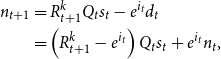 \begin{align} \begin{alignedat}{1}n_{t+1} & =R_{t+1}^{k}Q_{t}s_{t}-e^{i_{t}}d_{t}\\ & =\left (R_{t+1}^{k}-e^{i_{t}}\right )Q_{t}s_{t}+e^{i_{t}}n_{t}, \end{alignedat} \end{align}
where
 $R_{t+1}^{k}$
is the nominal ex-post gross return of capital (which defined in section A.3.1). The net worth evolves according to (11). Then, the growth rate of net worth can be written as
 \begin{align} \begin{alignedat}{1}\frac {n_{t+1}}{n_{t}} & =\left (R_{t+1}^{k}-e^{i_{t}}\right )\phi _{t}+e^{i_{t}}\end{alignedat} \end{align}
where
 $\phi _{t}\equiv \frac {Q_{t}s_{t}}{n_{t}}$
is the “leverage multiple.”
The financial intermediary’s problem can be summarized as
 \begin{align} \begin{alignedat}{1}\frac {V_{t}^{b}}{n_{t}} & =\underset {\phi _{t}}{\mbox {max}\ }E_{t}\left [m_{t+1}^{\$}\left (\left (1-\sigma \right )+\sigma \frac {V_{t+1}^{b}}{n_{t+1}}\right )\left (\left (R_{t+1}^{k}-e^{i_{t}}\right )\phi _{t}+e^{i_{t}}\right )\right ]\\ & =\underset {\phi _{t}}{\mbox {max}\ }\mu _{t}\phi _{t}+\nu _{t} \end{alignedat} \end{align}
where
 $\mu _{t}\equiv E_{t}m_{t+1}^{\$}\Omega _{t+1}\left (R_{t+1}^{k}-e^{i_{t}}\right )$
is the expected discounted excess return of assets over deposits,
 $\nu _{t}\equiv E_{t}m_{t+1}^{\$}\Omega _{t+1}e^{i_{t}}$
is the expected discounted marginal cost of deposits, and
 $\Omega _{t+1}\equiv \left (1-\sigma \right )+\sigma \frac {V_{t+1}^{b}}{n_{t+1}}$
is the weighted average of the franchise values per unit of net worth. The
 $\frac {V_{t}^{b}}{n_{t}}$
can be interpreted as Tobin’s
 $q$
ratio (e.g., Gertler and Kiyotaki, Reference Gertler and Kiyotaki2015). The banker is willing to increase the leverage multiple
 $\phi _{t}$
to maximize its franchise value per unit of net worth subject to the incentive constraint given by
 \begin{align} \frac {V_{t}^{b}}{n_{t}}\geq \vartheta \phi _{t}. \end{align}
Accordingly, the financial intermediary’s franchise value is maximized when the incentive constraint (14) binds. This maximization problem yields the leverage multiple:
 \begin{align} \phi _{t}=\frac {\nu _{t}}{\vartheta -\mu _{t}}, \end{align}
when
 $\mu _{t}$
is less than
 $\vartheta$
. If the expected discounted marginal gain from managing assets,
 $\mu _{t}$
, always exceeds the fraction
 $\vartheta$
of assets diverted by the banker, the incentive constraint does not bind. The leverage multiple
 $\phi _{t}$
is inversely related to the moral hazard parameter
 $\vartheta$
. Since the determinants of the leverage multiple
 $\phi _{t}$
are the same across financial intermediaries, the relationship between total financial assets and total net worth in the financial industry is given by
 \begin{align} Q_{t}S_{t}=\phi _{t}N_{t}, \end{align}
where
 $S_{t}$
is the aggregate quantity of claims and
 $N_{t}$
is the aggregate net worth.
The aggregate net worth consists of two components. The first is the net worth of surviving financial intermediaries,
 $\sigma \left (R_{t}^{k}Q_{t-1}S_{t-1}-e^{i_{t-1}}D_{t-1}\right )$
. The second corresponds to seed money,
 $\omega Q_{t}S_{t-1}$
, that an entering banker receives from their respective households. This seed money is a small fraction
 $\omega$
of the assets of exiting financial intermediaries. Accordingly, the aggregate net worth of the entire financial sector is
 \begin{align} N_{t}=\sigma \left (R_{t}^{k}Q_{t-1}S_{t-1}-e^{i_{t-1}}D_{t-1}\right )+\omega Q_{t}S_{t-1}, \end{align}
where
 $D_{t}$
is the aggregate deposit.
Lastly, the aggregate consumption level of exiting bankers,
 $C_{t}^{b}$
, is equal to the fraction
 $(1-\sigma )$
of net earnings on assets:
 \begin{align} C_{t}^{b}=\left (1-\sigma \right )\left [R_{t}^{k}Q_{t-1}S_{t-1}-e^{i_{t-1}}D_{t-1}\right ]. \end{align}
2.4. The term premium
The price of a default free zero-coupon bond can be written recursively as:
 \begin{align} p_{t}^{(n)}=E_{t}m_{t+1}^{\$}p_{t+1}^{(n-1)} \end{align}
where
 $p_{t}^{(n)}$
is the nominal price of n-period nominal bond at time
 $t$
, and
 $E_{t}$
denotes a mathematical expectation operator. At maturity, the zero-coupon nominal bond pays one dollar,
 $p_{t+1}^{(0)}=1$
. The yield to maturity of an n-period zero-coupon nominal bond is defined as:
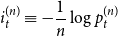 \begin{align} i_{t}^{(n)}\equiv -\frac {1}{n}\log p_{t}^{(n)} \end{align}
for any maturity greater than 1. The nominal bond entails risk since the price is not fixed over the lifetime of the bond.
The term premium is defined as the difference between the yield on the bond and the risk-neutral yield on the same bond. So, we also need the theoretical risk-neutral bond price to compute the term premium. An n-period risk neutral zero-coupon nominal bond price is as follows:
 \begin{align} \hat {p}_{t}^{(n)}=e^{-i_{t}}E_{t}\hat {p}_{t+1}^{(n-1)}, \end{align}
with
 $\hat {p}_{t}^{(0)}=1$
. Note that the expected risk-neutral nominal bond price
 $E_{t}\hat {p}_{t+1}^{(n-1)}$
is discounted by the risk-free nominal interest rate. Then, the term premium is defined as:
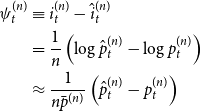 \begin{align} \begin{alignedat}{1}\psi _{t}^{(n)} & \equiv i_{t}^{(n)}-\hat {i}_{t}^{(n)}\\ & =\frac {1}{n}\left (\log \hat {p}_{t}^{(n)}-\log p_{t}^{(n)}\right )\\ & \approx \frac {1}{n\bar {p}^{(n)}}\left (\hat {p}_{t}^{(n)}-p_{t}^{(n)}\right ) \end{alignedat} \end{align}
where
 $\hat {i}_{t}^{(n)}\equiv -\frac {1}{n}\log \hat {p}_{t}^{(n)}$
is the yield to maturity on the risk-neutral bond, and
 $\bar {p}^{(n)}$
is the nonstochastic steady-state nominal bond price. As in Rudebusch and Swanson (Reference Rudebusch and Swanson2012), substituting equation (19) and (21) into (22) yields the difference between two bond prices:
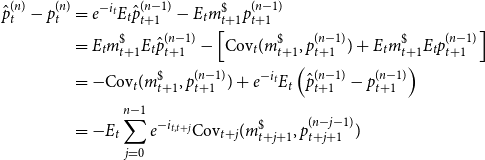 \begin{align} \begin{alignedat}{1}\hat {p}_{t}^{(n)}-p_{t}^{(n)} & =e^{-i_{t}}E_{t}\hat {p}_{t+1}^{(n-1)}-E_{t}m_{t+1}^{\$}p_{t+1}^{(n-1)}\\ & =E_{t}m_{t+1}^{\$}E_{t}\hat {p}_{t+1}^{(n-1)}-\left [\mbox {Cov}_{t}(m_{t+1}^{\$},p_{t+1}^{(n-1)})+E_{t}m_{t+1}^{\$}E_{t}p_{t+1}^{(n-1)}\right ]\\ & =-\mbox {Cov}_{t}(m_{t+1}^{\$},p_{t+1}^{(n-1)})+e^{-i_{t}}E_{t}\left (\hat {p}_{t+1}^{(n-1)}-p_{t+1}^{(n-1)}\right )\\ & =-E_{t}\sum _{j=0}^{n-1}e^{-i_{t,t+j}}\mbox {Cov}_{t+j}(m_{t+j+1}^{\$},p_{t+j+1}^{(n-j-1)}) \end{alignedat} \end{align}
where
 $i_{t,t+j}\equiv \sum _{k=0}^{j-1}i_{t+k}$
, and
 $\mbox {Cov}_{t}$
denotes the covariance conditional on information available at time
 $t$
. The last line of (23) can be obtained by recursively substituting the future price differences over the maturity of the bond.
Plugging (23) into (22) yields the term premium:
 \begin{align} \psi _{t}^{(n)}=-\frac {1}{n\bar {p}^{(n)}}E_{t}\sum _{j=0}^{n-1}e^{-i_{t,t+j}}\mbox {Cov}_{t+j}(m_{t+j+1}^{\$},p_{t+j+1}^{(n-j-1)}) \end{align}
This equation implies that a negative covariance between the stochastic discount factor and the bond price leads to a positive term premium. Consumption growth is negatively related to the stochastic discount factor. Accordingly, the term premium becomes positive when consumption growth and bond prices are positively related. Suppose a negative technology shock hits the economy. The shock lowers consumption, but increases inflation and interest rates. A rise in current and expected future short term interest rates lowers long-term bond prices. In order for bonds to provide a buffer against the negative technology shock, bond prices (wealth) should increase when consumption declines. However, bond prices decline, making consumption smoothing worse. Bondholders thus require a positive term premium for bearing the risk.
2.5. Solution method
We solve the medium-scale DSGE model using a third-order perturbation method based on the algorithm of Swanson et al. (Reference Swanson, Anderson and Levin2006).Footnote 12 We use this solution method for three reasons. First, a third-order perturbation is necessary to capture the dynamics of the risk premia; first-order approximations drop out risk premia entirely, while they’re constant in second-order. To determine how risk premia change, we then need third-order approximations (e.g., van Binsbergen et al. Reference van, Jules, Fernández-Villaverde, Koijen and Rubio-Ramírez2012). Second, the model with financial frictions has many state variables and four exogenous shocks. Due to high dimensionality, projection methods are not computationally tractable. Lastly, a third-order perturbation has almost the same performance as projection methods for models with generalized recursive preferences, but with much faster computing time (e.g., Caldara et al. Reference Caldara, Fernandez-Villáverde, Rubio-Ramírez and Yao2012 ).
3. Calibration and quantitative analysis
3.1. Calibration
Table 1 presents the choice of parameter values for the baseline model with financial frictions. There are twenty five parameters in the model. Three parameters are related to financial intermediaries, one parameter is associated with the additional curvature of household lifetime utility, and the remaining twenty-one are conventional parameters in the literature.
Baseline calibration
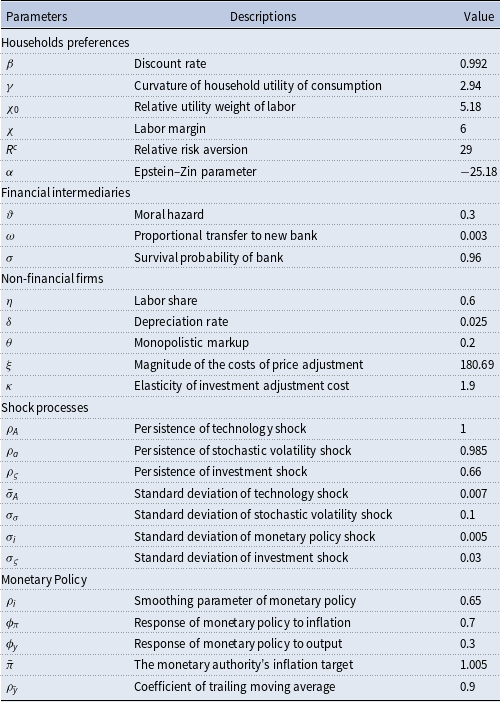
For the household’s discount factor,
 $\beta$
, the depreciation rate,
 $\delta$
, and the elasticity of output with respect to labor,
 $\eta$
, we use standard values. We set the relative utility weight of labor,
 $\chi _{0}=5.18$
, to normalize the steady state labor,
 $L$
, to 1/3 of the time endowment. The curvature of household utility with respect to consumption,
 $\gamma$
, is calibrated to 2.94, implying that the intertemporal elasticity of substitution is 0.34. We set the Epstein–Zin parameter,
 $\alpha$
, to
 $-25.18$
, meaning that we can pin down a coefficient of relative risk aversion
 $R^{c}$
of
 $29$
to match the size of the term premium in the data. These numbers are smaller (in absolute values) than the risk aversion and the Epstein–Zin parameter that were used in Rudebusch and Swanson (Reference Rudebusch and Swanson2012).Footnote 13 Our choice of the relative risk aversion coefficient, on the other hand, is relatively higher compared to survey responses (e.g., Barsky et al. Reference Barsky, Juster, Kimball and Shapiro1997). We do this for two reasons. First, the quantity of risk is too small in the model. As discussed in Bloom (Reference Bloom2009), agents face many uncertainties in the real economy, while agents in the model perfectly know all parameter values and how the economy works. A high risk aversion is then necessary for the model to match the observed term premium. Barillas et al. (Reference Barillas, Hansen and Sargent2009) show that generalized recursive preferences with high risk aversion are observationally equivalent to the expected utility preferences with low risk aversion when models have more uncertainty. Second, our value of
 $R^{c}$
is relatively smaller than the estimates in the literature. For example, Piazzesi and Schneider (Reference Piazzesi and Schneider2007) estimate risk aversion to be 57, and van Binsbergen et al., (Reference van, Jules, Fernández-Villaverde, Koijen and Rubio-Ramírez2012) estimate it to be about 65 using macroeconomic models with generalized recursive preferences.
Turning to the parameters for the financial sector, we set the fraction of capital diverted by the banker,
 $\vartheta$
, to
 $0.3$
, between the values of 0.38 and 0.19 used by Gertler and Karadi (Reference Gertler and Karadi2011) and Gertler and Kiyotaki (Reference Gertler and Kiyotaki2015), which implies a steady state annualized spread of about 100 basis points. Following Gertler and Kiyotaki (Reference Gertler and Kiyotaki2015), the parameter determining the amount of transfer from households to new financial intermediaries,
 $\omega$
, is set to 0.003, and we set the survival rate of the bankers,
 $\sigma$
, to
 $0.96$
. These are chosen to target a nonstochastic steady state leverage ratio of 5.5.Footnote 14
The persistence and the standard deviation of shocks are selected to minimize the distance between the model-implied moments and their empirical counterparts. The persistence of technology,
 $\rho _{A}$
, is set to 1. The permanent productivity shock helps the model to match the average level of the term premium since a random walk technology process increases the quantity of risk in the model economy as in Tallarini (Reference Tallarini2000) and Swanson (Reference Swanson2015). The standard deviation of the technology shock,
 $\bar {\sigma }_{A}$
, is set to 0.007 to match the volatility of output growth, which is in line with the estimate in King and Rebelo (Reference King and Rebelo1999). The persistence and the standard deviation of the investment shock,
 $\rho _{\varsigma }$
and
 $\sigma _{\varsigma }$
, are calibrated to 0.66 and 0.03 to match the variability of investment. These parameter values are in line with the estimates from Christensen and Dib (Reference Christensen and Dib2008). The standard deviation of the monetary policy shock is set to 0.005 to match the volatility of the short-term interest rate. This value is similar to the estimate in Rudebusch (Reference Rudebusch2002). The persistence and the standard deviation of the stochastic volatility shock,
 $\rho _{a}$
and
 $\sigma _{\sigma }$
, are chosen to 0.985 and 0.1 to match the unconditional standard deviation of the term premium. These values are similar to those of Bansal and Yaron (Reference Bansal and Yaron2004).
The rest of the macroeconomic parameters are adopted from previous studies. The labor margin,
 $\chi$
, is fixed at 6 implying the inverse Frisch elasticity of labor supply of 3 following Del Negro et al. (Reference Negro, Marco and Schorfheide2015). The Rotemberg parameter determining the magnitude of price adjustment costs,
 $\xi$
, is set to
 $180.69$
to be consistent with the average price contract period of six quarters as in Del Negro et al. (Reference Negro, Marco and Schorfheide2015).Footnote 15 The parameter for investment adjustment costs is set to
 $\kappa =1.6$
, which is similar to the estimate in Primiceri et al. (Reference Primiceri, Schaumburg and Tambalotti2006). The price markup,
 $1+\theta$
, is 1.2 as in Christiano et al. (Reference Christiano, Motto and Rostagno2014). We fix the parameters associated with monetary policy at
 $\rho _{i}=0.65$
,
 $\phi _{\pi }=0.7$
, and
 $\phi _{y}=0.3$
.Footnote 16 This setting is chosen to calibrate the model to replicate the volatility of the nominal interest rate and inflation observed in the data. The feedback coefficient of inflation is set to a value between 0.374, as estimated by Del Negro et al. (Reference Negro, Marco and Schorfheide2015), and 1.03, as estimated by Smets and Wouters (Reference Smets and Wouters2007). The monetary authority’s inflation target,
 $\bar {\pi }$
, is set to 1.005, which implies the steady state inflation rate is 2 percent per year. As in Swanson (Reference Swanson2015), the parameter for the moving average of output, a proxy of output gap, is set to
 $\rho _{\bar {y}}=0.9$
.Footnote 17 The unconditional moments implied by the model under the parameter values selected in this section closely match to the data as shown in Tables 2 and 3, which is discussed in detail below.
Unconditional moments
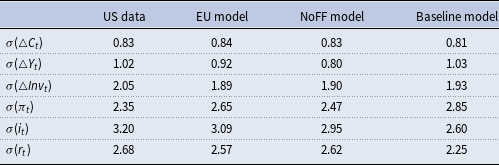
Note: This table reports the model-implied unconditional second moments of key aggregate variables, which are generated with or without financial frictions. For comparison, the observed counterparts are also reported. The US data ranges from 1961:Q2 to 2023:Q1.
Term premium and slope of the yield curve
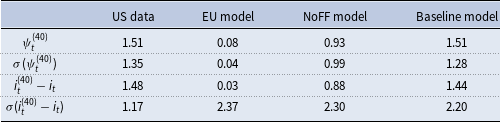
Note:This table reports the means and standard deviations of the term premium and the slope of the yield curve, which are generated with or without financial frictions. For comparison, the observed counterparts are also reported. The US data ranges from 1961:Q2 to 2023:Q1.
3.2. Financial frictions and the term premium
This subsection conducts an investigation of whether embedding the financial sector described by Gertler and Karadi (Reference Gertler and Karadi2011) in the standard New Keynesian model increases the term premium. In the model, financial intermediaries have limited borrowing capacity due to moral hazard problems. Three versions of the model are considered for comparison. The version with financial frictions is referred to as the baseline model, while the version abstracting financial frictions from the baseline model is called the NoFF model. The arbitrage condition between the return of capital and the risk-free return holds in the absence of financial frictions. Also, in order to investigate the influence of generalized recursive preferences, we adopt the expected utility (EU) model. This model does not include financial frictions, and households have expected utility rather than generalized recursive preferences. In other words, it is a NoFF model with the Epstein–Zin parameter,
 $\alpha$
, set to
 $0$
. For both the NoFF model and the EU model, we use the parameter values employed in the baseline calibration.
Tables 2 and 3 report the standard deviations of the key macroeconomic variables, the means and volatilities of the term premium, and the slope of the yield curve predicted by the models and observed from the data. The data for consumption, output, and investment are from the Bureau of Economic Analysis (BEA). The inflation rate is calculated using the GDP deflator from the BEA and reported in annualized percentage points. The nominal interest rate is the 3-month T-bill rate from the Statistical Release H.15 of the Federal Reserve Board of Governors. The real interest rate is defined as the difference between the nominal interest rate and the inflation rate. The empirical moments are computed using the data that range from 1961:Q2 to 2023:Q1.
Table 2 shows that all three models closely match the standard deviations of the key macroeconomic variables from the data. The unconditional moments of macroeconomic variables produced by both the EU model and the NoFF model exhibit nearly identical results. Given that the EU model corresponds to
 $\alpha =0$
in the NoFF model, any disparities can be ascribed to generalized recursive preferences. Nevertheless, as the observed difference is negligible, generalized recursive preferences exert minimal influence on macroeconomic variables, consistent with findings in the literature (e.g., Rudebusch and Swanson, Reference Rudebusch and Swanson2012).Footnote 18
Comparing the NoFF model (fourth column) and the baseline model (fifth column), output, investment, and inflation exhibit increased volatility, while consumption and nominal and real interest rates show a slight decrease in volatility. This outcome is somewhat counterintuitive, as the baseline model would be expected to elevate the volatility of these variables through the financial accelerator channel. This result can be attributed to two key mechanisms. First, the no-arbitrage condition within the NoFF model framework amplifies the volatility of interest rates. In the NoFF model, the no-arbitrage condition between capital return and the real interest rate,
 $E_{t}m_{t+1}R_{t+1}^{k}=E_{t}m_{t+1}e^{r_{t}}$
, must always hold to match the number of equations with the number of variables. Consequently, the real interest rate experiences increased volatility, as the more volatile capital return must equal the real interest rate. This, in turn, amplifies the volatility of the nominal interest rate through the Fisher equation. Ultimately, the rise in the volatility of nominal variables, driven by the consumption Euler equation, also influences the volatility of consumption.
Second, the investment shock dampens real variable volatility in the presence of financial frictions. A favorable investment shock enhances the marginal efficiency of converting final goods into investment goods, leading to a decrease in the capital price and an increase in both investment and labor hours. Compared to the NoFF model, the baseline model exhibits a greater reduction in the capital price. This reduction in replacement cost of capital results in a decrease in return on capital, ultimately leading to a decline in the net worth of financial intermediaries. Consequently, the diminished net worth of these intermediaries causes a wider spread, which helps to counterbalance the increase in investment, output, and, in turn, consumption.
Table 3 reports model-implied the term premium, the slope of the yield curve, and their second moments. The term premium stands out as the best gauge for the risk premium associated with long-term bonds, yet it remains unobservable. Consequently, estimated outcomes may differ based on the chosen model or estimation method. Conversely, the slope of the yield curve can be readily computed by subtracting the yield of short-term bonds from that of long-term bonds. Due to its simplicity, the slope of the yield curve frequently serves as a practical proxy for the risk premium of long-term bonds in empirical applications. The term premium,
 $\psi _{t}^{(40)}$
, in the second column (data) is the difference between the yields on the 10-year zero-coupon nominal bond and the risk-neutral nominal bond measured by Adrian et al. (Reference Adrian, Crump and Moench2013). The slope of the yield curve is defined as the difference between the 10-year and 3-month yields.
A comparison of the third and fourth columns reveals that the model-implied term premium through the EU model is 0.08 percent, while the term premium generated through the NoFF model is 0.93 percent, representing an increase of over 10 times. The rise in volatility from 0.04 to 0.99 underscores the significant role of generalized recursive preferences in elevating risk premiums, consistent with prior research findings (e.g., Bansal and Yaron, Reference Bansal and Yaron2004; Rudebusch and Swanson, Reference Rudebusch and Swanson2012; and Kung, Reference Kung2015). While the EU model can match the volatility of macroeconomic variables with data, it falls short in generating a term premium of sufficient magnitude. Conversely, the Epstein–Zin parameter can produce a sizable term premium by introducing additional curvature and disrupting the link between intertemporal substitution elasticity and risk aversion. The term premium from the NoFF model is, however, lower than its empirical counterpart. The term premium generated by the baseline model aligns well with the actual data, as illustrated in the fifth column. The model-implied term premium is 1.51 percent at an annual rate and the standard deviation of the term premium is 1.28 percent in the presence of financial frictions. These match well with their empirical counterpart, which are 1.51 percent and 1.35.Footnote 19 These results reveal that financial frictions raise the term premium by 48 basis points. We discuss why financial frictions induce a higher term premium with the impulse response analysis at the end of this section.
The slope of the yield curve, a proxy of the term premium, is 0.03 percent in the EU model, while it is 0.88 percent in the NoFF model. The slope also rises with generalized recursive preferences. The volatility of the slope is 2.37 in the EU model and 2.30 in the NoFF model. These predictions are greater than the empirical counterpart of 1.17. The inclusion of financial frictions in the model leads to a sharp increase in the slope to 1.44 percent. This value again matches the data very well. The volatility of the slope decreases slightly to 2.20 due to financial frictions, but it is still higher than the data. In sum, our findings indicate that financial frictions increase the term premium and the slope of the yield curve.
To better understand the role of structural shocks in determining the term premium, we simulate the baseline and the NoFF models with each shock in Table 4. From this point on, we focus on the role of financial frictions by comparing performances of the NoFF model and the baseline model. This is because the EU model is a special case of the NoFF model with
 $\alpha$
set to zero, and it cannot generate a term premium of sufficient size. Table 4 reports the moments of the key macroeconomic and financial variables, which are obtained by simulating the models without the uncertainty shock, including the other structural shocks, with only the technology shock, with only the monetary shock, and with only the investment shock. Given that consumption growth inversely relates with the stochastic discount factor and that bond prices inversely relate with interest rates, we present the volatilities of consumption growth and interest rates, along with the term premium and the slope of the yield curve.
Role of exogenous shocks
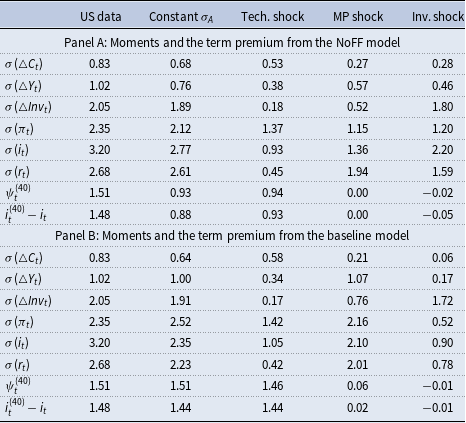
Note: This table reports the model-implied unconditional second moments of the key aggregate variables, the mean of the term premium and the slope of the yield curve. The moments are computed by simulating the baseline model without the uncertainty shock, but including the remaining three structural shocks (third column), with only the permanent technology shock (fourth column), with only the monetary shock (fifth column), and with only the investment shock (sixth column).
The fourth column presents the moments and the term premiums when the models include only the technology shock. The term premium predicted by the baseline model is 1.45 and by the NoFF model is 0.94 percent, indicating that the technology shock alone is able to explain the model-implied term premium. This is not surprising as the permanent technology shock that generates a sizable negative correlation between inflation (or interest rates) and consumption growth plays a crucial role in accounting for the term premium (e.g., Piazzesi and Schneider, Reference Piazzesi and Schneider2007; Rudebusch and Swanson, Reference Rudebusch and Swanson2012; and Kung, Reference Kung2015). Accordingly, other shocks such as uncertainty, monetary policy, and investment shocks fail to generate substantial size of term premium.
The sixth column of Table 4 shows that consumption growth and nominal interest rate volatility are both less pronounced with the investment shock when financial frictions are present. As previously explained, this is because a positive investment shock reduces banks’ lending capacity. Our results align with those of Christensen and Dib (Reference Christensen and Dib2008), despite their focus on the model in Bernanke et al. (Reference Bernanke, Gertler and Gilchrist1999), where firms encounter a leverage constraint during borrowing from banks.Footnote 20
Impact of financial frictions. Note: The figure shows the 3rd order impulse response functions of the key macroeconomic and financial variables to a negative one-standard-deviation (0.7 percent) technology shock. The solid blue lines plot the impulse response functions from the baseline model incorporating financial frictions, and the dashed orange lines plot the impulse response functions when financial frictions are abstracted from the baseline model.
We now study how financial frictions affect the dynamics of the key macroeconomic and financial variables and increase the term premium. Figure 1 plots the 3rd order impulse response functions for the key variables to a negative one-standard-deviation technology shock. We focus on the technology shock since, as shown in Table 4, the term premium is mostly explained by the shock. The solid blue lines plot the impulse response functions from the baseline model and the dashed orange lines plot the impulse response functions when financial frictions are eliminated from the baseline model. The horizontal axes are periods (quarters) and the vertical axes are percentage deviations from nonstochastic steady state values.
The figure shows that the introduction of financial frictions into the model exacerbates the decline in consumption, investment, and the price of long-term bonds, while inflation and interest rates experience a more pronounced increase. The decline in bank’s asset value, as a consequence of a negative technology shock, weakens the balance sheet of banks in the Gertler and Karadi framework. This weakening restricts banks’ ability to lend, elevating the credit spread and subsequently reducing corporate borrowing, leading to a further drop in investment when financial frictions are present. Within this framework, an increase in the credit spread raises the funding costs for firms, thereby increasing their marginal costs. This escalation contributes to a more significant rise in inflation and the nominal interest rate when financial frictions are factored in, which, in turn, depresses bond prices. The figure demonstrates that the introduction of financial frictions amplifies the responses of key variables to the technology shock, with the credit spread being instrumental in differentiating the model incorporating financial frictions from the model without such frictions (NoFF model).
The long-term bond loses its value more in the presence of financial frictions as can be seen in the figure. This result arises from the fact that a severe contraction in consumption leads to a lower demand of the long-term bond by households as the marginal utility of consumption rises.Footnote 21 Intuitively speaking, financial frictions make the long-term bond price and consumption decline more. It implies that holding long-term bonds makes it difficult to smooth consumption. This property makes the long-term bond riskier so that investors require more compensation for bearing this risk. Thus, the term premium on average is higher with financial frictions as shown in Table 3.
4. Monetary policy, financial frictions, and the term premium
Palomino (Reference Palomino2012) finds that monetary policy under commitment could lower the term premium. Similarly, Kung (Reference Kung2015) shows that strict inflation policy reduces the term premium. In this study, we investigate how financial frictions affect the term premium under various monetary policy stances on inflation and economic activity. We are interested in the relationship between the stance of monetary policy on inflation and economic activity and the balance sheets of financial intermediaries, as well as how monetary policy affects the term premium through the balance sheet channel. To this end, we simulate the NoFF model and the baseline model allowing the inflation coefficient in the Taylor rule,
 $\phi _{\pi }$
, to increase from 0.2 to 1.0, holding the other parameters fixed at their baseline calibration.
Table 5 presents the basic macroeconomic moments, the means and volatilities of the term premium and the slope of the yield curve under various monetary policy stances on inflation. The table reveals that with a low initial value of the inflation coefficient,
 $\phi _{\pi }$
, within the Taylor rule, increasing
 $\phi _{\pi }$
reduces the volatility of both consumption growth and interest rates markedly. As a consequence, the term premium declines significantly. However, when
 $\phi _{\pi }$
is already at a high level, further increment only marginally decreases the volatility of the variables and the term premium, reflecting the already strict nature of the policy. The NoFF model shows that a increase in
 $\phi _{\pi }$
from 0.2 to 1.0 declines the volatility of inflation, resulting in a decrease in inflation risk and a decrease in the term premium.Footnote 22 This is consistent with the empirical findings of Wright (Reference Wright2011) shows that the term premium rises with inflation volatility.
Financial frictions, the term premium, and Monetary policy stance of inflation
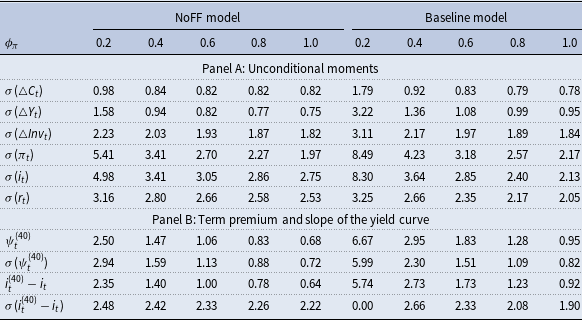
Interestingly, the contribution of financial frictions to the term premium could be higher, especially when the monetary authority has less concern on inflation. This is because financial frictions further amplify the response of inflation to the technology shock under weak inflation targeting. The slope of the yield curve is also higher when the monetary authority has a weak anti-inflationary stance or when the model includes financial frictions. An increase in
 $\phi _{\pi }$
from 0.2 to 1.0 causes the slope of the yield curve to decrease by 171 and 482 basis points in the NoFF model and the baseline model, respectively. These results show that the slope of the yield curve becomes steeper when the model includes financial frictions.
Financial frictions and the term premium across different
 $\phi _{\pi }$
. Note: The figure shows the relationship between the term premium and the inflation coefficient
 $\phi _{\pi }$
on the Taylor rule. The solid blue line represents the term premium from the baseline model, while the dashed orange line indicates the one from the NoFF model without financial frictions.
Comparing the term premiums predicted by the models clarifies the contribution of financial frictions to the term premium under various monetary policy stances on inflation. Figure 2, which illustrates how the contribution of financial frictions to the term premium varies with the monetary policy feedback coefficient on inflation. The vertical axis is the level of the term premium, while the horizontal axis is the value of the parameter
 $\phi _{\pi }.$
The dashed orange line and the solid blue line present the term premium predicted by the NoFF model and the baseline model, respectively. As shown in the figure, the stronger the monetary authority’s response to inflation, the smaller the term premium. More importantly, the figure also indicates that the contribution of financial frictions to the term premium is greater when the monetary authority has fewer concerns about inflation. Note that the difference between the term premiums generated by the models becomes larger as the parameter
 $\phi _{\pi }$
declines. Our results imply that financial frictions can have a substantial (negligible) contribution to the term premium when the monetary authority reacts weakly (strongly) to inflation.
To investigate how the influence of monetary policy on the balance sheets of financial intermediaries affects the term premium, we plot the impulse response functions of the macroeconomic and financial variables under strong and weak inflation targeting policy when the negative technology shock hits the economy.
Strong inflation targeting. Note: The figure shows the 3rd order impulse response functions of the key macroeconomic and financial variables to a negative one-standard-deviation (0.7 percent) technology shock. The solid blue lines plot the impulse response functions from the model incorporating financial frictions, and the dashed orange lines plot the impulse response functions when financial frictions are removed from the baseline model.
Weak inflation targeting. Note: The figure shows the 3rd order impulse response functions of the key macroeconomic and financial variables to a negative one-standard-deviation (0.7 percent) technology shock. The solid blue lines plot the impulse response functions from the model incorporating financial frictions, and the dashed orange lines plot the impulse response functions when financial frictions are removed from the baseline model.

Figures 3 and 4 present the impulse responses associated with strong inflation targeting and weak inflation targeting policies, respectively. The parameter
 $\phi _{\pi }$
in the Taylor rule is set to 1.0 for strong inflation targeting, while it is set to 0.4 for weak inflation targeting. The comparison of 3 and 4 reveals that the negative technology shock greatly increases inflation when the monetary authority has a weak response against rising inflation. The figure also illustrates that financial frictions further increase inflation. The negative technology shock places a downward pressure on the net worth of financial intermediaries due to a decline in the return on capital. When the monetary authority has a weak response to inflation and a relatively strong response to output, the real interest rate drops in response to the negative technology shock. The decline of the real interest rate has a positive impact on profits of financial intermediaries due to lower funding costs. An increase in the net worth of financial intermediaries makes it easier for firms to obtain loans from financial intermediaries. Easy financial conditions boost the demand for capital.Footnote 23 A rise in capital owned by firms due to the balance sheet channel increases the marginal product of labor and real wage. Consequently, the balance sheet impact linked to monetary policy exerts additional upward pressure on inflation. With financial frictions, this results in a greater increase in inflation, leading to heightened inflation risk. The higher interest rates associated with higher inflation further push the long-term bond price down when the model incorporates financial frictions. The stochastic discount factor rises more with financial frictions due to a sharper decline in consumption. Accordingly, the mean level of the term premium determined by the covariance between the long-term bond price and the stochastic discount factor is greater in the baseline model compared to that in the NoFF model.
We now investigate how the contribution of financial frictions to the term premium varies with the monetary authority’s stance for output stabilization. The moments of the variables of interest are generated using various values for the coefficient for the output gap in the Taylor rule,
 $\phi _{y}$
, which ranges from 0.2 to 1.0, while the other parameters are fixed at their benchmark calibration. Results are summarized in Table 6. This table shows that the volatilities of investment and output decrease when the monetary authority aggressively attempts to stabilize the output gap regardless of the presence of financial frictions. Increasing the value of
 $\phi _{y}$
lowers the volatility of output in both models. However, this comes at a cost of a higher volatility of inflation. When the parameter
 $\phi _{y}$
increases from 0.2 to 1.0, the volatility of inflation rises from 2.65 to 4.69 in the baseline model and from 2.13 to 4.71 in the NoFF model. These results imply that financial frictions make inflation more volatile under strong output stabilization policy. In both models, the short-term interest rate become more volatile when the monetary authority is more responsive to the output gap. As a consequence, the volatility of consumption rises with the parameter
 $\phi _{y}$
.
Unconditional moments across different
 $\phi _{y}$

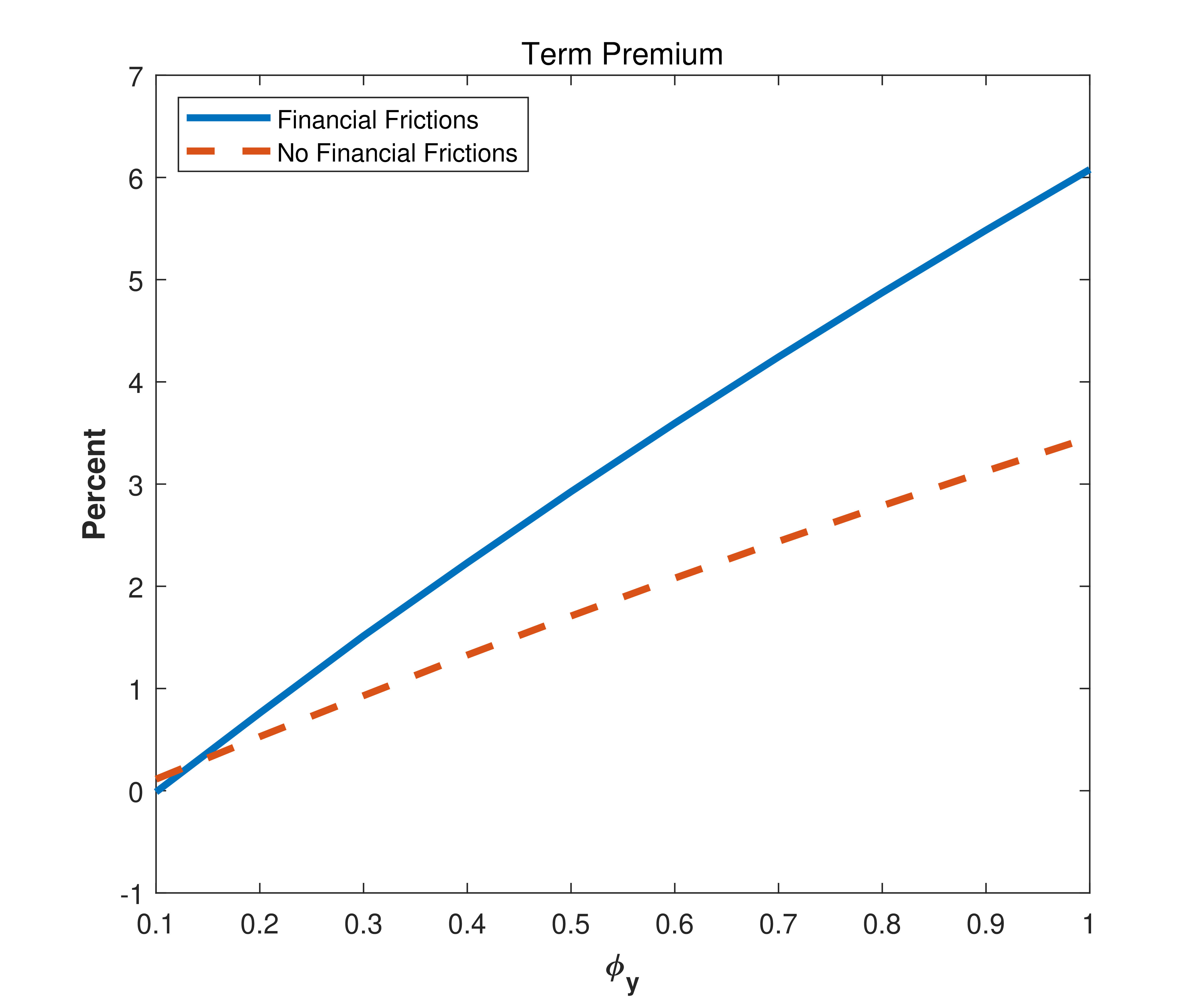
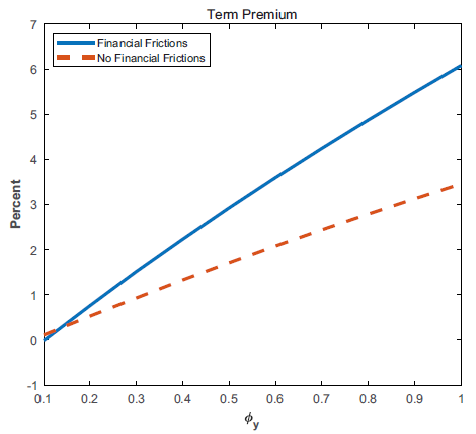
The table shows that the term premium rises as the monetary authority becomes more responsive to the output gap. The relationship of the term premium with the monetary authority’s stance on the output gap is explicitly illustrated in Figure 5. The horizontal axis is the value of
 $\phi _{y}$
and the vertical axis is the term premium. The figure shows that there is a positive relationship between the term premium and the monetary policy feedback parameter for the output gap. It also conveys that an increase in the parameter
 $\phi _{y}$
causes the term premium to rise in both models. In particular, the sensitivity of the term premium to the parameter
 $\phi _{y}$
is greater in the baseline model than in the NoFF model. This implies that the importance of financial frictions in determining the term premium becomes larger as the response of the monetary authority to the output gap becomes stronger.
Financial frictions and the term premium across different
 $\phi _{y}$
.
Our results demonstrate that financial frictions can generate a larger term premium with a greater responsiveness of the monetary authority to economic activity. Strong output stabilization policy concerns less about inflation as in the weak inflation targeting case. In this respect, these policies are very similar to each other. Although we do not report it here, the impulse response functions under strong (weak) output stabilization policy closely resemble those from weak (strong) inflation targeting. This implies that the mechanism behind strong output stabilization policy generating the term premium is the same as that of weak inflation targeting. Note that financial intermediary balance sheets can be significantly improved when the monetary authority aggressively responds to economic activity in the face of the technology shock. The improved balance sheets place an upward pressure on the demand of capital, investment, real wage, and inflation. Thus, inflation risk rises with strong output stabilization policy, yielding a larger mean term premium. In sum, our results suggest that the influence of monetary policy on intermediary balance sheets plays an important role in determining the term premium when the monetary authority has relatively more concerns on economic activity compared to inflation.
5. Financial shocks and the term premium
In this subsection, we explore how financial shocks affect the term premium with taking the balance sheet channel into account. We consider two different types of financial shocks separately.
5.1. Net worth shock
Our baseline model does not include financial shocks such as net worth shock. However, recent studies find that financial shocks are tightly linked with economic fluctuations (e.g., Nolan and Thoenissen, Reference Nolan and Thoenissen2009). In this subsection we consider a shock to the aggregate net worth of the entire financial sector. The net worth,
 $N_{t}$
, is given by
 \begin{align} N_{t}=\upsilon _{t}\sigma \left (R_{t}^{k}Q_{t-1}S_{t-1}-e^{i_{t-1}}D_{t-1}\right )+\omega Q_{t}S_{t-1}, \end{align}
where
 $\upsilon _{t}$
is the net worth shock which follows an AR(1) process:
 \begin{align} \ln \upsilon _{t}=\rho _{\upsilon }\ln \upsilon _{t-1}+\epsilon _{t}^{\upsilon }, \end{align}
where
 $\rho _{\upsilon }\in ({-}1,1)$
, and
 $\epsilon _{t}^{\upsilon }$
follows an
 $i.i.d.$
white noise process with mean zero and variance
 $\sigma _{\upsilon }^{2}$
. All other aspects of the model are the same as in the baseline model. We set
 $\rho _{\upsilon }=0.98$
and
 $\sigma _{\upsilon }=0.00008$
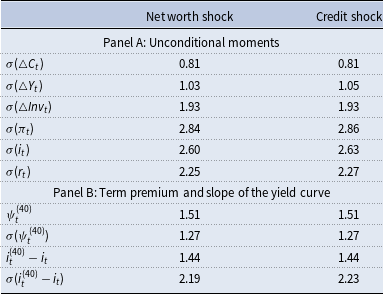
as in Nolan and Thoenissen (Reference Nolan and Thoenissen2009). Table 7 reports the second moments of the macroeconomic variables and the model-implied term premium when the model incorporates the net worth shock along with the other shocks considered in Section 3 (the second column). Adding the net worth shock to the model yields a slightly lower premium.Footnote 24 This financial shock as a demand-side shock lowers the term premium and the slope of the yield curve as the investment shock does. The net worth shock does make the bond price and the stochastic discount factor to move in the same direction, lowering the term premium.
Financial shocks and the term premium
5.2. Credit shock
In the baseline model, we assume that the fraction
 $\vartheta$
of assets that can be diverted by financial intermediaries is fixed. We now investigate how the term premium changes if we allow the moral hazard parameter
 $\vartheta$
to vary by time. We assume that the fraction follows a stochastic process:
 \begin{align} \ln \vartheta _{t}=\rho _{\vartheta }\ln \vartheta _{t-1}+\epsilon _{t}^{\vartheta }, \end{align}
where
 $\rho _{\vartheta }\in ({-}1,1)$
, and
 $\epsilon _{t}^{\vartheta }$
follows an
 $i.i.d.$
white noise process with mean zero and variance
 $\sigma _{\vartheta }^{2}$
. We interpret
 $\epsilon _{t}^{\vartheta }$
as a credit shock. The incentive constraint accordingly is given by
 \begin{align} V_{t}^{b}\geq \vartheta _{t}Q_{t}s_{t}, \end{align}
and the leverage multiple is given by
 \begin{align} \phi _{t}=\frac {\nu _{t}}{\vartheta _{t}-\mu _{t}}. \end{align}
 $V_{t}^{b}$
is the franchise value of the financial intermediary,
 $Q_{t}$
is the nominal price of financial claims on firms,
 $s_{t}$
is the quantity of claims,
 $\mu _{t}$
is the expected discounted excess return of assets over deposits, and
 $\nu _{t}$
is the expected discounted marginal cost of deposits.
We set
 $\rho _{\vartheta }=0.8$
and
 $\sigma _{\vartheta }=0.05$
following Dedola et al. (Reference Dedola, Karadi and Lombardo2013). The third column of Table 7 shows that attaching the credit shock, instead of the net worth shock, to the model has only minimal effect on the term premium. Its marginal effect on the term premium is negative. Overall, the credit shock generates analogous results as in the net worth shock.
6. Conclusion
This study examines the effect of financial frictions on the term premium. Our key findings show that financial frictions increase the term premium. We also find that the impacts of financial frictions can be amplified significantly when the monetary authority responds weakly to inflation.
We adopt the financial intermediation model of Gertler and Karadi (Reference Gertler and Karadi2011) to investigate the importance of financial frictions in accounting for the term premium. The Gertler–Karadi model does not consider a bank run equilibrium although it captures the fact that the financial intermediary’s borrowing and lending capacity shrinks during recessions. With this in mind, Gertler and Kiyotaki (Reference Gertler and Kiyotaki2015) extend the model for a bank run equilibrium to exist and show that economic activity shrinks more during banking crises than normal recessions. Although we do not analyze the case of a bank run equilibrium due to technical issues, allowing bank runs in the model economy is likely to increase the term premium since banking crises are more likely to increase the volatility of consumption, stochastic discount factor, and inflation. This issue might be worth investigating in future research.
Acknowledgements
We are particularly indebted to Eric Swanson for his generous advice and assistance. We would also like to thank Marcelle Chauvet, Maxwell Chomas, Stephen Cole, Miroslav Gabrovski, Jinill Kim, Kundan Kishor, Rebecca Neumann, Victor Ortego-Marti, Francisco Palomino, Kwanho Shin, Andrea Tambalotti, Yang Xie, and seminar participants at Bank of Korea, Korea University, Korea Capital Market Institute, Marquette University, SEA annual meeting, UC Riverside, UW Milwaukee, and WEAI annual conference for their helpful discussions, comments, and suggestions. The views expressed in this paper, and all errors and omissions, are our own and are not necessarily those of the individuals or groups listed above.
Supplementary material
To view supplementary material for this article, please visit https://doi.org/10.1017/S1365100524000713.



