Implications
Public health policies recommend population-wide decreases in the consumption of fat, saturated and trans-fatty acids (TFA), and higher intakes of polyunsaturated fatty acids. Ruminant foods are a major source of medium-chain saturates and contribute to TFA consumption in human populations. Significant progress has been made in characterizing changes in milk and tissue fatty acid composition to diet, feeding system and genotype. Recent developments highlight the potential for further progress to be made through genomic or marker-assisted selection of ruminant livestock and the formulation of diets to exploit this genetic potential.
Introduction
There is increasing evidence from clinical and biomedical studies that diet plays an important role in the onset and development of chronic disease in the human population including cancer, cardiovascular disease (CVD), insulin resistance and obesity (World Health Organization/Food Agricultural Organization (WHO/FAO), 2003). Both the direct and indirect costs of CVD have been estimated as €200 billion per annum within the European Union (Allender et al., Reference Allender, Scarborough, Peto, Raynor, Leal, Luengo-Ferna′ndez and Gray2008) and $403 billion per annum in the United States (Thom et al., Reference Thom, Haase, Rosamond, Howard, Rumsfeld, Manolio, Zheng, Flegal, O'Donnell, Kittner, Lloyd-Jones, Goff, Hong, Adams, Friday, Furie, Gorelick, Kissela, Marler, Meigs, Roger, Sidney, Sorlie, Steinberger, Wasserthiel-Smoller, Wilson and Wolf2006). These costs are projected to increase because of people living longer and the rapid increase in obesity in developed and developing countries (Givens, Reference Givens2010).
Studies in human subjects have indicated that saturated fatty acids (SFA), specifically 14:0 and 16:0, and trans-fatty acids (TFA) in the diet increase CVD risk, with the risk associated with TFA being higher than SFA (refer to Shingfield et al., Reference Shingfield, Chilliard, Toivonen, Kairenius and Givens2008b; Givens, Reference Givens2010). Excessive intakes of SFA may also be associated with lowered insulin sensitivity, which is a key factor in the development of the metabolic syndrome and diabetes (Funaki, Reference Funaki2009; Kennedy et al., Reference Kennedy, Martinez, Chuang, LaPoint and McIntosh2009). In an attempt to lower the economic and social burden of chronic diseases, public health policies in most developed countries recommend population-wide decreases in the intake of total fat, SFA and TFA and an increase in the consumption of the long-chain n-3 polyunsaturated fatty acids (PUFA), 20:5n-3 and 22:6n-3.
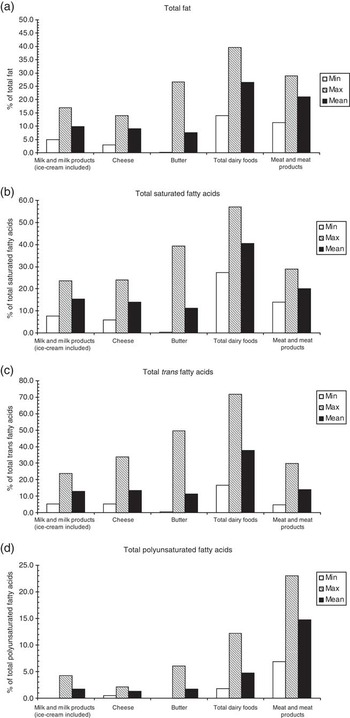
Milk and dairy products are the main source of 12:0 and 14:0 in the human diet, although collectively ruminant-derived foods contribute significantly to total 16:0 and TFA consumption. The TRANSFAIR study on fat and fatty acid intake across 14 European countries (Hulshof et al., Reference Hulshof, van Erp-Baart, Anttolainen, Becker, Church, Couet, Hermann-Kunz, Kesteloot, Leth, Martins, Moreiras, Moschandreas, Pizzoferrato, Rimestad, Thorgeirsdottir, van Amelsvoort, Aro, Kafatos, Lanzmann-Petithory and van Poppel1999) reported that depending on country milk and dairy products provided 27.4% to 57.1% of total SFA, with that from meat and meat products ranging between 13.9% and 29.0% (Figure 1). Milk, milk products, cheese, butter, meat and meat products were found to make a significant but variable contribution to total TFA in the human diet (Figure 1). However, simply advocating a population-wide decrease in the consumption of ruminant meat and milk to lower SFA and TFA intakes ignores the value of these foods as a versatile source of high-quality protein, vitamins, minerals and bioactive lipids. Altering the fatty acid composition of ruminant meat and milk represents one means to lower SFA intakes and increase cis monounsaturated (MUFA) and PUFA in the human diet without requiring changes in consumer eating habits, while at the same time maintaining the potential benefits associated with the macro- and micronutrients in these foods.
Contribution of animal-derived foods to the intake of total fat, saturated, trans- and polyunsaturated fatty acids as estimated in the TRANSFAIR study for 14 European Countries (Hulshof et al., Reference Hulshof, van Erp-Baart, Anttolainen, Becker, Church, Couet, Hermann-Kunz, Kesteloot, Leth, Martins, Moreiras, Moschandreas, Pizzoferrato, Rimestad, Thorgeirsdottir, van Amelsvoort, Aro, Kafatos, Lanzmann-Petithory and van Poppel1999).

The following review summarizes recent investigations of the physiological, biochemical and molecular mechanisms regulating fatty acid supply, lipogenesis and adipogenesis in growing and lactating ruminants and considers the potential to alter the fatty acid composition of ruminant meat and milk through diet and genetic selection.
Digestion of lipids in ruminants
Ruminal lipolysis and biohydrogenation
Tissue lipids and milk fat in ruminants contain much higher proportions of SFA compared with dietary intake, which is at least partly due to extensive lipolysis and subsequent biohydrogenation of unsaturated fatty acids in the rumen. Bacteria are thought to be primarily responsible, a process that serves to reduce the toxic effects of dietary unsaturated fatty acids on bacterial growth (Jenkins et al., Reference Jenkins, Wallace, Moate and Mosley2008; Lourenço et al., Reference Lourenço, Ramos-Morales and Wallace2010). Lipolysis represents the first step in the complete metabolism of dietary lipids, and under normal conditions more than 85% of esterified dietary lipids in the form of galactolipids, phospholipids (PL) and triacylglycerols (TAG) are hydrolysed (Palmquist et al., Reference Palmquist, Lock, Shingfield and Bauman2005; Buccioni et al., Reference Buccioni, Decandia, Minieri, Molle and Cabiddu2012).
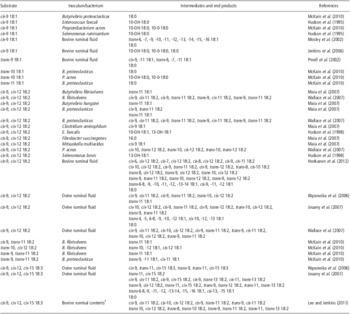
Significant progress has been made in characterizing intermediates formed during ruminal biohydrogenation of unsaturated fatty acids, the mechanisms involved and some of the bacterial species responsible (Jenkins et al., Reference Jenkins, Wallace, Moate and Mosley2008; Lourenço et al., Reference Lourenço, Ramos-Morales and Wallace2010; Shingfield et al., Reference Shingfield, Bernard, Leroux and Chilliard2010). Recent studies in vitro have demonstrated that a diverse range of intermediates are formed during incubations of pure fatty acid substrates with rumen fluid or pure strains of ruminal bacteria (Jenkins et al., Reference Jenkins, Wallace, Moate and Mosley2008; Lourenço et al., Reference Lourenço, Ramos-Morales and Wallace2010; Buccioni et al., Reference Buccioni, Decandia, Minieri, Molle and Cabiddu2012; Table 1). For most diets, ruminal biohydrogenation of cis-9 18:1, 18:2n-6 and 18:3n-3 varies between 58% to 87%, 70% to 95% and 85% to 100%, respectively (Glasser et al., Reference Glasser, Schmidely, Sauvant and Doreau2008c; Shingfield et al., Reference Shingfield, Bernard, Leroux and Chilliard2010), indicating that with the exception of diets containing fish oil or marine lipids 18:0 is the major fatty acid leaving the rumen.
Intermediates formed during incubations of 18-carbon unsaturated fatty acids with strained ruminal fluid or pure cultures of ruminal bacteria

1Following 48 h incubations of 13C-cis-9, cis-12, cis-15 18:3 with bovine ruminal contents, significant enrichment was detected for several unidentified fatty acids including two partially conjugated 18:3 isomers, 12 non-conjugated 18:3 and five non-conjugated 18:2 intermediates.
Fatty acids available for absorption are also derived from rumen bacteria and protozoa. Microbial fatty acids, primarily in the form of structural membrane lipids, originate from biohydrogenation and utilization of dietary fatty acids and fatty acid synthesis de novo. De novo fatty acid synthesis is also responsible for the occurrence of odd- and branched-chain fatty acids in membrane lipids of rumen bacteria (Vlaeminck et al., Reference Vlaeminck, Fievez, Cabrita, Fonseca and Dewhurst2006).
Lipid absorption and transport
Mechanisms involved in the digestion and adsorption of fatty acids in the small intestine of ruminants are well documented (Vernon and Flint, Reference Vernon and Flint1988; Bauchart, Reference Bauchart1993). On passage through intestinal epithelial cells, adsorbed fatty acids mainly in the form of non-esterified fatty acids (NEFA) are esterified to glycerol and used in conjunction with PL and cholesterol esters (CE) in the assembly of very-low-density lipoproteins (VLDL) and chylomicrons that enter the peripheral circulation via the thoracic duct (Vernon and Flint, Reference Vernon and Flint1988). Most of the fatty acids transported in plasma circulate as CE and PL within high-density lipoproteins (HDL), although TAG and NEFA typically account for less than 3% of total plasma lipids (Moore and Christie, Reference Moore and Christie1979). The small amounts of absorbed PUFA are preferentially incorporated into CE and PL of circulating HDL, which is thought to arise from the action of acyltransferases during the synthesis of PL in enterocytes and the activity of lecithin : cholesterol acyltransferase in plasma (Vernon and Flint, Reference Vernon and Flint1988). Preferential incorporation into lipid fractions with a low affinity for lipoprotein lipase (LPL) represents a mechanism to limit the amount of essential fatty acids used for milk fat synthesis and oxidation.
Mammary lipogenesis in ruminants
Milk fat comprises TAG (96% to 98% of total milk lipids) with small amounts of 1,2-diacylglycerols and monoacylglycerols (0.02%), NEFA (0.22%) and retinol esters. Ruminant milk fat contains more than 400 different fatty acids, but SFA of chain lengths from 4 to 18 carbon atoms, cis-9 16:1, cis-9 18:1, isomers of trans 18:1 and 18:2n-6 are the most abundant. Fatty acids incorporated into milk fat TAG are derived from the uptake of fatty acids from NEFA and TAG in arterial blood and synthesis de novo in the mammary gland (Chilliard et al., Reference Chilliard, Glasser, Ferlay, Bernard, Rouel and Doreau2007; Bernard et al., Reference Bernard, Leroux and Chilliard2008).
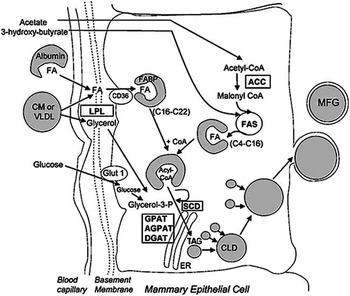
Several recent accounts have documented the biochemistry and molecular regulation of mammary lipogenesis in ruminants (Bernard et al., Reference Bernard, Leroux and Chilliard2008; Bionaz and Loor, Reference Bionaz and Loor2008; Harvatine et al., Reference Harvatine, Boisclair and Bauman2009; Shingfield et al., Reference Shingfield, Bernard, Leroux and Chilliard2010). Mammary epithelial cells synthesize short- and medium-chain fatty acids using acetate and 3-hydroxy-butyrate in the presence of two key enzymes, acetyl-CoA carboxylase (ACC) and fatty acid synthetase (FAS; Figure 2). Fatty acid synthesis de novo accounts for all 4:0 to 12:0, most of the 14:0 (ca. 95%) and about 50% of 16:0 secreted in milk, whereas all 18-carbon and longer-chain fatty acids originate from the absorption of fatty acids in the small intestine and body fat reserves. The activity of stearoyl-CoA desaturase (SCD) in mammary epithelial cells that catalyses the oxidation of fatty acyl CoA esters resulting in the introduction of a cis double bond between carbon atoms 9 and 10 is responsible for ca. 90%, 55%, 60% and 70% to 95% of cis-9 14:1, cis-9 16:1, cis-9 18:1 and cis-9, trans-11 conjugated linoleic acid (CLA), respectively, secreted in milk (Palmquist et al., Reference Palmquist, Lock, Shingfield and Bauman2005; Shingfield et al., Reference Shingfield, Bernard, Leroux and Chilliard2010). De novo fatty acid synthesis, uptake of long-chain fatty acids and the formation of SCD products contribute to the fatty acid pool available for TAG synthesis (Figure 2).
Synthesis of milk fat in the bovine mammary epithelial cell (adapted from Bernard et al., Reference Bernard, Leroux and Chilliard2008). ACC = acetyl-CoA carboxylase; AGPAT =1-acylglycerol 3-phosphate acyltransferase; CD36 = cluster of differentiation 36; CLD = cytoplasmic lipid droplet; CoA = coenzyme A; CM = chylomicron; DGAT = diacylglycerol acyltransferase 1; ER = endoplasmic reticulum; FA = fatty acid; FABP = fatty acid-binding protein; FAS = fatty acid synthase; Glut 1 = glucose transporter 1; GPAT = glycerol-3 phosphate acyltransferase; LPL = lipoprotein lipase; MFG = milk fat globule; SCD = stearoyl-CoA desaturase; TAG = triacylglycerol; VLDL = very-low-density lipoprotein.

Tissue adipogenesis in ruminants
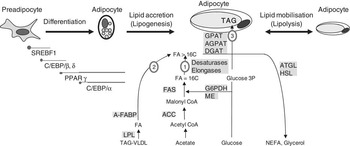
The primary role of adipose tissue (AT) is to serve as an energy store. Mobilization of TAG from body fat stores results in the release of NEFA that can be used for fat synthesis in the mammary gland or muscles. The majority of TAG found in muscle is deposited in intramuscular adipocytes. Adipocyte numbers and the amount of lipid stored within adipocytes are determined by cellular adipogenesis, which involves the development of adipocytes from preadipocytes that originate from progenitor cells. Relatively little is known about the differentiation of progenitors cells into preadipocytes, whereas the transition of preadipocytes into mature adipocytes defined as permanently cell cycle-arrested, spherical, lipid-filled cells is well documented (Hausman et al., Reference Hausman, Dodson, Ajuwon, Azain, Barnes, Guan, Jiang, Poulos, Sainz, Smith, Spurlock, Novakofski, Fernyhough and Bergen2009; Bonnet et al., Reference Bonnet, Cassar-Malek, Chilliard and Picard2010; Du et al., Reference Du, Yin and Zhu2010). Studies with cell cultures models, murine 3T3-L1 and 3T3-F442A cell lines and immortalized brown preadipocyte cell lines have enabled the biochemical mechanisms involved in the termination of the mitotic phase and initiation of cell differentiation to be elucidated (Figure 3), a process orchestrated by a tightly regulated transcriptional cascade involving nuclear receptors. Although the temporal pattern of nuclear receptor appearance differs between species (Hausman et al., Reference Hausman, Dodson, Ajuwon, Azain, Barnes, Guan, Jiang, Poulos, Sainz, Smith, Spurlock, Novakofski, Fernyhough and Bergen2009), CCAAT/enhancer-binding protein (primarily CEBP-α, but also CEBP-β and -δ) and peroxisome proliferator-activated receptor gamma (PPARγ) are known to be central transcriptional regulators of adipogenesis in cattle (Bonnet et al., Reference Bonnet, Cassar-Malek, Chilliard and Picard2010). Nuclear receptors induce the expression of numerous downstream target genes, including genes involved in the lipid metabolism and TAG deposition within adipocytes. The rate of TAG deposition and thereby adipocyte-lipid filling and hypertrophy depends on the relative rates of lipogenesis and lipolysis.
Cellular and biochemical pathways of terminal adipogenesis, lipid accretion and lipid mobilization. Numbers indicate de novo lipogenesis (1), lipolysis and uptake of circulating fatty acids (2) and esterification of fatty acids and synthesis of triacylglycerols (3). ACC = acetyl-CoA carboxylase; A-FABP = adipocyte fatty acidbinding protein; AGPAT = 1-acylglycerol 3-phosphate acyltransferase; ATGL = adipose triacylglyceride lipase; CEBP = CCAAT/enhancer-binding protein; CoA = coenzyme A; DGAT = diacylglycerol acyltransferase; FA = 16C = 16-carbon fatty acids; FA > 16C = fatty acids containing 16 or more carbon atoms; FAS = fatty acid synthase; G6PDH = glucose-6-phosphate dehydrogenase; GPAT = glycerol-3 phosphate acyltransferase; HSL = hormone-sensitive lipase; LPL = lipoprotein lipase; ME = malic enzyme; NEFA = non-esterified fatty acids; PPARγ = peroxisome proliferator-activated receptor gamma; SREBP1/ADD1 = sterol regulatory element-binding protein 1; TAG-VLDL = triacylglycerols transported in the peripheral circulation as very-low-density lipoproteins.

Three main lipogenic pathways are involved in TAG deposition in ruminants (Figure 3). Fatty acids are synthesized de novo, in the main, within adipocytes using acetate and to a lesser extent lactate as precursors, or are derived from LPL-mediated hydrolysis of plasma TAG. Synthesis de novo involves the coordinated activity of ACC and FAS and the involvement of glucose-6-phosphate dehydrogenase or malic enzyme (ME) (Figure 3). De novo fatty acid synthesis yields 16:0 as the final end product that can serve as a substrate for further elongation or desaturation. Fatty acid elongases 1, 3 and 6 use SFA and MUFA as substrates, whereas elongases 2, 4 and 5 act on PUFA (Cherfaoui et al., Reference Cherfaoui, Durand, Bonnet, Cassar-Malek, Bauchart, Thomas and Gruffat2012). Unsaturated fatty acids are synthesized via the activity of Δ-5, Δ-6 or Δ-9 desaturases. Within AT, stored TAG can be rapidly mobilized by the hydrolytic action of hormone-sensitive lipase (HSL) and adipose triglyceride lipase (ATGL), resulting in the release of NEFA.
Intramuscular fat (IMF) comprising PL and TAG varies between 1 and 5 g/100 g muscle. Accretion of TAG is directly related to body fatness, whereas the amount of PL in muscle is relatively constant. In both lipid fractions, 16:0, 18:0 and cis-9 18:1 are the major fatty acids, but PL contains higher proportions of PUFA. Typically, IMF contains 45 to 48, 35 to 45 and up to 5.0 g/100 g fatty acids as SFA, MUFA and PUFA, respectively (Scollan et al., Reference Scollan, Hocquette, Nuernberg, Dannenberger, Richardson and Moloney2006).
Altering the fatty acid composition of ruminant milk
Potential to alter milk fat composition
The extent to which dietary unsaturated fatty acids are incorporated into milk is dependent on both biohydrogenation in the rumen and the efficiency of transfer from the small intestine into milk fat. Transfer of 18-carbon or longer fatty acids into milk is regulated by the availability of fatty acids for absorption, with evidence that the supply of 4- to 16-carbon fatty acids synthesized de novo may also be important (Glasser et al., Reference Glasser, Ferlay, Doreau, Schmidely, Sauvant and Chilliard2008b). Infusions of oils or fatty acid preparations at the abomasum or duodenum have established the potential to increase the concentration of unsaturated fatty acids in milk in the absence of biohydrogenation in the rumen.
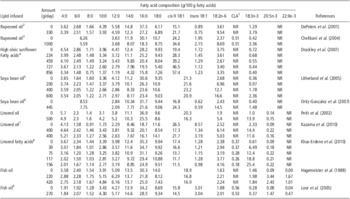
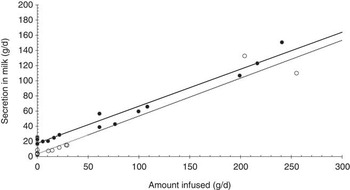
Infusions of rapeseed oil or high oleic sunflower oil fatty acids at the abomasum or duodenum increase cis-9 18:1 in milk of up to 57 g/100 g fatty acids (Table 2). Post-ruminal infusions of soya bean oil, linseed oil or linseed fatty acids indicate that bovine milk fat can be substantially enriched in 18:2n-6 and 18:3n-3 (16.6 and 25.4 g/100 g fatty acids, respectively; Table 2). Administration of linseed fatty acids also results in marginal increases in milk 20:5n-3 content (Table 2), confirming limited, but significant, elongation and desaturation of 18:3n-3 in ruminant tissues. Increases in the availability of 18-carbon unsaturated fatty acids in the small intestine also lower the concentration of 8- to 16-carbon fatty acids in milk fat (Table 2). Data from recent experiments, excluding studies where post-ruminal lipid infusions lowered intake and milk production, indicate that 18:2n-6 and 18:3n-3 are transferred from the small intestine into milk fat with a mean efficiency of 49% (Figure 4).
Effect of post-ruminal infusions of oils and fatty acid preparations on milk fatty acid composition in lactating cows

1Cis-9, trans-11 conjugated linoleic acid.
2Rapeseed oil contained (g/100 g fat) 16:0 (5.57), 18:0 (2.41), cis-9 18:1 (43.0), 18:2n-6 (26.5) and 18:3n-3 (7.99) as major components. Milk fatty acid concentrations reported as g/100 g fat.
3Rapeseed oil contained (g/100 g fatty acid methyl esters) 16:0 (4.21), 18:0 (2.08), cis-9 18:1 (62.4), 18:2n-6 (18.5) and 18:3n-3 (8.97) as major components. Milk fatty acid concentrations reported as g/100 g fatty acid methyl esters.
4High oleic sunflower fatty acid preparations contained (g/100 g) 16:0 (2.45), 18:0 (1.80), cis-9 18:1 (91.4) and 18:2n-6 (2.35) as major components. Milk fatty acid concentrations reported as g/100 g fatty acid butyl esters.
5Soya bean oil contained (g/100 g fatty acids) 16:0 (10.4), 18:0 (4.30), cis-9 18:1 (23.6), 18:2n-6 (52.4) and 18:3n-3 (7.71) as major components. Milk fatty acid concentrations reported as g/100 g fat.
6Soya bean oil contained (g/100 g fatty acids) 16:0 (9.04), 18:0 (3.26), cis-9 18:1 (25.8), 18:2n-6 (54.1) and 18:3n-3 (6.37) as major components. Milk fatty acid concentrations reported as g/100 g fat.
7Linseed oil contained (g/100 g fatty acid methyl esters) 16:0 (5.33), cis-9 18:1 (18.8), 18:2n-6 (16.1) and 18:3n-3 (53.7) as major components. Cows on the control diet received ruminal infusions of 400 g linseed oil/day.
8Fatty acid preparations contained (g/100 g) cis-9 18:1 (2.8), 18:2n-6 (14.7) and 18:3n-3 (82.4). Milk fatty acid concentrations reported as g/100 g fatty acid methyl esters.
9Fish oil contained (g/100 g fatty acids) 14:0 (7.60), 16:0 (9.20), cis-9 18:1 (8.00), 20:5n-3 (21.5) and 22:6n-3 (7.10) as major components.
NR, not reported.
Relationship between the amount of 18:2n-6 (●) or 18:3n-3 (○) infused at the abomasum and mammary secretion of 18:2n-6 and 18:3n-3 in lactating cows. Data derived from experiments involving infusions of examining the effects of post-ruminal infusion of soya oil (Litherland et al., Reference Litherland, Thire, Beaulieu, Reynolds, Benson and Drackley2005), soya fatty acids (Litherland et al., Reference Litherland, Thire, Beaulieu, Reynolds, Benson and Drackley2005; Ortiz-Gonzalez et al., Reference Ortiz-Gonzalez, Jimenez-Flores, Bremmer, Clark, DePeters, Schmidt and Drackley2007) and linseed oil (Petit et al., Reference Petit, Dewhurst, Scollan, Proulx, Khalid, Haresign, Twagiramungu and Mann2002; Kazama et al., Reference Kazama, Côrtes, da Silva-Kazama, Gagnon, Benchaar, Zeoula, Santos and Petit2010). Solid line indicates the relationship:- 18:2n-6milk = 0.488 × 18:2n-6infused + 17.67 (n = 11, R 2 = 0.968, P < 0.001) and the dotted line indicates the relationship:- 18:3n-3milk = 0.499 × 18:3n-3infused + 3.55 (n = 11, R 2 = 0.942, P < 0.001).

Even in the absence of biohydrogenation in the rumen, the potential to increase 20:5n-3 and 22:6n-3 in milk is extremely limited (Table 2). A lower transfer efficiency from the small intestine into milk for 20:5n-3 and 22:6n-3 (14.3% to 33.0% and 13.3% to 25.0%, respectively) than 18-carbon unsaturated fatty acids is thought to arise from the preferential incorporation of absorbed 20:5n-3 and 22:6n-3 into plasma PL and CE of HDL, rather than TAG of circulating VLDL and chylomicrons (Palmquist, Reference Palmquist2009).
A number of methodologies have been developed to protect lipids from biohydrogenation in the rumen, but in most cases the technologies used do not substantially increase the amount of unsaturated fatty acids available for absorption (Jenkins and Bridges, Reference Jenkins and Bridges2007). Changes in milk fat and tissue lipid composition in sheep, goats and cattle confirm formaldehyde treatment of emulsions of oilseeds or casein with oil as the most effective (Palmquist, Reference Palmquist2009; Doreau et al., Reference Doreau, Bauchart and Chilliard2011). The use of such supplements has been reported to enrich 18:2n-6, 18:3n-3, 20:5n-3 and 22:6n-3 in ruminant milk up to concentrations of 7.6, 5.1, 1.4 and 2.2 g/100 g fatty acids, respectively (Gulati et al., Reference Gulati, Garg and Scott2005).
Nutritional approaches to altering milk fat composition
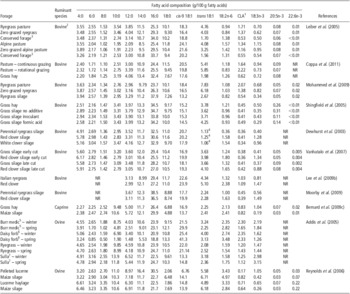
Replacing grass silage with red clover silage consistently increases 18:2n-6 and 18:3n-3 in milk and often lowers 4- to 18-carbon SFA concentrations (Dewhurst et al., Reference Dewhurst, Shingfield, Lee and Scollan2006; Vanhatalo et al., Reference Vanhatalo, Kuoppala, Toivonen and Shingfield2007; Lourenço et al., Reference Lourenço, Vlaeminck, Van Ranst, De Smet and Fievez2008; Table 3). Replacing grass silage, grass hay or conserved lucerne with maize silage has variable effects on milk SFA content, but typically increases trans 18:1 and 18:2n-6 and lowers 18:3n-3 concentrations (Chilliard et al., Reference Chilliard, Glasser, Ferlay, Bernard, Rouel and Doreau2007; Kliem et al., Reference Kliem, Morgan, Humphries, Shingfield and Givens2008; Bernard et al., Reference Bernard, Shingfield, Rouel, Ferlay and Chilliard2009c). Compared with lowland pastures, milk from cows fed botanical diverse pastures typically contains lower 4:0 to 16:0 and higher 18:2n-6 and 18:3n-3 concentrations (Table 3).
Effect of forage species, conservation method and herbage maturity on the fatty acid composition of ruminant milk

1Cis-9, trans-11 conjugated linoleic acid.
2Milk fatty acid concentrations reported as g/100 g fatty acid methyl esters.
3Conserved forage comprised a mixture of ryegrass silage, maize silage and grass hay fed in a ratio of 10 : 60 : 30 on a dry matter basis.
4Concentration of trans-11 18:1.
5Medicago polymorpha L.
6Chrysanthemum coronarium L.
7Hedysarum coronarium L.
NR, not reported.
Milk from grazing ruminants contains lower proportions of SFA and higher trans-11 18:1, cis-9, trans-11 CLA, 18:2n-6 and 18:3n-3 concentrations compared with dried or ensiled forages (Table 3). Effects on milk fat composition occur in direct relation to the amount of dietary energy from pasture, with the extent of 18:2n-6 and 18:3n-3 enrichment being related to grass maturity and lipid content (Dewhurst et al., Reference Dewhurst, Shingfield, Lee and Scollan2006; Chilliard et al., Reference Chilliard, Glasser, Ferlay, Bernard, Rouel and Doreau2007). Comparisons of milk composition from cows at pasture or housed indoors and offered chopped grass harvested from the same sward (Leiber et al., Reference Leiber, Kreuzer, Nigg, Wettstein and Scheeder2005; Mohammed et al., Reference Mohammed, Stanton, Kennelly, Kramer, Mee, Glimm, O'Donovan and Murphy2009) highlight that the effects of pasture on milk fat composition are not explained solely by differences in PUFA intake. Comparisons of milk fat composition in cows fed diets based on grass hay or grass silages indicate that drying rather than ensiling has relatively minor effects on most fatty acids, but consistently increases 18:3n-3 concentrations (Shingfield et al., Reference Shingfield, Salo-Väänänen, Pahkala, Toivonen, Jaakkola, Piironen and Huhtanen2005; Dewhurst et al., Reference Dewhurst, Shingfield, Lee and Scollan2006; Chilliard et al., Reference Chilliard, Glasser, Ferlay, Bernard, Rouel and Doreau2007).
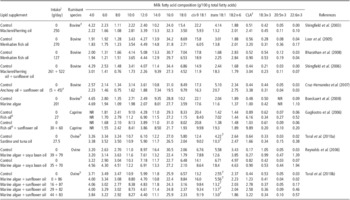
Dietary plant oil or oilseed supplements are known to alter the fatty acid composition of ruminant milk (Chilliard et al., Reference Chilliard, Glasser, Ferlay, Bernard, Rouel and Doreau2007; Glasser et al., Reference Glasser, Ferlay and Chilliard2008a; Shingfield et al., Reference Shingfield, Chilliard, Toivonen, Kairenius and Givens2008b). The extent to which plant oils or oilseeds alter milk fatty acid composition is dependent on several factors including the amount of oil included in the diet, fatty acid profile of the lipid supplement, form of lipid in the diet, and/or processing of oilseeds and the composition of the basal diet (Table 4). Plant oils or oilseeds in the diet result in dose-dependent decreases in the concentration and secretion of 10- to 16-carbon fatty acids, with no major differences in medium-chain SFA concentration responses to oils enriched in cis-9 18:1, 18:2n-6 or 18:3n-3 (Table 4). Such changes do not occur in isolation, but are also accompanied by increases in the relative abundance of 18:0, cis-9 18:1 and total trans 18:1 concentrations (Table 4).
Effect of dietary plant oil and oilseed supplements on the fatty acid composition of ruminant milk

LH = lucerne hay; LS = lucerne silage; BS = barley silage; RCS = red clover silage; MS = maize silage; GS = grass silage; GH = grass hay.
1Intake of oil from dietary lipid supplements.
2Dietary forage : concentrate ratio (on a dry matter basis). For studies in grazing cows, the amount of concentrate supplements fed (kg/day) is reported in parentheses.
3Cis-9, trans-11 conjugated linoleic acid.
4Fatty acid concentrations reported as g/100 g fat.
5Fatty acid concentrations reported as g/100 g fatty acid methyl esters.
NR, not reported.
On typical diets, concentrations of 18:2n-6 in bovine, caprine and ovine milk vary between 2.0 and 3.0 g/100 g fatty acids. Even when diets containing relatively high amounts of soya bean, sunflower or safflower oil are fed, enrichment of 18:2n-6 in ruminant milk is marginal and rarely exceeds 3.5 g/100 g fatty acids (Table 4). The potential to enrich 18:3n-3 in ruminant milk is also limited (mean responses 0.1 to 0.9 g/100 g fatty acids) even when oils or oilseeds enriched in 18:3n-3 are fed (Table 4).
Ruminant milk typically contains < 0.1 g of 20:5n-3/100 g fatty acids and trace amounts of 22:6n-3 (Table 5). Numerous experiments have examined the use of dietary fish oil, fishmeal or marine algae supplements to increase 20:5n-3 and 22:6n-3 in ruminant milk. Irrespective of the source of marine lipid, composition of basal diet or ruminant species studied, combined enrichment of 20:5n-3 and 22:6n-3 in milk fat rarely exceeds 1.2 g/100 g fatty acids (Table 5).
Effect of dietary fish oil and marine algae supplements on the fatty acid composition of ruminant milk

1Intake of oil from dietary lipid supplements.
2Cis-9, trans-11 conjugated linoleic acid.
3Fatty acid concentrations corrected for the effects of ruminal infusions of the lithium salt of cobalt ethylenediaminetetraacetic acid (Shingfield et al., Reference Shingfield, Ärölä, Ahvenjärvi, Vanhatalo, Toivonen, Griinari and Huhtanen2008a).
4Intake of lipid supplements not reported. Concentrations of oil in the diet (g/kg diet dry matter) indicated in parentheses.
5Fatty acid concentrations reported as g/100 g fatty acid methyl esters.
6Fish species not reported.
7Under the specified conditions of analysis cis-11 18:1 co-elutes with trans-15 18:1 and trans-16 18:1 and cis-14 18:1 elute as a single peak.
NR, not reported.
Genetic approaches to altering milk fat composition
It is well established that the milk fat content differs between cattle breeds. Selection for milk fat percentage typically increases the proportion of fatty acids synthesized de novo and 16:0 content and decreases 18-carbon fatty acid concentrations (Arnould and Soyeurt, Reference Arnould and Soyeurt2009). Even within breed, prolonged genetic selection for milk yield in Holstein–Friesians has in certain populations been associated with a decrease in milk fat 6:0, 8:0, 10:0, 12:0, 14:0 and 16:0 content and higher cis-9 18:1 concentrations (Arnould and Soyeurt, Reference Arnould and Soyeurt2009).
Developing effective breeding programmes for altering milk fat composition is dependent on the existence of genetic variation, estimation of genetic parameters, a mechanism for selection and sufficient economic incentives. Recent estimates of the heritability of milk fatty acid concentrations (Table 6) highlight the possibility to make further progress through breeding, although the impact of selection for milk fat composition on other economically important production, reproduction and health traits remains uncertain. More rapid progress towards the production of milk containing lower SFA and higher unsaturated fatty acid concentrations could be expected through the identification of polymorphisms of individual genes involved in milk fat synthesis. Consistent and significant associations have been reported between single-nucleotide polymorphisms (SNP) for diacylglycerol acyltransferase 1 (DGAT1) and SCD with milk fat composition traits, specifically the concentrations of medium-chain SFA and cis-9 containing unsaturated fatty acids in cattle (Arnould and Soyeurt, Reference Arnould and Soyeurt2009; Conte et al., Reference Conte, Mele, Chessa, Castiglioni, Serra, Pagnacco and Secchiari2010; Bouwman et al., Reference Bouwman, Bovenhuis, Visker and van Arendonk2011) and goats (Zidi et al., Reference Zidi, Fernández-Cabanás, Urrutia, Carrizosa, Polvillo, González-Redondo, Jordana, Gallardo, Amills and Serradilla2010). Available data suggest that polymorphism of the bovine SREBP1 gene is not significantly associated with milk fatty acid composition (Conte et al., Reference Conte, Mele, Chessa, Castiglioni, Serra, Pagnacco and Secchiari2010).
Heritability of individual fatty acids in bovine milk

1Cis-9, trans-11 conjugated linoleic acid.
2Population (%) included primiparous and multiparous cows of the Brown Swiss (2.90), Belgian Blue (12.3), Holstein–Friesian (45.4), Jersey (3.92), Montbeliarde (11.2), Normande (13.1), Meuse-Rhine-Yseel Red and White (4.31) breeds and those of unknown genetic origin (6.85).
3Fatty acid concentrations expressed as g/100 g fat.
4Heritability estimate of total trans fatty acid concentrations.
NR, not reported.
Altering the fatty acid composition of ruminant meat
Potential to alter muscle lipid composition
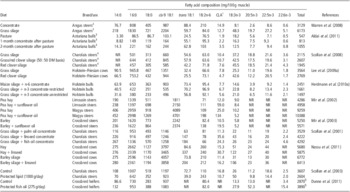
The potential to alter the fatty acid composition of muscle lipids is to a large extent determined by the extent of lipolysis and biohydrogenation of dietary lipids in the rumen. Reports on the recovery of post-ruminal infusions of oil in ruminant tissues are scarce. Infusion of linseed oil at the duodenum was reported to increase 18:3n-3 concentrations in bovine muscle from 0.7 to 7.6 g/100 g fatty acids (Bauchart et al., unpublished cited by Doreau et al., Reference Doreau, Bauchart and Chilliard2011). More recently, the influence of continous 42-day abomasal infusions of a control oil (3 : 2 w/w mixture of cotton seed oil and olive oil) or fish oil at a rate equivalent to 40 g/kg dry matter intake on muscle lipid composition was examined in growing crossbred steers (Fortin et al., Reference Fortin, Julien, Couture, Dubreuil, Chouinard, Latulippe, Davis and Thivierge2010). Compared with the control, administration of fish oil increased the concentration of 20:5n-3 and 22:6n-3 in muscle total membrane PL from 4.4 and 0.96 to 13.6 and 3.9 g/100 g fatty acids, respectively, and induce more than 8-fold increase in the sum of 20:5n-3, 22:5n-3 and 22:6n-3 of muscle TAG. As a result of the enrichment of both PL and TAG fractions, total long-chain n-3 PUFA content increased from 23.2 to 60.1 mg/100 g muscle. Responses to dietary rumen protected lipid supplements have also demonstrated the biological potential to alter meat fatty acid composition. In growing cattle, supplements of formaldehyde-treated soya bean and a mixture of sunflower oil and linseed oil (n-6 : n-3 ratio of 2.4 : 1) increased tissue 18:3n-3 content relative to unprotected linseed, but the incorporation of 18:2n-6 was much higher (Table 7). Feeding a similar type of supplement with a n-6 : n-3 PUFA ratio of 1 : 1 resulted in greater deposition of 18:3n-3 relative to 18:2n-6, leading to a relatively high 18:3n-3 content (ca. 130 mg/100 g muscle; refer to Scollan et al., Reference Scollan, Hocquette, Nuernberg, Dannenberger, Richardson and Moloney2006). In both studies, no effects on the abundance of longer 20-carbon chain PUFA were observed. However, rumen-protected fish oil supplements can be used to increase 20:5n-3 and 22:6n-3 concentrations several-fold and lower the n-6 : n-3 ratio of lamb and beef (Gulati et al., Reference Gulati, Garg and Scott2005; Dunne et al., Reference Dunne, Rogalski, Childs, Monahan, Kenny and Moloney2011).
Effect of forage species, plant oils and rumen protected lipid supplements on the fatty acid composition of muscle (mg/100 g muscle) in growing cattle

DM = dry matter.
1Cis-9, trans-11 conjugated linoleic acid.
2Data for 19-month-old cattle.
3Fatty acid content expressed as mg fatty acid methyl ester/100 g muscle.
4Silage offered ad libitum for 120 days followed by 100 days grazing on perennial ryegrass pastures.
5Chemical determinations of intramuscular fat.
NR, not reported.
Nutritional approaches to altering muscle fatty acid composition
Consistent with the nutritional strategies known to influence milk fat composition, the majority of studies in growing ruminants have examined the potential of forage species, forage conservation method and dietary plant oils, oilseeds, fish oil and marine algae supplements to alter muscle fatty acid composition (Table 7). However, in contrast to milk, it is possible to influence the abundance of 20-carbon PUFA in tissue PL by supplementing the diet with sources of 18:2n-6 and 18:3n-3, as well as dietary supplements containing 20-carbon PUFA (Table 7).
Rearing cattle or lambs on pasture rather than concentrate-based diets increases 18:3n-3 and the longer-chain derivatives 20:5n-3 and 22:6n-3 in the PL fraction of muscle (Aurousseau et al., Reference Aurousseau, Bauchart, Calichon, Micol and Priolo2004; Nuernberg et al., Reference Nuernberg, Nuernberg, Ender, Dannenberger, Schabbel, Grumbach, Zupp and Steinhart2005; Warren et al., Reference Warren, Scollan, Enser, Hughes, Richardson and Wood2008), reflecting the opportunity for elongation and desaturation of 18:3n-3 in ruminant tissues. Recent investigations have identified mRNA encoding the elongase and desaturase responsible in bovine tissues (Cherfaoui et al., Reference Cherfaoui, Durand, Bonnet, Cassar-Malek, Bauchart, Thomas and Gruffat2012). Concentrates rich in 18:2n-6 result in higher concentrations of 18:2n-6 and associated longer-chain derivatives in the muscle of cattle (Warren et al., Reference Warren, Scollan, Enser, Hughes, Richardson and Wood2008; Aldai et al., Reference Aldai, Dugan, Kramer, Martínez, López-Campos, Mantecón and Osoro2011; Juárez et al., Reference Juárez, Dugan, Aalhus, Aldai, Basarab, Baron and McAllister2011) and sheep (Nuernberg et al., Reference Nuernberg, Nuernberg, Ender, Dannenberger, Schabbel, Grumbach, Zupp and Steinhart2005; Radunz et al., Reference Radunz, Wickersham, Loerch, Fluharty, Reynolds and Zerby2009; Turner et al., Reference Turner, Karlsson, Mapiye, Rolland, Martinsson and Dugan2012a).
Both the amount of grass and duration of rearing on pasture has been shown to influence the potential to enrich 18:3n-3, 20:5n-3 and 22:6n-3 in bovine muscle (French et al., Reference French, Stanton, Lawless, O'Riordan, Monahan, Caffrey and Moloney2000; Noci et al., Reference Noci, Monahan, French and Moloney2005a; Alfaia et al., Reference Alfaia, Alves, Martins, Costa, Fontes, Lemos, Bessa and Prates2009). Conversely, feeding concentrates for a 2-month finishing period was shown to lower the proportion of n-3 and increase the abundance of n-6 PUFA (Aldai et al., Reference Aldai, Dugan, Kramer, Martínez, López-Campos, Mantecón and Osoro2011). Compared with finishing on high-concentrate diets, rearing of cattle or lambs on forage-based systems is often associated with a decrease in muscle 16:0 and total SFA and higher cis-9 18:1 concentrations (Scollan et al., Reference Scollan, Hocquette, Nuernberg, Dannenberger, Richardson and Moloney2006; Sinclair, Reference Sinclair2007; Alfaia et al., Reference Alfaia, Alves, Martins, Costa, Fontes, Lemos, Bessa and Prates2009; Aldai et al., Reference Aldai, Dugan, Kramer, Martínez, López-Campos, Mantecón and Osoro2011). Replacing grass silage with whole-crop wheat silage (Noci et al., Reference Noci, O'Kiely, Monahan, Stanton and Moloney2005b) or maize silage (Smith et al., Reference Smith, Gill, Lunt and Brooks2009) increased in the n-6 : n-3 ratio of muscle, whereas wilting grass before ensiling decreased this ratio (Noci et al., Reference Noci, Monahan, Scollan and Moloney2007b). Substituting grass silage with red clover silage increased 18:2n-6 and 18:3n-3 content of muscle (Sinclair, Reference Sinclair2007; Lee et al., Reference Lee, Evans, Nute, Richardson and Scollan2009a), but the higher content of 18:3n-3 due to red clover or lucerne in the diet is not associated with higher 20:5n-3 and 22:6n-3 enrichment (Table 7). Rearing cattle on concentrate containing linseeds increases 18:3n-3 in muscle and the longer-chain derivative 20:5n-3, but not necessarily 22:6n-3 (Noci et al., Reference Noci, French, Monahan and Moloney2007a; Herdmann et al., Reference Herdmann, Martin, Nuernberg, Wegner, Dannenberger and Nuernberg2010a; Nassu et al., Reference Nassu, Dugan, He, McAllister, Aalhus, Aldai and Kramer2011; Table 7). In several studies, linseeds also lowered the proportion of 16:0 in IMF (Noci et al., Reference Noci, French, Monahan and Moloney2007a; Herdmann et al., Reference Herdmann, Martin, Nuernberg, Wegner, Dannenberger and Nuernberg2010a; Nassu et al., Reference Nassu, Dugan, He, McAllister, Aalhus, Aldai and Kramer2011). Dietary supplements of oils and oilseeds enriched in 18:3n-3 induce similar changes in muscle fatty acid composition of growing lambs (Bessa et al., Reference Bessa, Alves, Jerónimo, Alfaia, Prates and Santos-Silva2007; Sinclair, Reference Sinclair2007; Turner et al., Reference Turner, Karlsson, Mapiye, Rolland, Martinsson and Dugan2012a).
A number of studies have examined the potential of feeding concentrates containing fish oil or marine algae to enrich 20:5n-3 and 22:6n-3 in muscle of growing cattle and lambs. Despite extensive biohydrogenation in the rumen changes in the abundance of long-chain PUFA in muscle reflects the fatty acid profile of dietary marine lipid supplements. Even though fish oil can be used to lower the n-6 : n-3 ratio, increases in the PUFA : SFA are often marginal (0.10 to 0.15). Given that 20-carbon n-3 fatty acids are incorporated mainly into PL rather than TAG, it is possible to enrich these PUFA in muscle without increases in fatness per se. Depending on the source and amount of fish oil supplement, concentrations of 20:5n-3 and 22:6n-3 in muscle can be increased by up to 2.33 and 2.55 g/100 g fatty acids, respectively (Scollan et al., Reference Scollan, Hocquette, Nuernberg, Dannenberger, Richardson and Moloney2006; Sinclair, Reference Sinclair2007; Noci et al., Reference Noci, Monahan, Scollan and Moloney2007b).
Potential to alter ruminant muscle composition through genetic selection
Genetics have a much lower influence on muscle PUFA composition in growing ruminants compared with nutrition, whereas age of the animal and breed type specifically affect the concentration of MUFA in beef by affecting SCD gene expression and activity (Smith et al., Reference Smith, Gill, Lunt and Brooks2009). Nevertheless, in cattle or sheep fed the same diet and slaughtered at a similar proportion of mature live weight, differences in the abundance of n-3 and n-6 PUFA in muscle between breeds have been identified (Sinclair, Reference Sinclair2007; Warren et al., Reference Warren, Scollan, Enser, Hughes, Richardson and Wood2008), confirming the importance of genetic factors in regulating IMF composition. The use of high-throughput DNA sequencing techniques, microarray technologies and protein analysis has facilitated the discovery of single SNP for several candidate genes involved in adipogenesis in cattle.
Comparisons of the full-length bovine SCD complementary DNA sequences of Japanese Black cattle revealed the occurrence of eight nucleotide substitutions, three in the protein coding region and five in the 3′ untranslated region (Taniguchi et al., Reference Taniguchi, Mannen, Oyama, Shimakura, Oka, Watanabe, Kojima, Komatsu, Harper and Tsuji2004). Nucleotide substitutions at 878 bp in the protein coding region correspond to valine replacing alanine in the SCD1 protein (Taniguchi et al., Reference Taniguchi, Mannen, Oyama, Shimakura, Oka, Watanabe, Kojima, Komatsu, Harper and Tsuji2004). The three SNPs detected in the protein coding region were shown to be linked, constituting two variants of the SCD gene, type V and A. Genotyping of 1003 Japanese Black steers revealed significant differences in IMF total MUFA concentrations between SCD genotypes, with the average effect of substitution for the SCD type A gene being associated with 0.81 g/100 g higher MUFA concentration (Taniguchi et al., Reference Taniguchi, Mannen, Oyama, Shimakura, Oka, Watanabe, Kojima, Komatsu, Harper and Tsuji2004). Genotyping for three SNPs in the 3′ untranslated region of the SCD gene for a reference Wagyu × Limousin F2 population also revealed that the high SCD alleles were associated with on average −1.76, +1.29 and 0.26 g/100 g differences in muscle SFA, MUFA and PUFA concentrations, respectively (Jiang et al., Reference Jiang, Michal, Tobey, Daniels, Rule and Macneil2008). Furthermore, there is increasing evidence of a positive association between muscle SCD mRNA abundance and MUFA concentrations (Smith et al., Reference Smith, Gill, Lunt and Brooks2009; Mannen, Reference Mannen2011), suggesting that differences in SCD expression contribute to the differences in muscle IMF composition between cattle breeds.
The bovine SREBP1 gene has also been sequenced. Although no mutation was identified in exon regions, a 84 bp insertion (long type, L) and a deletion (short type, S) in intron 5 of bovine SREBP1 was detected (Hoashi et al., Reference Hoashi, Ashida, Ohsaki, Utsugi, Sasazaki, Taniguchi, Oyama, Mukai and Mannen2007). Genotyping of 606 Japanese Black cattle reported that the SS genotype exhibited on average 1.3 g/100 g higher muscle MUFA concentration compared with the LL genotype (Hoashi et al., Reference Hoashi, Ashida, Ohsaki, Utsugi, Sasazaki, Taniguchi, Oyama, Mukai and Mannen2007). Sequencing of four exons that encode for the thioesterase domain located at the 3′ end of the bovine FAS gene revealed three SNPs, one that was predicted to result in threonine being replaced with alanine in the FAS protein and the other two being silent (Zhang et al., Reference Zhang, Knight, Reecy and Beitz2008). Among the three SNPS identified, two were significantly associated with the concentrations of PL, TAG and total lipid in muscle. Genotyping of 331 Angus bulls indicated that the SNP predicted to cause an amino acid substitution was associated with −0.40, −0.81, +1.89, −1.0 and +1.45 g/100 g differences in the concentration of 14:0, 16:0, total 18:1, SFA, MUFA concentrations in IMF, respectively (Zhang et al., Reference Zhang, Knight, Reecy and Beitz2008).
Further investigations have reported several SNP in the bovine ACSL1 (n = 3), FABP4 (n = 4), LXRα (n = 4) and ACC (n = 8) genes, but none for ACSL4 and DGAT2 (Hoashi et al., Reference Hoashi, Hinenoya, Tanaka, Ohsaki, Sasazaki, Taniguchi, Oyama, Mukai and Mannen2008; Zhang et al., Reference Zhang, Knight, Reecy, Wheeler, Shackelford, Cundiff and Beitz2010). Genotyping of single or multiple breeds has provided evidence that polymorphisms of the ACC, FABP4 and LXRα gene are associated with alterations in bovine muscle fatty acid composition (Hoashi et al., Reference Hoashi, Hinenoya, Tanaka, Ohsaki, Sasazaki, Taniguchi, Oyama, Mukai and Mannen2008; Zhang et al., Reference Zhang, Knight, Reecy, Wheeler, Shackelford, Cundiff and Beitz2010).
Although the association between polymorphisms of single candidate genes on muscle lipid composition may appear small, most have been determined for highly controlled reference populations used for progeny testing. When extending these investigations on commercial Japanese Black populations, both the SCD and FAS genotype have been significantly associated with 14:0, cis-9 14:1, 18:0 and cis-9 18:1 concentrations, whereas no effect of the SREBP1 genotype has been detected (Ohsaki et al., Reference Ohsaki, Tanaka, Hoashi, Sasazaki, Oyama, Taniguchi, Mukai and Mannen2009; Matsuhashi et al., Reference Matsuhashi, Maruyama, Uemoto, Kobayashi, Mannen, Abe, Sakaguchi and Kobayashi2011). Elucidating the role of other genes involved in tissue lipogenesis can be expected leading to the possibility of developing DNA tests to select for muscle fatty acid composition and the identification of molecular markers for predicting the potential of individual animals to produce meat of a specific lipid composition.
TFA content of ruminant-derived foods
The impact of TFA from ruminant-derived foods on the development of human chronic diseases is uncertain (Shingfield et al., Reference Shingfield, Chilliard, Toivonen, Kairenius and Givens2008b; Gebauer et al., Reference Gebauer, Jean-Michel Chardigny, Jakobsen, Lamarche, Lock, Proctor and Baer2011). However, understanding the changes in TFA abundance and isomer distribution on diets formulated to lower SFA and/or increase PUFA in meat and milk remains an important research priority, allowing the ruminant livestock industry to respond once more biomedical and clinical data become available.
Trans-monoenoic fatty acids
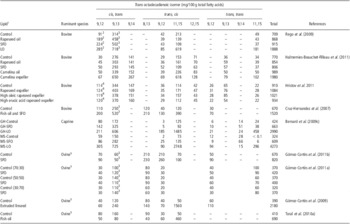
Ruminant-derived foods contain a diverse range of unsaturated fatty acids containing a single trans double bond that originate from ruminal biohydrogenation of unsaturated fatty acids. Trans 18:1 isomers are quantitatively the most important in ruminant meat and milk fat. Although numerous isomers with double bonds in positions Δ4 to Δ16 are present, trans-11 18:1 is typically the most abundant in milk and meat of grazing ruminants or on diets containing high proportions of grass silage or ensiled forage legumes (Nuernberg et al., Reference Nuernberg, Nuernberg, Ender, Dannenberger, Schabbel, Grumbach, Zupp and Steinhart2005; Bessa et al., Reference Bessa, Alves, Jerónimo, Alfaia, Prates and Santos-Silva2007; Vanhatalo et al., Reference Vanhatalo, Kuoppala, Toivonen and Shingfield2007; Table 8). Concentrations of trans-18:1 are higher in milk from pasture compared with conserved forages (Table 3) and tend to be increased on high-concentrate diets (Chilliard et al., Reference Chilliard, Glasser, Ferlay, Bernard, Rouel and Doreau2007; Table 4).
Effect of diet composition on trans 18:1 isomer concentrations in ruminant milk

1Forage : concentrate ratio of the diet (on a dry matter basis).
2Intake of oil from dietary lipid supplements.
3Individual isomers unable to be resolved during gas chromatography analysis.
4Includes cis-14 18:1 as a minor isomer.
5Also contains unresolved cis-11 18:1.
6Fatty acid concentrations reported as g/100 g fat.
7Fatty acid concentrations reported as g/100 g fatty acid methyl esters.
8Amount of lipid supplementation (g/kg diet dry matter) indicated in parenthesis.
NR, not reported.
Dietary plant oil, oilseed and marine lipid supplements increase the content of trans 18:1 in milk (Tables 4 and 5) and muscle (Table 7), and alter the abundance of specific isomers in lamb (Bessa et al., Reference Bessa, Alves, Jerónimo, Alfaia, Prates and Santos-Silva2007; Radunz et al., Reference Radunz, Wickersham, Loerch, Fluharty, Reynolds and Zerby2009; Turner et al., Reference Turner, Karlsson, Mapiye, Rolland, Martinsson and Dugan2012a), beef (Juárez et al., Reference Juárez, Dugan, Aalhus, Aldai, Basarab, Baron and McAllister2011; Nassu et al., Reference Nassu, Dugan, He, McAllister, Aalhus, Aldai and Kramer2011; Mapiye et al., Reference Mapiye, Aldai, Turner, Aalhus, Rolland, Kramer and Dugan2012) and milk (Rego et al., Reference Rego, Alves, Antunes, Rosa, Alfaia, Prates, Cabrita, Fonseca and Bessa2009; Halmemies-Beauchet-Filleau et al., Reference Halmemies-Beauchet-Filleau, Kokkonen, Lampi, Toivonen, Shingfield and Vanhatalo2011; Hristov et al., Reference Hristov, Domitrovich, Wachter, Cassidy, Lee, Shingfield, Kairenius, Davis and Brown2011; Table 8). Dietary supplements enriched in cis-9 18:1, 18:2n-6 and 18:3n-3 can be expected to alter the distribution of 18:1 isomers and result in the specific enrichment of trans 6-8, trans 10-12, and trans-11-16, respectively (Chilliard et al., Reference Chilliard, Glasser, Ferlay, Bernard, Rouel and Doreau2007; Shingfield et al., Reference Shingfield, Chilliard, Toivonen, Kairenius and Givens2008b; Table 8). Increases in trans 18:1 in response to fish oil and marine lipid supplements are associated with elevated trans-6 to -15 18:1 concentrations and decrease in trans-16 18:1 abundance (Table 8). On low-forage diets or high-concentrate diets containing plant oils or marine lipids, trans-10 18:1 often replaces trans-11 18:1 as the major TFA in muscle (Shingfield and Griinari, Reference Shingfield and Griinari2007; Radunz et al., Reference Radunz, Wickersham, Loerch, Fluharty, Reynolds and Zerby2009; Turner et al., Reference Turner, Karlsson, Mapiye, Rolland, Martinsson and Dugan2012a) and milk fat (Table 8).
Trans-polyenoic fatty acids
Ruminant milk and meat contains several non-conjugated trans 18:2 fatty acids, but the concentration and isomer distribution differs compared with hydrogenated plant oils, margarines and edible oils (Shingfield et al., Reference Shingfield, Chilliard, Toivonen, Kairenius and Givens2008b; Table 9). On typical diets containing no additional lipid supplements, total trans 18:2 in ruminant milk varies between 0.32 to 0.91 g/100 g fatty acids, but concentrations can approach or exceed 2.0 g/100 g fatty acids when plant oil or oilseeds are fed (Bernard et al., Reference Bernard, Shingfield, Rouel, Ferlay and Chilliard2009c; Gómez-Cortès et al., Reference Gómez-Cortés, Tyburczy, Brenna, Juárez and de la Fuente2009; Rego et al., Reference Rego, Alves, Antunes, Rosa, Alfaia, Prates, Cabrita, Fonseca and Bessa2009; Table 9). Trans-11, cis-15 18:2 is the major trans 18:2 isomer in milk from diets based on grass silage, grass hay or red clover silage (Bernard et al., Reference Bernard, Shingfield, Rouel, Ferlay and Chilliard2009c; Mohammed et al., Reference Mohammed, Stanton, Kennelly, Kramer, Mee, Glimm, O'Donovan and Murphy2009; Halmemies-Beauchet-Filleau et al., Reference Halmemies-Beauchet-Filleau, Kokkonen, Lampi, Toivonen, Shingfield and Vanhatalo2011), whereas cis-9, trans-13 18:2 is the most abundant isomer on diets based on maize silage, a mixture of barley silage, lucerne silage and lucerne hay or containing high proportions of concentrates (Shingfield et al., Reference Shingfield, Chilliard, Toivonen, Kairenius and Givens2008b; Bernard et al., Reference Bernard, Shingfield, Rouel, Ferlay and Chilliard2009c; Hristov et al., Reference Hristov, Domitrovich, Wachter, Cassidy, Lee, Shingfield, Kairenius, Davis and Brown2011).
Effect of dietary lipid supplements on the concentration of non-conjugated trans octadecadienoic fatty acids in ruminant milk

SFO = sunflower oil; LO = linseed oil; GH = grass hay; MS = maize silage.
2Detected as a mixture with trans-8, cis-12 18:2.
3Co-elutes with trans-8, cis-13 18:2.
4Detected as a mixture with cis-16 18:1 and trans-8, cis-12 18:2.
5Concentrations reported as g/100 g fatty acid methyl esters.
Collectively, trans 18:2 typically account for ca. 0.51 to 0.70 g/100 g total fatty acids in ruminant muscle with an isomer distribution similar to milk fat (Bessa et al., Reference Bessa, Alves, Jerónimo, Alfaia, Prates and Santos-Silva2007; Aldai et al., Reference Aldai, Dugan, Kramer, Martínez, López-Campos, Mantecón and Osoro2011; Juárez et al., Reference Juárez, Dugan, Aalhus, Aldai, Basarab, Baron and McAllister2011; Nassu et al., Reference Nassu, Dugan, He, McAllister, Aalhus, Aldai and Kramer2011). Supplementing the diet of growing lambs or cattle with oilseeds or plant oils increases total trans 18:2 to concentrations of ca. 3.0 g/100 g total fatty acids (Bessa et al., Reference Bessa, Alves, Jerónimo, Alfaia, Prates and Santos-Silva2007; Juárez et al., Reference Juárez, Dugan, Aalhus, Aldai, Basarab, Baron and McAllister2011; Nassu et al., Reference Nassu, Dugan, He, McAllister, Aalhus, Aldai and Kramer2011). Most trans 18:2 in milk and meat originate from ruminal biohydrogenation of 18-carbon PUFA, but there is evidence that cis-9, trans-12 18:2 and cis-9, trans-13 18:2 are also synthesized endogenously in ruminant tissues (Shingfield et al., Reference Shingfield, Chilliard, Toivonen, Kairenius and Givens2008b).
Conjugated fatty acids
The effects of diet composition on the concentration and relative abundance of CLA isomers in ruminant milk and meat are well documented (Chilliard et al., Reference Chilliard, Glasser, Ferlay, Bernard, Rouel and Doreau2007; Martins et al., Reference Martins, Lopes, Alfaia, Ribeiro, Guerreiro, Fontes, Castro, Soveral and Prates2007; Shingfield et al., Reference Shingfield, Chilliard, Toivonen, Kairenius and Givens2008b). Although ruminant foods contain numerous positional and geometric isomers with a conjugated bond system located between Δ6,8 and Δ13,15, cis-9, trans-11 is the major isomer due, in most part, to endogenous synthesis via the action of SCD on trans-11 18:1 (Palmquist et al., Reference Palmquist, Lock, Shingfield and Bauman2005).
Nutritional strategies to increase cis-9, trans-11 CLA in ruminant meat and milk include replacing conserved forages with fresh grass or dietary supplements of oils and oilseeds enriched in 18:2n-6 and 18:3n-3, fish oil or marine algae (Tables 3 to 5 and 7). Supplements of marine algal lipids or fish oil in the diet are more effective than plant oils or oilseeds for enhancing cis-9, trans-11 CLA concentrations in milk fat. Enrichment of CLA in milk in ruminants fed fish oil or marine algae can be increased yet further when diets contain plant oils rich in 18:2n-6 (Table 5). Although the combined use of marine lipids and plant oils is an effective means for increasing milk fat cis-9, trans-11 CLA content, there is considerable variation in the response, owing to a number of factors, including breed, composition of the basal ration, relative proportions of oil sources and time on diet. Supplementing a wheat pasture-based diet with fish oil (30 ml/day) and sunflower oil (150 ml/day) was reported to increase milk cis-9, trans-11 CLA concentrations in goats from 1.03 to 9.89 g/100 g fatty acids after 14 days on diet (Gagliostro et al., Reference Gagliostro, Rodriguez, Pellegrini, Gatti, Muset, Castañeda, Colombo and Chilliard2006), which represents the highest enrichment reported in ruminant milk. Studies with growing lambs and cattle have shown that dietary lipid supplements can be used to enrich cis-9, trans-11 CLA in muscle up to 2.40 g/100 g fatty acids (Sinclair, Reference Sinclair2007), whereas feeding Wagyu cattle diets supplemented with 60 g sunflower oil/kg diet dry matter cattle resulted in the highest reported cis-9, trans-11 CLA content of 134 mg/100 g muscle (Mir et al., Reference Mir, Mir, Kuber, Gaskins, Martin, Dodson, Calles, Johnson, Busboom, Wood, Pittenger and Reeves2002).
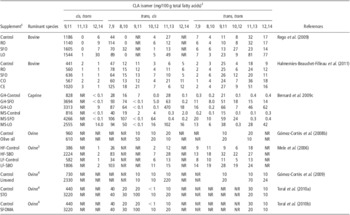
Detailed measurements of the CLA isomer distribution in ruminant milk indicate that supplementing the diet with sources of cis-9 18:1 increases trans-7, cis-9 CLA concentrations, 18:2n-6 results in higher trans-8, cis-10 CLA, trans-10, cis-12 CLA, trans-9, trans-11 CLA, and trans-10, trans-12 CLA abundance, whereas 18:3n-3 leads to cis-11, trans-13 CLA, cis-12, trans-14 CLA, trans-11, cis-13 CLA, trans-9, trans-11 CLA, trans-11, trans-13 CLA and trans-12, trans-14 CLA enrichment (Chilliard et al., Reference Chilliard, Glasser, Ferlay, Bernard, Rouel and Doreau2007; Martins et al., Reference Martins, Lopes, Alfaia, Ribeiro, Guerreiro, Fontes, Castro, Soveral and Prates2007; Shingfield et al., Reference Shingfield, Chilliard, Toivonen, Kairenius and Givens2008b; Table 10).
Effect of dietary lipid supplements on the concentration of conjugated linoleic acid isomers in ruminant milk

CLA = conjugated linoleic acid; RO = rapeseed oil; SFO = sunflower oil; LO = linseed oil; CO = camelina oil; CE = camelina expeller; GH = grass hay; MS = maize silage; HF = high forage diet (75:25); SBO = soya bean oil; LF = low forage diet (60:40); STO = sardine and tuna oil; SFOMA = a mixture of marine algae and SFO fed at an inclusion rate of 24 and 25 g/kg diet dry matter.
2Ruminant milk fat may also contain trace amounts of cis-9, cis-11 CLA, cis-10, cis-12 CLA, cis-11, cis-13 CLA, cis-8, trans-10 CLA, cis-13, trans-15 CLA, trans-6, trans-8 CLA and trans-13, trans-15 CLA.
3Concentrations reported as mg/100 g fat.
4Concentrations reported as g/100 g fatty acid methyl esters.
NR, not reported.
Ruminant milk and meat also contain trace amounts of several conjugated linolenic acids (CLNA) that contain at least one conjugated bond (Destaillats et al., Reference Destaillats, Trottier, Galvez and Angers2005; Plourde et al., Reference Plourde, Destaillats, Chouinard and Angers2007; Gómez-Cortès et al., Reference Gómez-Cortés, Tyburczy, Brenna, Juárez and de la Fuente2009). Concentrations of cis-9, trans-11, cis-15 18:3 and cis-9, trans-11, trans-15 18:3 in milk for most diets are extremely low (6 to 30 and 10 to 14 mg/100 g total fatty acids, respectively), but increased several-fold when diets containing 18:3n-3 rich oils and oilseeds are fed (Gómez-Cortès et al., Reference Gómez-Cortés, Tyburczy, Brenna, Juárez and de la Fuente2009; Halmemies-Beauchet-Filleau et al., Reference Halmemies-Beauchet-Filleau, Kokkonen, Lampi, Toivonen, Shingfield and Vanhatalo2011; Hristov et al., Reference Hristov, Domitrovich, Wachter, Cassidy, Lee, Shingfield, Kairenius, Davis and Brown2011). Muscle of growing lambs was reported to contain negligible amounts of cis-9, trans-11, cis-15 18:3, whereas supplementing the diet with linseed oil over a 42-day finishing period resulted in concentrations of 329 mg/100 g total fatty acids (Bessa et al., Reference Bessa, Alves, Jerónimo, Alfaia, Prates and Santos-Silva2007). Bovine muscle contains between 50 to 239 and 105 mg/100 g total fatty acid methyl esters of cis-9, trans-11, cis-15 18:3 and cis-9, trans-13, cis-15 18:3, respectively, and trace amounts (20 mg/100 g total fatty acid methyl esters) of cis-9, trans-11, trans-15 18:3 (Plourde et al., Reference Plourde, Destaillats, Chouinard and Angers2007; Aldai et al., Reference Aldai, Dugan, Kramer, Martínez, López-Campos, Mantecón and Osoro2011; Nassu et al., Reference Nassu, Dugan, He, McAllister, Aalhus, Aldai and Kramer2011). Feeding diets containing ground linseed over a 140-day finishing period was shown to increase CLNA content of LT in beef cows by between 30 and 70 mg/100 g total fatty acid methyl esters, with evidence that enrichment of specific CLNA isomers is dependent on the composition of the basal diet (Nassu et al., Reference Nassu, Dugan, He, McAllister, Aalhus, Aldai and Kramer2011).
Molecular mechanisms and alterations of fatty acid composition of ruminant-derived foods
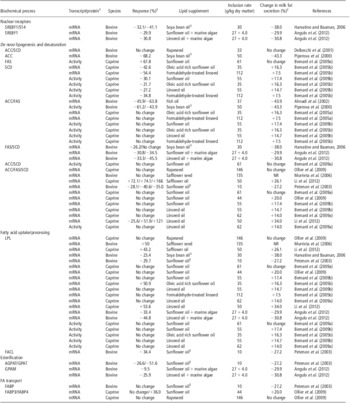
Synthesis of fatty acids in ruminant tissues and milk fat in the mammary gland requires efficient transcriptional, translation and secretory mechanisms that involve the coordinated and concerted action of multiple genes. Studies on the nutritional regulation of mammary lipogenesis in the bovine have almost exclusively been directed towards characterizing changes in the expression of a few candidate genes during diet-induced milk fat depression, rather than alterations in milk fat composition per se. Decreases in the proportion of milk fatty acids synthesized de novo and milk fat secretion on high-concentrate diets containing plant oils are known to be accompanied by a coordinate downregulation of mammary lipogenic gene expression (Table 11), which is thought to be partly mediated via the involvement of SREBP1c, S14 and PPARγ transcription factors (Bernard et al., Reference Bernard, Leroux and Chilliard2008; Harvatine et al., Reference Harvatine, Boisclair and Bauman2009; Shingfield et al., Reference Shingfield, Bernard, Leroux and Chilliard2010). However, in the absence of changes in milk fat synthesis, decreases in milk 8:0 to 16:0 content (−10.6%) and increases in 18:0 (+14.7%) and cis-9 18:1 (+16.6%) to dietary rapeseed supplements in cattle were not associated with changes in mammary ACC and SCD transcript abundance (Delbecchi et al., Reference Delbecchi, Ahnadi, Kennelly and Lacasse2001). Further studies are required to characterize mammary expression of lipogenic genes and gene networks for diets causing changes in milk fatty acid composition without altering milk fat synthesis.
Effect of dietary lipid supplements on mammary lipogenic gene expression and enzyme activity in ruminants

SREBF1 = sterol response element binding protein; S14 = thyroid hormone responsive spot 14; ACC = acetyl-CoA carboxylase; SCD = stearoyl-CoA desaturase; FAS = fatty acid synthase; LPL = lipoprotein lipase; FACL = fatty acyl CoA ligase; AGPAT = acylglycerol phosphate acyltransferase; GPAT = glycerol phosphate acyltransferase; GPAM = glycerol-3-phosphate acyltransferase 1; FABP = fatty acid binding protein.
1Measurement of tissue transcript abundance (mRNA) or protein activity (Activity).
2Response reported when treatment effects were significant (P < 0.10) and calculated as ((Treatment − Control)/Control × 100).
3Lipid supplementation also accompanied by decreases in dietary forage : concentrate ratio.
NR, not reported.
In goats, dietary plant oil and oilseed supplements typically stimulate milk fat synthesis lower milk fat 12:0 to 16:0 content and increase mammary 18-carbon unsaturated fatty acid secretion in milk (Chilliard et al., Reference Chilliard, Glasser, Ferlay, Bernard, Rouel and Doreau2007). Over a range of diets, changes in caprine milk fat composition are generally not accompanied by significant changes in mammary ACC, FAS and LPL mRNA abundance or activity (Table 11). However, high oleic or conventional sunflower oil, linseed oil and formaldehyde have in some, but not all cases, been reported to decrease mammary SCD mRNA and/or activity in goats fed grass hay-based diets (Table 11).
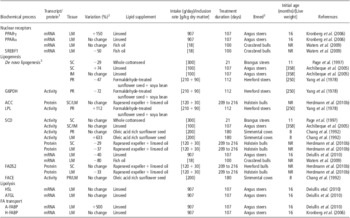
Fatty acids supplied by dietary lipid supplements are known to regulate gene expression in adipocytes in carcass and intramuscular adipose of growing and lactating ruminants (Hausman et al., Reference Hausman, Dodson, Ajuwon, Azain, Barnes, Guan, Jiang, Poulos, Sainz, Smith, Spurlock, Novakofski, Fernyhough and Bergen2009). In AT of growing cattle, lipogenesis from acetate de novo is decreased by oils rich in cis-9 18:1 and 18:2n-6, but increased by lipid supplements containing high proportions of 18:3n-3 (Table 12). These responses appear to be in direct contrast with the lipogenic and anti-lipogenic effects of 18:2n-6 and 18:3n-3, respectively, in rodents (Ailhaud et al., Reference Ailhaud, Guesnet and Cunnane2008; Flachs et al., Reference Flachs, Rossmeisl, Bryhn and Kopecky2009). However, ruminal biohydrogenation of PUFA results in the formation of numerous intermediates, including trans 18:1 and isomers of CLA capable of influencing adipocyte lipid metabolism. For example, trans-11 18:1 lowers lipogenesis de novo in rodent adipocytes (Cromer et al., Reference Cromer, Jenkins and Thies1995), whereas trans-10, cis-12 CLA was recently shown to decrease ACC protein abundance in differentiating primary bovine adipocytes (Lengi and Corl, Reference Lengi and Corl2010).
Effects of dietary lipid supplements on the expression of lipogenic genes, enzyme abundance and activity in adipose tissue and muscle of growing cattle

PPARγ = peroxisome proliferator-activated receptor gamma; LM = longissimus muscle; PPARα = peroxisome proliferator-activated receptor alpha; SREBF1 = sterol response element binding protein; SC = subcutaneous adipose tissue; IM = intramuscular adipose tissue; PR = perirenal adipose tissue; G6PDH = glucose-6-phosphate dehydrogenase; ACC = acetyl-CoA carboxylase; LPL = lipoprotein lipase; SCD = stearoyl-CoA desaturase; FADS2 = fatty acid desaturase 2 (Δ-6 desaturase); FACE = fatty acid elongase; HSL = hormone-sensitive lipase; ATGL = adipose triacylglyceride lipase; A-FABP = adipose fatty acid binding protein; H-FABP = heart-type fatty acid binding protein.
1Measurement of tissue transcript abundance (mRNA), protein abundance (Protein) or protein activity (Activity).
2Response reported when treatment effects were significant (P < 0.10) and calculated as ((Treatment−Control)/Control × 100).
3In vitro de novo lipogenesis from acetate.
NR, not reported.
The stimulatory effect of ground linseeds on de novo lipogenesis in subcutaneous, but not intramuscular AT (Archibeque et al., Reference Archibeque, Lunt, Gilbert, Tume and Smith2005) differs to the decrease in TAG accumulation within AT of rodents fed diets containing 18:3n-3 (Ailhaud et al., Reference Ailhaud, Guesnet and Cunnane2008; Flachs et al., Reference Flachs, Rossmeisl, Bryhn and Kopecky2009). In rodent AT, the inhibitory effects of 18:3n-3 arise because of the induction of PPARα-mediated FA oxidation and lipolysis. Thus far, PPARα expression has not been reported for bovine AT, and the effect of n-3 PUFA on lipolysis remains to be determined. Given its important role on converting SFA to unsaturated fatty acids, the role of diet on SCD mRNA and activity in ruminant AT has been an obvious candidate for investigation. In bovine AT, SCD mRNA is not altered by dietary supplements enriched in cis-9 18:1 and 18:2n-6, whereas oils and oilseeds abundant in 18:3n-3 generally lower SCD transcript abundance in AT and muscle (Table 12) possibly because of downregulation of SREBP-1c expression (Waters et al., Reference Waters, Kelly, O'Boyle, Moloney and Kenny2009). In growing cattle, linseed oil was reported to lower the expression of Δ6 desaturase protein in m. longissimus (Herdmann et al., Reference Herdmann, Nuernberg, Martin, Nuernberg and Doran2010b), whereas inclusion of extruded or roasted rapeseeds, soya beans or linseeds oilseed had no effect on Δ5 desaturase or Δ6 desaturase protein expression in m. masseter and pars costalis diaphragmatic (Turner et al., Reference Turner, Mitchell, Duynisveld, Pickova, Doran and McNiven2012b).
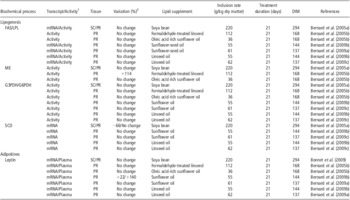
Data on the role of diet composition on the expression of genes and gene networks related to adipogenesis in AT of dairy ruminants in mid-lactation are scarce. Available data suggest that dietary lipid supplements that do not lower milk fat synthesis have few effects on the expression of genes related to adipogenesis in AT of goats and cows (Table 13). There are indications that more profound effects can be expected when rumen-protected lipids are fed. Daily infusions of 1.1 kg of rapeseed at the duodenum were shown to induce 26% decreases in FAS activity of perirenal AT of lactating cows (Chilliard et al., Reference Chilliard, Gagliostro, Flechet, Lefaivre and Sebastian1991), whereas formaldehyde-treated linseeds increased ME activity in perirenal AT of lactating goats (Bernard et al., Reference Bernard, Rouel, Leroux, Ferlay, Faulconnier, Legrand and Chilliard2005b). More recent studies indicate that dietary lipid supplements inducing milk fat depression in mid-lactation cows increase the transcription of genes or gene networks involved in adipogenesis in subcutaneous AT, with evidence that these changes are regulated via upregulation of the expression of genes encoding for adipogenesis-related nuclear receptors (Thering et al., Reference Thering, Graugnard, Piantoni and Loor2009). There is no substantial evidence that these effects are mediated via changes in leptin, a key adipose-derived signal of energy balance, as the expression of the leptin gene is generally not altered in response to diets containing plant oils or oilseeds (Chilliard et al., Reference Chilliard, Delavaud and Bonnet2005) even when upregulation by trans-biohydrogenation intermediates has been suggested to occur in lactating cows and goats (Bonnet et al., Reference Bonnet, Delavaud, Bernard, Rouel and Chilliard2009). Further studies are required to elucidate the mechanisms and genes involved in the repartitioning of energy from the mammary gland towards body fat stores.
Effects of dietary lipid supplements on the expression of lipogenic genes in adipose tissue of lactating goats

DIM = days in milk; FAS = fatty acid synthase; LPL = lipoprotein lipase; SC = subcutaneous adipose tissue; PR = perirenal adipose tissue; ME = malic enzyme; G3PDH = glucose-6-phosphate dehydrogenase; G6PDH = glucose-6-phosphate dehydrogenase; SCD = stearoyl-CoA desaturase.
1Measurement of tissue transcript abundance (mRNA), protein activity (Activity) or concentration in plasma (Plasma).
2Response calculated as ((Treatment−Control)/Control × 100).
Conclusions
Significant progress has been made in characterizing the influence of diet on the fatty acid composition of ruminant meat and milk, abundance of specific TFA in particular. Although it is possible to substantially alter the fatty acid composition of milk and meat under commercial conditions, the extent of changes do not allow nutritional claims to be made unless effective rumen-protected lipid supplements are fed. Identification of SNPs for several key lipogenic genes in growing and lactating ruminants and heritability estimates for certain fatty acids in milk highlight the potential of animal breeding to further alter meat and milk fatty acid composition. However, the impact of selection for product nutritional quality on other traits of economic importance remains uncertain. Application of genomic tools combined with a more complete understanding of the molecular mechanisms underlying changes in tissue and mammary lipogenesis offer the opportunity to breed genetic resources inherently suited to the production of meat and milk containing lower proportions of saturates and higher concentrations of unsaturated fatty acids. Elucidating interactions between diet and animal genetics, changes in the expression of key genes and gene networks regulating nutrient partitioning, lipogenesis–lipolysis and oxidation in ruminant tissues and milk fat synthesis can be expected to facilitate further progress in altering the fatty acid composition of ruminant foods.