INTRODUCTION
Genetic diversity is essential for sustainable production. Reduced diversity is a potential problem for long-term genetic improvement and a concern with regard to genetic vulnerability. The Irish potato famine in the 19th Century is a widely cited example of the devastating effects of growing genetically uniform crop material over a large area; the potato (Solanum tuberosum L.) variety Lumper was killed by the disease late blight (Phytophthora infestans) (Bourke Reference Bourke, Lucas, Shattock, Shaw and Cooke1991). In India, potato is a relatively recent crop; the Spanish or Portuguese introduced it to the country at the beginning of 17th century. Potato breeding was initiated in 1935 (Kishore Reference Kishore1974) and, to date, 45 improved varieties of potato have been released for commercial cultivation. Although a large range of potato selections are being conserved, only a few have been used in genetic improvement programmes. However, conservation of germplasm has little purpose unless it is being used in breeding programmes. Thus, it is important in any breeding programme to examine the trends in germplasm usage periodically, as a guideline for future cultivar development. Breeders have used pedigree analysis to assess relationships between parental lines, which can be used to enhance insight into the breeding materials (breeding clones and cultivars) and available germplasm. Genetic divergence calculated from pedigree information does not require experimental data, which can be influenced by the environment and/or technique used (Gopal & Oyama Reference Gopal and Oyama2005; Ariyarathna & Gunasekare Reference Ariyarathna and Gunasekare2006), but does require the availability of elaborate pedigree data. Pedigree analysis provides a wealth of information on historical selection choices (Schut et al. Reference Schut, Qi and Stam1997; Russell et al. Reference Russell, Ellis, Thomas, Waugh, Provan, Booth, Fuller, Lawrence, Young and Powell2000). Cowen & Frey (Reference Cowen and Frey1987) reported that crosses between parental lines with low-pedigree relationships, in general, had higher genetic variability of quantitative traits than those among parents with high-pedigree relationship. Relatedness between genotypes using pedigree analysis has also been found to enhance the power of approaches such as linkage disequilibrium or association mapping, used for identifying genetic factors underlying traits in unrelated germplasm (Malosetti et al. Reference Malosetti, Van der Linden, Vosman and Van Eeuwijk2007). A central pedigree database of world potato cultivars has been developed by van Berloo et al. (Reference van Berloo, Hutten, Van Eck and Visser2007). Pedigree analysis has been a useful method for determining the genetic relationship and inbreeding level of potato cultivars (Mendoza & Haynes Reference Mendoza and Haynes1974; Glendinning Reference Glendinning, Jellis and Richardson1987; Gopal & Oyama Reference Gopal and Oyama2005). It has been shown to be useful in identifying diverse genotypes in other crops including oats (Cowen & Frey Reference Cowen and Frey1987) and rice (Lin Reference Lin1991; Shivkumar et al. Reference Shivkumar, Subba Rao, Ram, Majumder, Padmavathi, Prasada Rao and Krishnaiah1998) and in obtaining transgressive segregates in many crops including oats (Cowen & Frey Reference Cowen and Frey1987; Souza & Sorells Reference Souza and Sorells1991), rapeseed (Lefort-Buson et al. Reference Lefort-Buson, Dattée and Guillot-Lemoine1987) and soybean (Cox et al. Reference Cox, Kiang, Gorman and Rodgers1985). Genetic divergence between parental lines can be calculated from phenotypic or molecular data, which requires that the plant material be analysed (Dilday Reference Dilday1990; Martin et al. Reference Martin, Talbert, Lanning and Blake1995; Chimote et al. Reference Chimote, Chakrabarti, Pattanayak and Naik2004; Becelaere et al. Reference Becelaere, Lubbers, Paterson and Chee2005; Alwala et al. Reference Alwala, Kimbeng, Gravois and Bischoff2006). Molecular markers have been used in potato to assess genetic diversity (Milbourne et al. Reference Milbourne, Meyer, Bradshaw, Baird, Bonar, Provan, Powell and Waugh1997; McGregor et al. Reference McGregor, Lambert, Greyling, Louw and Warnich2000; Bornet et al. Reference Bornet, Goraguer, Joly and Branchard2002; Chimote et al. Reference Chimote, Chakrabarti, Pattanayak and Naik2004; Braun & Wenzel Reference Braun and Wenzel2004; Fu et al. Reference Fu, Peterson, Richards, Tarn and Percy2009). With the availability of biochemical and molecular data, pedigree analysis as a source of genetic information tends to be neglected. Sometimes the estimates of genetic divergence from these different sources of information are not similar (Lefort-Buson et al. Reference Lefort-Buson, Dattée and Guillot-Lemoine1987; Loiselle et al. Reference Loiselle, Tai and Christie1991). Braun & Wenzel (Reference Braun and Wenzel2004) reported that the known pedigree information was well-reflected in genetic distances estimated using molecular markers. The objectives of the present study, therefore, are to: (1) determine the ancestors representing the pedigree of Indian early potato selections; (2) estimate the relative genetic contribution of the ancestors; and (3) understand the pedigree relationship among selections. Such information will be very useful to breeders in selecting parents for future cultivar development programmes as well as in exploiting genetic diversity.
MATERIALS AND METHODS
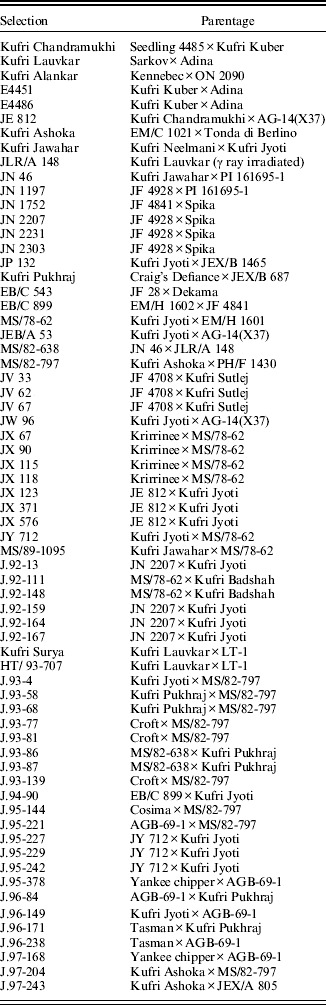
A total of 66 early maturing selections bred in India from 1957 to 1997 were included in the study (Table 1). These selections, developed through hybridization, included released varieties and advanced hybrid clones. Indigenous genotypes of unknown origin were considered as ancestors. All exotic parents were also considered as ancestral parents, although they might be related to some degree in the primary origin from which they were derived. The selections were grouped into time periods of development at 10-year intervals to study changes in genetic diversity with time and trends in the use of parental lines. Pedigree analysis was conducted to identify the ancestors of selections.
Potato selections used in the present study

Each appearance of an ancestor in a pedigree was given a score of one. The presence in pedigree scores for each ancestor was summed over all 66 selections. The frequency (f) of presence of an ancestor was calculated as a proportion of the total presence in pedigree scores of an ancestor to the total of presence in pedigree scores of all the ancestors. The relative genetic contribution was computed by partitioning the genetic constituents of each selection into theoretical proportions attributable to different ancestors. For computation, it was assumed that a selection derived from a cross obtained half of its genes from each parent. Relative genetic contribution scores of 0·500, 0·250 and 0·125 were given to ancestors that appeared as parent, grandparent and great-grandparent, respectively, to a selection. Cumulative genetic contribution of an ancestor was calculated as a proportion of total relative genetic contribution score of an ancestor to total relative genetic contribution scores of all the ancestors. All the ancestors were assumed to be unrelated to each other. Hence, these estimates are not real nuclear compositions but merely statistical representations.
Coefficients of co-ancestry for all pairs of selections and inbreeding coefficients for all the selections were calculated (Falconer & Mackay Reference Falconer and Mackay1996). The inbreeding coefficient of an individual depends on the amount of common ancestry in its two parents. The co-ancestry of any two individuals is identified with the inbreeding coefficient of their progeny if they are mated. These coefficients were used to calculate the coefficient of relationship. The coefficient of relationship represents the genetic similarity and was calculated as follows:
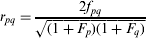
where r pq is the coefficient of relationship, f pq is the coefficient of co-ancestry and F p and F q are inbreeding coefficients of P and Q, respectively. The pair-wise matrix of coefficients of relationships representing genetic similarity was used for grouping potato selections using the computer software NTSYS-pc2.20 (Exeter, Setauket, NY, USA). Clustering and graphical representations were done using the modules Sahn and Tree of the software, respectively. This resulted in a dendrogram based on hierarchical and agglomerative clustering in which successive groups and selections within a group were joined based on their coefficients of relationship.
RESULTS
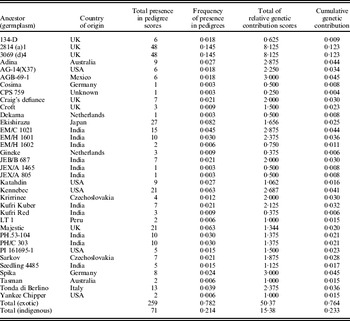
The pedigrees of the 66 selections developed from 1957 to 1997 were traced back to 35 ancestors (Table 2). Indian ancestors had a much lower frequency of presence in pedigrees (f=0·21) when compared to exotic (non-Indian) ancestors (f=0·78). This was also reflected in genetic contributions of 0·23 and 0·76 from indigenous and exotic ancestors, respectively. Major genetic contributions were from the UK (0·33) and USA (0·13). Six ancestors (CPS 759, Dekama, EM/H 1601, JEX/A 805, Cosima and JEX/A 1465) appeared only once in 66 pedigrees, while four ancestors (EM/H 1602, Tasman, Yankee Chipper and LT-1) appeared twice. Although the total genetic contribution of these 10 ancestors was low due to low frequency of their appearance in pedigrees, these ancestors contributed 0·50 of the genetic constitution of individual selections except for CPS 759, which contributed 0·25 of genetic constitution of the selection EB/C 543. The most frequent ancestors in pedigrees were 2814 (a)1 (f=0·145), 3069 (d)4 (f=0·145), Ekishirazu (f=0·08), Kennebec (f=0·06) and Majestic (f=0·06). The top genetic contributors were 2814 (a)1 (0·123), 3069 (d)4 (0·12), Spika (0·045), AGB-69-1 (0·05), Adina (0·04) and EM/C 1021 (0·04).
Genetic contribution and frequencies of occurrence of 35 ancestral contributors to 66 early maturing selections

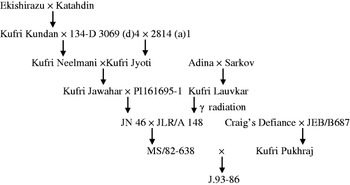
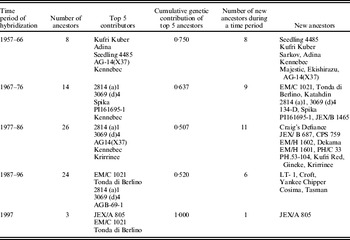
The number of ancestors, number of new ancestors and cumulative contribution of the five most important contributors in different time periods were evaluated with ancestors being added (Table 3). New ancestors were added in different periods. The top five ancestors in each time period comprised more than 0·50 of the genetic constituents in every period. The new ancestors were from many countries in all the time periods. In the first time period (1957–66), the eight ancestors belonged to six different countries, Australia, Czechoslovakia, Japan, USA, Peru and India. The ancestor Seedling-4485 and Kufri Kuber were selections from the cross (Solanum curtilobum×S. tuberosum)×Solanum andigenum. The most frequent ancestors 2814 (a)1 and 3069 (d)4 were derived from the cross between Solanum rybinii (a variant of Solanum phureja) and Solanum demissum, which was made at the Scottish Plant Breeding Station Edinburgh, UK in 1937 to introgress late blight resistance from S. demissum. For genotypes J.93-86 and J.93-87, pedigree records go back for six generations in one of the branches (Fig. 1). The coefficient of co-ancestry (0·44) was highest between genotypes Kufri Ashoka and J.97-204. The inbreeding coefficient (0·44) was highest for the genotypes J.95-227, J.95-229 and J.95-242.
Pedigree of selection J.93-86.

Ancestors and cumulative genetic contribution of top 5 ancestral contributors in different time periods

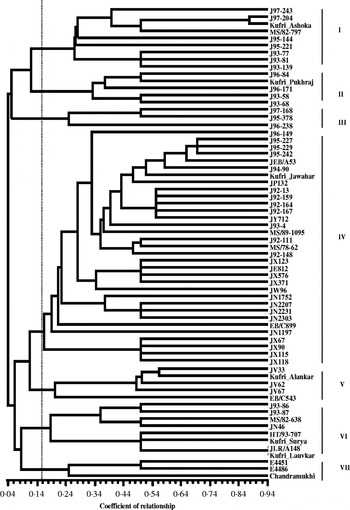
Based on the coefficient of relationship, the 66 selections were grouped into seven groups with less than 0·15 similarities (Fig. 2). Many selections showed a high relationship coefficient (⩾0·50) with other selections. These groups, from top to bottom of the dendrogram (Fig. 2), were: Group I with nine genotypes, which had Kufri Ashoka (EM/C 1021× Tonda di Berlino) as one of the ancestors; Group II consisting of five genotypes, with Kufri Pukhraj (Craig's Defiance×JEX/B 687) as one of the ancestors; Group III consisting of three genotypes, having AGB-69-1 as one of the ancestors; Group IV consisting of 33 genotypes, having Kufri Jyoti {2814 (a)1×3069 (d)4} as one of the ancestors except in JE 812; Group V consisting of five genotypes, having Kufri Alankar (Kennebec×ON 2090) as one of the ancestors; Group VI consisting of eight genotypes, having Kufri Lauvkar (Sarkov×Adina) as one of the ancestors except in JN 46 and Group VII consisting of three genotypes, having Kufri Kuber as one of the ancestors.
Relationship between different early maturing selections based on pedigree analysis.

DISCUSSION
Pedigree information of 66 early maturing potato selections has revealed the ancestors used and genetic similarity of the selections. The results of the present study show that the genetic base of Indian early maturing selections is narrow, as the origin of these selections could be traced back to 35 ancestors and many selections had a high coefficient of relationship (⩾0·50). Various estimates in the present study were based on the assumption that ancestors were unrelated; however, some of the ancestors, especially the indigenous ancestors, might as well be related especially those starting with same prefix such as EM/H 1601 and EM/H 1602; PH.53-104 and PH/C 303. Indian breeding programmes for early maturity started with crosses mainly between exotic varieties; therefore, it is likely that the indigenous ancestors may also be related to some exotic ancestors. If this was so, then the genetic base of early potato selections may be even narrower than that revealed by pedigree analysis. The narrow genetic base of Indian potato selections developed since 1990 has also been reported earlier (Gopal & Oyama Reference Gopal and Oyama2005). North American (Mendoza & Haynes Reference Mendoza and Haynes1974; Plaisted & Hoopes Reference Plaisted and Hoopes1989) and European (Hawkes Reference Hawkes, Zeven and van Harten1979; Ross Reference Ross1986) varieties have also been reported to have a narrow genetic base. In Europe, the potato was introduced from South America as a few original accessions of S. tuberosum subsp. andigena in the later part of the 16th century. In North America, the potato was introduced from Europe in 1719, and the imported germplasm played a prominent role in potato variety development (Hougas Reference Hougas1956). In North American varieties, the clone Rough Purple Chili found a place in the pedigree of almost all modern American varieties leading to a narrow genetic base (Plaisted & Hoopes Reference Plaisted and Hoopes1989). Although genetic uniformity in crops does not necessarily lead to immediate epidemics, it is desirable to have a more diverse genetic background in commercially grown cultivars since the diversity provides some protection against unexpected pest outbreaks (Chang Reference Chang1984). The potential for improving early maturing potato genotypes is immense, considering that the 35 ancestors used in developing 66 genotypes comprise only a small part of the potato germplasm (more than 3000 genotypes) available in India.
The ancestors used in developing early maturing genotypes in India have come from many countries and the genetic contribution of exotic ancestors was much greater than that of Indian ancestors. This scenario is expected, as there is little indigenous variability in potato (Gopal & Gaur Reference Gopal and Gaur1997). There were some clones or introductions whose identity could not be ascertained. These clones and some other variants with unknown parentage/identity available in India were termed as indigenous (Pal & Pushkarnath Reference Pal and Pushkarnath1951). The UK contributed the most exotic ancestors followed by USA, as in the early years most introductions were from these countries (Kishore Reference Kishore1974).
The large contribution of 2814 (a)1 and 3069 (d)4 to selections is attributed to the success of the cultivar Kufri Jyoti, which was derived from the cross 2814 (a)1×3069 (d)4. Kufri Jyoti performed well for yield throughout India over a diverse range of agro-climatic conditions. It is still a popular variety in the Indian plains as well as in the hills, despite having been released for cultivation in 1968. This variety, Kufri Jyoti, appeared in the pedigree of 36 selections out of a total of 66 selections studied and contributed 0·25 of the parentage. So, 36 selections are related to each other because of the link to Kufri Jyoti. In the pedigree of selections J.95-227, J.95-229 and J.95-242, Kufri Jyoti appeared thrice, suggesting that this variety may be carrying specific gene complexes with linked genes for desirable traits. However, to diversify the genetic base, such repeated appearance in pedigrees even of elite genotypes should be avoided.
Grouping of genotypes based on genetic similarity can be used to select diverse parents for use in future breeding programmes. Grouping of selections into seven groups was based on the coefficient of relationship and for each group the presence of one common ancestor in almost all the selections within a group shows the importance of genotypes Kufri Ashoka, Kufri Pukhraj, AGB-69-1, Kufri Jyoti, Kufri Alankar, Kufri Lauvkar and Kufri Kuber as parents/ancestors. Among these, Kufri Pukhraj and Kufri Jyoti are very popular varieties under commercial cultivation. In Indian breeding programmes for developing early maturing varieties, large numbers of genotypes have been used as parents but many of these genotypes could not find a place in the pedigree of advanced early maturing selections. Crosses can be made between selections belonging to different groups. Selections in a particular group can be crossed with the common ancestors of each of the other group. For example, selections from group I (with Kufri Ashoka as a common ancestor) can be crossed with Kufri Pukhraj (common ancestor of group II), AGB-69-1 (common ancestor of group III), Kufri Jyoti (common ancestor of group IV), Kufri Alankar (common ancestor of group V), Kufri Lauvkar (common ancestor of group VI) and Kufri Kuber (common ancestor of group VII). Inter-mating such distantly related selections may lead to highly heterozygous populations for the selection of superior clones. Genetic uniformity characterizing current potato cultivars suggests that gains can be made from increased heterozygosity which in potato is known to be essential to realize heterosis for economic characters such as tuber yield (Cubillos & Plaisted Reference Cubillos and Plaisted1976; Gopal et al. Reference Gopal, Chahal and Minocha2000; Kumar & Kang Reference Kumar and Kang2006). High inbreeding coefficient affects yield in potato (Loiselle et al. Reference Loiselle, Tai and Christie1991). Although it is desirable to use new parents in further breeding programmes to broaden the genetic base, at the same time potato breeders also want to maintain the complex of desired agronomic traits present in the existing popular cultivars. The presence of such complexes is also indicated by the results of the present study, as six out of the seven diversity groups have one Indian variety as the common ancestor. Introduction of new genetic material is generally expected to disturb genetic complexes responsible for desired traits. Crosses between selections from different diversity groups, as mentioned above, can result in the selection of useful clones while increasing or maintaining genetic diversity which is desirable to ensure sustainable breeding progress in the future. Hybridization among diverse elite selections would at least assure no further loss in the existing genetic diversity. The ancestors, i.e. CPS 759, Dekama, EM/H 1601, JEX/A 805, Cosima, JEX/A 1465, EM/H 1602, Tasman, Yankee Chipper and LT-1 with lower frequency of appearance in pedigrees but with comparatively good genetic contribution to individual selection can also be used as parents.
The main conclusion from the present study involving pedigree analysis is that the genetic base of Indian potato selections is relatively narrow and this needs to be widened. With the combination of pedigree analyses, phenotyping and molecular analyses, a complete picture of past efforts can be provided. This will then allow a more focused selection in the future to provide the diversity that is required to improve potato breeding to meet the requirements of an increasingly sophisticated and demanding market and also to meet new environment and disease resistance objectives.