Introduction
The world has over 23 billion poultry- about three birds per person on the planet (FAOSTAT, 2016), and about five times more than 50 years ago. They are kept and raised in a wide range of production systems, and provide mainly meat, eggs and manure for crop fertilisation. Poultry meat and eggs are among the most common animal source food consumed at the global level, through a wide diversity of cultures, traditions and religions, making them key to food security and nutrition. Within the livestock sector, poultry emerges as the most efficient sub-sector in its use of natural resources and providing protein to supply a global growing demand.
Poultry is particularly important for small holders and poor rural and urban communities and is mainly produced in large scale and intensive operations, making it one of the fastest growing agricultural sub-sectors. While most of the sector's growth has been driven by private investments, public concerns about the sector's impact on the environment and human health, its contribution to climate change and to local and global economy is triggering governments’ response and the development of public policies for the sector.
Current state of global poultry production and production systems
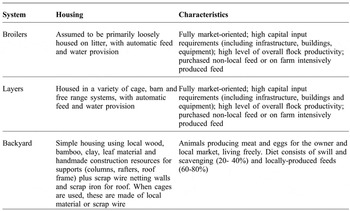
Poultry production is very divers and there are many typologies available, responding to different aims. Factors to consider in order to characterise this diversity may include the main purpose of the flock, feed, orientation and the type of housing. At the global level, three main types of poultry production systems can be considered: broilers, layers and backyard ( Table 1 ).
Poultry production systems (Gerber et al., Reference GERBER, HENDERSON, OPIO, MOTTET and STEINFELD2013).

Estimates from the Global Livestock Environmental Assessment Model (GLEAM 2.0, 2016) reveal that the global production of eggs is around 73 million tons and global production of poultry meat is close to 100 million tons. Based on this modelling approach, backyard systems contribute 8% of global egg production and 2% of global meat. The majority (92%) of poultry meat production comes from specialised broiler systems and layers only contribute to 6% of the total. But these global figures hide important regional differences. Backyard systems make significant contribution to eggs and poultry meat production in Eastern Europe, South Asia, Sub-Saharan Africa and, to a lesser extent, East Asia and Latin America and the Caribbean ( Figure 1 ). However, expert knowledge estimates may differ from modelling ones. For example, Sonaiya (Reference SONAIYA2007) estimates that smallholder family poultry accounts for 30 to 80% of the total poultry population in most developing countries and contribute about 98% of poultry products consumed in villages.
Estimates of eggs and poultry meat production by production systems and regions (GLEAM 2.0, 2016).

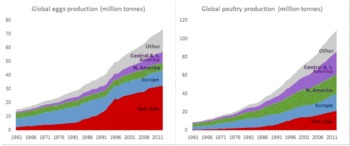
Demand for animal derived food is increasing because of population growth, rising income and urbanisation (FAO, 2009), and poultry meat has shown the fastest trend in the last decades. The average annual growth rate for poultry meat over the last 50 years was 5% while it was only 1.5% for beef, 3.1% for pork and 1.7% for small ruminants (Alexandratos and Bruinsma, Reference ALEXANDRATOS and BRUINSMA2012). Production has been particularly dynamic in developing countries, especially in East and South East Asia ( Figure 2 ), with an annual growth rate in poultry meat production of 7.4%. The biggest poultry meat producers are the United States, with almost 20 million tons a year, followed by China, with 18 million tons, the EU and Brazil with about 13 million tons. Global per capita consumption of eggs increased from 4.55 kg to 8.92 kg between 1961 and 2010, while global per capita consumption of poultry meat increased from 2.88 kg to 14.13 kg (FAOSTAT, 2016).
Technological changes in production practices have been one of the main drivers of the sector's growth. The move from free-ranging flocks to confined poultry operations dramatically increased the number of birds per farmer, facilitated the substitution of capital for labour, and led to a significant increase in productivity (Narrod et al., 2012). For example, these authors have shown that, between 1985 and 1996, the share of poultry farms with more than 10,000 heads grew from 42% to 78% in the Center West region of Brazil. Advances in breeding to improve animal size, fecundity, growth rate and uniformity, have also contributed to increase outputs.
Global eggs and poultry meat production by region (source: FAOSTAT, 2016).

Future trends of global poultry production
The growth of the global livestock sector is expected to continue. The global human population is estimated to reach 9.6 billion in 2050, with about 70% living in urban areas, while incomes could increase by 2% a year. In this context, Alexandratos and Bruinsma (Reference ALEXANDRATOS and BRUINSMA2012) projected that the demand for animal-derived food could grow by 70% between 2005 and 2050. While beef and pork demand could increase by 66% and 43% respectively, poultry meat is expected to have the highest growth, with 121%, and demand for eggs could increase by 65%.
Even though poultry meat is still the fastest growing subsector, production would be increasing at a slower rate than in past decades. By 2050, its annual growth rate is estimated to reach 1.8% at global level, and 2.4% in developing countries. This growth will be the result of strong regional differences. Most of the growth is expected to be driven by Asia. Average per capita consumption of poultry meat is still relatively low in Asia, with less than 10 kg/year, two times less than in Western Europe and five times less than in Northern America. OECD/FAO (2016) estimate that in East and South Asia, meat production will expand by 1.8 Mt annually by 2025, with pork and poultry accounting for the bulk of this expansion. In Sub-Saharan Africa, poultry consumption has expanded faster than any other meat. With domestic supply unable to match demand, almost 40% of the additional consumption was imported. For the period 2015-2025, the OECD/FAO (2016) estimated that imports will supply 66% of the growth in poultry meat demand in the region, while this share will only be 16% for beef and veal, 2% for sheep and 45% for pork.
Alexandratos and Bruinsma (Reference ALEXANDRATOS and BRUINSMA2012) forecasted a decrease in global meat prices in real terms due to a decrease in feed prices. Due to its short production cycles and high feed use efficiency, poultry is expected to experience an annual decrease in prices of nearly 1% between 2016 and 2025. Globally, 10% of all meat output will be traded in 2025, up from 9% in 2015, with most of the increase coming from poultry meat.
Poultry and food security
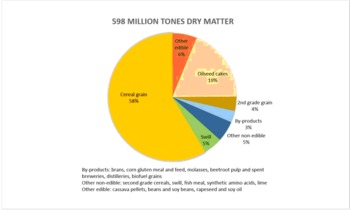
Using the same approach as Gerber et al. (Reference GERBER, MOTTET, OPIO, FALCUCCI and TEILLARD2015), five main drivers of poultry's contribution to food security can be considered. Firstly, the feed ration of the animals, and whether the materials included in the ration are used or produced in concurrence with human edible food should be considered. An example of this is grains and fodder crop cultivated on arable land. Crop residues, food by-products and swill produced on non-arable lands are not directly comestible by humans, although they could contribute to food production through fertilisation and energy production. Figure 3 shows the estimated composition of the global feed ration of poultry. Broken down, 58% of the global dry matter (DM) intake is from cereal grains, which represent a total of 348 million tons, or 14% of global cereal production. When adding cassava, soybeans, pulses, rapeseed and soy oil, human edible feed material represent 64% of total feed intake of the global poultry sector. When adding soybean meal, about 81% of the global poultry feed ration can be considered as directly in competition with human food.
Global poultry feed ration (source: GLEAM 2.0, 2016).

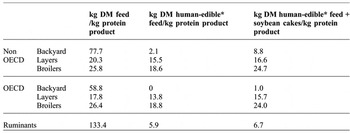
Secondly, the efficiency with which the animal convert feed into edible products (kg of feed per kg of meat or eggs) must be taken into account. This efficiency is driven by (i) quality of the feed, (ii) animal performance (e.g. growth rates, influenced by genetics and health conditions). Though less important, two more factors can influence feed use efficiency: (iii) proportion of meat supplied from spent layers, since maintenance energy is diluted over the two products meat and eggs and (iv) proportion of breeding stock in the herd (these animals need to be fed but do not contribute directly to the edible product output). Mottet et al. (Reference MOTTET, DE HAAN, FALCUCCI, TEMPIO, OPIO and GERBER2017) estimate that efficiency in poultry production systems is generally higher than in ruminant production. Layers and broilers require between 17.8 and 26.4 kg of DM feed to produce 1 kg of protein, while backyard systems, which are less productive and use lower quality feed, require 77.7 kg in non OECD countries and 58.8 in OECD countries ( Table 2 ). At a global level, ruminants need an average of 133.4 kg per kg of protein. However, when materials that are edible or in competition with food production are considered, layers and broilers systems appear less efficient than backyard systems or ruminants.
Feed conversion ratios by regions and production system (Mottet et al., Reference MOTTET, DE HAAN, FALCUCCI, TEMPIO, OPIO and GERBER2017).

DM = dry matter, * Only from grains, pulses, roots & tuber
It is important to recognise that the global poultry sector has made significant gains in productivity. The average carcass weight increased by 30%, from 1.3 kg in 1961 to 1.7 kg in 2013 (FAOSTAT, 2016). The highest gains were made in South America (75%), Northern America (57%), Western Europe (33%) and Eastern Asia (32%). The highest gains in eggs production were made in East Asia (108%), Africa (75%), and Western Europe (59%).
Thirdly, the contribution poultry makes to agricultural productivity through manure used in crop production needs to be evaluated. For example, in Europe, the share of animal manure in total nitrogen inputs was estimated at 38% and reached 61% in the Netherlands (European Commission, 2012). Fourthly, the availability and affordability of other sources of foods, particularly protein and micro nutrients, and thus the exclusive or optional nature of eggs and poultry meat contribution to nutrition must be accounted for.
Finally, the fifth issue, i.e. the income generated by poultry production at household and national level. In developing countries, family poultry generate 19-50% of rural incomes (Sonaiya, Reference SONAIYA2007). Today, an estimated 12% of total poultry meat and 4% of total eggs production are exported, with a few countries only (US, Brazil, EU and Thailand) generating substantial revenues (more than 85% of global exports). These shares are still relatively low compared to other animal source food, such as beef (17%) or milk powder (over 50%). In parallel, least developed countries find themselves increasingly dependent on imports of poultry products, whereby the level of imports increased from 2% in 1961 to over 28% in 2013. In 2013, least developed countries were net importers of nearly 1 million tons of fresh poultry meat (FAOSTAT, 2016). While poultry is key to poverty alleviation for small holders, least developed countries are becoming more dependent every year on imports to supply their increasing demand in poultry products.
Poultry, poverty alleviation and equity
The World Bank estimates that 900 million people live on less than US$1.9/day. About half of them depend directly on livestock for their livelihoods. To poor people, farm animals are a major asset - representing both capital and, in many cases, a source of income. Birds, which can be sold in times of crisis, act as household insurance. On the farm, poultry provide fertiliser from manure in addition to meat and eggs. Because of their short production cycle and their ability to convert household wastes into edible products, poultry have a particularly important role to play for small holders (FAO-AGAL, 2016). They can contribute to three major pathways out of poverty by: (1) increasing resilience (2) improving smallholder productivity and (3) increasing market participation (ILRI, 2008). There is extensive evidence of the contribution of poultry to poverty reduction (Alders, Reference ALDERS1996; Guèye, Reference GUÈYE2000; Pica-Ciamarra and Dhawan, Reference PICA-CIAMARRA and DHAWAN2010). For example, in Africa, rural family poultry account for about 80% of the total flock. In Nigeria, Alabi et al. (Reference ALABI, ESOBHAWAN and ARUNA2007) showed that small-scale family poultry husbandry generated about 35% of household income in the Niger Delta.
Some two thirds of poor livestock keepers - 290 million - are estimated to be women. They are largely involved in caring for small ruminants, poultry and dairy cows. But labour statistics may underestimate their role. That is because women are less likely than men to define their activities as work, especially with poultry, and less likely to report themselves as engaged in livestock management - while working, on average, longer hours than men. For example, Guèye (Reference GUÈYE1998) estimated that in rural areas of Sub-Saharan Africa, more than 70% of chicken owners were women, while pigeons traditionally belonged only to children. Despite women's important role in animal production and marketing, they have less access to resources, land, and capital in particular. In order to help achieve gender equality in agricultural populations, priority should be given to improving the conditions of women working in the livestock sector (FAO-AGAL, 2016).
Poultry, animal and human health
Animal-sourced foods are important to nutrition and health, especially for children and pregnant women and for the elderly (Murphy and Allen, Reference MURPHY and ALLEN2003). They can help reduce mortality among children and the new-born. Animal source foods provide a wide range of micronutrients - such as vitamin A, vitamin B-12, riboflavin, calcium, iron and zinc - which are difficult to obtain in adequate quantities from plants source alone (Murphy and Allen, Reference MURPHY and ALLEN2003). Poultry birds have a particular role to play in improving nutrition in developing countries by providing affordable and high quality protein and essential nutrients, without being associated with any major religious or cultural taboo. Eggs, in particular, contain 13 essential vitamins and minerals, protein, and about 70 calories (Egg Nutrition Center, 2016). Another major advantage of poultry is that families don't need a refrigerator to store eggs or large amounts of meat (Farrell, Reference FARRELL2013).
Conversely, livestock can represent a threat to human health, and poultry plays a significant role in this threat, given the intensity and frequency of contacts between humans and birds. A majority of recent pandemics such as H5N1 avian influenza since 1997 are of animal origin. In 2015, avian influenza caused the destruction of approximately 35 million laying hens and approximately six million pullets in the United States (Egg Industry Center, 2015). Dobrowolska and Brown (Reference DOBROWOLSKA and BROWN2016) showed that the 2015 outbreak could have caused a 50% rise in egg prices and 11% decrease in supply. Of the known animal diseases, 61% are zoonotic, meaning that they can also infect humans (IFAH, 2012). Disease transmission between animals and humans occurs daily around the globe, both through agricultural practices and everyday activities. Again, as the main consumer of in-feed antibiotic growth promoters, the livestock sector is a major contributor to global antimicrobial resistance (AMR) - a rapidly emerging threat to human health. Nonetheless anti-microbial consumption is expected to rise by almost 70% by 2030. Farm animals are among the sources of some of the most severe but neglected tropical diseases while, in economic terms, livestock diseases cause huge economic losses every year.
While poultry welfare is a legislative concern mainly in the EU, it is also a significant challenge for the global poultry sector. For example, it is estimated that 61% of egg production come from industrial systems (Steinfeld et al., Reference STEINFELD, GERBER, WASSENAAR, CASTEL, ROSALES and DE HAAN2006) and around 90% of hens are kept in cages at global level, while the percentage falls to around 57% in the EU (Windhorst, Reference WINDHORST2015). Beak trimming still has a high frequency. However, van Horne and Achterbosch (Reference VAN HORNE and ACHTERBOSCH2008) have shown that costs of production in laying hens are 30% and 40% in the US and Brazil respectively compared to the Netherlands, partly because of the absence of legislation on housing requirements and beak trimmings.
Increasing international trade results in growing concerns about food safety. They in turn can translate into requirements to comply with standards and regulations (Narrod et al., 2012), which can represent a challenge for small producers and slow down market integration. In order to increase livestock's positive contribution to human health, and reduce their negative impact, animal health should be made a priority in public policies, and a One Health approach, recognising that the health of humans is connected to the health of animals and the environment, should be adopted (FAO-AGAL, 2016).
Poultry, natural resources and climate change
Poultry production uses large amounts of land and water, mainly through the production of feed crops (Steinfeld et al., Reference STEINFELD, GERBER, WASSENAAR, CASTEL, ROSALES and DE HAAN2006). Land requirement per unit of edible product varies significantly between regions and production systems. Poultry production is a sector that requires the most land for cereal production, requiring an estimated 93 million ha in 2010 (Mottet et al., Reference MOTTET, DE HAAN, FALCUCCI, TEMPIO, OPIO and GERBER2017), including 74 million in non-OECD countries and 19 million ha in OECD countries. This represents 44% of the total cereal area required by the global livestock sector. The area necessary to produce oil seed cakes fed to poultry represent 16 million ha, when land is allocated to the different co-products of the crops (oil and cakes).
Mekonnen and Hoekstra (Reference MEKONNEN and HOEKSTRA2012) estimated that poultry needed an average of 4325 m3 of water per ton of meat and 3265 m3/t of eggs, which account for 11% and 7% of total water for animal production. The water footprint of broilers and layers are the lowest average among animal products. These estimations of the water footprint include different categories of water - blue water (diverted from surface and groundwater), green water (rainwater evaporated from soil and plants) and grey water (needed to assimilate the load of pollutants).
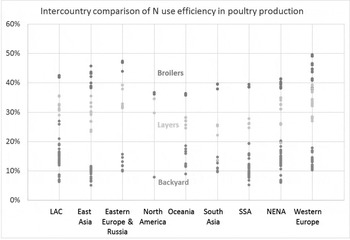
Intensive production systems consume large amounts of protein and other nitrogen-containing substances in animal diets. Conversion of dietary nitrogen to animal products is relatively inefficient, as 50 to 80% of the nitrogen is excreted (Arogo et al., Reference AROGO, WESTERMAN, HEBER, ROBARGE and CLASSEN2001). Nitrogen efficiency, i.e. the percentage of nitrogen input retained in products, is relatively higher in poultry production that in ruminants. It is, however, very different between production systems and regions, and show some differences even within systems and regions. Efficiency ranges from 5% in backyard production in some countries in East Asia and Sub-Saharan Africa to 50% in certain broiler systems in Western Europe (unpublished data, Figure 4 ). Non-retained nitrogen is excreted as urine or faeces. Part of this manure recycled as it fertilises pastures and crops but a large share is lost to the environment as gaseous emissions and leaching, and contributes to air and water pollution and climate change.
Intercountry comparison of nitrogen use efficiency in poultry production (GLEAM 2.0).

Poultry contributes to climate change by emitting greenhouse gases (GHG) either directly (from manure management) or indirectly (from feed-production activities or conversion of forest into croplands). Based on a Life-Cycle Assessment approach (GLEAM 2.0), it has been estimated that poultry supply chains emit about 836 million tons of CO2 equivalent, about 11% of the total GHG emissions from livestock supply chains ( Figure 5 ), which makes it the smallest contributor to the global livestock sector's emissions.
Greenhouse gas emissions from poultry supply chains (source: GLEAM 2.0).

When emissions are expressed on a per kg of protein basis, poultry is the commodity with the lowest emission intensity (amount of GHGs emitted per unit of output produced), with an average of 40 kg CO2-eq/kg protein. Different agro-ecological conditions, farming practices and supply chain management explain the heterogeneity observed both within and across production systems, though the range of emission intensity is smaller than for other species.
Manure management, energy used on farm and emissions from post-farm processing and transport account for 38% of total poultry emissions. The rest result from feed production, including field work, fertiliser and manure application and land-use change for soybean and palm oil production, which account for 17% of total poultry emissions.
Poultry production uses an important area of land for the production of feed. This modifies many habitats, which leads to biodiversity losses. For example, the expansion of arable land for feed production and soybean in particular, has been proven to be a direct driver of forest loss in Brazil and Argentina but is an indirect driver, via land-use change and the displacement of ranching to forest frontiers (Morton et al., Reference MORTON, DEFRIES, SHIMABUKURO, ANDERSON, ARAI, DEL BON ESPIRITO-SANTO, FREITAS and MORISETTE2006; Gasparri et al., Reference GASPARRI, GRAU and ANGONESE2013). Increasing productivity and feed use efficiency in poultry production can contribute to reduce its negative impact on biodiversity by sparing land. Climate change, nutrient and pesticides pollution, to which poultry production contributes directly and indirectly through feed production, are also important drivers of biodiversity losses.
Intensive and large scale poultry operations contribute to a number of air pollution and disturbances, including emission of atmospheric ammonia and its subsequent deposition in soils and water, hydrogen sulphide, other odour-causing compounds and particulates (Gerber et al., Reference GERBER, OPIO and STEINFELD2007).
Gains in productivity and efficiency have reduced the environmental impact of poultry production. For example, Pelletier et al. (Reference PELLETIER, IBARBURU and XIN2014) estimated that the environmental footprint of the US egg industry has decreased by 65% in acidifying emissions, 71% in eutrophying emissions, 71% in greenhouse gas emissions, and 31% in cumulative energy demand when comparing the production of a kg of eggs between 1960 and 2010.
However, there are growing concerns about animal genetic diversity losses due to cross-breeding programs and commercial poultry breeds to develop production and increase productivity. Numerous examples of failed programs can be found when imported breeds do not perform well in harsh and disease-prone environments (Hoffmann, Reference HOFFMANN2005). The same author concluded that local poultry genetic resources are probably more threatened through the indirect impact of market competition where the intensive commercial sector gains market shares.
Conclusions
The poultry sector needs to respond to the growing demand for meat and eggs and enhance its contribution to food security and nutrition. However, to be sustainable, it needs to consider its role beyond just providing food. It needs to produce more with less, while benefiting all. It has a key role in providing secure livelihoods and economic opportunities for millions of smallholder farmers and poor people. Enhancing this role requires a specific attention to market access. Poultry production needs to use natural resources efficiently, mitigate and adapt to climate change and reduce other environmental impacts. Conservation of poultry genetic resources has a key role to play in achieving these objectives. Finally it is necessary that the sector enhances human, animal, and environmental health and welfare.
Consequently, policies need to be designed in a holistic manner to best reconcile the various demands concerning productivity, sustainability and societal values. They should be tailored to regional/national contexts. Policy should not only consider the goods and services provided by the different production systems, their contribution to the economy and their environmental impacts, but also producers’ capacity to react and invest, the cost associated with dissemination, extension and monitoring change and the different entry points for public policies in the different production systems. Given the complexity of the challenges and the diversity of actors involved, multi-stakeholder initiatives are key to this process.