I. INTRODUCTION
Shape memory alloys (SMAs) are intelligent materials that can undergo martensitic phase transformations when thermomechanical loads are applied and are able to recover their original shape when heated above a certain temperature.
Reference Gandhi and Thompson1,Reference Otsuka and Wayman2
Two kinds of symmetries occur for the crystal lattice of this type of material; high symmetry at a high temperature is called austenite, and low symmetry at a low temperature is called martensite. The martensitic transformation that occurs for the transformation of austenite (high-temperature phase)
 $\leftrightarrows$
martensite (low-temperature phase) is the main feature responsible for the characteristics of SMAs. In addition, this transformation is known as a diffusionless solid-state phase transformation that occurs through nucleation and is followed by the growth process from the parent austenitic phase upon cooling.
Reference Gandhi and Thompson1,Reference Olson and Cohen3
Shape memory effect (SME) and pseudoelasticity are the most significant properties that make the SMAs remarkably different from other materials,
Reference Otsuka and Wayman2,Reference Fremond and Miyazaki4
which are associated with the way the martensitic transformation occurred. During this transformation, the SMAs transform from the austenite phase, which is usually a cubic lattice structure, to the martensite phase, which has various lattice structures, such as monoclinic and orthorhombic, etc. These kinds of martensite variants are able to arrange themselves in a self-accommodation structure mode by twinning during the absence of the applied stresses, with the result that no shape change can be observed.
Reference Kumar and Lagoudas5
The martensitic variants of the SMAs are capable of reorienting/detwinning into a single variant through applying mechanical loads, which can result in great inelastic strain.
Reference Kumar and Lagoudas5
Upon heating above a certain temperature, the inelastic strain is recovered by returning martensitic phase variants to the austenite phase, a phenomenon known as the SME.
Reference Kumar and Lagoudas5
The other phenomenon is known as pseudoelasticity; it can occur when a thermomechanical load is applied to the austenitic phase. This directly results in a detwinned martensite, thus inducing a martensitic phase transformation. With this phenomenon, a large inelastic strain occurs, and due to the reverse phase transformation, the strain can be recovered upon unloading. Many alloys exhibit the SME and pseudoelasticity, such as NiTi, Cu-based, and iron-based alloys.
Reference Kumar and Lagoudas5,Reference Nishiyama, Fine and Wayman6
As a result of their inexpensive, wide-ranging transformation temperatures, as well as their ease of production, their high-thermal stability and their small hysteresis with an affordable SME, Cu-based SMAs have attracted much attention from scientists and researchers.
Reference Otsuka and Wayman2
The binary systems of Cu–Zn and Cu–Al are the main two copper-based alloys that appear in the domains of the β phase.
Reference Davis7
The role, the third element in the ternary systems of these alloys plays, is to adjust the transformation temperatures in a wide range, i.e., T ≈ 643 K.
Reference Porter, Easterling and Sherif8–Reference Lagoudas10
Accordingly, it was proven that the transformation temperatures are highly sensitive to the composition of alloys.
Reference Porter, Easterling and Sherif8
Accuracy of 10−3 to 10−4 at.% is typically essential to obtain a reproducibility more appropriate than 5 K. Copper-based alloys commonly display considerably less hysteresis than NiTi.
Reference Lagoudas10
Many research efforts have been carried out in recent decades, for the purpose of improving the shape memory characteristics of these alloys, as well as to increase their commercial applications.
Reference San Juan, Nó and Schuh11–Reference Karagoz and Canbay14
A. The recent researches on the Cu–Al–Ni SMAs
Among the Cu-based alloys, Cu–Al–Ni SMAs are the most used alloys, particularly whenever high temperatures are required. As such, they are assigned to high-transformation temperatures that are able to work at or near 473 K, Reference Ibarra, Juan, Bocanegra and Nó15 which is usually difficult for Cu–Zn–Al and NiTi alloys, Reference Recarte, Pérez-Landazábal, Nó and San Juan16,Reference Font, Cesari, Muntasell and Pons17 whose maximum temperatures are around 373 K. Reference Pérez-Landazábal, Recarte, Sánchez-Alarcos, Nó and Juan18 Cu–Al–Ni causes substantially less hysteresis than NiTi and turns brittle as Ni increases much beyond 4 at.%. Reference Tadaki19 It is also common for Ni to be retained at a constant percentage of 4 at.%, and, therefore, this alloy is composed of Cu(96−x)–Al x –Ni4. Reference Miyazaki, Kawai and Otsuka20,Reference Horikawa, Ichinose, Morii, Miyazaki and Otsuka21 In general, increasing the Al amount can lead to an increase in the stability of martensite. The purpose of the Al addition is to reduce the transformation temperatures. This variety is nearly entirely linear, ranging from M f = 203 K and A f = 250 K for a 14.4 at.% Al to M f = 308 K and A f = 348 K for a 13.6 at.% Al. Reference Tadaki19 However, as the temperature tends to operate over a wide range, i.e., >473 K, there is certainly an immediate degradation in the transformation as a result of the aging effects. The typical Cu-based SMAs are able to exhibit a pseudoelastic strain of about of 4–6%. Reference Lagoudas10,Reference Schwartz22 With the martensite to martensite transformation, very high-pseudoelastic strain levels are displayed. A single crystal of the Cu81.8Al14Ni4.2 SMA can exhibit approximately 18% of the pseudoelastic strain associated with 100% of the shape recovery. Reference Otsuka, Sakamoto and Shimizu23 The melting and casting processes of Cu–Al–Ni alloys share common methods that become especially relevant when large quantities must be produced. However, there are many problems and constraints associated with these processes. The first problem to overcome in the melting and casting processes is the difficulty of controlling the alloy composition. This difficultly occurs because the high loss of the Cu and Al percentages created by the affinity to oxygen forms an oxide layer that can increase the melting temperature of the alloying elements, making it difficult to obtain a completed melting. The variations of alloy compositions can lead to the shifting of the transformation temperature (either as an increase or decrease), along with varying the mechanical properties of the entire alloy. Therefore, the use/application of these alloys will be limited to specific applications. Second is the large grain size (d = 1 mm), as confirmed by other researchers, Reference Sampath24,Reference Sugimoto, Kamei, Matsumoto, Komatsu, Akamatsu and Sugimoto25 which can be attributed to the high-stress concentration, thus increasing the brittleness of the Cu–Al–Ni alloy. Therefore, this alloy cannot be easily applied due to the high degree of order and high-elastic anisotropy of the parent β phase (austenitic) with a B2, DO3, or L21 structure. In addition, the high-elastic anisotropy ratio for the Cu–Al–Ni SMAs in the parent β phase is 13, as calculated in accordance with A = [2c 44/(c 11 − c 12)], where c 44, c 11, and c 12 are the elastic stiffness. Reference Sutou, Omori, Kainuma, Ishida and Ono26 Another aspect to consider with respect to the aforementioned problems is the intergranular cracks, which can be a result of the formation of coarse grain in the polycrystalline state and the segregation of metalloids at the grain boundaries. Reference Hondros and Seah27,Reference Stein, Johnson, White, Chadwick and Smith28 To overcome these particular problems, two methods have been identified by the researcher thus far. The first entails adding the alloying elements or heat treatment Reference Saud, Hamzah, Abubakar and Bakhsheshi-Rad12,Reference Karagoz and Canbay14,Reference Morris and Gunter29–Reference Yildiz and Kok31 to control grain size; this has an effect on the mechanical properties. Reference Pérez-Landazábal, Recarte, Sánchez-Alarcos, Nó and Juan18,Reference Sutou, Omori, Yamauchi, Ono, Kainuma and Ishida32 The second involves decreasing brittleness, which is one of the most important defects of Cu–Al–Ni SMAs.
B. Present work
This study aims to investigate the effects of various alloying elements, such as Mn, Ti, and Co, on the phase transformation characteristics, microstructures, and mechanical properties of Cu–11.9% Al–4% Ni (in wt%) SMA using differential scanning calorimeter (DSC), field emission scanning electron microscopy (FESEM), tensile test, shape memory test, and Vicker's microhardness. The outcomes of this research are correlated with the type of addition and the microstructural variations.
II. EXPERIMENTAL PROCEDURES
A. Material preparation
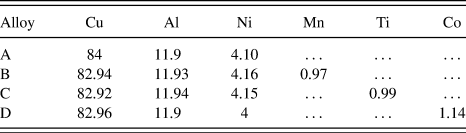
The alloy was produced by melting the high-purity metals of Cu (99.999), Al (99.999), Ni (99.95), and X [X is Mn (99.95), Ti (99.99), and Co (99.5)] using an induction furnace. These metals were melted in a silicon carbide crucible at a temperature of about 1573 K with continuous stirring and were then poured into a cast iron mold with dimensions of 270 mm × 50 mm × 20 mm. The ingot was cut into the required sample dimensions using electrical discharge machining wire, then homogenized at 1173 K for 30 min, and then quenched in water, which led to the formation of martensite. The chemical composition analysis for the Cu–Al–Ni–X SMAs was investigated using inductively coupled plasma mass spectrometry (ICPMS). These results are shown in Table I.
Chemical compositions of the alloys as determined by ICPMS (wt%).

B. Material characterization
Flat specimens were cut from the aged samples with dimensions of 10 mm × 10 mm × 2 mm for the microstructural and x-ray diffraction characterization. FSEM characterization in a Zeiss-LEO Model 1530 (Carl Zeiss Promenade, Jena, Germany) operated at 10 kV coupled with energy dispersive spectroscopy (EDS) operated at 30 kV was used to investigate the microstructural changes. Filings of the alloys removed were about 2–6 mg and were taken for the DSC measurements using a Mettler Toledo DSC 822e (Sonnenbergstrasse, Schwerzenbach, Switzerland). The heating and cooling rate were 10 K min−1 within the 323–573 K range. The phase identifications and crystal structure determinations were carried out at the room temperature using a D5000 Siemens x-ray diffractometer (Oestliche Rheinbrueckenstr, Karlsruhe, Germany) fitted with a Cu Kα x-ray source with a locked couple mode, a 2θ range of between 30° and 75° and a 0.05°/sec scanning step. The quenched samples were ground and polished, then etched in a solution containing 2.5 g ferric chloride acid (FeCl3.6H2O) and 48 mL methanol (CH3OH) in 10 mL HCl for 4 min. Reference Sarı and Aksoy33–Reference Chang35
C. Mechanical tests
1. Tensile and microhardness tests
The tensile test was performed using an Instron 5982-type universal testing machine (Grove City, PA) operated at a constant strain rate of 0.1 mm/min. The tests were carried out at room temperature until a failure occurred, then the fracture stress–strain was determined under the tensile load. The purpose of this test was to optimize the elastic and plastic area ranges before performing the SME test. A Vicker's microhardness test with 10 kg for 25 sec was performed to measure the hardness of these alloys.
2. SME test
The SME test was carried out using a specially designed machine, whereas the specially designed contents were analyzed using an Instron 5982-type universal testing machine. The machine was operated with special program parameters set according to the SME, which was connected with a heater tape and digital thermocouple to control the applied temperature, as well as an external extensometer to measure the shape extension and recovery. The tests were carried out at a temperature below M f, which was about 373 K, where the alloys would be able to obtain shape recovery. Then, the deformed sample that still had an unrecoverable shape was subsequently heated above the austenite finish temperature, i.e., 573 K for 10 mins. This was followed by a water quench to recover the residual strain (εr). The recovered shape was attributed to the transformation of the detwinned martensite to the austenite phase, which had been termed as a transformation strain (εt). After the cooling process, the martensite again formed into a self-accommodated structure.
III. RESULTS AND DISCUSSION
A. Microstructural observations
To investigate the effect of alloying Mn, Ti, and Co on the microstructure of Cu–Al–Ni SMA, optical and FESEM were used, as shown in Figs. 1(a)–1(h). From the optical results, it was observed that the grain size of the base Cu–Al–Ni alloy was refined to 450 µm with Mn, 650 µm with Ti, and 320 µm with Co addition, as it is indicated in Figs. 1(a)–1(d). There are several reasons to add alloying elements to Cu–Al–Ni SMAs.
Reference Sampath24,Reference Van Humbeeck, Chandrasekaran and Stalmans36,Reference Van Humbeeck and Stalmans37
These include: (i) refining the grain size, (ii) restricting the martensite stabilization, (iii) adjusting the phase diagrams, (iv) accommodating the transformation temperature, (v) improving the workability of these alloys (since they are difficult to process due to the formation of a large grain size during the solidification process), and (vi) enhancing the service life of Cu SMAs in applications. Previous studies stated that the most characteristic feature of the martensitic microstructures in noble metal copper-based ternary alloys, such as Cu–Zn–Al, Cu–Al–Mn, or Cu–Al–Ni, is the prevalence of groups of essentially parallel-sided plates and the occurrence of comparatively few large groups with unique orientations within the grains of the parent phase.
Reference Aydogdu, Aydogdu and Adiguzel38
Based on the mechanisms of martensite variants, the alloys have the ability to deform at low stress levels and can perform the SME. The formation of the martensite plates possibly requires a thin layer and parallel side, or they can grow into two or four plates that contact each other to produce a self-accommodating system that crisscrosses the matrix. This is called a conventional habit plane: the internal junction planes are referred to as twin martensite planes.
Reference Aydogdu, Aydogdu and Adiguzel38,Reference Friend39
Figures 1(f)–1(h) shows the microstructure of the Cu–Al–Ni SMA with different types and amounts of elemental additions. The microstructures obtained are in a martensite state at room temperature and have two different morphologies: needle-like and plate-like.
Reference Saud, Hamzah, Abubakar and Bakhsheshi-Rad12,Reference Sarı and Kırındı30,Reference Saud, Hamzah, Abubakar, Zamri and Tanemura40
These morphologies are also known as two types of thermal-induced martensites: the
 $\beta\grave _1\,{\rm{and}}\,\gamma\grave _1$
phase. The
 $\gamma\grave _1^$
phase formed as coarse variants/plate-like phase, while the
 $\beta\grave _1$
phase formed as a needle-like phase between the
 $\gamma\grave _1$
phases. The needle-like phase of the
 $\beta\grave _1$
martensite has a very high-thermoelastic behavior, which can be attributed to its controlled growth in the self-accommodating groups. However, the micrographs showed a self-accommodating martensite plate-like phase in which the plates have nucleated and grown in different directions. The growth process of the martensite involves the accommodation of the local stress field. Therefore, it requires forming other plates-like groups.
Reference Sari34
In the literature, an addition of a fourth element, such as Mn, Ti, Co, B, and Zr, to the base of the Cu–Al–Ni alloy tends to form intermetallic compounds with Al and Ni.
Reference Saud, Hamzah, Abubakar and Bakhsheshi-Rad12,Reference Saud, Hamzah, Abubakar, Zamri and Tanemura40
These compounds, or precipitation atom clusters, deplete the matrix of Al, and hence, the formation of
 $\beta\grave _1$
martensite is promoted.
Reference Sampath24
In the present investigation, new precipitations were formed that had regular or irregular shapes, and the distribution of these precipitations was either between the
 $\gamma\grave _1$
plates and
 $\beta\grave _1$
needles or in an individual area. These precipitates accommodate the
 $\gamma\grave _1$
and
 $\beta\grave _1$
parent phases, and their accommodation is in a coherent or mostly semicoherent mode that depends on the precipitates' sizes and crystal structure orientations with the parent phase.
Reference Lovey and Cesari41
Therefore, during the transformation of the precipitate into a single martensite variant after being surrounded by matrix, the precipitate leaves its place as vacancy. However, the occurrence of an intrinsic deformation led to a variety of other precipitates that were severely deformed during the transformation, and thus, the precipitate maintained its own shape.
Optical (left hand) and FESEM (right hand) micrographs of the Cu–Al–Ni SMA with different additions: (a, e) Cu–Al–Ni, (b, f) Cu–Al–Ni–0.97 wt% Mn, (c, g) Cu–Al–Ni–0.99 wt% Ti, (d, h) Cu–Al–Ni–1.14 wt% Co;
 $\beta\grave _1,\,\gamma\grave _1$
, and precipitates are the formed phases; 1 and 2 are the EDS scanned areas.

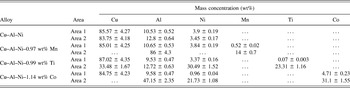
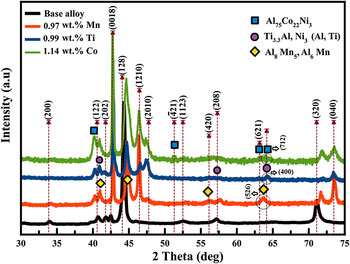
In accordance with the semiquantitative results of EDS in Table II and as confirmed with x-ray diffraction (XRD) in Fig. 2, it was found that precipitates/intermetallic compounds with the Mn addition are related to two phases: Al8Mn5 and Al6Mn. Meanwhile, the Ti additions formed a kind of precipitate known as the X-phase,
Reference Hurtado, Ratchev, Van Humbeeck and Delaey42,Reference Lee and Wayman43
which is related to the Ni3(Al, Ti) and Ti3.3Al compounds. However, the precipitates formed with the Co addition were an amalgamation of Co, Ni, and Al in the compound of Al75Co22Ni3, known as (γ2). In the literature, it was found that by adding a minor addition of Ti, Mn, or Zr to the base alloy, new precipitations/compounds formed with Al. These precipitations are able to enhance the formation of the martensite
 $\beta\grave _1$
phase.
EDS analysis of Cu–Al–Ni SMAs specimens with and without elemental additions. Areas 1 and 2 correspond with the EDS point analyses shown in Fig. 1.

X-ray diffraction patterns of Cu–Al–Ni with and without elemental additions.

To verify the existence of martensite phases in the microstructure of the Cu–Al–Ni SMAs, XRD diffraction patterns were obtained at room temperature, and the scanned curves are shown in Fig. 2. It was observed that a significant change occurred in the present patterns, compared with the base alloy, after the alloying elements were added. These changes are represented by shifting peaks that disappeared and had increased/decreased intensities, depending on the alloying elements. In an earlier work
Reference Aydogdu, Aydogdu and Adiguzel38,Reference Aydogdu, Aydogdu and Adigüzel44,Reference Gama, Dantas, Quadros, Ferreira and Yadava45
on Cu–Al–Ni alloys with ≤12 wt% Al and ≤4 wt% Ni, reflections/peaks corresponding to the following planes were obtained in addition to the
 $\beta\grave _1$
martensite: (122), (0018), (128), (1210), (2010), (040), and (320). However, there is a prospect of the
 $\gamma\grave _1$
martensite formation in the alloys in the (200) and (202) peaks. The present study obtained the same patterns, along with some other patterns that belong to the precipitates/intermetallic phases, such as (−421), (621), and (721) for Al75Co22Ni3 (γ2), and (400) for Ti3.3Al and Ni3(Al, Ti), while (420) and (526) belong to Al8Mn5 and Al6Mn. In the Cu–Al–Ni alloy, the crystal structure varied according to the alloy composition. For instance, with increasing Al content, the martensite phase changed from β (disordered FCC) to
 $\gamma\grave _1$
(2H) and
 $\beta\grave _1$
(18R).
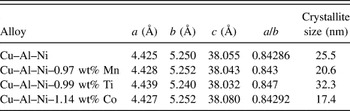
The lattice parameters and crystallite size of the Cu–Al–Ni SMAs, with and without elemental additions, were determined from the XRD patterns and recorded in Table III. The lattice parameters were evaluated in accordance with a monoclinic structure, which was proven by the XRD indexing patterns. Thus, the lattice parameters were determined using the following equation Reference Xuan, Bohong and Hsu46 :
 $${1 \over {{d^2}}} = {1 \over {{a^2}}}\left[ {{{{h^2}} \over {{{\sin }^2}\,\beta }}} \right] + {{{k^2}} \over {{b^2}}} + {1 \over {{c^2}}} + \left[ {{{{l^2}} \over {{{\sin }^2}\,\beta }}} \right] - {{2hl\cos \,\beta } \over {ac\;{{\sin }^2}\,\beta }}\quad .$$
Lattice parameters and crystallite size of Cu–Al–Ni SMA with and without elemental additions.

The a/b ratio was also calculated and presented in Table III. This ratio for the base alloy and modified alloys was less than
 ${{\sqrt 3 } \mathord{\left{\vphantom {{\sqrt 3 } /2}} \right\kern-\nulldelimiterspace} /2}$
in an ordered case due to the atomic sizes of the constituent atoms of the 18R martensite,
Reference Salzbrenner and Cohen47,Reference Adigüzel48
which depended on the obtained results. The XRD patterns of the alloys with a monoclinic structure were similar to those presented in an earlier work.
Reference Sampath24,Reference Balo and Sel49
Although the XRD results showed similar characteristics, the locations of some of the diffraction pattern planes shifted during the addition process. One of the most important factors that has a significant effect on martensitic transformation is structure ordering.
Reference Balo and Sel49,Reference Yang, LEE and Jang50
The crystallite size was determined by the Scherrer method,
Reference Cullity and Stock51,Reference Patterson52
with the mean value of the main five peaks of (122), (0018), (128), (1210), and (208) as determined using the following equation:
 $${\rm{Crysallite}}\,{\rm{size}}\,\left( d \right) = {{0.9\left( \lambda \right)} \over {B\cos \,\theta }}\quad .$$
The broadening and shifting of the Bragg peaks indicate a reduction in the crystallite sizes during the Mn and Co additions, as shown in Table III. This reduction may be attributed to the strain hardening and subsequent strain relaxation due to the dynamic recovery caused by the agglomeration of precipitates at the grain boundaries, which led to restricted grain growth and thus, to a reduction in crystallite size; the crystallite size of the Ti addition was the highest, as shown in Table III.
B. Transformation temperatures
In Cu-based SMAs, the most significant factor that controls the martensite transformation is the alloy's chemical composition. In commercial applications, the effect of alloying elements on the martensite transformation temperature is highly beneficial during the design of an alloy with the required characteristics. Reference Recarte, Pérez-Sáez, Bocanegra, Nó and San Juan53 Grain refiners are added to Cu–Al–Ni SMAs for many reasons. These effects are both direct and indirect, such as Reference Sampath24 (i) the transformation temperatures are modified due to the formation of intermetallics, and (ii) the remaining solid solution may increase the strength of the β phase, thus reducing the M s and other temperatures. This (iii) produces a chemical contribution and causes (iv) grain growth, which occurs during annealing and has an influence on the transformation temperatures. Sampath Reference Sampath24 found that the addition of alloying elements and grain refiners is the main factor that can increase solid solution strengthening as some of these elements are capable of dissolving in the solution, leading to the formation of a second phase. Therefore, with the addition of a minor amount of Ti, Zr, and B to the Cu–Al–Ni SMA, the transformation temperatures increase.
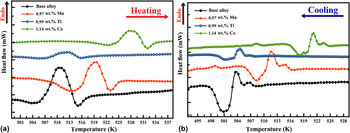
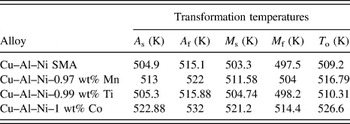
In the present work, the forward and backward transformation curves of the unmodified and modified alloys are illustrated in Fig. 3, and the data for the A s, A f, M s, and M f transformation temperatures are tabulated in Table IV. It was found that during the M ↔ γ transformation, the endothermic and exothermic peaks clearly shifted to higher temperatures, which were about 10 and 18 K with the Mn and Co additions, respectively. With the Ti addition, the transformation temperatures exhibited very slight shifting and a low intensity peak compared with the base alloys (Cu–Al–Ni). This finding is consistent with the findings of past studies by Sugimoto et al. Reference Sugimoto, Kamei, Matsumoto, Komatsu, Akamatsu and Sugimoto25 and Dutkiewicz, et al. Reference Dutkiewicz, Czeppe and Morgiel54 in which the addition of different percentages of Ti to the Cu–Al–Ni SMA resulted in slightly higher transformation temperatures. This increase is related to the presence of the X-phase and a reduced grain size as Ti-rich particles in the microstructure can reduce the mobility of the interfaces between the martensite and β phase. These results were contradicted by the experiments of Lee and Wayman, Reference Lee and Wayman43 who considered that the increasing amount of Ti led to a decrease in the transformation temperatures, and this decrease was attributed to the percentage of dissolved Ti in the β phase. In general, an extra elastic energy is required for the difficult accommodation between the martensite and precipitates, which leads to a shift in the transformation temperatures to the lower values. Reference Manjeri55 In contrast, the transformation temperatures are remarkably correlated to the precipitates' size and, therefore, with increasing precipitate size, the transformation temperatures and accommodation energy increased. Reference Pons and Cesari56 The occurrence of the martensite accommodation is not completely in the elastic state as there is a plastic deformation in the surrounded martensite. Reference Pons and Portier57 The results of the present study also indicated that the highest transformation temperatures were observed with the addition of 1.14 wt% Co, which is correlated to the highest volume fraction and size of γ2. However, a single plate of martensite is not able to absorb large precipitates (size ≥300 nm) due to the large amount of the accommodated deformation around the precipitates. Reference Pons and Cesari56 As an alternative, small plates of martensite, as a multifaceted group, are formed between the precipitates. The results of these changes led to a reduction in the elastic energy required for the martensite–precipitate accommodation. These reductions, along with the chemical influences of the precipitates, increase the transformation temperatures. Reference Kireeva, Picornell, Pons, Kretinina, Chumlyakov and Cesari58 An increase in hysteresis is also related to a change in the martensite microstructure. Furthermore, it can be noticed that some small peaks occurred before and after the main peak on the cooling curve. However, no such peaks occurred on the heating curve. These peaks are mainly attributed to the occurrence of intermartensitic transformations. Because of residual stress, intermartensitic transformations have been suppressed, which lead to their elimination during the heating process. The correlations of the transformation temperature, microstructural changes, grain refinement, and type of alloying element have been described in this study.
DSC curves of the Cu–Al–Ni SMA with and without elemental additions. (a) Heating and (b) cooling.

Transformation temperature of Cu–Al–Ni SMAs with and without elemental additions.

The equilibrium temperature, T o, between the parent phase and martensite phase occurs when the Gibbs free energy (G) of both phases is equalized. T o was calculated based on the following equations:
 $$\Delta {G^{M \to A}}\left( {{T_{\rm{o}}}} \right) = {G^A}\left( {{T_{\rm{o}}}} \right) - {G^M}\left( {{T_{\rm{o}}}} \right) = \left( {{H^A} - {T_{\rm{o}}}{S^A}} \right) - \left( {{H^M} - {T_{\rm{o}}}{S^M}} \right) = \Delta {H^{M \to A}} - {T_{\rm{o}}}\Delta {S^{M \to A}}\quad ,$$
Or
 $$\Delta {G^{A \to M}}\left( {{T_{\rm{o}}}} \right) = {G^M}\left( {{T_{\rm{o}}}} \right) - {G^A}\left( {{T_{\rm{o}}}} \right) = \left( {{H^M} - {T_{\rm{o}}}{S^M}} \right) - \left( {{H^A} - {T_{\rm{o}}}{S^A}} \right) = \Delta {H^{A \to M}} - {T_{\rm{o}}}\Delta {S^{A \to M}}\quad .$$
In addition, T
o for the alloy when the
 $\Delta {G^{M \to A}}\left( {{T_{\rm{o}}}} \right)\,{\rm{and}}\,\Delta {G^{A \to M}}\left( {{T_{\rm{o}}}} \right) = 0$
at T = T
o is expressed as
Reference Tatar59,Reference Ortín and Planes60
:
 $${T_{\rm{o}}} =\, {{\Delta {H^{M \to A}}} \over {\Delta {S^{M \to A}}}}\;{\rm{or}}\;{T_{\rm{o}}} =\, {{\Delta {H^{A \to M}}} \over {\Delta {S^{A \to M}}}}\quad .$$
The equilibrium temperature between the austenite and martensite phase transformation can be expressed as follows:
 $${T_{\rm{o}}} = {1 \over 2}\left( {{M_{\rm{s}}} + {A_{\rm{f}}}} \right)\quad .$$
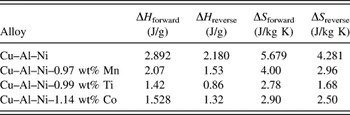
T o was calculated before and after the elemental additions, and the recorded data are listed in Table IV. The maximum value of T o was observed with Cu–Al–Ni–1 wt% Co. Moreover, the thermodynamic parameters of the forward and reverse transformations were calculated, and they are presented in Table V. The enthalpy and entropy of both transformations obtained minimum values with Cu–Al–Ni–0.99 wt% Ti.
Thermodynamic parameters of Cu–Al–Ni SMAs with and without elemental additions.

C. Strength, strain, and microhardness
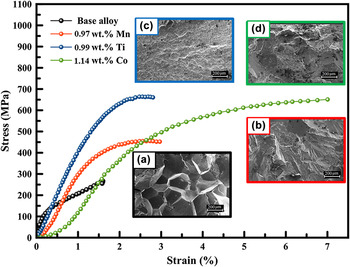
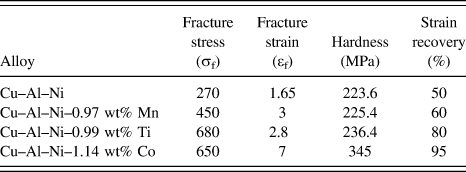
Cu–Al–Ni SMAs have been selected as being high-potential materials for high-temperature applications. This is attributed to their high-thermal stability at temperatures above 373 K. Reference Fremond and Miyazaki4,Reference Lojen, Anžel, Kneissl, Križman, Unterweger, Kosec and Bizjak61 On the other hand, these alloys have their limitations, such as high brittleness due to the appearance of the brittle phase γ2 at grain boundaries and the enormous increase in grain size duplicated with a high elastic variation. Reference Otsuka and Wayman2,Reference Miyazaki, Otsuka, Sakamoto and Shimizu62,Reference Husain and Clapp63 Thus, their disadvantages have restricted their usage to commercial applications. Reference Lee and Wayman64–Reference Gao, Zhu and Lai70 One way to solve this problem is grain refinement. Therefore, because of the addition of alloying elements, such as Ti, Mn, V, Nb, B, and others, or because of the varying the compositions of Ni or Al, some improvement in mechanical properties of the conventional Cu–Al–Ni SMAs Reference Kim, Roh, Lee and Kim68,Reference Adachi, Shoji and Hamada71,Reference Vajpai, Dube and Sangal72 was observed. This improvement is attributed to the addition of alloying elements; these elements are restricting the grain growth and refining the grains. However, these alloying elements have a significant effect on the mechanical properties of Cu–Al–Ni SMAs, due to their formation as a second phase in the microstructure. Reference Zhu, Ye, Li, Song and Zhai73 Roh et al. Reference Roh, Kim, Cho and Kim74 reported that the fine grained alloys resulting from the addition of Ti, Mn, and Zr to the coarse-grained Cu–Al–Ni SMA enhance the fracture stress–strain. It was found that the fracture stress and strain obtained the highest value of 930 MPa and 8.6%, respectively, with the combined addition of 0.3Ti–0.6Zr to Cu–13.4Al–3.05Ni SMA. This improvement is due to grain refinement and the presence of precipitates that formed within grains in the alloy. They have also confirmed other researchers' findings Reference Kim, Roh, Lee and Kim68,Reference Khan and Delaey75 that the tensile properties of (σt, σf, and εt) increased as a function of decreasing grain size. In contrast, the fractured surfaces of Cu–Al–Ni SMA changed from the brittle mode to different modes according to the type and amount of the addition element. In the present work, the typical stress–strain curves obtained from the tensile test, along with the surface fracture, are illustrated in Fig. 4, and the calculated fracture stress and fracture strain are shown in Table VI. The alloy without any grain-refining additions (base alloy) shows very brittle behavior. However, with the addition of Mn, Ti, and Co, the strength and strain of the alloy are increased to reach the maximum values with the Ti and Co addition, 680 MPa and 7%, respectively. These improvements are mainly attributed to the morphology of the martensite phase and the area fraction of the γ2 and X-phase that restricted the mobility of martensite variant interfaces and reduced the crack propagations and improved the mechanical properties.
Stress–strain curves performed at the room temperature along with fracture surface: (a) Cu–Al–Ni SMA, (b) Cu–Al–Ni–0.97 wt% Mn SMA, (c) Cu–Al–Ni–0.99 wt% Ti SMA, (d) Cu–Al–Ni–1.14 wt% Co SMA.

Results obtained from the tensile, microhardness, and SMEs of the Cu–Al–Ni–X SMA.

A common aspect observed in the traditional casting process of Cu–Al–Ni SMA is a feature of a brittle nature, which was confirmed by other researchers. Reference Miyazaki, Otsuka, Sakamoto and Shimizu62,Reference Motoyasu, Kaneko, Soda and McLean76,Reference Yang, Laird and Pope77 Generally speaking, it is important to bear in mind that a crack is always initiated at the grain boundaries and propagates into the specimen at different angles in accordance with the direction of the uniaxial tensile force, due to the high concentrations of internal stress at these regions. However, the principle behind the crack propagation is that when the distribution of the stress is so complicated at the threefold notes of grain boundaries that the stress is not easily released during the deformation process, the cracks are initiated at these fold notes and start to propagate into the materials, where some of the martensites are induced, due to the crystal orientations related to the tensile axis. Regarding the other part of the grains, the martensite is formed at the same stage of deformation. Furthermore, many factors can influence the propagation of cracks and increase the strength of materials, such as the stress-induced martensite plate-like sections, the segregation of the impurities at the grain boundaries, and the high-elastic anisotropy caused by the elastic and plastic strain incompatibilities at the grains, which are able to facilitate the cracks' propagation by changing the propagation's path and/or making the crack grow sufficiently large. Reference Otsuka, Sakamoto and Shimizu23,Reference Miyazaki, Otsuka, Sakamoto and Shimizu62,Reference Funakubo78,Reference Husain and Clapp79 These tendencies can be explained in that, when the crack is large enough and an elastic anisotropy has occurred, the stress concentrations at the crack tips are large enough to overcome the stress concentrations at the grain boundaries. Thus, the crack propagation will be controlled. Accommodating and/or displacing stress produced during the formation of the martensite-induced phase reduces the size of the crack with a small orientation and, therefore, avoids the intergranular cracks. Similarly, it was found that the surface fracture in the current study transferred from the brittle failure with many of the intergranular cracks to transgranular, intergranular, and dimples failure without observing any cracks on the surface of fracture, as shown in Fig. 4. This transformation is dependent on the type of the alloying element. The microhardness of the Cu–Al–Ni SMA, with and without addition, was evaluated in this research, and the findings are shown in Table VI. It can be seen that the addition of the alloying elements leads to significant increases in the values of microhardness, and this enhancement results in the presence of the precipitates in the microstructure, restricting the movement of dislocations and martensite variant interfaces and thus increasing the microhardness. It was also found that the highest microhardness value was observed with the addition of 1.14 wt% of Co. This may be attributed to the high-volume fraction and the large size of the ã2 phase.
D. Shape memory effect
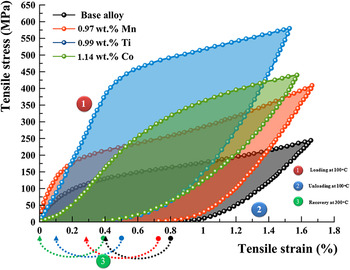
In stress-free conditions, the low-symmetry martensite lattice can exist in several lattice correspondence variants, which are reflections or rotations of each other. Consequently, martensite can exist in many different microstructures depending on its thermomechanical history. The thermal martensite is internally twinned, where twin-related variants create a coherent mirror image of the lattice across each twin boundary (special crystallographic planes). Some requirements for shape memory behavior to exist are as follows Reference Bhattacharya80 : (i) the transformation between austenite and martensite occurs with little volume change and (ii) the distortional strains relative to austenite are relatively small, typically on the order of 10%. In other words, the structure change can occur by small, coordinated shifts of the atomic positions without diffusion or plasticity. The SME arises from the fact that martensite can arrange itself into a self-accommodating, finely twinned (heterogeneous) structure with little or no macroscopic strain relative to austenite. Hence, upon cooling from austenite to martensite, little, if any, strain (or shape change) is usually observed (unless the material has been heavily processed to have a so-called two-way SME). We call this self-accommodated form thermal martensite. Reference Churchill, Shaw and Iadicola81 Figure 5 shows the strain recovery via the SME of Cu–Al–Ni SMAs as a result of varying the type of alloying elements; the determined data are obtained in Table VI. It was found that the highest strain recovery was indicated with the Co addition, which obtained a full 100% recovery of the original shape after being heated up to 573 K. This may be attributed to the grain refinement and high-volume fraction of γ2, which educed the movement of the martensite variants/dislocations and then reduced the irreversible strain, thus increasing the shape strain recovery.
SME curves of the alloys performed at 373 K, then preheated to 573 K to obtain the shape recovery.

IV. CONCLUSIONS
-
(1) The grain size of the Cu–Al–Ni SMA was refined, and high amounts of γ2 precipitates were observed when 1.14 wt% Co was added to the base Cu–Al–Ni SMAs.
-
(2) The highest transformation temperatures were observed with the modified Cu–Al–Ni–1.14 wt% Co SMAs. This demonstrates that this alloy may be a potential candidate for high-temperature shape memory applications.
-
(3) The behavior of the precipitates, as well as the grain refinement, has a significant effect on the strength and ductility of the 0.99 wt% Ti and 1.14 wt% Co alloys. This is because the presence of X-phase and γ2 precipitates that leads to the restricted movement of martensite variant interfaces, thus enhancing the mechanical properties.
-
(4) An excellent shape recovery of 95% was observed for Cu–Al–Ni–1.14 wt% Co SMAs. This is attributed to the higher volume fraction, as large γ2 precipitates can hinder the movements of dislocations/martensite variant interfaces and reduce the permanent strain, thereby increasing the shape recovery.
ACKNOWLEDGMENT
The author(s) would like to thank the Malaysian Ministry of Higher Education (MOHE) and Universiti Teknologi Malaysia for providing the financial support and facilities for this research, under Grant No. R.J130000.7824.4F150.