INTRODUCTION
In many, perhaps all, societies the relative social status of different social and cultural groups results in hegemonic relationships or an ‘order’ manifested as sets of taken-for-granted unmarked societal norms which influence behavior, including linguistic behavior. This article focuses on such sociocultural norms, and I introduce the concept of the culture order, which could be regarded as a potential sociolinguistic universal, manifested in different ways in different societies and social contexts. Many sociologists have pointed to ways in which macro-level societal structures are instantiated at the micro-level through concepts such as agency (Giddens Reference Giddens1984), habitus (Bourdieu Reference Bourdieu1977), and transformation (Agha Reference Agha2003), while sociolinguists who espouse a social realist approach have described both how societal norms constrain appropriate language use in different contexts, and how they are negotiated in face-to-face interaction (e.g. Wodak Reference Wodak, Harrington, Litosseliti, Sauntson and Sunderland2008; Cameron Reference Cameron, Pichler and Eppler2009; Bell Reference Bell and Coupland2016; Coupland Reference Coupland2016; Schnurr & Zayts Reference Schnurr and Zayts2017). However, much recent sociolinguistic and sociopragmatic research has tended to focus on micro-level analysis, with macro-level constraints attracting less attention.
Particular sociocultural values influence the ways in which individuals discursively construct their social identities in particular contexts in different societies. Connell (Reference Connell1987) introduced the term the gender order to describe the patterns of power relations between masculinities and femininities that are widespread throughout many societies and which influence the construction of gender identity. Emphasising the importance of paying attention to large-scale macro-level structures, Connell points to the hegemony of masculinities in most western societies and the influence of hegemonic power relations which shape notions of masculinity and femininity. As Eckert & McConnell-Ginet (Reference Eckert and McConnell-Ginet2013) discuss in detail, through socialisation processes and increasing familiarity with societal norms and expectations, we learn how to behave appropriately as gendered individuals in our society. The gender order acts as a societal level constraint to which members of society orient in their interactions, whether they conform to or contest it.
I propose the culture order as a parallel concept which identifies a hegemonic ideology influencing the ways in which individuals orient to the construction of their ethnic or cultural identity. Just as the concept of the gender order directs the attention of analysts to gendered assumptions which unavoidably influence the behaviour of individuals, so the concept of the culture order encourages analysis of taken-for-granted presuppositions about appropriate cultural behavior which impact interaction, especially in intercultural contexts.Footnote 1 In other words, the concept of the culture order draws attention to pervasive, hegemonic assumptions which constrain and shape social interaction—assumptions of which most individuals are largely unaware until some violation occurs which draws attention to generally undisputed, taken-for-granted sociocultural norms. However, one important aspect that distinguishes the culture order from the gender order is that while many members of society are increasingly aware of the ways in which gendered ideologies, expectations and norms influence social behaviour (including language), it is minority-cultural group members in many societies who are most aware of the impact of the culture order (see Holmes Reference Holmes and Vine2017a). Majority group members typically take them for granted and simply assume their ways of behaving are normal.
Eckert & McConnell-Ginet (Reference Eckert and McConnell-Ginet2013:20) note that gender is a social arrangement, ‘not primarily an individual matter but a practice connecting the individual to the social order’, and they argue that ‘[i]nequality is built into gender at a very basic level’ (Reference Eckert and McConnell-Ginet2013:21). The same is true of the culture order. Inequalities are unavoidably built into the social order when one group is the dominant cultural group in a society, as is often the case. The workplace is a prime site for the enactment of both gender and culture inequalities: workplace ideologies maintain and reinforce the notion that men are more suited for some (typically more senior, statusful, and well-paid) roles and women for other (less senior, less statusful, and less well paid) roles; and similarly majority-group cultural values and ways of doing things are regarded in many workplaces as the only relevant values and appropriate ways of behaving and interacting. Eckert & McConnell-Ginet (Reference Eckert and McConnell-Ginet2013) perceptively identify some of the myriad ways in which gendered assumptions influence everyday interaction. In this article, I draw on the Language in the Workplace (LWP) database (http://www.victoria.ac.nz/lals/lwp/) to provide evidence of how components of the culture order play out in a number of New Zealand workplaces, including some organisations where, unusually, the dominant interactional norms are those of one ethnic minority.Footnote 2 As is often the case, awareness of the existence of norms comes more sharply into focus when they are contested or challenged. In what follows, I first outline a model of the culture order, and discuss the component concepts, then very briefly discuss the methodology and database for the analysis. The analysis section explores evidence of a range of ways in which components of the culture order are instantiated in some New Zealand workplaces, while the final section discusses the affordances offered by the concept of the culture order.
THE CULTURE ORDER
In many societies, even those where there are numerous minority groups, the norms of the most powerful and politically influential group tend to prevail in many public or semipublic contexts. So, for example, in England, despite the existence of many different ethnic and regional communities with their own distinctive culture orders, it is middle-class English ways of doing things that typically characterise what is perceived as appropriate behavior in many formal public contexts. In Australia, a multicultural country, the dominant culture order in most public domains is that of ‘Anglo’ Australians (Peeters Reference Peeters2015a). While these are large generalisations, they provide a starting point for further research. In the New Zealand context, building on our earlier research, the concept of the culture order affords greater depth in analysing the often subtle influence of sociocultural constraints at the micro-level of workplace interaction, while also throwing further light on hegemonic relationships and ideologies in a purportedly bicultural society. In what follows I explore components of the culture order in New Zealand society, where the societal ideologies, values, and cultural practices of one group, the Pākehā (the Māori term for the majority group of European, mainly British, who colonised New Zealand in the nineteenth century), tend to predominate in most public and semipublic domains, including the workplace. I relate these to components of the Māori culture order, since Māori are both the indigenous people and the largest minority group.
Pākehā constitute 74%Footnote 3 while Māori constitute just 15% of the current New Zealand population. In many contexts, Māori people tend to identify with their iwi or tribal groups, rather than as a homogeneous ethnic group. As the respected Māori leader Sir Tipene O'Reagan points out, the concept ‘Māori i’ as applied to people ‘is essentially a Pākehā invention. The only need to distinguish a group of people as Māori came with the arrival of another group. Prior to that we were [different iwi] Kahungunu, Ngāti Porou, Ngāti Whātua, Ngāi Tahu’ (Diamond Reference Diamond2003:25). It is also true, however, that the gradual domination of New Zealand by Pākehā immigrants throughout the nineteenth and twentieth centuries, and the imposition of Pākehā ways of doing things in public spheres (which I am designating the Pākehā culture order), led to a recognition by Māori people of what the different iwi shared—their cultural values and distinctive ways of doing things compared to Pākehā (which I am designating the Māori culture order). Consequently, Pākehā ways of doing things dominate New Zealand society, while most Māori are bicultural.
A core component of the Pākehā culture order is a strong commitment to an egalitarian ethic (Kennedy Reference Kennedy, Chhokar, Brodbeck and House2007; Bönisch-Brednich Reference Bönisch-Brednich2008).Footnote 4 Pākehā New Zealanders do not comfortably tolerate explicit demonstrations of power, and people typically seek ways of reducing status differences and of emphasising equality with their colleagues. One consequence is that formality, which tends to focus on status differences, is generally kept to a minimum, as illustrated below in the discussion of Pākehā meeting openings. Although achievement is admired, it is not flaunted in most contexts. One important mechanism for restraining unqualified self-promotion or boasting is the Tall Poppy Syndrome (TPS) (Jackson & Parry Reference Jackson and Parry2001), which targets those who stand out in some way whether through achievement or wealth.Footnote 5 Examining its manifestations in Australia as well as New Zealand, Peeters notes that self-promotion is condemned, and people are encouraged to be humble and ‘not to shine above others’ (Reference Peeters2015b:221–23), at least in their interpersonal interactions.Footnote 6 McLeod (Reference McLeod1968) traces the roots of the TPS to an aggressive commitment to egalitarianism, which developed as a result of early settlers’ rejection of Britain's class-dominated social structure. The TPS is one means by which the Pākehā egalitarian ethic is policed, as illustrated in the analysis below.
Māori culture by contrast treats those with status and high standing with great respect. As Patterson (Reference Patterson1992:26) notes, ‘[t]raditional Māori society is by no means egalitarian. Rank and seniority of descent are taken seriously’. Māori leaders have great mana, which in Māoridom refers not just to social prestige but to ‘spiritual power and authority’ (Metge Reference Metge1995:87), and their followers recognise this and treat them respectfully. As suggested here, spiritual values (wairua) are integral components of Māori culture, and leadership confers spiritual as well as worldly authority (Metge Reference Metge1995). Nevertheless, Māori leaders are expected to be humble, and to avoid self-promotion. In Māori contexts, praise appropriately comes not from oneself but from others (Metge Reference Metge1995:103, 160): Waiho te mihi ma te tangata ‘Leave your praises for someone else’, as the Māori whakataukī ‘proverb’ says. A respected leader should not assert his or her own status on an individualistic basis; they must wait for endorsement from the group (whānau ‘extended family’, hapū ‘sub-tribe’, or iwi ‘tribe’). A related, widely cited Māori i whakataukī also condemns boasting: Kaore te kū mara e whaakii ana tana reka ‘The kū mara (sweet potato) does not announce it is tasty’ (Mead & Grove Reference Mead and Grove2003:36, proverb 176).
To some extent, then, there is overlap here with the value placed on modesty in Pākehā culture. However, as discussed above, the roots of the pressure to be modest lie in the egalitarian ethic in Pākehā culture, while in the Māori culture order the roots of the emphasis on humility lie in the priority given to the group over the individual. Leaders are expected to work for the benefit of their iwi, not for their own greater glory; the group takes priority in cultures described as ‘collectivist’, contrasting with the Pākehā culture order which favours a focus on individual responsibility. Hence, in Māoridom, ‘face’ is shared rather than pertaining to an individual, and honour and dishonour, prestige and shame accrue to one's group rather than to individuals (Metge Reference Metge1995). Consequently, harsh critical comments directed to individuals are typically avoided in Māori contexts; instead the message is often conveyed by means of a metaphor, a narrative, or a traditional proverb (Patterson Reference Patterson1992:51–60).
The gender order is another relevant component of both Pākehā and Māori culture orders, though its specific constraints and prescribed realisations are different in each. The patterns of power relations between masculinities and femininities (Eckert & McConnell-Ginet Reference Eckert and McConnell-Ginet2013:7) are subtly different in Pākehā vs. Māori contexts, and the way they ‘[structure and regulate] people's relation to society’ (Eckert & McConnell-Ginet Reference Eckert and McConnell-Ginet2013:21) also differ. Moreover, within Māoridom there are differences in the role and status of women in different iwi (Blank Reference Blank, Bunkle and Hughes1980:35–37; Salmond Reference Salmond1991:340; Metge Reference Metge1995:91–98). Gender is not the focus of this paper however, though it is clearly one important component of the culture order in most societies, alongside other components such as age. In the next section, the methodology and database of the LWP are briefly outlined.
METHODOLOGY
The methodology used by the Language in the Workplace Project (LWP) team has been thoroughly described in many publications (e.g. Holmes & Stubbe Reference Holmes and Stubbe2015; Marra Reference Marra and Spencer-Oatey2008; Holmes, Marra, & Vine Reference Holmes, Marra and Vine2011; see also www.vuw.ac.nz/lals/lwp). Here I provide a very brief summary. Our basic methodology involves an ethnographic approach: following a period of participant observation of the daily interactions of employees by team members, we ask volunteers to collect recordings of samples of their normal everyday workplace interactions usually over a period of two to three weeks. This is followed by debriefing interviews to collect comments and reflections on this process. Where possible we video-record meetings of groups, using small cameras that are fixed in place, switched on, and left running for the whole meeting. Our policy is to minimise our intrusion as researchers into the work environment. As a result, our database includes some excellent examples of workplace interaction that are as close to ‘natural’ as possible.
The LWP Corpus currently comprises more than 2,000 interactions, involving 700 participants from thirty different workplaces which include commercial organisations, government departments (Māori and Pākehā), small businesses (Māori and Pākehā), factories, building sites, and eldercare facilities. The data used in the analysis below draws from material recorded in meetings in professional white-collar Māori and Pākehā workplaces, as well as interviews with participants after the recording phase.
ANALYSIS
In order to demonstrate how the concept of the culture order is instantiated in a society such as New Zealand, it is useful to consider the experience of people of majority-group ethnicity working in minority-group workplace contexts. Just as the gender order is experienced differently by people with particular gender orientations (LGBTQ+), so the culture order is experienced differently depending on one's ethnicity. Majority-group members are typically unaware of the ways in which components of the majority-group culture order impose sociolinguistic constraints on acceptable behaviour in different contexts. It is only when Pākehā find themselves in a minority-group context and especially in what we have described as ‘ethnicised’ workplaces (workplaces characterised by tikanga Māori ‘Māori ways of doing things’) that their taken-for-granted norms come into focus.
We have many examples in our database illustrating how the conventional hegemonic Pākehā order is interactionally instantiated at particular times in specific types of workplace interaction.Footnote 7 There are also many aspects of New Zealand workplace culture which are shared across different workplaces, such as the occurrence of small talk at the beginning of the working day, before and after meetings, the use of humour to mitigate criticism, and a preference for conflict avoidance (e.g. Holmes & Stubbe Reference Holmes and Stubbe2015; Holmes & Marra Reference Holmes and Marra2004; Holmes Reference Holmes2006; Holmes, Marra, & Vine Reference Holmes, Marra and Vine2011; Marra Reference Marra2012). But some interactional norms differ, reflecting different cultural values or ideologies, and this is especially clear when we contrast ethnicised Māori workplaces with typical Pākehā workplaces.
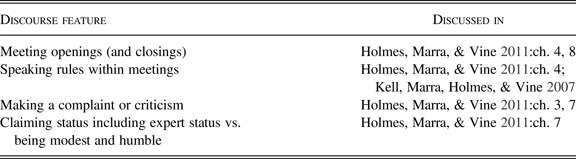
In ethnicised workplaces, ‘ethnicity acts as a taken-for-granted backdrop, crucial for interpreting everyday workplace communication; ethnic values underpin the guidelines or norms which influence the way people interact, and the ways in which they construct different aspects of their identity, including their ethnicity’ (Schnurr, Marra, & Holmes Reference Schnurr, Marra and Holmes2007; Holmes, Marra, & Vine Reference Holmes, Marra and Vine2011:3). These organisations are working for the benefit of the Māori indigenous minority in a variety of ways; the Māori culture order accounts for their ideological assumptions about appropriate behavior, and tikanga Māori characterises many aspects of workplace interaction. Table 1 summarises relevant findings from our previous research as a starting point for further discussion of the culture order in these contexts. I briefly illustrate each of these features in turn, as a basis for discussing their relevance to the concept of the culture order.
Summary of LWP research on distinctive features of discourse in Māori workplaces.

Meeting openings
As noted, it is the Pākehā culture order that dominates in New Zealand and hence the unmarked way of opening workplace meetings can be illustrated from any of the many Pākehā meetings in our large database, as well as from many of the less formal Māori meetings. Example (1) summarises some typical openings in Pākehā meetings.
-
(1) a. (okay/well/so) let's go/start/get underway
b. shall we start (now)
c. time we got underway
d. okay let's get cracking
e. I think we should start now if everyone's here
These brief compact openings typify both formal and informal Pākehā workplace meetings where lack of ceremony is valued as a sign of friendliness and solidarity. They represent the taken-for-granted ‘normal’ way of opening a New Zealand workplace meeting, and they contrast markedly with the meeting openings in ethnicised Māori workplaces where typically the opening of a meeting involved a ritual component involving an explicit welcome or greeting formula and a karakia ‘a prayer/traditional chant’, typically in te reo Māori ‘the Māori language’, which might be quite elaborate, as illustrated in example (2).Footnote 8
-
(2) Māori meeting opening


Example (2) clearly illustrates that the structure of this opening follows the pattern identified for other meeting openings in ethnicised workplaces described in our earlier research (Holmes, Marra, & Vine Reference Holmes, Marra and Vine2011:72). It includes a greeting to signal the start of the opening (kia ora), the opening of the karakia (where e pā signals this is not a traditional karakia, but a ‘religious’ one), a reference to the purpose of the gathering and proper behaviour in this context (Quentin's discussions with the company managers), a reference to extended family and especially those who are sick or dying (‘those who are ill or affected by death or illness’), and then a signal of the beginning of the closing (‘Jesus Christ is our saviour’), the closing, here amene, and a transition marker from the karakia to the meeting's business (‘this is just a short meeting’).
For Māori participants, the extended opening with its formal structure and traditional components signals respect towards the participants and their concerns—taken-for-granted components of the Māori culture order. The opening often includes explicit acknowledgement of participants’ status and their interests, and marks the boundary between the preceding small talk and gossip and the serious business that is about to commence. The structure is carried over and adapted from traditional Māori society where such openings are a core and indispensable component of any formal speech event (Salmond Reference Salmond1975; Metge & Kinloch Reference Metge and Kinloch1978). The absence of such a ritual opening, however brief, would be noticeable in a Māori context and considered an indication of lack of respect for the participants. By contrast, Pākehā who join a Māori workplace are struck by the formality of such openings, and often regard them as overly ritualistic and time-consuming. Hence, this aspect of workplace interaction provides an example where the Pākehā and Māori culture orders contrast markedly, reflecting the relative value attached to an emphasis on solidarity and egalitarianism vs. an emphasis on spiritual values and respect for status. And while our data clearly indicates that the dominant New Zealand culture order in workplace meetings prescribes short, informal meeting openings (as illustrated in example (1)), there is also some evidence of the modification of this pattern in more formal public domains, a point discussed in the final section.
Speaking rules within meetings
Once a meeting is underway, the norms for participation comprise another component of the culture order where some aspects of acceptable behavior differ in Māori and Pākehā contexts. The most marked contrast is the occurrence in Māori meeting contexts of low-level murmuring and positive verbal feedback while someone is speaking (Metge & Kinloch Reference Metge and Kinloch1978:20–21; Metge Reference Metge1995:85), whereas in Pākehā contexts the norm is to give silent attention to a speaker.Footnote 9 In other words, respect for others, and support for their contributions, are often explicitly expressed in Māori contexts, while silence tends to indicate respect and support in Pākehā contexts. Kell et al. (Reference Kell, Marra, Holmes and Vine2007) analysed two separate meetings with the same agenda in the same workplace, a government department, where one meeting involved a Māori group and the other a Pākehā group. The Māori meeting was characterised by much more overlapping talk, explicit verbal feedback, and collaborative interaction than the Pākehā meeting. The frequent verbal feedback and on-topic side conversations are indications of engagement (Metge & Kinloch Reference Metge and Kinloch1978), but these are often misinterpreted by Pākehā as signals of inattention and lack of respect, or attempts to take over the floor. Pākehā norms require silence while someone is speaking in a formal meeting (cf. Jaworski Reference Jaworski1993; Spencer-Oatey Reference Spencer-Oatey2000).
This contrast in the norms of the Māori and Pākehā culture orders is most dramatically illustrated by an example which is discussed in detail in Holmes & Marra (Reference Holmes, Marra, Davies, Haugh and Merrison2011a) and Holmes, Marra, & Vine (Reference Holmes, Marra and Vine2011). Here for illustration purposes, I provide it as example (3) (abbreviated from the original) with a brief summary of the discussion. It is an excerpt from a meeting of all of the staff in a Māori organization. Steve, a Pākehā member of the organization, is presenting a report (‘Ants’ is Frank's nickname).Footnote 10
-
(3) 1 Steve: we have capability development um
2 the g m oversight here //is from Ants with Caleb\
3 Frank: /[quietly to Daniel]: and what's maraetai mean?:\\ …
4 Frank: [quietly]: what's maraetai mean?:
5 Steve: obviously key area
6 //we want to ensure that um\ …
7 Daniel: /[quietly]: it's by your left eye:\\
8 Frank: [quietly]: by your left eye:
9 Daniel: //[quietly]: mm my right eye:\
10 Steve: /one of the important\\ things in communication is
11 not to talk when others are talking
12 [laughter] ….
13 Frank: Steve this indicates a need for you to be out in hui
14 [laughter]
15 Frank: one of the things that you learn very quickly
16 is that a sign of respect is that
17 other people are talking about what //you're saying
18 while you're saying it\
19 /[laughter]\\ [laughter]
20 Steve: I see I see….
During Steve's extended contribution to the meeting, many participants make quiet remarks to each other, but when Frank (Ants) makes a comment to Daniel, Steve reacts by humorously reprimanding them: “one of the important things in communication is not to talk when others are talking” (lines 10–11). From the perspective of the Māori culture order, Steve is inappropriately asserting the Pākehā communicative norm in a workplace where Māori ways of speaking obviously prevail, as is evident from the fact that others have been talking quietly during Steve's contribution. Frank, another Pākehā, responds (line 13) by challenging Steve's rebuke as inappropriate, implying that Steve is not yet familiar enough with Māori interactional norms “Steve this indicates a need for you to be out in hui” (i.e. to attend more Māori meetings). As a result of long immersion in this workplace, Frank is aware of the Māori culture order and the behaviour it licenses in such contexts, and he spells out the Māori norm for Steve's benefit: “a sign of respect is that other people are talking about what you're saying while you're saying it” (lines 16–18). In his quiet exchange with Daniel, Frank was seeking clarification of the word Maraetai, which he did not recognise as a placename, while Daniel's humorous response involved a well-known Māori joke based on its similarity to the phrase ‘my right eye’. For the Māori workplace participants, this is normal unmarked behaviour, whereas Steve's comment (lines 10–11) inappropriately asserts the Pākehā norm, which evaluates on-going background talk as indicating lack of attention and respect for the speaker. For Māori, however, such talk is a dynamic means of processing the formal content being presented, and an indication of ongoing attention and engagement as Frank points out (lines 15–18). The sociocultural norms of the Pākehā and Māori culture orders thus prescribe different behaviours to indicate respect and attention to a speaker in a formal context. The example illustrates well the taken-for-granted status of the Māori culture order in this workplace, which bicultural Frank obligingly spells out for the newcomer.
Criticism and complaint
Another area of contrast between the Māori and the Pākehā culture order is the ways in which criticism and complaint may be expressed, and this was evident in relatively subtle contrasts in the workplaces discourse we analysed. Strategies ranged from direct and explicit negative comment or disagreement, through negotiation, compromise, and mitigated feedback, to avoidance strategies that sidelined or diverted contentious issues, or evaded the area of dissent (Holmes & Marra Reference Holmes and Marra2004; Marra Reference Marra2012). These strategies were identified in both Māori and Pākehā workplaces. However, one distinctive difference was the absence of explicit, confrontational criticism or direct complaint aimed at an individual in the Māori workplace meetings, a cultural norm which has its roots in the Māori concept of whakamā ‘embarrassment’ or ‘shame’, and the importance of avoiding bringing shame on one's iwi or whānau.Footnote 11 As noted, Māori culture is collectivist with the group typically privileged over the individual (Metge Reference Metge1995). So, for example, Seamus, the managing director in a Pākehā organization frequently challenged his team quite explicitly about things he disapproved of. Discussing the use of a rusty and dented truck for deliveries, for instance, he asks “who's letting this happen …why wasn't it fixed initially”. In other words, he (perhaps rhetorically) demands the name of the person responsible, as well as challenging the decision which led to the unsatisfactory situation (Holmes & Chiles Reference Holmes, Chiles, Freed and Ehrlich2010). By contrast, Māori leaders tended to generalise criticisms and avoid focussing on specifics or identifying responsible individuals. A compelling example (discussed in detail in Holmes, Marra, & Vine Reference Holmes, Marra and Vine2011:53–58) involved a complaint about the state of the organization's kitchen voiced by a section manager, Rangi, during the regular weekly meeting of the whole organization. He used much-appreciated humour to convey the critical message and treated the problem as one for the group as a whole, thus avoiding causing whakamā or shame for any particular person. Example (4) illustrates this point in another Māori workplace. Hera is the team manager and in this excerpt from a team meeting she is complaining about the standard of writing of some members of her team.
-
(4) XF: unidentified female
1 Hera: which leads me onto one other item…
2 and that's the um issue of writing [inhales] um +
3 //+ when\ [drawls]:
4 XF: /mm\\
5 Hera: um: whenever you er are drafting
6 I've noticed a couple of mistakes creeping into our work
7 and that's stuff that e- that even that I've signed out ….
8 and I've suddenly as I'm rereading I spot a spelling mistake
9 which I didn't see the first time round or a grammatical mistake
10 XF: yeah
11 Hera: I really make a plea for all of you to make sure
12 that you take it to one other person at least
13 //+ to um to\ peer review
14 XF: /I'm doing that eh [laughs]\\
15 Hera: //before you\ before you sign it out
16 XF: /yeah kia ora\ …..
17 Hera: it's so easy to overlook just a simple mistake
Hera's criticism clearly conforms to the presupposed norms of the Māori cultural order, avoiding shaming specific individuals. Moreover, she uses a range of pragmatic and discursive devices to mitigate the critical comments, including hesitation and pauses (lines 2, 5, 13), attenuating phrases “a couple of” (line 6), and lexical items “creeping into” (line 6), “stuff” (line 7), and taking some responsibility herself for overlooking errors (lines 7–9).Footnote 12 She ends with a statement which further mitigates the force of the criticism: “it's so easy to overlook just a simple mistake” (line 17). While Hera's approach in avoiding direct criticism is similar to that of many of the Pākehā leaders in our data (indirectness is a feature of a number of kinds of Māori and Pākehā interaction, a point discussed further below), it represents the taken-for-granted norm in Māori culture. Direct, serious criticism can and does occur in Pākehā workplaces, particularly more ‘masculine’ workplaces (Holmes Reference Holmes, Ehrlich, Meyerhoff and Holmes2014), but there are no such examples in the Māori workplaces in which we recorded. The taken-for-granted values encoded in the Māori culture order mean that respect for others and their iwi is a paramount concern, and avoidance of whakama is thus crucial.
Be modest
The final component of the New Zealand culture order discussed in this article is complex. Although many of its manifestations suggest a shared New Zealand norm, there are other contexts where they index distinctively different Māori vs. Pākehā values. As noted in the introductory section, the shared New Zealand norm can be described as a general preference for modesty or avoidance of self-promotion, and there is evidence of an orientation to this norm among most New Zealanders, including those from minority groups such as the New Zealand Chinese-speaking community (Wong Reference Wong2016:173).Footnote 13 There are of course some contexts, such as job or performance interviews, where it is reasonable to draw attention to one's achievements. However, in the thirty-five New Zealand workplaces, including five distinctively Māori workplace contexts, that we have researched, the general orientation to modesty is very evident, often through self-deprecating humour, but also by the absence of serious self-promoting behaviour in most face-to-face interactions. Sir Edmund Hillary, the first person to climb Everest, is often cited as a canonical Pākehā example of this New Zealand preference, as indicated by his consistently modest comments on his many successful achievements. Among Māori leaders, Whata Winiata (see Diamond Reference Diamond2003) and the late Māori Queen Te Ā tairangikaahu can be considered good exemplars, and, as noted, there are many whakataukī that praise humility and the humble leader (e.g. Mead & Grove Reference Mead and Grove2003:proverb numbers 76, 176, 881, 1159).
The specifically Pākehā instantiation of this pan-New Zealand norm derives from the strong commitment to an egalitarian ideology mentioned above. Pākehā New Zealanders do not feel comfortable expressing explicit respect for those with status and they typically emphasise solidarity and equality rather than status and respect for colleagues. In Māoridom, with its collectivist culture, the roots of the high value assigned to modesty and humility are quite different, as noted in the discussion of the Māori culture order above. The requirement for modesty follows from the emphasis on the group rather than the individual: Māori leaders are expected to put the needs of the group first. The examples discussed in this section illustrate both culturally similar responses and culturally different responses to the shared ideological value attributed to modesty in both cultures. Just two aspects of this are considered here: (i) how New Zealanders in the workplace respond to praise, and (ii) how they enact an expert identity, while nonetheless orienting to the societal norm ‘be modest’.
Responding to praise
Ways of responding to praise is an area where the egalitarian ethic is clearly relevant for Pākehā New Zealanders, while the requirement to be modest constrains Māori responses to praise. Our data suggests that while New Zealanders sometimes quietly accept praise from superiors and colleagues without comment, often they adopt strategies which divert the credit to others or downgrade the praise in some way, such as by using self-deprecating humour. So, for example, Suzanne, a Pākehā manager, responds to a positive assessment from her division manager during her performance review by praising her team members “they're great actually… they um they've enabled me to do that”. And Gretel, the Pākehā leader of the communications team in a Māori organization, interrupts applause in response to her report that a major piece of work has been delivered on time to explicitly attribute the credit to another member of her team: “don't thank me thank Anthony Anthony's done seventy hours so far this week and we haven't got Friday's hours in”.Footnote 14 Attributing credit for achievements to one's team is a very acceptable strategy in both Māori and Pākehā contexts, a strategy that may possibly have its roots in Māori promotion of the group rather than the individual, though it is noteworthy that emphasis on the importance of team-work has increased globally in the leadership literature over the last decade (Jackson & Parry Reference Jackson and Parry2011).
Self-deprecating humour is another strategy often used to respond to praise in both Pākehā and Māori workplaces. Example (5) illustrates a typical response to a compliment in a large Pākehā commercial organisation. Sandy, the project leader and chair of the meeting, has arrived first. Brendan is next, and they chat as they wait for the rest of the team members to arrive.
-
(5) 1 Bren: where did you learn sort of
project management type of skills
2 Sandy: oh I never did
3 Bren: cos you seem really good at it
4 Sandy: /I've just winged it\\
5 Bren: //and awfully\ confident
Sandy's responses to Brendan's compliments are typically self-deprecating, playing down his expertise by claiming he “never did” (line 3) learn project management skills and responding to Brendan's admiration “you seem really good at it” (line 4) with the modest humorous comment “I've just winged it” (line 5).
Yvonne, the Māori leader mentioned above, uses self-deprecating humour to downplay praise reported in what she describes as her “first and only ever fan letter” (Holmes & Marra Reference Holmes and Marra2011b). And in another excerpt Yvonne responds to a compliment from a staff member, Sheree, about a presentation she has given (“I loved it… I came home raving”), by teasing Sheree that she liked it “only because I had a photo of you”, which elicits laughter from the whole group and deflects attention from the compliment (Holmes & Marra Reference Holmes and Marra2011b).
These examples suggest that complacent acceptance of praise is unusual in both Māori and Pākehā workplaces, indicating an orientation to the Modesty Maxim (Leech Reference Leech1983, Reference Leech2014), which has its New Zealand roots in both the Pākehā egalitarian ethic and the Māori orientation to the group rather than the individual. This evidence of a taken-for-granted assumption about appropriate behavior in response to praise suggests the development of an overarching New Zealand culture order, which despite different sources, is instantiated similarly by both Pākehā and Māori. However, there are also certain contexts in which employees are expected to demonstrate their skills and expertise in the workplace.
Doing being an expert
In all the workplaces we researched, there were people who had been employed because of their specific areas of expertise. Interestingly, how they deployed and demonstrated that expertise appears to be an area where differences may be observed in Pākehā and Māori workplaces in some contexts. To put it very simply, the Māori culture order orients to the need for modesty in these contexts (kaua e māhaki ‘don't flaunt your knowledge’), while the Pākehā culture order focusses on demonstrating competence. This contrast is most starkly experienced by Pākehā people working in Māori contexts. Gretel, the Pākehā manager of the Communications team in a Māori production organization, expresses the dilemma very clearly in this excerpt from a meeting of her team. Xavier is a senior communications consultant and is Māori.
-
(6) 1 Gretel: Xavier and I had a meeting with Mike Herema
2 a a we did a formal interview with him
3 and he's the manager of Māori strategy up there
4 and at the end of the interview I said
5 Mike have you got any questions for me
6 and he said yeah (are) you any good? [laughs]
7 XF: [laughs]
8 Gretel: and Xavier was sitting there
9 I'm thinking how do I answer that
10 because if I say I'm any good
11 I'll look like a tosser
12 XF: [laughs]
13 Gretel: and if I hesitate I'll look like an even bigger tosser
14 and Xavier said Mike since the white lady got here
15 everything's been a lot better
16 she checks our taxi card and our //( )\
17 All: /[laugh]\\ [laughs]
18 Gretel: and she tells us what to do
19 and we're doing a lot better now
20 so that was nicely deflected by Xavier
This is a very explicit statement of the problem facing a Pākehā who is sensitive to the constraints of the Māori culture order that censure boasting even in a work context where one's expertise is relevant. Gretel reports here how Xavier gallantly rescued her from the dilemma by testifying explicitly to her expertise.
The same dilemma is articulated in interview by Joy and Paula, Pākehā women working in different Māori organisations. They have learned not to parade their knowledge in meetings, even when the discussion is in an area in which they have been hired for their expertise (Holmes, Marra, & Vine Reference Holmes, Marra and Vine2011:156–62). Paula says that even though she is the most knowledgeable person on an issue (“I know the stuff and they don't know the stuff”) and in a manager role, nevertheless she must “be very careful to be whakaiti [‘humble’]” (Holmes, Marra, & Vine Reference Holmes, Marra and Vine2011:159–60). Providing advice without being asked to do so is likely to be perceived as whakahī hī ‘boastful’. Similarly, Joy, a usually voluble participant in interaction, says that she has learned to keep quiet in meetings: “I felt it might be quite easy to dominate… so I I shut up most of the time you know”. Joy had observed that the processes used to resolve problems and challenges in the Māori organization in which she worked often involved indirect pathways that promoted thoughtful engagement and learning by others, and hence it was often inappropriate to state what you knew directly and explicitly. This observation was endorsed by Gretel in interview who commented on the importance of “knowing when to sit down and shut up, actually knowing when your input when your direct input is not appropriate is very helpful”.
This is very different behaviour from that we have observed in meetings in Pākehā organisations where, typically, people were expected to ‘step up’ and contribute based on their knowledge and expertise. Here is a short excerpt from an extended contribution from a management consultant in an IT company.
-
(7) 1 Neil: um so so the first part of this plan
2 is really the introduction and guidelines
3. as of how to use it
4 the back part is really the tool
5 so when you actually sit down with your managers
6 and you get to page four
7 then what are the KPIs
8 and what are the measures
9 which is exactly what we've been doing this morning
10 how do you break that down to the next level
11 and er in there is the development needs
12 what have we got to do
13 to assist you to achieve these KPIs yep?
14 which is the development component
15 mid year review and end of year review
Neil is a consultant who has been hired to introduce new performance review tools and here he is quite explicitly ‘doing expertise’, demonstrating his knowledge and indicating his competence and control of the relevant information. This will seem unremarkable to most readers—it is the bread and butter of many meetings.
Another example from Holmes & Stubbe (Reference Holmes and Stubbe2015:76) illustrates the systems expert, Eric, speaking up to oppose a decision with which he strongly disagrees. One team member suggests that they test their new computer system by pretending to lose “all our documents and all our code” and then see if it can be restored. Eric responds forcefully “no don't do that” and enacting his expert identity proceeds to explain why. In a production company, Rob, the business development manager explicitly offers his expertise in a meeting with Jaeson, the general manager: “well I'm up I'm up for that discussion and he goes on later to joke and I‘m not cheap”, a comment that would be considered whakahihi ‘boastful’ in a Māori context. Moreover, this seems not to be a gendered feature since we have plenty of examples of women stepping up in Pākehā organisations when they judge that it is appropriate, as example (8) illustrates.Footnote 15
-
(8) Footnote 16 1 Neville: question about that room set up…
2 Pete still hasn't had any notification…
3 Tessa: okay well
4 Neville: so who should it be
5 Tessa: we we should talk to him
6 you and I will talk to him
In line 3, Tessa, the expert in the area of information technology, self-nominates to indicate she wishes to claim the floor, and in lines 5–6 she explicitly offers herself and Neville to undertake the relevant task. Throughout the rest of the discussion, Tessa continues to contribute most to the decision-making process, including proposing the solution that is finally accepted and ratified. In another example, from the same organization, Marlene, an expert in the area of communications, regularly volunteers her expertise in that area.Footnote 17 These examples illustrate how the Pākehā culture order entails employees taking the lead where appropriate, speaking up, critically if necessary, in areas of their expertise, and volunteering to pick up work in areas of their competence. These taken-for-granted assumptions about appropriate behavior were highlighted in our data by the reflections of Pākehā employed in ethnicised Māori workplaces (e.g. Gretel, Joy, Paula), rather than being recognised as norms in the wider society. In this area then, too, the Pākehā and Māori culture orders differ.
DISCUSSION AND CONCLUSION
So what affordances are offered by the concept of the culture order? Exploring this issue, I have focused on areas where the hegemonic Pākehā culture order often differs from that of the minority Māori people, namely, meeting discourse norms, expressing complaints or criticisms, responding to praise, and claiming expert status. Re-examining our workplace data in the light of this concept provides greater depth of understanding of the ways in which components of often overlooked contextual constraints or taken-for-granted norms influence micro-level face-to-face workplace interaction. The examples discussed in the preceding section support the argument that components of both the Māori and Pākehā culture orders influence patterns of interaction in New Zealand workplaces. Some components are distinctive to Māori while others appear to be shared by Māori and Pākehā, and, most interesting perhaps, are those where the realisations are similar in both culture orders although the roots of the behaviours are quite different. In this section I argue that the analysis of our data using the concept of the culture order provides new insights into undoubtedly hegemonic relationships, as well as indicating ways in which, despite the different origins of some components of the ideologies to which Māori and Pākehā subscribe in New Zealand society, there is evidence of mutual transformation through intercultural contact in some aspects of discursive interaction.
The analysis draws attention to absences, which often go unperceived in everyday interaction. Our data demonstrates that, allowing for some variations, Māori typically open formal workplace meetings in ways that are very different from the ways that Pākehā adopt. As illustrated in example (2), Māori meeting openings are typically rather formal, with ritual elements expressing respect for iwi, family, and the ancestors, elements that are completely absent from the Pākehā meeting openings, as example (1) illustrated. Pākehā meeting openings tend to be brief and informal, reflecting the privileging of solidarity over status, and indicating the Pākehā preference for reducing formality in line with an orientation to the egalitarian ethic. Clearly this is a potential source of miscommunication where Pākehā are unfamiliar with, or more often less than tolerant of, these Māori cultural norms that value respect for ancestors as well as those of higher status, and especially those who hold leadership positions. Among Māori, then, the culture order prescribes formality as a means of constructing a respectful demeanour towards others in appropriate contexts. For Māori working in majority-group contexts, the absence of ritualistic openings highlights the hegemony of the Pākehā culture order in formal workplace meetings.
Similarly, the patterns of feedback in formal meetings differ in Pākehā and Māori contexts, as example (3) clearly illustrated. Within the meeting, Pākehā tend to be silent when someone is presenting a report to indicate attention to the message and respect for the speaker, while Māori norms permit low-level supportive murmuring and commentary. This pattern of empathetic feedback while someone is talking can be described as the ‘conversationalisation’ of the meeting discourse (cf. Fairclough & Mauranen Reference Fairclough and Mauranen1997; it constructs an atmosphere of informality, engagement, and involvement. Here then Māori and Pākehā norms contrast sharply: Pākehā meeting openings are informal, but within a formal meeting silence indicates attention and respect, while for Māori exactly the opposite is often the case. The concept of the culture order draws attention to the hegemonic Pākehā assumption about respectful behavior within a meeting—behaviour which Māori experience as an absence of attentive verbal feedback.
When making a criticism or complaint, the culture order differences are more often a matter of degree than of all-or-none difference in norms. The Pākehā culture order can been described as favouring negative politeness ways of interacting (Marra Reference Marra and Spencer-Oatey2008): in general, direct criticism is avoided and complaints tend to be mitigated and attenuated, often by humour. As illustrated in example (4), the Māori culture order similarly eschews direct criticism of individuals but for somewhat different reasons. Māori tend to avoid criticism of an individual in order to prevent them experiencing whakamā or shame. Shame for an individual is regarded as bringing shame on one's iwi or whānau. The concept of the culture order draws attention to the different values and ideologies underlying superficially similar discourse behaviour.
Similarly, the Modesty Maxim, which is a component of both the Māori and Pākehā culture orders, proscribing boasting and self-promotion, has complexly distinctive roots in each. The Pākehā norm derives from the strong commitment to an egalitarian ideology, often kept in check by the TPS, while in Māoridom, with its collectivist culture, the roots of the high value assigned to modesty and humility again derive from the emphasis on the group rather than the individual. Exploring these seemingly similar behaviours, I discussed two different types of evidence: how, in the face of the proscription on boasting, people respond to praise, and how they enact their employment expertise in workplace interaction.
Responses to praise provide an area where Māori and Pākehā behave similarly. In both Māori and Pākehā contexts, participants sometimes responded silently, usually with a smile, behavior we might classify as a noticeable absence of a verbal response, or by using self-deprecating humour, as in example (5). Both Māori and Pākehā sometimes diverted credit to others (see Holmes, Marra, & Lazzaro-Salazar Reference Holmes, Marra and Lazzaro-Salazar2017), behaviour indicating an orientation to the group or team compatible with both culture orders though generated by different underlying values. All of these responses indicate an orientation to avoiding self-promotion or self-praise, a principle relevant to both Māori and Pākehā orders.
In some contexts, however, it is important to indicate or demonstrate professionalism and expertise, thus presenting a challenge to the general embargo on self-promotion. In Māori workplaces, the culture order requires participants to avoid asserting explicit claims to expertise, behaviour regarded as unacceptable self-promotion, as Gretel states explicitly in example (6). Experts should wait until they are asked for their advice, a requirement totally unfamiliar to Pākehā, as Joy and Paula indicated in their interviews. By contrast, Pākehā experts are expected to step up and offer expertise as illustrated in examples (7) and (8). Here the culture order plays out differently in Māori vs. Pākehā contexts, reflecting again the need for individuals to show respect for superiors in Māori culture, compared to the more egalitarian orientation apparent in Pākehā workplaces. Different ideologies, beliefs, and values are instantiated in contrasting expectations of what constitutes appropriate behaviour in workplace interaction. The concept of the culture order usefully draws attention to what could be easily overlooked, namely the absence of assertions of expertise by Māori participants in workplace meetings. The taken-for-granted hegemonic Pākehā norm requires experts to speak up as appropriate; the Māori norm is rather to wait until expert advice is explicitly requested.
The discussion has suggested ways in which the behaviours prescribed or proscribed by the Pākehā and Māori culture orders are distinct, ways in which they are superficially similar though based in different value systems, and ways in which they show evidence of mutual influence. In very formal public domains (such as graduation ceremonies, or welcome ceremonies for important overseas visitors), there is ever-growing evidence of the influence of the Māori culture order in the form of the inclusion of ritualistic components of Māori protocol including language, for instance. This suggests the possibility of a blended New Zealand culture order for certain contexts, with assumptions about appropriate behavior drawing on components of both cultures. The shared orientation to the Modesty Maxim, though rooted in different values, is another instance where similar behaviours are proscribed by both culture orders, suggesting further possible areas of convergence.
In this article I have suggested that the concept of the culture order can usefully direct attention to discursive behaviours that may be ignored or overlooked, including what could be considered absences, such as silent responses and avoidances. In conclusion, I propose the culture order as a potential empirically testable sociolinguistic universal that sociolinguists can investigate, interrogating how and why it is manifested in particular ways in particular social contexts within particular societies. The analysis has illustrated some of the ways in which different sociocultural ideologies and values play out in a number of New Zealand workplaces, providing evidence of the existence of at least two culture orders with interesting implications for a slowly developing trajectory of biculturalism and multiculturalism. Predictably, widespread myopic ethnocentrism means that it is generally those who come from cultural backgrounds other than the majority Pākehā group who are expected to make the adjustments, to become bicultural, and to learn to interact appropriately according to Pākehā norms. However, it could be argued that, if the majority group can be encouraged to exhibit greater openness towards minority groups (thereby addressing the challenge of tolerability; Grin Reference Grin, Skutnabb-Kangas and Phillipson1995; May Reference May2000; de Bres Reference de Bres2008), this could provide a more optimistic and constructive way forward. This might be achieved by drawing on widely recognised New Zealand values such as inclusiveness, friendliness, and mutual respect (Wong Reference Wong2016), values that reflect some of the positive aspects of the Pākehā culture order. In this case, we could anticipate a future where the New Zealand culture order continues to gain enrichment not only from Māori sources but also from the range of other minority groups who contribute to New Zealand society.
APPENDIX: TRANSCRIPTION CONVENTIONS
All names are pseudonyms.