INTRODUCTION
The Boston Diagnostic Aphasia Examination (BDAE) is one of the most commonly used test batteries for aphasia, both nationally and internationally, as well as across hospital settings (Katz et al., Reference Katz, Hallowell, Code, Armstrong, Roberts, Pound and Katz2000). The test battery allows comprehensive assessment of different aspects of language function in people with aphasia with the aims of assisting with the diagnosis of aphasia syndromes, providing guidance in therapy, and measuring treatment outcome (Goodglass et al., Reference Goodglass, Kaplan and Barresi2001a). Given these goals, examining the psychometric properties (i.e., reliability and validity) of BDAE is a clinical necessity.
The BDAE has undergone two significant revisions since the publication of its first edition in 1972 (Goodglass & Kaplan, Reference Goodglass and Kaplan1972b); it was revised in 1983 (Goodglass & Kaplan, Reference Goodglass and Kaplan1983b) and again in 2001 (Goodglass et al., Reference Goodglass, Kaplan and Barresi2001b). The 2001 revision integrated recent findings on neurolinguistic research while preserving the test’s clinical utility. Some of the changes in BDAE-3 include the addition of abbreviated and extended testing formats, the incorporation of the Boston Naming Test (Kaplan et al., Reference Kaplan, Goodglass and Weintraub1983) as a subtest, the addition of subtests assessing ideomotor praxis, and the clarification of scoring procedures and definitions. To demonstrate continued clinical utility, the authors reported that the BDAE-3 has good internal and alternate form reliability overall (Goodglass et al., Reference Goodglass, Kaplan and Barresi2001a).
In contrast, the validity of BDAE-3 has not yet received strong support. In one existing study that examined the validity of BDAE-3, language clusters were predefined (i.e., a priori) based on a conceptual framework. The authors then examined correlations among subtests within each conceptually predefined cluster without considering correlations across clusters (Goodglass et al., Reference Goodglass, Kaplan and Barresi2001a). This limited approach might pose a potential threat to the construct validity of the battery.
Although there are a few studies that examined the factor structure of the earlier versions of BDAE or the non-English versions of BDAE-3, no studies have yet explored the factor structure of the English version of BDAE-3 in people with aphasia. Moreover, prior studies suggested that the factor structure of the earlier versions varied considerably as a function of the subtests included in the analysis. Goodglass and Kaplan (Reference Goodglass and Kaplan1972a) identified five factors of the original BDAE based on a group of 207 people with aphasia. The factors were labeled as general language, spatial-quantitative-somatagnostic, articulation-grammatical fluency, auditory-comprehension, and paraphasia. Goodglass and Kaplan (Reference Goodglass and Kaplan1983a) also conducted a factor analysis on the second edition of BDAE using a sample of 242 people with aphasia. They included all the language measures and rating scales (primarily assessing language fluency) in the analysis. They found that auditory comprehension, repetition-recitation, reading, and writing were factors of roughly equal variance, followed by fluency, nonverbal oral agility, and paraphasia. These authors conducted another factor analysis on the same group of participants, but excluded all the rating scales. Results yielded a five-factor structure in which four factors were of approximately equivalent importance, and one was a minor factor. The main clusters were identified as reading, recitation-repetition, writing, and auditory comprehension. The minor factor was labeled as oral agility/rhythm.
Given the substantial changes made to the previous versions of BDAE, along with relatively weak evidence for its construct validity, it is crucial to examine the factor structure of this widely used instrument. Such data will enhance its clinical utility by providing users with an understanding of the underlying dimensions of the measure, thereby facilitating accurate interpretation. Hence, we conducted an exploratory factor analysis to examine the construct validity of BDAE-3 in a large sample of people with aphasia.
METHOD
Participants
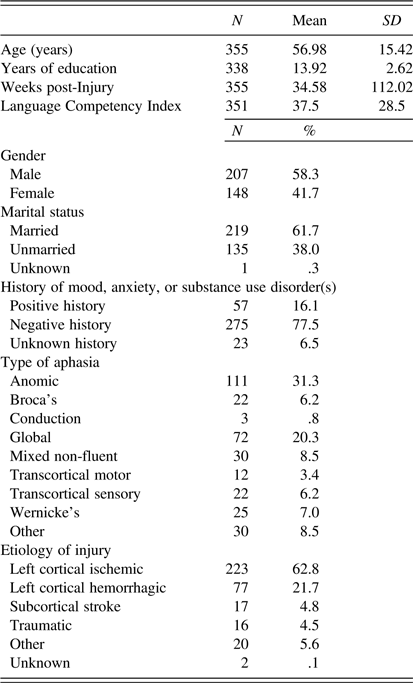
We analyzed data from 355 consecutive people with aphasia (times post-onset ranging from 1 week to 1248 weeks), aged 16–90 (M = 56.98; SD = 15.42), 42% female (see Table 1 for sample demographic characteristics), who were referred for language-focused neuropsychological evaluations at an academic medical center in the Midwestern United States. These assessments were conducted either in an out-patient office setting on site or on an in-patient basis in an affiliate rehabilitation center. As part of the testing procedures, all participants completed portions of the Boston Diagnostic Aphasia Examination, Third Edition (BDAE-3; Goodglass et al., Reference Goodglass, Kaplan and Barresi2001b). Participants also completed a variety of other tests of cognitive abilities and emotional functioning at the discretion of the board-certified neuropsychologist on staff (R.F.). However, the current study analyses pertain only to BDAE-3 subtests. The relevant clinical data were approved for research purposes by the affiliate university’s Human Research Protection Office.
Sample demographic characteristics

Measures
BDAE-3
The BDAE is a popular test battery examining various aspects of language functioning. Relative to other aphasia batteries, the BDAE is more comprehensive, consisting of more than 50 subtests and benefiting from interpretation through the lens of the Boston Process Approach. Empirical research supports the reliability and validity of previous versions of BDAE (Davis, Reference Davis1993; Goodglass & Kaplan, Reference Goodglass and Kaplan1972a; Helms-Estabrooks & Ramsberger, Reference Helms-Estabrooks and Ramsberger1986), and it has been adapted for use among non-English speakers (e.g., Pineda et al., Reference Pineda, Rosselli, Ardila, Mejia, Romero and Perez2000; Tsapkini et al., Reference Tsapkini, Vlahou and Potagas2010).
Statistical Analyses
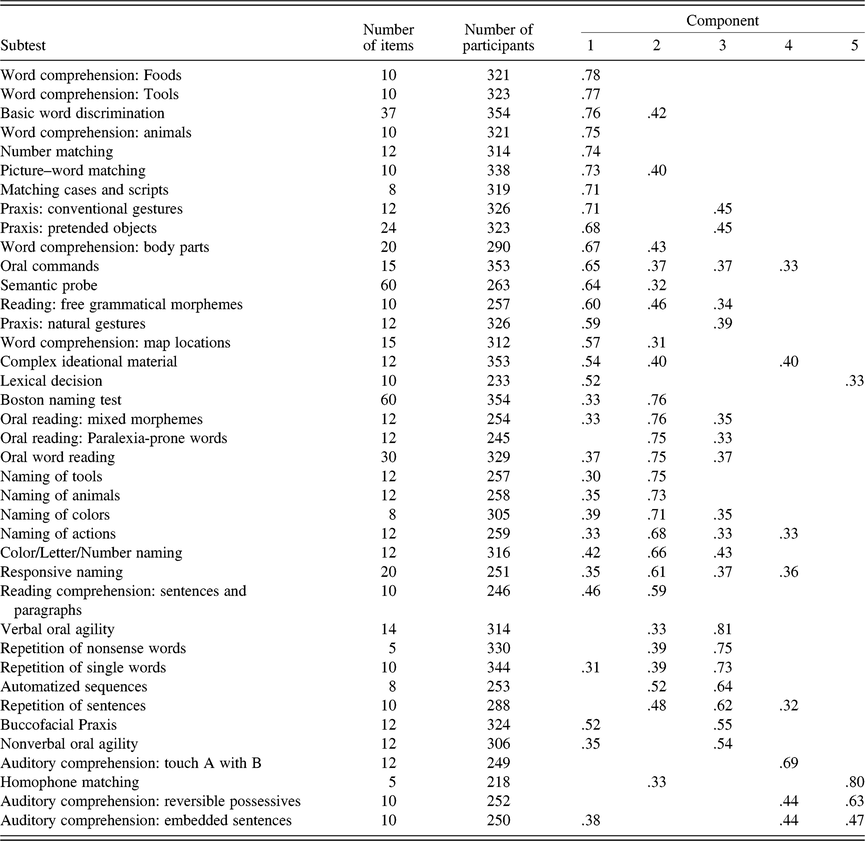
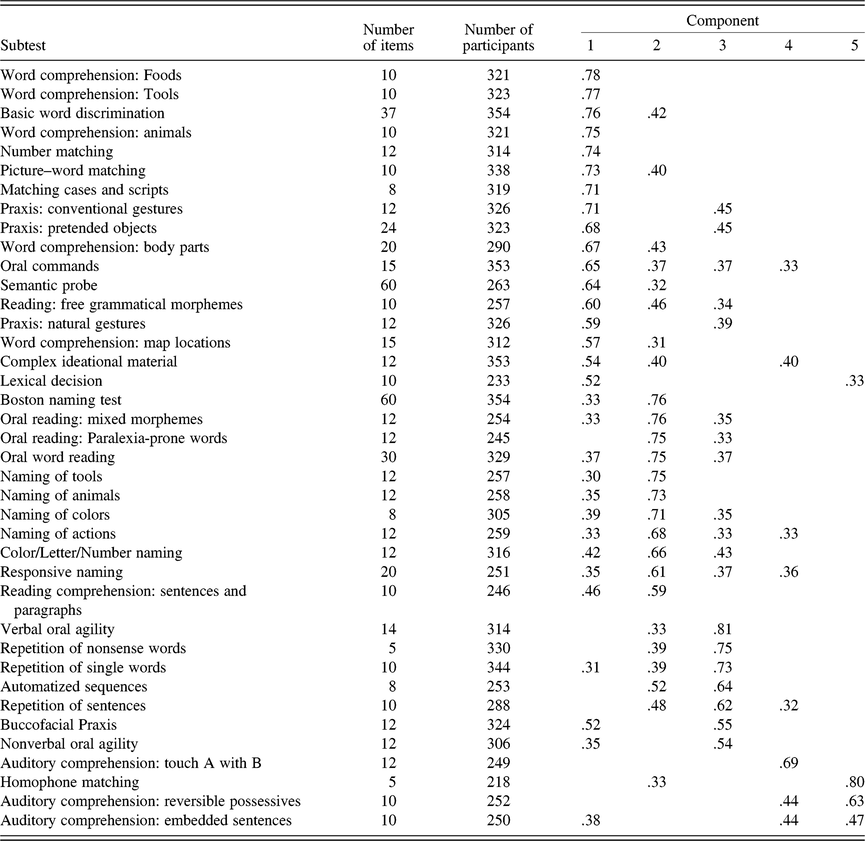
Given that the current study data were collected for clinical purposes, varying proportions of missing data were present across the BDAE-3 subtests. Specifically, the neuropsychologist overseeing the aphasia clinic utilizes a flexible battery within a hypothesis testing approach. Consequently, the clinician elected to administer those BDAE-3 subtests that were deemed most relevant in answering the referral question, contingent upon each patient’s individual background characteristics, severity, location of injury, and testing performance. For the purposes of the current study, we elected to exclude those BDAE-3 subtests with missing data ≥40% (i.e., a number of subtests in the Reading sections including oral sentence reading, oral sentence comprehension, pseudohomophones, bound morphemes, and derivational morphemes, as well as all subtests in the Conversational and Expository Speech and Writing sections), leading to a total of 39 subtests available for analysis (see Table 2). For these subtests, we implemented a five-iteration multiple imputation (MI) procedure in order to estimate the values of missing data. Sophisticated estimation techniques such as MI have been repeatedly shown to produce less parameter bias than simple deletion or mean imputation when examined in simulation studies (Newman, Reference Newman2003; Schafer & Graham, Reference Schafer and Graham2002). On a broad level, MI and maximum likelihood approaches have been determined to provide the greatest degree of accuracy when analyzing datasets with significant missingness on key variables, thereby reducing statistical bias and enhancing precision in data interpretation (Ning et al., Reference Ning, McAvay, Chaudhry, Arnold and Allore2013; Schafer & Graham, Reference Schafer and Graham2002).
Number of items and participants, and rotated component matrix of the selected BDAE-3 subtests
All statistical analyses were performed using SPSS 20.0. The Bartlett’s test of sphericity and Kaiser-Meyer-Olkin (KMO) measure of sampling adequacy were conducted to assess the factorability of data and the strength of shared variance. Since both component analysis and common factor analysis can produce comparable results (Tabachnick & Fidell, Reference Tabachnick and Fidell2001; Velicer & Jackson, Reference Velicer and Jackson1990) and that our goal was to reduce the number of subtests to a smaller number of representative components, we conducted a principal component analysis (PCA) with varimax rotation to examine the underlying dimensions of BDAE-3 subtests. Factors with eigenvalues >1 were extracted and interpreted.
RESULTS
Results of the Bartlett’s test were significant (χ 2 = 83957.3; p< .05). The KMO test was marvelous (KMO = .97) per the interpretation guidelines in Beavers et al. (Reference Beavers, Lounsbury, Richards, Huck, Skolits and Esquivel2013). Overall, the results of these tests suggest that the correlation matrix was factorable and the strength of the relationships was adequate.
Results of the PCA yielded five factors with eigenvalues >1 that accounted for 72.8% of the BDAE-3 total variance. Table 2 shows the factor loadings for each subtest (only loadings >.30 were reported). Factor 1 is the auditory comprehension/ideomotor praxis factor and explained 25.8% of the variance. This component is predominantly formed by tests requiring participants to perform various tasks (e.g., selecting pictures, pointing to parts of the body) after hearing spoken words and sentences, as well as tests assessing participants’ ability to perform conventional gestures or gestures using pretended objects. Factor 2 explained 21.6% of the variance and is labeled as the naming and reading factor. This component comprised tests that require participants to name various auditory and visual stimuli and orally read and understand words and sentences. Factor 3 is the articulation-repetition factor that includes tests of oral agility (speech and non-speech-related movements), buccofacial-respiratory praxis, and repetition of words and sentences (explaining 14.6% of the variance). Factors 4 and 5 each explained only about 5% of the variance. Factor 4 is the grammatical comprehension factor that assesses participants’ ability to process complex syntactical relations and represents only 5.8% of the variance. This factor comprised the Touch A with B subtest that requires participants to understand how grammatical structures like prepositions and conjunctions alter the meaning of phrases. Factor 5 is the phonological processing factor (explaining 5.1% of the variance) and mainly comprised the homophone matching test that requires participants to match phonemically identical words.
DISCUSSION
This is the first examination of the factor structure of BDAE-3. Our findings revealed that five factors accounted for >70% of the total variance in BDAE performance, with the first three explaining the majority of variance. Despite the differences in the selection of subtests across studies, the overall factor structure in this study appeared similar to findings in studies of previous versions of BDAE (e.g., Goodglass & Kaplan, Reference Goodglass and Kaplan1983a). Notably, the first two factors in our analysis, representing auditory comprehension/ideomotor praxis, and naming/(mostly oral) reading, were found to explain similar proportions total variance. These two distinct yet equally important language aspects are consistent with the idea of localization or dissociation of primary language functions.
One of the major revisions in BDAE-3 was the addition of ideomotor limb and buccofacial praxis subtests. We found that subtests of ideomotor limb praxis loaded on Factor 1, which also comprised some language tests mainly assessing auditory comprehension. This finding is not surprising. In fact, prior studies have already suggested that praxis is associated with auditory comprehension (Wang & Goodglass, Reference Wang and Goodglass1992; Weiss et al., Reference Weiss, Ubben, Kaesberg, Kalbe, Kessler, Liebig and Fink2016). For example, Wang and Goodglass (Reference Wang and Goodglass1992) showed that auditory comprehension was the only one among auditory comprehension, reading, and naming measures that was significantly and consistently related to pantomime tests. A more recent study using voxel-based lesion–symptom mapping found that lesions to the Brodmann area (BA) 44 are associated with combined deficits in language and praxis (Weiss et al., Reference Weiss, Ubben, Kaesberg, Kalbe, Kessler, Liebig and Fink2016). The authors of the study argued that BA 44 serves as an interface between language and (meaningful) action. Our results confirm previous research and suggest that the ability to plan and perform an action (e.g., with the use of pretended objects) is at least partly dependent on the ability to translate a concept into representational form.
The current findings, although of significant clinical utility, should be interpreted in light of several limitations. First, although we used the multiple imputation procedure to reduce bias from missing data, all writing-specific tasks and several other subtests were still excluded due to the unacceptably high proportions of missing data. It is possible that we would have obtained different results if we had analyzed all 50 BDAE-3 subtests. Nevertheless, the exclusion of all writing-specific tasks in this study allowed us to examine as many other subtests with reasonable proportion of missing data as possible while maximizing the accuracy of parameter estimation when implementing multiple imputations. This approach also allowed us to include people with a wider range of aphasia severity, which increased the representativeness and generalizability of our results. Second, we performed an exploratory procedure – a PCA – and our sample was not large enough to allow for the cross-validation of the obtained factor structure using confirmatory analysis. We leave such an endeavor to future researchers.
In conclusion, despite the discrepancy in BDAE subtests analyzed across studies, certain language functions remain primary across language domains (i.e., receptive vs. expressive language) and across different severity levels. Our study also indicated that the current edition of BDAE continues to demonstrate good construct validity, which is reassuring given its popularity in clinical use. Finally, our results inform clinical practice by outlining the inherent structure of language abilities in people with aphasia. Clinicians can utilize the current study to select core BDAE-3 tests that are most representative of their respective functions, thereby reducing the total testing time while preserving diagnostic sensitivity. For example, the administration of three BDAE-3 subtests measuring basic word comprehension, confrontation naming of objects (BNT), and verbal agility provides good, non-redundant coverage of the first three factors.
ACKNOWLEDGMENTS
The authors received no funding support for the research, authorship, and/or publication of this article.