Clinically significant irritability occurs commonly in children and adolescents (~3% of the general population; Althoff, Verhulst, Rettew, Hudziak, & van der Ende, Reference Althoff, Verhulst, Rettew, Hudziak and van der Ende2010; Brotman et al., Reference Brotman, Schmajuk, Rich, Dickstein, Guyer and Costello2006). Despite its prevalence, the literature on clinically impairing irritability is relatively limited. This insufficient evidence base has adverse clinical consequences, illustrated by the controversy about whether children with chronic, severe irritability and hyperarousal are exhibiting a developmental presentation of bipolar disorder and should be treated as such (American Academy of Child & Adolescent Psychiatry, 2007). Specifically, some investigators claim that youths with severe irritability, without distinct manic episodes, are exhibiting a developmental presentation of bipolar disorder, although data suggest that severe, nonepisodic irritability differs from classic bipolar disorder in longitudinal course, as well as pathophysiology and family history (Leibenluft, Reference Leibenluft2011). In any case, the controversy regarding pediatric bipolar disorder shines a bright light on the fact that there are many gaps in our knowledge about the presentation, course, and pathophysiology of severe irritability in youth.
Here we present a selective review of irritability throughout childhood, with a specific focus on its severe manifestations and, hence, its relationship to psychopathology. We focus specifically on important gaps in the literature, including the relative dearth of knowledge about the neurobiological mechanisms mediating severe irritability in youth. To lay a conceptual framework for our review, we begin by describing how irritability has been defined for systematic study, including its relationship to anger and aggression. Then we review recent studies describing the course of irritability through childhood and its longitudinal associations with psychopathology. Irritability is a diagnostic criterion for many mental disorders according to DSM-IV. However, it is most central to the diagnosis of oppositional defiant disorder (ODD). Therefore, we focus on studies describing the outcome of youths with ODD. As described below, a major, relatively recent, advance in the understanding of irritability has been the recognition that it predicts depressive and anxious psychopathology, apart from its association with disruptive behaviors. In the final section, we discuss relevant findings in affective neuroscience that may help us understand these associations at the level of neural systems that mediate emotional processing and behavioral control. This review reveals significant gaps in our knowledge, so we conclude with a series of recommendations for future research on irritability that integrates neurobiological, clinical, and longitudinal strategies.
Definitions
As detailed below, most definitions of irritability characterize it as excessive reactivity to negative emotional stimuli and describe it as having an affective component, anger, and a behavioral component, aggression (Berkowitz, Reference Berkowitz1993; Buss & Durkee, Reference Buss and Durkee1957; Caprara et al., Reference Caprara, Cinanni, D'Imperio, Passerini, Renzi and Travaglia1985). That is, irritable people are overly angry or aggressive in response to provocations (Caprara et al., Reference Caprara, Cinanni, D'Imperio, Passerini, Renzi and Travaglia1985). We will introduce these concepts before turning to irritability itself.
Spielberger, the developer of influential anger measures, suggested that anger can be defined “as a psychobiological state or condition consisting of subjective feelings that vary in intensity, from mild irritation or annoyance to intense fury and rage, with concomitant activation or arousal of the autonomic nervous system” (Spielberger, Reheiser, & Sydeman, Reference Spielberger, Reheiser and Sydeman1995). Two properties of anger are particularly relevant to irritability. First, anger is an emotion with a negative valence; that is, most people find it unpleasant (Watson & Tellegen, Reference Watson and Tellegen1985). Second, anger can be distinguished from other negative emotions (i.e., from sadness and fear) by its relationship to motivation (reviewed by Carver & Harmon-Jones Reference Carver and Harmon-Jones2009; see also Panksepp, Reference Panksepp2006, for a review of converging ethological evidence). From a motivational perspective, emotions are often divided according to whether they are associated with “approach” or “avoid” behavior. Simply put, if one cannot get what she wants, she may become angry and try harder to achieve her goal (approach), or she may become sad and give up (failure to approach). In contrast, fear is a negative-valence emotion that is associated with threats that are to be avoided. In this formulation, the adaptive function of anger is that its presence is associated with increased effort toward goals that are difficult to achieve (Lewis, Alessandri, & Sullivan, Reference Lewis, Alessandri and Sullivan1990; Weiner, Graham, Stern, & Lawson, Reference Weiner, Graham, Stern and Lawson1982).
Aggressive behavior frequently occurs in the context of anger. Aggression is behavior intended to harm another (Berkowitz, Reference Berkowitz1993). There are many aggression typologies, but the classification of aggression most relevant to developmental psychopathology is the empirical distinction between reactive and proactive aggression (Dodge & Coie, Reference Dodge and Coie1987; Vitiello & Stoff, Reference Vitiello and Stoff1997). Reactive aggression, which is nearly synonymous with “emotional aggression” or “hostile aggression,” is accompanied by visible signs of anger and occurs in response to a frustrating event or a perceived threat (Berkowitz, Reference Berkowitz1983; Dodge, Reference Dodge1980). Typical manifestations include anger expressions, temper tantrums, and vengeful hostility (Price & Dodge, Reference Price and Dodge1989). Proactive aggression, also known as instrumental aggression (Hartup, Reference Hartup1974), is designed to attain a goal, such as social dominance; typical manifestations include bullying, domination, name-calling, and coercive acts. These sorts of aggressive displays are more typical of boys, whereas girls tend toward more covert forms of aggression, such as relational aggression (i.e., damaging another's relationships or reputation; Côté, Vaillancourt, Barker, Nagin, & Tremblay, Reference Côté, Vaillancourt, Barker, Nagin and Tremblay2007; Crick, Reference Crick1995).
Although the correlation between reactive and proactive aggression within individuals is high (r = .70 ± .15; Vitaro & Brendgen, Reference Vitaro, Brendgen, Tremblay, Hartup and Archer2005), the two appear to have differential longitudinal predictions, analogous to those seen in the irritable versus headstrong dimensions of ODD. For example, proactive, but not reactive, aggression at age 10 predicts delinquency 3 years later (Vitaro, Brendgen, & Tremblay, Reference Vitaro, Brendgen and Tremblay2002). At age 10, it predicts antisocial behavior at age 26 (Fite, Raine, Stouthamer-Loeber, Loeber, & Pardini, Reference Fite, Raine, Stouthamer-Loeber, Loeber and Pardini2010). Reactive, but not proactive, aggression in adolescence predicts anxiety in adulthood (Fite et al., Reference Fite, Raine, Stouthamer-Loeber, Loeber and Pardini2010).
Anger and reactive aggression can occur in response to a number of provocations, including threat, noxious stimuli, verbal insults, and frustration (Berkowitz, Reference Berkowitz1993). In particular, frustration occurs when an individual performs an act in the expectation of a reward and does not receive it or attempts to avoid a punishment yet still receives it (Berkowitz, Reference Berkowitz1989; Berkowitz & Harmon-Jones, Reference Berkowitz and Harmon-Jones2004). In healthy individuals, the degree of frustration is proportional to the degree of reward anticipation (Berkowitz, Reference Berkowitz1993). For this reason, investigators studying the neuroscience of irritability often elicit frustration by manipulating the disparity between expected and received rewards (e.g., Abler, Walter, & Erk, Reference Abler, Walter and Erk2005; Siegrist et al., Reference Siegrist, Menrath, Stocker, Klein, Kellerman and Shah2005).
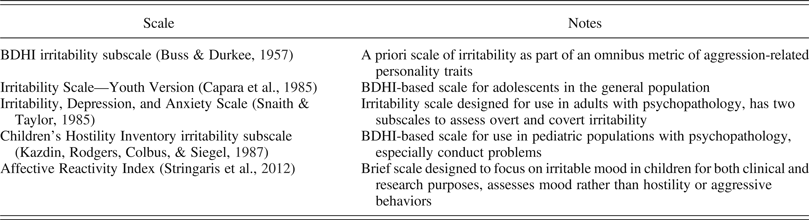
Irritability is often described as a trait. Specifically, it is a personality dimension characterized by a tendency to be angry and reactive to slight provocations and disagreements (Caprara et al., Reference Caprara, Cinanni, D'Imperio, Passerini, Renzi and Travaglia1985). This differs from anger, which is an affective state, and reactive aggression, which is a behavior. The concept of irritability was operationalized in 1957 in a series of studies validating an omnibus assessment of aggression, the Buss–Durkee Hostility Inventory (Buss & Durkee, Reference Buss and Durkee1957). The validation of the irritable trait and the construction of an irritability inventory resulted from a factor analysis of over 1,000 participants' responses to the Buss–Durkee Hostility Inventory (Caprara et al., Reference Caprara, Cinanni, D'Imperio, Passerini, Renzi and Travaglia1985). Since then, “irritable mood” was included in Index Medicus to clarify the meaning of irritability for clinical research (Snaith & Taylor, Reference Snaith and Taylor1985), and several irritability scales were created and validated (Table 1). These scales emphasize angry affect, rapid anger induction, inability to control anger, and increased reactive aggression.
Measures of irritability

Note: BDHI, Buss–Durkee Hostility Inventory.
Two basic properties of any trait are heritability and stability. The heritability of irritability has been estimated at approximately 0.3–0.4 in adolescents and adults (Coccaro, Bergerman, Kavoussi, & Seroczynski, Reference Coccaro, Bergerman, Kavoussi and Seroczynski1997; Stringaris, Zavos, Leibenluft, Maughan, & Eley, Reference Stringaris, Zavos, Leibenluft, Maughan and Eley2012), suggesting that environmental and genetic factors play nearly equal roles in its etiology. Irritability has been found to be relatively stable, with some attenuation from school age to adulthood (attention corrected r = .4; Olweus, Reference Olweus1979).
Irritability as a Predictor of Psychopathology in Nonclinical Childhood Samples
Here, we summarize longitudinal studies of irritability-related traits in nonclinical populations through childhood, focusing on these constructs as predictors of psychopathology. We emphasize studies that include relatively lengthy follow-up, because long study durations maximize one's ability to predict future psychopathology.
Emotional reactivity and reactive aggression are common from infancy to toddlerhood. Angry expressions appear soon after birth, and interindividual differences in angry or sad facial expressions in response to frustration can be observed by 2 months of age (Lewis et al., Reference Lewis, Alessandri and Sullivan1990). However, longitudinal studies of angry expressions, anger regulation, and reactive aggression beginning in infancy demonstrate limited stability of these constructs, poor interobserver reliability, and poor predictive power for conduct problems in toddlerhood (e.g., Gagne & Goldsmith, Reference Gagne and Goldsmith2011; He et al., Reference He, Degnan, McDermott, Henderson, Hane and Xu2010). Daily, angry outbursts are typical in toddlerhood, especially between 1 and 3 years of age (Potegal & Davidson, Reference Potegal and Davidson2003; Potegal, Kosorok, & Davidson, Reference Potegal, Kosorok and Davidson2003), and reactive aggressive interactions between peers are common (Hay, Reference Hay, Tremblay, Hartup and Archer2005).
From toddlerhood to school age, most children show a decline in aggression (Côté, Vaillancourt, LeBlanc, Nagin, & Tremblay, Reference Côté, Vaillancourt, LeBlanc, Nagin and Tremblay2006; Côté et al., Reference Côté, Vaillancourt, Barker, Nagin and Tremblay2007; Shaw, Gilliom, Ingoldsby, & Nagin, Reference Shaw, Gilliom, Ingoldsby and Nagin2003; Vaillancourt, Miller, Fagbemi, Côté, & Tremblay, Reference Vaillancourt, Miller, Fagbemi, Côté and Tremblay2007). This decline is broadly attributed to increasing social competencies (e.g., Dunn & Brown, Reference Dunn, Brown, Garber and Dodge1991) and maturation of self-regulation (i.e., the ability to control inner states and behavioral responses; Bell & Deater-Deckard, Reference Bell and Deater-Deckard2007; Gross, Reference Gross1998). Studies of preschoolers at temperamental extremes that include irritability (e.g., “difficult” children: Guerin, Gottfried, & Thomas, Reference Guerin, Gottfried and Thomas1997; high behavioral disinhibition: Hirshfeld-Becker et al., Reference Hirshfeld-Becker, Biederman, Calltharp, Rosenbaum, Faraone and Rosenbaum2003; for a review, see Egger & Angold Reference Egger and Angold2006) suggest that such a temperamental profile predicts a wide range of psychopathology, especially disruptive behavioral disorders. Of course, the effects of innate temperament on irritable behavior cannot be easily disentangled from their interaction with the caregiving environment, (e.g., maternal depression, low responsiveness to the child's distress, and/or hostile parenting; Davidov & Grusec, Reference Davidov and Grusec2006; Shaw et al., Reference Shaw, Gilliom, Ingoldsby and Nagin2003; Vaillancourt et al., Reference Vaillancourt, Miller, Fagbemi, Côté and Tremblay2007).
Irritability has not been characterized systematically through middle childhood, but there are relevant studies. During this developmental phase, anger/frustration correlates modestly with both poor self-regulation and conduct problems (rs = ~.4) and has a heritability of 0.25 (confidence interval [CI] = 0.02–0.58; Deater-Deckard, Petrill, & Thompson, Reference Deater-Deckard, Petrill and Thompson2007). Individuals who persist in angry, reactive aggression through middle childhood experience peer rejection, attribute hostile intentions to others, and are less flexible in both interpreting social cues and responding to them (Crick & Dodge, Reference Crick and Dodge1994, Reference Crick and Dodge1996; Price & Dodge, Reference Price and Dodge1989). In longitudinal, community-based studies, preadolescent youths who exhibit reactive aggression are at risk for affective and anxious psychopathology in adolescence (Vitaro et al., Reference Vitaro, Brendgen and Tremblay2002).
In a related and influential series of studies, Frick et al. (Reference Frick, Lahey, Loeber, Tannenbaum, van Horn and Christ1993) described the trait of oppositionality as consisting of overt aggression-related behavior that is not destructive, such as temper outbursts, noncompliance, and argumentativeness. Oppositionality can be measured along a continuum in the general population with the extreme end representing ODD (Frick et al., Reference Frick, Lahey, Loeber, Tannenbaum, van Horn and Christ1993; Hoffenaar & Hoeksma, Reference Hoffenaar and Hoeksma2002). In population-based, longitudinal studies tracing oppositionality throughout childhood, oppositionality was highest at age 4 and then declined for most youths, but it was stable for those whose baseline oppositionality was either extremely high (7%–20%) or extremely low (7%–10%; Bongers, Koot, van der Ende, & Verhulst, Reference Bongers, Koot, van der Ende and Verhulst2004; Boylan, Vaillancourt, & Szatmari, Reference Boylan, Vaillancourt and Szatmari2012; Nagin & Tremblay, Reference Nagin and Tremblay1999). Children who had a high-stable trajectory of oppositional symptoms were at risk for depressive, anxious, and conduct symptoms in adolescence (Boylan et al., Reference Boylan, Vaillancourt and Szatmari2012).
For most youths, irritability maintains a stable course through adolescence, with higher levels predicting aggression, generalized anxiety, and depression in young adulthood. In 500 youths followed from 12 to 20 years of age, Caprara, Paciello, Gerbino, and Cugini (Reference Caprara, Paciello, Gerbino and Cugini2007) found that the mean level and rank order of self-reported irritability was stable for most youths. The exception was 23% of participants who had moderate levels of irritability that decreased throughout adolescence. More girls than boys (34.9% vs. 28.1%) had stably high levels of irritability, which was longitudinally associated with self-reported physical aggression, verbal aggression, and violence.
Using data from the Children in the Community Study (Cohen & Cohen, Reference Cohen and Cohen1996), a longitudinal community-based study of 776 participants followed from 13.8 (±2.6) to 33.2 (±2.9) years of age, Leibenluft and colleagues (Leibenluft, Cohen, Gorrindo, Brook, & Pine, Reference Leibenluft, Cohen, Gorrindo, Brook and Pine2006; Stringaris, Cohen, Pine, & Leibenluft, Reference Stringaris, Cohen, Pine and Leibenluft2009) focused on the stability and diagnostic predictions of episodic versus chronic irritability. The motivation for this comparison was the suggestion by some researchers that bipolar disorder presents in children as chronic irritability, rather than with distinct manic episodes that include irritability and/or euphoria that is more severe than the child's baseline level and is accompanied by manic symptoms such as distractibility and decreased need for sleep (Biederman, Reference Biederman1998; Mick, Spencer, Wozniak, & Biederman, Reference Mick, Spencer, Wozniak and Biederman2005; Papolos & Papolos, Reference Papolos and Papolos2007). Chronic and episodic irritability were distinct constructs, in that the Pearson correlation between chronic irritability at mean ages 13.8 and 16.2 years was .56, higher than the correlation between episodic and chronic irritability measured simultaneously (i.e., .34 at 13.8 years or .26 at 16.2 years). Episodic and chronic irritability had different trajectories, with episodic irritability increasing linearly through adolescence and chronic irritability tracing a shallow inverted U that peaked in midadolescence. Perhaps of most importance, the irritability subtypes differed in their longitudinal predictions. Specifically, chronic irritability at mean age 13.8 years predicted attention-deficit/hyperactivity disorder (ADHD) at mean age 16.2 years and major depression at mean age 22.1 years, whereas episodic irritability at mean age 13.8 years predicted simple phobia and mania at mean age 16.2 years. When the authors extended the analysis, chronic irritability at mean age 13.8 years predicted major depressive disorders and generalized anxiety disorder at age 33.2 years, but it did not predict bipolar disorder or axis II disorders (Stringaris et al., Reference Stringaris, Cohen, Pine and Leibenluft2009). Furthermore, after controlling the effects of depression and anxiety, chronic irritability in adolescence predicted lower income and education attainment (Stringaris et al., Reference Stringaris, Cohen, Pine and Leibenluft2009).
Two other longitudinal, community-based studies reported associations between chronic irritability in adolescence and subsequent depressive symptoms. In the landmark Isle of Wight study, 14- to 15-year-old adolescents were assessed at baseline and then again 30 years later (Pickles et al., Reference Pickles, Aglan, Collishaw, Messer, Rutter and Maughan2010). There were three strong adolescent predictors of adult suicidality: irritability (odds ratio [OR] = 3.2, CI = 1.9–5.3), worry (OR = 3.0, CI = 1.8–5.1), and minor depression (OR = 3.4, CI = 1.7–6.7). Note that the relationship between parent-reported irritability in adolescence and adult suicidality was not mediated by either psychopathology or adult self-reported irritability. Finally, a study of 2,615 twins assessed at age 15 (range = 12–21) and again at age 17 (range = 14–23) found that genetic factors accounted for both cross-sectional and longitudinal associations between irritability and depression (Stringaris, Zaros, et al., Reference Stringaris, Zavos, Leibenluft, Maughan and Eley2012). The heritability of irritability was 0.31.
In summary, these longitudinal studies in nonclinical samples suggest that normative irritability peaks in toddlerhood. After toddlerhood, one can begin to discern stable developmental trajectories associated with increased risk for future psychopathology. Although studies are limited in middle childhood, data in adolescents suggest a largely stable course through this age and an association between irritability and subsequent unipolar mood and anxiety disorders. Unlike antisocial behavior (Moffitt, Reference Moffitt1993), there is little evidence of the emergence in adolescence of a large group of youths with severe irritability or reactive aggression.
Longitudinal Studies of ODD and Its Symptom Dimensions
Here, we examine the longitudinal course of irritability as it manifests as a component of ODD and oppositionality. Irritability is a criterion for many DSM-IV diagnoses, including mood, anxiety, and disruptive behavior disorders; however, in children, the diagnosis in which irritability features most prominently is ODD. Therefore, to examine the longitudinal outcome of severe irritability when it is conceptualized as a nosologic category, we review the course of ODD. However, there are two ways in which this categorical view overlaps with a dimensional perspective on oppositional behavior. First, youths at the extreme end of the oppositionality trait dimension (Frick et al., Reference Frick, Lahey, Loeber, Tannenbaum, van Horn and Christ1993) meet criteria for ODD. Second, recent studies find differences in longitudinal predictions between the irritable and headstrong dimensions embedded within both ODD and the oppositionality trait. Therefore, in addition to studies of ODD, in this section we describe studies based on the trait of oppositionality.
To meet criteria for ODD, a child must exhibit a chronic pattern of “negativistic, hostile, defiant” behavior, defined by having four of eight symptoms to a clinically impairing degree (DSM-IV) for at least 6 months. These eight symptoms are temper loss, anger/resentment, easily annoyed, argumentative, defiant, deliberately annoys others, blames others, or spiteful/vindictive. In the British Child Mental Health Survey (Maughan, Rowe, Messer, Goodman, & Meltzer, Reference Maughan, Rowe, Messer, Goodman and Meltzer2004), ODD was present in 3.4% of boys and 1.4% of girls from 5 years old until adolescence, when the rate declined (note the decline in adolescence did not occur if, contrary to DSM-IV, ODD was diagnosed in the presence of conduct disorder).
Although ODD is a precursor to a broad array of adult psychopathology (Kim-Cohen et al., Reference Kim-Cohen, Caspi, Moffitt, Harrington, Milne and Poulton2003; Nock, Kazdin, Hiripi, & Kessler, Reference Nock, Kazdin, Hiripi and Kessler2007), epidemiologic (Copeland, Shanahan, Costello, & Angold, Reference Copeland, Shanahan, Costello and Angold2009; Rowe, Maughan, Pickles, Costello, & Angold, Reference Rowe, Maughan, Pickles, Costello and Angold2002) and clinical (Burke, Loeber, Lahey, & Rathouz, Reference Burke, Loeber, Lahey and Rathouz2005; Loeber, Burke, & Pardini, Reference Loeber, Burke and Pardini2009) studies indicate that childhood ODD is more strongly predictive of emotional disorders than antisocial behavior in adulthood. Burke et al. (Reference Burke, Loeber, Lahey and Rathouz2005) suggested that an affective dimension of ODD may account for these associations. Stringaris and Goodman (Reference Stringaris and Goodman2009a, Reference Stringaris and Goodman2009b) tested this hypothesis in a series of studies examining whether an affective dimension of either ODD or oppositionality predicts emotional psychopathology. Specifically, Stringaris and Goodman (Reference Stringaris and Goodman2009a, Reference Stringaris and Goodman2009b) suggested that oppositionality encompasses three dimensions: irritable (temper outbursts, anger, and easily annoyed), headstrong (noncompliance, arguing, annoying, and blaming others), and hurtful (spitefulness and vindictiveness). In 7,912 youths from the British Child Mental Health Survey followed over 3 years, these dimensions correlated highly (rs = .62–.78) but had specific longitudinal associations. The irritable domain predicted depression and generalized anxiety disorder, whereas the headstrong dimension predicted ADHD and conduct disorder (Stringaris & Goodman, Reference Stringaris and Goodman2009a).
Subsequent studies yielded similar findings. Using factor analysis, Burke, Hipwell, and Loeber (Reference Burke, Hipwell and Loeber2010) explored the longitudinal associations of ODD symptoms in girls (n = 2,451, ages 5–8 years) followed for 5 years. The symptoms touchy, angry, and spiteful clustered together in a negative affectivity dimension that, like irritability, uniquely predicted depressive outcomes. In the first wave of the epidemiologic Great Smokey Mountain Study (n = 1,420, mean age = 9 years), a two-factor solution of ODD symptoms largely mapped onto Stringaris and Goodman's irritable and headstrong dimensions (Rowe, Costello, Angold, Copeland, & Maughan, Reference Rowe, Costello, Angold, Copeland and Maughan2010). Irritability at age 9 years predicted anxiety and substance use disorders at age 16 years. These data indicate that a focus on the disruptive behaviors characteristic of ODD should be complemented by a focus on the emotional predictions carried by the irritability dimension, so that attention can be paid to the possible prevention of emotional disorders.
Thus far we have discussed clinically significant irritability in the context of ODD. In addition, two longitudinal studies isolated and followed extremely irritable children from community-based samples, most of whom would meet criteria for ODD (Althoff et al., Reference Althoff, Verhulst, Rettew, Hudziak and van der Ende2010; Brotman et al., Reference Brotman, Schmajuk, Rich, Dickstein, Guyer and Costello2006). In a post hoc analysis of the Great Smokey Mountain Study (see Rowe et al., Reference Rowe, Costello, Angold, Copeland and Maughan2010, above), Brotman et al. (Reference Brotman, Schmajuk, Rich, Dickstein, Guyer and Costello2006) identified youths with severe mood dysregulation (SMD; Leibenluft, Charney, Towbin, Bhangoo, & Pine, Reference Leibenluft, Charney, Towbin, Bhangoo and Pine2003), that is, those with severely impairing chronic irritability and hyperarousal symptoms. SMD had a prevalence of 3.3% throughout childhood and predicted depressive disorders at age 18 years. Althoff et al. (Reference Althoff, Verhulst, Rettew, Hudziak and van der Ende2010) followed 4- to 16-year-old children drawn from Dutch birth registries for 14 years. The Child Behavior Checklist dysregulation phenotype is defined by extreme values on the anxious/depressed, attention problems, and aggressive behavior subscales and may be related to severe irritability (Althoff, Reference Althoff2010). It was present in 3.8% of 2,076 participants at Wave 1 and was associated with anxiety and disruptive behavioral disorders 14 years later.
The Neurobiology of Irritability
Little is known about the neural underpinnings of irritability. Proposed models generally focus on poor frontal inhibition of limbic and autonomic systems (e.g., irritability: Leibenluft, Reference Leibenluft2011; reactive aggression: Blair, Reference Blair2010; anger and self-regulation: Bell & Deater-Deckard, Reference Bell and Deater-Deckard2007). Here we focus on ways in which these broader observations may be better specified in future research programs. Based on available data and current conceptualizations, we discuss two broad constructs that show promise in differentiating irritable from nonirritable youths, that is, processing of emotional stimuli and impaired context-sensitive regulation. Dysfunctional attention–emotion interactions are likely to underlie deficits in both of these domains. The elucidation of neural mechanisms mediating irritability could guide the development of novel interventions.
Processing of emotional stimuli
A limited literature suggests that severely irritable youths have aberrant neurocognitive responses to emotional stimuli, particularly in social contexts, making them more vulnerable to anger and reactive aggression. We present evidence suggesting that preconscious neural mechanisms draw irritable youths' cognitive resources toward aversive social and affective signals and that irritable youths might tend to perceive ambiguous social signals as hostile. Then, we present data suggesting that youths with clinically significant irritability have impairments in face emotion recognition as well as amygdala dysfunction.
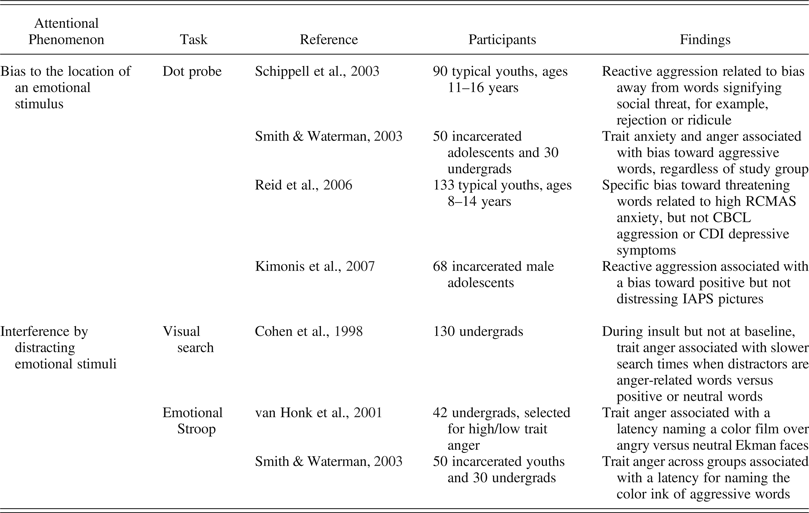
Selective attention paradigms can be used to measure interindividual differences in the extent to which a stimulus is considered salient. The limited available data suggest that negatively valenced social and emotional stimuli may be particularly salient for irritable youths (Table 2). On the visual search and the emotional Stroop tasks, trait anger is associated with greater interference from distracting emotional stimuli (Cohen, Eckhardt, & Schagat, Reference Cohen, Eckhardt and Schagat1998; Smith & Waterman, Reference Smith and Waterman2003; van Honk, Tuiten, de Haan, van den Hout, & Stam, Reference van Honk, Tuiten, de Haan, van den Hout and Stam2001). The dot probe paradigm measures attentional biases toward or away from threatening faces or other negative stimuli. Here, the literature on irritable individuals is limited and the data are mixed, with some studies showing a bias toward, and some a bias away from, negative stimuli in angry or aggressive individuals (Kimonis, Frick, Munoz, & Aucoin, Reference Kimonis, Frick, Munoz and Aucoin2007; Reid, Salmon, & Lovibond, Reference Reid, Salmon and Lovibond2006; Schippell, Vasey, Cravens-Brown, & Bretveld, Reference Schippell, Vasey, Cravens-Brown and Bretveld2003; Smith & Waterman, Reference Smith and Waterman2003). Thus, although considerably more work is needed to identify associations between irritability and impairment in early attentional processes, these data suggest that threatening or other negative stimuli may be particularly salient to irritable individuals and thus more likely to capture and/or hold their attention.
Studies of selective attention in trait anger and reactive aggression
Note: RCMAS, Revised Children's Manifest Anxiety Scale; CBCL, Child Behavior Checklist; CDI, Child Depression Inventory; IAPS, International Affective Picture System.
Two hypotheses suggest mechanisms that may mediate increased salience of emotional stimuli in irritable youths. In one account, Blair (Reference Blair2010) argues that reactive aggression is mediated through the threat–response system involving the amygdala, the hypothalamus, and the periaqueductal gray area. Partially overlapping fear and rage circuitry, which mediates both stress and arousal responses, is well documented in animals (Panksepp, Reference Panksepp2006). Either a failure of cortical areas to suppress this system or its hypersensitivity may be associated with pathologic reactive aggression (Blair, Mitchell, & Blair, Reference Blair, Mitchell and Blair2005). For example, in 10 individuals with pathologic reactive aggression (i.e., intermittent explosive disorder), viewing of angry faces was associated with increased amygdala activity and reduced orbitofrontal cortex activity, relative to healthy subjects (Coccaro, McCloskey, Fitzgerald, & Phan, Reference Coccaro, McCloskey, Fitzgerald and Phan2007). In subjects high in trait anger, resting state functional magnetic resonance imaging (fMRI) found reduced functional amygdala–orbitofrontal cortex connectivity (Fulwiler, King, & Zhang, Reference Fulwiler, King and Zhang2012). This formulation of overlapping circuitry between fearful and angry responses has clinical relevance in youths, given cross-sectional and longitudinal associations between anxiety and irritability (Leibenluft, Reference Leibenluft2011).
In the second hypothesis, van Honk et al. (Reference van Honk, Tuiten, de Haan, van den Hout and Stam2001) suggested that the distracting effect of angry faces in those with high trait anger reflects a bias toward approach responses. In the classic formulation by Gray (Reference Gray1990), opposing neural systems mediate the motivation to approach an emotional stimulus (behavioral activation system) or avoid it (behavioral inhibition system). An angry face could represent a threat to be avoided or a challenge to be approached and engaged (Öhman, Reference Öhman1986), and a person's disposition toward approach or avoidance might be reflected in his or her behavioral response. According to this account, angry individuals would have high behavioral activation system activity and would be more likely to approach the threatening stimulus (Beaver, Lawrence, Passamonti, & Calder, Reference Beaver, Lawrence, Passamonti and Calder2008). Evidence suggests that individuals with reactive aggression or trait anger may demonstrate increased approach responses, in the form of increased attention to positive emotional stimuli (Ford et al., Reference Ford, Tamir, Brunye, Shirer, Mahoney and Taylor2010; Kimonis et al., Reference Kimonis, Frick, Munoz and Aucoin2007). Thus, van Honk et al. emphasize a hyperactive approach system, whereas Blair emphasizes dysregulation in the threat system that may mediates either an approach to or avoidance of threat.
The evidence discussed thus far focuses on individuals' responses to unambiguously threatening stimuli. However, an influential theory in the cognitive underpinnings of reactive aggression is that of Dodge, who suggested that children prone to reactive aggression exhibit a hostile attribution bias, that is, a bias toward responding to social cues as if they reflected malicious intent (Crick & Dodge, Reference Crick and Dodge1994; Dodge, Reference Dodge1980; Dodge & Coie, Reference Dodge and Coie1987). Though hostile attribution bias has been documented in youths with reactive aggression and in adults with trait anger/irritability (Epps & Kendall, Reference Epps and Kendall1995), its neurobiology is not well understood (e.g., Lee & Hoaken, Reference Lee and Hoaken2007). Two eye-tracking studies suggest possible attentional mechanisms. When viewing social scenes, aggressive children (Horsley, de Castro, & van der Schoot, Reference Horsley, de Castro and Van der Schoot2010) and adults with high trait anger (Wilkowski, Robinson, Gordon, & Troop-Gordon, Reference Wilkowski, Robinson, Gordon and Troop-Gordon2007) did not differ from healthy subjects on initial fixation of clearly hostile social cues. Instead, compared to healthy subjects, angry, aggressive subjects spent more time looking back at ambiguous cues and less time viewing unambiguously hostile cues. The authors suggest that angry subjects have such strong expectations of hostility that they more quickly assess overt hostility and work harder to interpret ambiguous social cues (Horsley et al., Reference Horsley, de Castro and Van der Schoot2010; Wilkowski & Robinson, Reference Wilkowski and Robinson2008). Given evidence of hostile attribution bias in youths with reactive aggression (de Castro, Veerman, Koops, Bosch, & Monshouwer, Reference de Castro, Veerman, Koops, Bosch and Monshouwer2002), more study of the mediating neural mechanisms is warranted.
Although hostile attribution bias studies focus on the processing of complex social scenarios, other research examines the ability of severely irritable youths, in particular those with the SMD phenotype, to identify facial emotions. Across emotions, youths with SMD make more errors than do healthy subjects when labeling facial expressions (Guyer et al., Reference Guyer, McClure, Adler, Brotman, Rich and Kimes2007) and require more intense emotional expression to label affect accurately (Rich et al., Reference Rich, Grimley, Schmajuk, Blair, Blair and Leibenluft2008). It is notable that these studies did not detect a relative advantage or disadvantage within the SMD group for identifying angry affect, and in that sense they were not consistent with a hostile attribution bias. However, within the context of fMRI scanning (Brotman et al., Reference Brotman, Rich, Guyer, Lunsford, Horsey and Reising2010), youths with SMD rated themselves as more fearful of neutral faces than did healthy youths or nonirritable youths with ADHD. Youths with SMD have not been tested specifically for hostile attribution bias.
Given these face emotion identification deficits in SMD, two fMRI studies focused on the neural circuitry mediating face emotion processing in SMD. One compared youths with SMD to those with bipolar disorder, ADHD subjects without irritability, and healthy subjects. As noted above, during this scanning procedure, youths with SMD rated themselves as more fearful of neutral faces than did nonirritable youths, with or without ADHD. In addition, compared to other groups, youths with SMD demonstrated amygdala hypoactivation while explicitly processing the emotion on a neutral face but hyperactivation while rating nose width on the face (i.e., during implicit processing of the emotional stimulus; Brotman et al., Reference Brotman, Rich, Guyer, Lunsford, Horsey and Reising2010). Research suggests that such amygdala hypoactivation may be a signature of aberrant processing of social threat (Kret, Denollet, Grèzes, & de Gelder, Reference Kret, Denollet, Grèzes and de Gelder2011).
In a second study, SMD youths, as well as those with bipolar disorder and healthy subjects, rated the gender (implicit emotion processing) or hostility (explicit emotion processing) of faces that varied in emotional intensity between neutral and either happy or angry (Thomas et al., Reference Thomas, Brotman, Muhrer, Rosen, Bones and Reynolds2012). A parametric analysis found that, as the degree of anger on a face increased, healthy subjects showed increasing amygdala activity, whereas subjects with SMD (or bipolar disorder) did not. This suggests amygdala hyposensitivity to subtle changes in face emotion in SMD; such insensitivity might also be associated with the deficit in face emotion labeling described above.
In summary, evidence suggests aberrant attention–emotion interactions in irritable youths. Specifically, in irritable youths, attentional resources may be drawn toward an emotional stimulus, perhaps especially when that stimulus is threatening. Irritable youths may also have a heightened tendency to respond to inherent or perceived stimulus properties that trigger threat and/or motivational neural systems. Finally, data suggest that clinically irritable youths have impairments in face-emotion labeling and aberrant amygdala responses, although the precise nature of the latter remains to be defined clearly. In youths with severe irritability, aberrant early social information processing may compete with potentially corrective regulatory mechanisms for scarce attentional resources. Next, we describe how these regulatory mechanisms may be disrupted in clinical irritability.
Context sensitive regulation and frustration
As noted above, frustration occurs when an individual's progress toward a goal is blocked. Adaptive responses to frustration include modifying one's strategy toward the current goal or directing one's efforts toward an alternative goal. This is one example of the emotion regulatory process that Ochsner (Reference Ochsner2008) calls “context sensitive regulation,” that is, the ability to learn from, and adapt constructively to, changing environmental contingencies. For example, Blair (Reference Blair2010) has suggested that individuals who have difficulty adapting their behavior by inhibiting responses that were previously rewarded, and instead executing newly rewarded responses, will be at increased risk to experience frustration. Context sensitive regulation depends upon prefrontal regions associated with goal-directed behavior via cognitive control (Miller & Cohen, Reference Miller and Cohen2001).
In laboratory settings, reversal learning paradigms can be used to assess this adaptive ability. In such paradigms, individuals attempt to win points or money by performing a task in which the rewarded object (A vs. B) changes continuously and the individual must detect the change in reward contingencies. Studies suggest that youths with SMD have deficits in reversal learning and other measures of cognitive flexibility (Dickstein et al., Reference Dickstein, Nelson, McClure, Grimley, Knopf and Brotman2007). During reversal learning, the difference in caudate and ventrolateral prefrontal cortex (PFC) activation between incorrect and correct trials is less in youths with SMD versus healthy subjects (Adleman et al., Reference Adleman, Kayser, Dickstein, Blair, Pine and Leibenluft2011). The ventrolateral PFC facilitates the inhibition of prior responses and the execution of an alternative action, whereas the caudate mediates motor learning in response to error signals and other reward-related information. Thus, these data suggest that youths with SMD have deficits in engaging these regions as needed to learn from errors and adapt their behavior.
Frustration can be induced by changing reward contingencies so that subjects are unable to attain a desired reward (Berkowitz, Reference Berkowitz1989). In this way, frustration paradigms can, like response reversal paradigms, be used to elicit and study deficits in context-dependent regulation. It can be argued that the neurophysiology of irritability is a relatively tractable clinical research problem because it can be induced in the laboratory or during scanning through the use of frustration paradigms.
The literature seeking to define the neural correlates of frustration in healthy subjects is limited, and the corresponding literature in clinical populations is extremely sparse. Studies in healthy adults or children suggest that frustration elicits activation in widely distributed neural circuitry, including regions that mediate reversal learning (Abler et al., Reference Abler, Walter and Erk2005). Specifically, it appears that frustration engages circuitry mediating emotional responses and learning (e.g., amygdala and ventromedial PFC [vmPFC]); causing attentional shifts (e.g., ventrolateral PFC and dorsal parietal cortex); and resolving response conflict (e.g., dorsolateral prefrontal and anterior cingulate cortex). Finally, some frustration studies find insula engagement, perhaps reflecting the role of this region in mediating physical distress, such as might be precipitated by the unpleasant experience of being unable to attain a desired goal.
For example, Abler et al. (Reference Abler, Walter and Erk2005) found that frustration in healthy adults was associated with increased right anterior insula and ventral PFC activity and decreased ventral striatal activity. The latter is consistent with the prediction error signaling that occurs when an expected reward does not occur (Knutson, Adams, Fong, & Hommer, Reference Knutson, Adams, Fong and Hommer2001). Other groups report similar neurocorrelates, specifically increased vmPFC activation in response to frustration in nonclinical populations (Alia-Klein et al., Reference Alia-Klein, Goldstein, Tomasi, Zhang, Fagin-Jones and Wang2007; Perlman & Pelphrey, Reference Perlman and Pelphrey2011; Siegrist et al., Reference Siegrist, Menrath, Stocker, Klein, Kellerman and Shah2005). Moreover, this response may be more intense for those high in trait anger (Alia-Klein et al., Reference Alia-Klein, Goldstein, Tomasi, Zhang, Fagin-Jones and Wang2007). Amygdala–vmPFC functional connectivity during frustration may vary developmentally (Perlman & Pelphry Reference Perlman and Pelphrey2011). The vmPFC involvement across studies may relate to the prominent role this region plays in mediating emotional valence associations.
Few studies focus on the brain circuitry mediating frustration in clinical populations. Lewis, Granic, and Lamm (Reference Lewis, Granic and Lamm2006) found differences in the N2 potential during frustration among three groups of children: anxiety and aggression, aggression only, and healthy. Focusing on signal sources corresponding to the vmPFC, they found high N2 potential in the anxious–aggressive group, low and late N2 potential in the aggressive-only group, and low tonic N2 potential for healthy children (Lamm, Granic, Zelazo, & Lewis, Reference Lamm, Granic, Zelazo and Lewis2011). Moreover, evidence suggested that successful psychotherapeutic treatment normalized vmPFC activity in children with externalizing symptoms (Lewis et al., Reference Lewis, Granic, Lamm, Zelazo, Stieben and Todd2008; Woltering, Granic, Lamm, & Lewis, Reference Woltering, Granic, Lamm and Lewis2011). These results suggest increased vmPFC engagement during frustration in clinically irritable youths.
In studies using first event-related potential (ERP) and then magnetoencephalography, Rich et al. (Reference Rich, Carver, Holroyd, Rosen, Mendoza and Cornwell2011) used the affective Posner task, an attentional task with rigged feedback, to induce frustration. These studies provide further evidence for prefrontal abnormalities in youths with severe irritability during frustration. Using ERP, the authors found that SMD youths, compared to both healthy subjects and those with bipolar disorder, had deficits in early attentional processes (i.e., N1) in frontal, as well as temporal and central, sites (Rich et al., Reference Rich, Schmajuk, Perez-Edgar, Fox, Pine and Leibenluft2007). Using magnetoencephalography, the authors found that SMD youths responded to negative feedback with significantly greater anterior cingulate cortex and medial frontal gyrus activation than did healthy subjects (Rich et al., Reference Rich, Carver, Holroyd, Rosen, Mendoza and Cornwell2011). This suggests that negative feedback may have a disproportionate impact on the ability of irritable youths to monitor their own emotional state and to choose appropriately among competing behavioral options.
In summary, evidence suggests that context-sensitive regulation is disturbed in clinically irritable youths, consistent with their excessive responses and vulnerability to frustration. As discussed below, studies of frustration in clinical populations hold promise for further defining the pathophysiology of irritability and suggesting novel treatment approaches.
Future Directions
Measurement and phenotyping
An important maxim in research is that the ability to measure a variable is a prerequisite for studying it. Given this, the relative lack of scales to measure the presence of, and change in, clinically impairing irritability is both notable and an impediment to progress in the field (Table 1). Put simply, there is a need for better instrumentation to facilitate better phenotyping. First, the development of more refined scales would clarify whether there is a clinically meaningful typology of irritability that could guide diagnosis and treatment. Second, scales that are sensitive to change are needed for treatment trials. Third, pathophysiological studies require symptom measures that can be correlated with brain-based measures and other putative biomarkers.
The intense emotional nature of temper outbursts might compromise both a parent's and a child's ability to report these phenomena accurately. For example, the “peak-end” rule, or the tendency for recent, or severe, events to have a particularly marked impact on responses (Kahneman, Fredrickson, Schreiber, & Redelmeier, Reference Kahneman, Fredrickson, Schreiber and Redelmeier1993), may diminish the probability of acquiring valid data. New approaches, both technological (e.g., ecological momentary assessment; Ebner-Priemer &Trull, Reference Ebner-Priemer and Trull2009) and psychometric (e.g., item response theory; Wakschlag et al., Reference Wakschlag, Choi, Carter, Hullsiek, Burns and McCarthy2012) should be applied to the development of additional measurement techniques for measuring irritability, especially at the clinically meaningful end of the severity spectrum.
In discussing phenotyping irritability, it is also important to note that irritability is a symptom that is present across a number of DSM-IV disorders. This complicates the study of irritability as a distinct psychopathologic entity, because irritability occurring in the context of different mental disorders might have different underlying mechanisms and therefore require different treatment approaches. In contrast, irritability fits well within the framework of the recent National Institute of Mental Health Research Domain Criteria (RDoC; Insel et al., Reference Insel, Cuthbert, Garvey, Heinssen, Pine and Quinn2010) initiative. Under RDoC, research is organized around dimensional constructs that cut across multiple diagnoses, have translational value (e.g., can be elicited in model animals), and can be examined at multiple levels (e.g., molecular, brain circuitry, and environmental). Irritability lends itself to an RDoC approach, in that it can be measured dimensionally across diagnoses, modeled in animals using reward paradigms, and studied at different levels of analysis. The current RDoC draft includes the construct of frustrative nonreward within the negative emotionality domain; this construct could be said to encompass irritability (National Institute of Mental Health Research Domain Criteria Project, 2011).
The developmental trajectory of irritability in healthy youths
Idioms such as “the terrible twos” are evidence that, in healthy children, the degree and expression of irritability varies developmentally, which is well known. It is important to define this developmental trajectory to inform future research as well as parents and clinicians, thus facilitating assessment and potential intervention. The research described earlier demonstrates that investigators have made progress in this regard, but many important questions remain. For example, it is both challenging and particularly important to define the boundary between normative and nonnormative behavior in preschoolers, because the normative peak of irritability occurs then and stable patterns of behavior begin to emerge (Wakschlag et al., Reference Wakschlag, Choi, Carter, Hullsiek, Burns and McCarthy2012). In addition, there has been relatively little research about irritability in middle childhood, in part because measurement presents some significant challenges. That is, children in this age group spend significant periods of time away from their parents, meaning that parental report is necessary but not sufficient. The development of self-report scales for this age group presents a number of challenges, whereas the acquisition of data from teachers can pose ethical and logistical issues. However, middle childhood is an important time for research on irritability: irritability typically decreases during this time, so it is clinically important to understand why it does not do so in some children.
Predicting the longitudinal course of irritability
Multiple studies now show longitudinal associations between affective symptoms of ODD/irritability and mood/anxiety disorders. The longitudinal course of irritability presents an example of the developmental psychopathology principle of multifinality (Cicchetti & Rogosch, Reference Cicchetti and Rogosch1996). That is, severe irritability in childhood is associated with different potential outcomes in later life, including depression, anxiety, or no psychopathology. A major goal of developmental research is identifying which at-risk individuals will go on to develop psychopathology, so that preventive measures can be targeted appropriately. The research describing associations between irritability and psychopathology is relatively recent, so it is not surprising that little is known about mediators and moderators of subsequent psychopathology. Given preliminary data suggesting a genetic link between irritability and depressive disorders (Stringaris, Zavos, et al., Reference Stringaris, Zavos, Leibenluft, Maughan and Eley2012), the impact of family history is an important area for future research. A plausible hypothesis is that family history of depression confers risk for irritability and that, among those with such a family history, the presence of nonnormative irritability is associated with an increased risk for subsequent depression. If this hypothesis is supported, preventive psychotherapeutic interventions could be tested in this population (e.g., Garber et al., Reference Garber, Clarke, Weersing, Beardslee, Brent and Gladstone2009). It is also unknown whether the severity of irritability has predictive value in terms of subsequent psychopathology, and this can be tested in existing data sets. Finally, family environment is likely to play an important role in determining the course of irritability, including the development of subsequent psychopathology.
Genetic and environmental contributions to irritability
Current heritability estimates suggest that both genetic and environmental factors play a significant role in determining a person's trait level of irritability. Numerous factors have been associated with both state and trait changes in reactive aggression and anger, from specific genotypes to hot weather (Berkowitz Reference Berkowitz1993). Clearly, no one single factor will determine a person's tendency toward irritability. Therefore, future research needs not only to identify a range of etiologic factors, but also to understand the developmental timing of their influence and effects, cofactors required for the promotion or suppression of their effects, and the resulting neural changes.
Candidate gene approaches have implicated some alleles in the pathogenesis of negative affectivity and aggression. In an early suggestion of a genetic by environmental interaction, an allele coding for higher levels of monoamine oxidase A (MAOA) protects against the development of antisocial behavior in children, particularly males, exposed to early maltreatment (Caspi et al., Reference Caspi, McClay, Moffitt, Mill, Martin and Craig2002). In addition, higher levels of MAOA are weakly associated with a tendency to experience negative affects in males (Eley et al., Reference Eley, Tahir, Angleitner, Harriss, McClay and Plomin2003). Both associations may be due to the effects of the polymorphism on neural systems influencing emotional processing and impulsive aggression, especially in males (Meyer-Lindeberg et al., Reference Meyer-Lindenberg, Buckholtz, Kolachana, Ahmad, Pezawas and Blasi2006).
Similarly, the low activity, short allele of the serotonin transporter linked polymorphic region gene (5-HTTLPR) influences a person's tendency toward negative affect (Sen, Burmeister, & Ghosh, Reference Sen, Burmeister and Ghosh2004) and impulsivity (Lin & Tsai, Reference Lin and Tsai2004; Retz, Retz-Junginger, Supprian, Thome, & Rösler, Reference Retz, Retz-Junginger, Supprian, Thome and Rösler2004). Like MAOA, there may be a genetic by environmental interaction between 5-HTTLPR and stressful life experiences in predicting psychopathology (Caspi, Hariri, Holmes, Uher, & Moffitt, Reference Caspi, Hariri, Holmes, Uher and Moffitt2010; Caspi et al., Reference Caspi, Sugden, Moffitt, Taylor, Craig and Harrington2003; Karg, Burmeister, Shedden, & Sen, Reference Karg, Burmeister, Shedden and Sen2011). In addition, data suggest that 5-HTTLPR may be associated with amygdala hyperresponsiveness (d = 0.54 in 13 studies; Munafò, Brown, & Hariri, Reference Munafò, Brown and Hariri2008). Several other candidate genes may also influence irritability, including brain-derived neurotrophic factor (Terracciano et al., Reference Terracciano, Lobina, Piras, Mulas, Cannas and Meirelles2011), catechol-O-methyltransferase (Rujescu, Giegling, Gietl, Hartmann, & Moller, Reference Rujescu, Giegling, Gietl, Hartmann and Moller2003), and dopamine receptor D4 (Kang, Namkoong, & Kim, Reference Kang, Namkoong and Kim2008). Future research on the genetic susceptibility to irritability will likely focus not only on identifying genetic factors, but also on genetic and environmental factors with which candidate genes interact to both produce and protect against irritability and related psychopathology (e.g., Belsky et al., Reference Belsky, Jonassaint, Pluess, Stanton, Brummett and Williams2009).
We briefly considered some environmental factors above that influence trait anger and reactive aggression. Parental, peer, and socioeconomic factors have all been associated prospectively with increased reactive aggression or trait anger (Cole & Deater-Deckard, Reference Cole and Deater-Deckard2009; Lahey, Waldman, & McBurnett, Reference Lahey, Waldman and McBurnett1999). One prominent case in point is child maltreatment, specifically physical abuse. Not only is it a risk factor for reactive aggression (Dodge, Bates, & Petit, Reference Dodge, Bates and Pettit1990; Shields & Cicchetti, Reference Shields and Cicchetti1998) and trait anger (Springer, Sheridan, Kuo, & Carnes, Reference Springer, Sheridan, Kuo and Carnes2007), but like severe irritability, it has also been associated with increased attentional bias toward angry faces (Pollak, Klorman, Thatcher, & Cicchetti, Reference Pollak, Klorman, Thatcher and Cicchetti2001; Pollak & Tolley-Schell, Reference Pollak and Tolley-Schell2003) and deficits in social information processing (Dodge et al., Reference Dodge, Bates and Pettit1990; Teisl & Cicchetti Reference Teisl and Cicchetti2008). Nevertheless, though the literature on affective processing in physical abuse and irritability converges in these findings, it diverges in others. For example, unlike our findings in SMD, Pollak and colleagues (Pollak, Cicchetti, Klorman, & Brumaghim, Reference Pollak, Cicchetti, Klorman and Brumaghim1997; Pollak et al., Reference Pollak, Klorman, Thatcher and Cicchetti2001; Pollak & Sinha, Reference Pollak and Sinha2002) found that those with a history of physical abuse recognize angry affect more quickly and accurately than those without a history of maltreatment do. Clearly, there is a need for further studies that include large samples and measures of both irritability and physical abuse.
Differences in such social and affective processing have recently been shown to be influenced by multiple protective and deleterious factors across development (e.g., Teisl & Cicchetti, Reference Teisl and Cicchetti2008; Leist & Dadds, Reference Leist and Dadds2009). Therefore, a challenge for future research will be to elucidate the mechanisms by which these diverse experiences bring about lasting behavioral changes in susceptible individuals. A prominent example from rodent stress research demonstrates that caregiving behavior during developmentally sensitive periods impacts on offspring behavior and causes neural alterations that are transmitted epigenetically to future generations (Meany, Reference Meaney2001). Intense interest in this area has led to the extension of these findings to humans, where data suggest that adversity may be related to amygdala hypertrophy and prefrontal and hippocampal atrophy (Davidson & McEwen, Reference Davidson and McEwen2012). Despite these deleterious effects of stress, the brain remains plastic and may normalize in response to other, potentially corrective experiences, such as meditation, exercise, and psychotherapy (Davidson & McEwen, Reference Davidson and McEwen2012). Future research will continue to identify active ingredients of behavioral interventions associated with both positive affective and cognitive responses, and normalization of brain measures (e.g., electrophysiologic normalization of PFC signal in psychotherapy responders).
Physiologic markers of irritability
Biologic measures may be used to predict risk or evaluate therapeutic interventions (Cicchetti & Gunnar, Reference Cicchetti and Gunnar2008). For example, during the development of psychopathology and over the course of effective treatment, one would expect alterations in brain function to be associated with changes in peripheral measures of stress and arousal. Arousal physiology is altered in children prone to react aggressively and angrily (e.g., Hubbard, McAuliffe, Morrow, & Romano, 2002). The identification of physiologic response patterns that detect or predict pathologic irritability has obvious research and clinical applications. An imbalance between sympathetic arousal and adrenocortical stress response may be associated with disruptive problems in children (Bauer, Quas, & Boyce, Reference Bauer, Quas and Boyce2002). Lewis, Ramsay, and Sullivan (Reference Lewis, Ramsay and Sullivan2006) found that, in response to frustration, a greater increase in heart rate predicted anger, whereas low cortisol response predicted sadness. Moreover, they found that a group defined by high heart rate and low cortisol displayed the most anger. Whether this interaction goes on to predict pathologic irritability in an individual awaits longitudinal study.
Psychological and neural mechanisms mediating frustration
The psychological and neural mechanisms mediating frustration are likely to be both tractable and clinically important research foci. As noted above, frustration is an emotional response evoked by blocked goal attainment. As such, frustration can be induced in a number of experimental contexts, for example, during ERP measurement or fMRI scanning. In that sense, studies of frustration are similar to those of anxiety syndromes, where pathophysiologically relevant responses are induced while neural measurements are obtained (Davis, Walker, Miles, & Grillon, Reference Davis, Walker, Miles and Grillon2010). The clinical importance of frustration studies stems from the fact that irritability, which is one of the most common presenting complaints in child psychiatry clinics, reflects a low threshold for, or aberrant responses to, frustration.
However, the design of tasks that can be used to induce frustration poses a number of methodological challenges. First, if a paradigm is to be frustrating, the withheld reward must be emotionally salient to subjects, who are likely to vary by gender, developmental age, temperament, and interests. Paradigms that attempt to model frustration in a social context (e.g., modeling frustrating encounters with peers or parents) may be particularly challenging to design, but they are of obvious clinical importance. Second, although the time course of frustrative responses, that is, the affective chronometry of frustration (Davidson, Reference Davidson1998), has not been well studied, clinical observation suggests that the offset of frustration is not immediate and that this offset differs between irritable and nonirritable subjects. How and why frustration's offset differs between individuals with and without psychopathology is an important focus for research. These considerations indicate that order effects may occur in studies of frustration and must be considered in the experimental design. Third, an “effective” and ecologically valid frustration task will evoke different responses in irritable versus nonirritable youths, and such differences may complicate the acquisition or interpretation of data. For example, irritable youths may be more likely than nonirritable youths to discontinue the testing or to move so much that fMRI data are not usable.
The most important point is that frustration paradigms pose a number of ethical issues. Although investigators use such paradigms to induce frustration, a paramount consideration is to not cause the child undue discomfort or to elicit destructive behavior. One important standard is that the degree of frustration must not exceed that which the child often encounters in daily life (e.g., while doing homework or playing a game with peers; Miller, Wendler, & Swartzman, Reference Miller, Wendler and Swartzman2005). Clinical staff familiar with the child should be involved in the decision as to whether, and when, he or she should participate, and such staff should be available to monitor the research procedure. In addition, frustration paradigms often involve some degree of deception, for example, asking participants to play a rigged game or telling participants that they are receiving feedback from peers when the feedback is determined by an experimental algorithm. It is important for investigators to work collaboratively with their institutional review board to design assent, consent, and debriefing procedures that are appropriate for use in such circumstances.
Attentional dysfunction in irritable youths
Several lines of reasoning suggest that attentional dysfunction plays an important role in mediating clinically significant irritability in youths; one prominent goal of frustration studies is to elucidate such dysfunction. Considerable research documents reciprocal interactions between emotional and attentional processes at both neural and behavioral levels (Oliveira, Pessoa, Izhikevich, Pereira, & Bronner, Reference Oliveira, Pessoa, Izhikevich, Pereira and Bronner2010), and a particularly relevant line of research indicates associations between effective attention regulation and effective emotion regulation (Bell & Calkins, Reference Bell, Calkins and Posner2012). Further suggestive evidence for associations between attentional dysfunction and irritability is provided by the high comorbidity between ODD and ADHD (Costello, Mustillo, Erkanli, Keeler, & Angold, Reference Costello, Mustillo, Erkanli, Keeler and Angold2003). The problem of irritability in youths with ADHD is an important topic that is now receiving increased research attention (Sobanski et al., Reference Sobanski, Banaschewski, Asherson, Buitelaar, Chen and Franke2010).
Of course, there are multiple attentional subtypes, mediated by distinct but overlapping circuitry, so dysfunctional attention–emotion interactions in irritable youths are likely to be complex. As described earlier, current hypotheses link the neural systems mediating fear and anger. Therefore, it would be important to test for the presence in irritable youths of early, preconscious attentional biases toward threatening stimuli, such as have been well documented in anxiety. Furthermore, the landmark work associating hostile attribution bias with reactive aggression could be extended through the use of imaging techniques in order to identify the mediating neural circuitry. The specification of dysfunctional attentional mechanisms in irritability could provide important clues as to novel interventions, such has occurred with attention bias modification training in anxiety disorders.
Treatment and prevention
The ultimate goal of research is to facilitate the development of both pharmacologic and psychotherapeutic treatment and preventive strategies. Given the extent to which irritability figures in the clinical presentation of many children, it has been a relatively neglected target for pharmacologic treatment trials. One reason may be that pharmacologic treatment trials are typically designed for a specific DSM-defined mental disorder and irritability cuts across a number of psychiatric diagnoses. Irritability has been reported as a secondary outcome in ADHD stimulant trials, with data suggesting that stimulant treatment may decrease aggression in youths with ADHD (Connor, Glatt, Lopez, Jackson, & Melloni, Reference Connor, Glatt, Lopez, Jackson and Melloni2002). In a more limited number of trials, irritability was the specific target. For example, one trial resulted in an FDA indication for risperidone in the treatment of irritability in youths with autism (McCracken et al., Reference McCracken, McGough, Shah, Cronin, Hong and Aman2002).
The use of risperidone and other second-generation antipsychotic medications (SGAs) is increasing in the treatment of youths with ADHD (Alessi-Severini, Biscontri, Collins, Sareen, & Enns, Reference Alessi-Severini, Biscontri, Collins, Sareen and Enns2012; Fullerton et al., Reference Fullerton, Epstein, Frank, Normand, Fu and McGuire2012). Although the reasons driving this increase are unknown, one possibility is that clinicians are using SGAs to treat aggressive behavior and irritability in youths with ADHD. In addition, to the extent that youths with chronic irritability and ADHD symptoms are viewed as having bipolar disorder, that would tend to increase the use of SGAs in irritable youths. Such treatment is first line for bipolar disorder, and stimulants or antidepressants (for anxiety-related irritability) are contraindicated (Leibenluft, Reference Leibenluft2011). More attention has focused recently on the pharmacologic treatment of irritability (Hulvershorn, Fosselman, Dickstein & Janicak, Reference Hulvershorn, Fosselman, Dickstein and Janicak2012a, Reference Hulvershorn, Fosselman, Dickstein and Janicak2012b; Jairam, Prabhuswamy, & Dullur, Reference Jairam, Prabhuswamy and Dullur2012), as well as on the development of rating scales for irritability that can be used in treatment trials and other research (Stringaris, Goodman, et al., Reference Stringaris, Goodman, Ferdinanso, Razdun, Muhrer and Leibenluft2012). Such trials are of the utmost importance, given the significant metabolic side effects of the SGAs and the need for more benign and well-targeted treatments (Correll et al., Reference Correll, Manu, Olshanskiy, Napolitano, Kane and Malhotra2009).
Psychotherapeutic treatments are likely to be at least as important if not more important than psychopharmacologic approaches in the treatment of irritability, because irritability is not linked to one clear psychiatric syndrome and is often context dependent. A rich body of literature demonstrates effective psychotherapeutic approaches to the treatment of conduct problems, antisocial behavior, and aggression (Weisz, Jensen-Doss, & Hawley, Reference Weisz, Jensen-Doss and Hawley2006). Given the contribution of environmental factors to aggressive behavior, many of these include parent training in addition to child-centered approaches (Kazdin, Reference Kazdin, Weisz and Kazdin2010). However, many of these therapies are targeted toward aggressive behavior, with a particular focus on proactive aggression rather than on irritability and reactive aggression. Pathophysiological research can further psychotherapeutic treatment development by identifying both environmental and cognitive (e.g., attentional) factors that contribute to irritability.
Summary
This review of the psychological, psychiatric, and epidemiologic disciplines indicates that significant advancements have been made in clarifying the construct of irritability, creating measures to facilitate research, establishing the importance of irritability in developmental affective psychopathology, and suggesting possible neurocognitive and affective mechanisms. Much of this work has been accomplished only in the past quarter century, since the construct of irritability was validated and irritable mood was introduced into Indexus Medicus, thus facilitating clinical research. Future research should be designed to replicate current findings while including larger samples as well as measures in multiple domains. Such research will facilitate the identification of individuals at risk for severe irritability and of novel treatment targets throughout development. The development and testing of novel treatments will help to address the urgent need for evidence-based guidance for clinicians treating youths with severe irritability and their families.