Introduction
Cognitive behavioural therapy (CBT) has been used in alcohol use disorder (AUD) therapy for many years, with considerable success either alone (Project MATCH Reference Project MATCH1997) or with pharmacotherapy (O’Malley et al. Reference O’Malley, Rounsaville, Farren, Namkoong, Wu, Robinson and O’Connor2003; Anton et al. Reference Anton, O’Malley, Ciraulo, Cisler, Couper, Donovan, Hosking, Johnson, LoCastro, Longabaugh, Mason, Mattson, Miller, Pettinati, Randall, Swift, Weiss, Williams and Zweben2006; Farren et al. Reference Farren, Scimeca, Wu and O’Malley2009). It is one of the psychotherapies of choice for AUD (Project MATCH Reference Project MATCH1997), and is also used frequently in research and academic settings for other substance use disorders (Carroll and Onken, 2005). Computer-based delivery of cognitive therapy for AUD could help disseminate this therapy to a broader patient base. Computer-based therapies, based on cognitive models of therapy, have been used to treat a diverse range of disorders including depression, anxiety and panic disorder (Wright et al. Reference Wright, Wright, Albano, Basco, Goldsmith, Raffield and Otto2005; Spek et al. Reference Spek, Cuijpers, Nyklicek, Riper, Keyser and Pop2007; Andersson & Cuijpers Reference Andersson and Cuijpers2009), with proven efficacy.
A number of computer-based broad addiction therapies have also been developed, including one based upon CBT. One community-based study evaluated 77 individuals with substance abuse, primarily cocaine abuse, although only 18% had primary AUD (Carroll et al. Reference Carroll, Ball, Martino, Nich, Babuscio, Nuro, Gordon, Portnoy and Rounsaville2008). Using six modules of computer administered therapy, covering the core concepts developed by National Institute on Drug Abuse in the United States, the study covered a period of 8 weeks, with a treatment retention averaging 40 days. Subjects were randomised to treatment as usual (TAU) or TAU plus computerised CBT. Subjects undergoing the CBT had a greater percentage of negative drug urine specimens, although no drop in alcohol use. Some treatment benefits were noted for up to 6 months after completion (Carroll et al. Reference Carroll, Ball, Martino, Nich, Babuscio and Rounsaville2009).
A number of other alcohol-related computer therapies have been developed, with mixed results. One randomised study of a web-based cognitive model for hazardous drinkers gave evidence for being well liked by the users, with suggestion that some heavy drinkers might reduce their drinking, albeit in the setting of limited treatment retention (Wallace et al. Reference Wallace, Murray, McCambridge, Khadjesari, White, Thompson, Kalaitzaki, Godfrey and Linke2011). An analysis of studies of interventions for college drinking, some of which were computer delivered, showed only small effects for any intervention (Carey et al. 2007). Some other web-based intervention studies, which have employed normative feedback for heavy drinkers as a primary intervention, found that alcohol harm reduction outcomes were more successful that abstinence outcomes, and that any study with an active control virtually eliminated any treatment benefit (Rooke et al. Reference Rooke, Thorsteinsson, Karpin, Copeland and Allsop2010).
As computer-based alcohol therapies are essentially in their infancy, many basic questions remain about this type of intervention. For example, how can you translate established psychotherapy for AUD into a computer-based ‘therapy’; is the therapy appropriately treatment specific; is there basic efficacy relative to an appropriate placebo; is there adequate treatment retention; what constitutes appropriate treatment outcome for a computer-based therapy?
In order to answer some of these questions, we designed a cognitive therapy-based computerised intervention, called cognitive computer-based therapy (CCBT), for use in AUD. We designed it for parallel intervention with an inpatient 4-week rehabilitation programme, and randomly compared it with a general cognitive stimulation computer programme. We selected patients with an AUD alone, and measured a broad range of treatment outcomes over the succeeding 3 months after discharge.
Materials and methods
Therapy
A cognitive relapse prevention-based computerised therapy was developed, modelled upon the NIAAA therapy manual for Project MATCH. Project MATCH was the largest psychotherapy study of alcohol dependence, studying ∼2000 subjects for up to 3 years (Project MATCH Reference Project MATCH1997). It compared CBT, 12-step therapy, and motivational enhancement therapy in multiple sites in the United States, and produced detailed manualised descriptions of therapy for each intervention. It consists of 5×50-minute computer sessions, with components dealing with thoughts, feelings and behaviours around relapse to alcohol. The computer programme uses case histories, interactive questions and computer graphics to illustrate the goals of therapy.
The first session consisted of a welcome announcement, an interactive questionnaire exploring patterns of drinking habits, allocation of the patient to one of five drinking patterns based upon response to the questionnaire, and an interactive exploration of some emotions relating to triggers for drinking episodes. Session two explored inaccurate thinking associated with AUD; session three explored feelings around alcohol use, and the development of strategies to deal with distressing feelings around alcohol use; session four looked at education about relapse, and using strategies to prevent them; session five looked at craving induction and craving reduction strategies. Each session had an appropriate case history presented to the patient, based upon their original allocation to a personal drinking pattern. At the end of each session, the patient was given standardised feedback via computer about their answers to questions, and given specific therapeutic instructions regarding what would be helpful for their recovery.
A comparison group therapy of cognitive stimulating computer exercises was used as a placebo, for a similar number of 5×50-minute sessions. This series of sessions consisted of basic mental arithmetic exercises, from a web-based ‘cognitive stimulation’ site. The protocol was approved by the Research Ethics Committee of St Patrick’s University Hospital. Thus, the study design was of CCBT plus TAU, versus ‘placebo’ intervention plus TAU.
Eligibility criteria
The participants were patients who satisfied the criteria below:
a) Age over 18 years and able to provide informed consent.
b) Mini Mental State Examination (Folstein et al. Reference Folstein, Folstein and McHugh1975) score ⩾25. This cut-off point was chosen to ensure that patients did not have cognitive deficits (Bertolucci et al. Reference Bertolucci, Brucki and Campacci1994) that could impact on their ability to fully complete a computer-based intervention.
c) Patient fulfilled the criteria for Alcohol Dependence Syndrome/Alcohol Abuse according to the Structured Clinical Interview for DSM-IV Axis I Disorders (SCID; Spitzer & Williams, Reference Spitzer and Williams1992) and was enrolled on the inpatient Alcohol and Chemical Dependence (ACDP) in St Patrick’s University Hospital (Farren & McElroy, Reference Farren and McElroy2008).
d) Did not fulfill the criteria for depressive or bipolar affective disorder, psychotic disorder or current poly-substances dependence or abuse according to the SCID; Spitzer & Williams, Reference Spitzer and Williams1992).
Subjects
A group of 55 alcohol-dependent subjects, who were either abstinent for >5 days, or who had completed detoxification and who were participating in the ACDP programme at St Patrick’s University Hospital Dublin, were recruited for the trial. Patient flow is detailed in Fig. 1. The programme consists of a 4-week inpatient stay where patients are aligned to an individual-addiction therapist, and attends a schedule of 5-group therapy session per week, together with two psycho-education lectures, one to two individual therapy session with their counsellor, weekly psychiatric evaluation, and thrice weekly self-help addiction groups including alcoholics anonymous (AA). CCBT/placebo sessions were scheduled in addition to the above plan, and were conducted in order over the 4 weeks, at the rate of one to two sessions per week, with at least a 4-day gap between sessions.
Participant flow diagram.

Patients were recruited from the inpatient group, following completion of detoxification if required, and following initiation onto the ACDP programme. Full informed consent was obtained. Recruited patients were allocated a study number, and then randomization to CCBT or ‘placebo’ was carried out by one research assistant according to a randomised number table, and separate from another research assistant who set up and monitored the patients during the scheduled computer sessions, who was un-blinded to facilitate the setting up of each computer session. During each computer session, which took place in a separate research room, the patient was allowed to complete the exercise independently, and only questions related to computer set-up and log-on were answered. The assistant left the room during the exercise, until completion, and then the patient was escorted back to the treatment ward. The ‘placebo’ intervention was designed to mimic the setting, duration and attentional attributes of the active intervention.
Assessments
At baseline, patients completed informed consent for the programme, and for the parallel research protocol. All subjects were current inpatients. All subjects were free from alcohol for a period of at least 7 days before baseline assessments. Figure 1 illustrates the study design and participant retention. Upon completion of alcohol withdrawal patients underwent a baseline assessment by a psychologist who completed the SCID Research version and other assessments including the TimeLine FollowBack (TLFB) for the preceding 90 days (Sobell et al. Reference Sobell, Sobell, Leo and Cancill1988), the Alcohol Expectancy Questionnaire (AEQ; Brown et al. Reference Brown, Christiansen and Goldman1987), the Obsessive Compulsive Drinking Scale (OCDS; Anton et al. Reference Anton, Moak and Latham1996), the Alcohol Abstinence Self-Efficacy Scale (AASES; DiClimente et al. Reference DiClemente, Carbonari, Montgomery and Hughes1994) that evaluated both temptation to drink and confidence to abstain across 20 items representing cues in the four subscale areas of Negative Affect, Social, Physical and Withdrawal/Urges, as well as a urinary drug screen and blood tests.
Upon completion of the 4-week course, the patients were discharged. At 1, 2, and 3 months post discharge from the 4-week programme, patients were contacted and returned to the hospital to complete the discharge assessments (TLFB, OCDS, AEQ, AASES) plus the TLFB for the preceding 30 days. Note was made of group attendance, self-help group attendance, doctor attendance, medication use and any change in overall status (Table 2).
Primary outcome measures
Primary outcome measures absolute abstinence at 1, 2 and 3 months and proportion of patient continuously abstinent at each stage. The number of drinking days over the previous 30 days, and the number of drinking units per drinking day were also calculated. Results are also reported on the 90-day TLFB assessments. Secondary outcome measures included the AEQ, OCDS and AASES scores at 1, 2 and 3 months, and time to first alcoholic drink following inpatient discharge. Comparison was also made between groups regarding attendance at any medical, therapeutic or self-help session.
Results
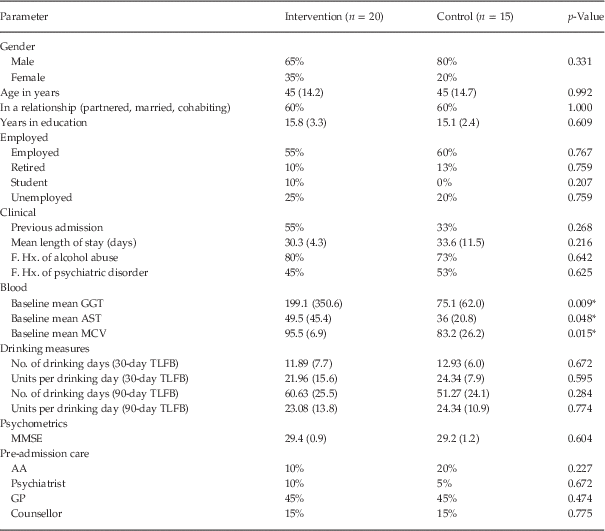
Patient recruitment and patient flow during the study are detailed in Fig. 1. Patient demographics are detailed in Table 1, and there were no differences between the intervention group (n=20) and the control group (n=15) in those demographics or in baseline drinking characteristics. There were some differences between groups when baseline liver function tests and mean corpuscular volume were assessed, with an increase in the intervention group.
Baseline demographic and clinical characteristics of participants
AST, aspartame aminotransferase; TLFB, TimeLine FollowBack; MMSE, mini mental-state exam; MCV, mean corpuscular volume; AA, alcoholics anonymous; GP, general practitioner.
p-values from Pearson’s χ 2-test for categorical variables or from t-test for continuous variables. *p<0.05.
Primary outcome variables
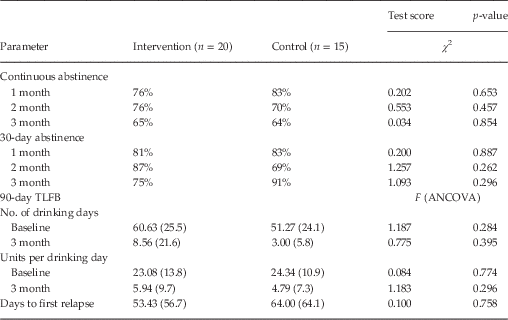
Comparison between intervention and control groups on drinking outcome measures are detailed in Table 2a. There was no overlap between the duration of the participant’s inpatient stay (during which they were abstinent as part of their treatment programme) and either the 90-day TLFB at 3 months or the 30-day TLFB at 1 month.
Mean scores on drinking measures for intervention and control groups
TLFB, TimeLine FollowBack.
There were no significant differences between intervention and control groups in absolute abstinence rates at each of the post-treatment time points. There were also no significant between group differences in other drinking measures including number of drinking days, and units per drinking day (see Table 2a).
There was a significant fall in number of drinking days, and in number of units per drinking day in both groups over the period of follow-up at 1, 2 and 3 months. A mixed between-within subjects analysis of variance was conducted. There was a substantial main effect for time, Wilks λ=0.699, F (1, 28)=13.927, p<0.0005, partial η 2=0.699, with both groups showing a reduction in number of drinking days across the three time periods (see Table 2a). The main effect comparing the intervention and control groups was not significant, F (1, 20)=0.412, p=0.528, partial η 2=0.020. For number of drinking days in the 30-day TFLB, there was no significant interaction between experimental condition and time, Wilks λ=0.135, F (3, 18)=0.936, p=0.444, partial η 2=0.135.
For units per drinking day in the 30-day TFLB, there was no significant interaction between experimental condition and time, Wilks λ=0.109, F (3, 18)=0.734, p=0.545, partial η 2=0.109. There was a substantial main effect for time, Wilks λ=0.748, F (1, 28)=17.817, p<0.0005, partial η 2=0.748, with both groups showing a reduction in number of drinking days across the three time periods (see Table 2a). The main effect comparing the intervention and control groups was not significant, F (1, 20)=0.289, p=0.597, partial η 2=0.014.
There were no differences between groups in number of drinking days (covaried for baseline drinking days), in number of units per drinking day (covaried for baseline drinking days), at each of the time points, or in number of days to first relapse to alcohol use. There were no differences between groups when subjects’ results were covaried for baseline gamma-glutamyl transferase (GGT) results. (For purposes of clarity, only the analysis covarying for baseline drinking is presented here (see Table 2a.)
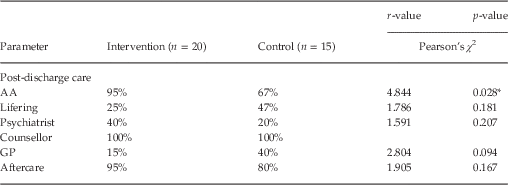
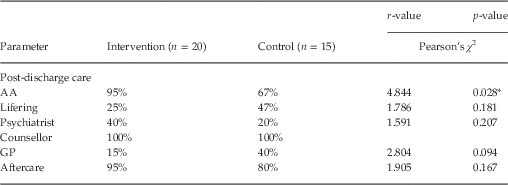
There were no significant differences between groups in post-discharge care with the exception of AA; significantly more participants in the intervention group than in the control group reported attending at least one AA meeting in the follow-up period, with a moderate effect size (χ 2 (1)=4.844, p<0.05; see Table 2b).
Attendance at post-discharge care services for intervention and control groups
AA, alcoholics anonymous; GP, general practitioner.
Analyses performed using Pearson’s χ 2-test.
*p<0.05.
Secondary outcome variables
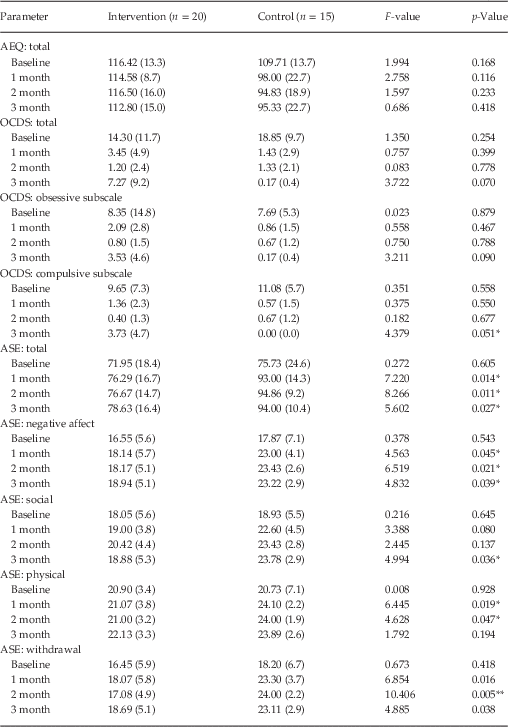
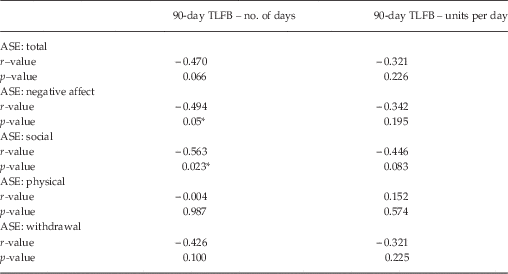
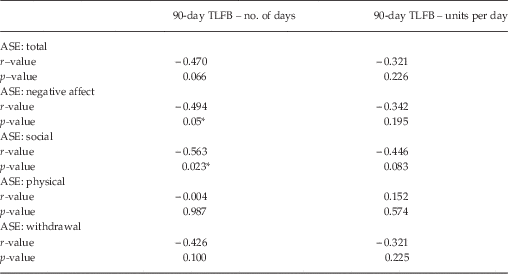
These are detailed in Table 3 and include the OCDS, AEQ (including subscales), AASES (including subscales) and post-discharge care. There were lower AASES scores in the intervention group during the follow-up time points, as well as differences in some AASES subscales including the negative affect, and social subscales, in the small effect size range. The AASES social subscale was significantly correlated with number of drinking days in both 30- and 90-day TLFBs and with units per drinking day in the 30-day TLFB, and approached significance with units per drinking day in the 90-day TLFB. The correlation between AASES total score and number of drinking days in the 90-day TLFB also approached significance, in the small effect size range. There was no correlation between AASES scores and drinking outcomes in the control group (see Table 4).
Mean scores on alcohol expectancy questionnaire, obsessive compulsive drinking scale and alcohol-related self-efficacy scale for intervention and control groups
AEQ, Alcohol Expectancy Questionnaire; OCDS, Obsessive Compulsive Drinking Scale.
ANCOVA analyses conducted using baseline measures as covariate.
*p<0.05, **p<0.01.
Correlations between alcohol-related self-efficacy scale and drinking outcomes for intervention group (n=20) at week 12
TLFB, Time Line Follow Back.
All analyses performed using Pearson’s r correlation (two-tailed).
*p<0.05.
Discussion
This study demonstrates the feasibility of using a well-developed computerised cognitive behavioural addiction programme for patients with AUD. There was a high degree of subject adherence in the study, which indicated that this type of intervention might be of interest to patients in either this setting, or indeed in other settings including outpatients. It also demonstrates that while drinking outcomes appear to be equivalent with a placebo programme, there are some benefits regarding self-help group attendance, and with higher self-efficacy awareness association with outcome in the intervention group. Patients were, in the main, able to complete the computerised intervention successfully over the 4-week inpatient programme, and both groups responded well to the various interventions.
CBT, styled relapse prevention therapy, has been used for treatment of alcohol used disorder over the last 20 years, either alone (Project MATCH, Reference Project MATCH1997), or in conjunction with pharmacotherapy (O’Malley et al. Reference O’Malley, Rounsaville, Farren, Namkoong, Wu, Robinson and O’Connor2003; Anton et al. Reference Anton, O’Malley, Ciraulo, Cisler, Couper, Donovan, Hosking, Johnson, LoCastro, Longabaugh, Mason, Mattson, Miller, Pettinati, Randall, Swift, Weiss, Williams and Zweben2006; Farren et al. Reference Farren, Scimeca, Wu and O’Malley2009). One of the main limitations of relapse prevention therapy is the need for person to person delivery, thus limiting patient access. Patient access is furthermore limited due to other factors including therapist expense, geographical accessibility and therapist style factors. The development of a computerised CBT programme, with patient-programme matching, may mean there is individualised therapy without the need for face to face therapist time. This would facilitate larger patient access to CBT, with a potential reduction in the costs of provision of CBT and potential expansion of access via use of the internet.
Although there are some studies about computer-delivered interventions for addictions, they appear to be primarily in tobacco use (Rooke et al. Reference Rooke, Thorsteinsson, Karpin, Copeland and Allsop2010), and if in alcohol, they appear to be targeted for problem drinking rather than for full AUD (Cunningham et al. Reference Cunningham, Wild, Cordingley, van Mierlo and Humphreys2009; Wallace et al. Reference Wallace, Murray, McCambridge, Khadjesari, White, Thompson, Kalaitzaki, Godfrey and Linke2011). Two recent studies in the Netherlands assessed the response of problem drinkers to an online journal self-help programme (Blankers et al. Reference Blankers, Koeter and Schippers2011) or to a schedule of nine self-help sessions with some personal communication (Postel et al. Reference Postel, de Haan, ter Huurne, Becker and de Jong2010), and both studies found evidence for a reduction in drinking by self-report (see review Twomey et al. Reference Twomey, O’Reilly and Byrne2013). There is evidence that a computerised CBT addiction model can be effectively delivered to a polysubstance abusing patient population, and that it can have some efficacy in urine drug screens (medium effect size) if not in actual self-reported alcohol consumption (Carroll et al. Reference Carroll, Ball, Martino, Nich, Babuscio, Nuro, Gordon, Portnoy and Rounsaville2008), although this has not been demonstrated in an AUD population alone. A minority of the Carroll et al. patients had alcohol dependence (29/77), and these appear to have done equally well as the other subjects, suggesting the potential benefit of an alcohol-dependent alone study. Retention and completion figures in our study (80%) are high relative to the Carroll study (66% completion), and also high relative to the Wallace study (40% completion at 3 months) of computerised feedback therapy in a high alcohol consuming population (Wallace et al. Reference Wallace, Murray, McCambridge, Khadjesari, White, Thompson, Kalaitzaki, Godfrey and Linke2011). The high retention rate in our study was probably aided by the running of the study in parallel with an inpatient treatment programme. Patients clearly engaged with the study intervention, and were, in general, willing to complete the five components of the intervention. A significant minority failed to complete the intervention component of the study due to computer errors, primarily online accessibility of the therapy, and this problem would need to be addressed in any further study. The majority of ‘dropouts’, however, were for issues unrelated to the computerised therapy.
The very high abstinence rate, the fall in number of drinking days and number of drinks per drinking day achieved in the intervention group over the 3 months post cessation of intervention is comparable with that achieved in mixed outpatient pharmacotherapy and psychotherapy combination studies (O’Malley et al. Reference O’Malley, Rounsaville, Farren, Namkoong, Wu, Robinson and O’Connor2003; Anton et al. Reference Anton, O’Malley, Ciraulo, Cisler, Couper, Donovan, Hosking, Johnson, LoCastro, Longabaugh, Mason, Mattson, Miller, Pettinati, Randall, Swift, Weiss, Williams and Zweben2006; Farren et al. Reference Farren, Scimeca, Wu and O’Malley2009), suggesting that a computerised type of intervention may be considered as an adjunct to conventional treatment options including pharmacotherapy. This high degree of treatment efficacy overall makes it less likely that a difference between intervention and placebo groups would be found in drinking outcomes. There was a higher degree of AA attendance in the intervention group, suggesting that some differences in treatment efficacy might emerge with a larger group and over a longer time, as increased AA attendance (Gossop et al. Reference Gossop, Harris, Best, Man, Manning, Marshall and Strang2003) is associated with alcohol treatment efficacy over time. While the intervention group had lower AASES scores, suggesting lower confidence about their ability to abstain from alcohol (Brown et al. Reference Brown, Carrello, Vik and Porter1998), unlike the control group they had a correlation between these scores and their actual drinking by 12 weeks. Thus, it is probable that the intervention group had increased realisation about dangers of poor drinking outcomes, and more realistic views of the negative consequences of drinking.
Computerised interventions are relatively novel in addictive disorders in general and AUD specifically. Computerised CBT has been demonstrated as being effective in controlled trials in such disorders as depression, anxiety and panic disorder (Kenardy et al. Reference Kenardy, Dow, Johnson, Newman, Thomson and Taylor2003; Wright et al. Reference Wright, Wright, Albano, Basco, Goldsmith, Raffield and Otto2005; Spek et al. Reference Spek, Cuijpers, Nyklicek, Riper, Keyser and Pop2007). Established programmes such as Beat the Blues (Proudfoot et al. Reference Proudfoot, Swain, Widmer, Watkins, Goldberg, Marks, Mann and Gray2003), have been demonstrated not only to be effective (Proudfoot et al. Reference Proudfoot, Ryden, Everitt, Shapiro, Goldberg, Mann, Tylee, Marks and Gray2004) but also to reduce costs associated with depression (McCrone et al. Reference McCrone, Knapp, Proudfoot, Ryden, Cavanagh, Shapiro, llson, Gray, Goldberg, Mann, Marks, Everitt and Tylee2004). The problems originally identified, namely poor treatment retention and limitation of treatment efficacy in an outpatient setting still remain (Foroushani et al. Reference Foroushani, Schneider and Assareh2011), but evidence is growing that computerised internet-based treatments with additional personal support appear to be more effective than those without personal support (Andersson & Cuijpers, Reference Andersson and Cuijpers2009). In our study, there was clear personal support in that the study was conducted in parallel with an inpatient rehabilitation programme. The question remains as to whether this intervention would prove as effective in an outpatient setting without the provision of personal support.
Early post-discharge interventions after inpatient rehabilitation may have significant influence in long-term outcomes in AUD. Early brief re-hospitalisation has proven effective in treatment of alcoholics with co-morbid affective disorder (Farren & McElroy, Reference Farren and McElroy2010), and the use of text messaging post discharge has also proven effective in depressed alcoholics (Agyapong et al. Reference Agyapong, Ahern, McLoughlin and Farren2012). In the latter study, text messaging was sent twice daily to a group of depressed alcoholics, alternatively giving mood support and alcohol recovery support messages for a 3-month period after completion of inpatient rehabilitation. Increased benefits in mood ratings, and a modest benefit in alcohol outcomes suggested a significant role for simple technology in addictive and mood disorders. Thus, computerised cognitive therapy may have to be delivered on an outpatient basis, either de novo, or post-inpatient rehabilitation to clearly demonstrate an advantage relative to ‘placebo’ therapy.
It is also possible that the ‘placebo’ therapy proved to have modest cognitive enhancing characteristics, unforeseen by the investigators that led to both interventions adding significantly to the treatment efficacy at 3 months. Certainly, the impressive treatment figures suggest a benefit above and beyond that in a normal post-rehabilitation setting.
Many problems and questions exist for computer-based therapies for any psychiatric disorder and for AUD specifically. These include whether it is possible to get equivalent treatment retention with personally delivered therapies, and unfortunately this study failed to address this question by having parallel personal therapy delivered to all participants. Another point is whether it is possible to get increased attendance at support sessions like AA, which are known to support alcohol rehabilitation, and this study suggests that CCBT may enhance this tendency, perhaps by reinforcement of the idea self-help through a different medium. It certainly appears possible to supplement interpersonal addiction psychotherapy with computer-based therapy as this study found there was no diminution in outcome figures in the CCBT group relative to placebo.
The study had a number of limitations. There were relatively small numbers of patients recruited diminishing the power of the study, and rendering the possibility of a false negative outcome. While the baseline numbers recruited might have had sufficient numbers to detect differences, the final analysis numbers (n=35) may have proven insufficient to detect meaningful differences in outcomes. The study was conducted in parallel with inpatient therapy, which while probably adding to overall study retention, rendered it less likely to find treatment efficacy differences. Ideally pilot studies of this nature would be conducted without the addition of a parallel TAU inpatient therapy, but running a pilot study in this study population, who were treatment seeking, without TAU would have proven ethically challenging. Thus, we decided to conduct the study with TAU, with the appreciation that it was less likely to produce significant findings. Also there were some differences between the group in baseline haematological and liver function findings, although not between the groups in their baseline alcohol history. These differences were unlikely to have influenced the study’s findings as self-report of alcohol consumption is still regarded as the method of choice of reporting alcohol treatment trial interventions (Project MATCH, Reference Project MATCH1997; O’Malley et al. Reference O’Malley, Rounsaville, Farren, Namkoong, Wu, Robinson and O’Connor2003; Anton et al. Reference Anton, O’Malley, Ciraulo, Cisler, Couper, Donovan, Hosking, Johnson, LoCastro, Longabaugh, Mason, Mattson, Miller, Pettinati, Randall, Swift, Weiss, Williams and Zweben2006), and these did not differ between groups at baseline at post-treatment.
It is likely that with increased exploration of computer technology over the coming years, that CBT for AUD will be further developed, made more accessible, individually variable, and more user friendly. It is important to explore the use of computerised CBT in a range of treatment settings to find its optimal use, as adjunct therapy or as a stand-alone intervention.
Acknowledgements
The authors would like to thank the Board of St Patrick’s University Hospital for their permission to conduct the research, and the staff of the Temple Centre for Addiction and Mental Health for their support during the study.