1. Introduction
Physically speaking, a free-electron laser (FEL) is based on the transfer of kinetic energy from a relativistic electron beam to electromagnetic radiation (Marshall Reference Marshall1985). It is understandable, therefore, that good quality of electron-beam transport is important in an FEL. There are three regimes in which to focus electron-beam transport: the natural focusing provided by the longitudinal component of a three-dimensional wiggler (Huang & Kim Reference Huang and Kim2007; Socol et al. Reference Socol, Kulipanov, Matveenko, Shevchenko and Vinokurov2011; Maier et al. Reference Maier, Meseck, Reiche, Schroeder, Seggebrock and Gruner2012), the magnetic focusing provided by an external magnetic system such as an axial guide magnetic field (Conde & Bekefi Reference Conde and Bekefi1991; Ruan et al. Reference Ruan, Johnson, Lumpkin, Thurman-Keup, Edwards, Fliller, Koeth and Sun2011; Huang et al. Reference Huang, Wang, Xu and Zhang2012; Xu et al. Reference Xu, Wang, Ji, Xu, Lu, Liu and Zhang2013; Zhang Reference Zhang2013), and the electric focusing provided by an ion-channel field (Martin et al. Reference Martin, Caporaso, Fawlcy, Prosnitz and Cole1985; Takayama & Hiramatsu Reference Takayama and Hiramatsu1988; Ozaki et al. Reference Ozaki, Ebihara, Hiramatsu, Kimura, Monaka, Takayama and Whittum1992).
As an electron beam is formed by a great number of electrons, the quality of electron-beam transport must be related to the motion and stability of each single electron. In the previous literature, electron motion and stability have been studied for natural focusing, magnetic focusing and electric focusing regimes, (Benettin, Galgani & Strelcyn Reference Benettin, Galgani and Strelcyn1976; Blewett & Chasman Reference Blewett and Chasman1977; Marshall Reference Marshall1985; Martin et al. Reference Martin, Caporaso, Fawlcy, Prosnitz and Cole1985; Takayama & Hiramatsu Reference Takayama and Hiramatsu1988; Whittum Reference Whittum1990; Conde & Bekefi Reference Conde and Bekefi1991; Ozaki et al. Reference Ozaki, Ebihara, Hiramatsu, Kimura, Monaka, Takayama and Whittum1992; Abarbanel et al. Reference Abarbanel, Brown, Sidorovich and Tsimring1993; Jha, Kumar & Pande Reference Jha, Kumar and Pande1999; Esmaeilzadeh, Mehdian & Willet Reference Esmaeilzadeh, Mehdian and Willet2001; Zhang & Elgin Reference Zhang and Elgin2004; Huang & Kim Reference Huang and Kim2007; Raghavi, Ninno & Mehadian Reference Raghavi, Ninno and Mehadian2008; Rouhan & Maraghechi Reference Rouhan and Maraghechi2009; Ruan et al. Reference Ruan, Johnson, Lumpkin, Thurman-Keup, Edwards, Fliller, Koeth and Sun2011; Socol et al. Reference Socol, Kulipanov, Matveenko, Shevchenko and Vinokurov2011; Esmaeilzadeh & Taghavi Reference Esmaeilzadeh and Taghavi2012; Huang et al. Reference Huang, Wang, Xu and Zhang2012; Maier et al. Reference Maier, Meseck, Reiche, Schroeder, Seggebrock and Gruner2012; Mehdian, Alimohamadi & Hasanbeigi Reference Mehdian, Alimohamadi and Hasanbeigi2012; Saviz, Rezael & Aghamir Reference Saviz, Rezael and Aghamir2012; Bahman & Maraghechi Reference Bahman and Maraghechi2013; Wang et al. Reference Wang, Xu, Ji, Xu, Lu, Liu and Zhang2013; Xu et al. Reference Xu, Wang, Ji, Xu, Lu, Liu and Zhang2013; Zhang Reference Zhang2013). In this paper we concentrate on a comparison of electron motion and stability for different focusing regimes. In the next section we describe the peculiarities of confinement of electron motion in different focusing regimes. Then, we compare the motion stability by calculating the Kolmogorov entropy in § 3. Finally, conclusions are summarized in § 4.
2. Confinement of electron motion in different focusing regimes
2.1. Natural focusing regime
Let us consider the electron motion in a three-dimensional helical wiggler (Blewett & Chasman Reference Blewett and Chasman1977):
 $$\begin{eqnarray}\boldsymbol{B}_{w}=\boldsymbol{B}_{w\bot }+\boldsymbol{B}_{wz},\end{eqnarray}$$
with
 $$\begin{eqnarray}\displaystyle & \displaystyle \boldsymbol{B}_{w\bot }=2B_{wA}\text{I}_{1}^{\prime }(k_{w}R)\cos ({\it\varphi}-k_{w}z)\,\hat{\boldsymbol{e}}_{R}-2B_{wA}\frac{\text{I}_{1}(k_{w}R)}{k_{w}R}\sin ({\it\varphi}-k_{w}z)\,\hat{\boldsymbol{e}}_{{\it\varphi}}, & \displaystyle\end{eqnarray}$$
 $$\begin{eqnarray}\displaystyle & \boldsymbol{B}_{wz}=2B_{wA}\text{I}_{1}(k_{w}R)\sin ({\it\varphi}-k_{w}z)\,\hat{\boldsymbol{e}}_{z}. & \displaystyle\end{eqnarray}$$
 $k_{w}=2{\rm\pi}/{\it\lambda}_{w}$
is the wiggler wavenumber,
 ${\it\lambda}_{w}$
and
 $B_{wA}$
are the wiggler period and amplitude,
 $\text{I}_{1}$
and
 $\text{I}_{1}^{\prime }$
are the modified Bessel function of the first kind and its derivative with respect to the whole argument, and
 $\hat{\boldsymbol{e}}_{R}$
,
 $\hat{\boldsymbol{e}}_{{\it\varphi}_{z}}$
and
 $\hat{\boldsymbol{e}}_{z}$
are unit vectors in the radial, azimuthal and axial directions of the cylindrical coordinate system
 $(R,{\it\varphi},z)$
, respectively.
The motion of a relativistic electron in electromagnetic field
 $\boldsymbol{E}$
and
 $\boldsymbol{B}$
is governed by the equation
 $$\begin{eqnarray}\frac{\text{d}{\it\gamma}\,m_{0}\boldsymbol{v}}{\text{d}t}=-e(\boldsymbol{E}+\boldsymbol{v}\times \boldsymbol{B}),\end{eqnarray}$$
where
 ${\it\gamma}=1/\sqrt{1-v^{2}/c^{2}}$
is the Lorentz energy factor,
 $e$
,
 $m_{0}$
and
 $\boldsymbol{v}$
are the electron’s charge, rest mass and velocity, and
 $c$
is the speed of light in vacuum, respectively.
Suppose that the electrons are injected into the wiggler with only an axial velocity
 $\boldsymbol{v}=\boldsymbol{v}_{z0}$
. Qualitatively speaking, the force composed by
 $-e\boldsymbol{v}_{z0}\times \boldsymbol{B}_{w\bot }$
drives the electron to move with a transverse quiver velocity
 $\boldsymbol{v}_{\bot }$
; in return, in the transverse plane, the induced quiver velocity
 $\boldsymbol{v}_{\bot }$
with
 $\boldsymbol{B}_{wz}$
composes a force
 $-e\boldsymbol{v}_{\bot }\times \boldsymbol{B}_{wz}$
to superpose a Larmor rotation on the electron. That is to say, an electron with an initial axial velocity has an approximately uniform velocity in the axial direction, while in the transverse plane it gains the superposition of Larmor rotation and the quiver motion of the Larmor centre. This confinement effect provided by a three-dimensional helical wiggler is the so-called natural focusing regime (Huang & Kim Reference Huang and Kim2007; Socol et al.
Reference Socol, Kulipanov, Matveenko, Shevchenko and Vinokurov2011; Maier et al.
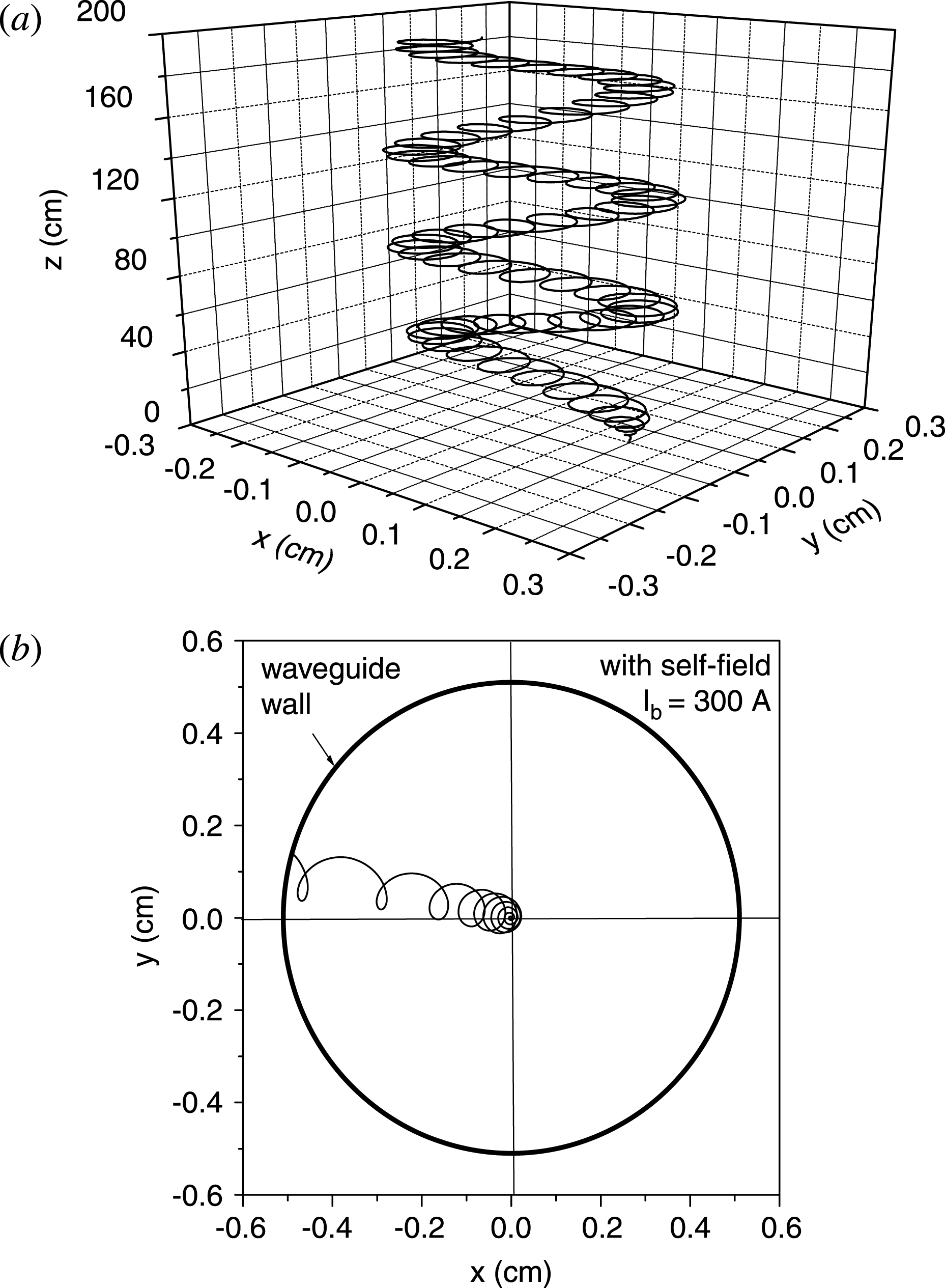
Reference Maier, Meseck, Reiche, Schroeder, Seggebrock and Gruner2012). Figure 1(a) quantitatively shows the electron motion to be confined by a three-dimensional helical wiggler, where calculation is based on the design parameters in the MIT experiment (i.e. electron energy
 $E_{b}=750~\text{keV}$
, beam radius
 $R_{b}=0.25~\text{cm}$
, wiggler period
 ${\it\lambda}_{w}=3.18~\text{cm}$
and wiggler amplitude
 $B_{wA}=630~\text{G}$
) (Conde & Bekefi Reference Conde and Bekefi1991).
Electron motion in a three-dimensional helical wiggler field (a) without and (b) with the electron beam self-fields taken into account, where the electron has an initial position of 0.15 cm in the transverse plane, the wiggler has a period of 3.18 cm, an amplitude of 630 G and a length of 200 cm, and the electron beam has an energy of 750 keV, an average radius of 0.25 cm and a current of 300 A.

However, the situation changes when the self-field of the electron beam is taken into account. As the electron beam carries negative charges, it has its self-field (Zhang Reference Zhang2013)
 $$\begin{eqnarray}\displaystyle & \boldsymbol{E}_{s}=\left\{\begin{array}{@{}ll@{}}-2{\rm\pi}en_{b}R\,\hat{\boldsymbol{e}}_{R},\quad & R<R_{b},\\ \displaystyle -2{\rm\pi}en_{b}\frac{R_{b}^{2}}{R}\,\hat{\boldsymbol{e}}_{R},\quad & R\geqslant R_{b},\end{array}\right. & \displaystyle\end{eqnarray}$$
 $$\begin{eqnarray}\displaystyle & \boldsymbol{B}_{s}=\left\{\begin{array}{@{}ll@{}}\displaystyle -2{\rm\pi}en_{b}\frac{v_{z0}}{c}R\,\hat{\boldsymbol{e}}_{{\it\varphi}},\quad & R<R_{b},\\ \displaystyle -2{\rm\pi}en_{b}\frac{v_{z0}}{c}\frac{R_{b}^{2}}{R}\,\hat{\boldsymbol{e}}_{{\it\varphi}},\quad & R\geqslant R_{b},\end{array}\right. & \displaystyle\end{eqnarray}$$
 $n_{b}=I_{b}/({\rm\pi}ev_{z0}R_{b}^{2})$
, where
 $n_{b}$
,
 $R_{b}$
,
 $I_{b}$
and
 $v_{z0}$
denote the electron-beam average volume density, average radius, current and initial drift speed. The self-field produces a force in the transverse plane:
 $$\begin{eqnarray}\boldsymbol{f}_{\!s}=\left(1-\frac{v_{z0}^{2}}{c^{2}}\right)\frac{e^{2}n_{b}}{2{\it\varepsilon}_{0}}R\,\hat{\boldsymbol{e}}_{R}.\end{eqnarray}$$
This force can be decomposed into two components to affect respectively the curvature radius and the curvature centre of the instantaneous trajectory in the transverse plane. If the electron beam has a large current, the self-field effect will be serious enough to destroy the natural focusing effect of the three-dimensional wiggler, as shown in figure 1(b).
Figure 1(b) plots the self-field effect of the electron beam with a current of 300 A, where the parameters are the same as in figure 1(a). It can be seen that the orbit in figure 1(a), which is confined by the natural focusing effect of a three-dimensional helical wiggler, is now broken. Instead, because of the beam’s self-field force, the electron’s instantaneous Larmor radius grows rapidly and the instantaneous Larmor centre moves outwards, which leads the electron orbit to be unconfined and divergent. As a result, the electron hits the wall of the waveguide (which has an internal radius of 0.51 cm) before the exit of the wiggler, as was observed in the experiment (Conde & Bekefi Reference Conde and Bekefi1991). It is for this reason that an external focusing regime is always needed.
2.2. Magnetic focusing regime
It is well known that one method to overcome the divergent effect of the beam’s self-field on electron motion is the application of an external magnetic system, an axial guide magnetic field (Huang & Kim Reference Huang and Kim2007; Socol et al. Reference Socol, Kulipanov, Matveenko, Shevchenko and Vinokurov2011; Maier et al. Reference Maier, Meseck, Reiche, Schroeder, Seggebrock and Gruner2012)
 $$\begin{eqnarray}\boldsymbol{B}_{guide}=B_{0}\,\hat{\boldsymbol{e}}_{z}.\end{eqnarray}$$
The axial guide magnetic field produces a magnetic force in the transverse plane:
 $$\begin{eqnarray}\boldsymbol{f}_{\!guide}=-e\boldsymbol{v}_{\bot }\times B_{0}\,\hat{\boldsymbol{e}}_{z}.\end{eqnarray}$$
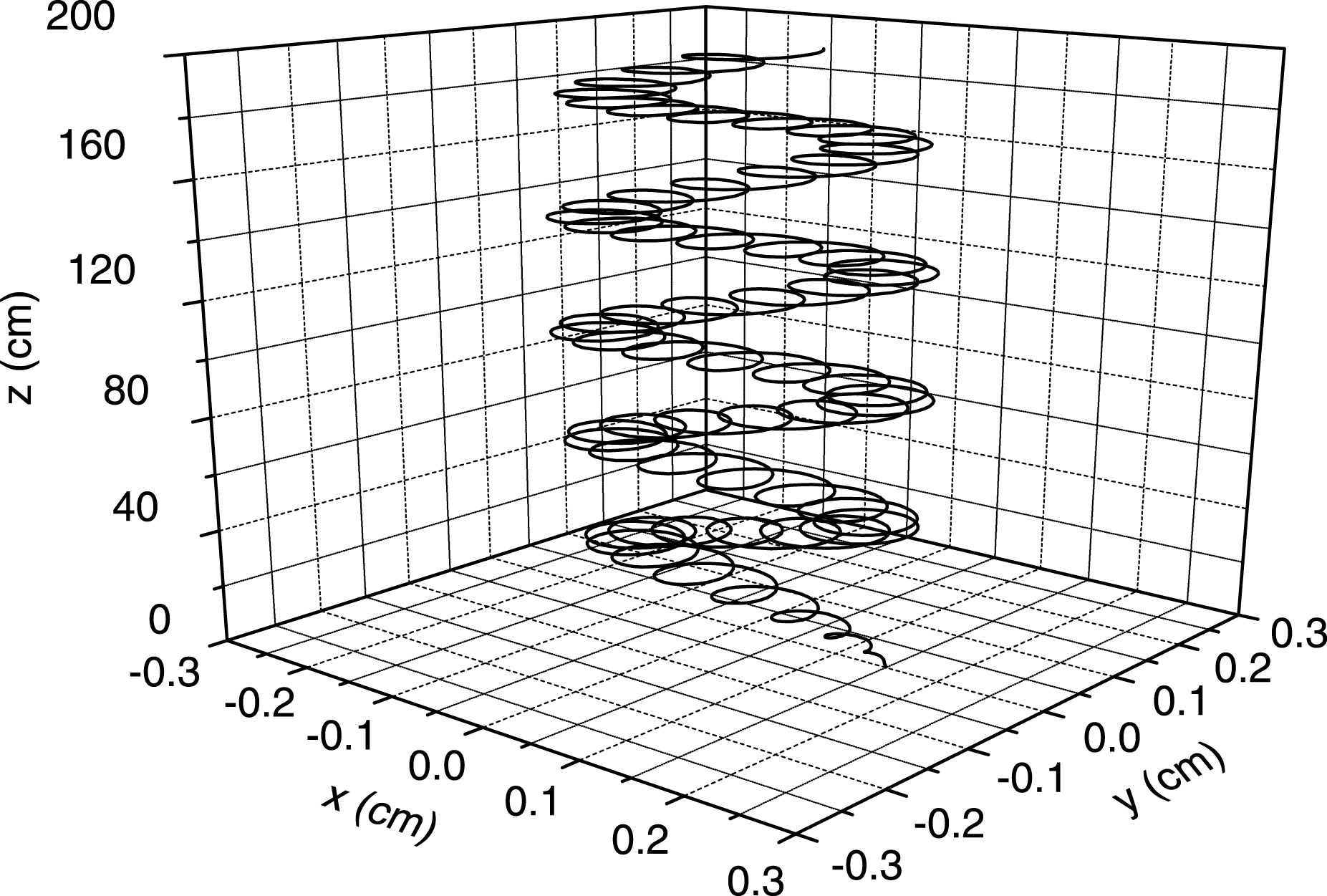
Physically, this magnetic force can be decomposed into two components: one affects the Larmor radius and the other controls the Larmor-centre shift. Therefore, this magnetic force is able to overcome the divergent effect of the beam self-field if the axial guide magnetic field is strong enough. Figure 2 displays the effect of an axial guide magnetic field of (a) 4060 G and (b) 10 900 G that is applied to the situation of figure 1(b). Compared to figure 1(b), the electron motion is indeed confined with a limited Larmor rotation by the axial guide magnetic field, although the electron motion has a larger Larmor radius and a shorter quiver period in comparison to figure 1(a).
Electron motion guided by an axial magnetic field of (a) 4060 G (Group-I) and (b) 10 900 G (Group-II), where the calculation conditions are the same as those in figure 1(b).

2.3. Electric focusing regime
An alternative method to focus the electron beam is the so-called ion-channel guiding regime (Martin et al.
Reference Martin, Caporaso, Fawlcy, Prosnitz and Cole1985; Takayama & Hiramatsu Reference Takayama and Hiramatsu1988; Ozaki et al.
Reference Ozaki, Ebihara, Hiramatsu, Kimura, Monaka, Takayama and Whittum1992). In this configuration, pre-ionized plasma is filled in the FEL chamber. When the electron beam is injected into and passes through the chamber, it expels the electrons of the plasma to move outwards, which leaves an ion core with a radius
 $R_{ion}$
and average density
 $n_{ion}$
. Since the ion core carries positive charges, it must generate an electric field (Whittum Reference Whittum1990)
 $$\begin{eqnarray}\boldsymbol{E}_{ion}=2{\rm\pi}en_{ion}R\,\hat{\boldsymbol{e}}_{R},\end{eqnarray}$$
and produce an electric force
 $$\begin{eqnarray}\boldsymbol{f}_{\!ion}=-2{\rm\pi}e^{2}n_{ion}R\,\hat{\boldsymbol{e}}_{R}.\end{eqnarray}$$
This electric force has opposite direction to the beam self-field force, and therefore is able to counteract the divergent effect of the beam self-field on the electron beam. In other words, an ion-channel guiding can be used to replace an axial guide magnetic field to focus the electron beam.
Figure 3 gives an example of the electric focusing regime, where the axial guide magnetic field in figure 2 is replaced by an ion-channel guiding field with
 ${\it\zeta}=n_{ion}/n_{b}=0.2$
. Owing to the counteraction between the ion-core field and the beam self-field, the electron orbit in figure 3 is very similar to that in figure 1(a). Furthermore, in figure 3 the ion-channel guiding field results in smaller Larmor radius and slighter Larmor-centre shift than the axial guide magnetic field does in figure 2. It is this peculiarity that provides the possibility: the electric focusing regime of an ion-channel guiding field may result in a better electron-beam transport quality than the magnetic focusing regime of an axial guide magnetic field.
Electron motion guided by an ion channel, where the axial guide magnetic field is replaced by an ion core with density
 $n_{ion}=0.2n_{b}$
, and the other calculation conditions are the same as those in figure 2.

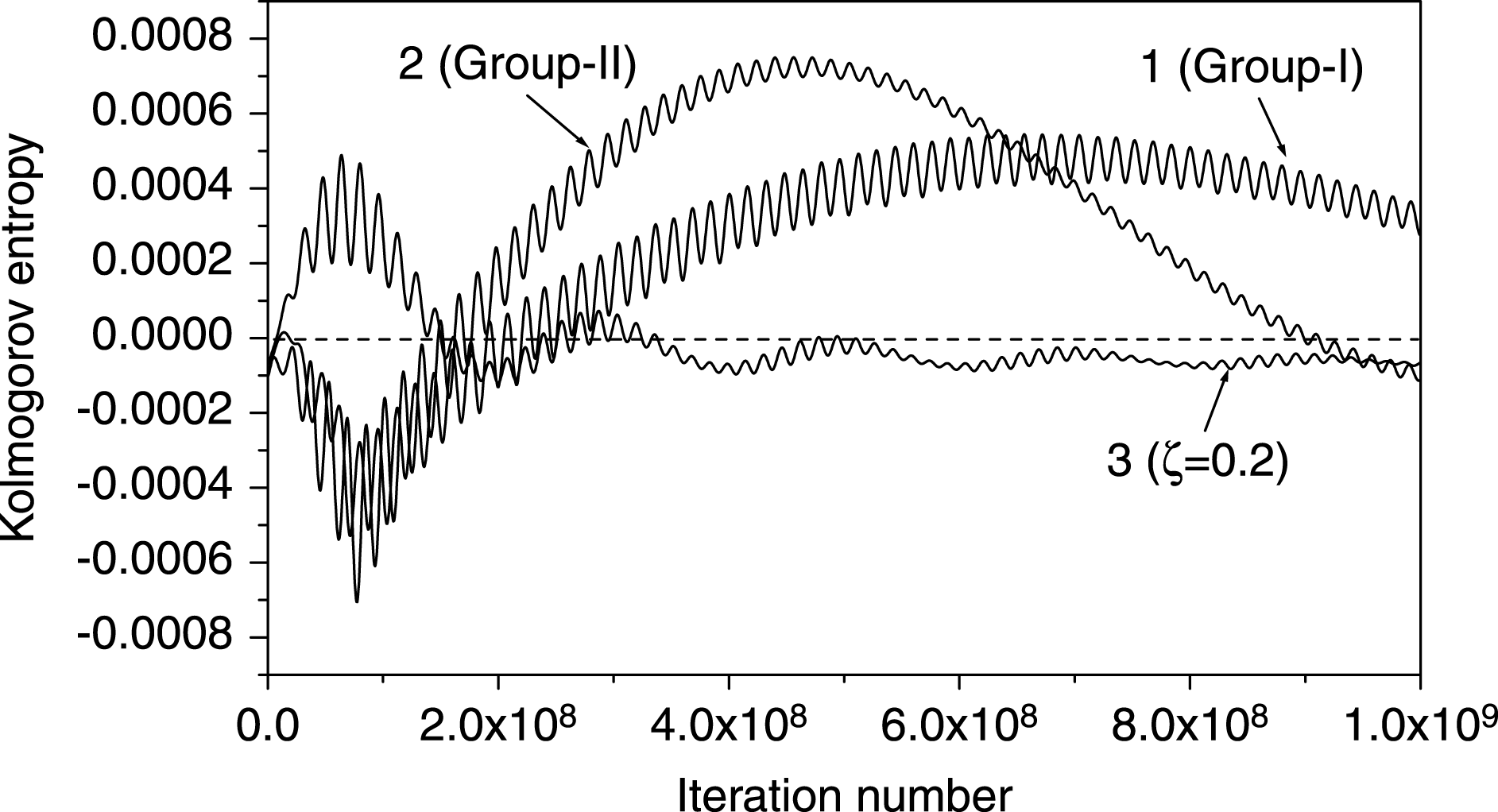
Kolmogorov entropy of the electron motion in figures 2 and 3, where curves 1, 2 and 3 denote the Group-I and Group-II parameter domains of a magnetic focusing regime (an axial guide magnetic field) and the parameter domain of an electric focusing regime (an ion-channel guiding field), respectively.

3. Motion stability
Mathematically speaking, the solution of differential equation (2.4) describes the electron motion, while the stability of the solution corresponds to the motion stability. It is significant to study the motion stability because perturbation of FEL operation conditions often exists in practice, such as manufacturing error and fluctuation of power supply. One of the useful tools to analyse stability is the calculation of the Kolmogorov entropy (Benettin et al.
Reference Benettin, Galgani and Strelcyn1976; Abarbanel et al.
Reference Abarbanel, Brown, Sidorovich and Tsimring1993). A detailed description to calculate the Kolmogorov entropy in an FEL can be found in Zhang & Elgin (Reference Zhang and Elgin2004). Briefly speaking, the Kolmogorov entropy,
 $k$
, is a measurement of the separation of two nearby electron trajectories in six-dimensional phase space: a positive value of
 $k$
corresponds to an unstable motion, whereas a negative value corresponds to a stable motion, and the smaller
 $k$
is, the more stable is the motion. Taking the electron motion in figures 2 and 3 as an example, we compare the motion stability in the magnetic focusing regime of an axial guide magnetic field and the electric focusing regime of an ion-channel guiding field. Figure 4 plots the evolution of
 $k$
values versus the iteration number (corresponding to the longitudinal position). It can be seen that the electron motion in the Group-I parameter domain of the magnetic focusing regime (
 $B_{0}=4060~\text{G}$
) has a positive value of the Kolmogorov entropy and so is unstable, while in the Group-II parameter domain of the magnetic focusing regime (
 $B_{0}=10\,900~\text{G}$
) the electron motion tends to be stable but has notable fluctuation. The best one of the curves is the situation of the electric focusing regime of an ion-channel guiding field: the electron motion is quite stable and has small fluctuation.
4. Conclusions
In this paper we have qualitatively and quantitatively compared the electron motion and stability in a three-dimensional helical wiggler for three focusing regimes in an FEL (the natural focusing regime, the magnetic focusing regime and the electric focusing regime). The results can be summarized as follows:
-
(a) The natural focusing regime of a three-dimensional wiggler confines the electron motion to have a small Larmor radius and a limited Larmor-centre quiver in the transverse plane. But it is easily broken by the self-field of the electron beam with a large current, and therefore an external focusing regime is always needed.
-
(b) The magnetic focusing regime of an axial guide magnetic field generates a magnetic force to confine the electron motion by superposing a strong Larmor rotation with relatively large Larmor radius and Larmor-centre shift.
-
(c) The electric focusing regime of an ion-channel guiding field generates an electric force to counteract the self-field of the electron beam, resulting in confined electron motion that is similar to that in the natural focusing regime.
-
(d) The electric focusing regime of an ion-channel guiding field can provide better stability of electron motion with smaller Larmor radius than the magnetic focusing regime of an axial guide magnetic field does. Meanwhile, the former may have potential advantage in cutting down the expense of the FEL device manufacture and operation due to the replacement of the guide magnetic field apparatus.
Acknowledgement
This work was partly supported by the Open Research Fund of Sichuan Province Key Laboratories (Research Center for Advanced Computation, Xihua University) under grant no. SZJJ2013-025.