Since the first edition of The Good Citizen in 2008, Russell Dalton (Reference Dalton2015) has spent the past thirteen years studying changes in democratic citizenship with the impact of the Millennial Generation as his primary focus. In 2020, however, a new generation of students arrived in our classrooms. Like their Millennial predecessors, members of Generation Z are more educated, more diverse, more nonpartisan, and more likely to view government as a potentially positive force. However, like Millennials, they also are less trusting of government and more skeptical of governmental authority (Parker and Igielnik Reference Parker and Igielnik2020). Conversely, the Boomer Generation—despite having been part of the origins of youth culture, rock n’ roll, anti-war protests, and the civil rights movement—has become increasingly conservative or at least non-progressive on social issues (Parker and Igielnik Reference Parker and Igielnik2020) and thus might deserve the “Okay Boomer” social media meme circulating among young people. Generational politics is an important dynamic in today’s political science classrooms.
Like their Millennial predecessors, members of Generation Z are more educated, more diverse, more nonpartisan, and more likely to view government as a potentially positive force.
Written by a later-era Boomer political science professor and two Generation Z honor students, the purpose of this study is to describe an approach of how to teach political polarization to Generation Z students. We are interested in whether the skeptical and nonpartisan tendencies of Generation Z might lead it to overcome political polarization and usher in an era of democratic cooperation. Led by a professor who asserts theoretical points and then encourages the two Generation Z coauthors to respond, our research questions whether Generation Z students in an introductory course are politically polarized. Answering the research question returns us to our central purpose—that is, teaching political polarization to Generation Z students.
THE COURSE
Taught at a public university in the United States, the introduction to politics course begins with lectures and readings on concepts including cognitive dissonance (Festinger Reference Festinger1957), confirmation bias (Taber and Lodge Reference Taber and Lodge2006), filter bubbles (Pariser Reference Pariser2011), narratives (Jones and McBeth Reference Jones and McBeth2010; McBeth and Pearsall Reference McBeth and Pearsall2019), and political emotion and identity (Huddy, Mason, and Aarøe Reference Huddy, Mason and Aarøe2015). There are subsequent discussions of the political brain (Westen Reference Westen2008), a critique of classic economics and utility maximization (Nowak, Page, and Sigmund Reference Nowak, Page and Sigmund2000), readings on motivated reasoning (Kahan, Jenkins-Smith, and Braman Reference Kahan, Jenkins-Smith and Braman2011), and discussions of political disinformation (Bennett and Livingston Reference Bennett and Livingston2018). The course encourages students to engage in deliberate, rational thinking about politics or, in other words, to use Kahneman’s (Reference Kahneman2011) System One while also recognizing the fast and uncritical-thinking biases of humans (i.e., Kahneman’s System Two). Such a cognitive approach to an introduction to politics course puts students in a position to evaluate not only how others make political decisions but also how they make decisions reflecting the use of cognitive science in pedagogy (e.g., Eyler Reference Eyler2018). We know that students’ political identity is more set than their issue positions (Woessner and Kelly-Woessner Reference Woessner and Kelly-Woessner2020); therefore, the course approach teaches them to recognize their biases and encounter evidence with the goal of avoiding concerns over political science and indoctrination (Mariani and Hewitt Reference Mariani and Hewitt2008; Woessner and Kelly-Woessner Reference Woessner and Kelly-Woessner2009).
Robert Putnam’s seminal work, Bowling Alone (Reference Putnam2000), provides an important starting point in teaching political polarization. Putnam argued that the United States is suffering from a decline in bridging social capital, thereby leading to a decline in reciprocity; in turn, this condition leads to decreased political trust and increased political conflict. In 2020, Putnam’s theory resonates more than ever given that our study originated in September 2020 as we watched both peaceful and violent protests erupt throughout the United States and the world. As we encountered Putnam in the third week of the course, his theory seems an appropriate summation of “how we ended up here.”
Generational politics, however, comes into play given Putnam’s insistence in Reference Putnam2000 that the younger generation of that era played the most significant role in democracy’s decline. Dalton (Reference Dalton2015) provided a counterpoint to Putnam’s (Reference Putnam2000) more pessimistic view of young people. Dalton’s central argument is not that democracy is in decline but instead that the norms of democratic citizenship are changing. For example, Putnam cited technology (although there was no social media in Reference Putnam2000) as leading to the decline in political participation. Today, some studies are negative about the impact of social media on democracy (Tucker et al. Reference Tucker, Theocharis, Roberts and Barberá2017). Yet, students in our class responded to a survey asking them to evaluate their social media friends on a bonding and bridging social-capital scale (Williams Reference Williams2006). They overwhelmingly reported that their social media friends reflect primarily bridging social capital: 25 of 44 students in the survey reported that it helped them understand others with different political views. Students view social media as something that brings other viewpoints into their world, and some of the literature validates these views (Phua, Jin, and Kim Reference Phua, Jin and Kim2017).
Students initially discussed whether their generation is polarized. One theme in the discussion almost parroted Dalton’s (Reference Dalton2015) thesis before the students began reading The Good Citizen. They contended that their generation is nonpartisan and their diversity moderates their views, making them open to new ideas. Students promoting this first theme agreed that polarizing narratives were dividing them, but they believed that a political middle remains strong and reflects their generational views. A second theme that emerged in the class was that today’s political narrative is so polarizing and so extreme that young people must take sides. Students choose “political tribalism” because if they are liberal, their conservative counterparts are so extreme that they cannot tolerate them (and vice versa).
When asked about this initial debate, one of the two Generation Z coauthors (Jules Belyea) commented:
Right now, most of my generation is dissatisfied with the two choices we have for POTUS. Neither Trump nor Biden appeals to Generation Z, and we feel left out of this election. Most Gen Z’ers have most likely changed their political view in the last five years, including me. I think this is because we are so diverse and open to new ideas that we feel that we are able to listen to both sides of the debate with reason and logic. I purposely surround myself with people who have different views and ideas so that I can be more understanding.
Drawing on class discussions around political tolerance and distinctions between rights and science and political issues, the other Generation Z coauthor (Andrew Perry) wrote as follows:
From my experience interacting and conversing with others of my generation, there are certain areas of politics that seem generally treated with different approaches—on “nonpolitical” issues, such as those of human rights and science, like LGBTQ rights, racism, climate change and, in general, social issues. Generation Z seems to unanimously stand strong for human rights and science. As such, they generally seem as intolerant toward those who take positions seen by Generation Z as human rights or founded in science. Regarding “political” issues, Generation Z overall is tolerant and open to discussion. They are able to hold productive conversations around the size of government, taxes, and other issues. However, there are other factions in this camp. There are both conservative and liberal sides, but there is a side that perceives many of these issues also to be about equality and human rights (e.g., current policy proposals such as the Green New Deal, Medicare for All, and Defund the Police). This side is generally more liberal than the Democratic Party and believes that not enough is happening. However, productive conversations occur around issues still perceived as political and not human rights or science based.
Indeed, the two student coauthors had initial disagreements about polarization, but political scientists also disagree about it. Although there is little doubt that the United States suffers from institutional polarization (e.g., Andris et al. Reference Andris, Lee, Hamilton, Martino, Gunning and Selden2015), the debates over individual polarization focus on those between Abramowitz and Webster (Reference Abramowitz and Webster2018) and Fiorina (Reference Fiorina2016). Abramowitz and Webster (Reference Abramowitz and Webster2018) contend that individuals are polarized, using the term “negative partisanship” to describe why and basing their conclusions on growing racial and media divides (among other factors). The growing racial divide is obvious in US politics. In the 2016 election, white non-Hispanic voters chose Trump over Clinton by a margin of 58% to 37% (Tyson and Maniam Reference Tyson and Maniam2016). The continued importance of Fox News and other more conservative outlets for influencing conservative voters, as well as more liberal outlets (e.g., MSNBC), demonstrates the growing media divide (Grieco Reference Grieco2020).
Fiorina (Reference Fiorina2016), conversely, contends that a political middle still exists. Similar studies suggest that there is a strong middle and that in red and blue congressional districts, there is far more agreement than disagreement on policy issues (Center for Policy Attitudes 2014). Moreover, Fiorina (Reference Fiorina2016) provided evidence that extreme partisans are far more satisfied with their political party compared to moderate partisans.
A third approach to political polarization suggests that both Abramowitz and Webster (Reference Abramowitz and Webster2018) and Fiorina (Reference Fiorina2018) are correct. “Affective polarization” describes how individuals who strongly identify as liberal or conservative disagree less on policy issues but greatly dislike and do not want social contact with those of opposing ideologies. Mason’s (Reference Mason2015, 142) work on this concluded that the United States is “a nation that may agree on many things but is bitterly divided nonetheless.”
POLITICAL POLARIZATION AND GENERATION Z STUDENTS
The first assignment consists of students writing an analysis in the form of a memo to a nonprofit group interested in bipartisanship. Students are asked to answer three questions: (1) What is political polarization?; (2) Are young people more or less politically polarized (based on survey data and interviews from the class)?; and (3) Why did you answer question 2 in the way that you did? The assignment teaches students the usefulness of political science and gives them an idea of the type of questions that political scientists answer. The assignment also encourages them to practice political science research by grappling with both qualitative evidence (i.e., students interview one another) and quantitative evidence (i.e., a course survey and data from a previous class).
Measures of Affective Polarization
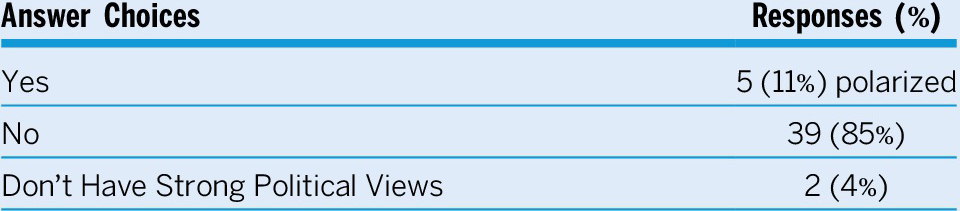
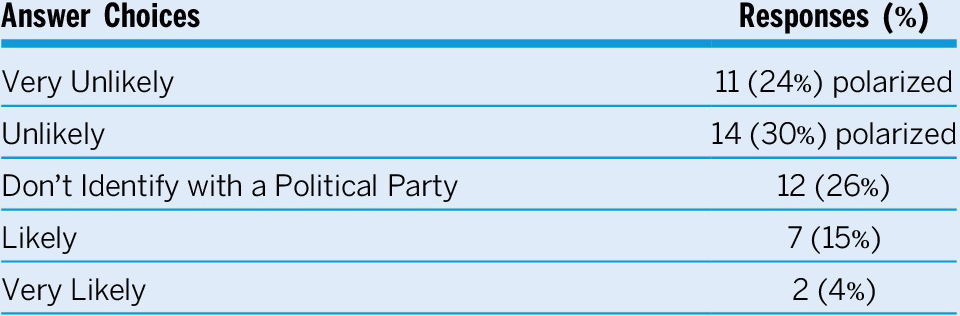
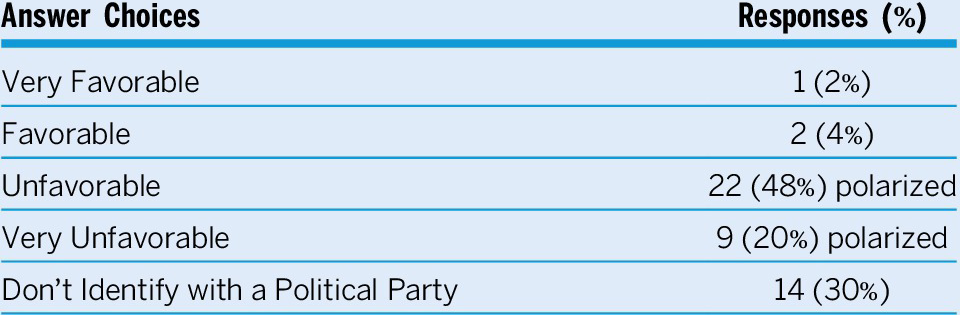
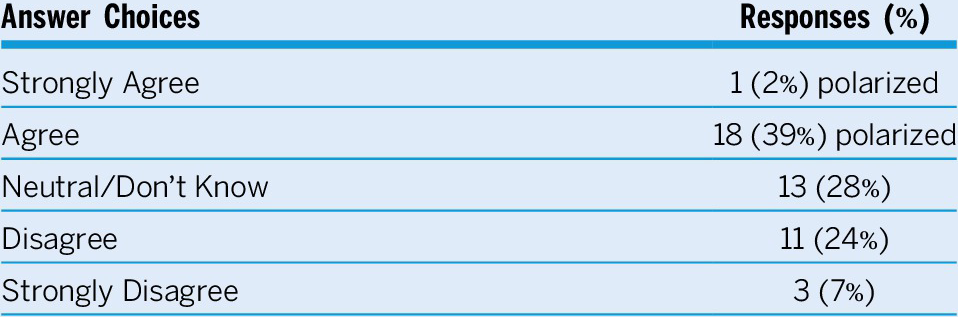
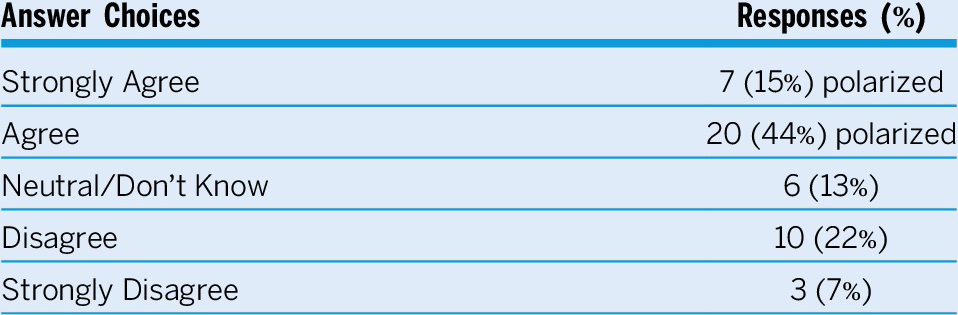
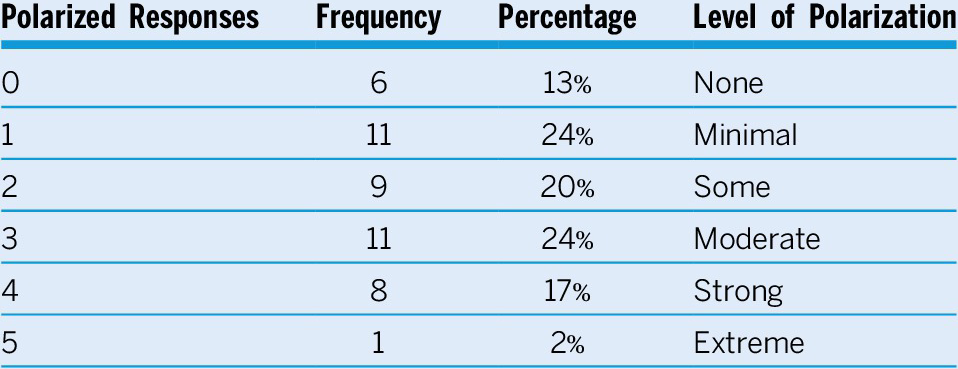
After interviewing one another, students answer a series of survey questions measuring political polarization. The data file for the survey (conducted over three semesters) is available on Harvard Dataverse (McBeth Reference McBeth2021). Tables 1–5 measure affective polarization, table 6 is an affective-polarization index, and table 7 measures issue polarization. Students use survey responses from the course and previous classes in their polarization paper. The survey questions are from the Pew Research Center (Reference Center2014) and also include original questions, one of which was developed by a student in a previous semester. It is interesting that although students were not upset if their hypothetical son or daughter married someone with a different political ideology (see table 1), a majority would not marry someone from the opposite party (see table 2). In table 3, 68% of students had a negative view of the opposite political party. In table 4, 41% agreed that it was important to them to live in a place where most people shared their values. In table 5, 59% agreed that their close friends shared their values.
Upset If Son or Daughter Married Someone with Different Political Ideology

Likelihood That You Would Marry Someone of Opposite Political Party

Views of the Opposite Political Party

Important to Live in a Place Where Most People Share My Values

Close Friends Share My Political Beliefs

Affective Polarization Index

Ranking of Where Things Should End Up: Most Important Issues Facing the Country

It is interesting that although students were not upset if their hypothetical son or daughter married someone with a different political ideology (see table 1), a majority would not marry someone from the opposite party (see table 2).
The affective-polarization index in table 6 counts the number of polarized responses to the five questions measuring affective polarization: 57% of students had some to no political polarization and 43% were moderately to extremely polarized.
Issue-Polarization Measure
A question concerning where political parties should end up regarding the most important issues facing the country revealed that a majority of students believed that it either depends on the issue or that both sides should get equally (see table 7). Only 13% of students ranked “Republicans should get everything” and only 18% ranked “Democrats should get everything” as their first or second choices. Thus, consistent with Mason (Reference Mason2015), the issue polarization of students was much lower than affective polarization, meaning that some students might support abstract principles of cooperation even though they personally have animosity toward the other party.
The perception of student polarization was interesting. Student coauthor Belyea commented as follows:
For my paper using the survey data, I again argued that the students reflect how Generation Z broadly thinks. The survey showed that most students are not politically polarized. Three questions demonstrated that most students are not bothered if a close family member married somebody of a different political party, as well as showing that an overwhelming majority of our class believed that Republicans and Democrats should work together for the common good. I think that students in the survey directly reflect Generation Z’s political thoughts.
Conversely, student coauthor Perry wrote:
When discussed during the class, in person, the class largely had opinions of being more centrist. However, I saw a slightly different story in the anonymous survey. At first glance, the survey seemed to confirm what the students thought of themselves. Students said that they would not be upset if a family member married somebody of the opposite political party. Yet, while accepting of others' choices, they had unfavorable views of the opposing party, as well as saying they would be unlikely to marry someone from the other party. They also had a strong preference to both surround themselves online and in person with people who share similar views. This is interesting because when asked how they believe social media affects them, 57% said that social media assisted them in understanding others while 37% said it leads them only to what they agree with. The bias in the belief that social media assists them in understanding others while also largely surrounding themselves with those possessing similar views leads me to believe that students are more polarized than they would like to think.
Student coauthor Perry concluded with an interesting self-reflection: “Gen Z seems to largely view political polarization as a bad thing. Given the difference in results of in-person versus anonymous discussion, I think this feeling plays into how this generation, and most generations, would view themselves. Nobody wants to be a villain, least of all in his or her own mind. We always want to be better and avoid the cognitive dissonance that arises when we recognize that we may not be as good as we think we should be.” This self-reflection is an important outcome of teaching introductory students about political polarization.
CONCLUSION
The Boomer professor concluded that students should be able to recognize their own biases and the course’s pedagogical approach with its concepts of confirmation bias. Although students did not agree on their level of polarization when compared to older generations, they were more than willing to confront the question. In this study, Generation Z students had little issue polarization but more moderate affective polarization (i.e., about 43% had moderate to extreme affective polarization). Although 57% had less affective polarization, we must remember that they were primed before the survey to keep bias in mind. A future experimental design with a control group (i.e., students not primed to look for bias) would be helpful in determining whether such cognitive-bias priming reduces polarization in students (at least in the short term).
Finally, we ask whether we should teach students that young people are eroding the bridging of social capital (as Putnam might argue) leading to polarization or whether we should teach them that their diversity encourages skepticism of entrenched partisan identities (as Dalton might suggest)? The answer is that both Putnam and Dalton have lessons to teach Generation Z. Studying Putnam’s theory of democracy helps students to understand the centrality of bridging social capital. Future studies should explore whether students do indeed engage in bridging social capital on social media. Studying Dalton (Reference Dalton2015) provides students with a positive view of their generation and democratic aspirations. In 2021, political polarization is tearing apart the fabric of US democracy and democratic institutions. Political science faculty can encourage Generation Z students to confront the insidious effects of affective polarization on democratic principles and, in doing so, encourage them to stake out their own democratic politics free of the toxic political identity and polarization that has consumed older generations.
Political science faculty can encourage Generation Z students to confront the insidious effects of affective polarization on democratic principles and, in doing so, encourage them to stake out their own democratic politics free of the toxic political identity and polarization that has consumed older generations.
DATA AVAILABILITY STATEMENT
Replication materials are available on Harvard Dataverse at https://doi.org/10.7910/DVN/0WRY9Q.