In front of his blank page, every child is already put in the position of the industrialist, the urban planner, or the Cartesian philosopher – the position of having to manage a space that is his own and distinct from all others and in which he can exercise his own will.
(de Certeau Reference Certeau and Rendall1984, 134)
The arrow points only in the application that a living being makes of it.
(Wittgenstein Reference Wittgenstein and Anscombe1967, §454)
Storage and retrieval are easier when the material makes sense, when it fits with what is already known.
(Norman Reference Norman2002, 67)
1. Introduction
a. Form and Meaning
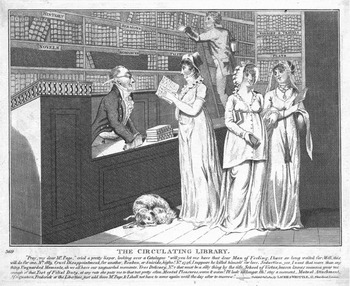
Around 1800, the Scottish painter and caricaturist Isaac Cruikshank published a print entitled “The Circulating Library.” It is a familiar image to historians of print culture because it exemplifies the middle class's increased demand for books during the late eighteenth century. In the print, a woman stands reading a catalog, which at the time would have been organized in the form of a table (fig. 1). The shelves in front of her are labeled with tags that reflect the kinds of literary genres of the day. In this scene we see a form of reading that, though common, has received little attention from scholars. If we consider the fact that the headings in the catalog and the labels on the shelves corresponded, then it becomes clear that this woman is in the middle of a multivalent act of reading in which her gaze is cast back and forth between the spatialized entries of the catalog, the square space of the room, and the tabulated bookshelves on the wall. How did she learn to read in this manner? How did she learn to spatialize in this way?
Isaac Cruikshank, “The Circulating Library,” circa 1800–1805. Collection of the author.

This essay focuses on these two questions by offering some thoughts on how children were taught to read the layout of the paper tools used in late eighteenth-century Scottish educational settings. More specifically, I explore the ways in which the words and spaces of print culture were used to order reoccurring visual information patterns. There have been a number of notable historical studies on this topic in recent decades, particularly by scholars interested in Walter Ong's work on the space of words in texts. The writings that followed in the wake of Ong's views, especially those published by Marshall McLuhan's devotees, took Ong's research further and argued that the different forms of media that preserved texts actually constituted part of the message being conveyed. Such a notion complicated the prevailing epistemology, inherited from Victorian interpretations of classical philosophy, which prioritized a text's content over its form. The subversive nature of McLuhan's view was perhaps an understandable reaction to the rise of digital culture and to the high value placed on textuality at the time by the academy and the reading public. In recent years, particularly after the rise of the Internet, a more egalitarian approach has arisen in which form and content are seen as equally important. This is the view that I take in this essay.Footnote 1
Balancing the graphic form and disciplinary content of educational texts is not an easy task for a historian, especially since the visual components of the paper tools used by early modern schools remain relatively unexplored. This is in spite of the fact that, ever since Jean Piaget, educational psychologists have emphasized how viewing images can function as a noteworthy learning experience (see Gardiner Reference Gardiner1990 and Perkins Reference Perkins1994).Footnote 2 Historical studies influenced by this research tend to focus on the lines and space of figural pictures such as prints, paintings, or illustrations contained in children's literature. But what about the visual patterns in the graphic design of the text itself? What about square paragraphs, rectangular columns, or even diagrammatic polygons? These functioned collectively as linear images and they were visually iterated time and again when young readers of the early modern period read the pages of books or when they wrote paragraphs, copied lists, drew tables, or scribbled marginalia.
Despite their pictorial nature, it is as if the ubiquity of such layouts has made them invisible and, consequently, the learning routines associated with them have remained relatively unexamined by historians. Indeed, those who study the form and meaning associated with the visual culture of learning routines generally tend to be social anthropologists or cognitive scientists and, while such scholars respect the value of historical documents, they usually do not write historically; that is to say, they seldom address the historical context of such artefacts and they refrain from offering guidance as to how images like word pictures were actually used or how they fit into the intellectual and social world that produced them. It is the goal of this essay, therefore, to treat the graphic layouts of words and lines as valuable historical artefacts that shed light on how early modern learners were taught to be literate and numerate. In following this approach, my thoughts are influenced by the anthropologist Tim Ingold's work on the cultural history of lines and the psychologist Barbara Tversky's research on the relationship between learning and graphic principles such as proximity, contrast, and modularity. These scholars emphasize that it is important to identify the graphic patterns onto which values and meanings were mapped by a given culture. This is the approach that I follow, albeit from a historical perspective (Ingold Reference Ingold2007).Footnote 3
b. Common Things
This essay focuses on the common paper tools used in the homes and classrooms of late Enlightenment Scotland. Such a focus naturally precipitates two important questions. Why did I choose such tools? Why did I select Scotland? I will answer these in turn. My interest in the common paper tools used every day in primary and secondary school classrooms stems directly from the historical approach taken by intellectual historians such as Ann Blair, Ursula Klein, and Sherry Turkle who, though they write about different topics and different eras, have shown that natural knowledge is an emergent phenomenon that is formed through acts of writing, drawing, and reading that are repeated over and over again. In their work, lines, symbols, and space are not fixed forms; they are versatile tools we think with (Blair Reference Blair2011; Klein Reference Klein2003; Turkle Reference Turkle2007).
This viewpoint is a powerful departure from the ways in which intellectual historians of the past approached texts. My work on children in this article extends this approach by asking how students were actually taught to make and value the graphic structures that they would one day use to manipulate their emerging thoughts about everything from the natural world to commerce. This means that I am interested in the layout of common texts that were used daily to teach basic subjects like the three R's (reading, writing, and arithmetic) or practical subjects like geography, grammar, and gauging. Such an approach differs significantly from the veritable research done on the history of children's literature in recent decades that tends to concentrate on expensive books that were sold to wealthy buyers seeking to supplement the texts used in the educational settings of the late Enlightenment.
Historians of readership regularly point to the “revolution” in reading that occurred during the early modern period and the “explosion” of print that took place during the middle of the eighteenth century. While we need not be detained with the specifics of those theses here, it will suffice to say that most of this research has not sought to ask questions about how the layout of books, much less educational texts, fit into the extensive and intensive reading habits fostered by the print explosion of the mid-eighteenth century to the dawn of steam printing in the 1820s. Since little research has been done on the graphic format of early modern educational books, I have chosen a corpus of Scottish school texts to serve as a relatively manageable case study that can be used as a point of comparison for other contexts. I also made this choice because the history of Scotland's eighteenth-century curriculum is well established and the country is generally acknowledged to have had a high rate of literacy and numeracy (Law Reference Law1965; Houston Reference Houston2002).Footnote 4
Following the lead set by Matthew Grenby's important work on eighteenth-century children's literature, I generally prefer to see students as “users,” rather than “readers,” of texts (Grenby Reference Grenby2011, 9).Footnote 5 Since I am interested in the historical context of the visual patterns evinced in Scottish texts and teaching tools, the next section of this essay explains the cultural placement of visual technologies in late Enlightenment Scotland, giving attention to how educational texts fit into the structure of Scotland's school system and, correspondingly, to how the educational psychology and graphic design of the Enlightenment reflexively influenced the kinds of visual information used by children and their instructors. Section 3 extends this discussion by focusing on the relationship between words and the space of the page. I show that the alignment of heads, lists, and tables created a collective image that helped students remember and organize information. Sections 4 and 5 use these structures to explore how the forms of directional reading and writing necessitated by narratives and tables nurtured the kinds of cognitive skills needed to understand various aspects of figures. To illustrate this conceptual link, I focus on the basic principles of geometry and illustrative figures used in educational prints. By the end of the essay, it will be clearer how eighteenth-century children in Scotland learned to both make and read the graphic patterns presented to them via the media of paper tools.
2. Education, Order, and the Mind
a. Schools and Texts
Perhaps it would be best to begin with the places where Scottish children were taught to use the spaces of print. There were many kinds of schools in eighteenth-century Scotland. Primary schools included English schools, hospital schools, charity schools, and workhouses. They taught the basic elements of reading, writing, arithmetic, and, oftentimes, singing. English schools and hospitals were better funded, whereas other kinds of charity schools and workhouses often struggled to teach beyond the basic rudiments of literacy and, sometimes, numeracy.Footnote 6 A core literacy text for primary schools, private tutors, and parent-teachers throughout the century was The A.B.C. or a Catechism for Young Children (1644), the content of which was formulated by the General Assembly of the Church of Scotland. It was reprinted over and over by numerous printers, usually in the same cramped spatial format.
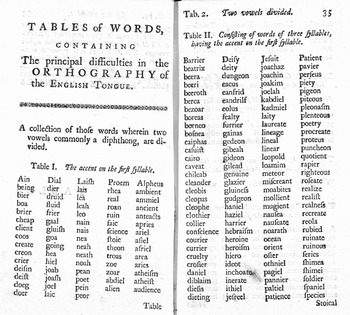
By the end of the eighteenth century, however, a number of new spelling books were published. The arrangements of words and tables in these were more spatialized, with many of them using the method of syllabification to teach English. From the 1750s to the 1810s, the spelling books by John Warden, Arthur Masson and Gilles Ker, William Scott, James Gray, and Alexander Barrie were especially popular (fig. 2). Yet, though historians know a good deal about the content of these books, judging how students internalized the information is a challenge.Footnote 7 This is because very few manuscript notes based on these texts survive. It is relatively certain, however, that students learned this information in a rote manner, usually through oral repetition or scribal recopying on slate boards. These practices, though so central to everyday classroom learning, can only be reconstructed from surviving copybooks and from pedagogically orientated treatises that summarize the state of learning in late eighteenth-century Scotland.
John Warden, A Spelling-Book, 1753, pp. 34–35. National Library of Scotland.

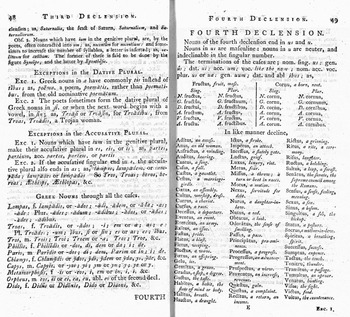
Secondary schools, which included grammar schools (sometimes called high schools), parish schools, and academies, represented the next stage of education. Grammar schools taught Latin with reference to the intellectual, political, and geographical history of ancient culture.Footnote 8 Two influential grammatical primers throughout the century in Edinburgh were the Latin textbooks by Thomas Ruddiman and James Barclay. Reflecting the increasing interest in vernacular languages, Alexander Adam's Rudiments of Latin and English (1772) became popular in the latter decades (fig. 3).Footnote 9 These books were more spatialized than those published at the beginning of the century in that they contained larger margins, more headings, wider line spacing, and more blank lines between sections. For an additional fee, secondary schools also taught “practical” classes on writing, mathematics, drawing, accounting, book-keeping, and surveying. In grammar schools, such subjects were oftentimes taught by the same teacher and their courses cost more than the main course given in English or Latin grammar. In academies, which were predominately founded in the last half of the century, these subjects sometimes comprised the bulk of the curriculum.
Alexander Adam, The Rudiments of Latin and English Grammar, 1786, pp. 48–49. National Library of Scotland.

Notably, “numeracy” in these settings was addressed in books that explicitly treated mathematics, algebra, geometry, and trigonometry as well as in those on surveying, navigation, and accounting. Key authors on these topics were Alexander Macghie, Robert Lundin, William Panton, Alexander Ewing, and William Wilson.Footnote 10 Aspects of literacy and numeracy were also addressed jointly in compendia such as the textbooks compiled by George Fisher, Richard Grey, and Batty Langley. Writing was treated by a number of copy-books, with Edmund Butterworth's Universal Penman (Reference Butterworth1785) being a good example. Aside from children born to enlightened aristocrats, the majority of students taking additional numeracy and penmanship classes were drawn more from the middle class, that is, from families who sought to use the spatialized forms of print taught in schools to enhance their business and trade. It was this spatial knowledge that laid the foundation for the forms of systematic classification that undergirded the Enlightenment vision of an ordered mind and, by extension, panoptic knowledge. As I will show below, the graphic prelude to the kinds of schematics that were used to teach students in Scottish universities consisted of learning how to import or invent several kinds of headings that were spatialized in various kinds of tables known to aid the memory.Footnote 11
b. Associationism and Visual Order
Learning in the foregoing educational settings was facilitated by repeated acts of reading, writing, speaking, and, sometimes, singing. During the eighteenth-century, these acts were seen as both moral and therapeutic activities in which the spaces of print provided a regularized form of visual order. The core psychological model that underpinned this kind of pedagogy was associationism, that is, the notion that ideas were associated or dissociated in the mind through volition and experience.Footnote 12 Associationist pedagogy promoted the notion of “moral management,” the idea that “disordered” minds could be “reordered” through measures that strengthened the will, therein affirming the therapeutic power of the self over the world. This philosophy of mind played a powerful role not only in Scotland, but also in Britain at large. Influential authors on this topic included classical orators like Marcus Tullius Cicero and Quintilian, as well as the philosopher John Locke, particularly his Some Thoughts Concerning Education (Reference Locke1693). Like a number of textbooks used in Scotland, Richard Grey's introductory comments in Memoria Technica explained this mindset in the following manner:
Tis the advice of Quintillian, that boys should be used to repeat, as fast as possible, harsh and crabbed Words and Verses, purposely made difficult, in order to give them more full and articulate Pronunciation . . . The frequent Repetition of the following Memorial Lines would certainly answer this End; and if I might also recommend, as he does, the Writing of them too, in order to make a deeper Impression. (Grey Reference Grey1756, xi)
Importantly, Grey's “memorial lines” were arranged in tables throughout his book.
Further insight into the learning routines employed in Scotland can be gained from the books and pamphlets written by educators who sought to improve or reaffirm the state of Scottish education from the 1760s onward. A good example of this genre is Patrick Bannerman's Letters Containing a Plan of Education for Rural Academies (1773). Bannerman (1715–1798), was the charismatic Church of Scotland minister of Saltoun, Haddingtonshire. Like the many clerics who ran local parish grammar schools, he held that a student “shall, from a fair copy written by his master, transcribe his system of divine and moral truth, of geography, and of history, into books, which he ought to preserve and peruse so long as he lives” (Bannerman Reference Bannerman1773, 27). Fortunately, a small number of such notebooks still survive, particularly the sets copied by students who attended the avant-garde Perth Academy during the 1780s and 1790s. I will make direct reference to these later in this essay, but it is important to note that most sources of this nature clearly show that note-taking was a manually reinforced act of graphic order instantiated by the vertical alignment of words in neat sentences, lists, and tables. Within the associationist milieu of Scotland, transcribing information in this manner was believed to be an effective pedagogical tool because it shaped the mind through an act of embodiment. Put another way, it was seen as a cognitively important practice, one that could be expanded later by adults in commonplace books, diaries, letters, and university notebooks (see Chapman Reference Chapman1774, 172). Thus, students were required to copy sentences daily and to repeat orally lists of information because teachers believed that there was a fundamental connection between the order of space on the page and, to paraphrase Michel de Certeau, the order of experiential knowledge in the mind (see Certeau Reference Certeau and Rendall1984, 134). The repetition of sentences (a form of horizontal order) and lists (a form of vertical order) provided a conceptual starting point for students when it became time for them to negotiate the tables and other layouts that they encountered throughout their professional careers or in the subsequent stages of their education.
3. Layout Patterns
a. Modules and Units
But what were the basic building blocks of the layouts featured in the textbooks and notebooks used or made by students? One way to approach this question is to take a look at the format used to visualize the information featured on their pages. One of the most prevalent layouts was a module that consisted of several component units like headings, blocks of textual material, or illustrative figures. Although their ubiquity has rendered these units invisible to historians, they are important artefacts that provide unique insight into the kinds of graphic patterns that were presented repeatedly to children in educational settings.Footnote 13 The geometry and layout of the modules used in schools were based fundamentally on the rectangular shape of the paper used for books and other kinds of paper tools. Again, this shape was ubiquitous, but important nonetheless. The rectangular surface of the page served as a field in which information was ordered visually. Within these parameters, the layouts used to frame words and figures were influenced by the varying sizes of the paper used to make books or notes. Although many textbooks were printed in octavo or duodecimo formats, copybooks and student notes were usually written on blank leaves of paper that came in different rectangular dimensions. For example, copybook pages, which were usually called slips, ranged from six inches to a foot long, with their height usually being one-fourth of their length. The dimensions of student notes also varied. In the classroom, students frequently took their rough notes on whatever size paper they could find, including the blank backsides of printed advertisement posters, proforma, and metric conversions that had become dated. If the sheet was too big, students would cut it down to manageable sized slips. Long and thin ledger books were also used. These rough notes were then recopied onto octavo or duodecimo paper that was often sold as folded gatherings or as bound notebooks.Footnote 14
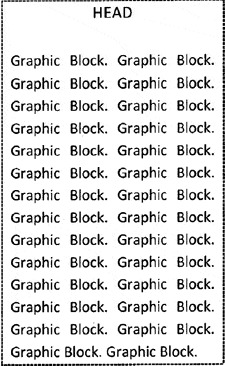
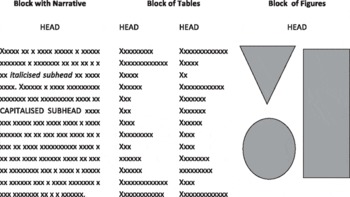
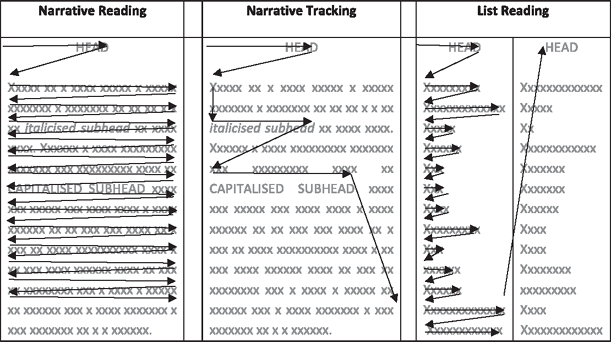
On the whole, there was parity between the modules used in textbooks and those shaped by students in their notebooks. They were usually units of text that addressed a common theme and there were three elements that occurred on a regular basis. First, there was a short heading that signaled the content of the module. It was usually capitalized and centered, serving as a visual cue to the forthcoming content. Second, there was a graphic block that contained words and, to a lesser extent, figures, arranged as a rectangular blob, a visually discernible unit on the page. Finally, there were horizontal bands of white space, usually single- or double-spaced blank lines, above the heading and below the graphic block. Taken as a whole, the three foregoing units created a visual code that allowed readers to navigate more quickly through the pages of textbooks and other paper teaching tools such as catechisms, copybooks, and manuals. Reading such modules, therefore, required a different set of skills than those used to read page after page of a straightforward narrative. Put more simply, there was a combinatorial logic of reading involved – one which was deeply spatial. When combined with the titular head, for example, the horizontal blank lines served as a spatial cue that indicated the beginning and end of a module that allowed readers to track through sets of modules quickly. Once a module was found, then the content of the graphic block was read in different ways according to its spatial, typographic, and grammatical arrangement (see Table 1).
The Modular Block

Kinds of Modular Blocks

b. Packaging Information into Patterns
There were three basic kinds of graphic blocks in textbook modules and their layout affected the ways in which students accessed them (Table 2). The first and most popular unit of this nature was the narrative block. This was a justified narrative arranged under a heading or subheading in which the key concepts were cued by italic or upper case letters. A good printed example of this format occurs in The A, B, C, with the Shorter Catechism. This was the most popular literacy text for primary educational settings and it consisted of a question and answer format designed by the General Assembly of the Church of Scotland. Each question was a short sentence that functioned as a heading and was italicized. The answer was usually a few sentences. A second reoccurring unit was some sort of table, which functioned as a “tabular” block of information. Whereas the narrative block was essentially one column of text, the layout of tabular blocks usually consisted of a few columns into which various kinds of words were placed. Key concepts were flagged by headings that were positioned in the open space above the columns. From the 1750s onward, this format was used more frequently in primers to spatialize noun declensions and verb conjugations, as well as logarithms, equations, and metric conversions in numeracy texts. The third kind of graphic block was one that contained some sort of figure (geometric, diagrammatic, or illustrative). Figural blocks were framed in white space and sometimes labeled with alphabetic or numeric headings that corresponded to a descriptive narrative or legend included above, below, or beside it. Overall, all three of these blocks serialized the space of the page through the geometric plotting of headings and margins in a manner that packaged information for students in a familiar and, hence, easily accessible visual pattern. Such repeated patterns as evinced in the modules of educational paper tools were part of the continuing serialization of graphic space that had been happening since the rise of double-entry accounting and bureaucratic proformas during the mid-seventeenth century. This regularization of space was used throughout print culture, but it was particularly noticeable in paratexts such as title pages, indices, and footnotes, as well as in the tables used by institutions such as the East India Company, the Royal Society, and the various colonial offices overseen by France and Britain.Footnote 15
Whereas the foregoing graphic blocks were used well into the nineteenth century, it is perhaps worth emphasizing that there were some spatial modifications during the years between Scotland's 1745 Jacobite Rebellion and the first decade of the nineteenth century. The space in and around the modules, for example, became more open. Margins were widened and line spacing became more generous. The tight spacing of the narrative block in The A. B. C., for example, was very common in instructional texts designed from the seventeenth century onwards. Near the middle of the eighteenth century, however, schoolbooks started to include more capitalized headings that were surrounded by a single or double blank line. In books like John Warden's A Spelling Book (Reference Warden1757), the text was sometimes double-spaced so that notations could be written or drawn between the lines. This injection of white space occurred despite the fact that space still remained at a premium in pedagogical books because paper was expensive. Providing more white space on the page elongated the book and drove up the price. The fact that printers, authors, and editors sought to introduce more space into the text is testimony to the value that they attributed to spatialized modules. When it came to the design of textbooks and other educational materials, the cheapest and easiest option was simply to cram all the information into typographically and spatially undifferentiated blocks. Spatializing the text took more planning, more time and, hence, more money. Such a spatial decoupage of modules was couched in the special role that associationist psychology attributed to the visual order of paginal and sentential space. It is also likely that such increased spatialization was driven by the competition that accompanied the rising demand for textbooks and the desire of authors to offer visually modified formats that called attention to their various views on pedagogical debates occurring at the time (especially in relation to key-wording and syllabification in primers).
4. Textual Images
a. The Heading as a Conceptual Box
Heads, or headings, were the main kind of visual tag that textbook authors used to label the information inserted into a module. This practice was linked directly to the fact that the “head” was a ubiquitous tool employed by adults to order commonplace books and other forms of print culture. More specifically, heads compressed topically-related information down into a representative word or short phrase. It was the textual instantiation of a conceptual box and, in addition to structuring the content of textbook modules, it could be used to extend textbooks through marginalia, customize classroom instruction through conversation, insert further observations into notebooks through the rewriting of rough notes, and structure memory through acts of intentional association.Footnote 16 As mentioned above, heads were usually employed as titles for modules. Such “titular” heads were centered and were usually surrounded by open space in a manner that turned them into reference cues. Various types of subheads were also used. Within modules that had a high degree of narrative content, italicized or capitalized subheadings were regularly employed to label paragraphs or demarcate keywords. Paragraph subheads were placed above, beside, or before a new paragraph, thereby offering a hierarchy of marginal space that was ordered through consistent patterns of indentation. Keyword subheads were used to tag important concepts or terms within the narrative block. Rather than being a mundane distraction, they disrupted space within the block of text and made the topic addressed by the surrounding text more memorable. From a pedagogical perspective, heads also made it easier to see what was supposed to be memorized – a point that was explained succinctly in the instructions given underneath “The Numeration Table” in Fisher's popular Instructor: “For easier Reading of any Number, first get the Words at the Head of Table by Heart” (see Fisher Reference Fisher1799).Footnote 17 Furthermore, within tabular blocks, heads served as labels for columns and rows, and within figural blocks they were used to further identify various aspects of geometric or illustrative pictures that occurred within the quadrangular structure of a block.
Since associationism emphasized the centrality of memory, authors of instructional texts often approached the usage of heads via a variety of commercial metaphors that likened the content of the mind to a “stock of knowledge” that must be “laid out,” “stored up,” and organized like goods bought and sold on a daily basis. But students had to be taught the skills of graphic reduction before they could stock and organize their own mental warehouse. In particular, they had to be taught to see heads as cues and how to plot such cues on a blank piece of paper or on the surface of an empty slate tablet. On the whole, evidence of Scottish students plotting heads and graphic blocks occurs more at the secondary school level. The layout of most student notebooks suggests that the formation of such heads was most likely developed through two stages of note-taking. First, students wrote down a set of “rough notes” based on oral instruction. This was effectively a public activity and such heads were usually the same as those used by their teachers in the classroom. The layout of these notes was rather cramped, as paper was limited, and they wrote fast so that they could capture as much information as possible. This led to the next stage, which was more of a private enterprise where the rough notes were then rewritten into narrative, tabular, or figurative formats. Thus, the line between print and manuscript forms of representation was blurred because the process of rewriting the notes both expanded and reordered them in a spatial manner that resembled the modules used in a printed book.
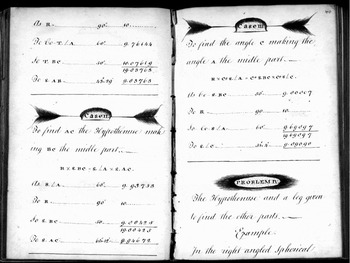
Good examples of recopied notes are the sets taken by the students of Thomas Blacklock in the last decades of the century. Entitled Kalokagathia, his lectures were given to adolescents and mirrored the topical structure of the interrogative headings used in the Church of Scotland's catechism. Blacklock was blind and he originally gained recognition as a poet. He subsequently transformed himself into a successful private teacher who taught Lowland worthies such as David Hume's brother. As stated in the title, his lectures were “Delivered for the use of Pupils in Question and Answer, under the four general Inquiries.” The questions served as heads and were as follows: “What are we?” “Whence are we?” “Where are we?” “Why are we?” The text underneath each head was broken up into further subheads (see Blacklock n.d.). In addition to interrogative headings, student notebooks also employed heads which simply encapsulated the subject of the lecture series or the specific topics covered across a set of lectures. Reflecting the fluidity between notational and textbook formats, arithmetic notes used heads to represent various acts of addition, subtraction, multiplication, and division, whereas geometric and trigonometric lectures featured numerated heads to signal cases, theorems, and rules. However, unlike print, student note-takers often placed heads in a larger font size than the main text. This was the case for the anonymous author of a set of Perth Academy Notebooks taken in 1787. He even used shapes, shading, and arrows explicitly to demarcate titular heads. Such visual additions served to make the head a picture, rendering the content associated with it more memorable (fig. 4).Footnote 18
Anon., Perth Academy Notebooks, Vol. I, Bound MS Notebook (1787), National Library of Scotland MS 14294, ff. 39v and 40r.

b. The Vertical List
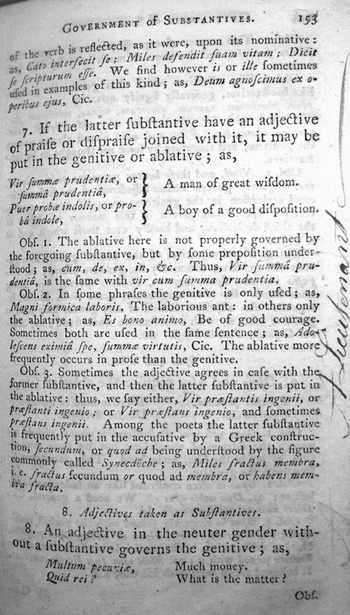
One of the primary visual units set inside the modular space of children's notes and textbooks was the list, which was effectively a vertical column that functioned as a grouping of related terms. List entries were selected based on their topical relation and, if their contents followed any kind of order, they were usually arranged alphabetically. Lists were popular in grammatical, geographical, and lexicographical textbooks, where they were the predominant format used to present vocabulary words, cartographic places, and alphabetical entries. From a spatial perspective, there were two kinds of lists that children were required to hear, read, and write repeatedly. Horizontal lists occurred within the line of a sentence, usually as a trail of terms separated by commas. Their visual format, however, was less accessible because there was little blank space around the sentence that provided an easy entry point to the list's entries. Vertical lists were used to spatialize large groups of words in a more visually accessible format. At the simplest level, a vertical list was a column. In textbooks they were aligned against the left margin (see figs. 2 and 3). When children wrote their own lists, they often repeated this visual pattern. Notably, since horizontal lists were written and read in the same linear fashion as any other narrative that occurred in a sentence, learning how to use and make a vertical list involved a fundamentally different kind of visual directionality – one that had to be mastered before a student could begin to understand the lists presented in a series of thematically related columns contained in a table.
Writing lists could both reinforce and subvert the proximate and conceptual order of printed lists that students were required to read, copy, or memorize. Yet writing a vertical list required a notable amount of paginal space that was often difficult to find. Blank paper was expensive and the surface area of the handheld chalkboards used in schools was restricted. This led children to write lists on scrap paper or old books in all sorts of ways, including the inscription of lists in the margins and blank pages of books in family libraries. The spatialization of such lists often occurred as a set of vertical entries written in a book's flyleaves or in the side margins of it pages. But they could also be written across a number of pages. Striking examples of this kind of indexical marginalia appear in the lists inscribed by James Erskine in the books of the Erskine library in Dunimarle Castle. These lists were a form of “cross-paginal” referencing because the entries were spread across pages. Sometime around 1783, James decided to use a copy of the anonymously published Principles of Latin and English Grammar as his personal notebook. At the time he was around ten or eleven years old, that is, right about the age when many boys were sent off to academies or grammar schools. Turning the text on its side, he wrote the name of a different occupation in the margins of around one hundred pages. Writing only one word in each margin, he created a list that could only be read by turning the page to see the next entry (fig. 5). Likewise, the family library also contains an unattributed list of birds written cross-paginally in James Moir's The Scholar's Vade Mecum (1775) sometime in the late 1780s.Footnote 19 The key point to note about this practice is that it is an intriguing modification of the kinds of lists featured in the very grammar books in which children were writing. Though their manuscript lists were written alongside printed lists of vocabulary and parts of speech, they used a cross-paginal form of spatialization. Moreover, the topics of their entries were not relevant to grammar per se. Rather, the children's lists oftentimes addressed natural and commercial knowledge, that is, topics likely to be found most interesting or useful to children writing in books. Cross-paginal lists developed the kind of indexical reading patterns necessary to access the cross-references employed in more advanced systematic tables found in university lectures as well as other collocations of information like encyclopaedias and handbooks.Footnote 20
Anon., The Principles of Latin and English Grammar (missing front flyleaf and title page), page 153, Dunimarle Library No. 247. Page 220 bears the following inscription: “James Erskine his Book January Anno Dominy 1782” and “James Erskine Dalmeny 24 June 1783.”

c. Directional Reading Skills
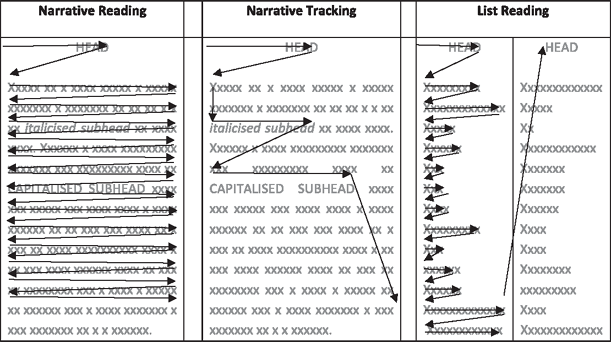
As intimated above, lists also could be turned into tables. As such, they played an adaptable role in education because their entries could be expanded horizontally into rows that, when read in a sequence, effectively became a formula of structured information.Footnote 21 In other words, columns could function as a visual unit inside the tables that were so often included in more advanced instructional texts like the books used for grammar and geography at the secondary level. But the basic reading skills needed to read a series of columns was instilled in students at primary schools, where children were taught how to use simple columns of lists that contained places or nonsense words relevant to the recognition of syllables (see again figs. 2 and 3). The latter were arranged alphabetically and were meant to be read primarily in a downward manner. Good examples occur in the large “Tables of Words” section of Warden's A Spelling Book and throughout widely-used books like Arthur Masson's An English Spelling Book (Reference Masson1757), James Gray's A Concise Spelling Book (Reference Gray1794), and Alexander Barrie's A Spelling and Pronouncing Catechism (Reference Barrie1796). This format was continued in secondary textbooks, especially in the geography sections that gave long lists of countries and cities. These longer word columns of places further trained students to read downwards from word to word. This kind of downward reading was reinforced through repetition and complemented the skills required to recognize other kinds of vertically plotted words, such as reoccurring heads of modules or the numbers featured in numeration tables. This kind of downward reading was also aided by a form of upward reading that required young readers to “jump” from the bottom of a column to the top of the next column in the table. Thus, in addition to the normal left to right movement required to read a sentence, columns iterated two more forms of directional reading, that is, downward and upward. This means that accessing the layout of paper tools used in primary educational settings required students to learn the kind of “multidirectional” reading skills required to access the more complicated tables used at the secondary level, or even later in government proformas and university classification systems (Table 3).Footnote 22
Visual Directionality in Modules
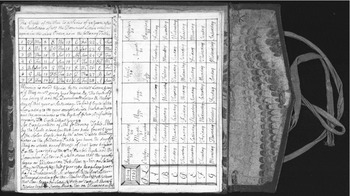
Adolescents also acquired multidirectional reading skills by copying tables relevant to their individual interests. Thomas Grieg's 1742 pocketbook, written when he was seventeen, provides excellent specimens of this kind of tabular replication. Echoing the interests of many a teenager at the time, he was especially keen to copy out astronomical and calendric tables. He even took care to draw neat, straight lines and equidistant columns that were undoubtedly plotted in advance (fig. 6). For those with money who did not have the skill to make their own table, there were also pre-printed, blank tables like those offered in numerous editions of The Ladies Complete Pocket Book. These were often printed in England but were regularly imported to Scotland. Adolescents and adults used texts of this sort and their pages contained various calendric, lunar, tax, interest, mileage, and financial tables that necessitated different kinds of multidirectional reading. Sometimes, the books even came with instructions. This made it easier for a reader to navigate the spaces that appeared in the blank calendric and financial tables that made up the bulk of such works. By writing such notations, adolescent note-takers were learning how to use and structure the graphic space of a table.Footnote 23 This preformatted notational space was an extension of the simpler tables used to arrange children's textbooks and other teaching materials. The multidirectional ability required to use this kind of visual tool worked in conversation with the skills required for the double entry accounting tables used in most academies and some grammar schools. Like the cross-paginal lists featured in James Erskine's marginalia, it also laid the foundation for the kinds of cross-referencing that students would encounter in encyclopaedias and professional handbooks. For literacy texts, multidirectional reading was also required for the many grammatical tables that listed parts of speech and those which contrasted the orthography and pronunciation of words.
John Grieg, Pocket-Book Belonging to John Greig (1762–4), Bound MS, National Library of Scotland, MS Dep 190, Greig Papers, Box 3, ff. 18 and 19.

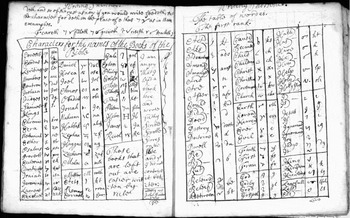
Instructions on how to read a table were given orally in classrooms and were explained in numeracy texts, with popular textbooks like E. Hoppus’ Practical Measuring giving a range of reading strategies (Hoppus Reference Hoppus1799).Footnote 24 But there was a difference between knowing how to read a table and knowing how to make one, especially when it came to tables with multiple columns and rows. Put more simply, learning how to draw and compose a multidirectional table was not easy for students learning how to do it for the first time. Since notepaper was blank, that is to say, “unruled,” making a table required the strategic placement of a steady hand, the successful manipulation of a straight edge, and the equal division of the space of the page into columns and rows. These skills had to be practiced over and over again and original compositions (for students often copied tables from books) required “pre-drawings.” Lower- and middle-class learners who could not afford to purchase large quantities of practice paper had to imagine the structure in advance. For most students, initial attempts to compose a table usually ended in frustration. A rare extant example of this ubiquitous practice occurs in the adolescent notebook of James Dunbar written in 1710 (fig. 7). Near the end of his notebook he tried to draw a table, apparently for the first time. His first attempt was a table entitled “Characters for the names of the Books of the Bible.” It gave the name of a book (“Numbers,” for example) and then its abbreviation (“Nu”) and its shorthand symbol (“v”). As the columns proceed to the right, they become less organized, with the lines becoming less parallel and the row and column widths becoming less standardized. The final column only had enough space for two rows instead of the three that were required, which meant that they could not be used. Dunbar was clearly irritated by this, so he filled the space of the column with the following script: “I am angry that I left a blank here and wrote filthy Scribble Scribble.” But he persisted. The title of his next table on the following page was “The table of words of the first rank.” This was more symmetrically designed and did not contain any superfluous tables or rows. This time he used a ruler or folded piece of paper to draw the column and row lines and the symmetry of the spacing strongly suggests that it had been thought out in advance. Clearly Dunbar, like so many children of the eighteenth century, developed his tabular composition skills through trial and error (see Dunbar Reference Dunbar1710).Footnote 25
James Dunbar, A Volume Completed by James Dunbar in 1710 containing Arithmetic, Introduction to Algebra, and A More Compendious Way of Writeing than Ordinar Called the Short Hand, Making Use of Farthing's Alphabet (1710), Bound MS, National Library of Scotland MS Acc 5706/11.

5. Figural Images
a. Geometric Figures
In his history of linearity, the anthropologist Tim Ingold astutely notes that “life is lived not at points but along lines” (Ingold Reference Ingold2007, 116). Nowhere was this observation more relevant than in the teaching of geometry during the Enlightenment. This subject was in many respects the instantiation of visual order par excellence, especially in the ideologies that guided the design of public and private space. Within children's texts, however, there was a distinct link between the plotting of heads, margins, and tables, and the basics of geometry as taught in schools. More specifically, the reading patterns that children used to understand geometric figures were built on the directionality required to understand the shape of modules. This means that students were already “pre-trained” to recognize straight lines via the straight path offered by sentences and by the edges of justified paragraphs. Thus, the point, line, angle, and polygon, that is, the four central components of geometry, were inherent in the graphic design used to package the content of most textbooks and notebooks. Though they were not inscribed as a linear strip of ink, sentences and margins were indeed lines in space. Sentences in particular facilitated unidirectional reading habits by guiding students’ eyes forward along a straight path. Building on this rectilinear pattern, students first learning geometry were asked to recognize and then draw straight lines divided into segments that were labeled “A,” “B,” “C,” etc. Such a practice not only laid the foundation for geometric figures, but also for diagrams that used lines to structure equations or to represent various quantitative features of the human body and the natural world. For example, crossing one line over the other created an “X” shape. This was effectively a chiastic diagram that could be used for various kinds of mathematic calculations. In Scotland, chiasms were used to facilitate “casting out the nines,” a calculation that was used to double-check the answer of problems that contained multiple acts of division. Numbers were placed at the end of each line or on the interior angles so that they could be remembered. As the children's marginalia from the Dunimarle Library reveals, this kind of chiasm was useful for young learners and was employed outside the classroom.Footnote 26
Reading and writing the right angles created by margins, particularly those that framed narrative and tabular blocks, familiarized students with the multidirectional reading patterns needed to recognize, use, and create geometric polygons. There are numerous connections between the geometric spaces of children's texts, but two are particularly noteworthy. First, the textual block of primary and secondary school texts familiarized children with the general concept of an angle and the way that it could be represented on the two-dimensional field of the page, a process that laid the foundation for the recognition of other kinds of angular forms used to commit the geometric world to paper. Second, the visual skills required to recognize sentences and margins, that is, the ability to guide the eye along a straight line, established a practice of reading and writing with reference to right angles. Such skills were directly transferable to the angles of geometry and functioned as a visual starting point for the angles used in trigonometry, spherical geometry, and planular geometry.Footnote 27 In particular, the arrangement of sentences with margins required students to think angularly. In other words, they not only had to move their eyes horizontally from one side of the page to the other, they also had to move them up and down in a horizontal manner. When these horizontal and vertical movements were combined, they formed angular reading paths. Such a practice could be transferred to the stylized, two-dimensional lines that were used to represent polygonal structures in geometry books and on slate boards or posters that were hung in classrooms.
b. Illustrative Figures
The foregoing forms of geometric reading, writing, and drawing were reinforced through the use of a wide array of figures at the primary, and even pre-primary, level. These often occurred in pedagogically orientated prints. For example, the content of educational lottery sheets, which ranged in size, was presented in tiled squares that were arranged into columns. Those aimed at an early primary school audience focused on the alphabet, presenting a letter and matching illustration inside each square. Those aimed at slightly older students divided the sheet into larger squares, each of which presented a moral, historical, or entertaining scene or object with an accompanying heading.Footnote 28 This simple linkage between a figural image and a tiled placement of letters or heads prepared young readers to recognize larger and more complex combinations of this nature as featured in the textbooks, maps, and prints used in schools. This interaction was made more memorable through reading and rereading tiled prints, as well as by the popular practice of cutting them out and pasting them into the blank pages of a scrapbook.Footnote 29 Additionally, a child's working knowledge of geometric layouts and illustrative figures was further developed at the secondary level by drawing courses. For those who could afford it, this kind of instruction became more accessible thanks to the rise in numbers of drawing textbooks, tutors, extracurricular classes (offered by schools and tutors), and the foundation of institutions like the Edinburgh Drawing School in 1760.Footnote 30 Building on the multidirectional reading practices outlined in the foregoing geometry section, drawing courses promoted neo-classical visualization techniques and linear perspective; that is, a geometric way of seeing the world that reduced the formal features of natural objects down to polygons (especially triangles and squares) arranged against a vanishing point on the horizon. Such images were, therefore, used to transfer some of the geometric directionality of print culture to the lived world. This kind of experiential interaction of space, text, and image offers many possibilities, but in what remains of this section I would like to focus on two examples: maps and moral prints aimed at adolescents.
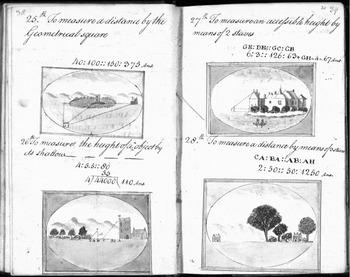
At the most basic level, maps and globes linearized the world.Footnote 31 They were usually dissected into longitudinal and latitudinal grids into which stylized images of continents, countries, and topographic features were placed. Though globes have received a respectable amount of attention by historians, the pedagogical use of printed maps, which were cheaper and more prevalent, remains relatively unexplored. They appeared as inserts in books and as large prints that were hung on classroom walls alongside other tabularizations of knowledge like chronologies. Within the geometric grid of maps, headings connected cartographic spaces and shapes to the content of the curriculum being instilled by primary and secondary school teachers. In the classroom, students were asked to orally match places on the map with various headings listed in their textbooks or written on chalkboards. These headings were usually the name of a city, country, region, or topographic feature. School textbooks helped to facilitate this exercise by giving long lists of geographic headings that a teacher could read out in quick manner. After they had successfully associated a heading with a place on the map, children were then asked to discuss relevant historical and political information about the place. Here the spatiality of print culture was intimately united with ostensive learning, that is, the acquisition of knowledge through tactile and visual demonstration. In following this pedagogical program, students were being taught how to interact simultaneously with a textual list and a linearized object elsewhere in the room, which was precisely the same kind of spatial reading taking place in the Cruikshank print mentioned at the start of this essay. Such cartographic matching was basically an oral form of labeling that reinforced the content of the heading in the student's mind. Crucially, this practice taught students to be familiar with the ways in which irregular lines, like the borders of countries and cities, could be placed and interpreted within the format of a grid, or in relation to other linear features like Rhumb lines (loxodromes) and triangulation lines. As evinced in surveying textbooks like Alexander Ewing's Synopsis of Practical Mathematics (1771) and the beautifully illustrated Perth Academy Notebook taken sometime during the 1780s or 1790s, the gridded format of cartographic space effectively served as a tool that allowed a student to move from reading a printed map to drawing a map on a blank notebook page (fig. 8). Thus, geographic features like mountains and houses were placed in conversation with the tools of surveying in a manner, which, like lottery sheets and prints, placed geometric figures in conversation with illustrations.Footnote 32
Anon., Perth Academy Notebook (1780s-90s), Bound MS, National Library of Scotland MS 14291, ff. 19r and 20v.

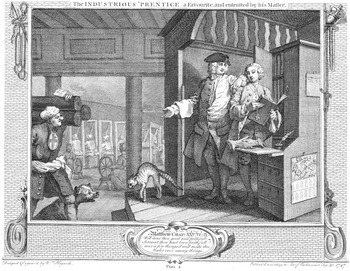
The prints used to teach adolescents varied in design and price. In Loose Hints upon Education (Reference Kames1781), Lord Kames, a leading Scottish commentator on education, mentions the pedagogical effectiveness of prints, especially in the scenes designed by William Hogarth that reinforced morality through association.Footnote 33 For Hogarth, tabularized knowledge often went hand in hand with commercial and moral order. Those who ignored the linearized knowledge of tables often met regrettable fates. For instance, the fortune of Tom Rakewell, the protagonist of Hogarth's series of prints entitled Rake's Progess, takes a terminal turn for the worse in the bawdy “Tavern Scene” of Plate 3. To foreshadow this fate, Hogarth depicts a prostitute setting fire to a global map affixed to the wall. Drunkenness was often seen as a possible cause of madness and so it is significant that the room's only piece of print culture, a form of figural order, was being destroyed, thereby signifying the rake's plunge into mental and financial disorder. In contrast to Rakewell, Francis Goodchild, a protagonist in Hogarth's Industry and Idleness, uses the spaces of print to build a successful career. At every stage of this virtuous apprentice's successful career, he is looking directly at some form of textual representation. This is perhaps most clearly represented in Plate 4, entitled “THE INDUSTRIOUS ‘PRENTICE a Favourite, and entrusted by his Master” (fig. 9). The workplace of the good apprentice is a literate space, with books, shelves, a desk, and writing quills. The apprentice holds an open day book and stares at the address label affixed to the top of the lumber being carried by a worker. This is a scene of multilinear spatial knowledge because he is checking the label against the tabular register in his daybook and against the money contained in the bag he is holding. The London Almanack and a work register, both tables, hang on the side of the cabinet. Notably, the book cabinet is guarded with a lock and the apprentice holds the keys in his right hand. Tabular literacy had literally given him the key to knowledge and success, a message that nicely encapsulates the view of graphic order that permeated eighteenth-century educational settings in Scotland.
William Hogarth, Industry and Idleness, Plate 4. “THE INDUSTRIOUS ‘PRENTICE a Favourite, and Entrusted by his Master,” 30 September 1747, Etching and engraving on paper. Image courtesy of Andrew Edmunds, London.

6. Conclusion
In The Design of Everyday Things, the psychologist Donald A. Norman emphasizes the usefulness of objects. In particular, he points out that artefacts that retain their design over a long period of time are well conceived and, indeed, useful. As shown above, though there were changes to the visual presentation of children's books and notes throughout the eighteenth century, the basic design remained consistent, thereby confirming their usefulness and, hence, their artefactual importance to historians. Though Norman's principle of utility was drawn from his experiences with modern pieces of technology like phones, keyboards, and cars, it affords deep anthropological insight into the relevance of print formats that are repeatedly used in the practices of everyday life. For historians, attending to the longevity of textual and figural images, as shown in this essay, offers a way to identify the kinds of learning routines that were used to shape the minds of children. It also explains why specific kinds of visual order were repeatedly employed by the adult authors and readers who were taught such practices. This suggests that it is through “commonness” that we are able to understand the longitudinal development of Scottish Enlightenment thinkers who have been traditionally held in high esteem for their apparent intellectual uniqueness. Such emphasis on the importance of taking a longitudinal view of artefacts was recently underscored by the philosopher Jean Baudrillard when he observed, “We may thus suppose that everything that disappears – institutions, values, prohibitions, even ideas – continues to lead a clandestine existence and exert an occult influence” (Baudrillard Reference Baudrillard and Turner2009, 26). Such a notion fits quite well with what I have shown above and with recent research on the materiality of graphic culture, especially for books and manuscripts that were used in defined institutional settings. Though many have “disappeared” through circumstance or design, some of them are still extant and the layout of their pages can be used to trace the “occult” influences harbored by the collective memory of an institution – especially those of a pedagogical nature. Overall, intellectual historians have overlooked the foundational importance of spatiality in graphic culture, especially as a key element of learning and instruction. This is mainly because space has not been treated as a purposely-conceived artefact. This essay shows that it was, and that spatial literacy must be seen as a central component of the visual order of the texts used by learners and educators during the late Enlightenment.
Acknowledgments
My understanding of the history of children and print culture was significantly aided by Robert Betteridge, Sue Bottinheimer, Sandra Cumming, Annette Hagan, Warren McDougall, and the helpful staff of the Manuscript Reading Room of the National Library of Scotland. I also had stimulating conversations on this topic with the participants of the “Writing and Drawing Knowledge” workshop held in 2010 at the Max Planck Institute for the History of Science, Berlin, and with Ann Blair, Rachel Dunn, Kasper Risbjerg Eskildsen, Ursula Klein, David M. Knight, and Bill Sherman. Research funding was provided by Durham University and the British Arts and Humanities Research Council. I would also like to thank the anonymous referees whose comments and suggestions strengthened the argument of this article.
Abbreviations
DH LIB = Dunimarle Library
EUL = Edinburgh University Library
MS = Manuscript
NLS = National Library of Scotland