Introduction
Historically, specifically in the last century, a solid link has been fashioned between neuropsychiatry and immunology, with a turning point in 1947 authored by Denny-Brown, who established a causal relation between immune system components present in the cerebrospinal fluid that act against the self and the resulting clinical presentation of a neuropsychiatric syndrome.Reference Denny–Brown 1 A neurological paraneoplasm is the final outcome of this interaction, having an underlying tumor as the origin for the immune targeting against the self.
Limbic encephalitis is characterized by an inflammatory process of the cerebral parenchyma, in particular, but not exclusively, the limbic system—hippocampus, cingulate gyrus, amygdala, insula, and frontobasal areas of the brain—with a subsequently clinical presentation of a myriad of neuropsychiatric features accompanied by variations (most commonly, hyperintensity) of the medial temporal lobe, on the brain magnetic resonance imaging (MRI), on transverse relaxation time (T2), and fluid attenuation inversion recovery (FLAIR) derivations, as well as a noted epileptic or slow-wave activity involving the temporal lobes registered on the electroencephalogram (EEG), which in 80% of the cases can be accompanied by leukocyte pleocytosisReference Gultekin, Rosenfeld and Voltz 2 and oligoclonal bandsReference Budhram, Leung, Nicolle and Burneo 3 in the cerebrospinal fluid.
The pathology was first described in 1960, by Brierly et al, in a three-patients-case with evidence of subacute inflammation of the limbic region.Reference Brierley, Corsellis and Hierons 4 However, at the time, even though two of the three patients had synchronic history of cancer, the authors described that a possible relation was unlikely. Officially, the term limbic encephalitis was only first used with an oncological precedent, in 1968 to describe, specifically, patients with short-term memory loss or dementia in association with bronchogenic carcinoma, by Corsellis et al.Reference Corsellis, Goldberg and Norton 5
Paraneoplastic autoimmune limbic encephalitis (PALE) is the main central nervous system (CNS) nonmetastatic complication of systemic malignancy responsible for acute psychiatric symptomsReference Bakheit, Kennedy and Behan 6 and manifests when the underlying tumor starts expressing proteins that act as antibodies, in a direct immune relation to CNS.
This action can occur, on one hand, at an intracellular level, as ribonucleic acid–binding proteins like anti–anti neuronal nuclear antibody 1 (anti-ANNA1 also known as anti-Hu), anti-Ma1, anti-Ma2 (also known as anti-Ta antibodies), anti–collapsin response mediator protein 5 (anti-CRMP5 also known as anti-CV2). Or, on the other hand, against cellular membrane (synaptic) antigens such as anti–N-methyl-D-aspartate receptor (anti-NMDAR), α-amino-3-hydroxy-5-methyl-4-isoxazole-propionic acid receptor (anti-AMPAR or antiquisqualate receptor), anti-γ-amino-butyric acid A (anti-GABAAR), anti-γ-amino-butyric acid B (anti-GABABR), anti–leucine-rich glioma inactivated 1 (anti-LGI1), anti–contactin-associated protein 1 (anti-CASPR1 or antiparanodin), anti–contactin-associated protein 2 (anti-CASPR2), anti–metabotropic glutamate receptor 5 (anti-mGLU5R), and anti–glutamate decarboxylase-65 (anti-GAD65 also known as anti–glutamic acid decarboxylase-65).
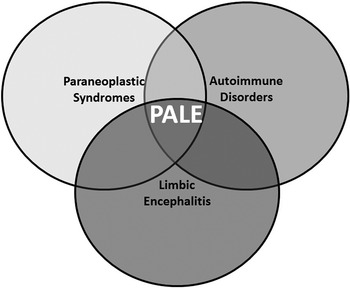
Nevertheless, psychiatric presentations, as a nonmetastatic complication of systemic malignancy, were only a secondary investigation target mainly associated to neuroimmunological features of the pathology (Figure 1).
Paraneoplastic autoimmune limbic encephalitis (PALE).

Given the premise that the psychiatric literature of the subject is disassembled in pair with the fact that a psychiatric complaint preceded the initial clinically described manifestation of an oncological patient in one-third of the time by an average of three and a half months,Reference Benros, Laursen, Dalton and Mortensen 7 there is a growing need to introduce PALE, the initial differential diagnosis of patients with acute onset of a group of symptoms, especially but not only in cases, without prior history of drug abuse or psychiatric dysfunction (either individual or familial).
Therefore, the main goal of this scoping review is to establish a structured chain causal relation between the most prevalent types of tumors, their characteristic antibodies related with CNS paraneoplasms, being PALE the main one, and their subsequent initial pure psychiatric manifestations.
Methods
A Preferred Reporting Items for Systematic Reviews and Meta-Analyses with Extension to Scoping Reviews checklist for precise methodology criteria has been accessed, with emphasis on a full description of inclusion criteria, information sources, as well as a selection of the latter, without the appliance of a protocol parameter due to its inexistence.Reference Tricco, Lillie and Zarin 8
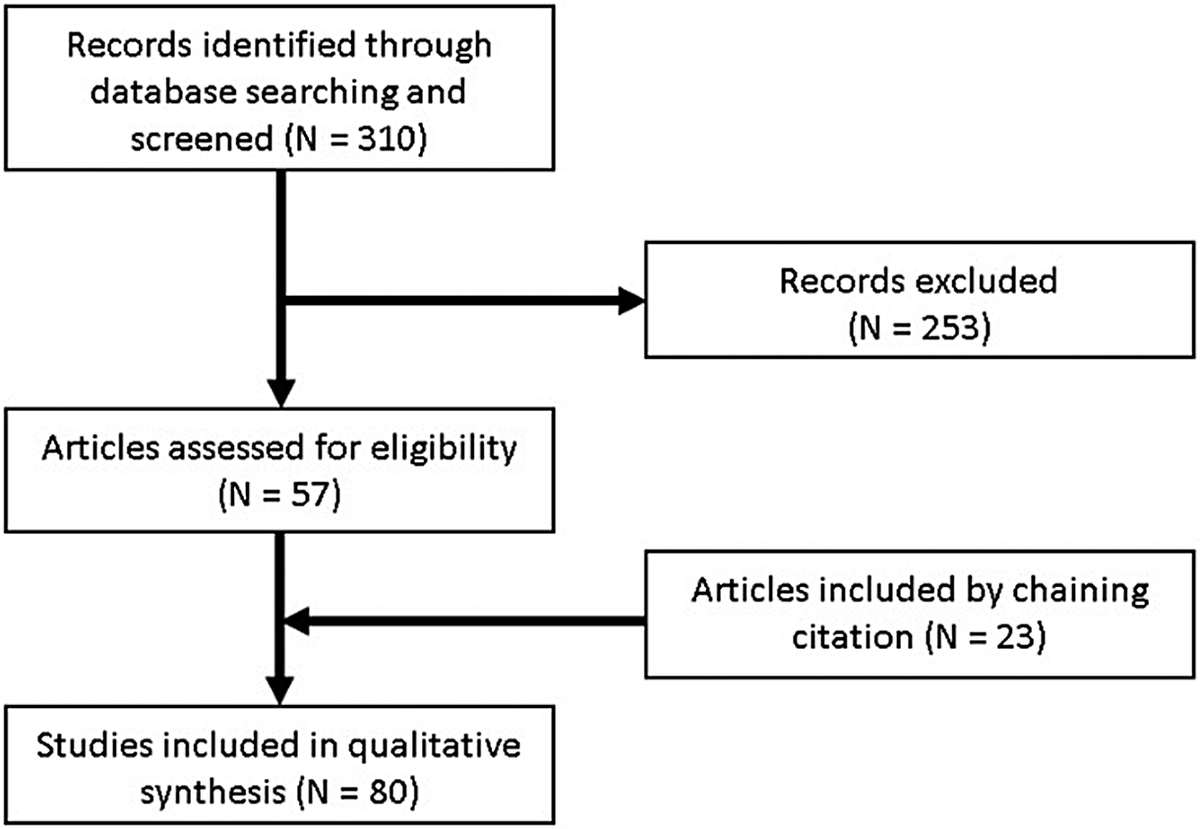
Research concerning PALE has been active for 50 years; however, the discussion focus has been majorly immune and neurological with weak highlighting regarding the psychiatric manifestations. The paradigm changed, showing however that information is dispersed, concerning tumor, antibody, and psychiatric symptoms. Being so, the eligibility criteria used was broad, showing no limitations in terms of type of study, population, intervention, or discussion. During the search terms of report characteristics, there were considered English, Spanish, Portuguese, German, Chinese, Hindu, and Italian articles with no restrictions regarding the year of publication, through search assistant via ClinicalTrials.gov, Cochrane Library, and PubMed. The search conducted on these platforms was last done on 23-03-2020, using diverse combinations of the terms “psychiatric,” “paraneoplastic,” and “limbic encephalitis” on ClinicalTrials.gov, Cochrane Library (most relevant search details: “psychiatric” AND “paraneoplastic” in Title, Abstract, Keywords in Trials) and (“psychiatric” AND “limbic encephalitis” in Title, Abstract, Keywords in Trials), and PubMed (most relevant search details: (“psychiatry”[MeSH Terms] OR “psychiatry” [All Fields] OR “psychiatric” [All Fields]) AND (“limbic encephalitis” [MeSH Terms] OR (“limbic” [All Fields] AND “encephalitis” [All Fields]) OR “limbic encephalitis” [All Fields] OR (“paraneoplastic” [All Fields] AND “limbic” [All Fields] AND “encephalitis” [All Fields]) OR “paraneoplastic limbic encephalitis” [All Fields]). Of the 310 articles found, only 57 articles met eligibility criteria and relevance in regard to psychiatric manifestations of PALE. Through chaining citation, we found an extra number of 23 articles, which were also included in this review (Figure 2).
Articles selection process for scoping review.

Results
Clinical depiction of PALE
PALE, until 30 years ago, was considered a rare autoimmune, cancer-related, refractory to treatment disorder. However, research by Dalmau and colleagues proved that this inflammatory process is more common than it once seemed, since it can occur unrelated to a tumor, being also responsive to immunosuppression,Reference Dalmau and Bataller 9 , Reference Dalmau and Graus 10 with the latter being proven by Mori and collaborators, on the turn of the millennia.Reference Mori, Kuwabara, Yoshiyama, Kanesaka, Ogata and Hattori 11
Regarding its clinical features, encephalitic autoimmune syndromes have an initial common denominator of prodromal fever and headaches, which represent a probable blood–brain barrier dysfunction, and a neuropsychiatric decline of acute to subacute onset (up to 12 weeks) that links all case reports of limbic encephalitis together. This is due to the fact that limbic encephalitis is a product of an early aggressive cytotoxic T-cell response. However, its incidence over the last decade has suffered an exponential growth, due to the establishment of improved antibody detection techniques, making early treatment possible. Nowadays, limbic encephalitis is still misdiagnosed, not due to the latter but rather because of its broad variety of initial neurological and psychiatric manifestations.
Diagnostic field of PALE
With an estimated prevalence of 3 for every 100,000 patients,Reference Dubey, Pittock and Kelly 12 PALE is an immune-mediated neuronal dysfunction, which occurs as a nonmetastatic complication of systemic malignancy, ultimately establishing an isolated inflammation of the limbic region parenchyma (or concomitantly affecting the surrounding regions of the cortex). The inflammation may translate into a clinical neuropsychiatric syndrome which can be detected up to 5 years prior to the diagnosis of the underlying malignancy.Reference Endres, Leypoldt and Bechter 13
In terms of diagnosis, PALE was originally targeted via criteria proposed by Gultekin and colleagues in 2000.Reference Gultekin, Rosenfeld and Voltz 2 This accounted for either neuropathological evidence of PALE or, alternatively, all four of the following: Symptomatology suggestive of limbic encephalitis, which accounted for anterograde amnesia, seizures, in some cases, dementia and unspecified psychiatric symptoms; a maximum period of 4 years between initial clinical picture and diagnosis of underlying malignancy; at least one of: pleocytosis (white blood cell count of more than 5 cells per mmReference Budhram, Leung, Nicolle and Burneo 3 ) on the Cerebrospinal fluid (CSF), hyperintensity of the medial temporal lobes on brain MRI (T2 or FLAIR-weighted images), and EEG with evidence of a slow-wave or epileptic pattern on the temporal lobe; as well as exclusion of another pathology capable of causing limbic encephalitis. However, in 2005, Graus and SaizReference Graus and Saiz 14 formulated a new set of criteria that, even though accounted for the previous stated by Gultekin,Reference Gultekin, Rosenfeld and Voltz 2 had the main distinction of requiring the demonstration of a neuropsychiatric clinical picture with subacute onset—less than 12 weeks—which was accompanied by screening detection of a well-defined paraneoplastic antibody, through enzyme-linked immunosorbent assay technique. In cases where the Graus and SaizReference Graus and Saiz 14 criteria have been identified with the exception of antibody screening, the latter is still relevant, since, as shown ahead, the positivity of a certain antibody has a strong specific tumor correlation and subsequently prompts its screening.
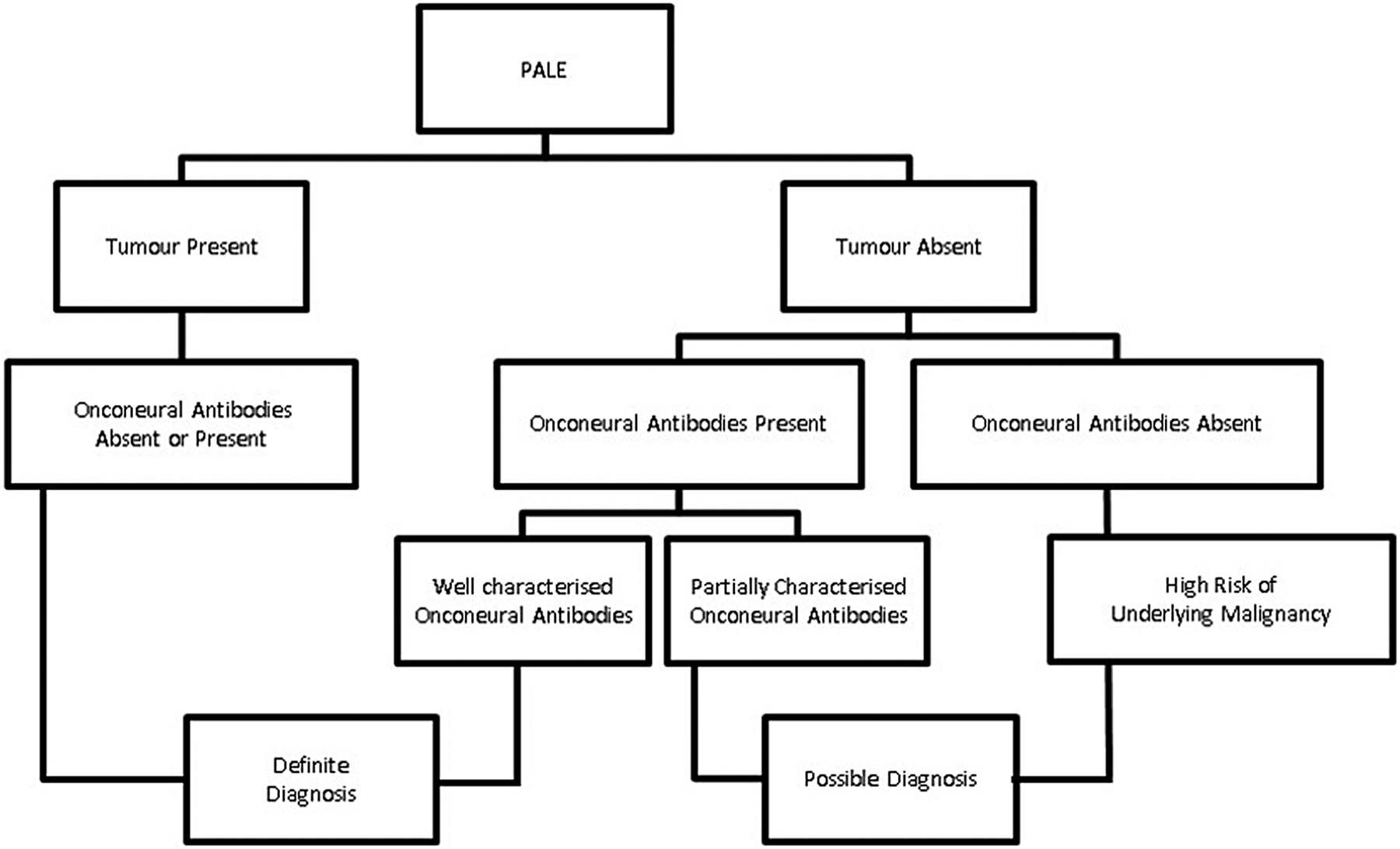
According to Graus et al, PALE falls into the classical neuropsychiatric syndrome groupReference Graus, Titulaer and Balu 15 (Figure 3), given that it is often associated with cancer and has a development that is, to a certain extent, predictable. Along with it, a patient without known history of synchronic tumor should be screened for onconeural antibodies so that the definitive diagnosis is precise. Taking the preceding two factors into account, there is a need to classify the different forms of psychiatric manifestations, in pair with the most common neoplastic presentations, according to the onconeuronal antibody detected. We will now develop on each of the most clinically significant antibody ordered by prevalence.
Diagnostic evidence of neurological syndromes.

Intracellular antibodies
Intracellular antigens with a clinical picture depicting PALE have been associated to an underlying malignancy in over 90% of the reported cases.Reference Alexopoulos and Dalakas 16 When detected, the impairment has a larger probability of becoming irreversibleReference Galli and Greenlee 17 and shows a weaker response to immunosuppression,Reference Marinas, Matveychuk, Dursun and Baker 18 in relation to extracellular antigens, which in hand translates into a need to establish a diagnosis as early as possible.
Anti-Hu antibodies
Anti-Hu is the most prevalent antibody connected with PALE but also associated with sensory neuropathy, brainstem encephalitis, motor neuron abnormalities, and cerebellar degeneration. Nonetheless, it has an underlying correlation with malignancy in up to 90% of the times it is detected.Reference Budhram, Leung, Nicolle and Burneo 3 Classically, anti-Hu antibodies have been depicted with a direct relation to small-cell lung carcinoma (SCLC), which is in part formed by cells that aberrantly produce Hu antigen.Reference Kayser, Kohler and Dalmau 26 However, recent studies found that the former is only accurate in adults, more common in men between 50 and 70 years old and with a higher prevalence when associated with a chronic smoking history. A clinical picture established a median of 4 months prior to diagnosis,Reference Sillevis Smitt, Grefkens and de Leeuw 27 depicting, on the first hand, anxiety and depressive symptomatology (depressive mood, mostly noted as feeling suddenly low in most case-reports), agitation, and confusion being the most underlined and, on the second hand, psychotic features (although rare, unspecified hallucinations) has been described, over the last two decades.Reference Kayser, Kohler and Dalmau 26 However, such point, examined in detail, is marked by statistic ambiguity, given the fact that the population used in the largest study only contained 73 patients with a median age of 57 years old, of which only 15% had a diagnosis of PALE.Reference Sillevis Smitt, Grefkens and de Leeuw 27
Anti-Ma1 and anti-Ma2 antibodies
In cases of PALE, anti-Ma2 appears associated with testicular germ cells tumor in men under 50 years old,Reference Kayser, Kohler and Dalmau 26 in around 40% of the cases reported on a study by Ortega Suero and colleagues.Reference Ortega Suero, Sola–Valls, Escudero, Saiz and Graus 28 Until 2018, this neoplasm–antibody correlation was direct. However, it has been noted that a positive antigen screening result of Ma2 in combination with Ma1, in older patients, is commonly associated with an underlying non-SCLC, followed in prevalence by pleural adenocarcinoma, digestive tract cancer (pancreatic, esophageal, and tonsil tumor). In a smaller percentage, there were reports of an association with ovarian adenocarcinoma, non-Hodgkin lymphoma, renal cell carcinoma, bladder carcinoma, and even metastatic adenopathies of unknown origin.Reference Budhram, Leung, Nicolle and Burneo 3 , Reference Kayser, Kohler and Dalmau 26 – Reference Roberts and Darnell 29 A non-SCLC can also, in a smaller percentage, present itself with a positive screening only toward detection of Ma1, which has a worse prognosis.Reference Ortega Suero, Sola–Valls, Escudero, Saiz and Graus 28
Despite the aforementioned immunological duality between anti-Ma1 and anti-Ma2 antibodies, the classic clinical acute presentation involves irritability, depressive mood, and unspecified hallucinations, always accompanied by anterograde amnesia as the main neurological symptom. However, anti-Ma1 antibodies have the peculiarity of presenting with a higher rate of behavioral mood changes, according to Ortega Suero and colleagues.Reference Ortega Suero, Sola–Valls, Escudero, Saiz and Graus 28 On a few cases, it has also been described, solely psychiatric presentations of unexplained fear, nervous breakdowns and panic attacks, or loss of self-confidence.Reference Dalmau, Graus and Villarejo 30
Anti-CRMP5 antibodies
Anti-CRMP5 antibodies have been identified in 1993.Reference Fukada, Watakabe and Yuasa–Kawada 31 At the time, identifying this autoantibody, in a PALE context, would translate into a 90% probability of SCLC.Reference Yu, Kryzer, Griesmann, Kim, Benarroch and Lennon 32 Presently, even though the anti-CRMP5 antibodies are rare among the intracellular antibody spectrum, it has a documented oncological association of 75% toward SCLC and 15% toward thymoma, with patients between 30 and 50 years old, being equally found in men and women. However, a 2020 study has reported the correlation of the autoantibody with thymoma.Reference Ibrahim Ismail, John, Ibrahim and Al–Hashel 19 In a clinical perspective based on the largest conducted study regarding anti-CRMP5 antibody detection, it was reported that the primary psychiatric manifestation was nonspecified personality change (11%), followed by depression (9%) and psychosis (4%).Reference Yu, Kryzer, Griesmann, Kim, Benarroch and Lennon 32
Extracellular antibodies
Even though this group is composed of antibodies which are more associated with autoimmune systemic diseases than with paraneoplasms, extracellular antibodies have a sturdier link with psychiatric features as initial clinical presentation of underlying tumor, when comparing to intracellular autoantibodies. Nevertheless, antibody presence does not necessarily confirm disease, in circumstances that turn psychiatric manifestations ambiguous.Reference Warren, Swayne and Siskind 33
Anti-NMDAR antibodies
In 2007, Dalmau et al defined anti-NMDAR encephalitis as a distinct psychoneuroimmunological disease, given its complexity, prevalence, and high mortality rate, if left untreated.Reference Tüzün and Dalmau 34 Nonetheless, detection of anti-NMDAR antibodies has a paraneoplastic association rate between 40% and 58% with ovarian teratoma, in women between 12 and 45 years old,Reference Dalmau, Geis and Graus 35 and 15% in women younger than 12 years old, with recent studies pointing out a correlation with other germ-cells tumorsReference Galli and Greenlee 36 as well as presentation, with an oncological context, in patients as old as 85 years old being reported.Reference Titulaer, McCracken and Gabilondo 37
A substantial amount of case reports of patients presenting a positive screening results to anti-NMDAR antibodies, with an underlying malignancy, have been described over the last 15 years. However, a psychiatric manifestation depiction did not go beyond the description of agitation or psychotic isolated symptoms, namely hallucinations, both auditory and visual. Even so, the aforementioned were not subject of a detailed description.Reference Wong and Fries 38 , Reference Jeraiby, Depincé–Berger, Bossy, Antoine and Paul 39 On the other hand, anti-NMDAR-related catatonia has been recently reviewed in a more systematic approach.Reference Marques Macedo and Gama Marques 40
In 2019, a study conducted by Al-Diwani et al gathered well-defined data, between the year of 2005 and 2017, of the initial psychiatric manifestations of 464 patients which had a subsequent diagnosis of anti-NMDAR encephalitis. Of this group, 147 patients (roughly 32%) had an underlying malignancy, specifically ovarian teratoma. The data regarding the symptomatic picture upon relapse were presented in the study as part of the initial manifestations, since the relapse symptomatology was always related in terms of higher-level features group to the presenting manifestations. In the study, the presenting psychiatric manifestations were divided into eight domains, according to the fourth edition of Diagnostic and Statistical Manual of Mental Disorders (DSM-IV), which were in decreasing order namely behavior (316 [68%]), psychosis (310 [67%]), mood (219 [47%]), catatonia (137 [30%]), sleep disturbance (97 [21%]), suicidality (32 [7%]), eating (28 [6%]), and obsessive-compulsive disturbance (9 [2%]). Cases that presented an underlying malignancy did not show any manifestation that would account for a mood, eating, or obsessive-compulsive disorder but showed a clinically noteworthy prevalence toward behavior and catatonia manifestations. Regarding the former, there was described agitation (56 [12%]), disorganized and/or incoherent speech (51 [11%]), verbal violence (37 [8%]), disinhibition (23 [5%]), and talking to self (17 [4%]). Catatonia, on the other hand, did not present with psychotic features, as it is common, and was only attributed by description of stupor (28 [6%]), echolalia (5 [1%]), and waxy flexibility (5 [1%]). Besides behavior disturbances and catatonia, there were also reports of psychotic manifestations, namely auditory hallucinations (14 [3%]) and persecutory delusion (10 [2%]). Both hallucinations and delusions presented in a fragmented form, in comparison with those typically found in first episode psychosis, according to DSM-IV. Sleep disturbances were also registered, such as hypersomnia (10 [2%]) and sleep–wake reversal (5 [1%]). Of all the initial psychiatric manifestations, there were no cases with isolated features, presenting, however, a registered median number of three features per patient (interquartile range between 2 and 5). The most common nonpsychiatric symptoms noted were neurological, dominated by motor dysfunction, such as development of dyskinetic movements—orofacial dyskinesias—(which were primarily mistaken for seizures) and autonomic instability—cardiac dysrhythmias and hypoventilation.Reference Al-Diwani, Handel and Townsend 20
Furthermore, evidence of NMDAR blockade, through studies involving NMDA antagonists—phencyclidine and ketamine—in relation to glutamate levels, is suggestible of being the underlying mechanism responsible for the aforementioned initial psychiatric symptomatology.Reference Stone, Dietrich and Edden 41
Anti-AMPAR antibodies
Association with an underlying malignancy is described in the literature as common, with approximately 60–64% of case reports being diagnosed between 2009 and 2014, upon antibody screening detection.Reference Höftberger, van Sonderen and Leypoldt 42 , Reference Lai, Hughes and Peng 43 A neoplasm detected is in its vast majority SCLC, with a higher frequency in women, between 64 and 90% with a median age comprised between 60 and 62 years old. However, there have also been reports of thymoma and, in a smaller unspecified percentage, ovarian teratoma and breast cancer. An initial psychiatric picture, although not as common as its neurological counterpart composed by anterograde amnesia, temporal seizures, and disorientation, is represented by agitation, aggressiveness, and hallucinations, both auditory and visual.Reference Joubert, Kerschen and Zekeridou 21 , Reference Graus, Boronat and Xifró 44 , Reference Wei, Liu and Lin 45
Anti-GABAAR and anti-GABABR antibodies
Anti-GABAAR and anti-GABABR antibodies have an almost direct relation with limbic encephalitis, with an association rate between 91 and 95%, being present mainly in men (60–82%) and an underlying malignancy frequency of 50–73% upon its detection, with a vast majority being SCLC. Some case reports also suggested anti-GABABR linked with thymoma and neuroendocrine tumor of the lung.Reference Jeffery, Lennon, Pittock, Gregory, Britton and McKeon 46 In terms of initial psychiatric manifestation, studies between 2014 and 2018 presented unspecified bizarre behavior and hallucinations in two-thirds of patients.Reference Chen, Sigurdsson and Pépés 22 , Reference Kim, Lee and Shin 47 , Reference Guan, Ren and Yang 48
Anti-VGKC complex antibodies
Although limbic encephalitis is the main pathophysiology associated with anti-LGI1, this antibody isolated form presents little to no malignancy link. Nonetheless, simultaneous detection of LGI1 and CASPR2 (which has an estimated rate of around 44% the cases anti-LGI1 is detected) is linked to an underlying thymoma in up to 50% of the registered cases. On a smaller percentage but also reported has been a correlation with breast, thyroid, colon, and pancreatic cancer.Reference Zhang, Yang and Wu 49
Although reports on specific psychiatric symptomatology associated with anti-VGKC complex paraneoplastic limbic encephalitis are scarce, in 2013, a case-report study presented a patient with a malignant hemopathy, specifically acute myeloid leukemia, which had as initial manifestation visual hallucinations, having no prior history of psychotic symptomatology.Reference Alcantara, Bennani, Verdure, Leprêtre, Tilly and Jardin 23
Anti-GAD65 antibodies
Anti-GAD65 antibodies are present mainly in patients with stiff-person syndrome and briefly in resistant epilepsy, cerebellar ataxia, and progressive encephalomyelitis.Reference Alexopoulos, Akrivou and Dalakas 50 However, in older male patients, or when noted a concomitant presence of other extracellular antibodies, majorly anti-GABABR antibodies, in pair with a psychiatric symptomatology, tend to have an underlying malignancy etiology in 25% of the cases, commonly SCLC or thymoma, being therefore associated with PALE. A case–control study with a population of 58 individuals presented that an initial clinical picture, with subsequent presence of anti-GAD65 antibodies on CSF, included mainly mood alterations (14% [8/58]), with major evidence of depression (11% [6/58]), and behavior alterations (19% [11/58]), specifically psychomotor agitation (9% [5/58]).Reference Sharma, Dubey, Sawhney and Janga 24 , Reference Gagnon and Savard 51
Anti-mGLU5R antibodies
The association between memory loss and Hodgkin’s lymphoma has classically been given the eponym of Ophelia syndrome, in memory of Shakespeare’s character. Ian Carr presaged the presence of autoantibodies, and since then, four different autoantibodies, besides anti-mGlu5R, have been associated with Hodgkin’s lymphoma.Reference Soto–Rincón, Castillo–Torres, Cantú–García, Estrada–Bellmann, Chávez–Luévanos and Marfil 52 However, a recent study showed that in 11 patients with Ophelia syndrome, only 5 had the diagnosis of Hodgkin’s lymphoma, while 1 presented with SCLC and 5 did not present an underlying tumor.Reference Spatola, Sabater and Planagumà 25 Ophelia syndrome includes, in more than half of the cases, anterograde amnesia, seizures, sleep disturbances, decreased level of consciousness, and a myriad of movement disorders, with the most common being myoclonus and postural tremor.Reference Lancaster, Martinez–Hernandez and Titulaer 53 On the other hand, case reports typically included a psychiatric depiction of depression, anxiety, and psychosis. However, Spatola et al, although with a small population, has shown that initial psychiatric symptoms include, in terms of prevalence, aggressive behavior (3/11 [30%]), depression (3/11[30%]), anxiety (3/11[30%]), and on a smaller group delusions (2/11[20%]) and hallucinations, both auditory (1/11[10%]) and visual (1/11[10%]).Reference Spatola, Sabater and Planagumà 54
Discussion
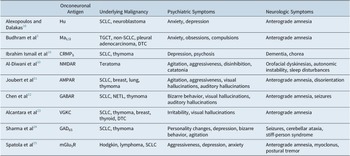
PALE as a classical neurological paraneoplasm has been acknowledged as a neuroimmunological entity present in a myriad of case studies in the last half of century. Over this course of time, its psychiatric sphere has been continuously described, in a shallow manner, as including personality changes, depression, and anxiety, even with the discovery of the antibodies that are known today. Nevertheless, the last decade has proven that the paradigm has shifted in a way that has provided space for a more complete clinical picture (Table 1). Such picture has turned into a potential early diagnostic tool, since it has been proven multiple times that a diagnosis of PALE is preceded by a psychiatric evaluation in one third of the times.
Paraneoplastic Autoimmune Limbic Encephalitis Neuropsychiatric Symptoms by Decreasing Prevalence

Abbreviations: AMPAR, α-amino-3-hydroxy-5-methyl-4-isoxazole-propionic acid receptor; CRMP, collapsin response mediator protein; DTC: digestive tract carcinoma; GABAR, γ-amino-butyric acid; GAD65, glutamate decarboxylase-65; mGLU5R, metabotropic glutamate receptor 5; NMDAR, N-methyl-D-aspartate receptor; NETL: neuroendocrine tumor of the lung; SCLC: small-cell lung carcinoma; TGCT: tenosynovial giant cell tumor. VGKC: Voltage Gated Potassium Channel
Although with no regard to such paraneoplastic etiology, a 2018 retrospective case-controlled study, with a population of 41 patients positive for NMDAR, CASPR2, and/or GAD65 antibodies, described a similar psychiatric clinical onset of lowered-mood—55.6% in anti-NMDAR, 61.5% in anti-CASPR2 and 64% in anti-GAD65—irritability—15% in anti-NMDAR, 23.1% in anti-CASPR2, 12.5% in GAD65-Ab—and agitation—38% in anti-NMDAR, 50% in anti-CASPR2, 50% in anti-GAD65. There were also reports of unspecified delusions in anti-NMDAR (10%) and anti-CASPR2 (14%) and unspecified hallucinations only in anti-NMDAR (14.3%).Reference Shen, Xu and Guan 55 Being so suggests that there may exist a certain degree of similarity between the paraneoplastic syndromes which are the product of extracellular antigens NMDAR, CASPR2, and GAD65. However, the population used was biased, given that it is formed by 41 individuals, allowing the conclusion that looks through both intracellular and extracellular antibodies. The fact that the formerly mentioned psychopathological syndromes are similar but not identical in two different patients, in pair with the myriad of currently identifiable neoplasms and subsequent antibodies, only strengthens the idea that a causal relationship between psychopathological, immunological (through antibodies), and oncological (through underlying malignancy) spheres does not exist in a way that could propose a stable connection between them, owing only to the fact that PALE is unveiling itself as the new great imitator of the ever-changing psychiatric grounds, such is the case of syphilis or tuberculosis.Reference Klausner 56 , Reference Jetley, Jairajpuri, Pujani, Khan and Rana 57 Being so, it is possible to extrapolate that neither psychiatric symptomatology nor specific antibody positive screening are pathognomonic of PALE, being however of irrefutable relevance in a pragmatic approach taken in the initial psychiatric evaluation. The latter is justified by the fact that, as time has shown, a mindset of organic etiology exclusion should be actively encouraged.Reference Gama Marques 58 , Reference Ponte, Brito, Nóbrega, Pinheiro and Gama Marques 59
In what accounts to therapeutics, the aim of the underlying malignancy treatment in paraneoplastic syndromes is to switch off the ectopic antigen source that maintains the autoimmune process, through appliance of three-step algorithm:
-
(1) Treatment as early as possible, with special consideration in cases where intracellular antigens are screened;
-
(2) Underlying malignancy treatment through combination of chemo/radiotherapy and tumor excision surgery according to type of tumor, given the fact that 60%–70% of PALE have an identifiable underlying malignancy;
-
(3) Immunotherapy.
It must be taken under special consideration that in individual cases of intracellular antigens, the protein targeted suffers destruction through a mechanism of T-cell-mediated response, resulting in neuronal apoptosis. This fact, as noted by Marinas et al in a 2019 study, may explain the noted refractoriness of these subtypes to typical immunomodulating treatment,Reference Marinas, Matveychuk, Dursun and Baker 60 without evidence of a different outcome under immunosuppression. Extracellular membrane (synaptic) antigens, however, due to the process of internalization of the receptors without subsequent destruction, have an inherent plausible reversibility. Therefore, immunosuppression has an overall superior success rate when targeting extracellular antibodies, turning intracellular antibody positive screening patients a group with an overall worse prognosis.
Future reviews similar to ours shall focus in the prognosis and theranostics of pure psychiatric manifestations after the medical and/or surgical treatment of the underlying neoplasm in patients with PALE. For instance, we believe it would be very interesting to study for how long the immunosuppressive and/or psychiatric management would have to be maintained, or, on the other hand, what will be their outcome regarding mortality, comorbidity, and quality of life.
Last but not least, we acknowledge that one of the most important limitations of our review was not including seronegative PALE.Reference Graus, Escudero and Oleaga 61 We believe seronegative PALE syndromes deserve a proper, fully dedicated, review as there is an impending need for better understanding of such syndromes. We hope to see it done in a near future.
Conclusion
With each study, regarding the immunopsychiatry field that constitutes PALE, knowledge matures in a nonlinear manner. The list of underlying malignancies as well as the expressed psychopathological manifestations for each known antibody is ever growing, which shows a constant unraveling of the importance of the initial psychiatric evaluation and which translates, through a broader connotation, in the epistemology of the neurosciences.
Over the different onconeuronal antibodies studied throughout the last decade updated articles, it is possible to arrive at the conclusion that although some share a common ground, whether in terms of underlying malignancy or initial psychiatric syndromes, nowadays, the amount of evidence, in particular regarding a clear lack of significant population, to induce either clear conclusions on the aforementioned subtopics or a causal relationship between them, is inadequate. Although there is a clear effort on the international neurosciences community, shown by the multilinguistic amount of PALE-related articles, on revealing a full neurological picture, the psychiatric branch should be better explored, since it is a primarily step in the pathophysiological development of PALE.
In the investigational future, PALE should be accessed through a meticulous clinical point of view, in a way that a full depiction of the pathophysiology, linked to psychiatric symptomatology, could be made and subsequently summarized so that it can be used in a protocoled fashion by all psychiatrists in first care units. In a similar way, a bigger effort should be made regarding the subsequent therapeutics, since immunosuppression has found positive results in recent years, having however a lack of randomized trials of more therapeutics of the same therapeutic group.
Acknowledgments
None.
Disclosures
João Costa Fernandes and João Gama Marques have nothing to disclose.