Introduction
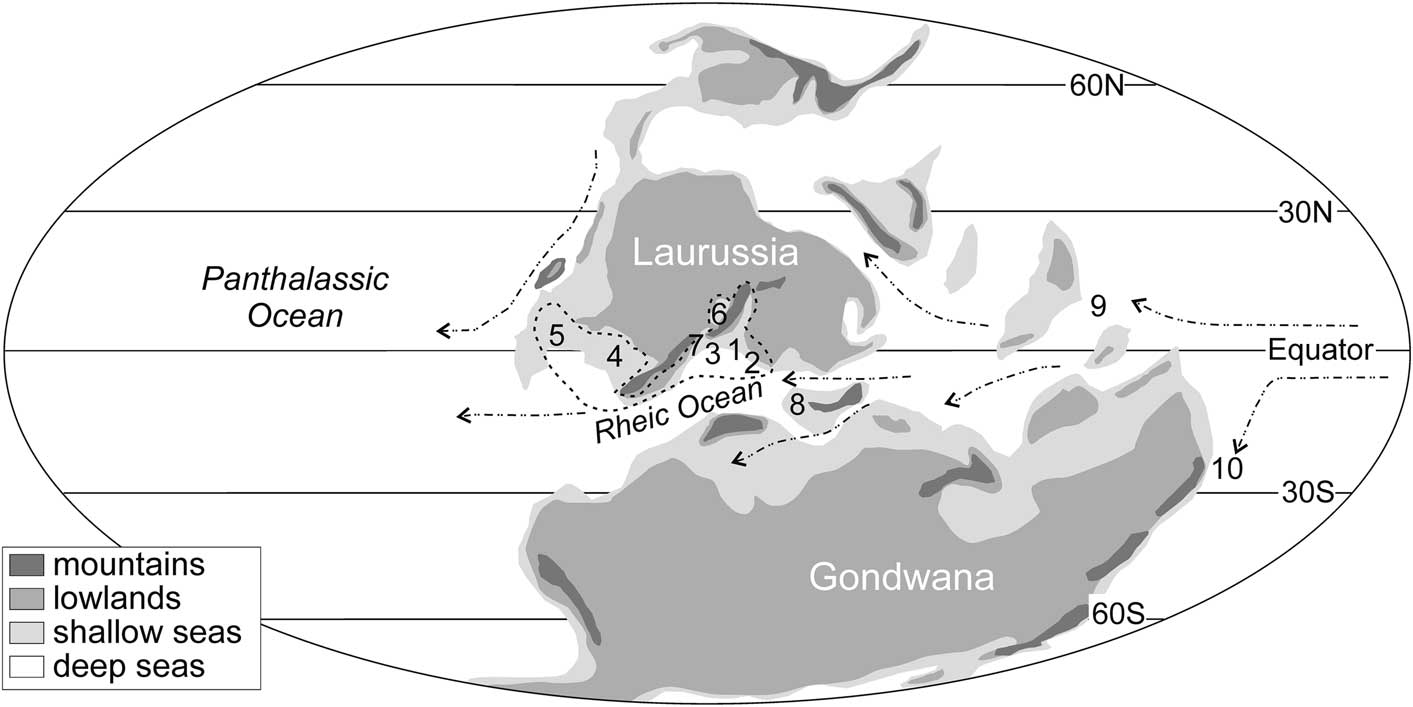
Tiny conodont elements from the Tournaisian of the South Wales Coalfield and the Bristol area (UK) were described by Rhodes et al. (Reference Rhodes, Austin and Druce1969) as a new species, Gnathodus simplicatus. Purnell (Reference Purnell1992) questioned the assignation of this species to Gnathodus, but he did not establish a new generic assignment due to the unknown composition of the apparatus. Belka and Groessens (Reference Belka and Groessens1986) suggested this species belongs in the genus Anchignathodus Sweet, Reference Sweet1970, but did not provide a detailed discussion. Gnathodus simplicatus has previously been described from the Mississippian at the south of the Anglo-Brabant Massif (a topographic relief in the southern margin of the central Laurussia): South Wales-Mendips Shelf (England and Wales, Fig. 1.1) and in the adjacent carbonate platforms in Belgium and Ireland (Fig. 1.2, 1.3), according to Austin and Husri (Reference Austin and Husri1975), Groessens (Reference Groessens1975), and Adams et al. (Reference Adams, Wright and Cossey2004).
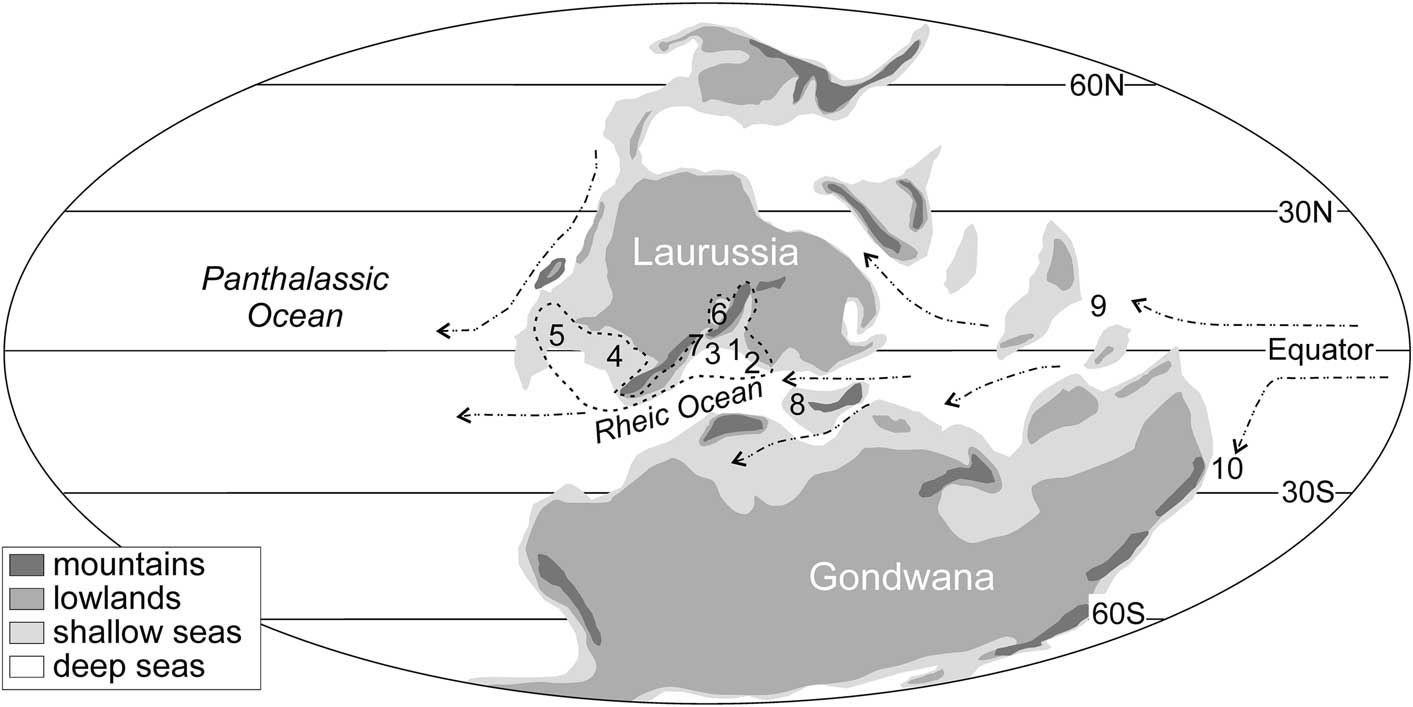
Viséan paleogeography (from Rowley et al., Reference Rowley, Raymond, Parrish, Lottes, Scotese and Ziegler1985) showing the occurrences of Vogelgnathus simplicatus on the tropical margin of the Laurussian landmass (area with dotted border): (1) southern England and Wales; (2) Belgium; (3) Ireland; (4) southwestern Missouri; (5) New Mexico. The Viséan diversification of Vogelgnathus show species restricted to small extensional basins as (6) Northumberland Trough and (7) Atlantic Canada; and other species inhabiting an offshore setting from North America, The British Isles to (8) the Spanish Cantabrian Mountains, (9) Japan and (10) eastern Australia.
The aim of this work is the revision of the concept for G. simplicatus through the study of the type material housed in The Natural History Museum, London (NHMUK). The species was originally defined based only on P1 elements, whereas we propose here a full apparatus reconstruction based on discrete specimens found in the same samples containing P1 elements. The composition of the apparatus suggests that G. simplicatus should be included in the genus Vogelgnathus Norby and Rexroad, Reference Norby and Rexroad1985. This hypothesis has implications for our understanding of the early evolution of this genus, as was previously suggested by Purnell and von Bitter (Reference Purnell and von Bitter1992).
Materials and methods
Samples studied from the Ronald Austin conodont collection housed at the NHMUK included 105 specimens from the type collection of Rhodes et al. (Reference Rhodes, Austin and Druce1969) from the North Crop of the South Wales Coalfield (samples ZLA15–ZLA33) and the Avon Gorge (samples Z33–Z38), England. Additional material studied included samples from the Republic of Ireland described by Austin and Husri (Reference Austin and Husri1975). Individual catalogue numbers have been assigned to illustrated specimens, while the rest of the fauna is present on registered assemblage slides.
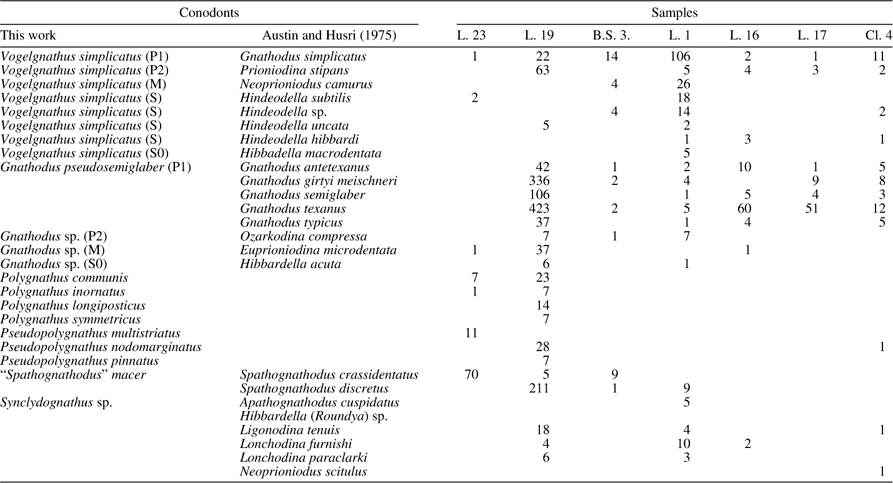
The starting point for the apparatus reconstruction was sample L. 1, which had low conodont diversity, a large proportion of P1 elements of Vogelgnathus simplicatus, and a sufficient number of associated P2 and ramiform elements. Sample L. 1 was collected at Durnish Point (County Limerick, Ireland) from a quarry close to the main road on Aughinish Island in the top of the Waulsortian Limestone Formation (Limerick Formation, according to Somerville et al., Reference Somerville, Strogen and Jones1992). The ratio between P1 elements of V. simplicatus and other ozarkodinid taxa (Gnathodus pseudosemiglaber Thompson and Fellows, 1970; ‘Spathognathodus’ discretus Austin and Husri, Reference Austin and Husri1975; and ‘S.’ macer [Branson and Mehl, Reference Branson and Mehl1934]) is 106/32 (Table 1). Other elements of the apparatus of V. simplicatus were identified by their relative abundance, differences in morphology with respect to known apparatuses of Gnathodus, and similar characteristics such as size, lateral compression, basal cavity shape, and type and style of denticulation. Another six samples also were studied from the Austin Collection to test the hypothesis. These were Austin and Husri (Reference Austin and Husri1975) samples from the upper beds of the Ballysteen Limestone (L. 23), the Waulsortian Limestone (BS 3, L. 16, and L. 19), from the lower Rathkeale Limestone (L. 17) in County Limerick, and from the Waulsortian Limestone (Cl. 4, top of the Inishloe Reef Formation, E of Inishloe Island in the Shannon Estuary) in County Clare.
Counts for individual elements of Vogelgnathus simplicatus in samples collected by Austin and Husri (Reference Austin and Husri1975) present in the Austin Collection at the NHMUK. Austin and Husri (Reference Austin and Husri1975) identifications are in the second column, and sample L. 1 was selected to reconstruct the apparatus of V. simplicatus.

Repository and institutional abbreviation
The studied material is deposited in The Natural History Museum, London (NHMUK PM X). Details of all registered material are available via the NHMUK Data portal (http://data.nhm.ac.uk).
Apparatus composition
The ozarkodinid 15 element apparatus plan is well established (Purnell and Donoghue, Reference Purnell and Donoghue1997, Reference Purnell and Donoghue1998; Purnell et al., Reference Purnell, Donoghue and Aldridge2000) and common to several groups with morphologically complex P elements. A standard 9 element S array is flanked by two M elements and followed by four complex P elements. Description and discussion of the apparatus follows the biological orientation of elements proposed by Purnell et al. (Reference Purnell, Donoghue and Aldridge2000) with conventional terminology for orientation indicated in parenthesis.
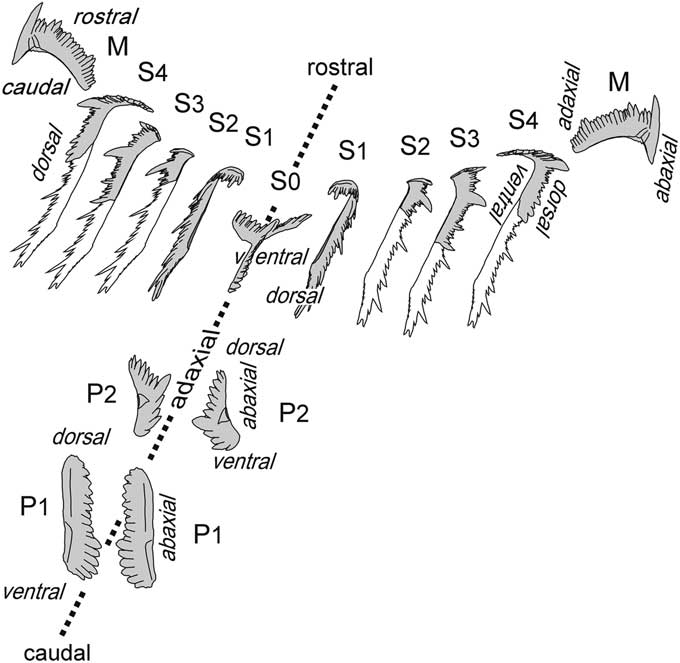
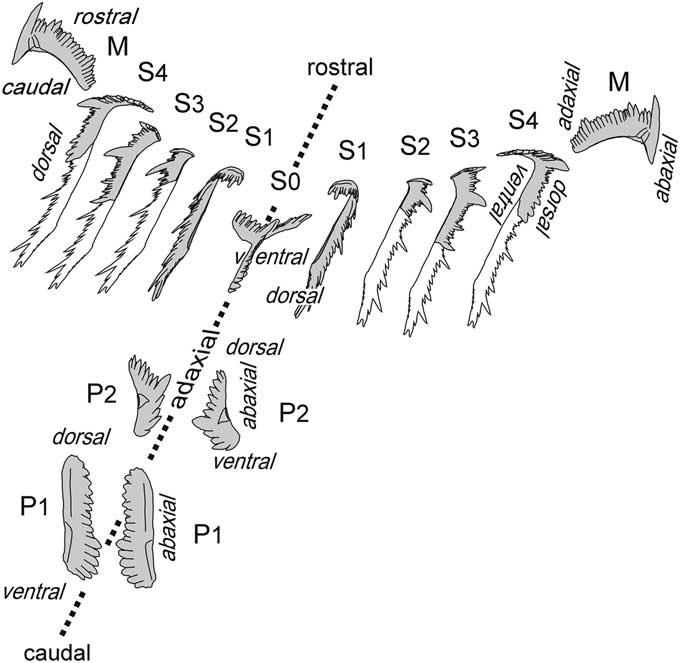
Elements of the ozarkodinid skeletal plan are most abundant in sample L. 1 from the Durnish Limestone (Table 1). The Gnathodus apparatus also follows the ozarkodinid plan, but is well known from natural assemblages and from studies based on discrete elements (Schmidt, Reference Schmidt1934; Norby, Reference Norby1976; Grayson et al., Reference Grayson, Merrill and Lambert1991; Purnell and Donoghue, Reference Purnell and Donoghue1998; Donoghue et al., Reference Donoghue, Purnell, Aldridge and Zhang2008). The S and M elements are less abundant in studied samples, except in sample L. 19 (Table 1). Other elements from the apparatus of Idioprioniodus Gunnell, Reference Gunnell1933 and Kladognathus Rexroad, Reference Rexroad1958 were also discounted (Purnell, Reference Purnell1993; Chauffe and Nichols, Reference Chauffe and Nichols1995). The apparatus composition for V. simplicatus was reconstructed by eye from elements in sample L. 1 and this hypothesis tested using other samples (Fig. 2).
Schematic representation of the apparatus composition of Vogelgnathus simplicatus. The angle of orientation of the P elements with respect to the S and the M elements is tentative and based on the ozarkodinid-apparatus model in Purnell et al. (Reference Purnell, Donoghue and Aldridge2000).
The apparatus of Vogelgnathus was erected by Norby and Rexroad (Reference Norby and Rexroad1985) using natural conodont associations and discrete elements of the type species V. campbelli (Rexroad, Reference Rexroad1957) from Montana and Illinois (USA). The model included P1, P2, M and three distinct S morphotypes (S0, S1/2, and S3/4) according to Donoghue et al. (Reference Donoghue, Purnell, Aldridge and Zhang2008). Purnell and von Bitter (Reference Purnell and von Bitter1992) used the reconstruction of V. campbelli to propose the apparatus composition of V. pesaquidi Purnell and von Bitter, Reference Purnell and von Bitter1992, from discrete elements in samples with a low diversity of species. They recognized a few elements from other species of Vogelgnathus and concluded a wider inter-specific variation for the P1 element than for the P2 and the ramiform M and S elements. These ramiform elements are morphologically conservative and do not appear to be diagnostic of a particular species. The evolutionary stability in these non-P1 elements makes them useful for recognition of Vogelgnathus and for interpreting supra-generic relationships.
The ramiform elements in sample L. 1 are close but not identical to the Vogelgnathus apparatuses previously described. Under the scanning electron microscope, they show secondary apatite overgrowths of type external cast microtexture (Blanco-Ferrera et al., Reference Blanco-Ferrera, Sanz-López, García-López, Bastida and Valín2011). The density of this overgrowth caused a finely granulated appearance on the outer surface of the conodonts as viewed under incident light.
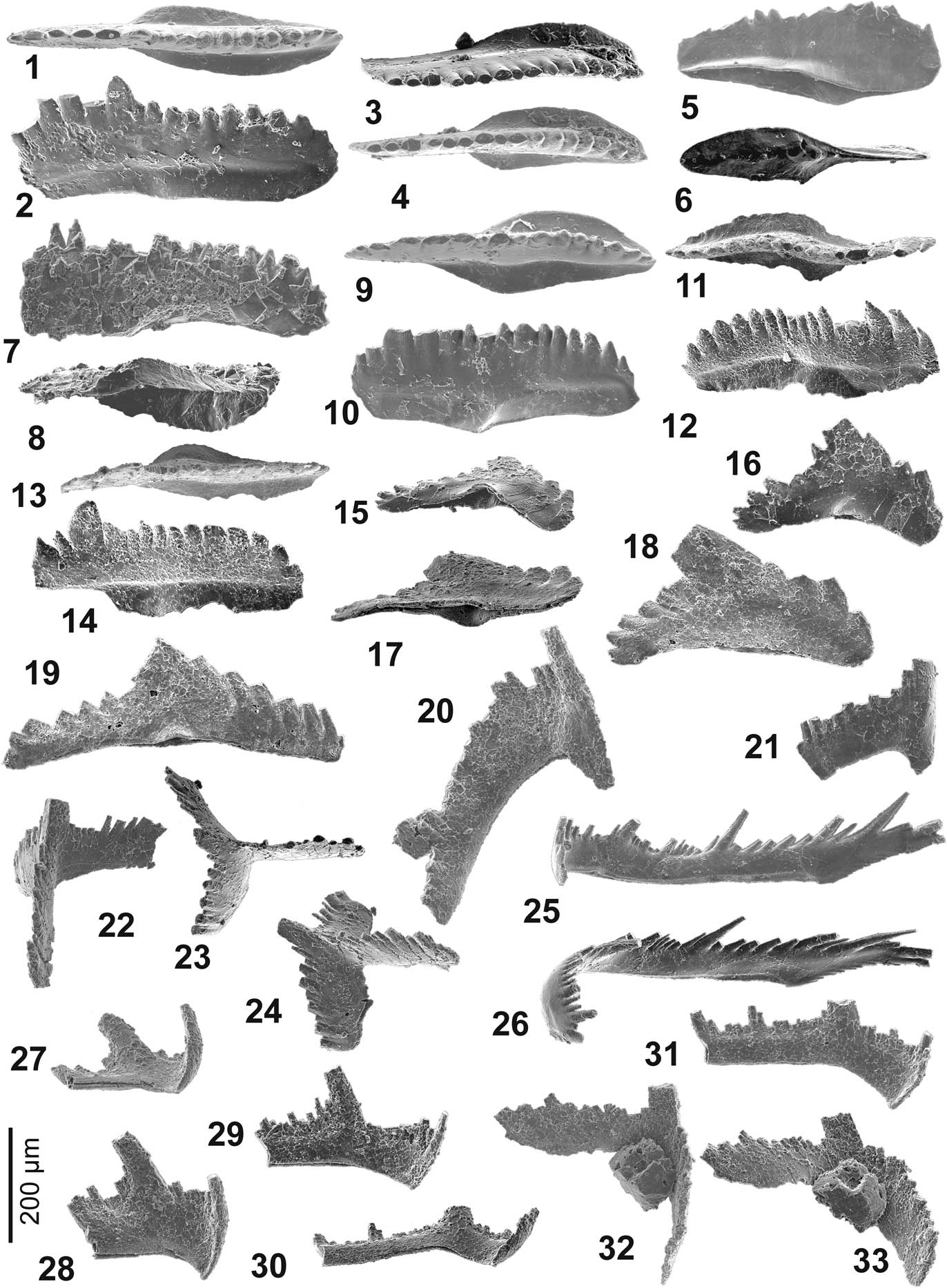
The P1 element of Vogelgnathus simplicatus is the most abundant in sample L. 1 (106 specimens, Table 1). It is a carminiscaphate element with differences in longitudinal curvature associated with the left and the right elements in a functional pair (Fig. 3.1–3.14). The morphology is close to Vogelgnathus campbelli, but shows larger denticles close to the ventral (or anterior) end of the blade rather than in the central part. The flared part of the basal cavity extends longitudinally farther along the element in V. simplicatus than in V. campbelli.
Vogelgnatus simplicatus; samples with ZLA prefix (1–6, 9, 10) from North Crop, South Wales Coalfield; samples with Z prefix (7, 8) from Avon Gorge, Bristol, England; samples with L. (11–20, 22–33) and B.S. (21) prefixes from County Limerick, Republic of Ireland. (1, 2) Adaxial (oral) and rostral (outer) views of P1 element, holotype NHMUK PM X 89, sample ZLA 33; (3, 4) oblique adaxial (oral) and adaxial views of P1 element, paratype NHMUK PM X 415, sample ZLA 32; (5, 6) rostral (outer) and abaxial (aboral) views of P1 element, paratype NHMUK PM X 91, sample ZLA 33; (7, 8) rostral (outer) and abaxial (aboral) views of P1 element, paratype NHMUK PM X 88, sample Z 38; (9, 10) adaxial (oral) and caudal (inner) views of P1 element, paratype NHMUK PM X 90, sample ZLA 33; (11, 12) adaxial (oral) and caudal (inner) views of P1 element, NHMUK PM X 3856, sample L. 1; (13, 14) adaxial (oral) and rostral (outer) views of P1 element, NHMUK PM X 3877, sample L. 19; (15, 16) abaxial (aboral) and rostral (outer) views of P2 element NHMUK PM X 3845, sample L. 1; (17, 18) abaxial (aboral) and caudal (inner) views of P2 element NHMUK PM X 3846, sample L. 1; (19) rostral (outer) view of P2 element NHMUK PM X 3870, sample L. 19; (20) dorsal (inner) view of M element NHMUK PM X 3842, sample L. 1; (21) ventral (outer) view of M element NHMUK PM X 3878, sample B.S.3; (22–24) lateral, dorsal (oral) and oblique-caudal (posterior) views of S0 element NHMUK PM X 3844, sample L. 1; (25, 26) adaxial (inner lateral) and dorso-adaxial (oral-inner lateral) views of S1 element NHMUK PM X 3841, sample L. 1; (27, 28) oblique ventro-adaxial (inner aboral) and adaxial (inner-lateral) views of S2/3 element NHMUK PM X 3847, sample L. 1; (29) adaxial (inner lateral) view of S2/3 element NHMUK PM X 3848, sample L. 1; (30, 31), oblique ventro-adaxial (inner-aboral) and adaxial (inner-lateral) views of S2/3 element NHMUK PM X 1977, sample L. 1; (32, 33) adaxial (inner-lateral) and oblique ventro-adaxial (inner-aboral) views of S4 element NHMUK PM X 3843, sample L. 1. Scale bar=200 µm.

The element M (morphospecies ‘Neoprioniodus camurus Rexroad, Reference Rexroad1957’ in Table 1) is the second most abundant element in the sample, so we suggest that this is the M element for V. simplicatus. This element shows a long and arched adaxial (posterior) process (Fig. 3.20). The M element in Gnathodus has a longer adaxial process than that in V. simplicatus, and a short, denticulate abaxial (anterior) process (morphospecies ‘Euprioniodina microdentata [Ellison, Reference Ellison1941]’ in Table 1).
The S elements (morphology of hindeodellid and hibbardellid in Table 1) show a denticulation similar to the M element, but they are relatively fragmented. Rare complete S elements show large denticles at the caudal termination (posterior; Fig. 3.25, 3.26). These characteristics are consistent with Vogelgnathus elements, as reconstructed by Norby and Rexroad (Reference Norby and Rexroad1985) and Purnell and von Bitter (Reference Purnell and von Bitter1992), but not known in S elements of Gnathodus (Purnell and Donoghue, Reference Purnell and Donoghue1998, text-figs. 7–10). The S elements of Gnathodus as those of Vogelgnathus show a repeating pattern of several small denticles between two larger denticles along the caudal (posterior) process. This pattern is more uniform in the longer caudal process of the S elements in Gnathodus than in the relatively short ones in V. simplicatus.
A wide variation of the rostral (anterior) process in S elements of V. simplicatus can be explained by relative location in the apparatus (Fig. 2). The length of the rostral process, and the curvature ventrally (downward) or adaxially (inward) varies between S elements. The interpretation of the location and notation of each S element used here follows the current template based on natural assemblages for Gnathodus and other ozarkodinids (Purnell et al., Reference Purnell, Donoghue and Aldridge2000). The rostral process of the S1 element is strongly curved adaxially (90º), but not ventrally (Fig. 3.25, 3.26). S2 and S3 elements show short and slight rostral (anterior) processes that are bent slightly ventrally (downward). Elements with a short rostral process show a strong distal curvature (Fig. 3.27), whereas elements with a longer rostral process are less abruptly curved adaxially at the distal end (Fig. 3.29–3.31). The probable S4 element has a relatively long rostral process that is curved both ventrally and adaxially (Fig. 3.32, 3.33). The hibbardellid S0 elements are also fragmented, but they show a long and broken caudal process (Fig. 3.22–3.24). The angle between the lateral and caudal processes is ~110–120º.
The P2 element in sample L. 1 shows strong differences from the elements described in species of Vogelgnathus (Purnell and von Bitter, Reference Purnell and von Bitter1992). Two relatively long and high dorsal and ventral (posterior and anterior) processes (element ‘Prioniodina stipens [Rexroad, Reference Rexroad1957]’ in Table 1) are very different from the P2 element of V. campbelli with its short ventral (anterior) process, large cusp, and dorsal process with or without one or two denticles. The basal cavity of the P2 element in sample L. 1 is asymmetrical in lateral view. The apex of the cavity is strongly proclined toward the ventral side, which is typical for P2 elements of Hindeodus cristula (Youngquist and Miller, Reference Youngquist and Miller1949) and V. campbelli according to Norby (Reference Norby1976).
Systematic paleontology
Class Conodonta Pander, Reference Pander1856
Subclass Conodonti Branson, Reference Branson1938
Order Ozarkodinida Dzik, Reference Dzik1976
Incertae Familiae Sweet, Reference Sweet1988
Genus Vogelgnathus Norby and Rexroad, Reference Norby and Rexroad1985
Type species
Spathognathodus campbelli Rexroad, Reference Rexroad1957, from the Mississippian of Illinois, USA, by original designation.
Vogelgnathus simplicatus (Rhodes, Austin, and Druce, Reference Rhodes, Austin and Druce1969)
non 1957 Spathognathodus subrectus Holmes; Reference Flügel and ZieglerFlügel and Ziegler, p. 53, pl. 11, fig. 12 (=P1 element of Vogelgnathus campbelli [Rexroad, Reference Rexroad1957]).
non 1961 Spathognathodus strigosus Branson and Mehl; Reference Dvorak and FreyerDvorak and Freyer, pl. 1, fig. 17 (=P1 element of V. campbelli).
1967 Spathognathodus elongatus (Branson and Mehl); Reference ThompsonThompson, p. 54, pl. 1, fig. 15 (P1 element).
1969 Gnathodus simplicatus Reference Rhodes, Austin and DruceRhodes et al., p. 107, pl. 8, fig. 5a–c; pl. 18, fig. 2a–5b (P1 element).
non 1975 Gnathodus simplicatus; Reference AustinAustin, pl. 1, fig. 20 (=P1 element of V. campbelli).
?1975 Hindeodella subtilis Ulrich and Bassler; Reference Austin and HusriAustin and Husri, pl. 2, fig. 24; pl. 15, figs. 8, 11 (only) (S element).
1975 Gnathodus simplicatus; Reference Austin and HusriAustin and Husri, pl. 4, fig. 5a, b, 13, 14a, b (P1 element).
1975 Neoprioniodus camurus Rexroad; Reference Austin and HusriAustin and Husri, pl. 15, fig. 15 (M element).
1975 Gnathodus simplicatus; Reference GroessensGroessens, pl. 36; pl. 37, fig. 11; pl. 40, fig. 23; pl. 41 (P1 element).
1976 Gnathodus simplicatus; Reference Groessens, Conil and LysGroessens et al., pl. 2, figs. 14, 15 (P1 element).
1976 Gnathodus simplicatus; Reference Conil, Groessens and LysConil et al., pl. 6, fig. 18 (P1 element).
1981 Gnathodus simplicatus; Reference Johnston and HigginsJohnston and Higgins, fig. 5.16 (P1 element).
1986 Anchignathodus simplicatus; Reference Belka and GroessensBelka and Groessens, pl. 2, fig. 8 (P1 element).
1987 Spathognathodus cf. S. regularis (Branson and Mehl); Reference CarmanCarman, p. 60, pl. 2, fig. 10 (P1 element).
1992 Gnathodus? simplicatus; Reference PurnellPurnell, p. 31, pl. 5, fig. 6 (P1 element).
Diagnosis
Carminiscaphate P1 element, with numerous denticles, higher on the ventral (anterior) process than dorsal (posterior). The dorsal process is decreasing in height and rapidly at the dorsal end. Narrowly flared extent of basal cavity one-half to two-thirds length of element with sub-symmetrical lateral expansions. Angulate P2 element with large cusp and high and moderately long processes that consist of low and sub-equal denticles. Bipennate S elements with irregular denticulation and alate S0 with a long caudal (posterior) process.
Occurrence
Late Tournaisian to early Viséan (Mississippian) in Europe (Belgium, The British Isles and Ireland) and USA (Missouri and New Mexico).
Description
P1 element with 17–19 discrete denticles covering the entire length of the blade. Length of the element is greater than the height. The ventral (anterior) part shows the widest and highest denticles from the second or the third from the end of the process until the fifth or sixth denticle (Fig. 3.2, 3.10, 3.12, 3.14). A few small denticles may be present more dorsally (posteriorly). The ventral blade shows palisade-type denticles, with similar size and less fused than on the dorsal carina. These may be triangular in outline on the dorsal part and extend shallowly into the blade. The tips of the denticles form a curve decreasing in height at the dorsal termination. A thin ridge may join denticles in the middle part of the dorsal carina. The expanded basal cavity occupies most of the half of the length of the element and it is narrowly flared and slightly asymmetrical. It is continued as a groove close to the tip of the blade. A brim or flared area extends along the abaxial (lower) margin of the free blade. The cusp is only rarely differentiated at the widest flared part of the basal cavity (Fig. 3.10). The long axis of the element forms a convex curve toward the rostral (outer) side, or is slightly sinuous in adaxial (oral) view.
The angulate P2 element corresponds to ‘Prioniodina stipans (Rexroad)’ sensu Austin and Husri (Reference Austin and Husri1975). The ventral (anterior) process is higher than the dorsal (posterior), which is also twisted caudally (inwards) so that the denticle row does not sit on the same plane as the well-developed cusp and the ventral process (Fig. 3.15–3.19). The dorsal process bears up to 6–7 denticles, and the higher ventral process 3–7 denticles; all are laterally compressed. A broad tall cusp is situated above the slightly flared part of the basal cavity. Flaring is asymmetrical and more pinched on the rostral (outer) side of the element.
The dolabrate M element (see ‘Neoprioniodus camurus Rexroad’ of Austin and Husri Reference Austin and Husri1975) consists of a relatively long adaxial (posterior) process with closely spaced and fused denticles, with the process highest closest to the cusp (Fig. 3.20, 3.21). Close to the cusp, there appears to be an alternating style of denticulation, but many of the denticles in the studied material are broken and this may be due to preservation. The cusp is tall, slender, and incurved to the dorsal side. The cusp extends to a well-developed anticusp.
The bipennate S1 to S4 elements correspond to four different hindeodellid morphotypes that may be recognized in sample L. 1. The four S elements have an irregular denticulation pattern of several higher and larger denticles intercalated with needle-like and smaller denticles. The S1 element is the only complete element type available (Fig. 3.25, 3.26), with the rostral (anterior) process curved at a right angle adaxially (internally) at the base of the cusp, but not ventrally (downward). The largest denticles on the caudal (posterior) process are located at the caudal end and are almost pointed caudally. The S2/S3 elements are represented by broken specimens with a large cusp and short rostral processes (Fig. 3.27–3.31). They are similar to ‘Hindeodella subtilis Ulrich and Bassler, Reference Ulrich and Bassler1926’ illustrated by Austin and Husri (Reference Austin and Husri1975). The short rostral processes are curved slightly towards the ventral side (downwards towards the aboral margin), and curved more strongly adaxially (internally) at the termination of the process. The denticulation on caudal (posterior) processes is mainly low, closely spaced, and fused denticles with intercalated less common taller, broader denticles. One S2 element shows a shorted rostral (anterior) bar, curved more strongly at the termination (Fig. 3.27) and contrasts with the S3 element that has a longer rostral process and a more open distal curvature (Fig. 3.29–3.31). The S4 element shows a distinct cusp and a long rostral process that bends adaxially and ventrally (inwards and downwards) at a right angle from the base of the cusp (Fig. 3.32, 3.33).
The alate S0 elements show an irregular style of denticulation and a long caudal process that is commonly broken even in the best-preserved specimens (Fig. 3.22–3.24). Two rostro-lateral processes are projected steeply downward (ventrally) and slightly rostrally (anteriorly), forming an angle of 110–120º with the caudal (posterior) process. Rostro-lateral processes show a similar style of closely spaced alternating denticles as the M element, although many of the denticles are broken.
Denticles on P1 elements from sample L. 1 show longitudinal striations on the surface without secondary overgrowth and corrosion. This can be observed in a few specimens of other elements of the apparatus.
Materials
105 P1 elements studied by Rhodes et al. (Reference Rhodes, Austin and Druce1969), among them the holotype (BNHM PM X 89, sample ZLA 33 from North Crop, South Wales, UK) and paratypes (BNHM PM X 88, 90, 91, 415); 157 P1 elements, and 188 distinct elements from the apparatus in samples studied by Austin and Husri (Reference Austin and Husri1975) (Table 1).
Remarks
The P1 element of V. simplicatus is close to V. campbelli, but has larger denticles close the ventral (anterior) end of the blade rather than mid-blade. The expansions of the basal cavity are more extended longitudinally in V. simplicatus than in V. campbelli. Variability in V. campbelli includes specimens with smaller denticles among the normal denticle row, a characteristic we have not seen in our studied material of V. simplicatus. The cusp is located mid-blade and not in the dorsal (posterior) half, as in V. campbelli.
Hindeodus pulcher Branson and Mehl, Reference Branson and Mehl1938 has a similar morphology with a wide basal cavity, but differs because it has one or two larger denticles at or close to the ventral (anterior) end of the blade. Hindeodus pulcher also has a low number of denticles on the blade (14) and a more symmetrical basal cavity than V. simplicatus.
The P2 element of V. simplicatus shows two relatively long denticulated processes and not a short dorsal (posterior) process with one or two denticles as in V. campbelli, which may be edentate according to Purnell and von Bitter (Reference Purnell and von Bitter1992). The cusp is distinct with respect to the smaller denticles on the processes. The P2 element of V. gladiolus Purnell and von Bitter, Reference Purnell and von Bitter1992, and descendant species, shows a short ventral process and does not have a well-developed dorsal process (Purnell and von Bitter, Reference Purnell and von Bitter1992). The P2 element of V. campbelli is more closely comparable to Hindeodontoides spiculus (Youngquist and Miller, Reference Youngquist and Miller1949), following the reconstruction of Rexroad and Merrill (Reference Rexroad and Merrill1996). The proclined basal cavity in lateral view (the apex of the cavity trends to the ventral or anterior side, against the cusp) is similar to that described in the P2 element of V. campbelli by Norby (Reference Norby1976). The P2 element of V. simplicatus has closely spaced denticles on the processes that are discrete and in some specimens separated by smaller denticles on the lower blade of the P2 element of Lochriea (see Norby, Reference Norby1976; Sweet, Reference Sweet1988).
The V. simplicatus M element shows an edentate anticusp, as do elements of V. campbelli from Atlantic Canada illustrated by Purnell and von Bitter (Reference Purnell and von Bitter1992). The adaxial (posterior) process is more caudally (downwardly) directed in the mature element (Fig. 3.20) than in previously illustrated material of V. campbelli (Norby and Rexroad, Reference Norby and Rexroad1985). M elements of V. gladiolus and V. pesaquidi do not have an anticusp; the cusp is narrower and lower and the adaxial process is more slender according to Purnell and von Bitter (Reference Purnell and von Bitter1992).
The S elements of the apparatus of V. simplicatus have irregular denticulation with large denticles intercalated by groups of low and narrow needle-like denticles, as has been described for several species of Vogelgnathus (Norby and Rexroad, Reference Norby and Rexroad1985; Purnell and von Bitter, Reference Purnell and von Bitter1992), and S elements of Lochriea (Norby, Reference Norby1976). The S elements of V. simplicatus also have more adaxially (internally) curved rostral processes, particularly on the S1 element. The S3/4 element of Vogelgnathus and Lochriea described by other authors shows a slight lateral curvature and a long rostral process ventrally curved (downward) in comparison with the S4 element identified in V. simplicatus (Fig. 3.32).
The S0 element of V. simplicatus with its long denticulate caudal (posterior) process is also present in the other reconstructed apparatuses of Vogelgnathus (V. campbelli and V. pesaquidi). The caudal process of the S0 element is not developed in reconstructions of Hindeodus (Norby, Reference Norby1976; Agematsu et al., Reference Agematsu, Uesugi, Sano and Sashida2017; Zhang et al., Reference Zhang, Jiang, Purnell and Lai2017).
Discussion
The composition of the apparatus of V. simplicatus agrees with the known apparatus of the genus Vogelgnathus, except for the P2 element that has longer processes than previously described (see Norby and Rexroad,Reference Norby and Rexroad1985; Purnell and von Bitter, Reference Purnell and von Bitter1992). This element shows long dorsal and ventral (posterior and anterior) processes typical of P2 elements in the apparatus of Lochriea and Gnathodus. The alternating style of denticulation in the S elements is also close to that observed in elements of Lochriea and Gnathodus. This is consistent with the interpretation of a phylogenetic affinity between Vogelgnathus and Lochriea (the same unnamed family according to Sweet, Reference Sweet1988), and both genera being related to Gnathodus according to Norby and Rexroad (Reference Norby and Rexroad1985). A relationship between Vogelgnathus and Hindeodus was interpreted by Donoghue et al. (Reference Donoghue, Purnell, Aldridge and Zhang2008) using cladistic analysis (family Anchignatodontidae Clark, Reference Clark1972). The morphology of the basal cavity and the denticulation of the blade are similar in P1 elements of V. simplicatus and H. pulcher, although the latter shows larger denticles than Vogelgnathus species at the ventral (anterior) end of the P1 element. Norby (Reference Norby1976) reported an angulate P2 element of Hindeodus cristula (=‘Ozarkodina curvata Rexroad, Reference Rexroad1958’) with relatively short processes as the proposed P2 element of V. simplicatus. However, the height of the blade is lower than that observed in V. simplicatus. Norby (Reference Norby1976) related the P2 elements of H. cristula and V. campbelli on the basis of similar asymmetrical basal cavities in lateral view, which are strongly proclined toward the ventral end. This trending of the apex of the basal cavity is also visible in the P2 element of V. simplicatus. However, the S elements of the apparatus of Hindeodus show higher blades, formed by multiple denticles that are more fused than in elements of Vogelgnathus. The S0 element of Hindeodus is different from the S0 element of V. simplicatus and other Vogelgnathus species, where a caudal (posterior) process is developed. The S0 element of Hindeodus is a single alate element with a slight caudal expansion of the apical tooth (Norby, Reference Norby1976; Agematsu et al., Reference Agematsu, Sano and Sashida2014, Reference Agematsu, Uesugi, Sano and Sashida2017; Zhang et al., Reference Zhang, Jiang, Purnell and Lai2017).
Stratigraphic range and paleoenvironment
Vogelgnathus simplicatus was present from the late Tournaisian to the early Viséan (Carboniferous) in Northwestern Europe. It inhabited the ocean located at the southern margin of the Laurussian landmass (Fig. 1.1–1.3). This species is well known from the southern areas of the Anglo-Brabant Massif, such as Belgium, the British Isles, and Ireland, during the Mississippian transgression on the Devonian Old Red Sandstone (Adams et al., Reference Adams, Wright and Cossey2004). There are sporadic occurrences in extensional basins at the north end of the Anglo-Brabant Massif (Fig. 1.6), such as the Craven Basin and Northumberland Trough (Metcalfe, Reference Metcalfe1981; Purnell, Reference Purnell1992).
In the Belgian Namur-Dinant region, the British Isles, and Ireland, the first occurrences of V. simplicatus are in beds together with Prioniodina oweni Rhodes, Austin, and Druce, Reference Rhodes, Austin and Druce1969 or Dollymae hassi Voges, Reference Voges1959 (Groessens, Reference Groessens1975; Johnston and Higgins, Reference Johnston and Higgins1981; Sevastopulo, Reference Sevastopulo1982). The first occurrence is in the Polygnathus carinus Conodont Zone, Ivorian Substage, previously differentiated as the British Courceyan Substage (Sevastopulo and Wyse Jackson, Reference Sevastopulo and Wyse Jackson2009). The last occurrences are in the Pseudognathodus homopunctatus Conodont Zone, lower Viséan, British Arundian (Austin and Husri, Reference Austin and Husri1975; Groessens, Reference Groessens1975; Mitchell et al., Reference Mitchell, Reynolds, Laloux and Owens1982). This interval coincides with the stratigraphical distribution of the Waulsortian carbonate build-ups characterized by microbially mediated muds (Lees, Reference Lees2006). The Waulsortian banks formed on the outer platform and basin in tropical latitudes from depths of several hundred meters (subphotic) to relatively shallow photic environments (Lees and Miller, Reference Lees and Miller1995). In Ireland, the top of the mud bank has been interpreted as being deposited at a depth between 65–170 m using cephalopod evidence (Histon and Sevastopulo, Reference Histon and Sevastopulo1993). Conodont samples from Waulsortian carbonate facies show low diversity and abundance, but V. simplicatus is commonly present (Austin and Husri, Reference Austin and Husri1975).
North American occurrences of V. simplicatus were previously assigned to other taxa. Thompson (Reference Thompson1967) collected material from the late Tournaisian Pseudopolygnathus multistriatus and G. cuneiformis Conodont subzones of southwestern Missouri (Fig. 1.4). He illustrated one specimen from the Pierson Formation (pl. 1, fig. 1). Other similar elements were illustrated by Carman (Reference Carman1987) from the P. multistriatus Zone in the Lake Valley Formation of the Sacramento Mountains, New Mexico (Fig. 1.5). These occurrences in the upper Tournaisian were correlated with the Upper typicus Zone of Lane et al. (Reference Lane, Sandberg and Ziegler1980). It is noted that both areas from North American recorded carbonate Waulsortian buildups or carbonate “mud-mounds” on the outer part of ramps and basins (King, Reference King1990; Lees and Miller, Reference Lees and Miller1995), at similar stratigraphical levels and depositional settings to European examples.
Vogelgnathus simplicatus in the early evolution of Vogelgnathus.—Vogelgnathus simplicatus is the oldest known species of the genus Vogelgnathus and first appears in the lower part of the Polygnathus carinus Conodont Zone, late Tournaisian (Fig. 4). The first occurrence of V. campbelli is in the younger late Tournaisian, more specifically in the Haw Bank limestones with shales (Metcalfe, Reference Metcalfe1981), although specimens from this horizon have not been illustrated. The lowest figured occurrence of V. campbelli is from the late Tournaisian of the Pyrenees together with Scaliognathus anchoralis Branson and Mehl, Reference Branson and Mehl1941 (Marks and Wensink, Reference Marks and Wensink1970), or in slightly younger beds with Mestognathus beckmanni Bischoff, Reference Bischoff1957 and below the first occurrence of the Viséan marker species Ps. homopunctatus (Ziegler, Reference Ziegler1960) in the United Kingdom and Germany (Metcalfe, Reference Metcalfe1981; Park, Reference Park1983). First occurrence of V. campbelli was described in the middle Viséan of North Africa (Nemyrovska et al., Reference Nemyrovska, Perret-Mirouse and Weyant2006) and the upper Meramecian Faunal Unit 8 in North America (Lane and Brenckle, Reference Lane and Brenckle2005). These late occurrences suggest a complex history in the dispersal of V. campbelli to low latitude oceans from the European populations.
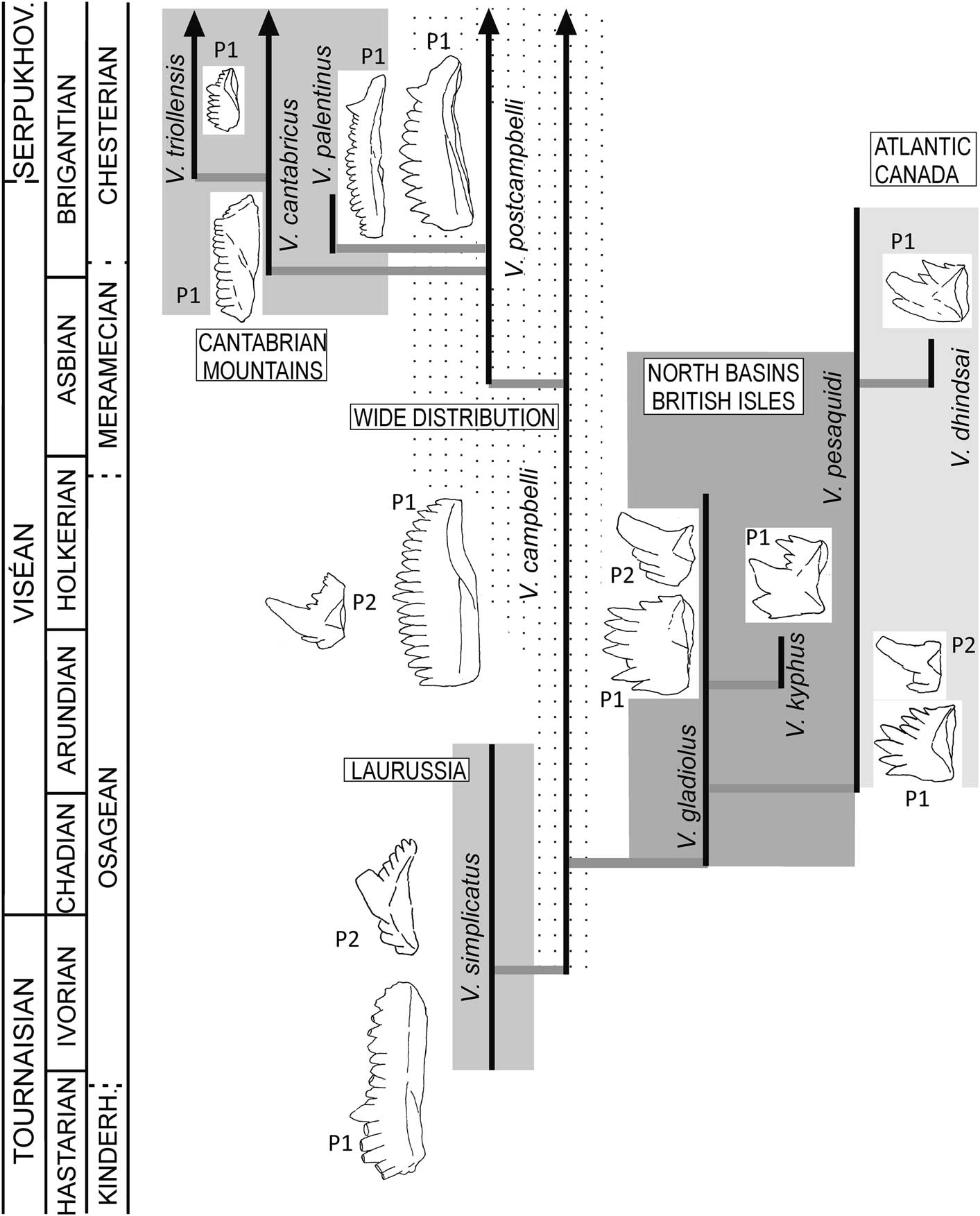
Phylogeny of Vogelgnathus species modified from Purnell and von Bitter (Reference Purnell and von Bitter1992) and including plots of specimens from Nemyrovska (Reference Nemyrovska2005) and from this work. All elements P1, except where indicated as P2 elements; dorsal (posterior) end of the specimen is upward. Stratigraphic ranges plotted against North Europe and North American Regional stages for the Tournaisian and Viséan. The Chadian is restricted by the use of the Ivorian according to Sevastopulo and Wyse Jackson (Reference Sevastopulo and Wyse Jackson2009). The gray background shows taxa with different geographic distribution.

In our opinion, V. campbelli evolved from V. simplicatus in the late Tournaisian through reduction in the height of the ventral (anterior) denticles in the P1 element and the length of the processes of the P2 element (Fig. 4). Vogelgnathus postcampbelli (Austin and Husri, Reference Austin and Husri1975) evolved from V. campbelli through the differentiation of a short dorsal (posterior) process formed by small to indistinct denticles (Purnell and von Bitter, Reference Purnell and von Bitter1992). Both species seem to be widely distributed from North America to Asia and Australia (Koike, Reference Koike1967; Norby and Rexroad, Reference Norby and Rexroad1985; Jenkins et al., Reference Jenkins, Crane and Mory1993; Mizuno, Reference Mizuno1997; Kabanov et al., Reference Kabanov, Gibshman, Barskov, Alekseev and Goreva2009; Qi et al., Reference Qi, Nemyrovska, Wang, Chen, Wang, Lane, Richards, Hu and Wang2014). They could have inhabited euryhaline environments of the euphotic zone and seem to have preferred an offshore setting, because van den Boogard (Reference van den Boogaard1992) and Nemyrovska (Reference Nemyrovska2005) noted invasions of V. campbelli during rises of sea level during the Viséan to lower Serpukhovian maximum floodings in the Cantabrian Mountains (Spain). Conversely, V. campbelli and V. postcampbelli were absent in the small extensional Northumberland Trough, which is characterized by shallow-water sediments (Purnell and von Bitter, Reference Purnell and von Bitter1992).
The wide dispersion of V. campbelli and V. postcampbelli is associated with a late Viséan diversification of species described in the Spanish Cantabrian Mountains by Nemyrovska (Reference Nemyrovska2005): Vogelgnathus cantabricus, V. palentinus, and V. triolloensis (Fig. 1.8). The Spanish species show a similar short and low dorsal (posterior) process in the P1 element to V. postcampbelli (Fig. 4). These species occurred in an offshore setting corresponding to a deep carbonate basin with sedimentation of cephalopod-bearing limestones, and they were adapted to open and deep marine settings like V. postcampbelli. Vogelgnathus akyoshiensis is very similar to V. cantabricus and was described from Southwest Japan (Fig. 1.9; Igo, Reference Igo1973). Vogelgnathus angustus Jenkins from eastern Australia (Fig. 1.10; Jenkins et al., Reference Jenkins, Crane and Mory1993) appears to be close to V. palentinus.
Another group of Vogelgnathus species evolved in relatively small extensional basins, which now cover the northern British Isles (Northumberland Trough) and Atlantic Canada (Maritimes Basin, Nova Scotia, and Newfoundland) (Fig. 1.6, 1.7). This group seems to include geographically restricted species, indicating provincialism related to sedimentation in shallow-marine, fluviodeltaic, and sabkha systems (Purnell and von Bitter, Reference Purnell and von Bitter1992; MacNeil et al., Reference MacNeil, Pufahl and James2018). Vogelgnathus gladiolus is known from lower Viséan (Chadian) beds in the Northumberland Trough (Purnell, Reference Purnell1992). Mature P1 elements of V. gladiolus seem to show retention of morphology of the immature P1 elements of V. campbelli, (Fig. 4), and both species show P2 elements that lack or have a very short ventral (anterior) process (Purnell and von Bitter, Reference Purnell and von Bitter1992). Consequently, a heterochronic evolutionary event from V. campbelli to V. gladiolus is suggested. Later V. gladiolus evolved to V. pesaquidi, which migrated into the extensional marine basins of Atlantic Canada according to its occurrence in beds correlated with probable Arundian and upper Asbian (Purnell and von Bitter, Reference Purnell and von Bitter1992; von Bitter et al., Reference von Bitter, Giles and Utting2007). The latter species evolved to the short-lived and geographically restricted V. kyphus Purnell and von Bitter, Reference Purnell and von Bitter1992 in the British Isles and V. dhindsai Purnell and von Bitter, Reference Purnell and von Bitter1992 in Atlantic Canada (Fig. 4). Vogelgnathus pesaquidi is identified in the NHMUK collection for the first time from Aldridge et al. (Reference Aldridge, Austin and Husri1968) Flintshire sample 4ae, North Wales (UK).
Conclusions
The apparatus of Vogelgnathus simplicatus included S and M elements similar to those identified in other species of Vogelgnathus. The P2 element is clearly differentiated and could be useful to search for relationships between this genus and its relatives. Vogelgnathus simplicatus is the oldest known species in the genus and ranges from the upper Tournaisian to the lower Viséan (Mississippian) in the southern margin of Laurussia. It is relatively common in Belgium, the British Isles, and Ireland, but only occasionally occurs in North America. The distribution and particularly its common occurrence in carbonate beds of Waulsortian bank complexes and adjacent facies of the outer platform and basin, suggest its preference for moderately deep water. Vogelgnathus simplicatus probably diversified in the Viséan to species with a wide geographical distribution (V. campbelli, V. postcampbelli, and descendants) and inhabited an offshore setting, while another geographically restricted group (V. gladiolus and descendants) preferred shallow-water environments.
Acknowledgments
J. Sanz-López received financial support from the SYNTHESIS 1 project (Application GB-TAF-4210, 2008) of the European Union. He and S. Blanco-Ferrera benefited from support via the project CGL2016-78738 of the Spanish Ministerio de Economía y Competitividad. We are very greateful to N.M. Savage, G.D. Sevastopulo, and P.H. von Bitter, who offered very useful comments and suggestions.