Introduction
Depression is thought to be an independent risk factor for cardiovascular disease (CVD) (Niranjan et al. Reference Niranjan, Corujo, Ziegelstein and Nwulia2012). Meta-analyses suggest that individuals with depressive disorders have almost twice the risk of developing CVD (Wulsin & Singal, Reference Wulsin and Singal2003; Van der Kooy et al. Reference Van der Kooy, van Hout, Marwijk, Marten, Stehouwer and Beekman2007; Pan et al. Reference Pan, Sun, Okereke, Rexrode and Hu2011; Rugulies, Reference Rugulies2002). Moreover, depression is known to increase the risk for cardiac mortality two to four times, irrespective of CVD history (Wulsin et al. Reference Wulsin, Vaillant and Wells1999; Penninx et al. Reference Penninx, Beekman, Honig, Deeg, Schoevers, van Eijk and van Tilburg2001; Barth et al. Reference Barth, Schumacher and Herrmann-Lingen2004; Nicholson et al. Reference Nicholson, Kuper and Hemingway2006; Whang et al. Reference Whang, Kubzansky, Kawachi, Rexrode, Kroenke, Glynn, Garan and Albert2009). In later life, depression has been associated with several cardiovascular risk factors, such as obesity, in addition to CVD, diabetes and stroke (Valkanova & Ebmeier, Reference Valkanova and Ebmeier2013).
To help clinicians to identify and focus more on patients with increased risk for CVD, the concept of the metabolic syndrome (MetS) has been introduced. MetS is defined by a combination of central obesity, high blood pressure, low levels of high density lipoprotein cholesterol (HDL-C), elevated triglycerides and hyperglycemia (Expert Panel, 2001). In the general population, these clustered risk factors have been associated with the development of CVD (Galassi et al. Reference Galassi, Reynolds and He2006; Gami et al. Reference Gami, Witt, Howard, Erwin, Gami, Somers and Montori2007; Bayturan et al. Reference Bayturan, Tuzcu, Lavoie, Hu, Wolski, Schoenhagen, Kapadia, Nissen and Nicholls2010; Mottillo et al. Reference Mottillo, Filion, Genest, Joseph, Pilote, Poirier, Rinfret, Schiffrin and Eisenberg2010). Although several definitions have been proposed for MetS, the most often cited ones are those formulated by the National Cholesterol Education Program (NCEP), that is the Adult Treatment Panel III (ATP-III) and adapted ATP-III (ATP-III-A) criteria (Expert Panel, 2001; Grundy et al. Reference Grundy, Cleeman, Daniels, Donato, Eckel, Franklin, Gordon, Krauss, Savage, Smith, Spertus and Costa2005), by the International Diabetes Federation (IDF; Alberti et al. Reference Alberti, Zimmet and Shaw2006) and by the World Health Organization (WHO Consultation, 1999). Current definitions for MetS are aimed at being easy to use in clinical settings and share similar diagnostic thresholds. However, the role of abdominal obesity is central to the IDF definition, with provision of ethnic specific thresholds for waist circumference (Alberti et al. Reference Alberti, Eckel, Grundy, Zimmet, Cleeman, Donato, Fruchart, James, Loria and Smith2009), whereas central obesity is not a mandatory NCEP/ATP MetS criterion. As a prevalent condition and predictor of CVD across racial, gender and age groups, MetS provides a unique opportunity to identify high-risk populations and prevent the progression of some of the major causes of morbidity and mortality (Galassi et al. Reference Galassi, Reynolds and He2006; Gami et al. Reference Gami, Witt, Howard, Erwin, Gami, Somers and Montori2007; Bayturan et al. Reference Bayturan, Tuzcu, Lavoie, Hu, Wolski, Schoenhagen, Kapadia, Nissen and Nicholls2010; Mottillo et al. Reference Mottillo, Filion, Genest, Joseph, Pilote, Poirier, Rinfret, Schiffrin and Eisenberg2010).
Patients with major depressive disorder (MDD) are subject to background socio-economic and lifestyle conditions that may influence the development and course of CVD (Atlantis et al. Reference Atlantis, Shi, Penninx, Wittert, Taylor and Almeida2012) and MetS. These include poor receipt of high-quality physical health care (Mitchell et al. Reference Mitchell, Malone and Doebbeling2009; De Hert et al. Reference De Hert, Cohen, Bobes, Cetkovich-Bakmas, Leucht, Ndetei, Möller, Gautam, Detraux and Correll2011a ), reduced uptake of mass screening (Lord et al. Reference Lord, Malone and Mitchell2010), reduced compliance with medical recommendations (Ziegelstein et al. Reference Ziegelstein, Fauerbach, Stevens, Romanelli, Richter and Bush2000; Swardfager et al. Reference Swardfager, Herrmann, Marzolini, Saleem, Farber, Kiss and Lanctôt2011) and adverse medication treatment effects (McIntyre et al. Reference McIntyre, Soczynska, Konarski, Woldeyohannes, Law, Miranda, Fulgosi and Kennedy2007, Reference McIntyre, Park, Law, Sultan, Adams, Lourenco, Lo, Soczynska, Woldeyohannes, Alsuwaidan, Yoon and Kennedy2010; Gartlehner et al. Reference Gartlehner, Hansen, Morgan, Thaler, Lux, Van Noord, Mager, Thieda, Gaynes, Wilkins, Strobelberger, Lloyd, Reichenpfader and Lohr2011; De Hert et al. Reference De Hert, Correll, Bobes, Cetkovich-Bakmas, Cohen, Asai, Detraux, Gautam, Möller, Ndetei, Newcomer, Uwakwe and Leucht2011b ), along with the presence of modifiable behavioral risk factors, such as smoking and physical inactivity (De Hert et al. Reference De Hert, Correll, Bobes, Cetkovich-Bakmas, Cohen, Asai, Detraux, Gautam, Möller, Ndetei, Newcomer, Uwakwe and Leucht2011b ). In addition, MDD is associated with physiological changes, including dysregulation of autonomic nervous system activity, impaired hypothalamic–pituitary–adrenal (HPA) axis function, dysregulation of immune mechanisms, coagulation abnormalities and vascular endothelial dysfunction (Brown et al. Reference Brown, Barton and Lambert2009; McIntyre et al. Reference McIntyre, Rasgon, Kemp, Nguyen, Law, Taylor, Woldeyohannes, Alsuwaidan, Soczynska, Kim, Lourenco, Kahn and Goldstein2009; Lamers et al. Reference Lamers, Vogelzangs, Merikangas, de Jonge, Beekman and Penninx2013).
In a meta-analysis of 29 cross-sectional studies, Pan et al. (Reference Pan, Keum, Okereke, Sun, Kivimaki, Rubin and Hu2012) reported indications of a bidirectional association between MetS and depression. Information on the overall prevalence of MetS and its components, and on the effect of moderating variables on MetS frequency, was not presented in that study because it focused exclusively on the strength and directionality of the association between MetS and depression. Therefore, to assess the prevalence of MetS and its components in persons with MDD and to explore the effect of geographical region, gender, age, treatment setting, psychiatric co-morbidity, illness duration and antidepressant and antipsychotic use and type, we conducted a systematic review and meta-analysis. We also aimed to assess the differences in the prevalence of MetS in studies comparing persons with MDD with age- and gender-matched healthy comparison groups. We hypothesized that persons with MDD are at an increased risk for MetS compared with matched healthy controls.
Method
Inclusion and exclusion criteria
The systematic review was executed according to the Preferred Reporting Items for Systematic Reviews and Meta-Analyses (PRISMA) standard (Moher et al. Reference Moher, Liberati, Tetzlaff and Altman2009). The focus was on individuals with syndromal depressive episode, irrespective of age and clinical setting (in-patient, out-patient or mixed). Inclusion criteria were: (a) an interview-defined MDD according to DSM-IV-TR (APA, 2000) or clinical depression according to the ICD (WHO, 1993); and (b) MetS diagnosis according to non-modified ATP-III (Expert Panel, 2001), modified ATP-III-A (Grundy et al. Reference Grundy, Cleeman, Daniels, Donato, Eckel, Franklin, Gordon, Krauss, Savage, Smith, Spertus and Costa2005), IDF (Alberti et al. Reference Alberti, Zimmet and Shaw2006) or WHO criteria (WHO Consultation, 1999). We included case–control studies, prospective cohort studies, cross-sectional studies and comparisons of study populations with age standardization. For estimation of the MetS prevalence, we excluded studies with: (a) non-interview-defined diagnoses of MDD, (b) non-standardized definitions of MetS, (c) insufficient data for extraction of MetS proportions, (d) a sample size below 50, and (e) restriction to patients at risk for or without CVD. In the case of multiple publications from the same study, only the most recent paper or article with the largest sample was included.
Search criteria and critical appraisal
Two independent reviewers (A.D.H. and D.V.) searched Medline, PsycINFO, EMBASE and CINAHL from database inception until June 2013. Key words used were ‘metabolic’ OR ‘diabetes’ or ‘cardiovascular’ or ‘blood pressure’ or ‘glucose’ or ‘lipid’ AND ‘depression’ OR ‘depressive’ in the title, abstract or index term fields. Manual searches were also conducted using the reference lists from identified articles. Data were abstracted by the same two independent reviewers. Methodological appraisal of each study was performed according to PRISMA standards (Moher et al. Reference Moher, Liberati, Tetzlaff and Altman2009), including evaluation of bias (confounding, overlapping data, publication bias). A funnel graph (Egger et al. Reference Egger, Davey, Schneider and Minder1997) was created, in which the study-specific effect estimates are displayed in relation to the standard error, to assess the potential presence of publication bias. In addition, publication bias was tested using the Egger regression method (Egger et al. Reference Egger, Davey, Schneider and Minder1997) and the Begg–Mazumdar test (Begg & Mazumdar, Reference Begg and Mazumdar1994), with a p value < 0.05 suggesting presence of bias. Lastly, a trim-and-fill approach (Duvall & Tweedie, Reference Duvall and Tweedie2000) was used to determine the adjusted MetS prevalence after figuring into the analyses results from potentially missing studies.
Statistical analysis
A meta-analysis, based on the above-described available studies, was performed to obtain an optimal estimation of the prevalence of MetS in the population with MDD. The effect size used for the prevalence of MetS was the proportion, but all analyses were performed, converting proportions into logits. As indicated by Lipsey & Wilson (Reference Lipsey and Wilson2001), logits are preferred over proportions because the mean proportion across studies underestimates the size of the confidence interval (CI) around the mean proportion (because of the compression of the standard error as p approaches 0 or 1) and overestimates the degree of heterogeneity across effect sizes. Lipsey & Wilson (Reference Lipsey and Wilson2001) note that this is especially the case when the observed proportions are < 0.2 or > 0.80, as was the case in some of the included studies. The logit method circumvents these problems and is the preferred method, especially given our interest in between-study differences. However, for ease of interpretation, all final results were back-converted into proportions. To examine the homogeneity of the effect size distribution, a Q statistic (Hedges & Olkin, Reference Hedges and Olkin1985) was used. A mixed random-effects model was used, implying that the observed variance stems from three sources: (a) variance due to subject-level sampling error, (b) variance from study characteristics that we could identify (e.g. geographical region), and (c) variance from other systematic, random or unmeasured sources. In these analyses, several study characteristics were incorporated including median year of data collection, geographical area, mean age of the study sample, criteria used for MetS (ATP-III, ATP-III-A, IDF or WHO), percentage of patients with psychiatric co-morbidity, and percentage of antidepressant and antipsychotic use, both in general and by class. Lastly, we pooled data from individual studies to calculate odds ratios (ORs) to statistically compare the prevalence of MetS between individuals with MDD and age- and gender-matched general population control subjects.
Results
Search results and included participants
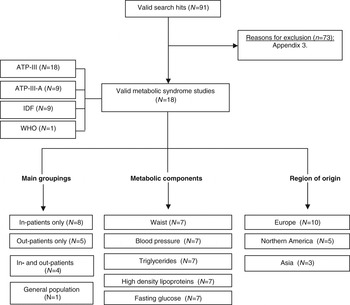
The initial electronic database search resulted in 91 valid hits. From candidate publications following exclusions, our search generated 18 studies fulfilling the inclusion and exclusion criteria. The list of included studies is presented in Appendix 1 in the online Supplementary Material. The dataset comprised 5531 unique individuals (38.9% male, mean age = 45.5 years) with a diagnosis of MDD (Fig. 1). Published studies involved sample sizes that ranged from 60 to 1028 participants. Details on the included studies are presented in Appendix 2 online. Of the 18 studies in persons with a diagnosis of MDD, eight were conducted among in-patients (n = 2393), five in out-patient settings (n = 558), four in mixed samples (n = 2303) and one included community patients (n = 277). Six studies (n = 1380) reported smoking, and 41.7% of persons with MDD in these studies were smokers. In addition, five of the included studies compared individuals with MDD (n = 4427, 47% male, mean age = 47.2 years) with healthy control subjects (n = 5172, 48% male, mean age = 49.6 years). A list of studies that were excluded and the reasons for exclusion are presented in Appendix 3 online.
Quality of reporting of meta-analyses (Quorom) search results.

Publication bias
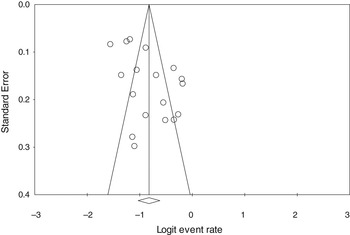
The funnel plot of the 18 studies included in our meta-analysis was asymmetrical, as shown in Fig. 2. Only the Egger test (p = 0.02), and not the Begg–Mazumdar test (p = 0.12), showed any evidence of publication bias. The trim-and-fill method demonstrated that adjusting for publication bias had little effect on the pooled MetS estimate.
Publication bias assessment for metabolic syndrome (MetS) studies in depression. Begg–Mazumdar: Kendall's tau-b with continuity correction = 0.20, z = 1.17, p = 0.12. Egger's bias = 4.11 [95% confidence interval (CI) 0.86–7.36], t = 2.68, p = 0.02.

Prevalence of MetS in MDD
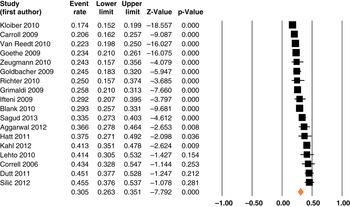
Based on a meta-analysis involving 5531 unique individuals with a MDD diagnosis, the estimated weighted mean prevalence of MetS defined according to either ATP-III, ATP-III-A, IDF or WHO standards in a random-effects model was 30.5% (95% CI 26.3–35.1). After adjustment for publication bias, the estimated weighted mean prevalence of MetS in a random-effects model was 29.7% (95% CI 25.6–34.1).
Fig. 3 shows the estimated MetS prevalences of each individual study together with the weighted mean MetS prevalence rate. The significant Q statistic of the fixed-effects model indicated that the distribution of MetS prevalence rate of individual studies was not homogeneous (Q 14 = 173.39, p < 0.001), implying that the variability in the prevalence rates of MetS between studies was larger than can be expected on the basis of sampling error. Consequently, in a next step, we examined the potential moderating role of several study, population and treatment characteristics to explain systematic differences in the observed prevalence rates of MetS between studies.
Summary of metabolic syndrome (MetS) rates in major depressive disorder (MDD). (See Appendix 1 online for study citations.)

Prevalence of individual metabolic abnormalities in subjects with MDD
Six studies reported on the rate of abdominal obesity defined as a waist circumference > 102 cm in males and > 88 cm in females (ATP-III or ATP-III-A), and one study reported on abdominal obesity defined as a waist circumference > 94 cm in males and > 80 cm in females (IDF). The estimated proportion of patients with abdominal obesity by ATP definitions was 38.0% (N = 6, n = 2827, 95% CI 30.9–45.6) and 40.5% according to IDF (N = 1, n = 988, 95% CI 25.2–57.9). Of studies reporting on hyperglycemia (⩾110 mg/dl; ATP-III) the estimated prevalence was 18.8% (N = 4, n = 2600, 95% CI 13.0–26.5), being 8.6% (N = 3; n = 1215, 95% CI 5.2–14.0) for those studies using a threshold of ⩾100 mg/dl (ATP-III-A and IDF). The prevalence of hypertriglyceridemia was 30.1% (N = 7, n = 3699, 95% CI 22.6–38.8) and the prevalence of abnormally low HDL-C was 31.1% (N = 7, n = 3699, 95% CI 23.1–40.4). Seven studies reported on high blood pressure, which was present in 36.7% (N = 7, n = 4202, 95% CI 22.7–53.3).
Moderating variables of MetS prevalence in patients with MDD
No significant differences between the different criteria for MetS were observed. Using the ATP-III-A criteria, the MetS prevalence was 38.8% (N = 5, n = 672, 95% CI 30.6–47.8), and estimated MetS prevalences using ATP-III, IDF and WHO definitions were 26.7% (N = 7, n = 3187, 95% CI 21.3–32.9), 30.8% (N = 5, n = 1395, 95% CI 23.6–39.1) and 20.6% (N = 1, n = 277, 95% CI 10.6–36.1) respectively.
Antipsychotic medication use explained part of the heterogeneity of the prevalence estimates of MetS between the included studies, being associated with significantly higher MetS prevalences (N = 4, n = 1745, p < 0.05). Furthermore, differences in prevalence estimates of different studies could not be explained by age, gender, geographical area, smoking, selective serotonin reuptake inhibitor (SSRI) use, presence of psychiatric co-morbidity, year of data collection and use of antidepressants (data not shown). Because of limited data, we were not able to investigate the effect of ethnicity, individual antipsychotic and antidepressant medications and illness duration as potential moderators.
ORs of MetS and metabolic abnormalities in MDD compared with age- and gender-matched general population controls
Compared with healthy control subjects (N = 5, n = 3297, 33.1% male, mean age = 44.1 years), those with MDD (N = 5, n = 3118, 33.2% male, mean age = 43.7 years) had a significantly increased risk of MetS (23.8%, 95% CI 19.6–28.6 v. 16.7%, 95% CI 12.3–22.4; OR 1.54, 95% CI 1.21–1.97, p < 0.001).
Four studies reported prevalence figures of individual MetS criteria in individuals with MDD (n = 3188, 34.8% male, mean age = 43.7 years) compared with healthy control subjects (n = 3118, 34.9% male, mean age = 43.9 years). Those with MDD had significantly more fasting hyperglycemia (11.8%, 95% CI 6.9–19.4 v. 8.7%, 95% CI 4.2–17.4; OR 1.33, 95% CI 1.03–1.73, p = 0.03) and hypertriglyceridemia (22.9%, 95% CI 17.1–30.0 v. 20.9%, 95% CI 15.9–28.4; OR 1.17, 95% CI 1.04–1.30, p = 0.008). However, no significant differences in the prevalence of hypertension (29.1%, 95% CI 13.8–51.3 v. 31.5%, 95% CI 16.7–51.5; OR 0.89, 95% CI 0.62–1.28), abnormally low HDL-C (29.2%, 95% CI 20.1–40.4 v. 22.9%, 95% CI 16.1–31.4; OR 1.41, 95% CI 0.94–2.12) and abdominal obesity (41.6%, 95% CI 35.3–48.2 v. 34.5%, 95% CI 22.5–48.9; OR 1.37, 95% CI 0.92–2.05) were observed.
Discussion
General findings
To our knowledge, this is the first meta-analysis on the proportion of MetS and its components in individuals with MDD. We found 18 publications including 5531 subjects with clearly defined MDD, all published between 2004 and June 2013 (see Fig. 1). This finding indicates that cardiometabolic risk in people with MDD has only been a focus of attention for the past 8 years and remains somewhat overlooked compared with patients with schizophrenia (Mitchell et al. Reference Mitchell, Vancampfort, Sweers, van Winkel, Yu and De Hert2013b ). We found that 30.5% (95% CI 26.3–35.1) of individuals with MDD had MetS. Our meta-analysis adds to the current literature by showing that the odds for MetS are 1.5 times higher for persons with MDD compared with general population controls. Regarding individual MetS criteria, about 40% of individuals with MDD had abdominal obesity or were hypertensive, about 30% had abnormal HDL-C or triglycerides, and 20% had significant pre-diabetes (using the > 110 mg/dl fasting glucose threshold for hyperglycemia). Importantly, persons with MDD were at a significantly increased risk for MetS, hyperglycemia and hypertriglyceridemia when compared to matched healthy controls. However, in the available studies we found no differences relative to healthy controls for waist circumference, HDL-C levels and hypertension. The observation that the presence of abnormally elevated blood pressure was not increased in MDD patients contradicts a recent meta-analysis of nine cohort studies linking depression with incident hypertension (OR 1.42, 95% CI 1.09–1.86, p = 0.009) (Meng et al. Reference Meng, Chen, Yang, Zheng and Hui2012). A possible reason might be that we were not able to control for antihypertensive drugs in our study and that the threshold for elevated blood pressure in MetS is lower than that for hypertension. The observation that waist circumference and HDL-C levels did not differ from those of matched controls warrants further investigation.
Identifying those who currently have, or are at high risk for, metabolic disorders is a clinical imperative. Although knowledge about factors that are associated with the highest MetS proportions can help to identify persons at greater risk, we were able to identify only one significant moderating variable. Consistent with population studies (Ford et al. Reference Ford, Giles and Dietz2002; Tillin et al. Reference Tillin, Forouhi, Johnston, McKeigue, Chaturvedi and Godsland2005; Hwang et al. Reference Hwang, Bai and Chen2006), there was no significant difference between men and women, indicating that both sexes need the same attention and care. In addition, in the current meta-analysis, age did not explain differences in prevalence estimates, indicating that the high risk for metabolic abnormalities should be a concern across the lifespan. This finding also indicates that depression and/or related biological processes may override even the strong, known risk factor of age for MetS (North & Sinclair, Reference North and Sinclair2012), at least within the restricted age range of the included cohorts (mean age range 38.3–54.3 years) and on a study level of analysis. Because of lack of sufficient data, we were unable to investigate whether illness duration had a moderating effect. It might be hypothesized that the cumulative long-term effects of poor health behaviors or of illness-related biological factors (McIntyre et al. Reference McIntyre, Soczynska, Konarski, Woldeyohannes, Law, Miranda, Fulgosi and Kennedy2007, Reference McIntyre, Rasgon, Kemp, Nguyen, Law, Taylor, Woldeyohannes, Alsuwaidan, Soczynska, Kim, Lourenco, Kahn and Goldstein2009) place persons with MDD with a longer illness duration at a greater risk for cardiometabolic risk factors and disorders.
The high co-occurrence between depressive symptoms and MetS suggests a possible pathophysiological overlap (Pan et al. Reference Pan, Keum, Okereke, Sun, Kivimaki, Rubin and Hu2012). Although the precise mechanisms mediating the pathophysiological overlap between MetS and MDD have not yet been elucidated, an elevated cortisol secretion due to hyperactivity of the HPA axis, (pro)-inflammatory processes involving interleukin-6 and C-reactive protein, oxidative stress, autonomic nervous system dysregulation including an increase in sympathetic and decrease in parasympathetic activity, and insulin resistance are all interacting biological mechanisms that may mediate the association between depression and MetS (McIntyre et al. Reference McIntyre, Soczynska, Konarski, Woldeyohannes, Law, Miranda, Fulgosi and Kennedy2007, Reference McIntyre, Rasgon, Kemp, Nguyen, Law, Taylor, Woldeyohannes, Alsuwaidan, Soczynska, Kim, Lourenco, Kahn and Goldstein2009). Although biological processes might be important, background lifestyle and socio-economic factors are probably equally relevant (Patton et al. Reference Patton, Carlin, Coffey, Wolfe, Hibbert and Bowes1998; Whooley et al. Reference Whooley, de Jonge, Vittinghoff, Otte, Moos, Carney, Ali, Dowray, Na, Feldman, Schiller and Browner2008; McIntyre et al. Reference McIntyre, Rasgon, Kemp, Nguyen, Law, Taylor, Woldeyohannes, Alsuwaidan, Soczynska, Kim, Lourenco, Kahn and Goldstein2009; Patten et al. Reference Patten, Williams, Lavorato and Eliasziw2009). For example, MDD increased the odds for developing hyperglycemia and hypertriglyceridemia, which could be due to depression or related changes in diet and exercise (Luppino et al. Reference Luppino, de Wit, Bouvy, Stijnen, Cuijpers, Penninx and Zitman2010) but clearly increases the risk for MetS.
We also did not find a relationship between antidepressant use and MetS prevalence. However, because of the limited data available on specific antidepressants and on duration of treatment, it is premature to draw any firm conclusions. Previous studies have found that some antidepressants may, in some circumstances, reduce hyperglycemia (McIntyre et al. Reference McIntyre, Soczynska, Konarski and Kennedy2006; Atlantis et al. Reference Atlantis, Shi, Penninx, Wittert, Taylor and Almeida2012; Hennings et al. Reference Hennings, Schaaf and Fulda2012), normalize glucose homeostasis and also increase insulin sensitivity, whereas others, including tricyclic antidepressants, may exacerbate glycemic dyscontrol or have little effect on glucose homeostasis (Knol et al. Reference Knol, Derijks, Geerlings, Heerdink, Souverein, Gorter, Grobbee and Egberts2008; Mojtabai, Reference Mojtabai2013).
Nevertheless, we did find that use of antipsychotics in patients with MDD was a significant moderator for increased prevalence of MetS. Many groups have previously found that use of antipsychotic medication is a likely risk factor for MetS, obesity and diabetes in schizophrenia (Smith et al. Reference Smith, Hopkins, Peveler, Holt, Woodward and Ismail2008) and bipolar disorder (Vancampfort et al. Reference Vancampfort, Vansteelandt, Correll, Mitchell, De Herdt, Sienaert, Probst and De Hert2013). Adjunctive treatment with antipsychotic medications has been endorsed for treatment-resistant depression by several clinical practice guidelines (Davidson, Reference Davidson2010) and was supported by a recent meta-analysis (Farahani & Correll, Reference Farahani and Correll2012). It is also clear that different antipsychotics differ in their cardiometabolic risk profile (Correll et al. Reference Correll, Lencz and Malhotra2011; De Hert et al. Reference De Hert, Detraux, van Winkel, Yu and Correll2011c ). It is therefore advisable for future studies to report MetS proportions in patients with depression by individual medication classes and groups, including different antidepressant and antipsychotic classes and, possibly, agents or groups of agents with similar cardiometabolic risk profiles.
We note that the pooled MetS proportion of 30.5% (95% CI 26.3–35.1) using either ATP-III, ATP-III-A, IDF or WHO definitions in patients with MDD is very similar to the recently reported pooled MetS proportion of 32.5% (95% CI 30.1–35.0) across 77 studies and 25 692 patients with schizophrenia (Mitchell et al. Reference Mitchell, Vancampfort, Sweers, van Winkel, Yu and De Hert2013b ), and lower than the 37.3% (95% CI 36.1–39.0) found across 37 studies involving 6983 bipolar disorder patients (Vancampfort et al. Reference Vancampfort, Vansteelandt, Correll, Mitchell, De Herdt, Sienaert, Probst and De Hert2013) using the same MetS criteria. We do, however, advise caution in interpreting these data, as patients with schizophrenia and bipolar disorder are more likely to receive long-term treatment with antipsychotics that have been associated with significant adverse effects on body weight, glucose and lipid metabolism and MetS risk (Correll et al. Reference Correll, Lencz and Malhotra2011; De Hert et al. Reference De Hert, Detraux, van Winkel, Yu and Correll2011c ; Mitchell et al. Reference Mitchell, Vancampfort, De Herdt, Yu and De Hert2013a ), and as study populations were assessed with varying methodologies.
Clinical implications
Our data support the recently developed Canadian Network for Mood and Anxiety Treatments (CANMAT) recommendations (McIntyre et al. Reference McIntyre, Alsuwaidan, Goldstein, Taylor, Schaffer, Beaulieu and Kemp2012) that individuals with MDD, and in particular those taking antipsychotics, should be considered a vulnerable group that should be screened proactively for MetS and CVD risk factors. Given the mean age of our sample, this proactive monitoring should not be reserved for older depressed patients over 65 years of age. Considering the high cardiometabolic risks observed, we suggest that patients with MDD should be screened for cardiovascular risk factors at least annually (even if they have normal baseline values). In addition, we suggest that assessments in these patients should be performed at baseline and repeated at 6 and 12 weeks after initiation of any high-risk treatment, such as antipsychotic medication (De Hert et al. Reference De Hert, Cohen, Bobes, Cetkovich-Bakmas, Leucht, Ndetei, Möller, Gautam, Detraux and Correll2011a ). An additional 6-week assessment has been endorsed in the European Psychiatric Association guideline (De Hert et al. Reference De Hert, Dekker, Wood, Kahl, Holt and Möller2009), but its advantages have not yet been tested. Given the high MetS risk observed across all treatment settings, we propose that a minimum standard of monitoring for MDD patients not treated with antipsychotics, even in those with normal baseline tests, should include blood pressure, smoking status and waist circumference or body mass index (BMI) at annual intervals. We further propose that optimal monitoring for MDD patients, and standard monitoring for those taking antipsychotics, should also include fasting lipids and hemoglobin A1C (HbA1c) and/or fasting blood glucose. HbA1c has the advantage of not requiring a fasting sample and is reported to identify a larger number of patients with early, only post-prandial hyperglycemia/pre-diabetes (Manu et al. Reference Manu, Correll, van Winkel, Wampers and De Hert2012, Reference Manu, Correll, Wampers, van Winkel, Yu, Mitchell and De Hert2013). A recent study (Mitchell et al., unpublished observations) proposes the optimal testing protocol with a HbA1c threshold ⩾5.7% followed by conventional testing with an oral glucose tolerance test and fasting blood glucose in patients who test positive.
An important second step regarding the management of MetS is treatment for any detected abnormality In addition, psychiatrists, physicians and other members of the multidisciplinary team should educate and help motivate individuals with MDD to improve their lifestyle through the use of effective behavioral interventions, including smoking cessation, dietary measures and exercise. If lifestyle interventions do not succeed, preferential use of lower-risk medication or the addition of a medication known to reduce weight and/or metabolic abnormalities should be considered (De Hert et al. Reference De Hert, Dekker, Wood, Kahl, Holt and Möller2009; Maayan et al. Reference Maayan, Vakhrusheva and Correll2010).
Limitations
We acknowledge several limitations in the primary data and in this meta-analysis. First, there was considerable methodological heterogeneity across studies. This heterogeneity may be attributable to the differences in study design, sample size, participant characteristics, diagnostic criteria for depression and different MetS definitions. To account for the heterogeneity, we chose random-effects models for the meta-analyses. Second, there was marked variation in the quantity and quality of analyzable studies, some of which had limited sample sizes, a reliance largely on cross-sectional and retrospective studies, and insufficient pre-treatment information on MetS in enrolled participants. However, to reduce heterogeneity and increase the generalizability of the analyzed studies, we excluded those with less than 50 participants. Third, moderator variables were not always reported, reducing the power for these analyses. In particular, ethnicity, duration of treatment and lifestyle behaviors, all relevant variables for cardiometabolic health, were recorded insufficiently, precluding the meta-analytic assessment of these factors as moderating or mediating variables. Fourth, the included patients were predominantly in-patients, which limits the generalizability of our findings. Fifth, as the data were too limited regarding individual prescribed antidepressants and antipsychotics, we were not able to assess the risk-moderating effects of specific medications. Nevertheless, despite these limitations, this is the largest study of MetS proportions and its moderators in MDD and the first formal meta-analysis of this important topic.
Future research
Variables, such as clinical subtypes of MDD and concomitant or previous use of antidepressants, mood stabilizers, such as lithium and valproate, or antipsychotics, were not reported or were insufficiently reported or controlled for in most available studies. Future studies should examine in more detail whether different clinical subtypes of depression (i.e. melancholic, atypical or undifferentiated MDD) are at equal risk for developing MetS. Very recent data from the Netherlands Study of Depression and Anxiety (NESDA) sample (Lamers et al. Reference Lamers, Vogelzangs, Merikangas, de Jonge, Beekman and Penninx2013) did demonstrate that persons with atypical depression had significantly higher levels of inflammatory markers, BMI, waist circumference and triglycerides, and lower HDL-C than persons with melancholic depression. In the same way, future studies should investigate to what extent risk for MetS in drug-naive and untreated persons with MDD is lower than in those treated with specific pharmacological regimens. Future studies should also examine whether there is an underlying genetic risk for the development of metabolic abnormalities after pharmacotherapy initiation. Examining whether cardiometabolic outcomes are moderated by genetic factors, but also by clinical characteristics, or are mediated by individual treatments should become a clinical research priority. Interventions that target the individual MetS components should also be evaluated. Furthermore, future research should undertake a comprehensive assessment of MetS risk factors following, at the very least, recommended monitoring guidelines and evaluate the optimal monitoring regimen and interventions in patients treated with antidepressants. To date, audits (De Hert et al. Reference De Hert, Vancampfort, Correll, Mercken, Peuskens, Sweers, van Winkel and Mitchell2011d ) of metabolic monitoring conducted in patients with bipolar disorder and schizophrenia show that most patients do not receive adequate medical surveillance. Lastly, prospective studies are needed to investigate the direct relationship between individual medications and MetS, and long-term follow-up studies are required to accurately document the emergence of some more distal outcomes, such as ischemic heart disease.
Conclusions
Our meta-analysis has clearly demonstrated that MetS, a significant constellation of risk factors for cardiovascular illness, is highly prevalent in individuals with MDD. Those taking antipsychotics should be considered as a particularly vulnerable population. We recommend that treating mental health professionals, general practitioners and medical specialists should be responsible for giving preventive and proactive lifestyle advice, implementing the necessary screening assessments, and orchestrating or conducting the appropriate treatment of clinically relevant, abnormal findings.
Supplementary material
For supplementary material accompanying this paper visit http://dx.doi.org/10.1017/S0033291713002778.
Acknowledgments
We are very grateful to the following authors for sending us additional data or information: Dr K. Blank, Memory Disorders Center, Braceland Center for Mental Health and Aging Institute of Living, Hartford Hospital, Hartford, CT, USA; Dr F. Bonnet, Department of Medicine, University of Lyon, and Centre for Research in Human Nutrition, Hôpital Edouard Herriot, Lyon, France; Dr J. A. Dunbar and B. Philpot, Greater Green Triangle University Department of Rural Health, Flinders University and Deakin University, Warrnambool, Victoria, Australia; Dr S. Grover, Department of Psychiatry, Postgraduate Institute of Medical Education and Research, Chandigarh, India; Dr T. A. Hartley, Biostatistics and Epidemiology Branch, Health Effects Laboratory Division, National Institute for Occupational Safety and Health, Morgantown, WV, USA and Department of Community Medicine, School of Medicine, West Virginia University, Morgantown, WV, USA; Dr P. Ifteni, Department of Medicine, Transilvania University, Brasov, Romania; Dr R. Kobrosly, Department of Community and Preventive Medicine, University of Rochester School of Medicine and Dentistry, Rochester, NY, USA; Dr F. Lamers, Department of Psychiatry, VU University Medical Center Amsterdam, The Netherlands; Dr P. D. Loprinzi, Department of Exercise Science, Donna and Allan Lansing School of Nursing and Health Sciences, Bellarmine University, Louisville, KY, USA; Dr T. Partonen, National Institute for Health and Welfare, Helsinki, Finland; Dr J. Miettola, Institute of Public Health and Clinical Nutrition, University of Eastern Finland, Kuopio, Finland; and Dr F. Thomas-Jean, Centre Investigations Préventives et Cliniques (IPC), Paris, France.
Declaration of Interest
C. U. Correll has been a consultant and/or advisor to or has received honoraria from: Actelion, Alexza, American Academy of Child and Adolescent Psychiatry, AstraZeneca, Biotis, Bristol-Myers Squibb, Cephalon, Desitin, Eli Lilly, GersonLehrman Group, GSK, IntraCellular Therapies, Lundbeck, Medavante, Medscape, Merck, National Institute of Mental Health (NIMH), Novartis, Ortho-McNeill/Janssen/J&J, Otsuka, Pfizer, ProPhase, Sunovion, Takeda, and Teva. He has received grant support from BMS, Feinstein Institute for Medical Research, Janssen/J&J, NIMH, National Alliance for Research in Schizophrenia and Depression (NARSAD), and Otsuka. P. Sienaert has been on the speakers/advisory boards of AstraZeneca, Lundbeck JA, Janssen-Cilag, Eli Lilly, Servier, Glaxo-Smith-Kline, and Bristol-Myers Squibb. A. De Herdt reports no financial relationships with commercial interests. M. De Hert has been a consultant for, received grant/research support and honoraria from, and has been on the speakers/advisory boards of: AstraZeneca, Lundbeck JA, Janssen-Cilag, European Diabetes Foundation/Lilly, Otsuka, Pfizer, Sanofi-Aventis, Bristol-Myers Squibb, and Takeda.