Introduction
A key feature of paranoid ideation, one of the most common delusions in psychosis (Garety & Hemsley, Reference Garety and Hemsley1987; Jorgensen, Reference Jorgensen1994), is a misinterpretation of other people's behavior (Freeman, Reference Freeman2008). Paranoia can be understood as an exaggerated perception or belief that others have malevolent or harmful intentions towards oneself (Freeman & Garety, Reference Freeman and Garety2000; Bentall et al. Reference Bentall, Corcoran, Howard, Blackwood and Kinderman2001). Some authors have suggested that aberrant motivational salience of neutral environmental stimuli may be responsible for such beliefs (Jensen & Kapur, Reference Jensen and Kapur2009; Roiser et al. Reference Roiser, Stephan, den Ouden, Barnes, Friston and Joyce2009). The social environment may thus be particularly important in the formation of paranoia.
Several experiments have confirmed the significance of social factors in the development of psychosis, and paranoia in particular. One experiment exposed participants briefly to a deprived urban environment. This real-life exposure exacerbated paranoid thinking in individuals with psychosis (Ellett et al. Reference Ellett, Freeman and Garety2008). Some recent experimental studies used virtual reality to investigate paranoia in different social contexts such as a library or a metro train (Ellett et al. Reference Ellett, Freeman and Garety2008). Avatars in these virtual reality settings showing ambiguous behavior (looking, smiling, talking) provoked ideas of persecution and reference in individuals from the general population with increased interpersonal sensitivity and high anxiety levels (Freeman et al. Reference Freeman, Slater, Bebbington, Garety, Kuipers, Fowler, Met, Read, Jordan and Vinayagamoorthy2003). Moreover, individuals with paranoid thinking patterns interpreted neutral social signals abnormally (Freeman et al. Reference Freeman, Garety, Bebbington, Slater, Kuipers, Fowler, Green, Jordan, Ray and Dunn2005). These studies thus suggest an important association between the environmental context and paranoia.
These studies, in addition to some daily life studies, have suggested that paranoia may fluctuate in intensity and preoccupation, not only over days or months but also over moments within the day (Myin-Germeys et al. Reference Myin-Germeys, Nicolson and Delespaul2001). Changes in social context may be crucial in these short-term fluctuations. Valid tests of whether contextual factors can trigger moment-to-moment variations in paranoia require momentary assessment strategies such as the Experience Sampling Method (ESM) (Csikszentmihalyi & Larson, Reference Csikszentmihalyi and Larson1987; Myin-Germeys et al. Reference Myin-Germeys, Oorschot, Collip, Lataster, Delespaul and van Os2009). The ESM is a structured diary technique that captures mental states and contexts in the flow of daily life. The ESM has been successfully applied to measure the experience of delusions and hallucinations in the course of everyday life in psychotic disorders (Myin-Germeys et al. Reference Myin-Germeys, Nicolson and Delespaul2001; Delespaul et al. Reference Delespaul, deVries and van Os2002; Oorschot et al. Reference Oorschot, Kwapil, Delespaul and Myin-Germeys2009). A non-clinical population study by Verdoux et al. (Reference Verdoux, Husky, Tournier, Sorbara and Swendsen2003) revealed that, in individuals with high psychosis vulnerability, fluctuations in general psychotic experiences depended on changes in social contacts. Specifically, a higher risk of minor psychotic experiences was found in the presence of non-familiar individuals whereas a lower risk was reported in the presence of family or friends (Verdoux et al. Reference Verdoux, Husky, Tournier, Sorbara and Swendsen2003). A study examining the context of delusions in a clinical population reported that the presence of familiar individuals decreased the probability of occurrence of delusions in individuals with a psychotic disorder (Myin-Germeys et al. Reference Myin-Germeys, Nicolson and Delespaul2001). These findings suggest that the social environment may influence the intensity of delusional ideations in the flow of daily life. However, specific associations underlying paranoid thinking have not yet been identified.
Paranoia may exist as a continuous trait or phenotype in nature and is thought to be expressed also at levels well below psychotic illness (Freeman, Reference Freeman2007), in which case it is usually referred to as psychosis proneness, schizotypy or at-risk mental state (van Os et al. Reference van Os, Linscott, Myin-Germeys, Delespaul and Krabbendam2009). Underlying mechanisms associated with paranoid symptoms are also likely to operate in individuals who have an at-risk mental state. Alternatively, there might be not only quantitative but also qualitative differences in the underlying mechanisms of clinical and subclinical paranoia (Kapur et al. Reference Kapur, Mizrahi and Li2005; Freeman Reference Freeman2007; Moutoussis et al. Reference Moutoussis, Williams, Dayan and Bentall2007). For instance, two different types of paranoid beliefs, ‘poor me’ paranoia (in which individuals believe that persecution is undeserved) and ‘bad me’ paranoia (in which persecution is believed to be deserved) (Trower & Chadwick, Reference Trower and Chadwick1995) have been found to be differentially prevalent in early and later stages of psychosis (Chadwick et al. Reference Chadwick, Trower, Juusti-Butler and Maguire2005; Fornells-Ambrojo & Garety, Reference Fornells-Ambrojo and Garety2005), suggestive of a qualitative difference occurring across the paranoia continuity. However, very few studies have investigated possible qualitative differences.
In the current study, participants with low, medium and high levels of trait paranoia were investigated to disentangle quantitative and/or qualitative differences in the effect of the social environment on fluctuations in momentary paranoia. Specifically, we investigated (i) whether trait paranoia was associated with differences in time spent in different social contexts (e.g. being alone versus being with others); (ii) whether social features of the situation were predictive of momentary paranoia and whether this was different between the low, medium and high paranoid participants; and (iii) whether the effects on momentary paranoia were specific for social contextual effects or whether they could be replicated for another type of stressor (i.e. event stress).
Method
Sample
To obtain a sample that ranged across the continuum of paranoia, the following individuals who differed in level of current paranoid symptomatology were included: (i) patients diagnosed with a psychotic disorder who currently presented paranoid psychotic symptoms, defined as having a score of >3 on item P6 (suspiciousness) of the Positive and Negative Syndrome Scale (PANSS; Kay et al. Reference Kay, Fiszbein and Opler1987); (ii) patients diagnosed with a psychotic disorder who currently had other positive psychotic symptoms, defined as having a score of <4 on the PANSS item P6 and having a score of >3 on at least one of the PANSS items P1 (delusions), P3 (hallucinatory behaviour), P5 (grandiosity) and G9 (unusual thought content); (iii) patients diagnosed with a psychotic disorder who reported remitted psychotic symptoms, defined as having a score of <4 on all the aforementioned PANSS items; (iv) individuals with no diagnosis of psychotic disorder who presented a psychometric at-risk mental state for paranoid psychosis (hereafter ‘high schizotypy participants’), defined as scoring high (>90th percentile) on the paranoid items of a questionnaire measuring psychosis proneness (Community Assessment of Psychic Experiences, CAPE; Konings et al. Reference Konings, Bak, Hanssen, van Os and Krabbendam2006); and (v) ‘healthy’ control participants defined in terms of scoring in the average range (between the 45th and 55th percentiles) on all three symptom dimensions of the CAPE, and not scoring high (>90th percentile) on the paranoid items (for a full description of this sample, see Thewissen et al. Reference Thewissen, Bentall, Lecomte, van Os and Myin-Germeys2008).
The study was approved by the local ethics committee, and all participants gave written informed consent. The inclusion criteria for all participants were age 18–65 years and sufficient command of the Dutch language to understand and fill out the questionnaires. Patients were recruited from in-patient and out-patient mental health facilities in the cities of Heerlen and Maastricht, The Netherlands. They were screened extensively in clinical interviews for psychiatric symptoms using the PANSS and the Life Chart (Susser et al. Reference Susser, Finnerty, Mojtabai, Yale, Conover, Goetz and Amador2000). Interview data and, when necessary, clinical record data were used to compose ICD-10 diagnoses using the OPCRIT computer program (McGuffin et al. Reference McGuffin, Farmer and Harvey1991). High schizotypy participants and healthy controls were recruited from an earlier longitudinal family study in the general population conducted in the city of Sittard, The Netherlands (Continuum of Mental Disorders Study, COMED; for a full description of the selection procedure, see Hanssen et al. Reference Hanssen, Peeters, Krabbendam, Radstake, Verdoux and van Os2003).
Instruments
The Paranoia Scale (PS)
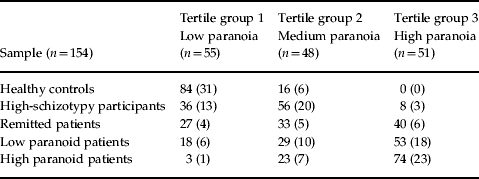
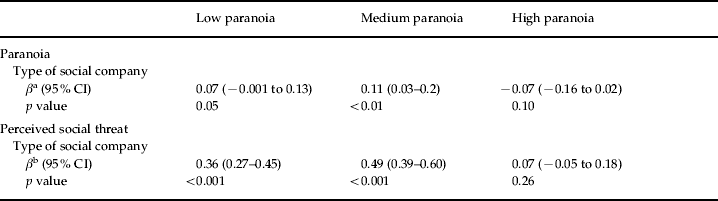
The PS is a 20-item questionnaire developed to measure subclinical levels of paranoid ideation (Fenigstein & Vanable, Reference Fenigstein and Vanable1992). It has been validated in a population of individuals diagnosed with schizophrenia (Smári et al. Reference Smári, Stefánsson and Thorgilsson1994). All items are scored on a five-point scale from ‘not at all applicable to me’ (1) to ‘extremely applicable to me’ (5). Good internal consistency (α=0.84) and stability (r=0.70) of the PS have been established. Mean scores on the PS were conceptualized as measures of trait paranoia, with higher scores reflecting higher levels of trait paranoia (scores ranging from 20 to 100). For the current study, the PS showed excellent internal consistency (Cronbach's α=0.92). The PS score distribution was divided by its tertiles, creating tertile groups (trait paranoia groups: low paranoia, medium paranoia, and high paranoia; see Table 1 for composition).
Composition of the paranoia tertile groups

Values given as % (n).
Because of rounding, percentages may not add up exactly to 100%.
The ESM
Paranoid ideation and social context variables were assessed with the ESM (Csikszentmihalyi & Larson, Reference Csikszentmihalyi and Larson1987; Myin-Germeys et al. Reference Myin-Germeys, Oorschot, Collip, Lataster, Delespaul and van Os2009). This is a random time-sampling, self-assessment technique to assess mental state and context in normal daily life. Participants received a digital wristwatch and ESM assessment forms collated in a booklet for each day. Ten times a day on six consecutive days, the watch emitted a signal at unpredictable times between 07:30 and 22:30 hours. After every ‘beep’, subjects were asked to fill out the ESM self-assessment forms previously handed to them, collecting reports of thoughts, current context (activity, persons present and location), appraisals of the current situation, mood and psychotic experiences. All self-assessments were rated on seven-point Likert scales. Open-ended questions were used to collect information on the social company at the time of each signal. Participants were instructed to complete their reports immediately after the beep to minimize memory distortions, and to record the time at which they completed the form. Reports are assumed valid when participants respond to the beep within 15 min. This was ascertained by comparing the actual beeping time with the reported time of completion of the reports. All reports completed more than 15 min after the signal were excluded from the analyses. Participants with less than 20 valid beeps were excluded from the analyses. Previous studies have demonstrated the feasibility, validity and reliability of the ESM in general and patient populations (Myin-Germeys et al. Reference Myin-Germeys, Oorschot, Collip, Lataster, Delespaul and van Os2009).
ESM measures
Social environment and company
At each beep, participants had to indicate whether they were alone or in social company (alone: 0=yes and 1=no). When not alone, participants were asked to specify the kind of social company they were in [social company: 0=being with familiar individuals (partner, children, siblings, other relatives and friends) and 1=being with less-familiar individuals (colleagues, neighbors, health-care professionals, other acquaintances and strangers)].
Momentary paranoia
In accordance with previous work (Thewissen et al. Reference Thewissen, Bentall, Lecomte, van Os and Myin-Germeys2008), momentary paranoia was defined as the mean score of the ESM items ‘I feel suspicious’, ‘I feel safe’ (reversed score), ‘I feel that others dislike me’ and ‘I feel that others might hurt me’. All items were rated on seven-point Likert scales (ranging from ‘not at all’ to ‘very’) (α=0.82).
Perceived social threat
As we sampled subjects across the range of paranoia, we also included a more subtle indicator of paranoia. In case participants were not alone at the time of the beep, they evaluated their social company. The mean score of the ESM items ‘I like this company’ (reversed score), ‘In this company, I feel threatened’, ‘In this company, I feel accepted’ (reversed score) and ‘I would rather be alone’, rated on seven-point Likert scales (ranging from ‘not at all’ to ‘very’), was conceptualized as a continuous variable of perceived social threat (Cronbach's α=0.71).
Event stress
In accordance with previous work, stress was conceptualized as the subjectively appraised stressfulness of distinctive events (event stress) (Myin-Germeys & van Os, Reference Myin-Germeys and van Os2007). Participants were asked to report the most important event that happened between the current and the previous beep. Subsequently, they evaluated its valence on a seven-point bipolar scale (ranging from –3=very unpleasant, 0=neutral, to 3=very pleasant). The variable event stress was recoded so that higher values represented higher stress levels.
Statistical analyses
Multilevel linear and logistic modeling techniques, which are ideally suited for analyses of clustered data (Schwartz & Stone, Reference Schwartz and Stone1998), were used because ESM data have a hierarchical structure with repeated momentary measurements (level 1) for each subject (level 2). Analyses were carried out with the xtreg module and the xtgee module in Stata/MP version 10.0 (StataCorp, 2007). Outcome variables included in the analyses were standardized by dividing the variables by the standard deviation of this variable over the group, yielding standardized effect sizes. All multilevel models were corrected for the a priori selected confounders sex and age.
Main effects and interactions were assessed by the Wald test. The size of moderator effects was calculated by applying and testing the appropriate linear combinations using the Stata lincom command. As we were interested in identifying quantitative versus qualitative differences across the range of paranoia, trait paranoia was included as a categorical variable in the analyses (1=low paranoia, 2=medium paranoia, 3=high paranoia).
Association between trait paranoia and the social environment
Associations between trait paranoia group and the frequency of moments that participants spent alone, with familiar individuals and with less-familiar individuals were investigated. Two multilevel logistic regression models were estimated, with trait paranoia group as the independent variable and alone and type of social company as the dependent variables respectively.
Association between momentary paranoia and the social environment
To examine the association between being alone and momentary paranoia, a multilevel linear regression analysis was estimated, with momentary paranoia as the dependent variable and alone and trait paranoia, and also their interaction, as independent variables. The interaction term (alone×trait paranoia group) was of major interest as the main hypothesis revolved around the question of whether trait paranoia group moderated the association between being alone and momentary paranoia. To estimate effect sizes for each of the trait paranoia groups separately, linear combinations were calculated. Similar analyses were conducted with social company as the independent variable and momentary paranoia and perceived social threat respectively as the outcome variables.
Paranoia at the previous moment and perceived social threat at the previous moment respectively were separately added as covariates because preceding levels of paranoia or social threat may influence the choice of company.
Association between momentary paranoia and subjectively appraised stress
All multilevel linear regression models with momentary paranoia as the dependent variable and trait paranoia group as the predictor variable were repeated with event stress as the predictor variable.
Results
Sample and descriptive statistics
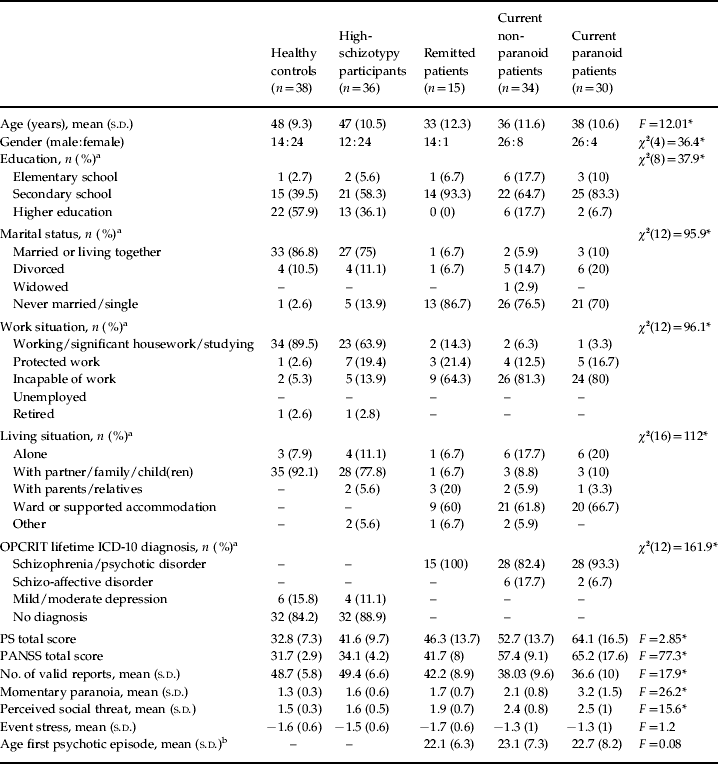
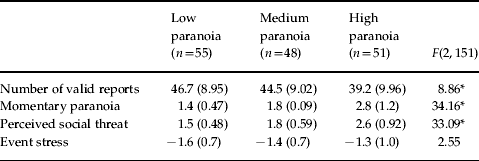
Of the 183 participants in the study, 29 (15.8%) were excluded from the analyses. Twenty-two participants terminated the study before the end of the 6-day sampling period because of severity of psychotic symptoms (n=11), not being able to understand the instructions (n=5) or lack of cooperation (n=6). Although they finished the study, three individuals were excluded because of an insufficient number (<20) of valid ESM observations, one individual because of missing data on the PS, one individual because of missing data on the PANSS, and two individuals because of missing data on both the PS and the PANSS. Of the 29 individuals who were excluded from the analyses, 24 were patients, three were high-schizotypy participants, and two were healthy controls. Drop-out was not associated with levels of event stress, momentary paranoia, momentary perceived social threat or trait paranoia. The final study sample therefore comprised 154 participants. These participants had each completed an average of 44 valid ESM reports (s.d.=10). Further details regarding the number of valid reports and sociodemographic and clinical characteristics of the sample are presented in Tables 2 and 3.
Subsample characteristics
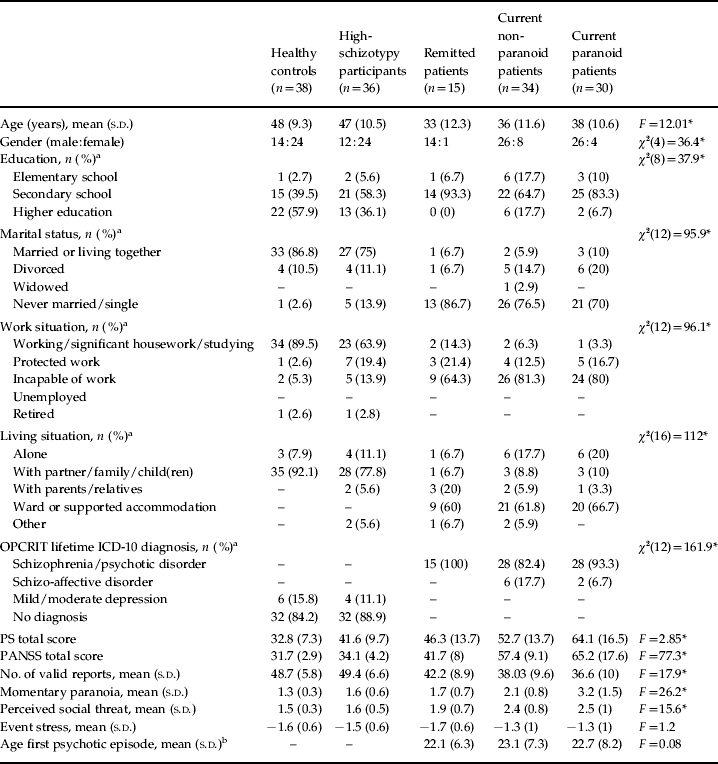
PS, Paranoia Scale; PANSS, Positive and Negative Syndromes Scale; s.d., standard deviation.
a Because of rounding, percentages may not add up exactly to 100%.
b Because of missing values, data were only calculated for 27 current paranoid patients, 30 current non-paranoid patients, and 14 remitted patients.
* p<0.001.
Experience Sampling Method (ESM) variables for each paranoia tertile
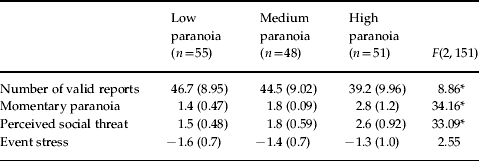
Values given as mean (standard deviation). Separate means were calculated for each participant and subsequently aggregated to obtain group means.
* p<0.001.
Association between trait paranoia and the social environment
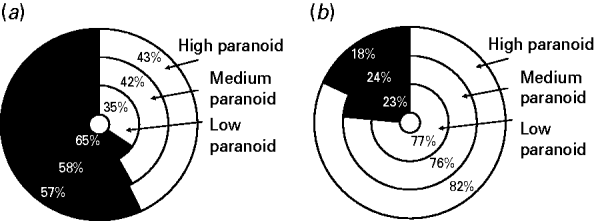
Trait paranoia group was not significantly associated with the amount of time participants spent alone [χ2(2)=3.30, p=0.19] (see Fig. 1 a for percentages). Moreover, trait paranoia group was not associated with the relative amount of time participants spent with either familiar or less-familiar individuals [χ2(2)=2.02, p=0.36] (see Fig. 1b for percentages).
(a) Time spent alone (□) versus time spent not alone (▪) by group. (b) Time spent in familiar company (□) versus time spent in non-familiar company (▪) by group.

Association between momentary paranoia and the social environment
There was no significant main effect of being alone on momentary paranoia [β(s.e.)=0.009 (0.02), p=0.68]. Moreover, multilevel analyses revealed no significant interaction between trait paranoia group and being alone in the model of momentary paranoia [χ2(2)=2.28, p=0.32]. A marginal main effect was found for type of social company in the model of momentary paranoia [β (s.e.)=0.07 (0.04), p=0.052], with more momentary paranoia in the company of less-familiar individuals. In addition, level of trait paranoia moderated the effect of social company on momentary paranoia [χ2(2)=10.02, p<0.01]. In the low and medium paranoia groups, more paranoia was reported when in the company of less-familiar people (Table 4). The high paranoia group reported no difference in paranoia when they were in less-familiar compared to familiar company (Table 4).
Effect of social environment on momentary paranoia assessed by paranoia group
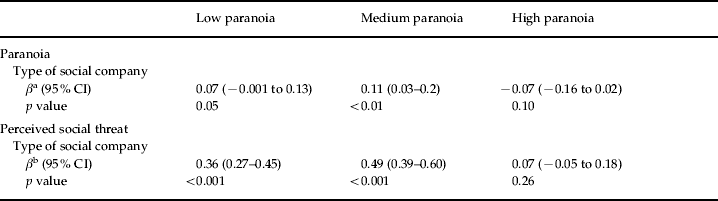
CI, Confidence interval; β, regression coefficient.
a Regression coefficient indicates change in ESM paranoia associated with being in familiar company versus being in non-familiar company, analyses adjusted for age and sex.
b Regression coefficient indicates change in ESM perceived social threat associated with being in familiar company versus being in non-familiar company, analyses adjusted for age and sex.
For perceived social threat, a main effect was found for the type of social company, suggesting more perceived social threat in the company of less-familiar individuals [β (s.e.)=0.36 (0.04), p<0.001]. Again, a significant interaction was apparent between trait paranoia and social company [χ2(2)=31.59, p<0.001]. Low and medium paranoid subjects reported higher levels of perceived social threat when they were with less-familiar compared to familiar individuals, whereas no difference was found for the high paranoia group (Table 4). After controlling for paranoia or perceived social threat at the previous moment, all interaction effects remained significant.
Association between momentary paranoia and subjectively appraised stress
Multilevel analyses revealed a significant interaction between paranoia group and event stress in the model of momentary paranoia [χ2(2)=12.86, p<0.01]. Higher levels of event stress predicted higher levels of momentary paranoia in all groups. However, the effect was largest in the high paranoia group [β (s.e.)=0.06 (0.01), p<0.001], medium large in the second paranoia tertile [β (s.e.)=0.04 (0.01), p<0.001] and smallest in the low paranoia group [β (s.e.)=0.03 (0.004), p<0.001]. Slightly decreased but still significant effect sizes were found when controlling for paranoia at the previous moment.
Sensitivity analysis
Additional analyses were performed to investigate whether inclusion of the participants, who were excluded because of an insufficient number of valid ESM observations, influenced the results. Apart from some small effect size alterations, all results remained unchanged.
Discussion
The present study investigated the effect of real-life social situations on moment-to-moment changes in paranoia. It was shown that social situations may be particularly relevant in the variability of low and mild levels of paranoia, whereas high levels of paranoia may become autonomous and independent of the social environment. However, general levels of subjective distress were important predictors of paranoid thinking at all levels of trait paranoia, and indeed the most paranoid individuals showed the greatest reactivity to subjective stress.
Trait paranoia and social context
There were no differences between the paranoia groups in time spent alone versus time spent in company. Moreover, there were no differences between the groups in time spent in familiar company versus time spent in less-familiar company. This may seem counterintuitive because, for example, the overall size of the social networks of psychotic patients is often smaller than in control groups (Macdonald et al. Reference Macdonald, Hayes and Baglioni2000). Moreover, social avoidance as a result of safety behaviors has been related to trait paranoia (Freeman et al. Reference Freeman, Garety and Kuipers2001, Reference Freeman, Garety, Kuipers, Fowler, Bebbington and Dunn2007). Likewise, social withdrawal is a common phenomenon emerging prior to manifestation of psychosis (Hoffman, Reference Hoffman2007). However, our results are in line with the results of another ESM study that reported no effect of psychosis proneness on time spent alone or with familiar individuals (Husky et al. Reference Husky, Grondin and Swendsen2004). Our results thus suggest that individuals with high levels of paranoia are not necessarily alone more often during everyday life, even though their social networks may be smaller. Demographic characteristics of the three groups might explain these results. Although few participants of the high paranoia group lived together with a partner or family, about 57% of them were living on a psychiatric ward or in supported accommodation with other patients, probably resulting in more social company.
Momentary paranoia and the social environment
The current study found a different association between the type of social company and momentary fluctuations in paranoid ideation dependent on trait paranoia. Type of social company most prominently affected momentary paranoia in the medium paranoia group, who experienced increases in momentary paranoia and perceived social threat when in the company of less-familiar people. This result concurs with earlier findings. In the study by Verdoux et al. (Reference Verdoux, Husky, Tournier, Sorbara and Swendsen2003), a non-clinical population with a high level of vulnerability for psychosis experienced an increase in psychotic experiences when in non-familiar compared to familiar social company (Verdoux et al. Reference Verdoux, Husky, Tournier, Sorbara and Swendsen2003). Moreover, an effect of social company on paranoia for high-schizotypy groups in particular has been confirmed repeatedly by virtual reality studies (Freeman, Reference Freeman2008).
Of note, these effects were absent at high levels of trait paranoia. This seems in contrast with the results of the study by Myin-Germeys et al. (Reference Myin-Germeys, Nicolson and Delespaul2001), who found a decreased risk of experiencing delusions when patients were in familiar social company. A possible explanation for this difference might be the composition of the samples. Whereas in the current study participants were divided on the basis of their level of trait paranoia, the patient sample in the study by Myin-Germeys et al. (Reference Myin-Germeys, Nicolson and Delespaul2001) consisted mostly of stable, chronic patients, possibly with medium rather than high levels of trait paranoia.
The qualitative differences we found between paranoia groups seem to be specific for the association between paranoia and social company, which is a relatively ‘objective’ contextual measure. For event stress, which reflects the subjective appraisal of an event as stressful, we found quantitative differences of paranoid reactivity between the groups. The low paranoia group experienced the least paranoia in response to event stress whereas the high paranoia group experienced the most, suggesting a dose–response effect on paranoid thinking.
These findings suggest that, for highly paranoid individuals, subjective experiences of stress have become decoupled from social context.
Underlying mechanisms
The current findings suggest that, superimposed on the continuity of psychosis, which has been supported by a meta-analysis of data on the distribution of psychotic symptoms (van Os et al. Reference van Os, Linscott, Myin-Germeys, Delespaul and Krabbendam2009), there may be qualitative differences between those with severe psychotic experiences and those whose experiences are less severe. Our observations are unlikely to reflect a ceiling effect for paranoid thinking because even those participants who were high on trait paranoia showed fluctuations in response to subjectively appraised stress.
The results obtained from the low and medium paranoia groups suggest that sensitivity to social context is a normal, perhaps adaptive, process; when exposed to unfamiliar people, an individual may be inclined to be wary and suspicious of their intentions, but when encountering someone with whom they have a long history of positive interactions, wariness may not be warranted. The failure to take into account this social contextual information may be a core feature of severe paranoid delusions.
It is possible that this finding helps to explain other discontinuities that have been observed across the paranoid spectrum. Attributional style (reasoning about causes of events) (Kinderman & Bentall, Reference Kinderman and Bentall1996) has been found to differ across the range of paranoia. Some studies have reported that paranoid patients make excessive external attributions for negative events (e.g. Kaney & Bentall, Reference Kaney and Bentall1989; Janssen et al. Reference Janssen, Versmissen, Campo, Myin-Germeys, van Os and Krabbendam2006), but this style seems to be absent in less severely paranoid non-clinical samples (Martin & Penn, Reference Martin and Penn2001; Combs & Penn, Reference Combs and Penn2004; Janssen et al. Reference Janssen, Versmissen, Campo, Myin-Germeys, van Os and Krabbendam2006). Furthermore, acutely ill paranoid patients predominantly have ‘poor me’ paranoid beliefs, in which they believe that they do not deserve to be persecuted (Fornells-Ambrojo & Garety, Reference Fornells-Ambrojo and Garety2005; Bentall et al. Reference Bentall, Rowse, Kinderman, Blackwood, Howard, Moore, Cummins and Corcoran2008), but less severely paranoid non-patients typically report ‘bad me’ beliefs, in which they believe that they do deserve to be persecuted (Melo et al. Reference Melo, Corcoran, Shryane and Bentall2009). The relationship between these discontinuities is as yet poorly understood. One possibility is that, in the absence of the ability to adjust suspiciousness and perception of threat according to context, paranoid beliefs escalate, leading to the generalized assumption that misfortunes are always caused by the intentional action of others (externalizing attributional style), together with the belief that one is being undeservedly persecuted (poor me paranoia).
Recent evidence suggests that the striatal dopamine system may play a role in threat anticipation that parallels its well-documented role in reward learning (Moutoussis et al. Reference Moutoussis, Bentall, Williams and Dayan2008). Hence, the finding that, at a high level of paranoia, social threat anticipation and paranoid thinking are independent of social context may be consistent with the hypothesis, supported by some recent evidence (Roiser et al. Reference Roiser, Stephan, den Ouden, Barnes, Friston and Joyce2009), that acute psychosis is associated with a hypersensitized dopamine system that operates independently of context (Laruelle & Abi-Dargham, Reference Laruelle and Abi-Dargham1999). Evidence from recent functional magnetic resonance imaging (fMRI) research is also in line with the present findings, suggesting that paranoid individuals with schizophrenia in contrast to non-paranoid individuals with schizophrenia and a control group exhibit impaired modulation of neural activity when processing social stimuli (Pinkham et al. Reference Pinkham, Hopfinger, Pelphrey, Piven and Penn2008).
Methodological issues
Measurements of momentary paranoia, perceived social threat, event stress and the social environment were based on subjective reports. Although it is sometimes assumed that subjective reports can be considered less reliable than objective measures, they can be valid, whereas the validity of objective approaches should not be taken for granted (Strauss, Reference Strauss1994). In addition, the current study used a daily life assessment technique in which participants had to comply with a paper-and-pencil diary protocol without the researcher being present, making it impossible to determine directly whether patients filled in the booklets after the beeps or whether they were backfilling their diaries. Therefore, some authors have cast doubt on the reliability and subject compliance in paper-and-pencil ESM studies, favoring the use of electronic devices (Stone et al. Reference Stone, Shiffman, Schwartz, Broderick and Hufford2003). However, in a comparative study, Green et al. (Reference Green, Rafaeli, Bolger, Shrout and Reis2006) concluded that both methods yielded similar results. With a paper-and-pencil approach, participants are instructed to write down the time when they filled out the assessment and only those assessments filled out within a 15-min time frame of the beep are considered valid. If participants want to backfill the diary, they at least have to carry the watch and note all the times, because beeps are presented randomly over the day. A recent study of our group using a signal-contingent random-time sampling procedure with multiple observations per day, such as the protocol used in the current study, found evidence underscoring acceptable compliance rates and thus the validity of the paper-and-pencil random-time self-report data in the current study (Jacobs et al. Reference Jacobs, Nicolson, Derom, Delespaul, van Os and Myin-Germeys2005). The research sample was specifically selected for paranoid symptoms. Therefore, conclusions cannot be generalized to delusions in general.
Conclusions
The data suggest that important differences exist across the range of trait paranoia in the effect of social context on paranoid thinking. The development of momentary paranoia seems to be context dependent in individuals with medium or at-risk levels of trait paranoia, probably reflecting adaptive processes. However, at high levels of trait paranoia, momentary paranoia and momentary perceived social threat seem to become autonomous and independent of the social reality.
Further examination of these effects may have implications for the clinical management of paranoid patients. Cognitive behavioral therapy for paranoid symptoms usually involves encouraging patients to reflect on the social context of their symptoms and question their interpretations of events (Morrison et al. Reference Morrison, Renton, Dunn, Williams and Bentall2003). If paranoid thoughts are autonomous of social context, patients may have difficulty doing this. It seems possible that approaches that encourage detached acceptance of unpleasant thoughts, for example acceptance and commitment therapy, will be more effective. A small randomized controlled trail has reported positive effects of acceptance commitment therapy for patients recovering from acute psychosis (Bach & Hayes, Reference Bach and Hayes2002).
Acknowledgements
This work was supported by a 2006 National Alliance for Research on Schizophrenia and Depression (NARSAD) Young Investigator Award and by the Dutch Medical Research Council, VIDI grant (no. 917.76.341) to I.M.-G. We thank T. Driesen and F. van Goethem for data administration.
Declaration of Interest
None.