An estimated 107,600 cases of hospital-onset Clostridium difficile infection (CDI) occur in the United States each year.Reference Lessa, Mu and Bamberg 1 Intervention measures recommended by the Healthcare Infection Control Practices Advisory Committee (HICPAC) to prevent C. difficile transmission within healthcare settings include the use of contact isolation precautions.Reference Siegel, Rhinehart and Jackson 2 Prompt initiation of contact precautions following clinical suspicion of CDI is advised when ongoing transmission of C. difficile is evident or an increase in CDI rates occurs. 3 However, time lags in implementing isolation protocols for CDI have been reported.Reference Behta, Landzberg and Jia 4
One strategy to decrease the time to isolation precautions for CDI patients is to bundle interventions such as isolation orders electronically (eg, with computerized order entry) for ease of use and standardization of care. 3 , Reference Dubberke, Carling and Carrico 5 , Reference Abbett, Yokoe and Lipsitz 6 Although several studies have reported reductions in CDI rates using bundle approaches, the impact of CDI bundles on the timing of contact precaution initiation remains largely unexplored.Reference Abbett, Yokoe and Lipsitz 6 , Reference Muto, Blank and Marsh 7 , Reference Weiss, Boisvert and Chagnon 8 The aim of this study was to evaluate clinician usage of an electronic CDI prevention and management bundle and to compare time to isolation with bundle use versus no bundle use.
METHODS
A retrospective study was conducted at St. Joseph Mercy Hospital, a 537-bed teaching community hospital, and included all adult patients diagnosed with CDI from January through June 2014. Testing for CDI consisted of an enzyme immunoassay (EIA) for glutamate dehydrogenase (GDH) and an EIA for detection of toxin A/B (C. diff Quik Check Complete, Alere, Waltham, MA). If testing for GDH was positive and the EIA for toxin A/B was negative, then a confirmatory commercial polymerase chain reaction (PCR) assay (Xpert C. difficile, Cepheid, Sunnyvale, CA) was performed. A diagnosis of CDI was defined as GDH-positive and toxin-positive or as PCR-positive laboratory results.
Institutional guidelines for the management of CDI were developed in accordance with national and international guidelines.Reference Cohen, Gerding and Johnson 9 , Reference Bauer, Kuijper and Dissel 10 The guidelines delineate appropriate CDI antimicrobial therapy based on clinically defined disease severity (eg, mild, moderate, severe, or severe with complications) and number of CDI occurrences. They also contain ancillary treatment recommendations such as the discontinuation of unnecessary concomitant antimicrobials and acid suppressant medications whenever possible.
An order set for the prevention and management of CDI based on institutional guidelines was implemented in our computerized prescriber order entry (CPOE) system, Cerner PowerChart (Kansas City, MO), in November 2013. The bundle included interventions in 4 key areas: consults (to infectious diseases or colon and rectal surgery for severe or severe and complicated CDI), patient care (isolation precautions, patient education, consideration for fecal management system), medications (discontinuation of non-essential proton-pump inhibitors or H-2 blockers and concomitant antibiotics; CDI treatment based on severity), and tests (C. difficile laboratory order). Physicians and mid-level providers could use the electronic bundle to order 1 or more interventions. However, options to order CDI-related interventions independent of the bundle remained. If the electronic bundle was used for any CDI intervention, contact precaution orders for CDI were automatically issued. Nurses and infection preventionists (IPs) were not able to use the electronic CDI bundle but were able to place electronic isolation orders through a separate infection prevention order. Several educational sessions were conducted to teach and encourage physicians, residents, and nurses about the use and specific components of the CDI prevention and management bundle. For this study, 3 key bundle components were evaluated: the CDI laboratory test, isolation orders, and treatment orders.
Time to isolation was defined as the length of time (hours) from the first CDI laboratory test order to the time contact precautions for CDI were ordered. For patients with no documentation of contact precaution orders, time to isolation was defined as the time from the CDI laboratory test order to the time of patient discharge, given that the patient was discharged ≥48 hours after the CDI positive laboratory result was reported.
Patients were identified by positive laboratory result and historical chart reviews conducted on all cases meeting the inclusion criteria. The 2 coinvestigators (C.M.D. and N.B.) completed data collection through the electronic medical records. Validation procedures were conducted for 10% of the study population to ensure consistency between reviewers. SAS 9.4 was used for statistical analysis. Tests for significance of demographic variables by bundle use were conducted using χ2 and Wilcoxon Rank-sum tests. To assess differences in mean time to isolation by selected variables, we used linear regression, Wilcoxon Rank-Sum, and Kruskal-Wallis tests.
RESULTS
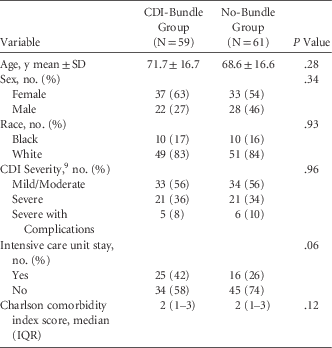
We identified 132 patients with CDI during the 6-month study period. Contact precautions were ordered for 114 patients (86.4%), and 18 patients (13.6%) had no documentation of isolation for CDI. Of these 18 patients, 6 patients were discharged ≥48 hours after a CDI-positive laboratory result, and the remaining 12 patients had laboratory results reported <48 hours before discharge or results reported after patient discharge from the hospital. These 12 patients were therefore excluded from further analyses. Finally, 120 patients were included in our analyses of time to isolation (Table 1).
Demographic Characteristics of the Study Population

NOTE. CDI, Clostridium difficile infection; IQR, interquartile range.
Among these 120 patients, the CDI bundle was accessed in 59 cases (49.2%), and use of the CDI bundle reduced time to implementation of contact precautions (Fig. 1a): the mean time to isolation was reduced by 11.3 hours (from 33.7 to 22.4 hours; P<.04) (Fig. 1b). Use of individual bundle components also reduced time to isolation compared to no bundle use, but not significantly (Fig. 1c). However, use of the bundle to order all 3 components (ie, laboratory testing, isolation orders and treatment orders) was associated with a significant reduction in mean time to isolation (−11.8 hours; P<.01).
Analysis of time to isolation with use of an electronic C. difficile infection (CDI) prevention and management bundle by (A) proportion of cases not in isolation following the CDI laboratory test order with bundle use (any component) versus without bundle use (Wilcoxon χ2=3.56; P<.06), (B) mean time to isolation by bundle use (any component) versus no bundle use (Z=−2.07; P<.04), and (C) mean time to isolation by first bundle component accessed (F value=0.77; P<.55). *Other, defined as use of the CDI bundle to order a component apart from the laboratory test, treatment order, or isolation order.

Time to isolation differed significantly by the provider ordering isolation precautions. When placed by physicians and mid-level practitioners (n=78; 68%), the mean time to isolation was 13.9 hours, compared to 34.8 hours when placed by nurses (n=12; 11%) and 53.5 hours when placed by IPs (n=24; 21%; P<.0001).
DISCUSSION
The results of our study indicate that adoption of a CDI prevention and management bundle by physicians and mid-level providers for suspect CDI cases will reduce time to isolation. The greatest reductions were associated with bundle use to order all 3 components studied (ie, laboratory test, isolation orders, and treatment orders) and when laboratory testing was the first component ordered through the electronic bundle. Differences in time to isolation by ordering provider likely reflect access to the electronic bundle. Delays in time to isolation associated with IPs highlight the importance of early bundle use by clinicians to ensure that electronic isolation orders are implemented upon clinical suspicion of CDI as opposed to initiation of contact precautions after IPs are made aware of a positive test for CDI. Initiatives to increase physician and mid-level provider use of the electronic bundle are needed; the CDI bundle was used to manage <50% of CDI cases. One strategy might use electronic methods to automatically direct physicians to the bundle when ordering CDI-related interventions. Further investigation should also explore automatic linking of electronic orders with contact precautions when ordering CDI testing.
Due to the single-center nature of this study, the association between CDI bundle use and reduced time to isolation may not be generalizable to institutions with differing CDI management bundles or protocols. Additionally, compliance with initiation of contact precautions for CDI was determined by electronic documentation only; adherence to these precautions in actual clinical practice was not measured. Nonetheless, our results suggest that electronic bundles can be effective to facilitate and standardize care to reduce transmission of CDI in acute care settings.
ACKNOWLEDGMENTS
The authors would like to thank Cheryl Morrin, BS, Infection Preventionist at St. Joseph Mercy Hospital for providing consultation on hospital protocols.
Financial support: This study was supported by the University of Michigan School of Public Health Certificate in Healthcare Infection Prevention and Control program and the Frank Robbins Scholarship fund.
Potential conflicts of interest: All authors report no conflicts of interest.