During the Ulster crisis (1912-14), a postcard of ‘Newry under Home Rule’ depicted farm animals grazing in the town centre, statues erected to James ‘Skin the Goat’ Fitzharris and ‘the great statesman and patriot’ Redmond, along with an impressive building with green flags flying and the title ‘Ancient Order of Hibernians’ emblazoned across its front.Footnote 1 The Newry image was just one in a series of anti-home rule propaganda pieces, each illustrating the fears expressed by unionists concerning Irish self-government: the neglect of Ulster's commercial strength in favour of a focus on agriculture; nationalist political domination; and the hegemony of the Catholic interests exemplified by the fraternal organisation, the Ancient Order of Hibernians (A.O.H.). All of these features represented a regime its opponents viewed as Rome rule rather than home rule. Described by Michael Foy as a ‘political religious pressure group’, the A.O.H. was a powerful auxiliary to the Irish Parliamentary Party (I.P.P.) in early-twentieth-century Ireland.Footnote 2 It achieved significant political as well as social and economic prominence, attracting thousands of members and inspiring both loyal support and opprobrium in equal measure from politicians across the spectrums of nationalism and unionism. One of the organisations with delegates at the Irish Party's United Irish League (U.I.L.) selection conventions, the order's pre-war growth was, according to Wheatley, ‘in stark contrast’ to the decline of the U.I.L.Footnote 3 However, its organisational — and therefore political — strength was most pronounced in Ulster where its fidelity to ‘faith and fatherland’ was tested to the limit as proposals for home rule and partition separated Hibernians in towns like Newry from their members elsewhere.
While the A.O.H. is, therefore, crucial to understanding nationalist Ulster and the border question in this period, its reputation for fraternal secrecy and the apparent suddenness of its decline in the years after the Irish Party's 1918 collapse caused it to receive little scholarly attention for many years (certainly in comparison to the loyal orders).Footnote 4 Although the order's official histories claim a lineage dating back to the era of the penal laws and Rory Oge O'More, academic historians have tended to trace the order's origins to the Ribbonmen movement — an agrarian secret society with a lodge structure and associational culture which prospered in the northern half of Ireland in the nineteenth century.Footnote 5 Exclusive to Irish Catholic men (women could join the Ladies’ Auxiliary) or those of Irish descent as well as clergy, the A.O.H. was already a major organisation among the North American diaspora by the late nineteenth century. Having begun in Ribbonism, it developed into a more public Hibernian body offering communal solidarity and opportunities for collective action for its largely working-class membership, most famously in the mines of Pennsylvania.Footnote 6
Indeed, it was in the United States that Hibernianism caught the attention of Joe Devlin, an ambitious young home rule politician with a flair for organisation. While the order was bedevilled by splits on both sides of the Atlantic, in 1904, Devlin became president of the Board of Erin (B.O.E.) A.O.H. — the dominant branch in Ireland throughout the twentieth century and the organisation under consideration in this article.Footnote 7 The B.O.E. A.O.H. exercised control in Ireland and Britain but was in fact largely estranged from its American counterpart — a far larger organisation which split with the board in 1884 due to the B.O.E.'s insistence that both of a prospective member's parents had to be Irish to qualify for membership.Footnote 8 Schism developed within Ireland and Britain too as a Glasgow branch registered as a friendly society, leading to the A.O.H. ‘benefit society’ with advanced nationalist sympathies splitting from the pro-Irish Party B.O.E. in 1904. The B.O.E., however, won a protracted legal and propaganda battle, and its rival went bankrupt. On a visit to Ireland in 1909, American Hibernian President Matthew Cummings endorsed alliance with the B.O.E.'s rivals rather than the Devlin-backed organisation. However, membership of the subsequently-styled ‘Irish American Alliance A.O.H.’ remained small despite the participation of its adjunct, the Hibernian Rifles, in the Easter Rising.Footnote 9
The B.O.E. was, therefore, overwhelmingly successful in Ireland and Britain with Irish Party M.P. Joe Devlin as President and John Dillon Nugent, who minuted the board's meetings and directed the organisation's day-to-day operations, the national secretary.Footnote 10 Beneath the board in the organisational structure were districts and county boards, and each branch was called a ‘division’. Board members were elected at the order's biennial convention and provincial directors at provincial conventions. As well as being Catholic and Irish (or having Irish descent), candidates for membership in the 1900s had to pledge support for Irish self-government. ‘Benefit’ members were a feature but candidates for such had to furnish a medical report before applying. Others could simply join as a ‘friendly’ member with no claim to benefits in case of sickness of death.Footnote 11 From 1911 onwards, the order became an ‘approved society’ which saw the creation of a separate national health insurance society. By this point, Devlin, Nugent and the Board were able to direct policy, and individual divisions had little opportunity to influence the direction of the organisation other than via contributions to the A.O.H.'s biennial conventions.
Despite such close ties to the Irish Party as the third home rule crisis developed, aspects of the role of the order in Ireland have eluded scholarly attention. Michael Foy's 1976 dissertation remains the only full-length study of the order in Ireland, and its focus lies primarily in the period up to the Irish Party's defeat in 1918, after which he describes the order going into ‘almost relentless decline’.Footnote 12 The work of A. C. Hepburn, Eamon Phoenix and Fergal McCluskey has illuminated key elements of the order's relationship with northern nationalism. Scholars of the home rule movement and the Ulster crisis have noted the A.O.H.'s contribution to politics and its contemporary reputation.Footnote 13 Recent research by Daniel McCurdy has posited the A.O.H. as a ‘constitutional separatist’ wing of the home rule movement, while others like Wheatley and Charles Townshend have contrasted it with the agrarian-based U.I.L., labelling the order ‘overtly sectarian’ and ‘frankly sectarian’ — criticisms echoed by its contemporary opponents (including advanced nationalists who resented an organisation which was seen to put a religious test on nationalism).Footnote 14
Yet, despite this scholarship, Tim Wilson's penetrating analysis of the A.O.H.'s role in communal defence and its relationship with the I.R.A. in the early 1920s,Footnote 15 and a burgeoning field of sophisticated studies examining the history of the Irish border, there has been no dedicated study of the order from the beginning of the Ulster crisis through to the early years of partition which draws on the A.O.H.'s own records.Footnote 16 As the first study beyond parish level to examine the records of the order's governing Board of Erin, this article analyses how Devlin, Nugent and other key figures in the organisation directed policy and sought to negotiate the tumults of the period in its Ulster heartland.Footnote 17 The Board of Erin files in the National Archives of Ireland and the order's monthly publication, the Hibernian Journal, also allow some scrutiny of grassroots foment, dissension among Hibernians, the suspension of divisions and the defections to Sinn Féin which undermined A.O.H. organisation. Highlighting the importance of gender and class to political activism, this article will illustrate how Devlin and the order coped with proposals to exclude counties in its northern powerbase from home rule and how the A.O.H. sought to sustain and reinvent itself amid the violence which accompanied the implementation of partition. While the A.O.H. shared many of the travails of the wider home rule movement, the period following 1918 drove it back to its northern strongholds on both sides of the new border.
I
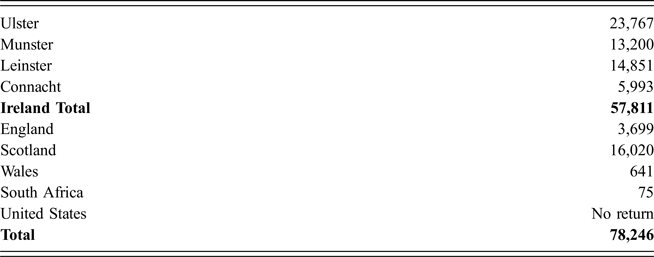
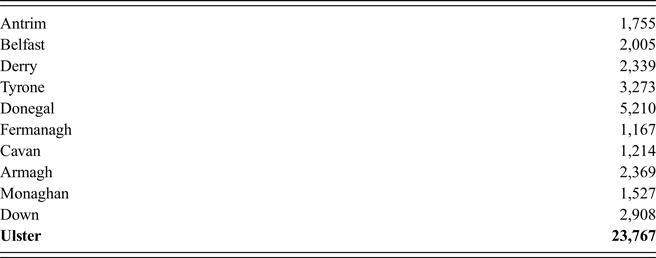
The Board of Erin-controlled order was the primary support to the Irish Party in Ulster, where the salience of the land question was less pronounced and the U.I.L.'s appeal commensurately weaker than elsewhere.Footnote 18 An organisation with a strong Catholic ethos, the social functions of the order were also important to its members — dances and parades involving Hibernians bands were key features of its activities. It won further support nationally after the 1911 National Insurance Act, with the order's ‘approved society’ providing health insurance to thousands of members around the country. Indeed, as Wheatley has pointed out, by the end of 1912 it had enrolled 130,000 ‘purely insurance members’ in its approved society. By 1914, over 1,400 people were employed in its insurance interest.Footnote 19 Its core membership grew too, even if its appeal remained strongest in Ulster, as can be seen in Tables 1 and 2.Footnote 20
A.O.H. Board of Erin membership, 31 March 1913Footnote 21

A.O.H. membership in Ulster, 31 March 1913

Source: Hibernian Journal, Apr. 1913, p. 22
Devlin worked hard to improve the order's less than respectable reputation and to promote communal solidarity with a cross-class appeal. However, the order's Ribbon origins and members often attracted hostility, with Cardinal Michael Logue of Armagh being foremost among those in the church who remained critical — to the point that Irish Party M.P. Jeremiah MacVeagh, rather than Devlin, was often sent to meet the prelate.Footnote 22 The order was characterised by Seán T. O'Kelly as ‘our most vigorous opponents’ when he was a young Sinn Féin activist. The Hibernians’ influence was also felt by William O'Brien, the M.P., whose final exit from the Irish Party came at the hands of the A.O.H. at the infamous ‘Baton Convention’ of 1909, where O'Brien and his followers who opposed Redmond's approach to the Birrell Land Act were attacked by Hibernians.Footnote 23 In addition to their role in fighting the 1908 North Leitrim by-election, the order's reputation as the I.P.P.'s ‘Belfast stormtroopers’ was, thus, a controversial theme in debates about who would wield power in a home rule Ireland.Footnote 24
For unionists, home rule was the thin end of a wedge which would ensure Catholic domination of economic policy, government jobs, education and a Tammany Hall-style politics where members ensured votes were delivered to the A.O.H. boss.Footnote 25 Such fears were at the heart of unionists’ objections to home rule in toto, and later its application to Ulster. These concerns were hardly assuaged by the A.O.H.'s rhetoric, which could be fierce — though it rejected claims it aspired to ascendancy. As Foy has observed, the A.O.H. was on the ‘militant side’ of the home rule movement and the language of many members was not in the tradition of Isaac Butt or John Redmond in seeking to make the relationship with British rule work more effectively.Footnote 26 Articles in the Hibernian Journal (which was not sold publicly between 1911 and 1915) attacked what it saw as the malign influence of Freemasons, while Nugent wrote how ‘the whole system of government in Ireland is poisoned by intolerance and ascendancy’.Footnote 27 While its leadership was constitutional, the order's more ambiguous roots were again underlined by the ‘Castledawson incident’ on 29 June 1912, when a Presbyterian Sunday school party of approximately 500 was attacked by about 300 Hibernians near the county Derry village. McGaughey notes violence is believed to have started when the Hibernian William Craig ‘allegedly ran into the crowd of mostly women and children’ to grab a Union Jack flag, sparking locals to rush to defend the Sunday school party. There was clearly a gendered element to this (and suggestions that alcohol played a part on the Hibernian side).Footnote 28 This attack and the shipyard expulsions of Catholic workers in Belfast which followed highlighted the potential for fraternal orders to drive intercommunal violence and inflame an already volatile political situation. However, in the Hibernian Journal the expulsions were simply blamed on
the Belfast bigot [who] is merely the product of a selfish gang of sweaters and place-hunters who look to the propagation of sectarian bigotry in Ireland and racial hate in Great Britain as the only ladder by which they can climb to places of power and wealth.Footnote 29
Considering the A.O.H. in a wider context, the common features of fraternalism in early modern Europe and modern America identified by Mary-Ann Clawson — corporate idiom, proprietorship, public ritual and masculinity — could all certainly apply to an organisation for which a conception of society as composed of groups was essential. The order offered collective cooperation and sought to promote its members in public and commercial life, while its parades, green sashes and regalia indicated a performative masculinity which privileged traditional gender roles.Footnote 30 Its Ladies’ Auxiliary was a relatively late development — it had just 170 branches in Ireland in 1915 compared to 1,027 male divisions and seventeen boys’ brigades.Footnote 31 The A.O.H. was, therefore, not very different to other fraternities, though masonry was anathema to the A.O.H. and it rejected any comparison between itself and the loyal orders.Footnote 32 As tensions rose surrounding parades during the home rule crisis and the unity of Ireland (and Ulster) was questioned, the A.O.H. sought to demonstrate the difference by cancelling its Lady Day parades (the biggest event in the Hibernian calendar) on 15 August in Ulster between 1912 and 1914.Footnote 33 The order argued that Volunteer drilling in A.O.H. halls did not give the order ‘a sectarian hue’, and in June 1914 it denied accusations that the Hibernians took a ‘bloodthirsty’ sectarian oath.Footnote 34 While a portrayal of the order as an ‘anti-Protestant conspiracy’ had appeared in the 1907 publication The unknown power behind the Irish nationalist party, the A.O.H.'s 1914 defence was part of a sustained contrast it sought to draw between itself and the Orange Order.Footnote 35
While the Castledawson episode remains one of the most infamous of the Ulster crisis, the Hibernian Journal's outburst addressing intercommunal tensions was unusual in these years. At an official level, the A.O.H.'s strategy for the vexed period when volunteer forces were formed and armed in both communities was often to play down the biggest controversies in Ulster, especially the threat of partition. Exclusion of Ulster counties was the dog that did not bark in the Hibernian Journal between 1912 and 1914. There was significant Hibernian cooperation with the Volunteers (including enlistment, the ‘erection of miniature shooting ranges’ and the provision of ‘drill accommodation’ in A.O.H. halls).Footnote 36 Yet, the publication the order distributed to divisions referred to arguments surrounding Ulster and home rule infrequently, instead focusing on the operation of the new insurance legislation in 1912 and the Dublin strike and lock-out in the winter of 1913‒14.Footnote 37
As high-political debates at Westminster and elsewhere teased out the intricacies of ’county option’ for Ulster in a home rule settlement, by June 1914 the A.O.H. projected an ebullient confidence in imminent self-government, declaring the ‘union is dead’.Footnote 38 The Hibernian Journal furthermore praised the ‘forbearance and restraint’ of Ulster nationalists throughout the crisis:
Foremost in fighting the battle of freedom in the past, the Hibernians will be amongst the first to welcome any advance towards conciliation and concord, realising that in true union lies the real strength of the nation, and that in realising its destinies and fashioning its future, Ireland needs the help of all our sons. Hibernianism does not and never has stood for ascendancy of either class or creed.Footnote 39
Such sentiments were as close as the publication came to acknowledging the threat to unity in these years. As war broke out in Europe, the A.O.H. produced a special souvenir edition of the Journal in September 1914 to mark the ‘result of our united effort’ as it proclaimed ‘victory is ours’ in response to the home rule legislation attaining royal assent.Footnote 40 Once more rejecting the claims that the Hibernians were ‘bigots’ and ‘secret intriguers’, the only oblique reference to Ulster exclusion was the printing of Parnell's dictum that ‘we cannot give up a single Irishman’ as the poetry of Thomas Davis appeared alongside quotes from Devlin, Redmond and John Dillon. The war saw the A.O.H. move away from its previous ban on army members joining the order, and it sought to maintain morale with discussion of how a home rule Ireland might operate.Footnote 41 Its hierarchy also moved closer to power in this envisaged future when Nugent, a native of Keady, County Armagh, was elected to parliament in a by-election in Dublin College Green in 1915.
II
While the early years of war saw a near suspension of ‘normal politics’ as it existed in the years prior to 1914, the Easter Rising and its aftermath represented a time of unprecedented political flux after decades of broadly stable home rule support in nationalist areas. The Irish Party's organisation had been weakened by war; no general election had been held since 1910 and the U.I.L. atrophied in many areas. The A.O.H. retained greater vitality,Footnote 42 nowhere more obviously than in Ulster. However, close association with home rule left the order as vulnerable as any wing of the movement in the aftermath of rebellion, and Devlin and other leaders were faced once again with the dilemma of managing the threat of partition dividing its members in Ulster.
The order held a special convention in Dublin on 13 June 1916 where it was declared that ‘had the counsels of the Irish leaders been acted upon by the Government, the consequences of the rising would have been relatively little’.Footnote 43 Such a statement reflected a broad home rule line that condemned the rising but also supported the speech by John Dillon at Westminster which lambasted the British response.Footnote 44 The government's proposal for immediate home rule with provision for the exclusion of Ulster counties was more controversial, however, and convulsed northern nationalism, with senior clergy among those opposing the scheme.Footnote 45 David Lloyd George's plan for the implementation of home rule, as presented, meant different things to nationalist and unionist leaders. Yet, even presented by the Irish Party as ‘temporary and provisional’, exclusion of the six counties of Antrim, Armagh, Derry, Down, Fermanagh and Tyrone was a hard sell for Hibernians.Footnote 46 The A.O.H. was torn between their membership in Ulster and its leadership of Nugent and Devlin in the Irish Party.
At this convention, a resolution was proposed and seconded that the organisation should oppose the proposal.Footnote 47 However, amid strong opposition, President Devlin intervened, arguing that this matter should be left to the upcoming larger conference of northern nationalists called to consider the government's proposal at St Mary's Hall in Belfast ten days later. Devlin insisted that he
did not think it advisable that the Order should bind any of its members who might participate in the deliberations of the Conference by passing a resolution such as that proposed, but on the contrary every delegate attending the conference should be free and untrammelled by any resolution or pledge to decide the issue on its merits.Footnote 48
Loyalty to the Belfast M.P. remained and the resolution was then withdrawn on the understanding that the A.O.H. abide by the decision of the conference set for 23 June.
While the conference eventually voted to support temporary exclusion, as Phoenix has shown, Devlin was accused of using the A.O.H. to secure its passage, despite the modest number of official Hibernian delegates present.Footnote 49 However, while Devlin's enduring influence among Hibernians should not be underestimated even in trying circumstances, faith in the A.O.H.'s leadership was tested to the limit by the entire episode. A majority of nationalist delegates from Derry city, Fermanagh and Tyrone had opposed the measure.Footnote 50 Dissension was also visible among Hibernians. A number of A.O.H. divisions published in the Irish Independent resolutions disapproving of the conference's decision, including five divisions each from Fermanagh and Tyrone, two from Tipperary and one each in Derry and Donegal.Footnote 51 Rupture in the organisation was clearly visible and members who voted for the conference were subsequently boycotted by their fellow Hibernians as bitterness increased. Acknowledging that tensions were particularly acute in Ulster, Nugent advised the Board of Erin that while ‘allowance could be made for some natural resentment on the part of our Ulster friends, finding their province practically excluded from a home rule measure, on the other hand, we cannot afford to allow all discipline within the organisation to be disregarded, and our members’ lives made a hell, without endeavouring to take some steps to come to their assistance’.Footnote 52
When the entire settlement collapsed and it became clear that assurances had been made to unionists that exclusion would be permanent, Redmond and the Irish Party were humiliated by the episode.Footnote 53 Nugent and others in the A.O.H. subsequently defended Redmond and Devlin, emphasising that they had only agreed to temporary exclusion, while divisions in Derry city, Ballybay and Ballymacarrett expressed confidence in the I.P.P. leader.Footnote 54 Further expressions followed as time went on, but it was not business as usual for A.O.H. branches which had customarily reiterated fidelity on a regular basis. By September, the Board called on all county boards in Ulster to meet and decided to suspend divisions in the province which published resolutions against the Belfast conference without the authority of their county boards. Nugent admitted that feeling had become ‘extremely bitter’ and that members who backed the Irish Party were boycotted by a campaign sometimes led by clergy as the order became inactive in certain districts, especially along the proposed border.Footnote 55
III
As bitterness over exclusion persisted, the Board of Erin's own returns compiled by Nugent reflected decline. By March 1917, based on receipts in levies for 1915 and 1916, membership had reduced by 6,974 across Ireland and Britain, including a loss of 3,056 in Ulster.Footnote 56 Defections and indiscipline were also visible in by-elections for the Irish Party in North Roscommon and South Longford, and in response, the A.O.H. continued to promote its range of activities to maintain spirits in the ranks.Footnote 57 Although distribution of the Hibernian Journal was once more restricted to members and divisions from June 1917, additions were made to it, such as the publication of rallying songs. Lady Day parades for 15 August were also fully restored across Ulster, and in September, the order reported that it still had 16,849 members across the province and 36,593 in Ireland in total.Footnote 58
The order sought to link Sinn Féin and socialism in the aftermath of the Russian Revolution, and efforts were again made to promote the Ladies’ Auxiliary — a body which had started in Scotland and, which in Ireland, remained strongest in Dublin and in the north of the country. The A.O.H. had been accused of attacking suffrage activists in 1912 and Senia Pašeta has likened the role of the auxiliary within the order as a whole to nuns vis-à-vis priests within the wider Catholic Church.Footnote 59 Charity work, ‘spiritual wellbeing’ and the promotion of temperance and ‘good Catholic literature’ were at the core of the auxiliary's objectives and activities, and during the war years officers such Katie Lenaghan and Minnie McCoy in north Belfast were profiled in the Hibernian Journal.Footnote 60 With the arrival of women's suffrage, the work of the Ladies’ Auxiliary moved more from the ‘sphere’ of social issues to participation in electoral politics, as members helped to canvass and update electoral registers. While Sinn Féin and Cumann na mBan offered greater opportunities to advanced nationalist women, as Urquhart has shown, the auxiliary was the most significant home rule organisation for women and offered a more viable avenue for political mobilisation than the meagre opportunities offered by the U.I.L.Footnote 61
Hibernian strength in Ulster was evident as northern by-elections bucked national trends in early 1918. The A.O.H.-backed I.P.P. held seats in South Armagh and East Tyrone. However, Nugent's complaints that Sinn Féin had introduced intimidation to campaigning in March 1918, and the support of Irish Party candidates by unionist voters indicated the shifting sands of political allegiance in the province.Footnote 62 While the electoral pact with Sinn Féin brokered by Cardinal Logue helped to secure Irish Party representation in the general election in December, the enduring vitality of the A.O.H. cannot be disputed — support for the I.P.P. was clearly proportionally stronger in Ulster than elsewhere and the order was an important factor. Nor did the partition proposals seem to affect the popularity of Devlin.Footnote 63 In nationalist Belfast Falls constituency, where the Ladies’ Auxiliary was a vigorous campaigning presence, Devlin defeated Éamon de Valera by almost three to one.Footnote 64 The national results, however, highlighted that support for the party and the A.O.H. itself had largely retreated back to its northern heartland — the territory still in constitutional doubt as Sinn Féin claimed national victory.
IV
Although it proudly trumpeted Devlin's success, the organisation was left with a dilemma of what to do once it was clear that nationalist Ireland had backed Sinn Féin. The results had delivered an emphatic endorsement for advanced nationalism on the island while highlighting the distinctiveness of Ulster's political culture. The I.P.P., and by extension A.O.H., therefore, became marginalised from the political proposals for partition and self-government in the years that followed. Hibernianism survived at grassroots level in Ulster to an extent it did not elsewhere but was greatly weakened by the political tensions. The order still held rallies throughout 1919, with meetings in Cavan and Monaghan reaffirming faith in the declining Irish Party which was effectively being allowed to die further south.Footnote 65 While McPhillips noted the ‘sticks, stones and hurleys used by Hibernians’ to disrupt Sinn Féin meetings in Monaghan previously, files in the A.O.H.'s archives for the period read like a catalogue of attacks on Hibernians and their property.Footnote 66 In Monaghan, members endured mockery as ‘west Brits’ and ‘traitors’ from their republican opponents, yet throughout the year accounts of attacks on halls from both Orange and republican sources were interspersed with regular notes of cheer. Even an attack on the Dungannon hall in March 1919 did not deter branches in Donegal, Armagh and Belfast holding events to mark St Patrick's Day.Footnote 67 While the order remained financially secure, the fall in membership meant reduced income from management levies and the order was forced to refuse members’ requests for financial assistance or aid in building halls. The Ladies’ Auxiliary went into even steeper decline than its male equivalent.Footnote 68 In August 1919, there were not enough women's branches outside Belfast, Dublin and Glasgow to form county and provincial boards.Footnote 69
David Fitzpatrick's conclusion that the violence of 1920s meant loyalists were more focused on survival than the border was also true for many Hibernians.Footnote 70 In many areas, the order proved an enemy to both the I.R.A. and its traditional foes in the unionist community as violence increased and Northern Ireland was born into bloodshed.Footnote 71 In light of the I.P.P.'s defeat, Nugent advocated officially for ‘members to observe strict neutrality, and to avoid, as far as possible, conflicts with brother Nationalists who had accepted the republican pledges’.Footnote 72 This was not always observed — or where it was, the efforts of the leadership to distance the order from occasions of violent dispute was not rewarded as new nationalist movements began to assert their dominance in the community. Referring to an attack on an A.O.H. hall in Ballyhaise, County Cavan on 23 November 1919, the Hibernian Journal reported that, ‘the hall was forced open, the seats and tables broken, the blinds burned, the stage curtains covered with paraffin and burned, and the floor of the Hall burned … if this is the new nationality which is to awaken the soul of Ireland, then God help Ireland.’Footnote 73 While Wilson has determined that nine Hibernians were killed by the I.R.A. in this period compared to ‘at most’ one republican killed by Hibernians, disputes over parades between Hibernians and Orange Order members also had a long history.Footnote 74 Members of the A.O.H. were, thus, often part of a three-cornered conflict in this period.
The order, formerly accused of intimidating and attacking its opponents, found itself on the retreat. On 16 March 1920, Hibernians in Kilmacrennan, County Donegal complained of being stoned on the way to Confession.Footnote 75 There were also raids on halls in Armagh and damage to the A.O.H. hall in upper Laragh in County Cavan.Footnote 76 Nor was the A.O.H. solely in the role of defenceless victim. Its members often came from similar social backgrounds to those who became I.R.A. volunteers and, as Wilson has argued:
Hibernians attempted to mobilize the Catholic community in a mimetic politics of confrontation to match those of the Orange Order. It was, therefore, entirely to be expected that, when serious intercommunal rioting broke out in Derry and Belfast during the summer of 1920, it was largely the Hibernians who took the lead from the Catholic sideFootnote 77
At official level, the A.O.H. raised money through an appeal to gather a relief fund for members after attacks on Catholics in Derry, Belfast and Lisburn. While the sums collected were dwarfed by Bishop MacRory's Belfast Expelled Workers’ Fund, the order had raised £415 exclusive of subscriptions of individual divisions by the Board of Erin's September meeting.Footnote 78 At the same meeting, Nugent reported that the order had transferred arms secured by Irish M.P.s before the outbreak of the First World War to some of its members in Derry to defend themselves against ‘the Orange mob’ with ‘forty or fifty rifles … stowed away in the Hibernian hall’.Footnote 79 Nugent further claimed to have armed Hibernians in Belfast and detailed how members further south offered refuge to those whose homes were burned in Lisburn.Footnote 80
Amid such upheaval, the order remained active in politics too, printing 250 large cardboard sheets and 2,000 leaflets containing instructions on proportional representation ahead of the January 1920 local elections. In the aftermath of positive results for nationalist candidates in Ulster, Nugent proudly proclaimed that in north-east Ulster ‘the old fortresses of Ascendancy have, in many instances, fallen or crumbled’.Footnote 81 However, despite its concerns at gerrymandering in Ulster counties, by May 1920, the A.O.H. acknowledged some members were not inclined to take part in the upcoming local elections for rural districts and left the decision up to county boards.Footnote 82 Reflecting concern about violence, a Hibernian Journal article in June complained that ‘freedom of election is now impossible; as prospective candidates have been terrified into withdrawing their names, as no protection will be afforded to voters who dare to exercise their God-given rights as citizens’.Footnote 83 The Board of Erin did not meet between September 1920 and 14 June 1921 due to the level of unrest in the country. By then, trouble was particularly acute in Tyrone and Monaghan. Arthur Treanor complained to the board of being forced by republicans to leave his home in Emyvale.Footnote 84 Ten days after this meeting, Treanor was killed. Along with Michael O'Brien (20 November 1920) and Francis McPhillips (9 March 1921), Treanor was one of three Hibernians killed in Monaghan as suspected informers. They would be honoured by the order in subsequent decades as ill-feeling lingered in communities.Footnote 85
While events like the killing of McPhillips ‘resulted in a period of intimidation, fear, bitterness and a very low profile being kept by the organisation’, the order's influence was still felt in politics as the Government of Ireland Act, 1920 was introduced — legislating for a division of the country into a twenty six-county Southern Ireland and a six-county Northern Ireland.Footnote 86 Hibernians in Dublin, Cavan, Monaghan and Donegal were denied a role in the elections by the Irish Party's withdrawal, but Devlin and the A.O.H. remained pivotal in the ballot for a Belfast parliament.Footnote 87 Devlinite nationalists entered into a pact with Sinn Féin for elections in the new six-county territory on the basis of joint opposition to partition and abstention from parliament.Footnote 88 Despite the compromise on parliamentary principles, nationalists would contest and win six seats in the northern parliament in May 1921; Devlin was victorious in two constituencies while Nugent and fellow Hibernian George Leeke were also returned.
Even at this point, however, Nugent was chiefly concerned with violent attacks on Hibernians.Footnote 89 In total, the order reckoned 210 A.O.H. halls were burned down in 1921 (75 of them in Northern Ireland).Footnote 90 Nugent reported to the B.O.E. that ‘so grave has the menace become, and more particularly in the North, that I thought it well to open up correspondence with the responsible republican leaders’, including Éamon de Valera. Detailing the commandeering of halls, fines and levies and attempts by the I.R.A. to conscript Hibernians, he expressed confidence that the situation would improve once de Valera was informed.Footnote 91 On the other hand, the Belfast I.R.A. officer Roger McCorley blamed Hibernians for looting of Protestant businesses in the city after the truce in July 1921, and Nugent later noted that his letters had little effect until after the Treaty split when Michael Collins issued ‘unqualified condemnations’.Footnote 92 The Board of Erin had actually met on 6 December 1921 — the day the Anglo-Irish Treaty was signed — but opted not to issue a view on the settlement until Devlin's arrival the following day when the Board again decided not to make a public statement but postpone a discussion of policy to a later date.Footnote 93 The Devlinite Irish News gave the Treaty a ‘cautious welcome’ at first, and Hibernians on the ‘right’ side of the border such as the Dundalk Democrat editor, T. F. McGahon, supported a return to peace and a settlement. However, the implementation of the border would have major implications for the organisation and its members on either side of it.Footnote 94
V
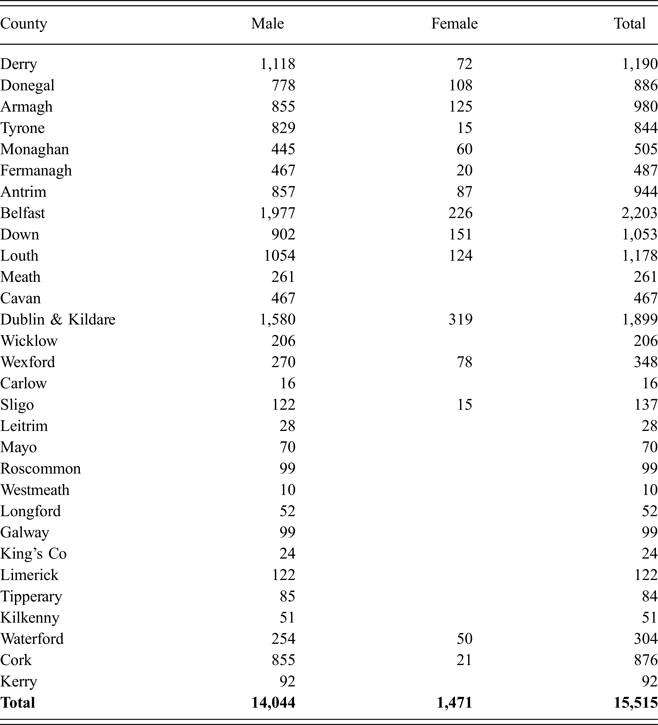
While by 1922, the Board of Erin reported that Ulster Catholics ‘were practically in the throes of civil war’, attention soon turned to how the order and its insurance interests would adapt to the constitutional changes on the island that meant almost half of its reduced membership would remain in the north while in the Free State, the biggest concentrations of membership were in the border region and larger urban centres like Dublin and Cork.Footnote 95 As Table 3 demonstrates, decline from the order's pre-war membership levels was visible across Ireland in 1921.
A.O.H. adult members paid (Ireland), 30 September 1921Footnote 96

Source: National secretary's report to the national board, 6 Dec. 1921 (N.A.I., LOU 13/1/3 (a))
At the establishment of the Free State in December 1922, the order there counted 158 male divisions and 16 Ladies’ Auxiliary branches and a total membership of 6,125. Of these, 65 male and 3 female divisions (1,225 total members) were in the three largest border counties of Donegal, Cavan and Monaghan. In Northern Ireland, the order could boast 195 male and 26 women's divisions with a total membership of 5,238 and 715 respectively.Footnote 97 As Phoenix has noted, some Hibernian divisions split into Sinn Féin and I.P.P. supporters in these years, but in such cases the nexus of Hibernian and I.P.P. interest meant that abandoning the party almost necessarily involved leaving the order too.Footnote 98 For Nugent, the Irish Party had represented a national movement. The order could not otherwise be associated with a ‘mere’ political party and there was, thus, no question of its hierarchy endorsing Sinn Féin. After partition, the order's insurance section continued to sustain 125,000 members in Ireland, though it had to set up separate societies north and south.Footnote 99 The A.O.H.'s defence of Catholic identity against the threat of Protestant domination had sustained it in Ulster and, aside from members only enrolled in the insurance society, the order had very little presence in many other counties by the mid 1920s.Footnote 100
It retained vitality in major urban centres, particularly Belfast, Derry and Dundalk. In the Free State, its strength lay in the border counties of Donegal, Monaghan, Cavan and Louth, reflecting a loyalty to an older nationalism which transcended the new boundary and the death of the Irish Party. Overall membership figures were, however, much lower than those recorded at the order's apogee (a fact Nugent attributed to the loss of those who joined before 1914 seeking patronage in a home rule Ireland), and Free State numbers remained proportionately lower than figures for the six counties.Footnote 101 By 1927, there were 217 divisions in Northern Ireland; 110 of the 146 divisions in the Free State were in the four largest border counties.Footnote 102 Assemblies and public gatherings certainly remained such as the Lady Day (15 August) and St Patrick's Day rallies. From 1922 on, such events tended to be held in Northern Ireland or in southern border counties and were great social occasions for members with frequent contacts over attendees and supplies of flags and banners transcending the border.Footnote 103 In 1923, McPhillips remarked that ‘50 [Hibernians] even went from Lisdoonan into Armagh under noses of B-Specials’ for a demonstration.Footnote 104 Members were also heartened by figures such as Tom O'Donnell, ex-M.P. for West Kerry, addressing political meetings in Toomebridge and Armagh.Footnote 105
The A.O.H. repeated scarcely believable claims that it was non-political. In its own conception, its involvement in politics had been to advance Catholic nationalists, and the Irish Party as a national movement in a one-party political culture. In later years, it would oppose identification with what it called ‘sectional parties’ and especially class-based politics. The presence of figures like O'Donnell underlined, however, the continued political dimension to these rallies. If Hibernians were more inclined than other nationalists to recognise the Belfast parliament in 1922, this too needs to be placed in the context of the clear west-east divisions which largely governed attitudes towards abstention.Footnote 106 In the north, any ‘border’ nationalism related to Fermanagh and Tyrone — the two counties which, it appeared, stood to gain from the Boundary Commission and where the influence of Sinn Féin's Cahir Healy was significant. Nationalists worked together politically in Tyrone and Fermanagh in the 1922 and 1923 Westminster elections. However, two candidates with Sinn Féin roots were chosen in 1924 and both seats were lost as nationalism remained splintered. While the Hibernian Journal was keen for the Boundary Commission to begin its work in 1923, for Belfast Hibernians the commission had promised little relief and a strategy which might defend their place in a unionist-controlled Northern Ireland held far greater importance.Footnote 107 Addressing a Lady Day rally in Dundalk in 1924, Devlin condemned any new boundary ‘as a new pale’ and expressed pessimism about the commission.Footnote 108 While nationalist divides in some ways allowed a greater influence for old nationalist figures, many saw little prospect of the commission reuniting Hibernians in Newry or south Armagh with their counterparts in the Free State.Footnote 109 Nugent, who dismissed the significance of article 12 of the Treaty, lost his Armagh seat in the 1925 elections to the Northern parliament. In Belfast West, Hibernians were clearly happy for Devlin to take his seat in the aftermath of the 1925 poll.Footnote 110
In the south, many in the Order pined for the days of the Irish Party and offered support to Devlin and northern nationalists while others drifted into the new politics of the Free State. For example, Louth Hibernian James Coburn attempted to run for the Labour Party in 1923. Failing to win the nomination, he ran as an independent in Monaghan.Footnote 111 The order organised dances, and subscriptions in Dundalk showed little slippage, particularly among benefit members with many labourers availing of the medical cover offered.Footnote 112 The return of peace gave Hibernians in the Free State greater opportunities to re-organise. The Hibernian Journal carried partisan accounts of Ireland's recent history, glorying in the Irish Party's record of achievements and absolving it of any of the blame associated with partition. In 1924, the order published Joseph P. O'Kane's The canker of partition which rejected the Irish Independent's argument that Devlin was responsible for partition.Footnote 113 Commemorative events for John and Willie Redmond in the south-east and Clare offered social outings with Hibernians from both sides of the border going to great lengths to attend.Footnote 114 Attacks on the new Free State administration were, however, frequent in the Hibernian Journal in the 1920s — usually containing anti-partitionist rhetoric which complemented motions on unity raised by A.O.H. divisions along the border.Footnote 115 At a gathering in Donegal in 1925 Patrick Boyle, president of the A.O.H. in the county, claimed ‘you would almost believe’ listening to government speeches last year ‘that you were listening to speeches in support of the Constitutional candidate in 1918’. Like many Hibernians, Boyle felt that the acknowledgement by the Treatyites that a republic was not possible had vindicated the stance adopted by the A.O.H. since 1918.Footnote 116 Other members simply felt that there was ‘no alternative to the Free State but further destruction and slaughter’.Footnote 117 In 1925 Nugent's advice for the Seanad elections urged votes for Hibernians or those who ‘have interested themselves in the work of the Order’.Footnote 118
Tentative endorsement of the Treaty settlement among Hibernians was tested when the collapse of the Boundary Commission in November 1925 copper-fastened partition.Footnote 119 In the aftermath, Hibernians in the north-east urged an end to abstention — a stance backed by Nugent in the Journal and the A.O.H. south of the border.Footnote 120 There was actually evidence of Hibernian revival in the six counties as membership there increased in the first half of 1926.Footnote 121 In March, the order's Cavan county board passed a resolution calling for a 32-county demonstration of former Irish Party followers focused on commemoration of John or Willie Redmond. This was ignored by Devlin and Nugent and united political action by Hibernians seemed to be rendered impossible by the existence of two polities on the island.Footnote 122 The Board of Erin remained imprecise about who members might vote for in the Free State.Footnote 123 Some members apparently urged Nugent that the order should become an actual political party, though the order repeated its claim to stand aside from ‘merely sectional politics’ and that no party was, or could be, national in the broad sense that the I.P.P. had been.Footnote 124 Nugent maintained neutrality too when Tom O'Donnell and Capt. William Redmond formed the Irish National League party in the Free State in 1926, drawing on the old Irish Party. Hibernian pride had been hurt by the league's reluctance to identify officially with the order, and Nugent responded with good wishes but no endorsement.Footnote 125
However, any officially neutral line was wholly compromised by the nexus of Hibernians and league members in Donegal, Louth and Monaghan. In these counties where Hibernianism was more prevalent than elsewhere in the state, members mobilised fully behind members — a counterpart to the value of the Orange Order in electoral politics in the border counties identified by Fitzpatrick.Footnote 126 Although Devlin turned down an opportunity to stand for election to the Dáil, the prominent Hibernian and league candidate for Louth, James Coburn, and fellow Hibernian, Daniel McMenamin in Donegal, were elected on the league's ticket in June 1927, while John F. O'Hanlon in Cavan was returned as an independent.Footnote 127
The order was a frequent critic of abstention and by November 1927 all ten Nationalist M.P.s had taken their seats in the Belfast parliament, their cohort including the Hibernians Devlin and Leeke.Footnote 128 As abstention was finally abandoned, the A.O.H. took a different approach north of the border when Devlin and Cahir Healy united to form the National League of the North the following year. Bearing no connection to the Free State movement beyond the name, the northern venture received the full support of the order as Nugent viewed it as a Catholic nationalist party for the whole community in the north. The A.O.H. remained an important forum for political meetings though Cahir Healy's personal support base meant that the League had a strong Sinn Féin hue in Fermanagh and Tyrone while A.O.H. members predominated elsewhere.Footnote 129 However, the league's success was short-lived. Nationalists won eleven seats in the 1929 election despite the abolition of proportional representation, but thereafter struggled to reach double figures in the Belfast parliament or maintain the kind of political organisation the I.P.P. had done prior to the First World War as many reverted to abstentionism.Footnote 130
On both sides of the border, the order claimed continued attacks on its property, including the burning of its halls in Bessbrook, County Armagh and Gweedore, County Donegal in 1926 and 1927.Footnote 131 By this point, A.O.H. decline was irreversible, though the order was sustained by political activities in support of individual members, persistent criticism of partition and efforts to claim the Catholic Action agenda of fierce opposition to communism.Footnote 132 In 1929, Nugent underlined the significance of the national health insurance section claiming that the society had distributed almost £2.5m (stg) to its members by that point as well as contributing £40,000 to the Free State's national loan.Footnote 133 It was, thus, a serious blow when Free State legislation amalgamated approved societies under one unified banner and brought the A.O.H. National Health Insurance Society to an end on 31 December 1934.Footnote 134 The Hibernians did retain their own insurance scheme for private members. The order rationalised its structures in the Free State, creating eleven district divisions. Although its head office remained in 1 Mountjoy Square, Dublin (demonstrating a commitment to the order in the south), its regionalisation in the became more noticeable as the 1930s progressed.Footnote 135 Of the 147 divisions listed in 1932, 97 were in Donegal, Louth, Cavan or Monaghan — accounting for 2,266 members from a total of 4,068 south of the border.Footnote 136
The order's battle against decline was revealed by motions at the 1934 and 1936 biennial conventions calling for reorganisation and ‘progressive policy’ which might help to attract more young and female members.Footnote 137 Nugent encouraged debate at meetings, hoping that issues of Catholicism would be discussed in Hibernian clubs and that its working-class members would act as forces against ‘communism’ in any trade unions they joined. He also favoured traditional activities like billiards, cards and dances, but there is little doubt that sustained emigration in border counties exercised a heavy toll on membership figures.Footnote 138 As memory of the Irish Party faded, opposition to communism and partition sustained the order and it staged impressive anti-partition rallies in Cavan in 1931 and 1932. Such events raised morale and allowed for cross-border gatherings of members, but they did little to undermine the reality of partition.Footnote 139
Unquestionably, the order remained a sturdy political machine in circumstances where candidates could harness it to their electoral benefit. In Northern Ireland, even a weakened A.O.H. offered electoral aid to Devlin until his death in 1934 and to other members thereafter. Joseph Stewart was a Stormont M.P. for East Tyrone until 1964, Hugh McAleer represented Mid-Tyrone (1929–41), and Gerry Lennon was a member of the Northern Ireland senate from 1944.Footnote 140 The Louth A.O.H. was vigorous in assisting James Coburn's 1933 campaign for election as an independent, with Hibernians canvassing and organising cars to bring voters to polling stations.Footnote 141 Similarly, James Dillon relied on A.O.H. support in Donegal in 1932, with Nugent acting as his chief organiser.Footnote 142 In 1933 Nugent refused to endorse the new Fine Gael party (a combination of Cumann na nGaedheal, the Centre Party and Eoin O'Duffy's Blueshirt movement), urging Hibernians to work for any party ready to defend Catholicism from communism.Footnote 143 While such a statement reflected continued commitment to nominal neutrality, Nugent's relation, Peter Nugent, was among the founding vice-presidents of Fine Gael, and the order's opposition to Monaghan Hibernians endorsing Fianna Fáil told a different story.
In border counties, the order had tended to allow Cumann na nGaedheal use their premises regularly, and this practice continued with Fine Gael and A.O.H. bands marching in Blueshirt rallies on occasion.Footnote 144 Although an A.O.H. band was caught in a disruption at a Blueshirt march in Bundoran in 1934, there are no accounts of any other major disruptions at the order's own gatherings in the Free State in this period.Footnote 145 Divisions in Cavan and Monaghan had also sometimes opened their halls to meetings of Fianna Fáil, agricultural groups and trade unions.Footnote 146 Monaghan Hibernians kept fast to the memory of O'Brien, McPhillips and Treanor by erecting memorials near to the sites of their deaths.Footnote 147 Antipathy towards the Free State had been exacerbated by the refusal to establish a Government inquiry in the 1920s when Eoin O'Duffy, the I.R.A. Commander in the county during the War of Independence, was garda commissioner.Footnote 148 Unsurprisingly, O'Duffy's emergence as the first leader of Fine Gael further antagonised Hibernians in the county.Footnote 149 Although individuals in the order were by then prominent politicians, the Board of Erin ruled it unacceptable that some Monaghan Hibernians officially associated the order with a political party by declaring support for Fianna Fáil in the 1930s. This led to a bitter dispute and the B.O.E. seized a hall in Ballybay, locked out local members and eventually moved to dissolve divisions and even the Monaghan board. A new board was eventually constituted and legal proceedings issued by the Order against former members.Footnote 150 In 1937, Dillon moved constituencies to Monaghan, thereby helping to bring the county somewhat in line with its neighbours.Footnote 151
Fine Gael eventually captured the A.O.H. element of the I.P.P.'s legacy in the border counties as both Dillon and Coburn moved into the Treatyite party in the 1930s. Indeed, in spite of the Order's decline in other areas of the Free State, its regional vitality meant there were six Hibernian T.D.s by 1937 — a success which Nugent hoped could be replicated in Northern Ireland.Footnote 152 Each of the six was a deputy for a border county (and a Fine Gael representative), except for Timothy Linehan in Cork.Footnote 153 Each was re-elected in 1938, and Hibernians returned to the Dáil in the 1930s and 40s were all Fine Gael deputies, except for the Cavan independent Thomas O'Reilly (1944-8) and James Dillon's period outside the party (1942–53). Hibernians would go on to represent border counties in the Dáil through to the retirement of Fine Gael's Brendan McGahon in 2002.
VI
Given its vast health insurance concerns, its role within the home rule movement, and the number of M.P.s, local councillors and some clergy who counted themselves as Hibernians, the A.O.H. remains crucial in gaining a fuller understanding of pre-rising Irish nationalism in all its forms, particularly in the northern half of the country. However, if, as Tim Wilson has suggested, there are ‘multiple Ulsters’ to be considered when examining the period of the War of Independence, outbreaks of sectarian violence, and the post-partition experience, the order can also tell us much about the evolutions in and variety of nationalist opinion and support in each area.Footnote 154
In March 1921, after the killing of Francis McPhillips by the I.R.A., one Monaghan Hibernian wrote to Devlin that ‘partition is a glorious thing, compared with the rule of those boys [the I.R.A.]’.Footnote 155 The remark illustrates the minority position articulated by nationalists in south Ulster counties who remained loyal to the order rather than adopting republicanism. While in the north-east, I.R.A. volunteers like McCorley could accuse Hibernians of attacks on Protestant properties after the truce of July 1921, for Hibernians after partition, Northern Ireland represented the kind of hegemony of one community that many unionists had feared the A.O.H. would impose in a home rule polity.Footnote 156 In the fractured post-Treaty period, Hibernians in Belfast and their old political leaders were sustained by a desire to try to defend their rights through parliamentary action in unpropitious circumstances while the ‘border nationalism’ of Counties Fermanagh and Tyrone lent itself more, at least at first, to support for Cahir Healy and the promise of the Boundary Commission. Free State Hibernianism on the other hand had a distinctive hue of a border identity.
The A.O.H., like its Ribbon antecedents, had always been strongest in the northern part of the country. Its Catholic ethos had always made it unpopular among opponents ranging from William O'Brien's All-for-Ireland League, to advanced nationalists, to unionists opposed to home rule. Stripped of its association with power and mainstream nationalism when Sinn Féin became dominant, the A.O.H. was pushed back to its old strongholds and larger urban centres. Though this process was set in train by the fall of the Irish Party, it was only after 1918 that decline accelerated and much later still that the order would finally fade into obscurity, with regional variation important in any estimation of decline. Some Hibernians remained prominent in northern and southern politics into the 1960s and 70s. James Dillon led Fine Gael from 1959 to 1965 and remained president of the A.O.H. while leader of the opposition. Gerry Lennon served at Stormont, was involved in the Anti-Partition League, and was A.O.H. vice-president from 1951 and president from 1975, having participated in the early civil rights movement.
Although it would be easy to dismiss the A.O.H. as the vestigial organ of a vanquished political entity, it remained an important part of the lives of many Catholics and formed part of a border identity in counties where the order protested against the partition which separated members from their fellow Hibernians. Over time, it became more of a social organisation providing a sense of fellowship among comrades, while its insurance schemes offered health cover to many who could not otherwise afford it. However, we can never divorce the A.O.H. from politics or religion if we are to understand it — as demonstrated by its (albeit more modest) successes after the accepted date of Irish Party defeat in 1918. Consideration of the Hibernians in Ulster before and after partition, thus, not only highlights important threads of continuity in a period of political and social upheaval, but also illustrates something of the lived experience of partition and indicates how fading movements influence the movements that take their place in a changing society.