Introduction
Recently, magnesium alloys have attracted many interests for more investigations, due to their lightweight among other structural alloys [Reference Deng, Wang, Wang, Wu and Zheng1]. However, besides some desirable properties such as high specific strength and stiffness to density ratio, Mg alloys show some deficiencies such as low wear resistance and elastic modulus [Reference Deng, Wang, Wang, Wu and Zheng1, Reference Sun, Wang, Deng, Kang, Bai, Nie and Shang2]. To overcome these restricted features, among different techniques, the simple and cost-effective way is creating the particle-reinforced metal matrix composite (PMMC) by adding ex situ or in situ particles [Reference Sun, Wang, Deng, Kang, Bai, Nie and Shang2]. However, unlike the in situ PMMCs, fabrications of the ex situ PMMCs have typical obstacles such as appropriate absorption and wettability of reinforcements to the matrix [Reference Lotfpour, Emamy, Dehghanian and Pourbahari3, Reference Shang, Deng, Nie, Li, Zhou, Xu and Fan4]. Among different fabrication techniques, one of the commercial manufacturing procedures to create a well-distributed and absorbed particles, PMMC is using the stir casting together with conventional thermomechanical processes such as hot extrusion [Reference Deng, Wang, Wu, Hu, Wu and Gan5].
Generally, the PMMCs are composed of two parts: reinforcements and the matrix. Among several ceramic reinforcements, the SiC particles are more well-known because of their high elastic modulus, low expense, high hardness values, and no reaction with Mg matrix [Reference Li, Deng, Zhang, Wang, Kang, Nie and Liang6, Reference Lim and Gupta7]. Numerous investigations have been conducted regarding the effect of SiC addition on the properties of the various Mg alloys. Shang et al. [Reference Shang, Deng, Nie, Li, Zhou, Xu and Fan4] demonstrated that addition of the SiC particles could suitably form the fine grain structure during the hot extrusion due to the increment in the dynamic recrystallization (DRX) nucleations and controlling the DRX grain growth of the AZ91 alloy. Furthermore, dispersed SiC particles could be led to obtaining preferred mechanical properties for the extruded Mg–4% Zn–0.5% Ca–SiCp composite, because of the SiC particles’ role in preventing the annihilation of dislocation [Reference Li, Deng, Zhang, Wang, Kang, Nie and Liang6]. Deng et al. [Reference Deng, Wu, Wu, Nie and Zheng8] stated that adding 1.5 vol% submicron SiC particles decreased the grain size of the AZ91 alloy. Moreover, 2 vol% SiC addition enhanced the ultimate tensile strength (UTS) and yield tensile strength (YTS) values of the composites [Reference Deng, Wu, Wu, Nie and Zheng8]. Nevertheless, higher contents of SiC deteriorated the mechanical properties and grain growth restriction potency [Reference Deng, Wu, Wu, Nie and Zheng8]. Shen et al. [Reference Shen, Wang, Li, Zhang, Hu, Zheng and Wu9] illustrated that SiCp addition has led to more completed DRX during hot extrusion and provides higher strength and elastic modulus for the AZ31B alloy. In addition, by performing hot extrusion, agglomeration of SiC particles could be mostly dismissed and a homogeneous distribution of particles obtained [Reference Wu, Deng, Nie, Wu, Wang, Hu and Zheng10]. The SiC particles were also identified as an efficient grain refiner for the AZ91D alloy [Reference Chen, Jiang, Ma, Li and Hao11].
On the other hand, matrix can include multiple kinds of the cast and wrought Mg alloys. Among them, the Mg–Zn–Cu alloys were less studied than other alloys such as AZ series, especially being as a matrix for the PMMCs. For the Mg–Zn–Cu alloying system, two distinctive intermetallics, Mg(Zn,Cu)2 and MgZnCu, were formed in both low and high Zn content of Mg–Zn–Cu alloys [Reference Golmakaniyoon and Mahmudi12, Reference Lotfpour, Emamy, Dehghanian and Tavighi13]. Microstructure of the cast Mg–Zn–Cu alloys manifested a typical cast structure with discontinuous MgZnCu and Mg(Zn,Cu)2 eutectic phase along the dendritic boundaries [Reference Golmakaniyoon and Mahmudi12, Reference Lotfpour, Emamy, Dehghanian and Tavighi13]. Moreover, adding SiC particles represented a good bonding between matrix and particles for the ZC63 magnesium alloy. Interfaces of the SiC particles could be acted as nucleation sites for the eutectic phases and fine precipitations after heat treatment [Reference Inem and Pollard14].
According to the literature, there are limited studies considering the effect of SiC additions together with hot extrusion on the Mg–Zn–Cu alloys. Therefore, the aim of the current study is to examine the influences of SiC particles and hot extrusion on the microstructure and mechanical properties of the ZC71 alloy.
Results and discussion
Microstructure characterization
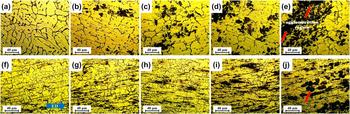
Figure 1 shows the optical micrographs of the as-cast and as-extruded ZC71–SiCp (0, 2.5, 5, 7.5, and 10 wt%) composites. It can be observed that the cast ZC71 alloy reveals a typical cast structure, in which the primary a-Mg phases are entirely encircled by the semi-continuous network of the intermetallics. Moreover, different contents of SiC particles obviously decrease the volume fraction of the intermetallics [Figs. 1(a)–1(e)]. Most of the SiC particles also are observed in the dendritic boundaries. With high content of SiC particles, agglomeration regions are noticed [see Figs. 1(d) and 1(e)]. After hot extrusion, the ZC71 alloy shows a typical extruded microstructure with fine grain structure and distributed intermetallics along the extrusion direction. Moreover, the as-extruded composites contain fewer agglomerated SiC particles than the same as-cast composites. However, with more SiC content, clustering happens again with fewer amounts.
Optical micrographs of the as-cast ZC71 alloy with (a) 0, (b) 2.5, (c) 5, (d) 7.5, and (e) 10 wt% SiC additions and (f–j) for the same as-extruded conditions.
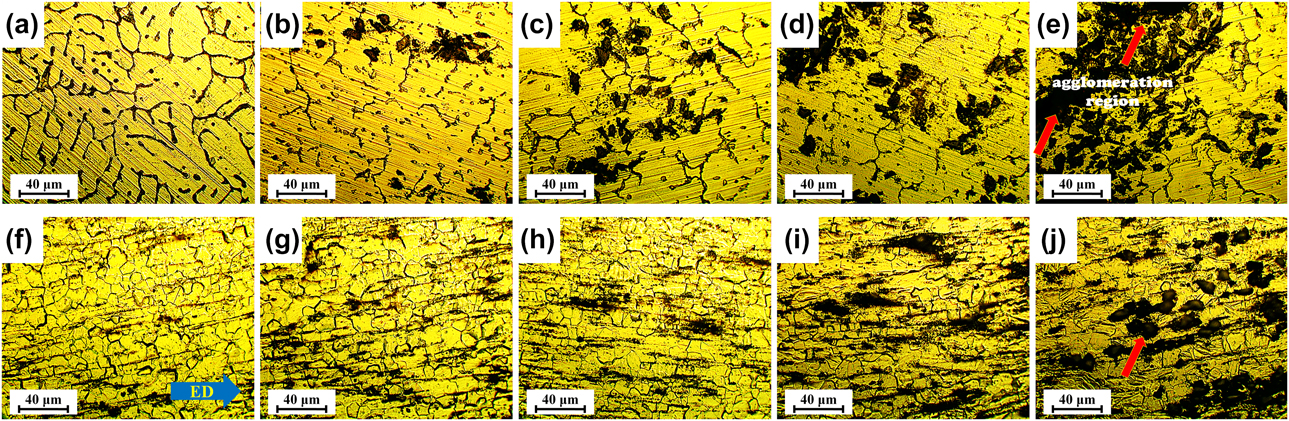
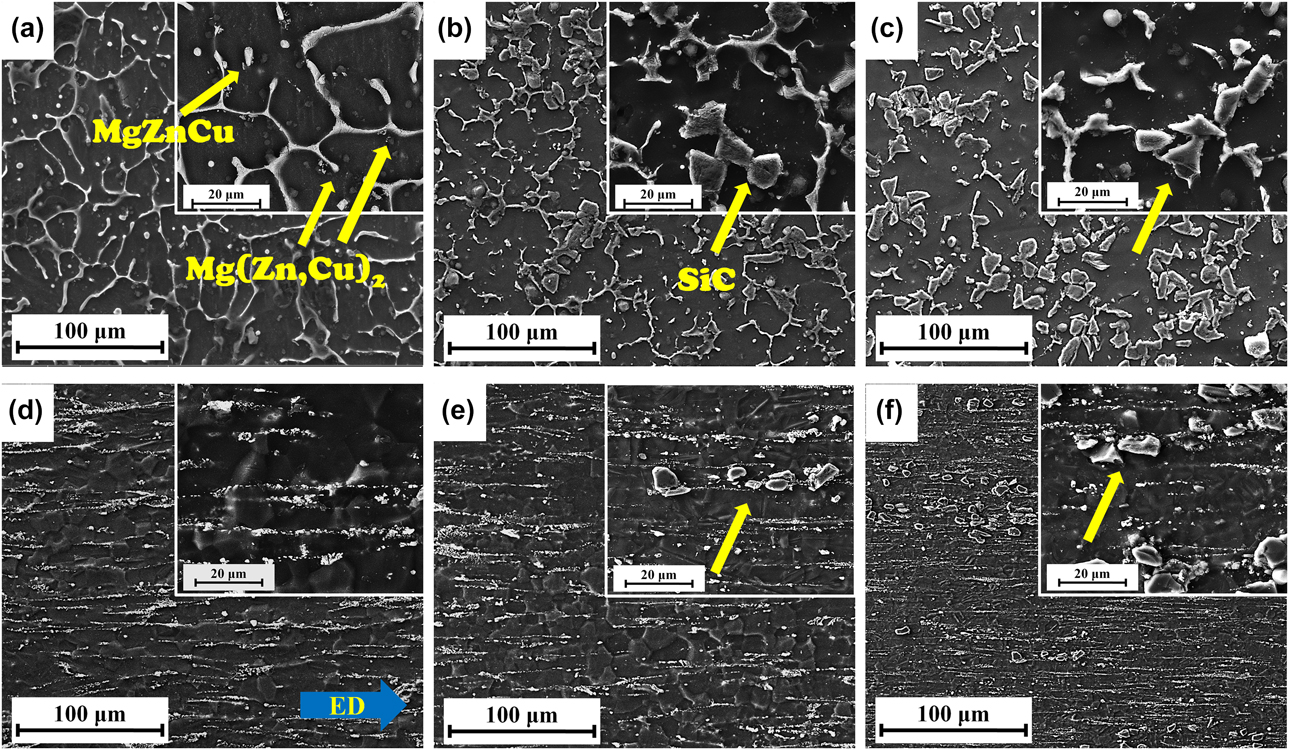
Figure 2 presents the scanning electron microscopy (SEM) micrographs of the as-cast and as-extruded ZC71–SiCp composites. Figure 2(a) interprets the microstructure of the cast ZC71 alloy with two types of bright particles. Some of them have lamellar eutectic structures and located at the dendritic boundaries and others are found between the dendritic arms with the form of small particles. Based on other studies [Reference Golmakaniyoon and Mahmudi12, Reference Lotfpour, Emamy, Dehghanian and Tavighi13], the intermetallics that formed at the lamellar structure were denoted as Mg(Zn,Cu)2. Small particles also were implied as MgZnCu intermetallics, as shown in Fig. 2(a) [Reference Golmakaniyoon and Mahmudi12, Reference Lotfpour, Emamy, Dehghanian and Tavighi13]. Furthermore, the SEM micrographs of the as-extruded composites show that the intermetallics are broken and distributed during the hot extrusion process [Figs. 2(d)–2(f)]. It is interesting to note that the presence of SiC, MgZnCu, and Mg(Zn,Cu)2 particles can help to form more DRX grain structure. Ball and Prangnell [Reference Ball and Prangnell15] showed that the particle stimulated nucleation mechanism could not occur during the hot deformation for the ZC71 alloy and its intermetallics [i.e., Mg(Zn,Cu)2] only could act as obstacles for the grain growth. However, Doherty et al. [Reference Doherty, Hughes, Humphreys, Jonas, Juul Jensen, Kassner, King, McNelley, McQueen and Rollett16] demonstrated that the particle deformation zone was a region that was formed in the proximity of a non-deforming particle, such as SiC particle. Thus, these locations could be suitable for the recrystallized grains to nucleate [Reference Doherty, Hughes, Humphreys, Jonas, Juul Jensen, Kassner, King, McNelley, McQueen and Rollett16]. As a result, the SiC particles can promote the DRX grain structure fabrication and maintain the grain boundaries from growing.
SEM micrographs of the as-cast ZC71 alloy with (a) 0, (b) 5, and (c) 10 wt% SiC additions and also (d–f) for the same as-extruded conditions.
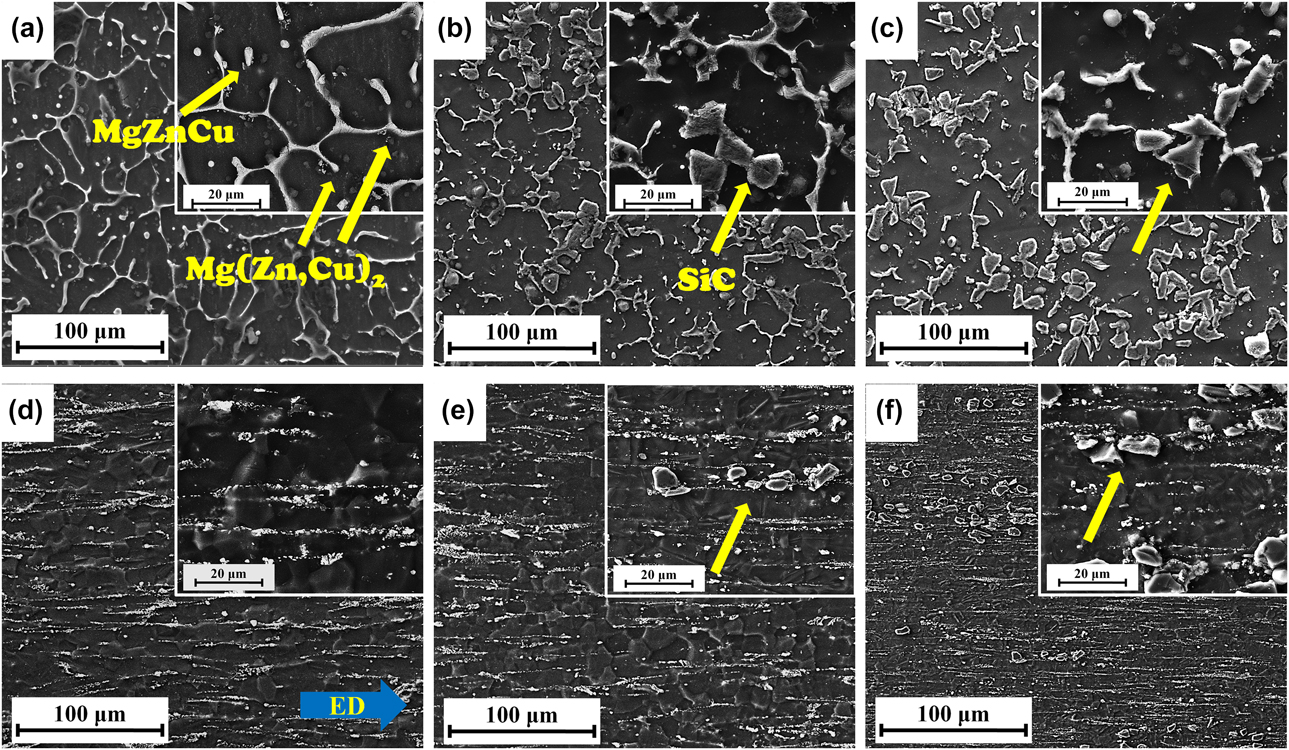
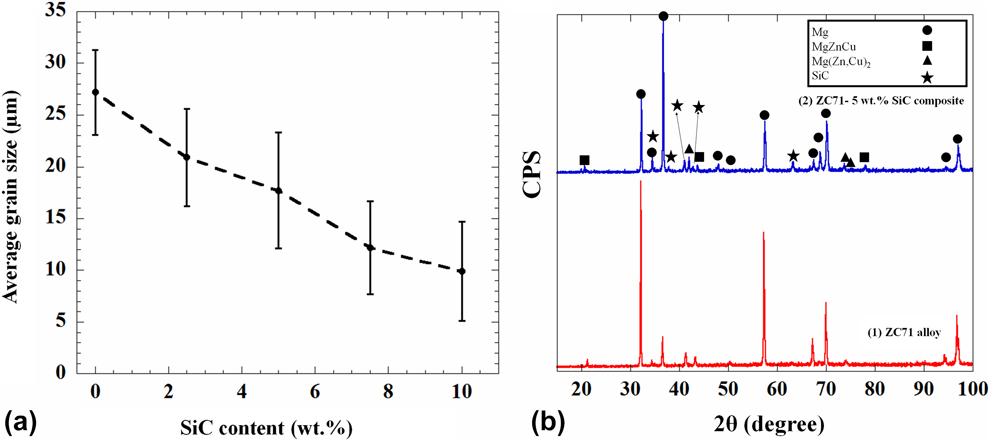
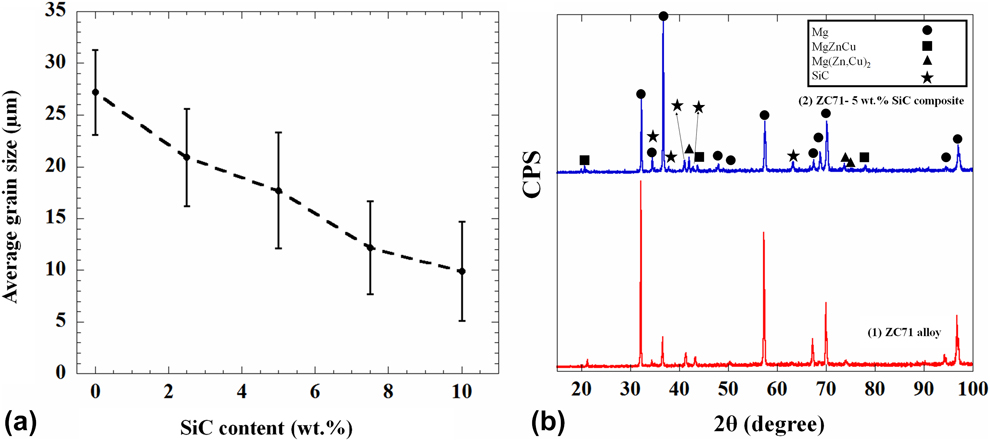
Figure 3(a) displays the deviation of the average grain size for the as-extruded ZC71--SiC composites via SiC contents. As can be seen, adding SiC particles can reduce the average grain size of the as-extruded composites. The average grain size of the extruded ZC71 alloy is 27.2 μm due to the dynamic recrystallization during hot deformation. Furthermore, by adding 2.5 wt% and 10 wt% SiC particles, the average grain size values drop as much as 23.2% and 63.6%, respectively. The grain size reduction can be related to the role of SiC particles in heterogeneous nucleation for the α-Mg phases, restricting the grain growth during solidification and hot deformation and also helping in the formation of DRX grain structure. However, Chen et al. [Reference Chen, Jiang, Ma, Li and Hao11] investigated that Al4C3 phase could act as nucleation sites for the α-Mg phase instead of SiC particles. During solidification, the SiC particles are pushed by the solid/liquid interface and segregated at the interdendritic regions, which can reduce not only the size of dendritic regions but also the grain size. Then, during hot extrusion, they can act as obstacles for grain growth and also create deformation zones that provide suitable sites for nucleation of recrystallization grains.
(a) Variation in the average grain size of the as-extruded ZC71 alloy with different SiC contents. (b) XRD patterns of the as-extruded ZC71 alloy with (1) 0 wt% and (2) 5 wt% SiC additions (CPS: Counts Per Second).
Furthermore, the average dimensions of SiC particles are 14.6 ± 2.5 μm and 10.3 ± 3.1 μm, respectively for the as-cast and as-extruded composites. Hot extrusion also has more effective role in decreasing the average dimensions of the SiC particles. According to Tham et al. [Reference Tham, Gupta and Cheng17], SiC particles were cracked during the extrusion process due to the presence of shear stresses. Larger particles were also encountered with more shear pressures, and as a result, the particles are fractured more [Reference Tham, Gupta and Cheng17]. Similar effects are discerned in the current study, in which the SiC particles of the as-extruded composites are fractured and distributed more than those of the as-cast composites.
Two X-ray diffraction (XRD) patterns of the extruded ZC71 alloy and ZC71-5 wt% SiC composite are given in Fig. 3(b). As expected, the main phases are α-Mg, MgZnCu, Mg (Zn,Cu)2, and SiC, which are noticed with defined 2θ positions and intensities.
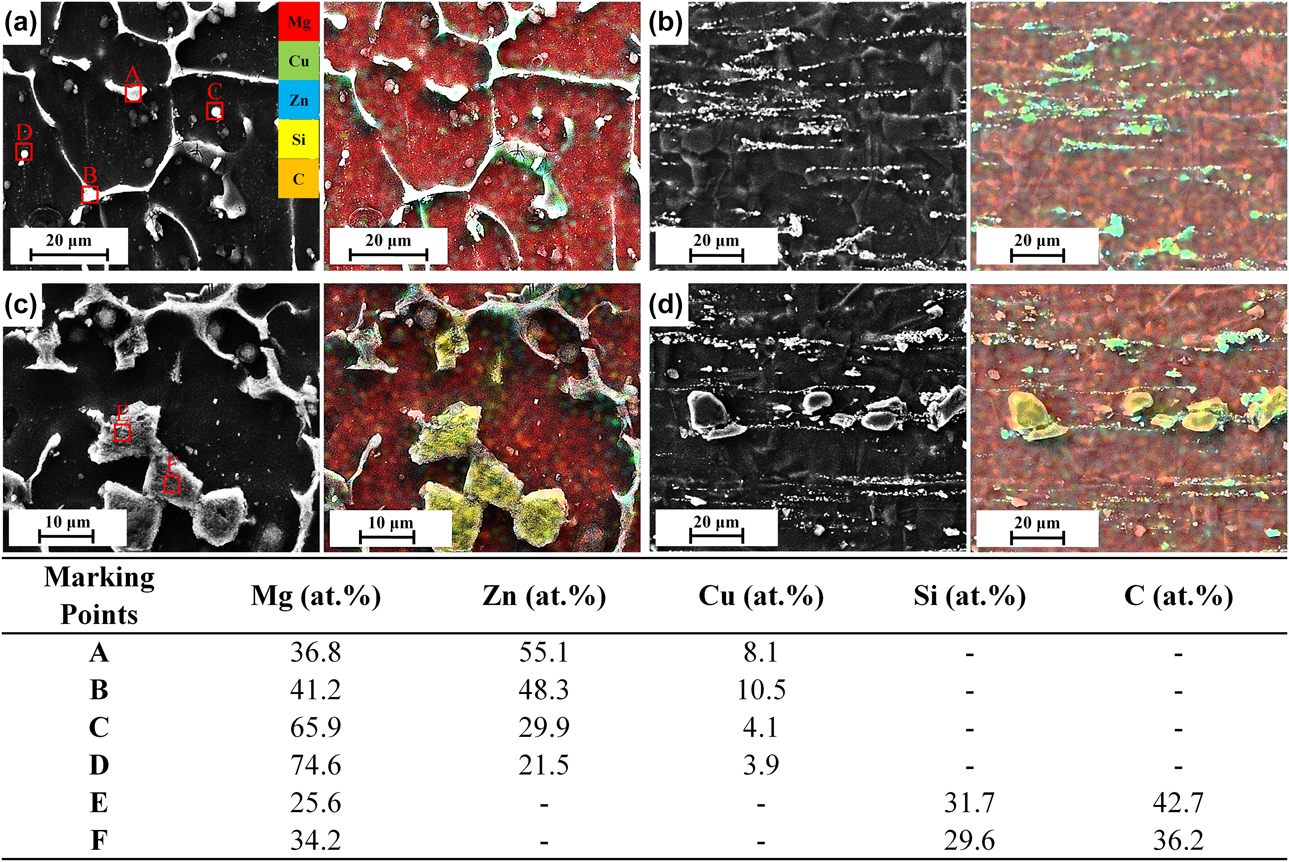
For more comprehensive investigation, SEM micrographs, related point, and elemental map energy dispersive spectroscopy (EDS) analysis for the as-cast and as-extruded ZC71 alloys with 0 and 5 wt% SiC particles are shown in Fig. 4. The related EDS results of points are listed below the figures.
SEM micrograph with related point and elemental mapping EDS analysis for the (a) cast and (b) extruded ZC71 alloys and (c) cast and (d) extruded ZC71-5 wt% SiC composites and also quantities of EDS point analysis for the marking points.
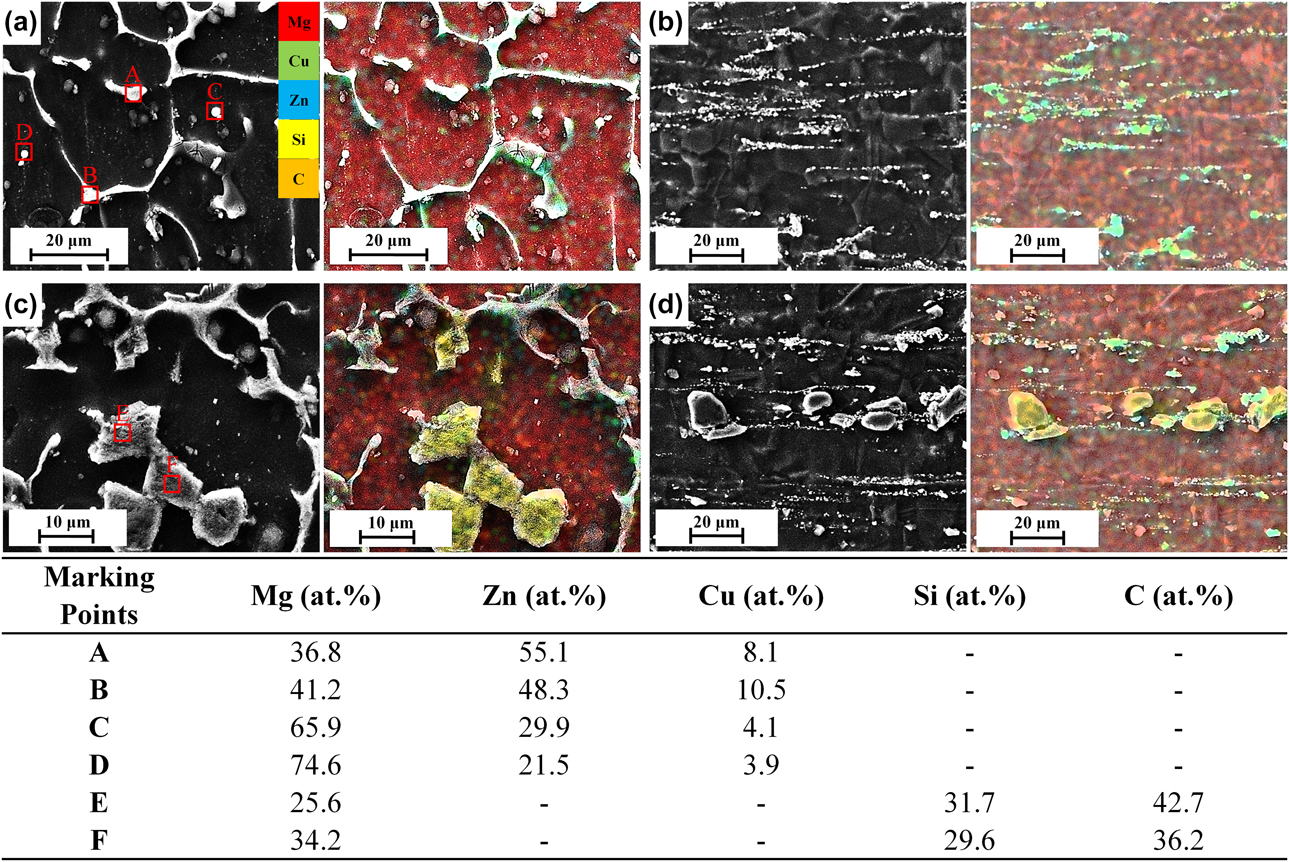
According to Figs. 4(a) and 4(b), the microstructure of the as-cast ZC71 alloy consists of two kinds of intermetallics: particles in the semi-continuous eutectics, which are marked as A and B, and small bulky particles inside the α-Mg phases, which are labeled as C and D. The average qualitative interpretations of (A, B) and (C, D) points are Mg39Zn52Cu9 and Mg70Zn26Cu4, which correspond to the Mg(Cu,Zn)2 and MgZnCu compounds, respectively. Moreover, elemental mapping EDX spectra of the as-cast and as-extruded ZC71 alloys elucidate the presence of two mentioned intermetallics, which have been broken to small particles after hot extrusion and distributed along the extrusion direction [see Figs. 4(a) and 4(b)]. In Fig. 4(c), two points have been selected as E and F with the average qualitative measurements of Mg30Si31C39 that can be related to the SiC particles. Elemental mapping EDX spectra of the as-cast and as-extruded composites also appropriately discern the distribution of SiC particles.
Mechanical properties
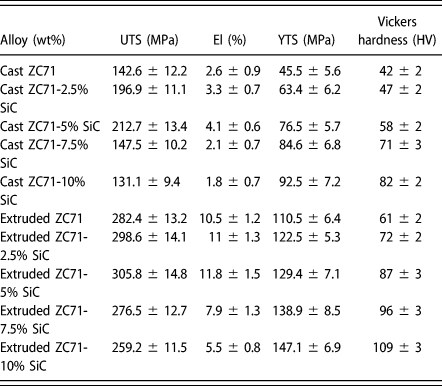
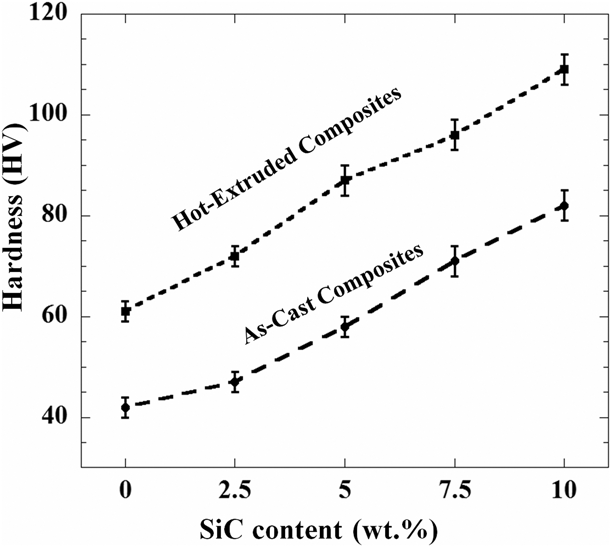
Mechanical properties of the as-cast and as-extruded composites have been assessed by the values of UTS, El%, and YTS obtained from tensile tests, fracture surface observations, and examinations of the Vickers hardness. Table I reports the values of UTS, El%, YTS and Vickers hardness. Figure 5 also presents the variation in hardness via various SiC contents.
Mechanical properties of the cast and extruded ZC71 alloys with various amounts of SiC particles.

Vickers hardness of the cast and extruded ZC71-SiC composites as a function of SiC particles concentration.

As can be observed, the Vickers hardness of the as-cast ZC71 alloy is 42 HV. By adding 10 wt% SiC particles, the value of Vickers hardness enhances to 82 HV. Furthermore, implementing hot extrusion has enhanced the hardness of the ZC71 alloy and other composites. Accordingly, the Vickers hardness values for the as-extruded ZC71 alloy and ZC71-10 wt% SiC composite are 61 and 109 HV, respectively. The existence of hard ceramic SiC particles can improve the hardness of the ZC71 alloy. After hot extrusion, the creation of fine-grain structure and work hardening properly increase the hardness values of ZC71 alloy and other composites.
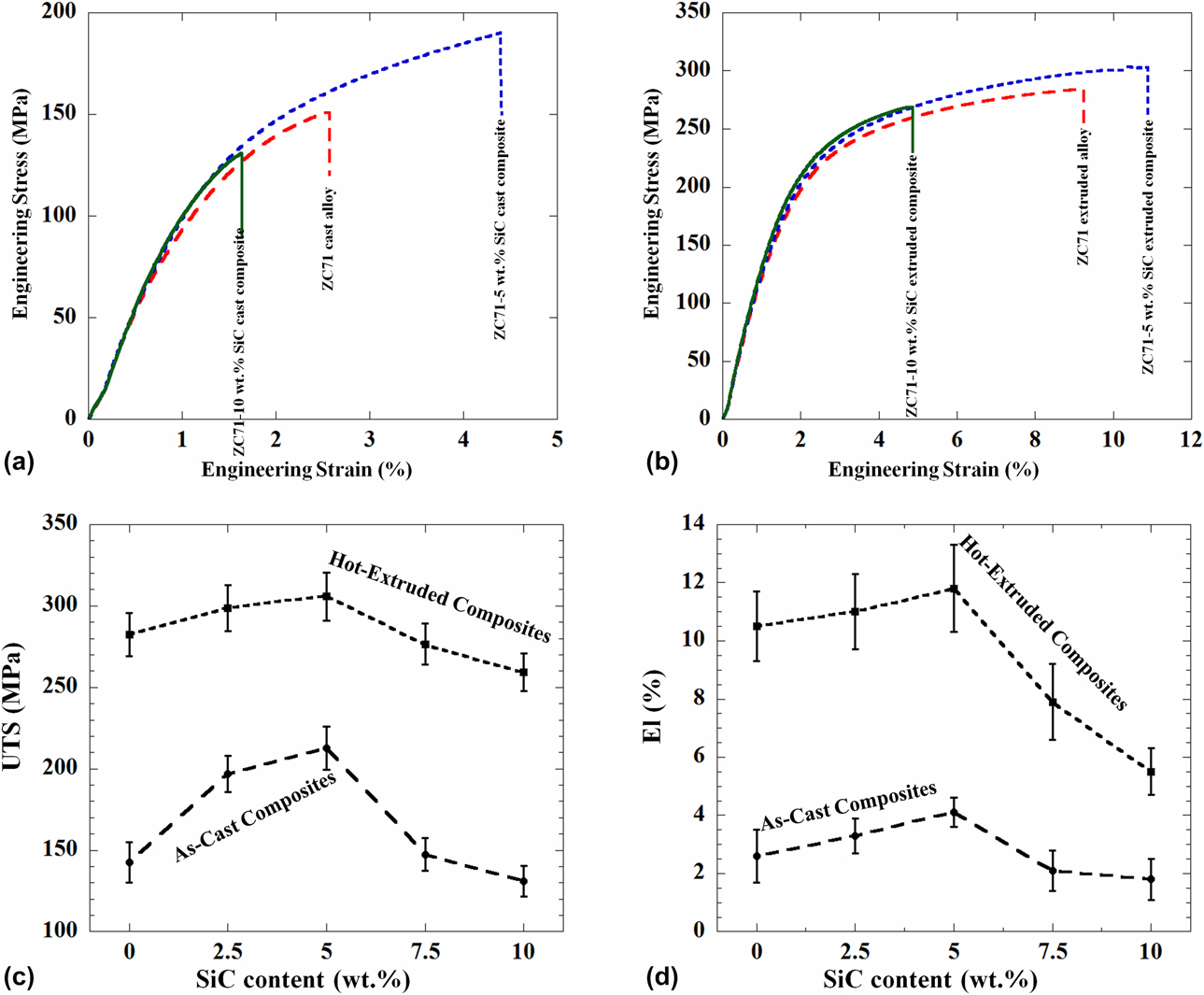
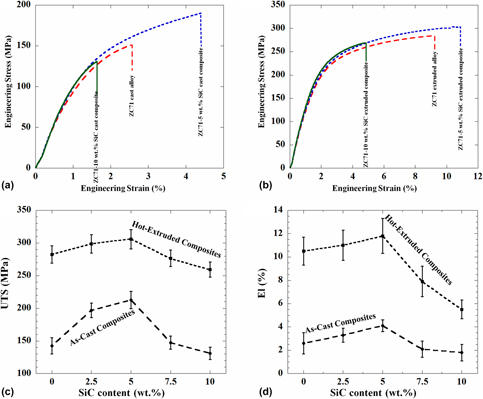
Figures 6(a) and 6(b) show the typical tensile stress via strain curves for the as-cast and as-extruded ZC71 alloys with 0, 5, and 10 wt% SiC addition. To explain more about the tensile properties of the composites, the UTS and El% values of the as-cast and as-extruded ZC71-SiC composites are given in Figs. 6(c) and 6(d), respectively.
(a, b) Engineering stress versus engineering strain of the cast and extruded ZC71-SiC composites. (c, d) Variation in UTS and El% for the cast and extruded ZC71-SiC composites as a function of SiC content.
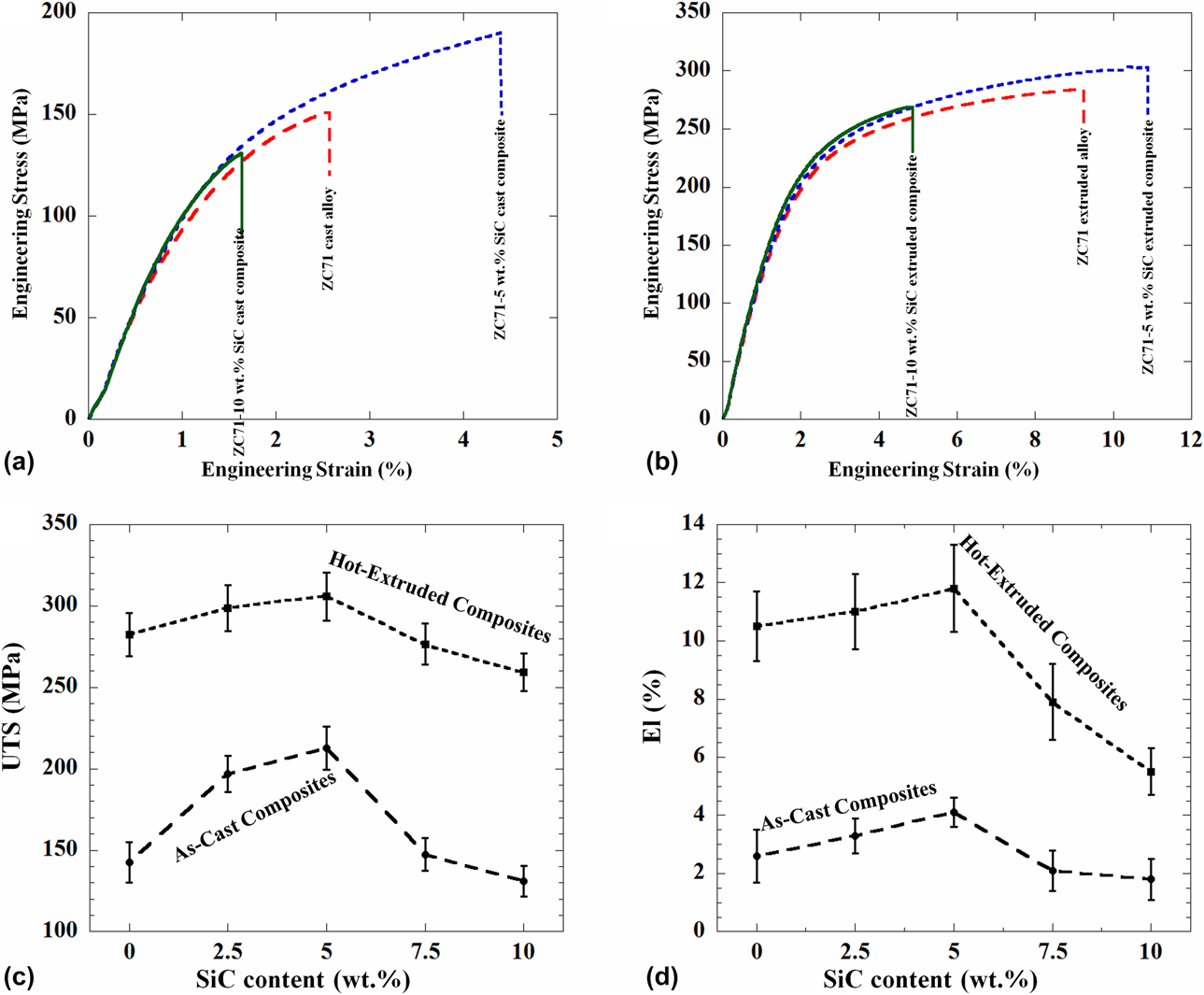
According to Figs. 6(c) and 6(d) and Table I, in the as-cast composites, the UTS and El% values of the ZC71 alloy are 142.6 MPa and 2.6%, respectively. By adding 5 wt% SiC particles, the best results obtained as 212.7 MPa and 4.1%, and after that decrease to 131.1 MPa and 1.8% with 10 wt% SiC addition. The hot extrusion also can enhance the UTS and El% values of the ZC71 alloy to 282.4 MPa and 10.5%, respectively. The maximum values of UTS and El% attained with 5 wt% SiC content were 305.8 MPa and 11.8%, respectively. Generally, the strength and ductility are related to the factors that led to the initiation and propagation of the cracks, such as stress concentration during the tensile test [Reference Wang, Xu, Hu, Nie, Deng, Wu and Zheng18, Reference Zhong, Espérance and Suéry19]. For the ZC71 alloy reinforced with SiC particles, initiation and propagation of the cracks may be affected by some factors: (i) defects during casting, such as porosities and oxidation surfaces; (ii) shape and distribution of the eutectic intermetallics; and (iii) size, form, and dispersion of the SiC particles and their bonding with the matrix [Reference Shang, Deng, Nie, Li, Zhou, Xu and Fan4, Reference Wang, Xu, Hu, Nie, Deng, Wu and Zheng18, Reference Zhong, Espérance and Suéry19]. The weak interface of particles and matrix can assist the propagation of the cracks, while fine particles and grain boundaries can act as inhibitors for the movement of the cracks [Reference Shang, Deng, Nie, Li, Zhou, Xu and Fan4]. The cast ZC71 alloy demonstrates relatively low strength and ductility due to the existence of casting defects and also the semi-continuous network of intermetallics around the α-Mg phases, which can act as suitable sites for initiation of he microcracks. Addition of 5 wt% SiC particles also enhances the strength and ductility due to grain refinement and fine distribution of the SiC particles. However, more SiC additions can accelerate the agglomeration of particles and intensify the stress concentrations. After hot extrusion, modifying the semi-continuous networks of MgZnCu and Mg(Zn,Cu)2 into the finer particles, eliminating the casting defects, and reduction of the average grain size can improve the strength and ductility for the ZC71 alloy. Moreover, for the ZC71-5 wt% SiC composite, hot extrusion can also split some of the SiC particles into smaller ones, distribute them more homogeneously, decrease the number of segregated particles, and improve the binding of particles and matrix [Reference Shang, Deng, Nie, Li, Zhou, Xu and Fan4]. Moreover, due to the relatively high temperature of the hot extrusion process, the space between cracked particles can be filled by the matrix, so microcracks cannot be made with cracked particles [Reference Shang, Deng, Nie, Li, Zhou, Xu and Fan4]. On the other hand, hot extrusion decreases the amounts of agglomeration and preserves the relatively high strength and ductility, even with 10 wt% SiC addition in comparison with the same as-cast composite (see Figs. 1 and 2).
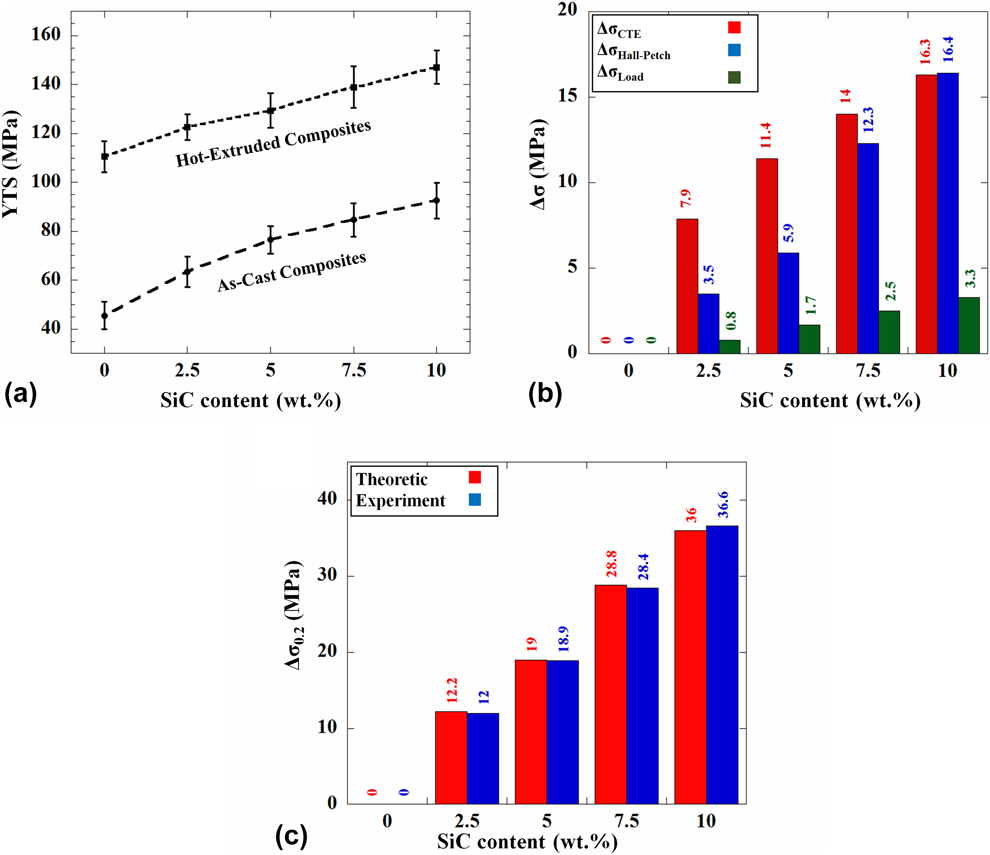
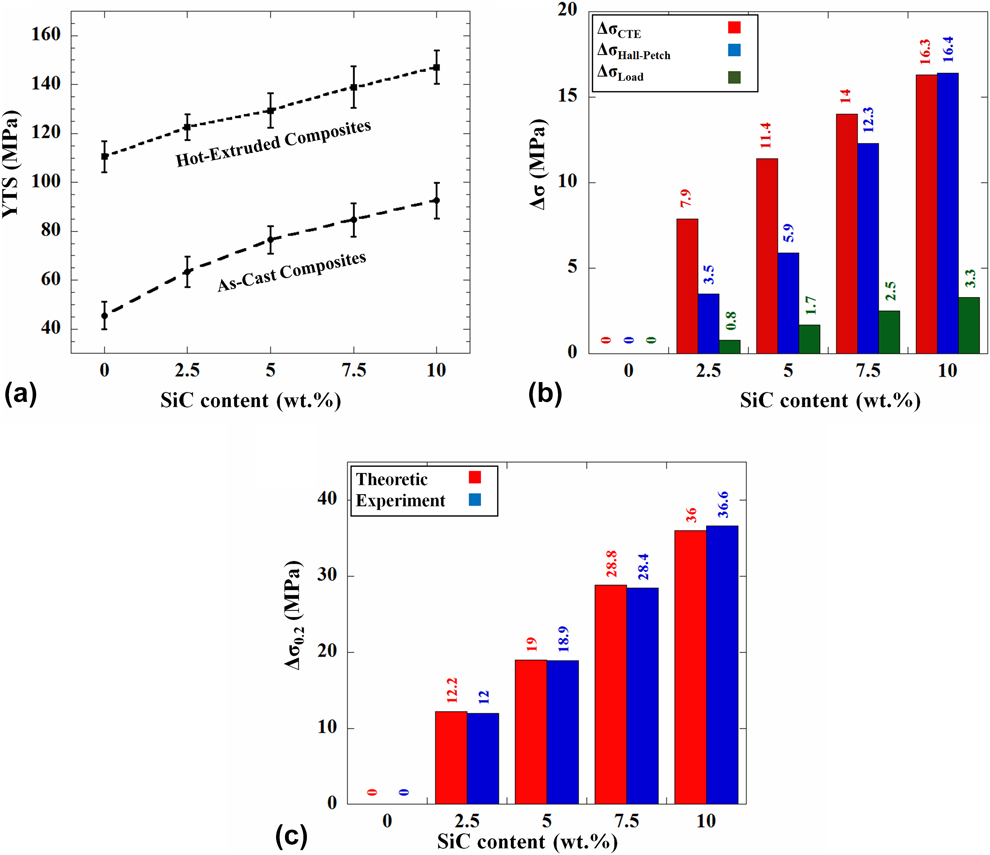
Figure 7(a) shows the alteration of YTS values via different contents of SiC particles. The YTS values increase continuously from 45.5 MPa for the as-cast ZC71 alloy to 92.5 MPa for the composite with 10 wt% SiC addition. After hot extrusion, the YTS value of ZC71 alloy reaches 110.5 MPa. The diagram of the YTS for the as-extruded composites has the same trends as the as-cast composites, which by adding 10 wt% SiC particles, the YTS value increases to 147.1 MPa. Enhancement of the YTS is related to the factors that can prevent the movement of the dislocations, which is contributed by grain boundaries strengthening and also volume fraction of second phase particles [Reference Deng, Shi, Wang, Wang, Wu, Nie and Wu20]. Furthermore, in the current study, increasing the YTS values for the as-extruded composites can be described by the following equation [Reference Sun, Wang, Deng, Kang, Bai, Nie and Shang2, Reference Deng, Shi, Wang, Wang, Wu, Nie and Wu20]:
 $$\Delta {\sigma _{0.2}} = \Delta {\sigma _{{\rm{load}}}} + \Delta {\sigma _{{\rm{CTE}}}} + \Delta {\sigma _{{\rm{Hall}} - {\rm{Petch}}}}\quad .$$
Variation in (a) YTS and (b) the calculated values of Δσload, ΔσCTE, and ΔσHall–Petch and (c) the theoretical and experimental values of Δσ0.2 for the as-extruded ZC71-SiC composites as a function of SiC content.
Description of all the parameters in the above equation is given as follows:
(i) Δσload parameter (load transfer effect) shows the increment in the YTS values due to the role of SiC particles in transferring loads from the matrix to hard particles for the SiC-containing composites and is calculated by Eq. (2) [Reference Sun, Wang, Deng, Kang, Bai, Nie and Shang2, Reference Deng, Shi, Wang, Wang, Wu, Nie and Wu20].
 $$\Delta {\sigma _{{\rm{load}}}} = 0.5f{\sigma _{\rm{m}}}\quad ,$$
where σm is the YTS value of the as-extruded ZC71 alloys.
(ii) ΔσCTE parameter (dislocation strengthening) is existed due to the disagreement between the thermal expansion coefficient of SiC particle and ZC71 matrix, which can generate dislocations near the SiC particles during cooling phenomenon after hot extrusion [Reference Habibnejad-Korayem, Mahmudi and Poole21]. ΔσCTE is calculated by Eq. (3) [Reference Sun, Wang, Deng, Kang, Bai, Nie and Shang2, Reference Deng, Shi, Wang, Wang, Wu, Nie and Wu20, Reference Habibnejad-Korayem, Mahmudi and Poole21, Reference Goh, Wei, Lee and Gupta22].
 $$\Delta {\sigma _{{\rm{CTE}}}} = \sqrt 3 \beta {\mu _{\rm{m}}}b\sqrt {{{12f\Delta \alpha \Delta T} \over {\left( {1 - f} \right)b\bar{d}}}} \quad ,$$
where µm is shear modulus (µm = E/(1 + 2νm)), β is strengthening coefficient, b is Burgers vector,  $\bar{d}$ is average size of SiC, f is volume fraction of SiC particles, and Δα is the difference of CTE between particles and matrix. Also, ΔT is the deviation between the temperature of various processes and room temperature [Reference Deng, Shi, Wang, Wang, Wu, Nie and Wu20, Reference Habibnejad-Korayem, Mahmudi and Poole21, Reference Goh, Wei, Lee and Gupta22]. The values of defined parameters value are given in Table II.
(iii) ΔσHall–Petch parameter (grain refinement) is related to the Hall–Petch relationship, which can be defined by Eq. (4) [Reference Sun, Wang, Deng, Kang, Bai, Nie and Shang2, Reference Deng, Shi, Wang, Wang, Wu, Nie and Wu20, Reference Habibnejad-Korayem, Mahmudi and Poole21, Reference Goh, Wei, Lee and Gupta22, Reference Avedesian and Baker23].
 $$\Delta {\sigma _{{\rm{Hall}} - {\rm{Petch}}}} = K\left( {d_{{\rm{composite}}}^{ - {1 \over 2}} - d_{{\rm{ZC71}}}^{ - {1 \over 2}}} \right)\quad ,$$
where K is the Hall–Petch coefficient and is given as 0.13 MPa m1/2 [Reference Deng, Shi, Wang, Wang, Wu, Nie and Wu20]. d composite and d ZC71 are the average grain size of composite and ZC71 alloy, respectively. Figures 7(b) and 7(c) show the calculated values of Δσload, ΔσCTE, and ΔσHall–Petch and the theoretical and experimental values of Δσ0.2 for the extruded ZC71-SiC composites. As can be observed, for the as-extruded composites, the experimental values of Δσ0.2 are nearly equal to the theoretical values due to the elimination of the casting defects during hot extrusion and obtaining fine grain structures. On the other hand, the values of calculated Δσload, ΔσCTE, and ΔσHall–Petch in the current study are relatively lower than those in other investigations [Reference Sun, Wang, Deng, Kang, Bai, Nie and Shang2, Reference Deng, Shi, Wang, Wang, Wu, Nie and Wu20] due to higher average grain size and SiC particles size. The strengthening mechanisms of SiC particle-reinforced composites are load transfer effects, dislocation strengthening, and grain refinement, of which the dislocation strengthening and grain refinement have more important influences because of their relatively higher values of ΔσCTE and ΔσHall–Petch. In conclusion, the YTS values can be correlated with the grain size of the matrix, particles size, and volume fraction of particles.
The parameters values used for calculating Δσ0.2 [Reference Sun, Wang, Deng, Kang, Bai, Nie and Shang2, Reference Deng, Shi, Wang, Wang, Wu, Nie and Wu20, Reference Habibnejad-Korayem, Mahmudi and Poole21, Reference Goh, Wei, Lee and Gupta22, Reference Avedesian and Baker23].

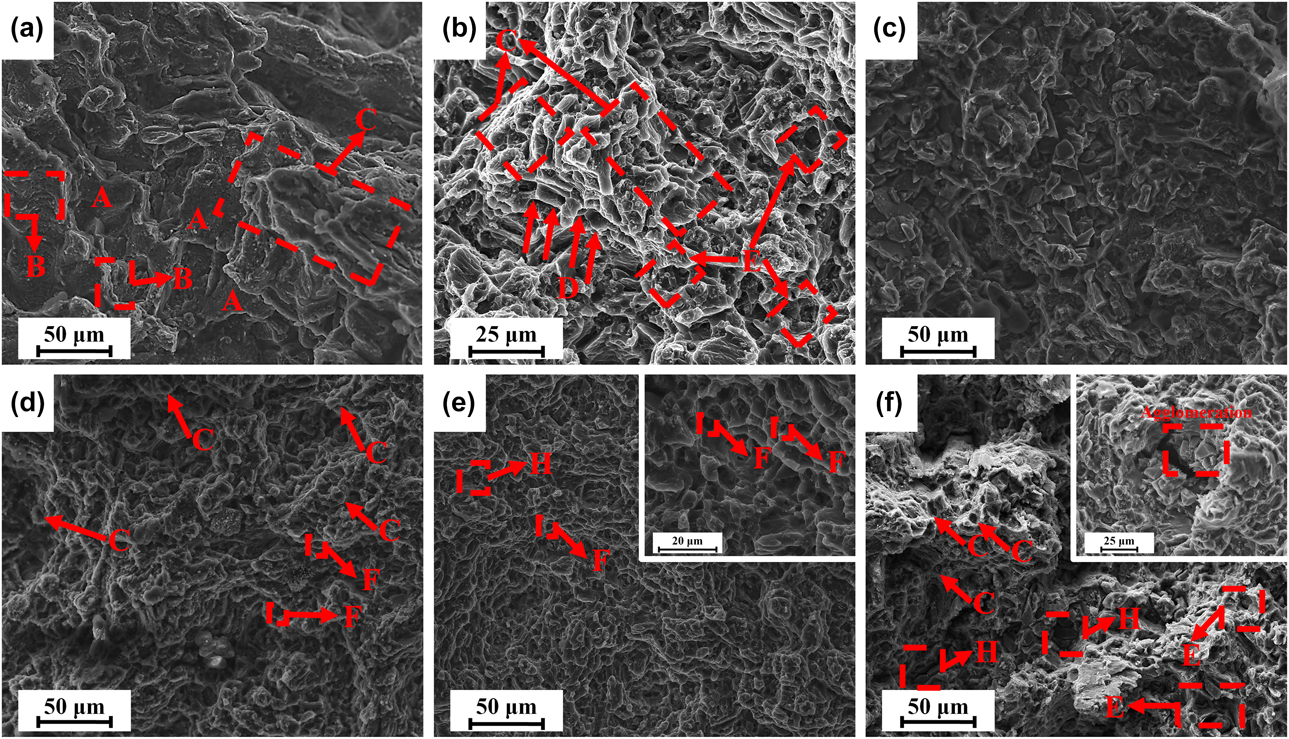
Figure 8 shows the fracture surfaces of the as-cast and as-extruded ZC71 alloys and ZC71–5 wt% SiC and ZC71–10 wt% SiC composites. As can be seen in Fig. 8(a), the cast ZC71 alloy is characterized by cleavage planes (marked with A), steps (marked with B), and some dimples (marked with C), which present the cleavage fracture. Existence of cleavage planes and steps shows the brittle mode of fracture. The ZC71-5 wt% SiC composite shows more quasi-cleavage fracture, which the surface is observed with more fine dimples, tearing ridges (marked with D), and decohered particles (marked with E). The decohered particle is formed by weak interface binding between particle and matrix, which is recognized as a feature of brittle fracture in the composites [Reference Lotfpour, Emamy, Dehghanian and Pourbahari3]. The load during tensile testing cannot be transferred from the matrix to the particles by this weak interface and led to rupture at low elongation [Reference Lotfpour, Emamy, Dehghanian and Pourbahari3]. The ZC71-10 wt% SiC composite is described by cleavage planes, decohered particles, and high volume fraction of hard particles, which turn the fracture mode to brittle fracture.
Fracture surface (SEM micrographs) of the cast and extruded ZC71 alloys with (a, d) 0 wt%, (b, e) 5 wt%, and (c, f) 10 wt% SiC particles addition.
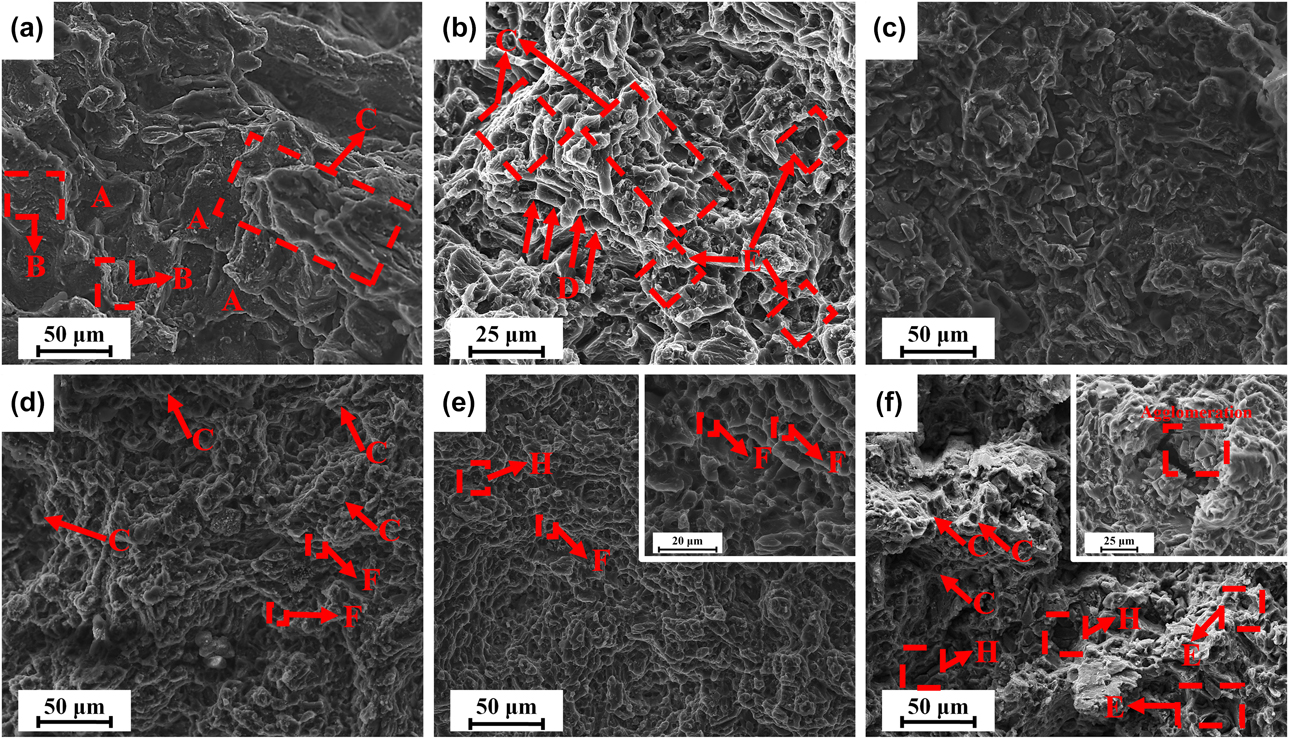
After hot extrusion, the fracture surfaces of ZC71 alloy, ZC71-5 wt% SiC, and ZC71-10 wt% SiC composites are determined with more ductile features in comparison with the same as-cast conditions. For the ZC71 extruded alloy, fine dimples, tearing ridges, and particles located at the bottom of dimples (marked with F) are investigated in fracture surface, which presents the ductile fracture. The particles at the bottom of dimples are MgZnCu and Mg(Zn,Cu)2 intermetallics. From Fig. 8(e), the ZC71-5 wt% SiC composite shows the above similar features with some cracked SiC particles (marked with H), which declare the contrast effects in comparison with decohered particles and show high strength bonding of particles and matrix and led to more UTS and elongation. The figures can fully assure the fact that although elongation of the alloys drops with the addition of higher content of SiC, the extruded alloy and composites mainly show the domination of ductile fracture mode, as it can also be seen in Fig. 6(d) that the elongation values of all the as-extruded alloys and composites are above 5%.
Conclusions
The influences of various amounts of SiC particles on the microstructure and mechanical properties of the as-cast and as-extruded ZC71 alloys were studied. The following conclusions are drawn:
(1) The microstructure of the ZC71 alloy consisted of the primary α-Mg phases and the semi-continuous network of the MgZnCu and Mg(Zn,Cu)2 intermetallics. After hot extrusion, the microstructure was properly refined and intermetallic particles were rearranged along the extrusion direction. Based on XRD, SEM, and EDS analysis, main intermetallics of the study were Mg(Zn,Cu), Mg(Zn,Cu)2 intermetallics and SiC particles.
(2) The grain size values of the extruded ZC71 alloy was 27.2 μm. The average grain size values continuously reduced to 9.9 μm with 10 wt% SiC addition.
(3) The best results of the Vickers hardness values were 82 HV and 109 HV, respectively, for the cast and extruded ZC71-10 wt% SiC composites, which showed the proper effect of SiC additions on increment of the hardness.
(4) The optimum levels of UTS and El% values for both the as-cast and as-extruded composites were achieved with 5 wt% SiC additions; after that, the strength and elongation reduced due to agglomeration. The UTS and El% values of the cast ZC71-5 wt% SiC composite were 212.7 MPa and 8.2%, respectively, and those for the extruded condition were 305.8 MPa and 11.8%, respectively.
(5) The YTS values increased continuously for the as-cast and as-extruded composites with further SiC additions. The YTS values of the cast and extruded ZC71-10 wt% SiC composites were 92.5 MPa and 147.1 MPa, respectively. The strengthening mechanisms of extruded composites were grain refinement, dislocation strengthening, and load transfer effects.
(6) The tensile fracture surface examinations presented that the fracture mode for the cast ZC71 alloy was cleavage. By adding 5 wt% SiC particles, the surface contained more dimples and revealed more quasi-cleavage fracture. After hot extrusion, the ZC71 alloy and SiC-containing composites showed the domination of ductile fracture mode. With more than 5 wt% SiC additions, the fracture surface had characterizations of more brittle fracture.
Experimental procedure
The current composites were formed with the ZC71 (7 wt% Zn and 1.5 wt% Cu) Mg alloy as matrix and different contents (2.5, 5, 7.5 and 10 wt% or 1.5, 3, 4.5 and 6 vol%) of SiC particles (average size of ∼15 µm) as reinforcement. To fabricate the composites, pure Mg (99.90%), Zn (99.99%), Cu (99.99%), and SiC particles were used. In the first place, Mg–20 wt% SiC, Mg–50 wt% Zn, and Mg–20 wt% Cu master alloys were created via an induction furnace in an inactive environment, including a mixture of CO2 and SF6. The Mg–20% SiC master alloy was formed by stir casting method. Then, with exact numerical calculations, composites were formed by stir casting technique at 1023 K (750 °C) with a constant rotational velocity of 680 round/min and stirring time of 15 min. Eventually, each molten composite was cast into a cylindrical steel mold with the height of 45 mm and inner diameter of 34 mm and preheated at 523 K (250 °C), which was used in another study [Reference Lotfpour, Emamy, Dehghanian and Tavighi13]. For hot extrusion, the cast composites were divided and shaped into the cylindrical samples with the length of 28 mm and diameter of 29 mm. Before extrusion, the composites were preheated in an electrical resistance furnace at 673 K (400 °C) for 1 h. Afterward, hot extrusion was performed by applying a pressure-driven device at a ram speed of 1 mm/s, with an extension ratio of 12:1 at 673 K (400 °C).
Microstructural observations were carried out by utilizing an optical microscopy (OM) and also an SEM operated in the Vega©Tescan microscope implemented with an EDS analysis after etching polished specimens in the acetic-picral solution (5 mL acetic acid +6 g picric acid +10 mL H2O + 100 mL ethanol) [Reference Lotfpour, Emamy, Dehghanian and Tavighi13]. XRD with the Cu kα radiation was used for the phase identification.
For the mechanical properties, the Vickers hardness measurements for all the composites were performed with the load of 100 Kgf (980.665 N) and 20 s holding time. For the as-extruded composites, the Vickers hardness tests were conducted from the perpendicular cross-section to the extruded direction. Tensile test specimens were fabricated based on the ASTM E8-04 standard, and tensile tests were carried out for each composite based on the ASTM: E8/E8M-16a in a digital testing machine (SANTAM STM-20) at the constant cross-head speed of 1 mm/min. For each composite, four tensile samples were fabricated and tested to obtain accuracy. The fracture surfaces of the tensile specimens were also analyzed with the SEM.