Major tornadoes often result in incalculable environmental damage, loss of life, and threats to public health. Between 1984 and 2013, a total of 2201 tornadoes occurred in China with an average of 73 tornadoes per year. Tornadoes in China are most common in the Anhui, Jiangsu, Henan, Hubei, and Guangdong provinces. Jiangsu province has experienced a total of 313 tornadoes over the past 30 years.Reference Dapeng, Shanshan and Ge1
On June 23, 2016, at about 2:30 PM, Yancheng City, Funing, Jiangsu province suffered a strong hail storm and tornado disaster, which caused heavy casualties and property loss. An Enhanced Fujita Scale (EF Scale), designed to obtain a rating for a tornado event, was used to rate the tornado. The enhanced scale addresses the major limitations of the original Fujita Scale that was first published in 1971. The categories range from EF0 to EF5.2 The China Meteorological Administration rated the storm as an EF4 on the EF Scale, with a maximum wind speed surpassing 266 km/hr.Reference Jia and Pan3 The disaster resulted in 99 deaths and 846 injuries. In Funing County, Yancheng province, 28 104 houses of 8004 families were damaged and 2 primary schools were destroyed. The tornado destroyed 8 buildings and 48 thousand acres of greenhouses. In addition to Funing, 615 homes were damaged or collapsed in Sheyang County.4
Five hours after the disaster, the National Disaster Reduction Committee and the Ministry of Civil Affairs initiated a national emergency response to prompt disaster relief. Jiangsu province also launched a natural disaster response to the emergency. As of June 25, at 12:00 PM, Yancheng city medical institutions treated 846 wounded in the hospital. There were 744 with injuries, who were admitted to hospitals, including 20 critically ill; after medical treatment, 102 were effectively curedReference Jia and Pan3 and no longer had the specific condition at presentation and were able to live a normal life.5, 6 Because Funing County was an area that was hard-hit by the tornado, the number of dead and injured was also the greatest, and the People’s Hospital of Funing County undertook the bulk of the casualty treatment.
METHODS
The data used in this paper are from the People’s Hospital of Funing County, Yancheng City, Jiangsu province in China. The research method and content of this study were approved by the Medical Ethics Committee of the Second Military Medical University. Four investigators were masters degree students in Social Medicine and Public Health Service Management. They visited the hospital from July 12–30, 2016, a month after the tornado. After arrival at the hospital, they first obtained hospital authorization and explained to the hospital administrator the intention, purpose, and significance of obtaining medical records. They then sought consent on a case-by-case basis based on patient contact numbers collected at the time of hospitalization. After explaining the purpose of the study, along with content and scope of medical record use, as well as protection of information, a total of 288 patients were recruited to participate. The investigators conducted an informal interview to gather consent and information regarding the location and work they were doing at the time of the tornado. For injured patients ages < 18 years, consent was given by legal guardians. Finally, a total of 288 medical records were collected and the data were analyzed anonymously. Prior to data collection, the investigators received training to familiarize themselves with the medical record structure and research guide. Cases were defined as patients receiving diagnostic procedures, care, and interventions for tornado-related trauma at the hospital. We used Microsoft Excel 2016 (Microsoft Corporation, Redmond, WA) to collate information regarding tornado-related injuries in medical records and to create a custom database containing these data. This study focused on demographic information collected on the wounded, including the injury, cause, and prehospital time. Descriptive analysis of the data was performed using IBM SPSS Statistics 22 (IBM, Armonk, NY).
RESULTS
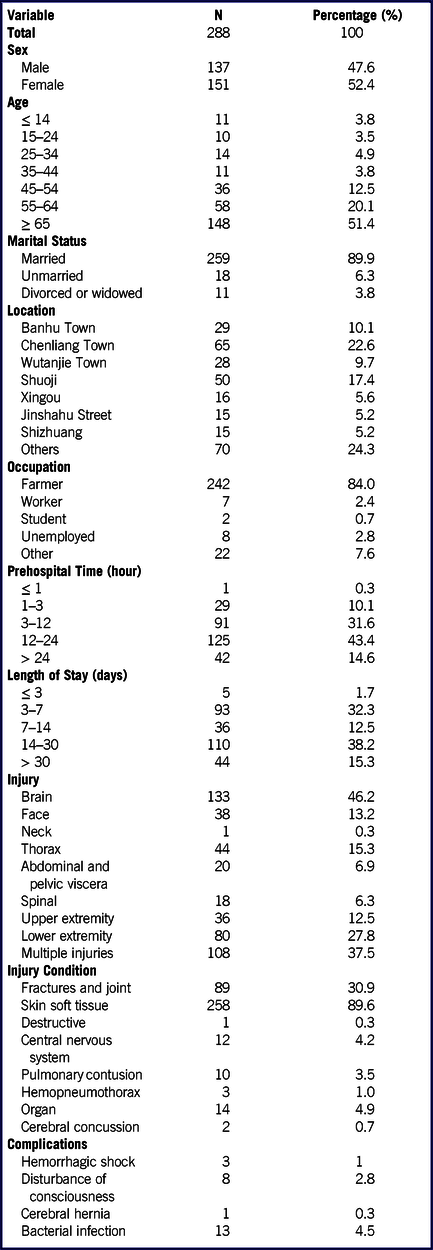
The total number of the tornado-related injuries were 288 with 137 (47.6%) males and 151 (52.4%) females, and these results are presented in Table 1. The mean age of the wounded was 60.5 years (range: 1–92 years, median: 65 years). The mean age of male casualties was 61.7 years (range: 4–49 years, median: 67 years). The mean age of female casualties was 59.3 years (range: 1–89 years, median: 64 years). A total of 84% of the wounded were over 45 years of age, and the proportion of wounded who were over 65 years old was 51.4%; with an increase in age, the proportion of the wounded also increased. There were 259 (89.9%) married people, 18 (6.3%) unmarried, and 11 (3.8%) divorced or widowed. The number of patients from Chenliang Town was 65 (22.6%), followed by Shuoji Town, where the number of injured persons was 50 (17.4%). Regarding profession, 242 (84%) of the wounded were farmers, and a total of 29 (10.1%) were unemployed or engaged in other occupations. A total of 17 (10.1%) were workers, civil servants, or students.
Demographics and Injury Characteristics of the Tornado-Related Injuries

Only 30 (10.4%) people were sent to the hospital for treatment within 3 hours after the disaster, and a total of 121 (42%) patients were sent to the hospital within 12 hours. Within 24 hours, 246 (85.4%) people were sent to the hospital. Forty-two (14.6%) patients had a prehospital duration of more than 24 hours. Five (1.7%) wounded were discharged on the same day, and 93 (32%) patients were hospitalized between 1 and 3 days. The number of wounded patients hospitalized between 3 and 7 days was 36 (12.5%), whereas 110 (38.2%) were hospitalized for between 7 and 14 days, and 44 (15.3%) were hospitalized for more than 2 weeks.
Analysis of the causes of tornado injuries revealed that 191 (66.3%) patients were injured by heavy objects or collapsing houses. In addition, bruises and fall injuries occurred, but the incidence was very low (less than 5%). Three patients were hospitalized for acute stress disorders.
The proportion of people with brain injuries was 46.2%, followed by lower extremity injuries (27.8%). A total of 89.6% of the wounded had skin and soft tissue injuries, followed by fractures and bone and joint injuries (30.9%). Three (1%) of the wounded had hemorrhagic shock, 8 (2.8%) had a disturbance of consciousness, and 13 (4.5%) had an infection.
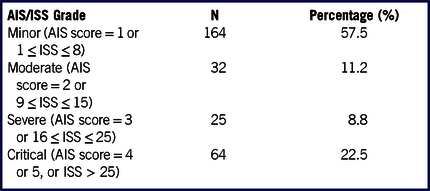
Funing County People’s Hospital treated 129 (44.8%) patients with multiple injuries and 156 (54.2%) patients with a single injury. The injuries were assessed for each casualty by reference to the International Classification of Diseases (ICD-90),7 the Abbreviated Injury Scale (AIS),Reference Gennarelli and Wodzin8 and the Injury Severity Score (ISS).Reference Baker, O’Neill and Haddon9 These results are presented in Table 2. Sixty-four (22.5%) of the patients had critical trauma, 25 (8.8%) patients had severe trauma, 32 (11.2%) had moderate trauma, and 164 (57.5%) had minor trauma. Previous studies from researchers in the United States also evaluated tornado-related injury with the ISS and obtained similar results.Reference Niederkrotenthaler, Parker and Ovalle10 Niederkrotenthaler et al. studied injuries from tornadoes in Alabama on April 2011 and found that most (n = 1111, 79.5%) injuries treated were non-life-threatening, with severe injuries often affecting the head (72.9%) and chest regions (86.4%).Reference Niederkrotenthaler, Parker and Ovalle10
The Abbreviated Injury Scale (AIS)/Injury Severity Score (ISS) Grades of Tornado-Related Injuries

DISCUSSION
Half an hour after the tornado occurred, Funing County People’s Hospital received notification of the disaster and immediately sent 6 ambulances to rescue the injured. Local civilian vehicles and police cars were also involved in the evacuation of the wounded. The disaster area was subject to serious damage, including damage to power facilities, communications facilities, and the environment, as well as road traffic blockages. This resulted in the first patients not being received at the hospital until 3 hours after the disaster. Funing County People’s Hospital is the county’s largest public hospital and undertakes major public health emergencies, including emergency rescue missions. The hospital set up a special emergency rescue office, which developed contingency plans for natural disasters, accidents, social security incidents, and other public health emergencies. Although the Funing County People’s Hospital did not offer a treatment plan specifically for the tornado-wounded, the hospital’s contingency plan was still very effective. On arrival at Funing County People’s Hospital, patients were immediately classified by the medical staff; however, the prehospital index (PHI)Reference Lavoie, Emond and Moore11 and revised trauma score (RTS)Reference Champion, Sacco and Copes12 classification method were not used; rather, staff did so per their own experience, and medical staff determined whether patients required surgery, admission to the hospital, referral to specialized hospitals, or discharge after simple treatment. This approach had the advantage that more than 50% of the patients who arrived at the hospital had light injuries and were therefore easily screened from other casualties. The disadvantage of this method was that some emergent and critically wounded cases were not treated in time. In addition, in instances with a large number of casualties, medical resources cannot meet treatment needs. After summarizing the tornado disaster relief efforts, the hospital began to use the START method to carry out triage for cases and casualties caused by the emergency. This classification method evaluated the injury condition by examining aspects of breathing, circulation, and consciousness. Generally, it requires 1 doctor and 3 nurses to complete. At 10 PM, more than 7 hours after the disaster, Funing County People’s Hospital had received 375 patients, which exceeded the receiving capacity of any county-level hospital. Many patients could only stay in the outpatient hall, and hospital leaders decided, based on the principle of rapid classification and reasonable diversion, that after the lightly injured patients were bandaged, the doctors in the township hospitals and village clinics would bring these patients back to the village to receive further medical treatment. Seriously injured patients were transferred to a higher-level hospital, Yancheng People’s Hospital and the remaining patients received emergency surgery or hospitalization at Funing County People’s Hospital. Six and a half hours later, the patients who were stranded in the outpatient hall began to be diverted, and, by 6:30 AM the next morning, the classification and diversion of hundreds of patients was completed. Patients were dispersed to surrounding hospitals based on their injuries, which relieved the burden of limited hospital resources, reduced delayed treatment, and also enabled some patients to receive early treatment.
We informally interviewed the tornado victims admitted to the Funing County People’s Hospital and found that residents did not recognize the seriousness of natural disasters and prevention of related injuries. About 2 hours before the tornado, the local meteorological department issued a warning signal to alert the public to lightning, but this did not cause too much concern for the residents because they were accustomed to similar warnings. Subsequently, when the disaster occurred, many local residents had begun work when they should have refrained from doing so.
The most common traumatic injuries caused by the tornado were to the brain, skin, and soft tissue, followed by bone fractures and joint injuries. This finding is similar to that of a previous report concerning a 1999 Oklahoma City tornado in the United States, following which the most common injuries were complex soft tissue wounds, head injuries, and fractures.Reference May, Hogan and Feighner13 According to AIS scores and ISS, minor trauma is the highest reported injury. Niederkrotenthaler et al.Reference Niederkrotenthaler, Parker and Ovalle10 studied the casualties caused by tornadoes in Alabama in April 2011 and found that most of the tornado-related injuries with known ISS (n = 1170) were relatively minor (n = 1041, 89%), though 6% (n = 70) were moderate, and 5% (n = 59) were severe. The head, chest, and abdominal regions were affected in the majority of severe trauma cases. Head injuries resulted in many hospitalizations (46.5%), most intensive care unit admissions (56.3%), and deaths (71.4%). More than 70% were directly related to tornado impact. The tornado disaster directly caused 99 instant deaths. Building structures in the disaster area were not designed to withstand such weather because they comprised mainly tiles and bricks.
Close to more than half of the casualties were elderly, and children comprised the second-most affected group. Yancheng City, Jiangsu province, is a typical large agricultural Chinese city. With new urbanization strategies, labor force transfers have resulted in few young people residing in the village.Reference Liu14 This situation is more common in rural China with the main reason for this phenomenon being that rural farmers in China mainly have a single, low income source that is obtained from planting crops. In contrast, cities can provide more employment opportunities with higher incomes, so local adults (ages 18–45 years) will mostly go to the city for work, while the remaining family stays behind, thus leaving the elderly and younger children. As a result of this work relocation, the population level of elderly as well as young children increases proportionally.
Compared with other provinces, tornado disasters occur frequently in China’s Jiangsu province. However, our informal interview found that tornado awareness was limited among the local residents, and that they would not be able to take effective measures to avoid injury. Local authorities should disseminate tornado-related knowledge, protective measures, and encourage local residents living in rural areas to prepare personal protective equipment such as helmets, thick clothes, and blankets.15 In order to meet the needs of the large patient numbers resulting from tornado disasters, hospitals should carry out emergency drills in advance. First, a natural disaster emergency plan should be formulated and planned in advance for personnel, materials, and rescue work processes. Then the medical staff should be organized to simulate training accordingly, and improve quality through many drills. Finally, medical staff should clearly understand the operation process and job responsibilities of emergency rescue, so as to ensure the timeliness and effectiveness of emergency rescue.
CONCLUSIONS
The data used in this study consisted of medical records of the wounded treated at Funing County People’s Hospital. For the majority of the injured, their arrival was unexpected by the hospital. Regardless, emergency treatment measures were undertaken. After stabilizing patients, doctors then completed the medical records resulting in prehospital times that may be longer than the actual.
This study analyzed medical records and records of only the sick and wounded in the Funing County People’s Hospital. In order to reduce the pressure on hospital resources due to the number of those injured, the local government transferred a number of patients to other hospitals to ensure normal and continued operations.
A preparation plan, including tornado warning, prevention, and rescue, is a basic requirement for the prevention of tornado-related injuries. Additionally, population education regarding protection from tornadoes is also critical in minimizing injury and loss of life.
Acknowledgments
We are grateful to the residents of Funing County and the local government for their cooperation, and thanks to all of the people who helped us during the investigation.
Conflict of Interest Statement
The authors have no conflicts of interest to declare.
Financial Support
This research was funded by the National Natural Science Foundation of China (L.Z., grants 71774167, 71233008, and 91224005; P.K., grant 71603271), the Special Innovation Project of National Defence Science and Technology (L.Z., grant 003004), the Military Medical Innovation Project of the 13th Five-Year Plan of the People’s Liberation Army (L.Z., grant 17CXZ001), the Major Project of the 12th Five-Year Plan of the People’s Liberation Army (L.Z., grant AWS12J002), and the Joint Research Project in Major Disease at the Shanghai Health Service (L.Z., grant 2013ZYJB0006).