Background
Maternal mortality is excessively high across the world. In 2017, nearly 295 000 women died during, and following pregnancy and childbirth globally, with considerable majority (94%) of these deaths occurred in low-resource settings, and most could have been prevented (WHO, 2019). Of the total maternal deaths, almost 86% of maternal deaths occurred in Sub-Saharan Africa and Southern Asia. Sub-Saharan Africa accounted for roughly two-thirds of maternal deaths, whereas Southern Asia accounted for nearly one-fifth. Almost 75% of maternal deaths are due to severe bleeding (mostly bleeding after childbirth), infections (usually after childbirth), high blood pressure during pregnancy (pre-eclampsia and eclampsia), complications from delivery and unsafe abortion (Say, et al., Reference Say, Chou, Gemmill, Tunçalp, Moller, Daniels and Alkema2014).
Many direct and indirect causes are associated with the high rate of MMR in the world. Moreover, indirect causes of maternal death are becoming prominent and accounting for more than a quarter of maternal deaths worldwide (Say, et al., Reference Say, Chou, Gemmill, Tunçalp, Moller, Daniels and Alkema2014). Indirect causes include deaths due to communicable, non-communicable diseases (NCDs), and other indirect causes such as accidents (Lumbiganon, et al., Reference Lumbiganon, Laopaiboon, Intarut, Vogel, Souza and Gülmezoglu2014; WHO, 2012). More Stress has been placed on communicable diseases during pregnancy because it can be easily detected, for illustration- prevention and control of malaria, syphilis, HIV etc. However, NCDs during pregnancy do not adequately address especially in resource constraint areas.
Important NCDs during pregnancy comprise a huge number of different health conditions. They are cardiovascular diseases such as hypertension, endocrine, or metabolic diseases such as diabetes, haematological diseases such as anaemia, mental illness such as antepartum and postpartum depression and neoplasm (Hussein, Reference Hussein2017). Prevalence of NCDs during pregnancy have a substantial adverse effect on maternal health and pregnancy outcomes. Hypertension, diabetes, anaemia, obesity, overweight, and undernourishment during pregnancy are linked to haemorrhage, pre-eclampsia, stillbirth, low birth weight, preterm birth, congenital malformation, and maternal and neonatal mortality (Heslehurst et al., Reference Heslehurst, Simpson, Ells, Rankin, Wilkinson, Lang and Summerbell2008; Wendland et al., Reference Wendland, Torloni, Falavigna, Trujillo, Dode, Campos and Schmidt2012; Haider et al., Reference Haider, Olofin, Wang, Spiegelman, Ezzati and Fawzi2013). NCD-related symptoms during pregnancy are generally misinterpreted as normal (by women themselves) and in general, are often dismissed by health practitioner (March of Dimes, 2014; Amant, et al., Reference Amant, Han, Gziri, Vandenbroucke, Verheecke and Van Calsteren2015). Nevertheless, eighteen million women of reproductive age die each year from NCDs and two in every three deaths among women are due to the NCDs. Diabetes affects 1 in every 6 pregnancies around the world (Iversen, Reference Iversen2017) and Hypertensive disorders affect up to 10 percent of pregnancies globally (American College of Obstetricians and Gynecologists, 2019). The rising incidence of NCDs in pregnant women directly affects the number of maternal deaths globally.
In India, the recent estimates of Maternal Mortality Ratio (MMR) is 113 maternal deaths per every 100,000 live births (Office Registrar General of India, 2020). Perhaps, India may achieve the Sustainable Development Goals (SDGs) for maternal health. However, India is experiencing high interstate differences in MMR. It is also evident that socio-economically backward sates have higher rates of maternal mortality in India (Office Registrar General of India, 2020). The Non-communicable diseases (NCDs) make up a significant health burden in India. Pregnancy Induced Hypertension, Gestational Diabetes Mellitus, and gestational hypothyroidism were identified as factors contributing to a high-risk pregnancy (Majella, et al., Reference Majella, Sarveswaran, Krishnamoorthy, Sivaranjini, Arikrishnan and Kumar2019). Women from rural India and belongs to marginalised sections are particularly vulnerable due to limited knowledge and healthcare access. Further, high-risk conditions during pregnancy, such as hypertensive disorders and gestational diabetes mellitus (GDM) increase the risk of cardio-metabolic disease in the years following birth.
Though, the burden of NCDs has been grown, India still does not have sufficiently detailed data on NCDs for research and policy purposes, particularly data on pregnant women. Hence, limited evidence is available on the magnitude of common NCDs in pregnant women in India; and available evidence are based on either empirical data or from facility-level data. As India is in the third stage of Obstetric transition phenomena, the development of evidence-based guidelines for improving knowledge and practice is vital to minimize adverse maternal and pregnancy outcomes.
The determinants of maternal mortality and morbidity have been described since back in terms of distal and intermediate determinants. The distal determinants include factors like women’s socio-economic characteristics as well as broader cultural factors. Intermediate determinants encompass biomedical factors, including women’s general and reproductive health, and health care system factors, like access to care and use of services. The commonest causes of maternal death are the so-called direct causes, due to obstetric complications like haemorrhage during childbirth, eclampsia, abortion, obstructed labour and sepsis. For these causes, efforts to reduce global maternal mortality have focused on obstetric interventions and motherhood services. Less attention has been paid to the general health of women and medical conditions during pregnancy that result in maternal mortality and morbidity. In the backdrop of the Sustainable Development Goals (SDG), countries have united behind a new target to accelerate the decline of maternal mortality by 2030. SDG-3 focuses to reduce the global maternal mortality ratio (MMR) to less than 70 per 100 000 births, with no country having a maternal mortality rate of more than twice the global average. To achieve the SDG-3 and national goal (of reduction in maternal and new-born mortality) proper identification and magnitude of NCDs among women during pregnancy need to be addressed. Therefore, this study focuses attention on the relatively neglected problem of non-communicable diseases namely; Anaemia, Hypertension and Diabetes during pregnancy at national, and investigates the public health implications of changing patterns of health in pregnancy. The present study has two-fold objectives. First, it systematically assesses the prevalence of Anaemia, Hypertension and Diabetes among pregnant women. Secondly, study attempts to find out the determinants of Anaemia, Hypertension and Diabetes among pregnant women using the nationally representative data set.
Data source and method
Data
To study the prevalence of NCDs among pregnant women across socio-economic and demographic characteristics fourth round of National Family Health Survey (NFHS-4) data, conducted during 2015-16 has been used. The fourth round collected information from 601509 households on important population, nutrition, socioeconomic, and maternal-child health indicators. It was the first round to cover all 36 states and union territories in India and included biomarker sampling for height, weight, blood pressure, and blood glucose. About 699686 eligible women age 15-49 were interviewed. At the time of the survey, trained health investigators conducted biomarker sampling and measurements of weight, height, blood pressure, and random blood glucose level for respondents. The response rate for NFHS-4 was approximately 98% for households and 97% for eligible women. Out of the total interviewed women (699686), 31,123 (4.5%) women were pregnant at the time of the survey. Of total pregnant women, 30516, 30315 and 30326 pregnant women provided information on Hypertension, Diabetes and Anaemia, respectively.
Outcome variables
The anaemia, Hypertension and Diabetes in the pregnant women were the primary outcome variables of the study. The operational definition of the mentioned indicators is defined as;
-
Anaemia: A pregnant woman is classified as anaemic if she has a Hb level < 10.0 g/dl.
-
Hypertension: A pregnant woman is classified as having hypertension if she has SBP≥140 mmHg or DBP≥ 90 mmHg at the time of survey, or she is currently taking medicine to lower her blood pressure
-
Diabetes: A pregnant woman is classified as having Diabetes if she has a random blood glucose level of 141 mg/dl or higher.
All of the outcome variables of the present study were coded in dichotomise form; i.e. present of anaemia, present of hypertension and present of diabetes were assigned code ‘1’, otherwise ‘0’.
Explanatory variables
Based on the extensive literature, we considered explanatory variables such as trimester of pregnancy (first, second and third); age (15-24, 25-34 and 35-49 years); Children ever born (no child, one child and two or more than two child); place of residence (urban vs. rural); wealth quintile (poorest, poor, middle, rich and richest); caste (scheduled castes, scheduled tribes, other backward classes - OBC and general); religion (Hindu, Muslim and others); education level (no education, primary, secondary and higher); women’s height ( < 145 cm vs. 145 cm or more); tobacco use (yes vs. no); nutritional/health services matters talked about in the last 3 months with any health worker (no vs. yes); mass media exposure (no vs. any exposure); geographical region of residence (north, central, east, northeast, west and south).
Statistical analysis
Bivariate analyses were carried out to assess the level of anaemia, hypertension and diabetes among pregnant women by their demographic and socioeconomic characteristics by applying appropriate sampling weights. In multivariate analysis, binary logistic regression models were used to assess the net effects of several confounding factors associated with the occurrence of anaemia, hypertension and diabetes among pregnant women. The regression result has been presented in terms of adjusted odds ratio with 95% confidence interval across the categories of the predictor variables. All analyses of this study were carried out using STATA 14 software.
Results
Demographic and socio-economic profile of respondents
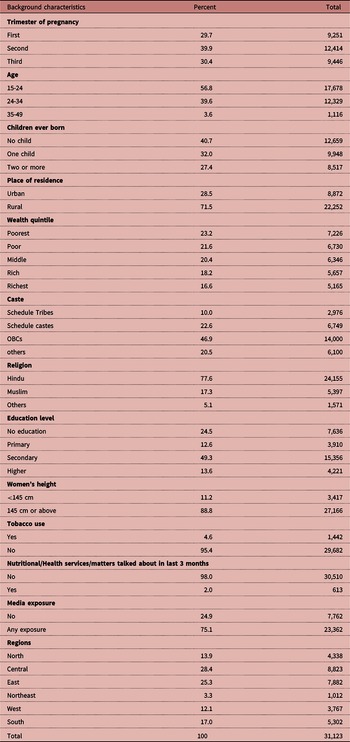
Table 1 shows the distribution of the pregnant women by their demographic and socio-economic characteristics. The majority of the respondents (56.8%) were in the 15-24 age group, followed by 39.6% in the 25–34 years’ age groups. The distribution of pregnant women suggests that most of them were from rural areas (71.5%), from OBC group (47%) and from Hindu religion (77.6%). The majority (49.3%) had secondary level education and 27.4% had two or more children. Most of the women (95.4%) did not consume tobacco, a majority of the pregnant women (98%) had talked about nutritional/health services related matters with any health worker (ASHA, MPW, etc.) in the last three months and (24.9%) had no media exposure. Central region women comprised 28.4% of the sample and only 3.3% of pregnant women belonged to Northeast region.
Distribution of pregnant women aged 15–49 years by their demographic and socio-economic characteristics, India, 2015-16

Note: Cases are not equal due to missing values.
Prevalence and Determinants of Anaemia among pregnant women
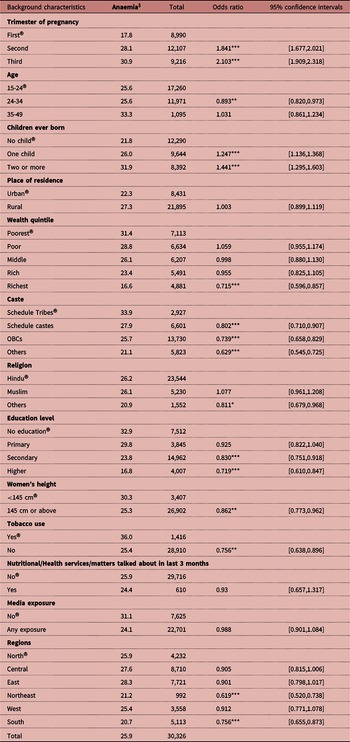
Table 2 presents socio-economic differentials in the prevalence of anaemia among pregnant women. In total, a little more than one fourth (25.9%) of the pregnant women found to be anaemic at the time of survey. The prevalence of anaemia was higher among the pregnant women who were in their third trimester (30.9%), belong to age group 35-49 years (33.3%), who had already two or more children (31.9%), resides in rural areas (27.3%), belonged to poorest household (31.4%), from the Scheduled tribes (33.9%), women from Hindu religion (26.2%), women with no education (32.9%), women with less than 145 cm of height (30.3%), consume tobacco (36%), not advised or talk about nutritional/Health related matters in the last 3 months by any health worker (25.9%) and women from eastern region (28.3%). The regression results also confirm the same. For example, the odds of having anaemia during pregnancy was higher among women who were in their third trimester (OR: 2.10; p < 0.001) and having two or more children (OR:1.44; p < 0.001) compared to women in the first trimester and women with no child respectively. Similarly, odds for having anaemia was significantly lower among women belongs to 24-34 age group (OR: 0.89; p < 0.05), belongs to richest household (OR: 0.71; p < 0.001), from other caste group (OR: 0.62; p < 0.001), following other religion (OR: 0.81; p < 0.05), women with the height of 145 cm or above (OR: 0.86; p < 0.01), currently do not consume tobacco (OR: 0.75; p < 0.01) and belong to northeast region (OR: 0.61; p > 0.001) and south region (OR: 0.75; p < 0.001) compared to women in the age group 15-24, belong to poorest household, women from scheduled tribe community, women from Hindu religion, women’s height less than 145 cm, currently consuming tobacco and women from north region respectively.
Prevalence and determinants of Anaemia (<10.0 g/dl) among pregnant women aged 15-49 years by their background characteristics in India, 2015-16

Note: level of significance: * p<0.05, ** p<0.01, *** p<0.001. ®: reference category.
A pregnant woman is classified as anaemic if she has a Hb level <10.0 g/dl; $: Prevalence of anaemia.
Prevalence and Determinants of Hypertension among pregnant women
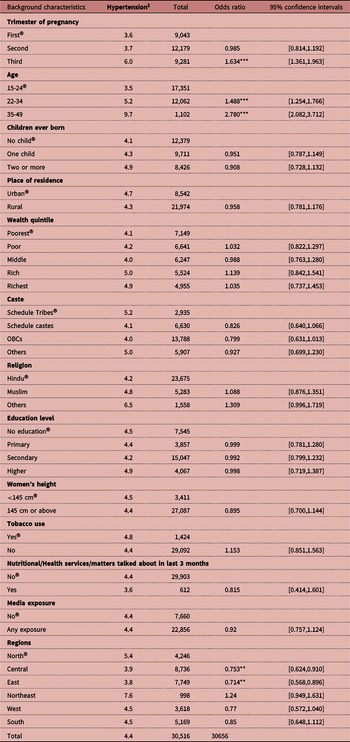
A similar exercise has been conducted in order to identify prevalence and odds of hypertension and presented in Table 3. Results suggest that on an average 4.4% of pregnant women were suffering from hypertension at the time of survey. This prevalence considerably varies by socio-economic condition of the respondents. The prevalence of hypertension was higher among the pregnant women who were in their third trimester (6.0%), women belonged to age group 35-49 years (9.7%), who had already two or more children (4.9%) resides in urban areas (4.7%), belonged to richest household (4.9%), from the Scheduled tribes (5.2%), women from other religion (6.5%), pregnant women with higher level of education (4.9%), consume tobacco (4.8%), not advised or talk about nutritional/Health related matters in last 3 months with any health worker (4.4%) and women from Northeast region (7.6%). The results of regression results also affirm these findings. For illustration, the odds of developing hypertension during pregnancy was significantly higher among women who were in their third trimester (OR: 1.6; p < 0.001) and those who were in their 35-49 age group (OR: 2.7; p < 0.001) compared to women in the first trimester and women in the age group of 15-24 respectively. Similarly, odds for having hypertension was significantly lower among women belongs to central India (OR: 0.75; p < 0.01) with respect to women from Northern region.
Prevalence and determinants of hypertension among pregnant women aged 15-49 years by their background characteristics in India, 2015-16

Note: level of significance: * p<0.05, ** p<0.01, *** p<0.001. ®: reference category.
A pregnant woman is classified as having hypertension if she has SBP≥140 mmHg or DBP≥ 90 mmHg at the time of survey, or she is currently taking medicine to lower her blood pressure; $: prevalence of hypertension.
Prevalence and Determinants of Diabetes among pregnant women
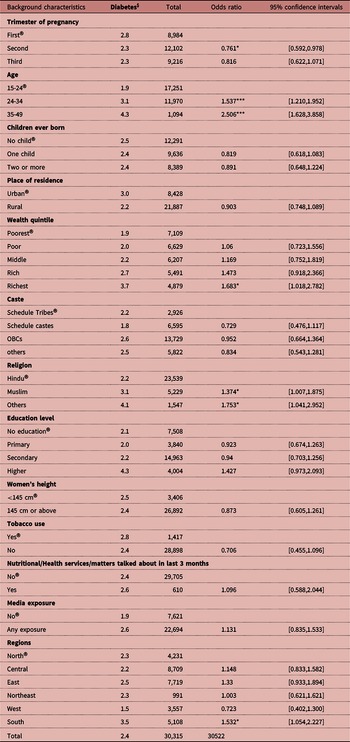
The prevalence and determinants of diabetes have been identified and presented in Table 4. At national level the prevalence of Diabetes among pregnant women was 2.4%. The prevalence of diabetes is varied by socio-economic characteristics and evident from the Table 3.
Prevalence and determinants of Diabetes among pregnant women aged 15-49 years by their background characteristics in India, 2015-16

Note: level of significance: * p<0.05, ** p<0.01, *** p<0.001. ®: reference category.
A pregnant woman is classified as having Diabetes if she has a random blood glucose level of 141 mg/dl or higher; $: Prevalence of Diabetes.
The prevalence of Diabetes was higher among the pregnant women who were in their first trimester of pregnancy (2.8%), women belonged to age group 35-49 years (4.3%), among urban residents (3.0%), belonged to richest household (3.7%), women from other backward classes (2.6%), followers of other religion (4.1%), pregnant women with higher level of education (4.3%), women with less than 145 cm of height (2.5%), consume tobacco (2.8%), who had advised or discuss about nutritional/Health related matters in last 3 months with any health worker (2.6%), pregnant women who exposed to media (2.6%) and pregnant women from south region (3.5%). While identifying odds of diabetes among pregnant women, results suggest that the odds for having diabetes during pregnancy was significantly higher among women who were in their 35-49 age group (OR: 2.5; p < 0.001), women from the richest household (OR: 1.6; p < 0.05), either belong to Muslim (OR:1.4; p < 0.05) or other religion (1.753; p < 0.05) and residents of southern region (OR:1.5; p < 0.05) as compare to women in the age group 15-24, women from poorest household, women from Hindu religion and women from northern region respectively.
Summary and Discussion
The main objective of the study is to present the prevalence and determinant of Anaemia, Hypertension and Diabetes among pregnant women using the fourth round of National Family Health Survey (NFHS-4) data. The study observed a higher proportion of pregnant women in India suffer from Anaemia, Hypertension and Diabetes during their pregnancy and the prevalence of all these three indicators drastically varied by women socio-economic and demographic characteristics.
Anaemia
Anaemia during pregnancy is associated with an augmented risk of maternal and child mortality and morbidity in low-income countries (Kalaivani, Reference Kalaivani2009; WHO, 2014). Similar to earlier studies of other countries (McLean et al., Reference McLean, Cogswell, Egli, Wojdyla and De Benoist2009), the present study supports that the later stage of pregnancy and higher parity are associated with higher risk of anaemia among pregnant women. In the analysis, women’s age emerged as a critical factor that elevates the risk of NCDs during pregnancy. Older women were at a significantly higher risk of having anaemia, hypertension and diabetes during pregnancy. The etiology of anaemia is complex and ranges from bone marrow failure syndromes to chronic kidney disease and from nutritional deficiencies to inflammatory processes, including inflammation in immune-senescence (Stauder, et al., Reference Stauder, Valent and Theurl2018).
The result further suggests that the prevalence of anaemia among pregnant women is majorly skewed toward the disadvantaged group of women. For illustration, pregnant women living in rural areas, belongs to the poorest and poor households, women from schedule tribes and schedule castes, women with no education and having no media exposure are at greater risk of developing anaemia during their pregnancy. These women suffer more because of demand-side factors. They have less purchasing power to acquire essential levels of supplements, protein, and vitamins during the pregnancy (Goli, et al., Reference Goli, Rammohan and Singh2015). The risk of having anaemia among pregnant women decreases with the increase of the economic status of the household. This is probably because anaemia is associated with diet patterns and nutritional deficiencies, and less awareness and least access to health facilities among the poor than richer.
Additionally, increasing the height of women is negatively associated with the risk of anaemia among pregnant women. The prevalence of anaemia was higher among smokers compared with non-smokers, though the association was not statistically significant. Biochemically, tobacco use may affect iron metabolism (Kocyigit et al., Reference Kocyigit, Erel and Gur2001), iron stores (Northrop-Clewes and Thurnham, Reference Northrop-Clewes and Thurnham2007), inflammation (Chelchowska et al., Reference Chełchowska, Ambroszkiewicz, Gajewska, Jabłońska-Głąb, Maciejewski and Ołtarzewski2016), and haemoglobin levels (WHO, 2013). Behaviourally, tobacco use may act as an appetite suppressant (Blaha et al., Reference Bláha, Yang, Meguid, Chai and Zadák1998; Koopmann et al., Reference Koopmann, Bez, Lemenager, Hermann, Dinter, Reinhard and Kiefer2015; Miyata et al., Reference Miyata, Meguid, Fetissov, Torelli and Kim1999), and has been linked with lower food intake. In contrast, even though many women in India use tobacco during pregnancy, but there is no national policy to address antenatal tobacco use, despite international recommendations (WHO, 2013).
Hypertension
The study shows relatively high prevalence of Hypertension among Indian pregnant women and its varies considerably by socio-economic characteristics of the respondents. The prevalence of Hypertension among pregnant women was significantly higher particularly among the women in their third trimester of pregnancy, and the women belong to the age group 35-49. Further, it is found higher for pregnant women belonging to wealthier families, women belonging to either Muslim or other religions and women from the northeast region of India. The higher prevalence of Hypertension among women belongs to richer households might be because of their risky health behaviours such as stress, unbalanced diet, and physical inactivity.
Interestingly, higher educated pregnant women reported a relatively higher prevalence of Hypertension. This can be because education makes the people aware of the disease and the precautions to be undertaken by a healthy individual. Additionally, the prevalence of Hypertension was higher among those who consume tobacco than non-users, though the regression result shows the peculiar result that indicates that mere consumption of tobacco is not enough to raise the risk of developing hypertension. Study also found that discussion with the frontline health worker in the last three months was associated with reduced risk of hypertension, indicating the importance of counselling and awareness during pregnancy.
A wide regional variability existed in the prevalence of Hypertension among pregnant women. For illustration, the prevalence of hypertension found significantly higher for the Northeast region. One of the plausible reasons for high prevalence in this region could be unhealthy lifestyles and dietary patterns and inadequate knowledge about the risk factors of NCDs (Imamura et al., Reference Imamura, Micha, Khatibzadeh, Fahimi, Shi and Powles2015; Vaidya et al., Reference Vaidya, Aryal and Krettek2013; Choudhary et al., Reference Choudhary, Sharma, Kumari and Gautam2016). Other reason could be unaffordable anti-hypertensive medication or lack of treatment services, and distant heath care centres (Chow et al., Reference Chow, Teo, Rangarajan, Islam, Gupta, Avezum and Yusuf2013).
Diabetes
As far as the prevalence of diabetes among pregnant women is concerned, the existing evidence demonstrated the inconsistency regarding the prevalence of diabetes among women during pregnancy in India, which varies between 4% to 14%. (Raja, et al., Reference Raja, Baba, Hanga, Bilquees, Rasheed, Haq and Bashir2014; Seshiah et al., Reference Seshiah, Balaji, Balaji, Sanjeevi and Green2004; Mithal et al., Reference Mithal, Bansal and Kalra2015; Rajput et al., Reference Rajput, Yadav, Nanda and Rajput2013). The difference in the estimates might be due to differences in the variations in sample size and different cut-offs used. Our study shows that the rates of diabetes substantially vary across the demographic and socioeconomic characteristics of the respondents. The rate of diabetes was significantly higher among elderly women, who belong to rich households, women from Muslim or other religions and women residing in the south region.
Interestingly, those women who were in their second trimester of pregnancy had a significantly lower risk of becoming diabetic than women who were in their first trimester of pregnancy. In the first three months of pregnancy, a drastic change in the female body creates a hormonal imbalance that elevates the glucose level. Besides, in the early stage of pregnancy, women are less familiar with pregnancy management, associated with a low level of awareness regarding diet and nutritional supplements that leads to an elevated risk of Gestational Diabetes among pregnant women.
Women’s increased age is an important risk factor for the development of diabetes during pregnancy (Swaminathan, et al., Reference Swaminathan, Swaminathan and Corsi2020). In the present study, the prevalence of diabetes gradually increased with advancing age. We also observed an effect of parity on the prevalence of GDM. Women with no children before are more likely at risk of diabetes during pregnancy. This might be because of a sudden change in the hormones as they become pregnant first time.
Women residing in urban areas are more likely to be associated with an elevated risk of diabetes than rural inhabitants. This may be due to a generally lower level of physical activity, unhealthier diet, as well as other factors such as increased pollution in urban compared to rural habitats (Ramachandran, et al., Reference Ramachandran, Snehalatha, Latha, Manoharan and Vijay1999; Zargar et al., Reference Zargar, Sheikh, Bashir, Masoodi, Laway, Wani, Bhat and Dar2004; Ramachandran et al., Reference Ramachandran, Snehalatha, Latha, Vijay and Viswanathan1997). Besides, the higher level of awareness and access to health care facilities might be one of the reasons for the elevated risk of diabetes among urban habitant women.
The study has found that the risk of diabetes among pregnant women increases with the increase in the household wealth and education level. Though the education level is not showing a significant association. The higher prevalence of diabetes among richer shows their better access to health care and awareness of the disease and the precautions to be undertaken by a healthy individual.
Furthermore, women’s height greater than 145 cm is less likely to be associated with diabetes during pregnancy. The height of the women is associated with the disadvantaged groups and to some extent express growth ‘stunting’. The women’s height may be a marker of early pre-and post-natal nourishment and development, and may to some extent support the role of the early environment and developmental programming on the risk of developing Gestational Diabetes. Moreover, Diabetes was found to be more among those who discussed nutritional/health matters with the frontline health worker in last 3 months than others. It may be because advice provided by frontline health workers is targeted who are already suffering from diabetes and belongs to disadvantageous group.
Conclusion and Policy recommendations
In conclusion, the study shows the high prevalence of anaemia, hypertension and diabetes among pregnant women in India. To reduce the risk of these avoidable life-threatening diseases among pregnant women and eventually to avoid preventable maternal mortality and morbidities, strengthening and monitoring the existing programs, i.e. ICDS, RKSK, JSSK, RMNCH+A, National Food Security Act, removing bottlenecks in accessing the programs by promoting awareness and health knowledge among women regarding nutrition and health care is critical for improving anaemia, hypertension and diabetes among women in India. Therefore, addressing the specific needs of pregnant women through an effective healthcare delivery system would help to reduce the prevalence of anaemia, hypertension and diabetes among pregnant women. Moreover, increased outreach of health services, training, and motivating frontline health workers not only for pregnancy registration but also for promoting knowledge about balanced nutrition, dietary diversity and provision of supplementary nutrition is crucial to prevent these diseases among pregnant women. There is a guideline for the screening and management of gestational diabetes (GOI, 2014), but this guideline needs to be contextualised and modified according to the local need for effective treatment and adoption. Similarly, early screening for Pregnancy Induced Hypertension (PIH) during pregnancy is recommended.
Acknowledgements
Not applicable.
Limitations of the study
This study has a few limitations that need to be mentioned while interpreting the results. NFHS is a cross-sectional study, therefore, a causal relationship cannot be necessarily established between the predictors and outcomes variables. Furthermore, there could be a possibility of misreporting because of single-day measurements.
Funding
This research received no specific grant from any funding agency, commercial entity or not-for-profit organization.
Ethical approval
This analysis was based on the Demographic and Health Survey data from India available in the public domain. The study conducted a secondary analysis with no identifiable information on survey respondents.
Consent for publication
All authors have given their consent for publication.
Declaration of Competing Interest
The authors declare that they have no known competing financial interests or personal relationships that could have appeared to influence the work reported in this paper.