Introduction
Traumatic brain injury (TBI) is an international public health issue (Frost, Farrer, Primosch, & Hedges, Reference Frost, Farrer, Primosch and Hedges2012). In Australia, the prevalence of TBI among the general population is an estimated 5.7% (Anstey et al., Reference Anstey, Butterworth, Jorm, Chistensen, Rodgers and Windsor2004) and the lifetime cost of severe TBI is an estimated $4.5 million per person (Access Economics, 2009). A major component of these costs is the lost productivity associated with poor levels of return to work (RTW) (Access Economics, 2009). TBI can be defined as ‘an alteration in brain function, or other evidence of brain pathology, caused by an external force’ (Menon, Schwab, Wright, & Maas, Reference Menon, Schwab, Wright and Maas2010, p. 1637). TBI fits under the umbrella of acquired brain injury (ABI). ABI refers to brain damage acquired after birth, and encompasses conditions such as stroke and hypoxic/anoxic brain damage as well as TBI (Australian Institute of Health and Welfare, 2007).
Rates of return to competitive employment after severe TBI are low, typically ranging between 30 and 40%, approximately half the pre-injury employment rate (Agency for Clinical Innovation, 2013; Brooks, McKinlay, Symington, Beattie, & Campsie, Reference Brooks, McKinlay, Symington, Beattie and Campsie1987; Harradine et al., Reference Harradine, Winstanley, Tate, Cameron, Baguley and Harris2004; Kreutzer et al., Reference Kreutzer, Marwitz, Walker, Sander, Sherer, Bogner, Fraser and Bushnik2003; Olver, Ponsford, & Curran, Reference Olver, Ponsford and Curran1996; Ponsford et al., Reference Ponsford, Downing, Olver, Ponsford, Archer, Carty and Spitz2014; van Velzen, van Bennekom, Edelaar, Sluiter, & Frings-Dresen, Reference van Velzen, van Bennekom, Edelaar, Sluiter and Frings-Dresen2009). Factors that account for these poor rates of RTW include pre-injury employment status, post-injury neurophysical impairments, cognitive impairments (e.g., deficits in memory, attention, speed of information processing and executive functions), behavioural changes (e.g., increased impulsivity, anger outbursts), and mental health problems (e.g., heightened levels of anxiety and/or depression) (Agency for Clinical Innovation, 2013; Nightingale, Soo, & Tate, Reference Nightingale, Soo and Tate2007; Tate, Simpson, & McRae, Reference Tate, Simpson, McRae, Escorpizo, Brage, Homa and Stucki2015). Notwithstanding these barriers, employment remains a high priority for people recovering from brain injury.
Currently, there is a lack of ABI specialist skills within the vocational rehabilitation (VR) sector in Australia, including both government and privately funded service providers, reflective of a reduction in specialist services in favour of generic service providers. For instance, the dominant groups in the Disability Employment Service (DES) system are people with physical disability (43.9%) and psychiatric disability (35.4%). Only 1.3% of the caseload comprises people with ABI (Department of Employment, 2015). Other changes made to the DES over the past decade impacting on suitable service options for people with TBI include shortening of work training placements from 12 to 4 weeks, decontextualised job capacity assessments and a compliance-focussed funding model that encourages rapid job outcomes over pursuing individual vocational goals.
To better address the current challenges of RTW after brain injury, it is important to gather data from the client perspectives of participating in VR.
Very little data from an insider perspective have been reported within the Australian and international literature to date. The one qualitative study that did investigate the client experience of VR service provision conducted in the United Kingdom highlighted the value of services that located appropriate and interesting job placements, provided pro-active and extended follow-up and increased client confidence (Macaden, Chandler, Chandler, & Berry, Reference Macaden, Chandler, Chandler and Berry2010). In contrast, qualitative studies investigating VR have focussed on the broader range of client and employer attributes associated with successful RTW and have aggregated participants into a single group regardless of their pathway back to work (Ellingsen & Aas, Reference Ellingsen and Aas2009; Medin, Barajas, & Ekberg, Reference Medin, Barajas and Ekberg2006; Oppermann, Reference Oppermann2004; Petrella, McColl, Krupa, & Johnston, Reference Petrella, McColl, Krupa and Johnston2005; Rubenson, Svensson, Linddahl, & Bjorklund, Reference Rubenson, Svensson, Linddahl and Bjorklund2007; van Velzen, van Bennekom, van Dormolen, Sluiter, & Frings-Dresen, Reference van Velzen, van Bennekom, van Dormolen, Sluiter and Frings-Dresen2011). Further delineation of sub-groups, particularly those returning to their pre-injury employment as distinct from people seeking new employment or those preparing for work, may reveal that these pathways pose very different challenges, requiring VR providers to customise their approach and workplace strategies. Therefore, the current study aimed to describe and contrast the VR experiences and issues of people who participated in different employment pathways: return to pre-injury employment, job seeking and those who had not worked since injury, from an Australian perspective.
Method
Research Design
This study was based within a realist, data-driven epistemological approach, which takes the assumption that meaning and experiences are directly reflected in the language of individuals (Braun & Clarke, Reference Braun and Clarke2006). Thematic analysis is commonly used in qualitative studies, including with brain injury populations (Gilworth, Eyres, Carey, Bhakta, & Tennant, Reference Gilworth, Eyres, Carey, Bhakta and Tennant2008; Gracey et al., Reference Gracey, Palmer, Rous, Psaila, Shaw, O'Dell, Cope and Mohamed2008). This method was selected for its flexibility in conducting interviews and its potential for elucidating rich and detailed information about client experiences in navigating complex service delivery systems.
Participants and Setting
The present study forms part of a larger project examining employment participation for people with severe TBI in New South Wales (NSW) in response to the growing challenges in achieving RTW outcomes. The study of 721 adults with predominantly severe TBI reported an employment rate of 29% (207/721), in contrast to 532 (74%) who had been working at the time of injury (Agency for Clinical Innovation, 2013). In addition to the collection of RTW outcome data, case study interviews were conducted to understand the perspective of people with TBI about their experiences of working post-injury, or attempting to return to the workforce. The 29 individuals who participated in this component of the study were all clients of the NSW Brain Injury Rehabilitation Program (BIRP), a state-wide network of 15 specialist services provided by NSW Health, the state health system.
The BIRP comprises a mix of inpatient, transitional living and community rehabilitation services provided across metropolitan and rural areas of NSW (Agency for Clinical Innovation 2014; Harradine et al., Reference Harradine, Winstanley, Tate, Cameron, Baguley and Harris2004; Simpson, Daher, Hodgkinson, & Strettles, Reference Simpson, Daher, Hodgkinson and Strettles2016). Under Australia's universal healthcare system, all people who are resident within NSW, aged between 0 and 65 years who sustain a severe TBI are eligible to access BIRP services. The community BIRP teams provide limited direct vocational services. Clients with vocational goals are usually referred to external services (either DES or private providers), particularly if a job-seeking programme is required. The exception to this is the Head2work programme at the BIRP based at Liverpool Hospital in Sydney, which provides VR programmes within the health setting.
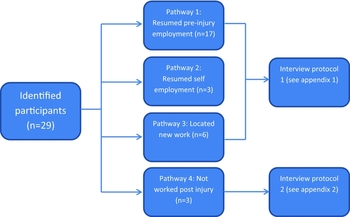
Participants were selected using heterogeneous sampling, a purposive sampling technique used to capture a wide range of experiences. Clinicians from the BIRP community rehabilitation teams were instructed to select clients based on the following potential pathways: (i) resumed pre-injury employment, (ii) resumed self-employment, (iii) located new work post-injury or (iv) had not yet achieved a work placement post-injury. No upper limits were placed on time post-injury, so that the experiences of participants at various times over the course of recovery and the longer term could be captured. Additionally, clinicians were instructed to select a mix of clients who had been either successful or unsuccessful within these pathways as well as a mix of clients who had received assistance from a VR service and those who had not.
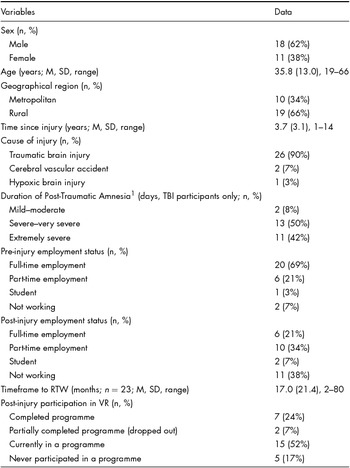
The sample comprising the interview participants reflected the typical age, sex and pre-injury employment profile of the population serviced by the BIRP community rehabilitation teams (see Table 1). However, there was an over-representation of people living in rural locations (66%) in this sample. Almost all participants were working at the time of injury, most employed full-time. At the time of the interviews, just over half of the sample were employed, but with only one-fifth in full-time work. With regards to vocational supports received, nine participants (9/29) accessed a DES provider, eight (8/29) accessed a private VR provider, seven (7/29) received vocational support through the BIRP (including four within the Head2work programme), three participants (3/29) managed RTW with no additional support and the remaining two participants (2/29) had not commenced an employment programme.
Demographic and Injury Characteristics of Participants (N = 29)

Note. RTW Return to Work; VR Vocational Rehabilitation; TBI Traumatic Brain Injury
1Duration of Post Traumatic Amnesia: Mild–Moderate < 24 hours, Severe–Very Severe 1 day–4 weeks, Extremely Severe >4 weeks (Teasdale, Reference Teasdale1995).
Data Collection
Collection of demographic and injury details was done from BIRP databases as part of the larger project. Two semi-structured interview protocols were developed by the researchers, one for clients who had participated in paid work post-injury (pathways i – iii above) and one for those that had not yet achieved a work placement (pathway iv) (see Figure 1). The protocols (refer to Appendices A and B) were devised in consultation with an expert project steering committee, which included both clinician and consumer representatives as well as drawing upon on the researchers’ clinical experience of providing specialised brain injury VR for over 10 years.
Participant pathways.

For the clients who had worked post-injury, the protocol posed nine questions which covered the following areas: their work roles pre- and post-injury, the challenges they encountered in re-entering the workforce, the factors that assisted them in the RTW process, their future goals and suggestions for improving service systems. Each question contained a number of prompts to elicit further detail, if required. The protocol for those clients who had not worked post-injury (pathway iv) contained similar questions concerning their employment background, interest in working and challenges encountered, though with additional items concerning what programmes were available in helping them to prepare for work or participate in alternate vocational activities.
Each interview was conducted by one or two of the researchers (PM, LH). The two researchers were external to each of the BIRP services, and no local BIRP clinicians were present during the interviews. The majority of interviews were conducted face to face at a BIRP site (20 cases), though a smaller number were conducted via telephone (eight cases) or videoconference (one case). Interviews were between 25 and 70 minutes in duration. Notes were taken and interviews were recorded by an audio-recording device, which was later used to complete a summary report for each case. The completion of notes by each researcher along with the use of audio files allowed cross-checking of interview content, thereby ensuring the trustworthiness of the data. A check of the summary reports found no difference in length between interviews undertaken face to face versus interviews done by telephone or videoconference.
Procedure
The study received ethics approval from the eight relevant Local Health District Human Research Ethics Committees. BIRP clinicians identified potential participants, provided them with information sheets, invited their participation and gained informed consent. No payment or inducements were provided to the clients, who were interested in sharing their experiences to assist other clients in the future. Not all centres identified clients for each of the pathways. The majority of clients had sufficient cognitive capacity to participate in the interviews independently, though in two cases a family member attended to assist with their recall of information.
Data Analysis
Data were analysed using thematic analysis, a method that identifies and analyses patterns within a dataset in order to identify meanings that are valid for the majority of participants (Braun & Clarke, Reference Braun and Clarke2006). Braun and Clarke's (Reference Braun and Clarke2006) six phases of thematic analysis were used to guide the process of data analysis. First, summary reports of the interviews were read and re-read to identify initial ideas and trends in the data. The second phase focussed on generating a set of initial codes, which was done separately by two of the researchers (PM, LH). Third, the researchers organised their codes into potential themes together. In the fourth and fifth stages of analysis, the researchers collated and refined the themes, now involving the third researcher (GS) so that there were clear, identifiable distinctions between them (Braun & Clarke, Reference Braun and Clarke2006). The final stage of analysis focussed on explaining the meaning and implications of each of these themes. Only one change to the data grouping arose from the analysis. It was found that the data contained in the three cases who were self-employed (pathway ii) were comparable to the larger group who resumed their pre-injury employment (pathway i) and did not contribute additional thematic content. Therefore, the first two pathways were combined, resulting in only three pathways for analysis: return to pre-injury employment (n = 20), job seeking for new employment (n = 6) and not yet worked post-injury (n = 3).
Results
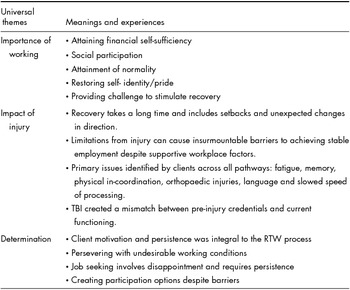
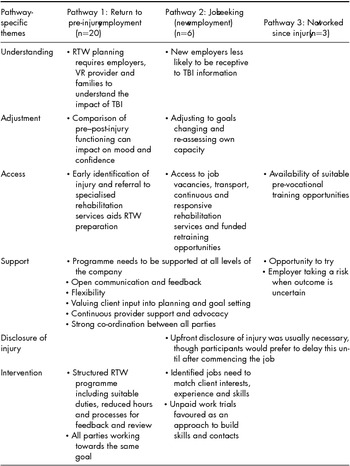
In total, eight themes were identified from the analysis. Three themes were common across all participants, regardless of their pathway (universal themes, see Table 2). The other five themes contained content specific to the different pathways, as outlined in Table 3.
Universal Themes

Pathway-Specific Themes

Universal Themes
The Importance of Working
Within this theme, the importance of working following brain injury encompassed five main benefits, which are listed in Table 2. The aspiration to earn an income independent of welfare payments or family support was evident: ‘I don't want to rely on the government. . . I don't want to just get by, I want to do well’ (participant 25, age 28, 2–5 years post severe TBI). Work was credited with aiding recovery: ‘helped with building up strength again’ (participant 2, age 57, 2–5 years post mild-moderate TBI), restoring confidence, providing the opportunity to socialise and was the key to re-gaining normality: ‘working makes me feel as though I'm human again’ (participant 11, age 45, more than 5 years post severe TBI).
Impact of Injury
The next theme consisted of both the range of impairments that were encountered post-injury which impacted upon RTW, as well as the duration of the recovery process itself. In relation to the latter, a strong element in this theme was the experience that recovery took much longer than expected and included setbacks and changes of direction: ‘I'm five years since my accident, and that's how long it's taken me to get here, and I'm still not better yet, but I'm still improving. It's just so slow, that you cannot see it’ (participant 28, age 29, 2–5 years post extremely severe TBI). The primary effects of injury that were highlighted included fatigue, memory loss, physical effects such as poor balance, orthopaedic restrictions, as well as language and information processing difficulties including confusion and slowness. Of interest, the impact on employment was not always due to the cumulative effect of multiple impairments, but on occasions single impairments (such as inappropriate communication, orthopaedic injury, severe anxiety) caused insurmountable barriers to succeeding in employment. The other component of this theme was the mismatch between pre-injury credentials and current functioning, which led to great uncertainty about participant work ability.
Determination
The final universal theme centred on the importance of participant's own motivation, positive mindset and persistence as vital in progressing their employment (see Table 2). Examples of persevering with undesirable situations for longer term gain included moving to a neighbouring town to eliminate travel obstacles to the workplace, accepting a lower position with a pre-injury employer than previously held and undertaking unpaid work trial placements in the hope of transitioning to a paid position. Job seeking required particularly high resilience in the face of multiple disappointments: ‘It's really hard, I'm getting to the point where I'm getting sick of looking for work because I keep being rejected for the work that I apply for’ (participant 1, age 21, 2–5 years post extremely severe TBI).
Employment Pathway-Specific Themes
A further five themes reflected distinct characteristics dependent upon the employment pathway. Some of the themes did not apply to the group who had not worked post-injury (pathway iii; see Table 3).
Understanding
A common barrier to work re-integration was a lack of understanding of the person's condition and needs on the part of VR providers, employers and family members (in the case of those who were self-employed). This could be attributed to the invisible nature of TBI: ‘They think the accident is in the past and don't understand that problems persist’ (participant 20, age 46, more than 5 years post severe TBI). Many of those participants resuming their pre-injury employment (pathway i) considered that the employer developed an insufficient, inaccurate and/or problem-focussed account of the injury, leading to inappropriate selection of tasks, pacing of hours, as well as instilling a sense of doubt. On the other hand, satisfaction was associated with the provision of information to employers by staff with specialist knowledge about acquired brain injury. In pathway (ii) (seeking new work), conveying an understanding of one's condition and needs was even more problematic without the benefit of a pre-existing relationship and the competitive nature of employment.
Adjustment
This theme captured the experience of how resuming pre-injury employment (pathway i) raised awareness of the altered level of function resulting from the injury, which then impacted on mood and level of confidence. This was in contrast to the expectation that the process would occur more quickly and with fewer difficulties: ‘I expected that I would be able to do what I couldn't do’ (participant 27, age 60, 2–5 years post extremely severe TBI). One example was an apprentice who resumed his pre-injury trade and was confronted by the realisation that he had fallen behind his peers: ‘I'm stuck behind’ (participant 17, age 24, 2–5 years post severe TBI). Another component of this theme related to adjustment in the context of self-employment, including experiences such as no longer being able to manage the full scope of tasks, needing to re-define pre-injury roles within the business and having to accept paid help. In relation to seeking new employment (pathway ii), having to undergo a more lengthy process of adjustment, coping with changing of goals and direction, often through multiple job placements was highlighted. For instance, one participant held 11 jobs over a four-year period.
Access
Access to suitable rehabilitation services, job vacancies, transport and funding all contributed to the outcomes and experiences of RTW. In the context of returning to pre-injury employment (pathway i), the importance of early referral to the BIRP (prior to resuming work) and the value of continuous therapy and case management throughout the RTW process was stressed: ‘knowing that I've always got someone here (BIRP) that I can fall back to’ (participant 5, age 48, 2–5 years post extremely severe TBI). In seeking new employment (pathway ii), the experience of finding access to job vacancies and transport in rural areas was extremely difficult, particularly with suspension of driver's licence following injury. For instance, one participant considered moving towns to improve job seeking opportunities: ‘Not having much luck at the moment, there's not much going up here’ (participant 1, age 21, 2–5 years post extremely severe TBI). Offsetting these challenges, the availability of insurance claims (where funding was approved) afforded greater access to paid pre-vocational training and work trial placements in the case of both pathways (ii) and (iii).
Support
This theme was depicted as falling along a continuum, from experiences of very good support through to a total lack of support from employers, co-workers, VR providers, BIRP clinicians and families. Irrespective of pathway and degree of success in employment, there was a general acknowledgement of the positive support received from families and BIRP teams. Families provided encouragement and practical assistance. BIRP services including case management, transitional living programmes, driving assessments and psychological counselling were considered particularly helpful.
A variation of experiences was expressed in support provided by VR providers and employers. In the case of returning to pre-injury employment (pathway i), positive experiences were associated with clear communication and feedback, accommodation of a graduated RTW programme with no time constraints and support at all levels of the company. VR providers who provided continuous follow-up, respected client input and followed a flexible approach were viewed as positive. The well-co-ordinated support across multiple parties was highlighted in the cases who successfully maintained pre-injury employment: ‘It was a team effort’ (participant 14, age 66, 1–2 years post mild-moderate TBI).
Conversely, poor workplace support was associated with no formalised process for RTW, lack of feedback and lack of advocacy in workplace negotiations. In the context of attempting to negotiate RTW (pathway iii), disappointment was expressed when the opportunity to trial pre-injury job roles was not supported by the employer due to perceived risk. Within pathway (ii), dissatisfaction with the level of VR provider support was elicited in relation to the job seeking approach, particularly with insufficient post-placement support: ‘[the provider] helped put my resume together and listed with recruitment agencies but that's all. They cut me off as soon as I started working’ (participant 4, age 19, 1–2 years post severe TBI).
Disclosure
Disclosure of injury was not relevant to people returning to their pre-injury employment (pathway i), as in all of these cases the employer was aware of their employees’ TBI. However disclosure posed a particular dilemma for the other two groups. This theme explored the perception that disclosing the injury jeopardised the chances of securing work (extending the job-seeking process) and as a consequence, the more ‘ideal’ approach of delaying disclosure until settled into a workplace was preferred. However, this was rarely the direction taken in practise. There were a number of accounts relating to disclosure, either in the written application or verbally at the time of interview, or through a VR provider disclosing the injury in canvassing job opportunities on the client's behalf. Despite the belief that disclosure would block some job opportunities, it seemed necessary for disclosure to occur. As stated by one participant: ‘instead of trying to hide it, thought I'd put it straight out there, and it worked’ (participant 4, age 19, 1–2 years post severe TBI).
Intervention
The final theme related to intervention, with a number of elements comprising the VR programme being identified. In resuming pre-injury employment (pathway i), these consisted of graduated RTW programmes, on-site training and strategies, functional assessment, employer education, case monitoring and reviews. Not all participants received each element, and there were varying levels of satisfaction with service provision. In securing new employment (pathway ii), elements viewed favourably included unpaid work trials, the use of wage subsidies and training courses. Elements viewed less favourably included vocational assessment and job-seeking services, with accounts of low intensity of intervention, including needing to generate one's own job goals and having to apply for work independently. In some instances, jobs proposed did not match client's experience, interests or skills. One participant commented that he had to generate his own job options when the one suggested by the provider was not possible: ‘I thought about it and I thought about it . . . it took me 4–5 months and then I decided on real estate’ (participant 25, age 28, 2–5 years post severe TBI).
Discussion
The current report is the largest qualitative study presenting a consumer perspective on RTW after severe brain injury in Australia. Twenty-nine participants described a range of experiences, barriers and facilitators, and data were thematically analysed according to employment pathway (‘return to pre-injury employment’, ‘job seeking’ and ‘not worked since injury’).
The themes of the importance of working, impact of injury and determination were common across the three vocational pathways. These findings resonate with previous international accounts of RTW after TBI and acquired brain injury more broadly. Oppermann (Reference Oppermann2004), for instance, also reported that returning to work increases an individual's financial independence, self-worth and personal fulfilment. Gilworth, Phil, Cert, Sansam, & Kent (Reference Gilworth, Phil, Cert, Sansam and Kent2009) found persistent symptoms impacting on work performance to be headaches, irritability and problems with memory and tiredness within their sample of 13 individuals following stroke, factors also highlighted by the participants in the present study. Participants in the present study found RTW to be a harder and longer process than they had originally expected. It was often a journey of self-exploration, adjusting to changing goals and learning to work within own limits, which required high levels of motivation and persistence. Similarly, Petrella et al. (Reference Petrella, McColl, Krupa and Johnston2005) found an integral part of the journey to be discovering one's personal capacity which was considered to be an ongoing and evolving experience. Macaden et al. (Reference Macaden, Chandler, Chandler and Berry2010) also stressed the importance of ‘internal and unconditional motivation’ in sustaining employment following severe TBI.
The challenges in undertaking the RTW process were exacerbated by the lack of brain injury specialisation in the VR sector. Participants commonly perceived a lack of understanding about their condition in the workplace, many attributing this to the presentation of inadequate or overly negative information to employers. Medin et al. (Reference Medin, Barajas and Ekberg2006) also found under-preparation of the workplace to be a factor in their study of six individuals with stroke, in which no liaison with the workplace had occurred in four cases. In seeking new work, participants in the present study contemplated disclosing of injury during the application process, many believing this would jeopardise job opportunities. This issue is rarely discussed in the literature, as most studies focus on return to pre-injury employment. Only one previous case study addressed the issue of disclosure, in which the participant did not disclose of injury and then repeatedly fell out of employment due to undisclosed cognitive issues (Sabatello, Reference Sabatello2014).
Two overarching clinical implications for VR practice can be drawn from the client accounts in this study. First, every client and their employment situation are unique, and VR services need to provide both structure and flexibility in order to meet the needs of each person. RTW should follow a structured process to prevent setbacks and provide a clear sense of direction, yet have the flexibility to be self-paced and accommodate change. A stepping-stone approach of linking activities that lead to a final goal (‘rehabilitation’ approach) allows clients the time they need to adapt to the demands of the workplace. The structure includes identification of suitable duties, schedule of hours, processes for communication, supervision and support. In seeking new work, participants valued a hands-on approach to job placement and training. The current study also found voluntary work and unpaid work trials (aiming for paid work) to be positive replacements of the work role either as short- or long-term options. Placements need to be designed to fit the pace and duration of clients’ adaptation to a new environment. Second, RTW after TBI potentially involves an array of parties (employer, co-workers, VR provider, insurer, health clinicians, families), each playing a distinctly different role and all need to be working towards the same goal. This highlights the importance of a central vocational case co-ordinator, who brings expertise in TBI rehabilitation and promotes a cohesive team approach alongside the employer, family and health providers.
There are some limitations to the current study to consider. As an exploratory study, generalisations cannot be made to other samples or service contexts. Specifically, the interviews all took place within NSW and within the context of the BIRP programme, mostly conducted at the BIRP sites. Furthermore, the participating clients often had a long-standing association with their local service, and therefore, their responses may have been biased by social desirability or halo effects. Third, there was an over-representation of rural clients in this sample, resulting from only 5 of the 11 BIRP sites being in metropolitan areas. Therefore, specific challenges faced by people with brain injury in metropolitan areas seeking RTW may not have been adequately represented. Also, the number of participants within each pathway differed, with a bias towards people who have resumed their pre-injury employment (n=20) and fewer in pathway (iii) (not worked post-injury; n=3). This is an expected distribution. The BIRP vocational outcomes study mentioned above (n=721) found that of those who returned to work, 70% were with their pre-injury employer. Given the nature of this study, clinicians selected clients who have some experience in attending a programme or workplace to draw upon in the discussion. In the current study, there were few clients (n=3) who had commenced vocational activities but not secured a work placement. The large number of BIRP clients without vocational goals (due mostly to injury sequalae) was unlikely to be put forward for this study. Finally, the unit of analysis was interview summaries, rather than transcripts, and it is possible that if transcripts had been the unit of analysis, further themes could have been elicited, or further variation found within the identified themes.
In conclusion, this study sought to understand the experience of people with TBI in accessing employment within the current VR service climate in NSW. Issues concerning VR participation were identified for the participant group as a whole and specific to vocational pathways. Investigating models of service delivery that can accommodate these issues and recommendations is the next step in improving VR experiences for people with brain injury.
Acknowledgements
This project was funded by the Lifetime Care and Support Authority of NSW. The authors thank the project steering committee and the participating BIRP clinicians.
Appendix A
Scenario 1: Participated in Paid Employment Post-Injury
-
1. Can you outline your employment background prior to the injury Prompts:
-
• Education/training background.
-
• Summary of career progression – jobs held and duration.
-
• Job status at time of injury.
-
-
2. Tell us about your experiences in work after the injury Prompts:
-
• When did you start work?
-
• How did the negotiation of placements take place?
-
• Summary of job progression – jobs held and duration.
-
• What programme was involved (e.g. gradual RTW programme, job-seeking programme and across what time span)?
-
• What is your current work situation?
-
• Did you participate in any rehabilitation programmes that helped prepare you for work? What did this involve and across what timeframe?
-
• What supports are in place (including people, employer incentive schemes, equipment) to assist you at work?
-
-
3. Is it important for you to be able to work? Why? Prompts:
-
• Are there financial incentives to work?
-
• Are there social benefits to working?
-
• Are there benefits to physical and mental health?
-
• Compared with your involvement in work prior to the injury, how satisfied are you currently with your participation in work?
-
-
4. What sorts of resources have been required to assist you to get a job and maintain work? Prompts:
-
• Services and supports available within the Brain Injury Unit.
-
• Services provided by employment service provider.
-
• Which people have provided help - family, work colleagues/supervisor, carers?
-
• Transport requirements.
-
• Have you utilised insurance schemes – funding for equipment, employer incentives, work trial programmes?
-
-
5. What challenges or obstacles have you encountered in getting back into work? Prompts:
-
• Obstacles related to how employment and rehabilitation services are arranged and delivered.
-
• Are there effects of the injury that pose challenges to working?
-
• Are there obstacles related to your physical environment and location?
-
• Characteristics of the job and/or workplace that pose some challenge.
-
• What could have been done/changed to improve your work programme?
-
-
6. What factors have been helpful in getting back into work? Prompts:
-
• Are there aspects of your own condition or skills that have helped the process of RTW?
-
• Factors related to positive recovery from injury.
-
• Services and supports provided by rehabilitation and employment service providers.
-
• Characteristics of the job and/or workplace that have been advantageous?
-
-
7. Has the process of returning to the workforce been the same or different to what you expected would occur following the injury? Prompts:
-
• Is this the outcome that you expected?
-
• Did you expect this to be a gradual process?
-
• Has the timeframe been what you expected?
-
-
8. Tell us about your work goals and plans for the future.
-
9. What could you suggest needs to be improved in rehab services and workplaces for it to be better for people with brain injury?
Appendix B
Scenario 2: Not Participated in Paid Employment Post Injury
-
1. Can you outline your employment background prior to the injury Prompts:
-
• Education/training background.
-
• Summary of career progression – jobs held and duration.
-
• Work status at time of injury.
-
-
2. Tell us about the rehabilitation and training programmes you have attended to help prepare for work: Prompts:
-
• Group and individual therapy provided by BIRP services.
-
• Which employment services/programmes have you participated in? – Types of programmes and timeframes of service provision.
-
• Have you attended TAFE or done other training? Outline courses
-
• Have you completed work experience or voluntary work placements?
-
• Have you worked in disability supported employment?
-
• What is your current routine of activities during the week?
-
-
3. Why do you want to work? Prompts:
-
• Are there financial incentives to work?
-
• Are there social benefits to working?
-
• Are there benefits to physical and mental health?
-
• Would work be more satisfying than other activities that you are currently involved in?
-
-
4. Can you describe how you envisage yourself working Prompts:
-
• What do you believe you can do?
-
• How long do you expect it will take to achieve employment?
-
• How much money do you think you should earn at work?
-
• How confident are you that you will achieve employment?
-
-
5. What challenges or obstacles have you encountered in trying to access employment? Prompts:
-
• Obstacles related to how employment and rehabilitation services are arranged and delivered.
-
• Are there effects of the injury that pose challenges to working?
-
• Are there obstacles related to the area where you live?
-
• Are their factors related to the requirements of the labour force?
-
• Are their financial, insurance or legal barriers to you working?
-
• What could be done/changed to improve your prospects of achieving employment?
-
-
6. What factors do you see as positive in helping you move towards employment? Prompts:
-
• Are there aspects of your own condition or skills that enhance your job opportunities?
-
• Services and supports provided by rehabilitation and employment service providers.
-
• Family and other social supports.
-
• Links and contacts within the workforce?
-
-
7. Has the process of preparing for work or applying for work been the same or different to what you expected would occur following the injury? Prompts:
-
• Has the timeframe been what you expected?
-
• Have you needed to change goals or plans along the way?
-
-
8. Tell us about your work goals and plans for the future
-
9. What could you suggest needs to be improved in rehab services and workplaces for it to be better for people with brain injury?