This study attempts to evaluate the differential effects of Textual Enhancement (TE) on the learning of two Italian syntactic structures that pose different kinds and degrees of learning difficulty for speakers of Spanish. Given the strong typological affinity between the two languages, Spanish-speaking learners of Italian (SSLI) can often rely on their L1 for their interlanguage hypotheses. However, there are cases in which the two grammars do not entirely overlap, and SSLI either need to develop new rules that are not attested in their L1 or, vice versa, they must ignore L1 rules not existing in the L2. The first case may be straightforwardly called “learning,” the second has been termed, somewhat controversially, “unlearning” (see Gabriele, Reference Gabriele2009, for discussion). This article will examine whether, how, and why the learning and the unlearning of grammatical structures proves to be either more or less difficult for learners of a closely related language, and what role, if any, instruction can play in these processes.
Learning an L2 structure implies a series of cognitive processes that are well described in the existing literature, such as selective attention, awareness, noticing, memorization, and automaticity (Godfroid, Boers, & Housen, Reference Godfroid, Boers and Housen2013; Robinson, Reference Robinson, Doughty and Long2003; Schmidt, Reference Schmidt and Robinson2001; Segalowitz, Reference Segalowitz2007).
Unlearning an L1 structure or property seems to be quite a different matter, as it means coming to understand that this structure or property is not allowed in the L2 and, therefore, that its transfer has to be avoided. The unlearning problem arises when the L2 input is insufficient to make the learner aware of the ungrammaticality of certain L1-based options in the target language (Yin & Kaiser, Reference Yin, Kaiser, Granena, Koeth, Lee-Ellis, Lukyanchenko, Botana and Rhoades2011), that is, learners have to notice the absence in the L2 of an element instantiated in their L1 that they might be inclined to transfer to their interlanguage. In order to do so, they must rely on indirect negative evidence, which consists in the nonappearance of an ungrammatical structure in the L2 input (Carroll, Reference Carroll2001, pp. 18–19, 116; Gabriele, Reference Gabriele2009; Gass & Mackey, 2002; Judy, Reference Judy2011), and that is thus different from direct negative evidence, that is, overt corrections by teachers or interlocutors. Unlearning an L1 rule merely on the basis of indirect negative evidence is a difficult task, and one that learners often fail to accomplish even after long exposure to the L2 (Bowles & Montrul, Reference Bowles, Montrul, Bruhn de Garavito and Valenzuela2008; Judy, Reference Judy2011; Lefebvre, White, & Jordan, Reference Lefebvre, White, Jordan, Lefevbre, White and Jordan2006). Neither long-term input exposure nor most types of instruction are believed to help learners solve the unlearning problem, as shown by several studies (but see Slabakova, Reference Slabakova2006, for a successful case of semantic unlearning).
White’s (Reference White1991) seminal study focused on English and French dative constructions. English allows for both prepositional and double-object datives (e.g., John gave the book to Mary; John gave Mary the book), whereas French allows for prepositional datives only (e.g., Jean a donné le livre à Marie), double object constructions being incorrect (e.g., *Jean a donné Marie le livre). White found that high-proficiency English speakers of L2 French considered the last, ungrammatical sentence to be correct. The unlearning problem of double-object datives arises because nothing in the French input suggests that sentences such as the last example are not correct. French-speaking learners of English, by contrast, do use the English double-object dative as they can find positive evidence for it in the input.
Inagaki (Reference Inagaki2001) found that L1 Japanese learners of English were able to learn manner-of-motion verbs with goal Phrasal Phrases in English from positive evidence, whereas L1 English learners of Japanese experienced more difficulty in learning that these constructions are impossible in Japanese because nothing in the input makes this evident.
Larrañaga, Treffers-Daller, Tidball, and Ortega (Reference Larrañaga, Treffers-Daller, Tidball and Ortega2012) demonstrated that L1 English learners of L2 Spanish transfer the English satellite configuration of particular motion events (boundary crossing) regardless of their proficiency and length of exposure to the L2. The authors account for this persisting transfer-generated error in terms of lack of positive and direct negative evidence in learners’ exposure to L2 input: The expression of manner of motion in Spanish has low salience, is rare, and is hardly ever part of the syllabus.
Unlearning thus seems more difficult than learning, and in order to unlearn some L1 features, L2 users need explicit negative evidence as provided by pedagogic interventions. Several explanations have been advanced for this learning-unlearning asymmetry. The first has to do with the type of evidence required to (un)learn a structure and its availability in the input. Positive evidence provides the learner with a concrete, processable example of correct L2 usage— it shows what can be said through the physical presence of an element in the input. With indirect negative evidence, however, the learner has to infer from the absence of an element in the input that a feature or rule is ungrammatical (Carroll, Reference Carroll2001; Gass & Mackey, Reference Gass and Mackey2002). When the L1 and L2 are closely related, learners will approach L2 acquisition by strongly relying on their L1 (Ringbom, Reference Ringbom2007; Ringbom & Jarvis, Reference Ringbom, Jarvis, Long and Doughty2009). This may pose learnability problems when an L1 rule has a wider scope than an L2 rule, which prima facie looks exactly the same, given that learners will be tempted to transfer the entire scope of the L1 rule to the L2 (Spada & Tomita, Reference Spada and Tomita2010). In this case, learners will only find indirect negative evidence in the input informing them about the ungrammaticality of this transfer. In the opposite case, learners will encounter positive evidence (i.e., the presence of a new L2 rule or feature in the L2 input), helping them to revise their first L1-based hypotheses according to the L2 model. A second line of explanation comes from cognitive neuropsychology. The somewhat controversial notion of “unlearning” can be more precisely rephrased as “inhibition of L1 processing habits.” Learners do not “unlearn” an L1 structure in the sense that they forget it, but, rather, they need to learn how to inhibit its automatic activation in L2 contexts potentially triggering it. Recent research has shown that inhibitory control of automatic L1 linguistic processes is cognitively demanding, and this is particularly true when the L1 and the L2 are closely related and when the learners are less proficient in the L2 (Abutalebi, Reference Abutalebi2008; Abutalebi et al., Reference Abutalebi, Della Rosa, Ding, Weekes, Costa and Green2013, p. 910; Jarvis et al., Reference Jarvis, O’Malley, Jing, Zhang, Hill, Chan, Sevostyanova and Schwieter2013, p. 293). In closely related languages, where most L2 processing assumes heavy transfer from L1 procedures (Ringbom, Reference Ringbom2007, pp. 30–31; Ringbom & Jarvis, Reference Ringbom, Jarvis, Long and Doughty2009), blocking a specific L1 rule when so many others are unproblematically carried over to the L2 may prove to be a very difficult undertaking. Bearing these terminological caveats in mind, for the sake of convenience in the rest of this article we will sometimes also refer to this process of inhibiting a highly automatic L1 structure with the term unlearning.
THE TARGET STRUCTURES
This study will look at the effect of instruction on two structures whose difficulty varies along the learning/unlearning dimension. The structures are the Pre-possessive Determiner Article (PPDA), a feature of Italian grammar that SSLI need to “add” to their interlanguage, and the Prepositional Accusative (PA, the Spanish and other Romance languages’ realization of Differential Object Marking), a feature of L1 Spanish that needs to be “removed” or inhibited when processing Italian sentences.
PPDA
In Spanish the article always has a negative value (i.e., it never appears) in front of a possessive determiner while in Italian it can have both a negative and a positive value, in that the article is compulsory in front of all possessive determiners except for those preceding singular, unmodified nouns denoting family relationships:
-
1) Italian:
-
a) Questa è la mia macchina
This be.1SG.PRES ART.SG.FEM. my car
“This is my car” [+PPDA];
-
b) Questa è mia madre
This be.1SG.PRES my mother
“This is my mother” [-PPDA]
-
-
2) Spanish:
-
a) Este es mi coche
This be.1SG.PRES my car
“This is my car” [-PPDA];
-
b) Esta es mi madre
This be.1SG.PRES my mother
“This is my mother” [-PPDA]
-
When acquiring the Italian determiner system, SSLI must thus learn to add a value to their initial setting on the basis of positive evidence from the L2 input.
PA
In Spanish, PA has two values in SVO sentences: positive (i.e., the Object is prefaced by “a”) with animate and specific direct objects (Bowles & Montrul, Reference Bowles, Montrul, Bruhn de Garavito and Valenzuela2008) and negative (i.e., no “a” before the Object) with inanimate and nonspecific direct objects. In standard Italian, PA only has the negative value. Footnote 1 This is illustrated by the following examples:
-
3) Italian:
-
a) Aspetto Marco
Wait.1SG.PRES Marco
“I wait/am waiting for Marco” [-PA];
-
b) Aspetto l’ autobus
Wait.1SG.PRES ART.SG.MASC bus
“I wait/am waiting for the bus” [-PA]
-
-
4) Spanish:
-
a) Espero a Marcos
Wait.1SG.PRES PREP Marcos
“I wait/am waiting for Marc” [+PA];
-
b) Espero el bus
Wait.1SG.PRES ART.SG.MASC bus
“I wait/am waiting for the bus” [-PA]
-
It is hypothesized that in the case of (3) and (4), SSLI will, on the basis of their L1, assume that both PA values are grammatical in Italian and thus will have to unlearn the configuration [+PA].
While both instances of L1/L2 mismatch may cause difficulties to SSLI, it is interesting to note that their acquisitional timing and outcomes differ. The absence of the prepossessive article has been observed mainly in the early stages of acquisition and tends to be gradually resolved or self-corrected and to disappear at intermediate stages of acquisition (Ferrario, Reference Ferrario2013; Schmid, Reference Schmid1994). The presence of PA, by contrast, is considered to be difficult to eliminate from SSLI’s interlanguage. All studies to date (see Della Putta, Reference Della Putta, Favilla and Nuzzo2015, for a review) identify it as an error prone to fossilization or one that still persists even after years of formal learning or exposure. While there is a body of research on how PA is acquired by L2 learners of Spanish (e.g., Guijarro-Fuentes & Marinis, Reference Guijarro-Fuentes, Marinis, Collentine, García, Lafford and Marín2009), we are not aware of any previous study that has looked at how speakers of L1 Spanish learn to inhibit this feature in their interlanguage.
Enhancing Positive and Indirect Negative Evidence in Closely Related Languages
The effects and effectiveness of instructional intervention for L2 acquisition have been debated for the last 30 years, and while much controversy still remains, there is growing evidence from diverse bodies of research (and meta-analyses thereof) that at least some forms of instruction are helpful for successful L2 acquisition. There are also both theoretical arguments and some compelling empirical evidence that instruction, and form-focused instruction in particular, may even be necessary for the successful acquisition and accurate mastery of some L2 features, in particular features of the type investigated in this study (de Graaff & Housen, Reference De Graaff, Housen, Long and Doughty2009; Ellis, Reference Ellis2002, Reference Ellis2006a; Norris & Ortega, Reference Norris and Ortega2000). These features include nonsalient aspects of the L2 grammar, that is, those that are underdetermined by the input available to the learner. Therefore PPDA, and even more so PA, for SSLI provide a telling testing case for this claim. The type of instruction used in the present study is TE.
TE is a relatively implicit and proactive type of Focus on Form intervention that graphically enhances items in written L2 input (e.g., through underlining, bolding, coloring) in order to increase the likelihood that the learner will pay more focal attention to them. Making forms perceptually more salient is a first attempt to make them (more) noticeable (Schmidt, Reference Schmidt and Robinson2001), that is, noticing at the level of attention (Godfroid et al., Reference Godfroid, Boers and Housen2013; Winke, Reference Winke2013). There is no consensus of opinion about the effectiveness of TE, however, which is thought to be mediated by various factors that have an impact on form-focused instruction in general (e.g., intensity of TE, type of target structure, type of learner), many of which have not been adequately controlled in past research designs (de Graaff & Housen, Reference De Graaff, Housen, Long and Doughty2009). The role of these factors mediating the effectiveness of TE are reported and discussed in the meta-analyses by Han, Park, and Combs (Reference Han, Park and Combs2008) and Simard (Reference Simard2009).
To the best of our knowledge, TE has never been tested within typologically closely related languages. Usually—and especially in Spanish and Italian (De Angelis, Reference De Angelis2005a, Reference De Angelis2005b)—closely related languages show a high level of lexical transparency that leads to mutual intelligibility, thus facilitating reading comprehension (Ringbom, Reference Ringbom2007). One of the controversial issues highlighted by Han et al.’s (Reference Han, Park and Combs2008) meta-analysis concerns the different degrees of effectiveness that a simultaneous versus sequential processing of meaning and form could have during the reading of an enhanced text. Han et al. (ibid., p. 605) maintain that TE is more effective when semantic and grammatical information is processed sequentially, that is, when learners are asked to first pay attention to the meaning of the text and thereafter to pay attention to the enhanced forms of the same text. Simultaneous processing, however, is the most common experimental design option in TE studies. Here students are asked to focus simultaneously on both meaning and enhanced forms during a reading comprehension task. In the former situation, once semantic comprehension is achieved, more attentional resources can be allocated to the enhanced forms and this should guarantee better processing, while in the latter case simultaneous processing of meaning and form “can lead to inadequate processing of either or both types of information and to a trade-off effect” (ibid., p. 604) due to the limited amount of attention that learners can simultaneously allocate to meaning and form (see also VanPatten, Reference VanPatten1989).
The present study, too, involves the simultaneous processing of meaning and form. However, given the strong intercomprehension between Spanish and Italian, the semantic processing dimension can be assumed to pose a lighter cognitive load than in other studies conducted on typologically distant languages (e.g., Alanen, Reference Alanen and Schmidt1995; Shook, Reference Shook1994). Thus the SSLI of this study might have had more attentional resources for the incidental processing of form, a factor that might ameliorate TE effectiveness.
Our study also differs from previous research on TE in another respect. TE has so far only been employed as a means to provide positive evidence by enhancing what is physically present in a text. In our study, we set out to verify if and to what extent TE can also be used to enhance indirect negative evidence in textual input, that is, whether TE can also be effective when it draws learners’ attention to the absence of an L1 feature in the L2.
METHODOLOGY
This study seeks to answer the following research questions:
-
RQ1: What is the relative learning difficulty of the two grammatical structures PA and PPDA, one of which has to be “unlearned” while the other has to be “learned” by SSLI?
-
RQ2: What are the effects of TE on the acquisition of the target structures, as operationalized by accuracy levels on a timed grammaticality judgment test (GJT)?
-
RQ3: What are the cognitive effects of TE on learners’ processing of target forms as operationalized by their reaction times (RTs)?
-
RQ4: Are there differential effects of TE to be found on accuracy of GJTs and RTs depending on the different L1-L2 relationships of PA and PPDA?
Given the literature reviewed in the introduction, our hypothesis is that inhibiting PA will be cognitively more demanding (i.e., difficult) than learning to produce PPDA and will require direct negative evidence, that is, an intervention that draws learners’ attention to the ungrammaticality of PA, which TE alone cannot provide. Previous research does not allow us to formulate a clear directional hypothesis about the effects of TE on learners’ attention allocation as indicated by their RTs.
Participants
Sixty-eight Spanish-speaking undergraduate exchange students (mean age 21.4) enrolled in Italian language courses in four universities in Northern Italy took part in the study. Their nationalities were as follows: 62 Spaniards, two Argentinians, two Colombians, one Mexican, and one Chilean. The sample is thus highly homogeneous with respect to the diatopic variation of PA (Balasch, Reference Balasch2014).
Participants were neither bilinguals nor learners of other Romance languages and they had no formal instruction in Italian before arriving in Italy. In their self-assessment forms, 64 out of 68 subjects declared to speak English, four declared to speak German, one to speak Chinese, one to speak Swedish, and two to speak Russian. None of them studied Italian linguistics, philology, or literature. All claimed to be absolute beginners in Italian, which was also confirmed by entrance tests placing them in classes designed for total beginners. The learners consistently followed one Italian course with the same teacher in a class composed of only SSLI.
The length of the courses was the same for all participants, that is, 60 hours of formal instruction over a period of three months. Those failing to follow at least 80% of the course were excluded from the study. Furthermore, participants lived and studied in Northern Italy, which means that they were not exposed to regional varieties of Italian where PA may be found in SVO contexts.
Five qualified and experienced native-speaker teachers of Italian as a second language (including the researcher) took part in the project. In contrast to the participating students, the teachers were informed about the aims and research methods of the study. They followed a notional-functional syllabus that included grammatical structures, lexicon, and communicative functions typically presented and practised with beginner learners. Importantly, neither instruction nor error correction focusing on the Italian article system or PA was provided during the course. Students were divided in two experimental groups, A (n = 35) and B (n = 33).
Learners in groups A and B came from intact classes, but these were randomly assigned to two instructional conditions (see following text), so that participants in each treatment group had different teachers and came from different institutions. Given that all learners were assigned to beginner-level classes on the basis of similar placement tests, and that in the pretest no significant differences were found between the two groups for any of the GJT and RT measures, it can be reasonably assumed that they had similar proficiency profiles at the beginning of the study.
Instructional Treatments and Materials
After two months in the Italian language course, the learners read five texts manipulated with TE during their normal classroom activities in five consecutive lessons. The learners read the texts individually and were asked to respond to multiple-choice and/or free response questions designed to test their reading comprehension. This activity was overtly presented by the teachers as aimed at improving reading comprehension skills.
The texts dealt with five topics that had been presented and discussed during the previous lessons (leisure time in Italy, the experience of studying abroad, Italian food habits, holidays in Italy, and holidays abroad). The grammar of the texts was controlled to avoid features that had not been studied and practised during the two months of instruction before the treatment. Furthermore, the texts consisted of lexical items that could be assumed to be readily comprehensible, as they had already been presented and practiced during previous lessons or because they were strongly transparent for SSLI (i.e., cognates and near cognates). This high level of lexical intercomprehension can be assumed to facilitate the reading process and to allow for the allocation of more cognitive resources to the enhanced forms. Group A read the texts where TE was applied on PA, whereas group B read the same five texts but with TE applied on PPDA.
TE was operationalized in the texts as shown in Table 1. The presence of PPDA is enhanced using a two-cue TE, bold and color, bold being one of the most commonly used cues to enhance forms (Simard, Reference Simard2009). The absence of PA before the animate object is enhanced using a red arrow placed in between the verb and the animate object. The aim of the arrow was to draw students’ attention to an empty position in a sentence where they would expect, given full transfer from Spanish, an a. Alternative symbols like Ø or ≠ were not deemed appropriate because they convey some meaning, and we wanted to avoid meaning misinterpretations during the reading of the five texts. Showing the ungrammaticality of PA by using a symbol like a would have been even more problematic, as this would have been an explicit correction (direct negative evidence) and not a TE (enhanced indirect negative evidence).
Operationalization of TE on PPDA and PA

The texts read by the two groups were identical, the only difference being the phenomenon highlighted by TE. The mean length of the texts was 427 words and the average number of TEs per text was 10.4 for PA and 10 for PPDA.
Procedures and Data Collection
A timed GJT was used to measure subjects’ implicit knowledge of PA and PPDA. A timed GJT is thought to minimize the influence of explicit knowledge as it does not allow the subjects to resort to metalinguistic information (Ellis, Reference Ellis2006b). In this study RTs are also taken to measure the load of cognitive resources used by the subjects during the GJTs (Mackey & Gass, Reference Mackey and Gass2005, p. 63; Jiang, Reference Jiang2012, p. 3).
The DMDX program was used to administer and record both the GJTs and the RTs. The trial was a self-paced one: Participants sat in front of a 15" computer monitor on which a sequence of 60 Italian sentences appeared. Each sentence remained on the screen for six seconds and was followed by a two-second pause. Learners were asked to judge the grammatical correctness of each sentence as fast as possible by pressing one of two buttons (True/False) on a large pad attached to the computer. We opted for such a design to minimize participants’ fatigue and mistakes in clicking the correct key on a computer keyboard.
As Jiang (Reference Jiang2012, p. 50) suggests, we included three types of items: 10 practice items aimed at making subjects acquainted with the procedure and 60 experimental items, of which 40 were filler and 20 were target items. Such a high number of fillers prevents subjects from inferring that the experiment is about PA and PPDA. All sentences were short (maximum six words), and only included known grammatical and lexical features. Particular attention was given to the 20 target items, which were of similar length and whose lexicon and grammar were carefully controlled so as not to include unknown words and structures.
Critical sentences were divided as follows: five items are labeled as -PA (i.e., grammatical sentences in Italian that display no a in front of the animate direct object, as in the example Marco ha conosciuto Silvia), five items labeled as +PA (i.e., ungrammatical sentences in Italian that display the a in front of the animate direct object, as in the example Flavio ha conosciuto a Linda), five items labeled as +PPDA (i.e., grammatical sentences in Italian that display the article in front of the possessive determiner, as in the example La tua macchina è nuova), and five items labeled as -PPDA (i.e., ungrammatical sentences in Italian without an article in front of the possessive determiner, as in the example Tua bicicletta è piccola). The 20 target items are available in the online appendix.
Participants were tested three times: a pretest before the treatment, a posttest four or five days after the treatment, and a delayed posttest that was administered about 70 days after the treatment.
To analyze the subjects’ GJT data, one mark was assigned for each correct response, and zero for incorrect responses (Gutiérrez, Reference Gutiérrez2013). RTs are expressed in milliseconds. Answers given in less than 750 milliseconds and answers varying more than 2.5 Standard Deviations (SDs) from the mean of the same participant in each experimental condition would have been excluded (Jiang, Reference Jiang2012), but none of the original data had to be removed on the basis of these criteria.
DATA ANALYSIS AND RESULTS
All analyses employ a mixed-design ANOVA with group (A or B) as the between-subjects independent variable and time as the within-subjects independent variable. Recall that group A received instruction (TE) on PA and group B on PPDA. In addition, a one-way ANOVA with group as the between-subjects variable was repeated for the three testing times. The variable time refers to the period of about 70 days between the pre- and the delayed posttest.
Accuracy: GJT Results
GJT Accuracy Scores for –PA Sentences (Grammatical in Italian).
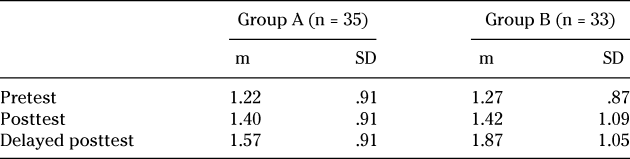
Table 2 shows the descriptive statistics for the GJT data on sentences lacking PA (-PA). The one-way ANOVA shows that no significant differences between A and B were found in the pretest, F(1, 66) = 1.31, p = .23, while group A scored significantly better than group B in the posttest and delayed posttest, F(1, 66) = 6.34, p = .01; F(1, 66) = 5.38, p = .01, respectively. The mixed-design ANOVA shows weakly positive and nonsignificant main effects of time, F(2, 132) = 1.54, p = .24, η2 p = .023, with stronger and significant effects for group, F(1, 66) = 10.21, p = .002, η2 p = .13. No significant effects of group*time interaction were found, F(2, 132) = 0.46, p = .61, η2 p = .006.
Descriptive statistics of –PA GJTs

Note. GJT scores range from 0 to 5 points. m = mean.
The instructed group scored better than the noninstructed one even before the treatment, and this is the only case in which there was a rather sizeable (but nonsignificant) difference between groups at Time 1. TE seems to have made group A’s accuracy level grow slightly more than the control group’s in both posttest and delayed posttest, so that the two groups ended up as being further apart than they were initially. However, the nonsignificant time*group interaction shows that, factoring in the initial difference between groups, TE had no clear effects.
GJT Accuracy Scores for +PA Sentences (Ungrammatical in Italian).
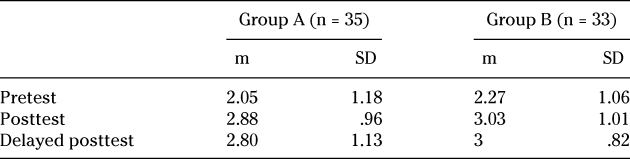
Table 3 shows the descriptive statistics of the GJT data for +PA. The one-way ANOVA shows that in no condition the GJT differences are significant (p always > .05). While both groups steadily increased their scores for this feature, they nonetheless remained very low in absolute terms, that is, most participants found +PA sentences to be acceptable in L2 Italian at all times. The instructed group (A) did not score better than the noninstructed one, which means that TE had no effects on accuracy for this structure.
Descriptive statistics of +PA GJTs

Note. GJT scores range from 0 to 5 points. m = mean.
GJT Accuracy Scores for +PPDA Sentences (Grammatical in Italian).
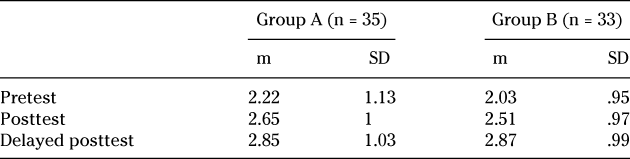
Table 4 displays the descriptive statistics of the GJT data for +PPDA. The one-way ANOVA showed no significant differences in any of the conditions between the GJT scores of group A and group B. The mixed-design ANOVA showed positive main effects only of time, F(2, 132) = 15.51, p = .002, η2 p = .19.
Descriptive statistics of +PPDA GJTs

Note. GJT scores range from 0 to 5 points. m = mean.
A within-subjects repeated-measures ANOVA with a test condition as independent variable and the GJT of group A (control group) as dependent variable shows significant accuracy improvements in time, F(2, 68) = 7.26, p = .001, also for the nontreated group.
Given that no significant time*group interaction was found, the mere exposure to input for +PPDA seems to have been a sufficient condition to improve the GJT scores of all participants. Hence, adding TE to the positive evidence for +PPDA already present in the naturalistic input does not bring about any relevant difference.
GJT Accuracy Scores for -PPDA Sentences (Ungrammatical in Italian).
Table 5 displays the descriptive statistics of the GJT data for -PPDA. The one-way ANOVA again showed no significant differences between the GJT scores of group A and B in any of the conditions. The mixed-design ANOVA showed positive main effects of time only, F(2, 132) = 9.98, p = .002, η2 p = .13. Both the instructed group (B) and the control group (A) improved their accuracy over time. In fact, a within-subjects repeated-measures ANOVA with test time as independent variable and the GJT of group A (control group) as dependent variable shows significant accuracy improvements in time, F(2, 68) = 3.61, p = .029.
Descriptive statistics of -PPDA GJTs

Note. GJT scores range from 0 to 5 points. m = mean.
Again, given that no significant time*group interaction was found, one can conclude that the mere exposition to input is sufficient for improving learners’ GJTs about -PPDA. -PPDA sentences are built according to Spanish syntax and are ungrammatical in Italian. Hence we deduce that the four months of exposure to Italian and the reading of the texts (whether enhanced or not) are sufficient conditions to improve learners’ judgments of PPDA ungrammatical and grammatical sentences.
Allocation of Cognitive Resources: RT Results
This section will discuss whether TE had an effect on participants’ RTs, which might be taken as evidence for the allocation of more cognitive resources in parsing the target items.
RTs for –PA Sentences (Grammatical in Italian).
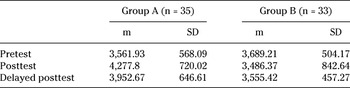
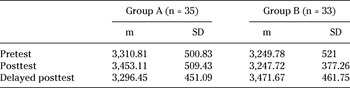
Table 6 shows the descriptive statistics for sentences without PA, which are grammatical in Italian but contradict the Spanish pattern. The one-way ANOVA shows that in the test condition no significant differences between groups A and B are found, F(1, 66) = 0.92, p = .33, and that in the posttest and delayed posttest conditions the differences are significant, F(1, 66) = 17.41, p = .003, F(1, 66) = 8.45, p = .005, respectively. The mixed-design ANOVA shows positive main effects of time, F(2, 132) = 5.24, p = .013, η2 p = .07 and group, F(1, 66) = 7.81, p = .007, η2 p = .10. The effects of group*time interaction were stronger and highly significant, F(2, 132) = 17.65, p = .001, η2 p = .23.
Descriptive statistics of -PA RTs
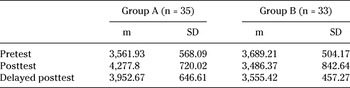
Note. RT values range from 0 to 6,000 ms. m = mean.
TE had a clear effect in slowing down the RTs of the treated group vis-a-vis the nontreated group, whose RTs remained constant throughout time. This can be taken to suggest that the treated subjects were led to invest more cognitive resources when parsing -PA sentences.
RTs for +PA Sentences (Ungrammatical in Italian).
As regards +PA sentences (ungrammatical in Italian and following the Spanish model), the treated group shows a developmental trend analogous to that for -PA sentences: an increase in RTs immediately after the treatment, with a decline in the delayed posttest. However, these differences are much more modest, and at no time are control and experimental groups significantly different (p always > .05, see Table 7 for descriptive statistics).
Descriptive statistics of +PA RTs

Note. RT values range from 0 to 6,000 ms. m = mean.
RTs for +PPDA Sentences (Grammatical in Italian).
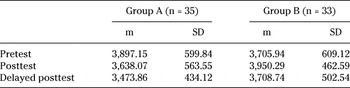
For +PPDA, significant differences in RTs were found in the posttest condition, F(1, 66) = 6.17, p = .015, but not in the delayed posttest one, F(1, 66) = 4.23, p = .45. The mixed-design ANOVA shows positive main effects of time, F(2, 132) = 6.47, p = .003, η2 p = .09, and of the interaction time*group, F(2, 132) = 8.31, p = .001, η2 p = .11, with stronger effect sizes for the latter. Descriptive statistics are shown in Table 8.
Descriptive statistics of +PPDA RTs

Note. RT values range from 0 to 6,000 ms. m = mean.
The RTs of group B slowed down significantly in the posttest condition, whereas the RTs of group A speeded up. Similarly to what happened for -PA, TE had a short-term effect in increasing subjects’ RTs, causing them to parse +PPDA sentences more carefully. What is interesting here is that group A, which did not receive any treatment on +PPDA, improved its GJT accuracy scores in a similar way to group B but did not show any RT increases. We therefore interpret these results as indicative of a cognitive effect of TE in leading instructed learners to think longer before giving their answers. Nevertheless, this effect has not helped them to make more accurate judgments of +PPDA sentences when compared to the noninstructed group.
RTs for –PPDA Sentences (Ungrammatical in Italian).
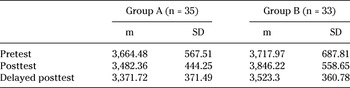
For -PPDA sentences, too, significant RT differences between groups were found in the posttest condition only, F(1, 66) = 8.81, p = .004.
The mixed-design ANOVA showed positive main effects of time, F(2, 132) = 10.43, p = .002, η2 p = .13, and of time*group interaction, F(2, 132) = 3.66, p = .033, η2 p = .02, with stronger effect sizes for the former. Descriptive statistics are displayed in Table 9. Group B significantly slowed down its RTs in the posttest condition, whereas group A (noninstructed) speeded up its RTs over time. This is in line with the conclusions for +PPDA: TE has led the instructed learners to reflect longer on how to answer during the GJT but has not helped them to judge -PPDA sentences more accurately than noninstructed subjects.
Descriptive statistics of -PPDA RTs

Note. RT values range from 0 to 6,000 ms. m = mean.
DISCUSSION AND CONCLUSIONS
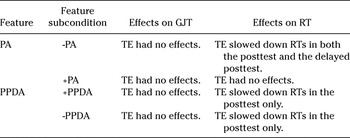
The main research question guiding this study was whether TE has differential effects on the noticing and potential learning of two language features—PPDA and PA—differing in one dimension. One has to be “learned,” in that SSLI must learn to add an article in a syntactic context where this is absent in their L1; the other structure has to be “unlearned,” in the sense that native speakers of Spanish must learn to inhibit the production of the a preposition before a certain type of direct object, as would be required by their L1. Findings, as summarized in Table 10, allow answering the four research questions as follows.
Summary of TE effects

RQ1: What is the relative difficulty of the two grammatical structures PA and PPDA, one of which has to be “unlearned” while the other has to be “learned” by SSLI?
Unlearning PA seems to be more difficult than learning PPDA. This difficulty mainly has to do with rejecting a syntactic pattern deeply entrenched in the L1. In fact, both groups had the lowest accuracy scores in the +PA sentences, which they were strongly inclined to accept as grammatical at all times. They found it far less problematic to accept Italian sentences without PA, and to correctly judge the grammaticality of sentences with and without PPDA. RTs, too, show that rejecting +PA was the most difficult condition, as participants not only accepted these sentences as grammatical, but they also did it very rapidly, as if they had no doubts regarding the sentences’ grammaticality.
RQ2: What are the effects of TE on the acquisition of the target structures, as operationalized by accuracy levels on a GJT?
Overall, TE had no discernible effect on learners’ performance in the GJT. Despite the typological proximity of Spanish and Italian, which facilitates reading comprehension and should thus free more attentional resources for form processing, TE did not lead to any significant restructuring of participants’ interlanguage representations.
RQ3: What are the cognitive effects of TE on learners’ processing of target forms as operationalized by their RTs?
TE had more substantial effects on learners’ cognitive processing of sentences. Immediately after the treatment, participants in both groups paused longer after seeing the target structures, with the difference reaching statistical significance in all cases except for +PA. Around two months later, this effect decreased in all conditions, but treated participants still had longer RTs than the control group in all conditions except for +PA, although the difference was significant for -PA only.
RQ4: Are there differential effects of TE to be found on accuracy of GJTs and RTs depending on the different L1-L2 relationships of PA and PPDA?
TE had no effects on GJTs for any of the two structures. However, as regards RTs, +PA clearly stands out as the structure most impervious to instruction, in that both treated and nontreated participants kept accepting it unhesitatingly at all times. Interestingly, the complementary case of -PA caused the longest RTs recorded in the experiment in the treated group, as if they were struggling to decide whether these sentences, violating a deeply entrenched L1 norm, could be grammatical in Italian.
Overall, findings suggest that unlearning PA is harder than learning PPDA for Spanish-speaking learners of L2 Italian. SSLI tended to accept a significantly higher proportion of ungrammatical structures when these corresponded to a well-entrenched L1 pattern (+PA sentences), while they were more willing to accept +PPDA sentences, which also deviate from their L1, but that can be restructured on the basis of positive evidence in the input. It thus seems that avoiding the transfer of a L1 feature by relying solely on indirect negative evidence (even if enhanced) is a very complex task (Ayoun, Reference Ayoun2003; Gass & Mackey, Reference Gass and Mackey2002; Lefebvre, White, & Jordan, Reference Lefebvre, White, Jordan, Lefevbre, White and Jordan2006). This is analogous to saying that enhancing the “presence of an absence” (i.e., providing indirect negative evidence) of a structure that has a wider scope in the L1 than in the L2 is not sufficient to restrict its scope according to the L2 model, as discussed in previous studies (Gabriele, Reference Gabriele2009; Trahey & White, Reference Trahey and White1993; White, Reference White1991). It is not possible to leave the restructuring of PA to the input (whether enhanced or not): Pedagogical intervention providing learners with explicit, direct negative evidence (i.e., a correction) may be necessary in this case for learners to acquire the target pattern.
With the exception of +PA, TE increased subjects’ RTs when parsing the target sentences. Given that TE works solely at the attentional level (i.e., it does not provide the learner with any metalinguistic explanations), such longer RTs may be indicative of an increase in attentional allocation, which occurred most clearly in the immediate posttest. This shows that TE can be effective in increasing the level of selective attention on a particular feature of the target language.
Nevertheless, one important finding of our study is that more attention does not necessarily correspond to more accuracy and, hence, more learning. Results for PPDA show that, while instructed subjects paid more attention to these forms, they achieved similar accuracy gains as the control subjects, who did not allocate more attentional resources during the test. An increase of selective attention may thus not be a sufficient condition for acquisition to occur, as Winke (Reference Winke2013) maintains, echoing Sharwood-Smith’s (Reference Sharwood-Smith2011) warnings about the effectiveness of TE. In some cases, it may not be necessary either, for some structures can be restructured as a consequence of simple exposure to the input, as was the case for +PPDA.
Needless to say, the findings of this study should not be taken to mean that TE as such is an ineffective instructional procedure in all contexts and for all linguistic structures. TE can take different forms and degrees of intensity. Coloring, or the use of symbols other than arrows for marking the absence of forms in the input (e.g., Ø), or more exposure to textual negative evidence than in the present study (in terms of duration and/or frequency of exposure) might be more effective ways to stimulate unlearning. Learners’ general proficiency level (or developmental stage) might be another mediating factor. Future studies should investigate whether the same results are found with higher proficiency learners, and if there are any systematic correlations between proficiency and the acceptance/rejection of specific structures or individual items in the test.
Another possible limitation of this study is that TE’s cognitive effects were gauged exclusively through the timed GJTs at the end of the treatment, and virtually nothing can be said about learners’ cognitive processes during the instructional period. Some qualitative data on learners’ explicit uptake during the treatment were collected by asking the five teachers to record on a form the questions raised by the students about the manipulated forms in the texts. Although this topic cannot be developed here for lack of space, suffice it to say that the teachers reported, both in the forms and in subsequent debriefing sessions, that students hardly ever asked questions about the highlighted structures, which could be taken as a strong indication that no explicit focus on form took place in the classes during the experiment. However, future studies may investigate learners’ attentional processes while they are engaged with reading the enhanced texts (e.g., by using eye-tracking or monitoring reading time for each passage).
It would also be instructive for future research to verify if the results obtained here with SSLI also hold for Italian-speaking learners of Spanish. For them, the L1-L2 asymmetry would be reversed: PPDA has to be restructured according to indirect negative evidence, whereas PA can be reset according to positive evidence. According to our hypotheses and findings, PPDA should be the more difficult feature to learn and the one that needs a stronger and more explicit pedagogical intervention than TE.
SUPPLEMENTARY MATERIAL
To view supplementary material for this article, please visit http://dx.doi.org/10.1017/S0272263116000073.