Lying behaviour plays a critical role in the production potential, profitability and welfare status of intensively managed dairy cattle. When cows are deprived of adequate lying time, their welfare may be reduced (Fregonesi & Leaver, Reference Fregonesi and Leaver2001; Cooper et al. Reference Cooper, Arney and Phillips2008). Cows may even prioritize lying time over eating time and social contact in both early and late lactation cows (Munksgaard et al. Reference Munksgaard, Jensen, Pedersen, Hansen and Matthews2005). Cows deprived of ample lying time exhibit both physiological and behavioural signs of stress (Munksgaard & Simonsen, Reference Munksgaard and Simonsen1996; Cooper et al. Reference Cooper, Arney and Phillips2008). Such cows may express frustration in the form of abnormal behaviour (Cooper et al. Reference Cooper, Arney and Phillips2007, Reference Cooper, Arney and Phillips2008). Reduced plasma concentrations of growth hormone, known to be positively associated with milk production, have been observed in cows prevented from lying down for extended periods of time (Munksgaard & Lovendahl, Reference Munksgaard and Lovendahl1993). Furthermore, there is some evidence that changes in lying behaviour are related to lameness (Singh et al. Reference Singh, Ward, Lautenbach, Hughes and Murray1993; Juarez et al. Reference Juarez, Robinson, DePeters and Price2003).
Until recently, research examining lying behaviour of dairy cattle was limited to direct visual observation or video recordings (McGowan et al. Reference McGowan, Burke and Jago2007; O'Driscoll et al. Reference O'Driscoll, Boyle and Hanlon2008). Both of these methods are limited by subjectivity, time constraints and the potential of observer interference with behaviours (O'Driscoll et al. Reference O'Driscoll, Boyle and Hanlon2008). Animal activity monitoring sensors (e.g. IceTag™, IceRobotics Ltd., Roslin, Scotland, UK; TinyTag, Gemini Dataloggers Ltd., Chichester, UK; Pedometer+™, Zaham Afikim, Israel) have now been developed that measure lying behaviour automatically and have been validated using direct visual observations (Munksgaard et al. Reference Munksgaard, Reenen and Boyce2006; McGowan et al. Reference McGowan, Burke and Jago2007; O'Driscoll et al. Reference O'Driscoll, Boyle and Hanlon2008).
The IceTag™ animal activity monitoring sensor uses accelerometer technology to monitor lying, standing and stepping behaviour. Automatic monitoring of lying behaviour is less labour-intensive, more objective and more practical under field conditions than visual observation. Additionally, these technologies provide new opportunities to examine more animals simultaneously without observer interference. In turn, they can be used to gain an increased understanding of physiological and management factors that influence dairy cattle lying behaviour. The objective of this study was to utilize this new technology to determine how milk yield, lactation stage and body condition influence lying time in a working dairy herd. Prior to this research, these factors had not been examined simultaneously across a substantial number of animals.
Materials and Methods
Housing and feeding
Data were collected at the new Barony College Dairy Technology Centre in Dumfries, Scotland, UK during autumn 2006. Cows were first introduced to this new facility on 4 September 2006 and had been housed without access to pasture since 5 October 2006. Freestalls were bedded with sand; alleys were supplemented with rubber flooring; and at least one stall was available to each cow. Cows were housed and milked within two different management systems (MS). About 165 cows were managed in a 190-stall freestall barn with cows milked twice daily in a herringbone parlour (conventional system). Another group of about 60 cows were managed in a 60-stall freestall barn and milked by an automated milking system (AMS, Merlin Automated Milking System, Fullwood Limited, Ellesmere, Shropshire, England, UK) and also were housed in freestalls. Cows were fed once daily with a total mixed ration consisting of barley straw, grass silage, alkalage whole crop wheat, corn silage, a grain blend, crushed wheat and a mineral package.
Selection of animals
Any cow that was visibly lame was excluded from the study to avoid confounding effects of apparent lameness. Cows were assigned to a body condition score (BCS) category (BCSCAT) using a 3-week average BCS as follows: thin (BCS<2·75), moderate (2·75⩾BCS<3·25) and heavy (BCS⩾3·25). BCS were collected weekly from 15 September to 1 December 2006 using the BCS system developed by Edmonson et al. (Reference Edmonson, Lean, Weaver, Farver and Webster1989), later modified by Ferguson et al. (Reference Ferguson, Galligan and Thomsen1994). BCSCAT assignment was made using the scores from the 3 weeks prior to the experiment week. Cows were also assigned to a lactation stage category as follows: early (⩽150 DIM) and late (>150 DIM). Eighty-four Holstein-Friesian cows (21 different cows per week) were selected from the two MS based upon BCSCAT and lactation stage as depicted in Table 1.
Numbers of cows by management category included in the study

† Body condition score measured using the methodology of Ferguson et al. (Reference Ferguson, Galligan and Thomsen1994)
‡ Body condition score categories: (T) Thin (BCS<2·75, N=28), (M) Moderate (3·25>BCS⩾2·75, N=28) and (H) Heavy (BCS⩾3·25, N=28)
§ Stages of Lactation: (E) Early, ⩽150 DIM (N=42); (L) Late, >150 DIM (N=42)
Data collection
An IceTag™ animal activity monitoring sensor (IceRobotics Ltd., Roslin, Scotland, UK) was attached to a hind leg of each cow above the fetlock for 5–7 d. The tag was a device with dimensions (mm) of 95·0 (H)×82·3 (W)×31·5 (D) weighing 130 g (Munksgaard et al. Reference Munksgaard, Reenen and Boyce2006). The device was attached to a rear leg using a Velcro strap. The 84 cows were allocated equally among four collection periods. Data collection periods were 28 October to 2 November (week 1), 4–9 November (week 2), 11–15 November (week 3) and 18–23 November (week 4). As tags were attached in the milking parlour for conventional cows, the tag was attached to the leg closest to the milking parlour pit, which varied depending on the side of the parlour the cow entered. For AMS cows, tags were randomly assigned to the right or left leg within each week. The final data set included 48 cows with tags attached to the left hind leg and 35 cows with the tags attached to the right hind leg.
Data editing
Data from each activity monitor were downloaded and imported into SAS® (Cary NC, USA) for editing and analysis. Raw data from the activity monitors were reported as percent lying, percent active, percent standing and number of steps/min. To provide cows with a short period to adjust to the novelty of having the new apparatus attached to their legs, data from the day on which the activity monitor was attached were discarded. Thus, each cow's recording period began at 0:00 on the day following attachment of the activity monitor. Only days with a full 24 h of data available were included for analysis. Lying and standing bouts were calculated using per minute percentages. If the within-minute lying percentage was greater than or equal to 50%, cow status was defined as lying for that minute. Otherwise, cow status was defined as standing. Consequently, each standing or lying bout was calculated by counting the number of consecutive minutes with identical status. In scenarios where a bout began on one day and ended on the subsequent day, the resulting bout was summarized on the second day. This allowed for proper handling of continuous bouts; however, it complicated comparison of bouts to daily time budgets. The percentages of time, within a day, spent lying, active and standing were converted to h/d. This method of calculating daily time budgets may provide slightly different results (in the magnitude of seconds per day) than using calculated lying and standing bouts in time budget calculations. Step counts were totalled within day. These accumulated times represent the time budget for each day in h/d.
Cow descriptions
Herd demographic and event information was obtained from the Crystal Herd Management System software (Fullwood Limited) and the Cattle Information Service (Rickmansworth, Hertfordshire, England, UK). Daily milk weights were available and obtained from the Crystal software. However, owing to some technical difficulties probably attributable to the new set-up, milk weights were missing spuriously for some milkings and cows. To account for these missing weights, a retrospective 28-d moving daily average milk production (MILK28) was calculated to describe production levels for each cow. Events of interest (oestrus, illness) were included to identify any potential events that could influence lying behaviour. Cows were categorized by parity (PARCAT) as parity 1 or parity ⩾2.
Statistical analysis
Six cows (two AMS; four conventional MS) were removed from the data set prior to analysis. Two of the original cows were removed from the data because of difficulties in interpreting identification brands resulting in uncertainty of data matching. Two cows were removed because they exhibited clinical lameness after the tags had been attached. One cow was removed from the data set because she contracted mastitis during the study period and another because of a serious reproductive trait disorder. After removal of these cows, the mean per cow daily hours lying was calculated to check for outliers. This calculation led to removal of one cow because her mean daily hours lying was more than 3 sd less than the group mean. In addition, the 11 oestrus events in the data set, the day before, day of, and day after recorded breeding were removed. The final day of recording for one cow was removed because she was moved from the conventional MS to AMS. After these edits, the final data set contained 408 d of data for 77 cows.
Number of lying bouts, maximum and minimum lying bouts, average lying bouts, hours lying, hours standing, hours active and number of steps were calculated within day for each of the 408 d included in analysis. Correlations were calculated among daily hours lying, hours standing, hours active and number of steps. Descriptive statistics for general demographic and recorded behaviour were calculated for the 77 cows in the experiment overall and by BCSCAT.
The MIXED procedure of SAS® was used to develop models to describe hours lying. For this analysis, the mean values for each cow were used for all dependent and independent variables. The COVTEST option of PROC MIXED was used to provide covariance parameter estimates for random effects in each model. Random effects tested were week, MS, week*MS, week*BCSCAT, week*PARCAT, MS*PARCAT, MS*BCSCAT, along with all three-way (that included week) interactions of these fixed variables using a 0·25 significance level for pooling among interactions from PROC MIXED's COVTEST output. Then, for each model, the fixed class variables (BCSCAT and PARCAT), covariates (MILK28 and DIM), and all two-way interactions were tested with the appropriate remaining random effects. Like the dependent variables, the covariates MILK28 and DIM represented the mean of daily values, across the observation period, for the days that lying behaviour was measured for each cow. Fixed interactions were selected for the models using a 0·10 significance pooling level. To further examine the effects of each variable tested independent of the other effects remaining in the model, Type 1 tests for each variable in the final model were calculated.
Results and Discussion
Daily time budget
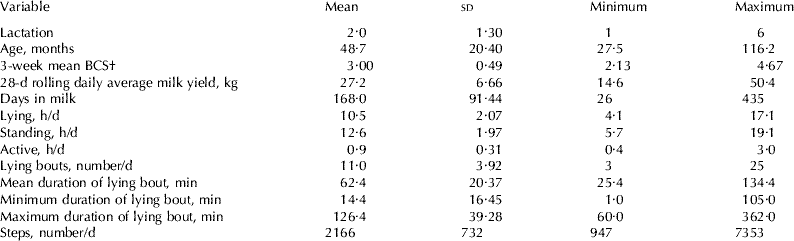
Descriptive statistics for the 408 d analysed in the data set are provided in Table 2. By most standards, the 10·5 (±2·1) h/d of lying found in this study represents an inadequate quantity of lying, although considerable deviation exists in recommendations for lying time. Recent studies of lying time in cows housed in freestalls have reported average lying times ranging from 11·37 to 13·70 h/d (Cook et al. Reference Cook, Bennett and Nordlund2005, Drissler et al. Reference Drissler, Gaworski, Tucker and Weary2005). Jensen et al. (Reference Jensen, Pedersen and Munksgaard2005) conducted a demand experiment and concluded that heifers had an inelastic demand for 12–13 h/d of lying time. As research provides additional insight into lying requirements, it may be more pertinent to establish requirements based upon physiological states, such as stage of lactation, age, and production level, rather than adhere to such general recommendations. The average daily hours standing and active were 12·6 (±2·0) and 0·9 (±0·3), respectively.
Daily mean, sd, maximum and minimum for 408 analysis days of 77 experimental cows

† Body condition score measured using the methodology of Ferguson et al. (Reference Ferguson, Galligan and Thomsen1994)
Lying bouts per day
The number of lying bouts in this study (11·0±3·9) was similar to those reported in other recent studies (Drissler et al. (Reference Drissler, Gaworski, Tucker and Weary2005), 10·67–11·92; Endres and Barberg (Reference Endres and Barberg2007), 11·0±3·2). However, the mean of the present study was slightly less than the range recorded by Blackie et al. (Reference Blackie, Scaife and Bleach2006) who reported 11·9–14·6 lying bouts/d with an average duration of 45·5–55·9 min. These differences may be partly attributable to the use of a greater threshold, defining within-minute % lying at >96%, (Blackie et al. Reference Blackie, Scaife and Bleach2006) than in this study (>50%) which could increase the number of changes in status within a day. Further, the cows in that study were all in the first 12 weeks of lactation possibly dealing with transitions into new lactations, herdmates and facilities.
Model results
Examination of the Type 1 effects for explanatory variables considers the effect of each variable independent of the other variables succeeding it in the model. Type 1 effects of each trait as the first fit in separate models (Table 3) demonstrates that the effect on daily hours lying of mean daily milk yield and DIM are highly significant when each is considered independent of the other. However, because of the multi-colinearity of these effects, the significance of Type 3 tests of individual effects may have been reduced. Additionally, BCS category was significant using Type 1 effects and parity category approached significance. These results demonstrate that milk yield, lactation stage and BCS exert some influence on lying time in dairy cattle, though the magnitude of this influence cannot be discerned from this small data set, largely because the effects themselves are quite inter-related.
Tests of significance of fixed effects for mean daily hours spent lying mixed model

† Type 1 tests of fixed effects from separate models with variable within row fit first
‡ Body condition score category: (T) Thin (BCS<2·75), (M) Moderate (3·25>BCS⩾2·75), and (H) Heavy (BCS⩾3·25)
§ Parity category: 1 or ⩾2
Effects of DIM on lying behaviour
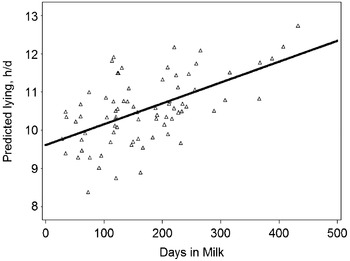
Results of the mixed model analysis demonstrated that only DIM (P=0·05) was a significant predictor of mean daily hours lying (Table 3). Using results of this model, predicted hours lying are plotted against DIM in Fig. 1, depicting a trend of increasing lying time with increasing DIM. Chaplin & Munksgaard (Reference Chaplin and Munksgaard2001) also reported that cows in early lactation (<100 DIM) spent significantly less time lying than cows in late lactation (>200 DIM). Cows in early lactation may be spending more time eating, and consequently less time lying down, to meet the nutritional needs of higher milk production in early lactation.
Predicted average daily hours spent lying by stage of lactation (days in milk).

Effects of milk yield on lying behaviour
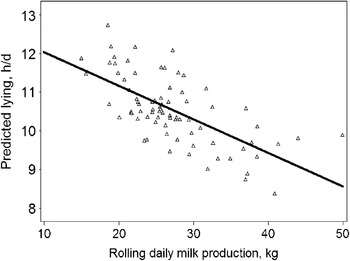
Although the mean MILK28 only approached significance (P=0·08) as a predictor of mean daily hours lying in this model after accounting for DIM, the observed trend between milk production and lying time is consistent with other studies. In Fig. 2, predicted mean daily hours lying are plotted against mean MILK28, depicting a trend of decreasing lying time with increasing production level. This concurs with most research examining the relationship between lying time and production. Lovendahl & Munksgaard (Reference Lovendahl and Munksgaard2005) also found lying time to be negatively correlated with yield (r=−0·26) and Fregonesi & Leaver (Reference Fregonesi and Leaver2001) found that high production cows spent less time lying than low production cows.
Predicted average daily hours spent lying by average rolling daily milk production.

Intuitively, one might think that increasing lying times would be beneficial for milk production. However, it is important to consider that this was an observational study of cows of varying physiological states. The higher producing cows in this study are not necessarily producing more milk because they are spending less time lying down. Rather, they may be spending less time lying down because of other factors such as production levels resulting in an increased requirement for feed. Investigating the lying behaviour of cows with similar DIM, parity, BCS and genetic potential might demonstrate the effect of increasing milk production resulting from increased lying that one would expect.
Effects of BCS and parity on lying behaviour
It is also of interest to consider those variables that did not have a significant impact on hours lying using this mixed model. Given the amount of variability in the data and the limited population studied, a lack of statistical power was a likely major reason for this lack of significance in many cases. Despite a trend observed in the raw data of increasing lying times with increasing BCS, BCSCAT did not have a significant impact on average daily hours lying. After data edits, 25, 25 and 27 cows remained in the thin (2·51±0·14), moderate (2·92±0·14) and heavy (3·51±0·32) BCSCAT, respectively. The lack of significant difference is probably attributable to both milk production level and DIM already being accounted for within the model. The lack of significance for PARCAT is less surprising given that it was not part of the experimental design and the other factors already accounted for in the model. The lack of significance for parity agrees with results from other studies (Krohn & Munksgaard, Reference Krohn and Munksgaard1993; Chaplin & Munksgaard, Reference Chaplin and Munksgaard2001).
Conclusions
After adjustments for DIM and milk production, BCSCAT did not impact lying time. Stage of lactation was the only variable with a significant impact on average hours spent lying. Additional research should be conducted to further explore the management factors influencing lying time with particular emphasis on exploring the effects of milk production and stage of lactation across a larger number of animals under varying environmental conditions.
The willingness of Russel Marchant, Principal and Chief Executive of Barony College, for agreeing to participate in this research project is greatly appreciated. The assistance of Jeremy Hockin, Craig Drummond and Barry Scott of Barony College in working with the herd during this experiment is greatly acknowledged. The technical expertise of Chloe Capewell and Oliver Lewis of IceRobotics in downloading and interpreting the data is also appreciated. The financial contributions of IceRobotics, Ltd. in providing the animal activity monitoring sensors for the study and in support of Jeffrey Bewley's time in Scotland are also acknowledged. Finally, the authors thank Mr Jim Westaway, Cattle Information Service, for his assistance in accessing the herd data.