

Italian culture, ‘assailed’ and apparently ‘suffocated’ at length by foreign domination, was afforded a unique opportunity compared to other European cultures: to cultivate and strengthen an inclination to absorb and develop elements from other cultures, making a virtue out of necessity. In various aspects, between the sixteenth and eighteenth centuries, Spaniards, Austrians and the French helped to stimulate and enhance an exceptional cultural laboratory in Italy.
Among other disciplines, the study of seventeenth-century libretti has a role in delineating the time, place and manner of circulation, and the appropriation and transformation of foreign cultural products in Italy. The migration of subjects and the importation of foreign dramatic texts in Italian opera libretti is an area of recent research that has proven to be an excellent example of the virtue of interdisciplinary collaboration in the performing arts.Footnote 1 The present article is a contribution in this spirit.
I have recently discovered that a manuscript libretto, La simpatia nell'odio, overo Le amazoni amanti by Giovanni Pietro Monesio (1664), is an Italian translation of a Spanish play, Las Amazonas, by Antonio de Solís (1657), which was long known as the basis of another libretto, written at much later date, La caduta del regno delle Amazzoni by Domenico De Totis (1690).Footnote 2 Drawing on my research on the myth of the Amazons as the subject matter of Baroque operas,Footnote 3 a topic common to the three works dealt with here, I discuss Monesio's libretto in the light of the European circulation of another Spanish text and its context in the Viennese imperial court, an investigation that sheds more light on the political and cultural meanings that were most likely conveyed by the Amazonian theme.
The libretto La simpatia nell'odio has many interesting aspects. First, along with Giulio Rospigliosi's well-known dramas (Dal bene il male, 1654; L'armi e gli amori, 1656), it appears to be one of the earliest works that is a close adaptation, nearly a translation, of a Spanish play, even though it has recently been discovered that basing libretti on Spanish models dates from as early as the 1640s.Footnote 4 Furthermore, La simpatia nell'odio confirms Rome as the location of the vogue for libretti based on Spanish texts, preceding the period in which Spanish theatre was very popular in Vienna, which began in 1666 with the arrival of an Infanta to be married to the Emperor. Moreover, it attests to Solís's Italian success in seventeenth-century librettos well before Il palazzo del segreto (1683) by the Milanese Giovanni Rabbia.Footnote 5 In its subject matter Monesio's libretto anticipates the success of the Amazons in Italian Baroque opera by a decade. It is increasingly clear that the subject is of Spanish origin, and was appreciated outside Italy as well. It appears to validate a symbolic link between the representation of viragos and the legitimacy of female power in the seventeenth century. The work also sheds light on a librettist, Monesio, of whom we still know too little: he is best known as the author of the text of L'accademia d'Amore by Alessandro Stradella but, owing to the irrepressible imagination of Remo Giazotto and his elusive source, his role in mid-seventeenth century Rome has yet to be discovered.Footnote 6
I. rome–vienna: la simpatia nell'odio by monesio
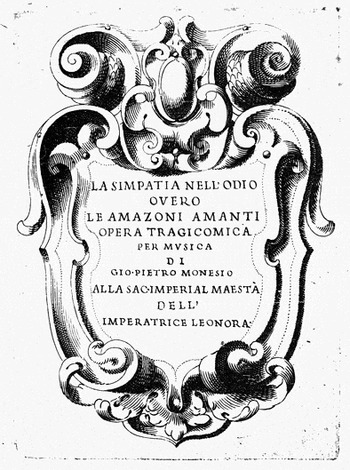
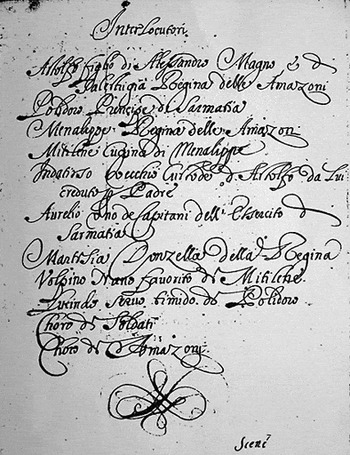
Monesio's libretto, preserved in a sumptuous manuscript with the imperial coat of arms of a double-headed crowned eagle in the centre,Footnote 7 was cited by Herbert Seifert in 1985 in his monograph on seventeenth-century opera in Vienna, but has never been studied for its theatrical content.Footnote 8 The dedication (transcribed in the Appendix) to the Dowager Empress Eleonora II Gonzaga-Nevers was signed in Rome by the author himself, on the 1st of August, 1664; therefore the libretto, of which the title page is shown in Figure 1 and the list of characters in Figure 2, could have arrived in Vienna in August, or September at the latest.
Giovanni Pietro Monesio, La simpatia nell'odio, overo Le amazoni amanti, Cod. 9956, title page, fol. [2r]

Giovanni Pietro Monesio, La simpatia nell'odio, overo Le amazoni amanti, Cod. 9956, cast, fol. 3v

In addition to the libretto, the music of an aria composed by Emperor Leopold I survives. It is well known that the Emperor was not only an erudite patron and protector of the arts and sciences, but also an impassioned musician. In the final pages of a manuscript volume from Leopold's personal library the music for the song Arruoli a mio danno is written in his own hand and its origin is indicated in the top margin: from ‘Monesio's play, act II, scene IV’;Footnote 9 it is in fact the second stanza from the aria Desire di gloria sung by Mitilene.
Seifert identified the libretto with the ‘drama’ set to music by Leopold for the Empress's birthday celebrations, on 18 November of that year, which is mentioned in a avviso sent to Florence a few days later.Footnote 10 A reference to the birthday of 1664, however, appears in the score of a one-act composition by Antonio Bertali, Pazzo amor: ‘Operetta per la nascita dell'imperatrice Eleonora, 1664’.Footnote 11 Therefore, according to Seifert, there are two possible hypotheses: either the author of the avviso named the wrong composer, though it is highly unlikely he would confuse His Majesty with a common composer, or two separate works were written for the event, only one of which was performed.Footnote 12
Two other elements, however, support the hypothesis that the opera that was performed was actually La simpatia nell'odio: (a) the avviso speaks of a ‘drama’, a term that is usually used for three-act operas rather than one-act plays; (b) a libretto ready at the beginning of August would normally be staged within a few months (postulating that it arrived in Vienna in August or September). But the lack of a printed copy of the libretto, a prologue and any reference to the birthday celebrations in the dedication suggests that the opera was not entirely set to music and performed.Footnote 13 Ultimately, the song featured in Leopold's manuscript could simply mean that the Emperor used the text for a one-off aria and the possibility that the opera was not staged could be explained by the period of mourning at the Viennese court from late January to mid-August, following the death of the Emperor's brother, the Archduke Charles Joseph. The libretto probably reached Vienna just as the mourning period was over, but since it was an ‘opera tragicomica per musica’ (as stated on the title page of the manuscript), a rare genre in the capital of the Empire,Footnote 14 it was probably not the most suitable opera to be staged within these few months. To date, nothing more is known about the performance.
The professional relationship between Monesio and the Viennese court is not easy to reconstruct, as biographical information on the poet, as mentioned earlier, is scarce.Footnote 15 In any case, there must have been a long-standing relationship, since ten years after the libretto for La simpatia nell'odio Monesio published two collections of poems for music in Rome, La musa seria and La musa familiare (1674), dedicated respectively to Leopold and Eleonora, his symbolic muses.Footnote 16 The dedication of a poetic text to Eleonora, included in La musa seria, even refers to an annual salary paid to Monesio by the Empress.Footnote 17 Moreover, his collaboration with the Viennese court already seems to have been established by 1663 with his libretto for the oratorio Il figlio prodigo, also set to music by Leopold, but printed only in 1678,Footnote 18 and even earlier than this, in 1661, with the verses of a pastorale entitled Indovinelli amorosi, which has not been mentioned in the musicological literature.Footnote 19
II. the subject and plot of la simpatia nell'odio
The libretto depicts the vicissitudes of the son of the Queen Thalestris and Alexander the Great in the kingdom of the Amazons. The classic historical legend – which does not belong to the Hellenic core of Amazonian mythography, but rather to Quintus Curtius Rufus’ History of Alexander the Great – only tells the story of the encounter between the virago and Alexander, without any mention of descendants. Briefly, it is the story of how Thalestris, in a moment of crisis within the female realm, seeking to have a daughter worthy of the throne, travels with an army to Hyrcania, hoping to conceive a child with Alexander, after a couple of weeks returning to her empire. The episode, which is also mentioned in the argomento of La simpatia nell'odio with reference to the sixth book of Curtius Rufus’ History of Alexander, only represents the background leading up to the opera, because the protagonist of the story is actually Thalestris's son, ironically not the girl his mother wanted but a boy. Of course, it is precisely this play on sexual identity that irreverent seventeenth-century drama is based on.
The events following the encounter between Thalestris and Alexander, and therefore the plot of the story, are modern invention. The background to the opera is described in the argomento and can be summarized as follows:
1. On her way back Thalestris gives birth to a baby boy, Astolfo, but her maternal affection and her love for Alexander keep her from killing the child, as the Amazonian law requires. Since the oracle of Apollo has announced that the birth of this child will cause the kingdom of the viragos to collapse, Thalestris hides the boy in a cave and hands him over to the care of Indatirso, an exile from Sarmatia. She asks him to pretend to be the biological father and not to tell the child about his true origins. In order to avoid having anyone enter the forest she consecrates it to Jupiter, erects a temple and elects Indatirso as the priest.
2. After Thalestris's death, Menalippe is elected to the throne, arousing the wrath of her envious cousin Mitilene.
3. Polidoro, Prince of the Sarmatians, wants to attack the kingdom of the Amazons, but when he sees a portrait of Menalippe he falls in love with her. With the help of Martesia, one of the queen's ladies-in-waiting, he manages to enter her rooms secretly.
Although they have nothing to do with the legend of Thalestris, Martesia and Menalippe are appropriate names since they belong to Amazonian mythography. The Sarmatians, or Sauromatians, according to Herodotus, were a people born from a cross between the Scythians and the Amazons, just like the creation of mixed couples at the end of the opera, an aspect I will discuss again later. Herodotus recounts how the Sarmatians, having tested the heroism of the viragos in battle, wanted to have their young men sleep with them to ensure valorous progeny, and therefore invited the men to camp next to the female nation. When the women understand the good intentions of the Sarmatians, they gradually agree to sleep with them and involve them in their daily lives, until the time comes when the young men decide to live with the viragos permanently. The early modern subject of the work therefore combines a legendary tradition regarding Thalestris and Alexander the Great (as narrated by Curtius Rufus) and a historical one, regarding the relationship between the Amazons and the Sarmatians (as reported by Herodotus).
The plot of the opera develops around two main couples: a clandestine one that has already been formed, Queen Menalippe and Polidoro the Prince of the Sarmatians; and a couple in the process of coming together, the belligerent Mitilene and Astolfo, son of Thalestris and Alexander. Initially, the latter are indifferent to amorous passion: she is obsessed with weapons and hatred towards anyone of the male sex, while he is a savage, raised in a cave, and has never seen a woman before in his life. Thus on the one hand, we have a couple that cannot declare their relationship and lives on fleeting encounters, and on the other a couple that suffers the uncertainties of inexperience in love. At the end of the second act the two couples are placed in a difficult situation under suspicion of mutual betrayal, in a typically Baroque dramatic manoeuvre; this delays the finale and thus increases its effect. Parallel to these two love stories is a third plot, a common element in seventeenth-century plays, involving the servants Martesia, Volpino and Lucindo.
III. the original spanish text: las amazonas by solís
Although the paratexts in Monesio's libretto do not refer to any early modern source, as was standard practice, it is sufficient to compare the characters of the opera with those of Antonio de Solís's heroic-mythological play Las Amazonas (1657) to realize that the former is very likely a revised translation of the latter.Footnote 20 As can be seen in the synoptic table below, the characters not only share the same names – undergoing only minor graphic and phonetic adjustments in the transition from Spanish to Italian (Miquilene becomes Mitilene, Menalife becomes Menalippe) – but they also share the same roles:

The only difference concerns the queen's servants, who, as minor characters, could be reworked without altering the coherence and unity of the play. Compared to Solís's play, Monesio's libretto reduces the number of servants from three female (Camila, Iulia, Martesia) to two who are of the opposite sex (Volpino, Martesia). For this reason, the man creating the third intrigue in the Spanish text is Polidoro's servant Lucindo, an outsider to the realm of the Amazons, while in the libretto Volpino, the virago's court dwarf, the only man allowed in the female empire, plays the role of one of the seducers.
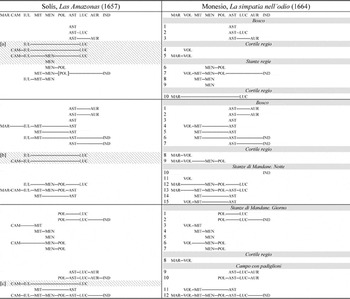
Table 1 outlines and compares the presence and alternation of the characters in the scenes of the play and the opera,Footnote 21 from which it becomes clear that almost identical configurations of characters take part in the development of the dramatic action. Note in particular the agreement between the first and the third set change of each act of the libretto and the related sections of Solís's text. The only exceptions are the following: (1) the first scenes of the third set change of Act II (II. 10–11), namely the solo laments of Indatirso and Volpino; (2) the scenes involving only servants (those labelled with the letters a, b and c in the column related to the play). The latter have different characters in the libretto, but except in scene c they have the same position in the play and correspond systematically to the second set change of each act, always set in the Royal Courtyard. Therefore the comic scenes in the libretto function as intermezzi between the set changes in which the main action takes place:

Comparison of the alternation of the characters on stage (liaisons des scènes) in the texts by Solís and Monesio (in the left column the grey bands a b c mark the comic scenes)

Apart from rewriting of these scenes, which moreover was the quite frequent, Monesio made a rather unusual choice not to alter the overall dramatic structure of the play: the three jornadas of the Spanish text correspond precisely to the three acts of the libretto and its individual scenes have the same dramatic content as the corresponding episodes in the play. Although the transition from a spoken play to a libretto always involves cutting down the length and number of the dialogues and monologues to adapt the lines to a different ‘dramatic time’, the themes that create action and interaction between the characters in the libretto basically remain untouched.
To understand in greater detail how Monesio tackled the job of translating the piece from its Spanish idiom and adapted it to the new dramatic genre it is helpful to compare a few passages from the libretto, both dialogues and monologues, with the original text. Let us begin with the very first lines, where the savage Astolfo launches into a long soliloquy complaining about his life as a recluse, living in a cave, and decides to go out to discover the outside world:Footnote 22

The comparison between the two texts reveals that Monesio's version is in part a faithful translation, and partly a rewritten version that maintains the original motifs, while spreading them over more lines. The passage from the libretto appears to be longer than that of the play, though the overall length of the monologue is greater in the latter (Las Amazonas: 91 lines; La simpatia nell'odio: 62 lines). There are also other lines in Astolfo's soliloquy in which the identity between play and libretto is even clearer, especially the passages expressing his growing sense of wonder in exploring the world:

Another scene which is interesting to analyse synoptically, and which is one of the most dramatic in the play, is the scene where the proud Miquilene, who would like to exterminate all the Sarmatians since they are men, has the opportunity to kill the enemy Astolfo in his sleep, but an unexpected attraction stops her from her murderous intentions.Footnote 24 Even the stage directions – which indicate how the Amazon approaches him, hesitates, and then falls in love, followed by Astolfo's awakening – confirm the complete dramaturgical correlation between the two texts. The episode opens with a long monologue delivered by the Amazon, where she becomes aware of experiencing a new feeling for the first time in her life and for fear of falling a victim to this feeling she prepares to kill Astolfo.

Note that in this case the librettist keeps the beginning and end of the dramatic curve unchanged, which ranges from the first symptoms of infatuation to the desire to kill someone who is a threat to her moral strength, but in no fewer than three successive arias he develops the Amazon's most emotionally intense moment. In this case, Mitilene's monologue in the libretto is twice as long as the one in the Spanish play (Las Amazonas: 27 lines; La simpatia nell'odio: 54 lines).
Astolfo's awakening is also full of tension, for he sees a woman for the first time in his life. Monesio preserves not only the dramatic motifs underlying the verbal exchange in Solís's play, but also the length and alternation of the individual speeches. It is even possible to observe how he maintains the stichomythia in the line split between the two characters and the anaphora in Astolfo's last speech:

Solís's play was performed for the first time on 7 February 1655 at the Royal Palace in Madrid, and was then printed in 1657 in Parte ix de comedias nuevas escogidas de los mejores ingenios de España.Footnote 25 It is fairly certain that Monesio consulted this collection, and that he had no difficulties in reading Spanish. It is more difficult, however, to explain his decision to translate a Spanish text for the Viennese court, apart from the fact that it was becoming a common practice.
In virtue of the connection between the two Habsburg families (Iberian and Austrian) Spanish theatre was never lacking in Vienna, although its period of greatest success is generally placed a few years after the libretto of La simpatia nell'odio, in other words from the time of the arrival of the new Spanish empress, Margarita, at the end of 1666.Footnote 26 The marriage of Margarita, the daughter of Philip IV of Spain and Mariana of Austria (Eleonora II's stepdaughter), to her uncle, Leopold I (Mariana's brother), was intended to strengthen relations between the courts. The wedding was planned for April 1660, but since the Infanta was only nine years old it was necessary to wait until December 1663 for the capitulaciones and April 1666 for the proxy marriage in Madrid.Footnote 27 After 1666, a libretto is known that proclaims on the title page that it is the translation of a Spanish text, Benché vinto, vince amore, o il Prometeo. Opera in musica tradotta dallo spagnolo all'italiano idioma (1669),Footnote 28 but before this time the circulation of Spanish commodities in Vienna is not very noteworthy, even though Leopold I was already acquainted with Spanish literature and purchased volumes for his library.Footnote 29 In this context, Monesio's libretto – if it were recognised that it was derived from Solís's play – represented an exception.
There are at least two possible hypotheses that might explain this circumstance: (1) the subject matter was imposed by the individual commissioning the piece, and perhaps even the source text; (2) Monesio may have had carte blanche, but in this case I would not rule out the influence of another Roman, Cardinal Giulio Rospigliosi, author of the only libretti preceding La simpatia nell'odio that were faithful adaptations of Spanish plays. Having returned from his nunciature in Spain, Rospigliosi composed the librettos Dal bene il male (1654) and L'armi e gli amori (1656), basing them on Spanish cloak-and-dagger plays by Antonio Sigler de Huerta and Juan Pérez de Montalbán.Footnote 30
Moreover, Monesio's libretto precedes what was hitherto considered to be the first Italian translation of a play by Solís, namely Il finto medico (1669), derived by the actress Angiola D'Orso from El doctor Carlino and dedicated to the Roman Maria Mancini Colonna.Footnote 31 Similarly, Monesio's text also precedes what has so far been considered the first libretto based on a play by Solís, Il palazzo del segreto by Giovanni Rabbia (Milan, 1683), based on El alcázar del secreto (1657).Footnote 32
IV. rome: la caduta del regno delle amazzoni by de totis
Again in Rome, in January 1690, the poet Domenico De Totis published the libretto of another opera on the same subject matter, the sumptuous La caduta del regno delle Amazzoni.Footnote 33 As had long been known, this libretto was also based on Solís's Las Amazonas. The opera, in fact, resulted from a commission of Spanish origin: it was performed in Rome, with music by Bernardo Pasquini, at the initiative of the Spanish ambassador Luis Francisco de la Cerda, Marquis of Cogolludo and Duke of Medinaceli,Footnote 34 and staged in the theatre at Palazzo Colonna. The Colonna family supported Spanish politics (Maria Mancini, wife of the high constable Lorenzo Onofrio Colonna, was the dedicatee of the D'Orso's translation of El doctor Carlino by Solís), and the opera was intended to celebrate the marriage between Charles II of Spain and Maria Anna, the daughter of the Palatine Elector.Footnote 35 For such an occasion, setting to music the subject of a Spanish play was almost de rigueur.
De Totis already had long experience in developing libretti based on Spanish plays for productions at the Royal Palace in Naples that were dedicated to the Spanish viceroy: Psiche (1683) and Fetonte (1685) were both based on plays by Calderón, Ni amor se libra de amor (Madrid, 1664) and El Faetonte (Madrid, 1674) respectively.Footnote 36 At the time De Totis wrote the libretto for La caduta in 1690, two editions of the Spanish play were available, one of 1657, and a second that was included in the edition of Solís's plays in 1681. The latter edition seems to have brought new fortune to the play in Madrid, judging from the number of times it was revived during the decade just prior to the Roman staging of La caduta,Footnote 37 which may have been the catalyst for the decision to develop a new libretto from the Spanish play. Similarly, the libretto for Il palazzo del segreto, of 1683, probably was based on the same edition.
Since the correlation between De Totis's libretto and Solís's play has recently been examined by Maria Grazia Profeti,Footnote 38 here I will only analyse the relationship between De Totis's and Monesio's libretti; the latter is chronologically placed exactly between the Spanish text and La caduta, and both were written in the same city. In contrast to Monesio, however, De Totis changed the names of all the characters except for Mitilene:

Replacing the name Menalippe with Mandane is perfectly consistent with the names that were associated with the myth of the Amazons, although in this case it is merely the use of a name and not a different character. Licandro is not Prince but King of Sarmatia; Mandane and Mitilene are cousins, not sisters; Mandane has a female servant, Tisbe, as in Solís's play, but in this case there is only one, not three. In short, the changes were very minor.
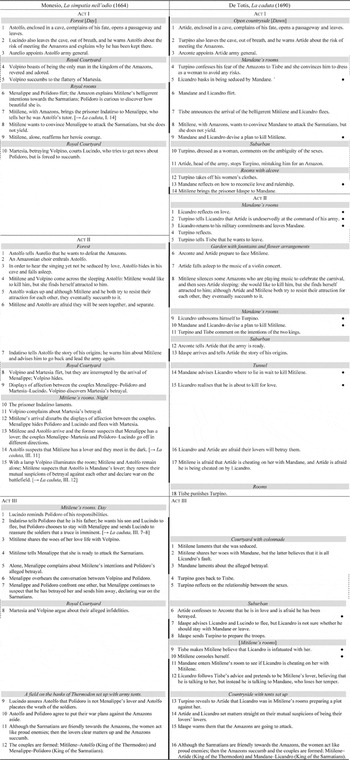
By comparing the dramaturgy of the two texts in detail, outlined in Table 2, one can see how, apart from the names of the characters, the overall structure of De Totis's libretto is largely faithful to Monesio's libretto, albeit with some alterations, possibly due to changes in theatrical tastes. Once again, the greatest alterations are in the servants’ scenes: the number of scenes changes and consequently their plot, though the love intrigue remains. The only new elements are Turpino's disguise as an Amazon (I. 4 and I. 12) and the solo scenes where he mocks the inversion of the relationship between the sexes and the virile identity of the Amazons (I. 10 and III. 5). Such scenes keep the comic element of the opera high, perhaps even raising it, as can be seen in the following lines:


Comparison of the dramaturgical framework in the libretti by Monesio and De Totis
Legend: | (central)=common scenes; ¦ (side)=comic scenes; •=new scenes

Turpino, having disguised himself as an Amazon (I. 4) to blend in with the viragos and save himself from their murderous hatred, laments about the reverse danger (I. 12), that he was arrested by the Sarmatians for being a woman warrior (Artide, deceived by his female disguise, aggressively defines him as ‘donna o danno del mondo’). And in another intermediate scene, Turpino draws inspiration from his cross-dressing to make fun of the effeminate, and therefore lewd, habits of a part of contemporary male society (I. 10). By comparing the same passage and the same concept in Monesio's and De Totis's libretti, it is clear that the latter aims for a more comical tone than the former (especially the biting tone of the verses ‘ma, summarie del sesso/fatta ricognizione, si decapita.’):Footnote 40

It is also possible to deduce from Table 2 that De Totis has made the following structural innovations in the main plot, compared to the libretto for La simpatia nell'odio:
1. Mandane and Licandro's plot to kill Mitilene (I. 9);
2. Mandane's considerations on how to reconcile ruling and love (I. 13);
3. rtide's deep sleep, induced not by a concert of female voices but by violins (II. 7);
4. Mitilene's silencing of the concert of the Amazons at Carnival (II. 8).
In contrast, compared with the original play, De Totis leaves out, for example, the long narrative about the myth of the Amazons (I. 2) and Polidoro falling in love with Menalippe through her portrait – a motif, moreover, which mirrors Thalestris's infatuation with Alexander the Great. Though he maintains the plot of the play almost entirely, he completely rewrites the setting. There are only a few small passages which unavoidably seem reminiscent of the text of the play or of Monesio's libretto, to the point that it is difficult to understand which one De Totis had under his eyes while he was writing. Let us examine a few.
In Artide's opening monologue, referring to the oil lamp that was the only source of light in the cave, the De Totis uses the Marinian term ‘liquefatta oliva’,Footnote 41 which is not found in the Spanish text. He seems to have taken it out of Monesio's libretto, at the same point in the scene:

Likewise, in a scene from La caduta where Mitilene wants to kill Artide in his sleep, the Amazon defines him as ‘nuovo mostro’, reminiscent of ‘mostro inumano’ from La simpatia nell'odio, but then reconsiders and decides that he is ‘non già sì deforme / come apparve il primier questo ravviso’, wording reminiscent of the Viennese libretto in the lines ‘non è così deforme / come me ’l figurò sdegno adirato’.

This scene, with its dramatic length and organisation, is the culminating point of the opera. After the staging, twelve Spanish and Italian sonnets were printed in praise of the patrons and singers of La caduta,Footnote 42 at least four of which, as indicated by the titles, focus on this scene, especially those which praise the performer playing the part of Artide.Footnote 43 José María Domínguez Rodríguez has noted that the scene between Mitilene and Artide is very similar to that between Armide and Rinaldo in Quinault and Lully's Armide, whose Roman performance in the same year was sponsored by the French Cardinal de Bouillon, based on the libretto translated by Giacomo d'Alibert.Footnote 44
It seems plausible to assume that Monesio's work influenced De Totis's, based on the examples presented so far – thus it is likely that a copy of the libretto had been kept in Rome, and may have been consulted by De Totis – an episode in La caduta which is not found in the libretto of La simpatia nell'odio but in the Spanish play indicates that De Totis knew Solís's text. It is the episode where Mitilene, absorbed in her implacable military plans, abruptly silences the Amazons who are entertaining themselves with music and songs:

In the Italian reworking of the piece, dramaturgical coincidences aside, the analogy of Mitilene's first verse can clearly be noted, specifically the order ‘Tacete, anime vili!’ with ‘Dejad de cantar, villanos!’, and the ironic expression ‘spirti festosi’ with ‘rumores festivos’. In the libretto this is followed by a speech made by the servant Tisbe, which defuses the situation with an extra-theatrical reference to the historical time of the performance, carnival, as a time of year when priorities can be relaxed. Thus far I have examined only some of relevant passages, but a systematic philological study – which I leave to Spanish scholars – will certainly clarify the correlation between De Totis's libretto and his models.
The revision of a libretto intended for the Viennese court twenty-five years earlier for a performance at Palazzo Colonna might be connected with the phenomenon – which remains to be clarified – that operas having their debut in Vienna, or at least passing through there, were presented in the theatre of Lorenzo Onofrio Colonna up to twenty years later. There are no reports of relations between the Colonnas and Leopold's court, but the phenomenon has been tentatively linked to the High Constable's fondness for libretti by Nicolò Minato, who spent twenty-nine years at the Viennese court.Footnote 45
The Colonna family contributed significantly to the new Spanish Empress's journey to Vienna, mostly thanks to Cardinal Girolamo Colonna, who had entered into the good graces of Philip IV while studying in Spain; he was instructed by His Majesty in April 1664 to accompany his daughter Margarita to Vienna. In 1666, while travelling with the Infanta shortly after having celebrated her marriage to Leopold in Madrid, the cardinal died in Finale Ligure. Awaiting the passage of the Empress in Milan, however, was his brother, Lorenzo Onofrio, with his wife Maria Mancini. We do not know, however, if this event was an opportunity to initiate or to strengthen contacts between the Colonna family and the Habsburg court to the extent that it would have promoted the migration of operas and influenced their appreciation. Lorenzo Onofrio himself died one year prior to the performance of La caduta and the production of the opera was sponsored by the Spanish ambassador, and thus perhaps the event was a development independent of the theatrical policy of the Colonna family.
Domínguez Rodríguez assumed that the Duke of Medinaceli had chosen to represent La caduta at Palazzo Colonna in order to take advantage of the entrepreneurial skills of the Roman family and the complex scenic equipment of their modern theatre, and also that he had personally chosen the Spanish text that would be translated and engaged the librettist, as he had previously done for the first opera that he staged in Rome, I giochi troiani (1688). Domínguez Rodríguez also assumed that it was almost certain that Medinaceli took part in the staging of Las Amazonas at Madrid in 1681, the same year that the edition of Solís's theatrical works came out, precisely on 9 June, Emperor Leopold's birthday. It was for the same occasion that in 1686, also in Madrid, the play Los juegos olímpicos was performed, which the Duke then had turned into the libretto Giochi troiani.Footnote 46 Therefore, not only did Medinaceli's first two operas produced in Rome curiously originate from texts that were already linked to the Habsburgs from an encomiastic point of view, but it is even more surprising to learn that in Madrid a play was being staged with a dedication to the Emperor which itself had been turned into a libretto for the Viennese court seventeen years earlier, and which the Emperor himself partly set to music.
These coincidences effectively support the symbolic interpretations of the libretto, which in turn contribute to understanding the reasons leading to the choice of the subject matter. For example, the hypothetical parallelism, suggested by Domínguez Rodríguez, between Artide and the ruler in charge – whether Leopold I or Charles II – was very likely designed to honour the greatness of the originating families, the Habsburgs in both cases, likening them to the heroic pair of Thalestris and Alexander the Great.Footnote 47 This aspect – as will be seen later – might well be related to the idea of an ‘Amazonian’ element in the Habsburg heritage, as would seem to emerge from the interpretation of a scene from Adone by Giovan Battista Marino, discussed below.
V. naples: barbò's mitilene
Despite the understandable doubts recently expressed by Maria Grazia Profeti, there is another libretto that takes up the subject of Solís's play, although in a much more elaborated version, almost completely modified:Footnote 48Mitilene, regina delle Amazoni by the Milanese count Teodoro Barbò,Footnote 49 performed in Naples on 6 November 1681, with music by Giovanni Bonaventura Viviani, and staged again in Naples in 1707, with music by Giuseppe de Bottis.Footnote 50 A decade earlier Barbò, moreover, was the author of an opera that presented a proud sovereign who was often portrayed as a warrior queen and referred to as an ‘Amazon’: Elizabeth I of England.Footnote 51 The opera, entitled La regina Floridea (1670), was also based on a Spanish play, El conde de Sex by Antonio Coello (1638), and performed in another city also under Spanish domination at the time, namely Milan.Footnote 52 Barbò was bilingual, having been born of a Spanish mother, and therefore his inclination to develop libretti from Spanish works, which he consulted in the original language, comes as no surprise.
The argomento of Mitilene is structured analogously to Monesio's libretto: mention is made of Thalestris and Alexander's encounter, referring back to Quintus Curtius Rufus as the historiographical source, and then fictitious elements are incorporated in the drama, relating to the background and coinciding to a great extent with those in La simpatia nell'odio:
1. Thalestris learns from the oracle that she will die during childbirth and that if she gives birth to a boy, it will be the ruin of the kingdom.
2. Thalestris orders Menalippe (her successor to the throne) to kill any male child she may bear, should she die in childbirth.
3. Menalippe, given the beauty of the child that is born, decides to spare him and hand him over to a trusted person, who raises him outside the kingdom.
4. The Sarmatians, whose king died in a war against the Amazons without leaving heirs, on the advice of the oracle name as successor the son of Thalestris and Alexander, who is found in a cave on the borders of the Amazonian kingdom. They call him Armidoro like the deceased king, but are totally unaware of his origins.
5. The new Sarmatian king besieges Themyscira, where Mitilene reigns.
The only variation in Mitilene is that Armidoro, the son of the illustrious couple, is appointed king of the Sarmatians in the backstory: this involves eliminating Polidoro and combining the roles of Astolfo and Polidoro into a single character, whose name is reminiscent of the latter. The list of characters and correlations with Monesio's libretto follow:

The Queen of the Amazons takes the name of her army general cousin or sister and, like her, falls in love with the son of Alexander and Thalestris: and just as with Armidoro, the roles played by Menalippe and Mitilene in La simpatia nell'odio are combined. Ipolita and Camilla, two army generals, are reminiscent of the heroic and proud Mitilene of Monesio's libretto, but compared to the latter they have completely different temperaments and experience very different events (imprisonment and disguises).
The opera begins with a scene that is directly reminiscent of the original theatrical subject: Mitilene approaches the Sarmatians’ camp to kill Armidoro in his sleep and as soon as she sees him she falls in love, abandoning her murderous intentions (I. 2); in this case, however, when Armidoro wakes up, the Amazon has already fled in the grip of her inner turmoil (I. 3). Therefore the episode coincides with the central motif of the second jornada of Solís's text and the second act of La simpatia nell'odio (II. 4) and La caduta (II. 8).
To some extent the end of the play is also reminiscent of the Spanish plot, in the idea of a physical clash between Amazons and Sarmatians, where the former are overwhelmed from a military as well as an emotional standpoint, although in this case it is a personal challenge between Mitilene and Armidoro and not a battle between peoples.
Apart from the initial and final scenes, which from a dramaturgical point of view remain the only strong points of correlation with Monesio's libretto, the rest of the libretto develops by means of different theatrical motifs. It is a typical comedy of intrigue, based on pieces of paper, letters, disguises, portraits and sleep scenes that continually create misunderstandings, misinterpretations, clarifications, recognitions, fits of jealousy, anger, despair and desire for revenge. Mitilene, seduced by Armidoro, and the two Sarmatian officers Ormondo and Arsindo, who are in love with Ipolita, all suspect that Armidoro and Ipolita have developed a romantic relationship; Armidoro swaps clothes with the Amazon Ipolita, his prisoner, to meet unbeknownst with Mitilene; Ormondo disguises himself as a Moor in the hopes of meeting Ipolita who, out of jealousy, was then imprisoned by Mitilene; in the end they manage to clarify the situation, and Mitilene is defeated in a duel. The couples then rearrange themselves as Mitilene–Armidoro, Ipolita–Ormondo and Camilla–Arsindo. It almost seems that the core of the opera is based on another Spanish play of which we do not currently know the identity, because the specific motifs, linked to the Amazonian world and the satire on gender identity, get a bit lost in relation to the works that have been analysed so far, and in general with those representing the myth of the viragos.
On a more general level, the relationship with the original subject, in addition to the scenes that frame the opera, is confirmed by the strong similarity between the configurations of the characters, in other words by the relations between the interlocutors as generators of action (bold arrows indicate emotional ‘transport’, dotted arrows indicate suspected relationships):

The only differences in Mitilene, compared to La simpatia nell'odio, are: (a) the third couple, Camilla–Arsindo, comes together at the end, but does not produce a love intrigue since over the course of the drama Arsindo is in love with Ipolita (he only pretends to be infatuated with Camilla in III. 2 in order to meet Ipolita in prison); (b) the suspected betrayals, which only concern the couple formed by Ipolita–Armidoro (or Mitilene–Polidoro in Monesio's text) and exclude Mitilene–Ormondo (Menalippe–Astolfo).
With Mitilene, therefore, Solís's Spanish subject appeared, though reworked, in an opera intended for Naples, a city under Spanish rule, to celebrate the birthday of the Habsburg Charles II, King of Spain, and was dedicated to the contemporary Neapolitan Viceroy Fernando Joaquín Fajardo de Requesens y Toledo, the Marquis of Los Velez. Moreover, a similar event took place in Naples a couple of years later, with the staging of the aforementioned Psiche (1683), based on a libretto adapted from a play by Calderón, to celebrate the birthday of the Spanish Queen Marie Louise Bourbon-Orléans. Furthermore, regarding dedicatees, there is a curious coincidence concerning the revival of Mitilene in 1707: it was dedicated to the Duchess Carlotta Colonna, Lorenzo Onofrio Colonna's niece, owner of the theatre (after his death) where La caduta was staged. The dedication stresses the opportunity of devoting an opera on the adventures of an ‘Amazon warrior’ to a woman who, like the mythical viragos, knows the value of pity and heroism, clearly endorsing the recurrent and privileged relationship between the subject and female patrons.Footnote 54
VI. padua–vienna: dottori's ippolita
Returning to the Viennese court, a curious fact seems to be connected with Monesio's libretto for La simpatia nell'odio: two years before he composed it for Eleonora, the Empress had commissioned another libretto on the Amazons from the Paduan poet Carlo de’ Dottori. Ippolita, however, focuses on a different episode. It is not based on the legendary encounter between Thalestris and Alexander the Great, as were its predecessors, but the legendary battle between the Greeks and the Amazons at the Thermodon (even though the battle itself is part of the background information and the plot depicts the events in its aftermath, which are probably fabricated).Footnote 55Ippolita, which has no connection with the opera of the same title by Giovanni Rabbia performed in Milan in 1670,Footnote 56 was never set to music and was published posthumously in 1695 an edition that announces the patron on the title page: ‘commissioned by Her Caesarean Majesty the Empress’ (‘comandato dalla Maestà Cesarea dell'Imperadrice’). Let us try to understand what happened to this libretto by examining part of Dottori's surviving correspondence.
In a letter to the Dottori of 17 November 1662, Eleonora wrote: ‘[To] put your talent to work once again we would kindly like to commission you to compose a play for the birthday of His Majesty the Emperor [9 June 1663], and we will provide you with further information of what we have in mind.’Footnote 57 On 18 November, in celebration of Eleonora's birthday, Leopold had organised a play set to music at the Hoftheater of Vienna, based on another ‘strong woman’ from the seventeenth-century repertory, Zenobia di Radamisto, with a libretto by Dottori and music by Antonio Bertali. Dottori therefore received a new commission the day before the staging of his first libretto for the Habsburg court. Eleonora does not refer to the subject of the play, but tells the poet that he will receive precise details on her ideas (‘del nostro pensiero’): words which do not allow us to exclude that the subject was chosen by Leopold and Eleonora herself.
The next surviving letter, from Eleonora to Dottori, is dated 21 April, a time when the libretto should have been close to completion, since the premiere was scheduled for 9 June. But something must have gone wrong since the Empress tells the poet that the libretto, for reasons that will be explained to him by the court composer Pietro Andrea Ziani, will be set to music for another occasion, yet to be decided: ‘please do not go to any pains to put the finishing touches on the Ippolita opera, because (as you have learned from our maestro di cappella) it is best to postpone the play for another occasion, and in this case we will have plenty of time to work on the prologue and other things’.Footnote 58 The revision of the libretto was therefore brought to a halt at the very last minute, when only the prologue and little else was left to finish. However, it is likely that in one of Dottori's earlier letters (Eleonora cites two of ‘the 21st and 30th of the previous month’ (‘21 e 30 del passato’)) he apologized for any delay in the work due to health problems (‘ci narrate nell'ultima circa qualche incommodo di salute’); this is why the Empress reassures him, telling him not to worry about not finishing the libretto quickly. Oronisbe was performed in place of Ippolita, on 9 June 1663, at the Teatro della Favorita, based on the libretto by Antonio Draghi and music by Ziani.
The reasons for the decision to postpone setting the work to music, as reported by Ziani, are explained by Dottori himself in a letter of 25 June 1666, sent to Vienna to the Empress's court poet Domenico Federici:
[Ippolita] is still slumbering on His Majesty's table and even I myself think that with time it could be happier, more lively, shorter and would require less time [compared to his libretto Zenobia di Radamisto, produced 18 November 1662 with music by Antonio Bertali].Footnote 59 I stuffed it with too many women, Ziani said, and [in Vienna] there is not even a single one. I turned to castrati, as they are in some sense similar to the Amazons, but was disappointed that I could not find a single one who knew how or wanted to portray a woman warrior. Though I let time pass, I never lost my affection for the play, which received numerous requests from the stages of this country [Italy]. I always turned them down, however, due to the fact that it is a sacred work and must not be desecrated. Moreover, to come down to it, I don't want any other stages than the Imperial one to represent compositions which, in a similar situation, might unfortunately spring from my pen; I have never felt any desire of the sort.Footnote 60
If the libretto was lying on His Majesty's desk it was certainly finished: in fact the posthumous print of 1695 also contains a prologue where mention is made of Leopold's upcoming wedding, which took place by proxy in Madrid in April 1666, thus the terminus ante quem for the completion of the libretto.Footnote 61 From the prologue we can also deduce that the opera was still intended for the celebration of Leopold's birthday a few years later, to be staged therefore in June.Footnote 62 Unfortunately, in June 1664, due to the period of mourning, all performances were cancelled (and Leopold was not even in Vienna); in June of 1665 Cristoforo Ivanovich's Circe was staged with music by Ziani, and in June 1666, only a few weeks prior to Dottori's letter to Federici, Federici's L'onore trionfante was performed, also set to music by Ziani. It is remarkable that the Paduan librettist was in essence sharing his complaints with his ‘competitor’, who at the time was nevertheless the court poet and wrote five libretti between 1666 and 1667.Footnote 63 From the letter it seems that Dottori was still hoping his Ippolita would be produced, but in June 1667 yet another opera was staged, Semiramide by Antonio Moniglia, set by Giovanni Andrea Cesti.
The official reason for the lack of singers for Dottori's libretto is the great number of virtuosas it required – Ziani speaks of ‘too many women’ – seemingly scarce in Vienna at the time. In the libretto's list of characters, there are five parts that could potentially be played by female singers.Footnote 64 Certainly La simpatia nell'odio required only three (Menalippe, Mitilene and Martesia), but in general five is neither few nor an impossible number to achieve. There is a Venetian opera, for example, also based on the legendary viragos, Le Amazoni nell'Isole fortunate by Francesco Maria Piccioli and Carlo Pallavicino (1679), which requires exactly this number.
Curiously, on the other hand, we learn in the same letter that the castrati, who, because of their androgyny ‘are in some sense similar to the Amazons’, did not know how to or did not want to play the roles of women warriors. This seems an odd assertion, but in fact it corresponds to reality. From the perusal of libretti with Amazons which include the names of the performers it results that the roles of the viragos were almost always performed by women, with the exception of three cases: (a) Camilla in Mitilene (1681), (b) when men are dressed as Amazons (Oronte/Orithia in Talestri, 1693; Delmiro/Alinda in Demofonte, 1698); (c) when the opera is staged in Rome (Ercole sul Termodonte, 1723).Footnote 65
Still, the sneaking suspicion remains that the lack of virtuosas was simply an excuseFootnote 66 not to stage a libretto that perhaps did not particularly appeal to Eleonora or Ziani as much as Zenobia, or that Ziani, whose appointment was a result of both Draghi and Dottori's efforts, happened to prefer Draghi, to whom he assigned, in fact, the libretto that would replace Ippolita, namely Oronisbe.Footnote 67 When it comes down to it, if it were only a matter of finding a couple of virtuosas it would have been possible, as was often the case, to ask for musicians from the Italian courts – a simple solution for a Gonzaga and for a court that certainly did not have any economic problems – unless, of course, the castrati were much more appreciated in Vienna than female singers, but this is a hypothesis that has yet to be proven.
VII. vienna: the amazons as an allegory of female power
Ippolita (1662) and La simpatia nell'odio (1664), two operas based on the subject of the Amazons written within a couple of years, both commissioned or dedicated to a Dowager Empress, Eleonora: the emphasis on the subject is undeniable. The two Viennese libretti therefore seem to be the result of a deliberate choice, especially if we consider that they occur very early in the process of establishing this subject in Baroque operatic repertory. Furthermore, though these libretti were developed in Italy, they were not intended for Italian theatres – as one would expect – but for a foreign court.
Until the 1670s, the only known operas were produced in Venice, where the Amazons play the role of single lovers of the unfaithful Theseus, completely decontextualized from the matriarchal society they belong to, a context which represents, however, a true ideological challenge to the current morality: L'incostanza trionfante by Francesco Maria Piccioli and Pietro Andrea Ziani (1658) and Elena by Nicolò Minato and Francesco Cavalli (1659) come to mind. In the libretti intended for Vienna, on the other hand, the viragos belong to a nation that is militarily opposed to another (the Greeks or Sarmatians), which is certainly a more appropriate subject for a monarchical government, such as the Habsburg Empire, rather than a Republic, such as Venice, and recurring in Italy only following the aforementioned Milanese Ippolita (1670).Footnote 68
Before the 1670s, apart from the Viennese libretti, the authentic Amazonian subject is found only in a trilogy of musical performances. Gli applausi festivi by Pietro Paolo Bissari and Johann Kaspar Kerll was performed – yet again – in a court on the other side of the Alps, Munich, precisely in September 1662, thanks to another Italian sovereign, the Electress Henrietta Adelaide of Savoy. The Amazons also appear in a ‘drama guerriero’, Antiopa giustificata, a kind of tournament-opera, loaded with scenic effects, that was organized for the birth of her first son Max Emanuel.Footnote 69 It would almost seem that Eleonora's choice to commission Ippolita in November 1662 from Dottori was a sort of symbolic entertainment challenge between the two Germanic courts. Moreover, Henrietta Adelaide herself was the daughter of the first of two Savoy women rulers of the seventeenth century, Christine Marie of France, who only a few years earlier, in 1659, held a masquerade entitled Les Amazones,Footnote 70 the verses of which establish a direct link between the representation of the Amazons and the legitimacy of female power in an exemplary fashion. And about a decade later, the Electress Henrietta had La giostra delle Amazoni (1670) staged in Munich in celebration of the birthday of her husband, Ferdinand Maria.Footnote 71
In Vienna, we discover another coincidence of dates: in 1662, the year in which Eleonora commissioned Ippolita from Dottori, she also instituted a female order of knighthood for the ladies of the court, called ‘Schiave della virtù’, and propagandised it with a text that was published in Venice in 1664,Footnote 72 the same year in which Monesio wrote La simpatia nell'odio. Footnote 73 Even Dottori was aware of the event – perhaps because he spent time in Vienna between May and July of 1662 – as we can deduce from his ode entitled La virtù regina, ovvero Le Schiave della virtù Footnote 74 through the reference made to Eleonora, in the dedication to Zenobia di Radamisto, as ‘incomparable Princess, who claims that the title of “Slave of virtue” is tantamount to that of three crowns’.Footnote 75
The programmatic objective is made very clear in the preface of the pamphlet, dated 1664:
the vast talent of this great lady wished to give a sign of her affection to the Germanic ladies, and because she has virile and lofty spirits, she ordered a moral discourse to be written on the order itself. This serves to show that even today there are women who are skilful in understanding letters and arms: thus they, like men, may establish orders for ladies and achieve honours.Footnote 76
Therefore Eleonora's moral and political programme is clear. Like all women regents, she had lost her husband. Ferdinand III died in 1657, and the heir to the throne was Leopold, barely eighteen years old. In the early years of his reign, the government was officially led partly by Eleonora, and, as a woman, she was probably anxious to legitimize her political role: I believe this was what led her to found the female order. Moreover, the tone, contents and rhetorical organisation of the text are the very same that fostered seventeenth-century feminist literature, in the great cultural debate known today as the Querelle des femmes, which developed from the end of the sixteenth century in conjunction with a long and exceptional series of queens and regents.Footnote 77
In this genre of polemical literature, first one had to set forth the thesis being defended: if men are superior to women in military and intellectual arts, it is only because they are allowed to lead a public life and continuously have the opportunity to learn and improve their skills, opportunities which, on the other hand, are precluded to women:
Furthermore, women cannot be defined as inferior to men in the exercise of virtue, both in arms and letters. Many women know that men have more skill and intelligence, and because they exercise public power they have the opportunity to improve. Women, held on the sidelines and relegated to the management of the household and the procreation of children, are thus deprived of learning and disinclined to the valour of warfare. They do not lack courage and talent; they are simply deprived of power. Many rightly bemoan their state … Mars was not miserly in providing them with a virile chest and spurring them to heroic actions: this is why you see so many Palladian warrior women. Yes! even today there are excellent Dianas in hunting and highly learned Minervas in the academies.Footnote 78
Secondly, one had to prove that reality and history contradicted the platitude of male superiority by listing a whole series of examples of strong women from the past (Camilla, Semiramis, Tomyris, and of course Zenobia, the subject of Dottori's libretto), epic-chivalric literature (Clorinda) and – indeed – from mythology:
There are also numerous other women who have lived through the hardships of military life and, always invincible and glorious, have come out victorious. But overcome by men and ceding to their sensuous desires, they have been deprived of the opportunity of reaching glorious goals and have remained inexperienced in the use of arms … may malicious people meet an army of bellicose Pallades or a team of Amazons to restrain their pride, and they will soon realise whose right hands are striking them.Footnote 79
In the structure of the discourse, one then honed in on the fundamental political objective: you cannot deny women the same skills, at least potentially, as men:
therefore, who will deny that this gender [women], just as the Caesars and sovereigns, cannot establish equestrian orders, of both men and women, not only for the conservation of the realm and individuals, but also for the universal good? In fact, as we have seen, many women have helped their kingdoms by fighting.Footnote 80
Finally, the theoretical model imposed throughout the text is applied to the specific case of Eleonora:
For all these reasons and more … Eleonora Gonzaga of Austria … to demonstrate how much she appreciates virtue and how much she appreciates that women, and the great ones, must present themselves particularly to the world as such, found an honourable and virtuous way … to achieve the effect, based on the principle that women must not let themselves be outdone by men in learning virtue, since women can also crown themselves, like men, with the halo of letters and triumphs in arms. And if they cannot [achieve this] in the public ranks of hostile enemies, [they must do so] at least by proving to have manly strength and courage, and pursue universal vengeance against the infidels of the Catholic Church.Footnote 81
Unjustly excluded from holding main positions of power, they have no option but to devote themselves to the defence of the Catholic religion, a defence which nevertheless maintains the characteristics of a military metaphor and links itself to the heroic and war-like image of the virgin martyrs of the Old Testament.Footnote 82 Eleonora herself, in her final speech ‘to the ladies, to explain to them why this order has been instituted’, shares her thoughts on the equality/inequality of the sexes: ‘A man can take pride in being the most perfect of the human race and a woman, who is the man's companion, should not be inferior to him, since many women have equalled men in heroic actions and letters.’Footnote 83 Furthermore, in describing the order of the Slaves in a list of the equestrian orders in 1672, Bernardo Giustiniano curiously compares Eleonora's valour to that of Alexander the Great and implicitly underlines how the Empress founded her order on the basis of the many ‘Amazons’ that have honoured the feminine sex over the centuries: ‘with the spirit of a Macedonian … she [Eleonora] took pride in passing on the honoured memory of the endeavours of the feminine sex to posterity; and while this sex passed on its Amazons over the centuries, she established the incorruptible memory of so many goddesses in the year of eternity itself’.Footnote 84
One can therefore understand how the Amazons should symbolically represent the possibility of redemption, at least in part, of the ‘sesso donnesco’, especially for regents who had to guide young sovereigns such as Leopold, who were not particularly gifted with virtues which at the time were considered purely ‘masculine’. In the report drawn up by the Venetian ambassador Alvise Molin, the young emperor, while practising ‘riding and hunting’, ‘has no inclination for arms, because his education was more religious than military and kept him distant from this discipline’ (27 September 1661);Footnote 85 and a report by Giovanni Sagredo asserts that ‘the people want to see him as martial as he is pious and religious, so that he can prove to be equal to his competitors of about the same age, the King of France and the Sultan of Constantinople’ (2 May 1665).Footnote 86
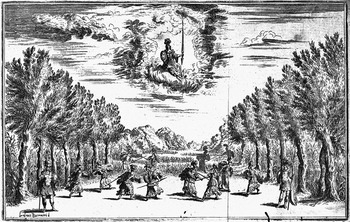
The legendary viragos return to the Viennese stages only a few years later, with Il pomo d'oro by Francesco Sbarra and Antonio Cesti (1667):Footnote 87 the end of the second act, as stated in the azioni of the libretto, includes a ‘tourney of armed maidens dressed as Amazons, in honour of Pallas’ (II. 13–14), a scene of which an engraving by the court set designer Lodovico Ottavio Burnacini has survived (see Figure 3). The staging of Il pomo d'oro was intended to inaugurate the new Theater auf der Cortina and at the same time celebrate the wedding of Leopold to the Spanish Infanta (December 1666), but delays in concluding the construction of the theatre have led to the assumption that the opera, although ready in 1667, was performed for the new Empress only in July 1668. The hypothesis is confirmed in the stage direction of scene I. 13 – ‘this is followed by the duel that the young women perform on Pallas's birthday, as is the custom’Footnote 88 – in which he alludes to the sovereign's birthday by identifying her with the Greek goddess of war, depicted in the engraving as the arbiter, in macchina, of the bout.
Francesco Sbarra and Antonio Cesti, Il pomo d'oro, II. 13–14; engraving by Lodovico Ottavio Burnacini

The obsession with having Amazons appear in court performances had already infected Eleonora's aunt, Eleonora I Gonzaga, who preceded her on the throne of the Holy Roman Empire and, in turn, was left the widow of Ferdinand II of Habsburg. In 1650 it was she who convinced her stepson Ferdinand III, after the death of her husband in 1637, to marry her niece, to ensure the prestige of the House of Gonzaga. In 1626, for the wedding between Duke Adam Paul von Slavata and Princess Maria Margarethe von Eggenberg, Eleonora I had the ladies-in-waiting appear dressed as Amazons, on wagons wielding swords and spears, having them simulate a tournament that turned into a dance, in which she herself participated.Footnote 89 A few years later, in February 1629, an ‘operetta’ set to music was performed,Footnote 90 with verses by Cesare II Gonzaga, Prince and Duke of Guastalla, and Amazonian dances. And as we learn from the diary of the Austrian Cardinal Ernst Adalbert von Harrach, another Amazonian dance, along with a dance for knights, was held in the court in March 1639 for the Carnival celebrations.Footnote 91
There is a final aspect which is quite curious in this network of recurrences and symbolic references to the Amazonian subject. In the same years as the dance performances organised by Eleonora I, Giovan Battista Marino inserted a heroic episode in Adone (1623) which symbolically indicates the Amazons as the founders of the Spanish royal house (canto XX, ottave 388–404).Footnote 92 In a final tournament, in honour of the death of Adone, two armed knights face each other, one of which is actually a woman in disguise, Austria, who in the end, upon revealing her true identity, falls in love with her contender, Fiammadoro (an episode recycled from Tasso's Tancredi and Clorinda). Marino describes Austria as the daughter of the proud Tigrina, queen of the Amazons and descendant of Penthesilea, who, having fallen in love with Austrasio, violates the laws of the Amazon nation and marries him after he rescues her from the amorous clutches of the tyrant Argamoro: Austrasio himself underlines the absurdity of the Amazonian law, ‘against [the laws of] the sky, the world and nature’ (‘contraria al cielo, al mondo ed a natura’), which had always driven the viragos to ‘want them to dread and detest the wonderful pleasure of honest embraces’ (‘voler che s'abborrisca e si detesti / il bel trastul degli abbracciari onesti’).Footnote 93 Even here it is not difficult to notice the analogy between the events of the couple composed of Tigrina and Austrasio and those experienced by Menalife and Polidoro, or Miquilene and Astolfo from Solís's Las Amazonas, according to the common narrative model in the representation of Amazons: they discover sexual desire and let themselves be ‘tamed’, abandoning the battlefield and their matriarchal customs for the secondary role of wife.Footnote 94
There is more: according to Giovanni Pozzi, the Marinian passage alludes, for political and encomiastic purposes, to the French–Spanish wedding which took place in 1615 between Anne of Austria and Louis XIII de Bourbon, the dedicatees of the poem.Footnote 95 The poet himself, in the initial allegory of the canto, expounds how Austria and Fiammadoro represent the Spanish and French houses respectively through their insignias. From this perspective it is possible to read behind the genealogy of the characters cited by Marino a reference to the succession of contemporary rulers, as outlined here:

If Austria and Fiammadoro refer respectively to Anne of Austria (the name is also a reference) and Louis XIII of France, Tigrina and Austrasio, as the parents of the Austria, must refer to Margaret of Austria and Philip III of Spain, also parents of the future King of Spain, Philip IV, and grandparents of the Emperor Leopold.
This brings us to three important aspects of our discussion. First, the viragos, belonging to a remote society (located outside the Eurocentric world), and the conflicts they represent are also a metaphor for the political-cultural encounter that occurs in mixed marriages between different lineages. Secondly, although Austria is Amazonian through her mother, she is certainly no longer identified as such for belonging to a female society, but only ‘as an individual … although she is living in a mixed society, of which she acknowledges and partially accepts the rules, she is still a warrior not for her own personal cause – to defend a kingdom, along with its dignity and exclusively female power, such as the Amazons – but at the service of something or someone else, like any self-respecting epic hero’.Footnote 96 In these same terms, from a male perspective, replacing Austria with Anne of Austria probably led to the creation of the ideal model of queens and rulers, who often had to replace or substitute for their male spouses who were not able to rise to the occasion: therefore they had to possess virile virtues, and at the same time be cleansed of the subversive social-political values associated with the myth, in order to accept the restrictions of the patriarchal model.
Finally, with this symbolic interpretation, Marino seems to suggest, though metaphorically, the idea of an Amazonian component in the Spanish Habsburg dynasty, represented by its Austrian branch of women. In this regard, a few decades after Adone – but during the same years as Solís's play – on the age-old question of whether the Amazons existed or not, the Spaniard Baltasar Gracián wrote in El Criticón (1651–7): ‘Not only did they once exist, but in reality and in deeds they still exist. Is Anne of Austria, the Queen of France, not an Amazonian woman, just as were all the Spanish Infantas that crowned that kingdom with happiness and offspring?’Footnote 97
APPENDIX
La simpatia nell'odio, overo Le Amazoni amanti. Opera tragicomica per musica di Giovanni Pietro Monesio, alla sacra imperial maestà dell'imperatrice Leonora
[Dedica:] Sì come con altra penna io mi figuro di non vergare i fogli che con quella imprestatami dall'ali di quella grand'aquila imperiale, che se ha doppie luci da contemplare il sole, ha dupplicati anco i rostri da insanguinare quella luna a cui fissa lo sguardo idolatra l'ottomana cecità, così la mia musa, beneficata dalla real munificenza di Vostra Maestà non riconosce altro Apollo che la Maestà Vostra medesima. Onde se tutto ciò che questa detta e quella scrive, in riguardo de’ miei grandissimi oblighi, vien destinato, anzi dovuto al virtuoso compiacimento di Vostra Maestà; io col presentarle quest'opera delle Amazoni, ultimo parto sudato del mio debole ingegno, potrei dire di fare un dono alla Maestà Vostra di ciò ch'è suo. Ma per renderla meritevole di qualche applauso, che da se stessa conosce di non poter conseguire, io ho preso ardire di porle in fronte il glorioso nome di Vostra Maestà, i cui clementissimi raggi non solo potranno felicitare le di lei fortune col farle acquistar maggior luce, ma sapranno anco far ammutire le lingue più malediche de’ zoili invidiosi. Supplico dunque riverentemente la Maestà Vostra a degnarsi di riceverla sotto la sua benignissima protezione e di gradire con gli atti della sua generosa magnanimità gli umilissimi ossequi, coi quali la porgo a Vostra Maestà, a cui profondissimamente mi prostro.
Roma, primo agosto 1664.
Umilissimo, divotissimo ed ossequiosissimo servo Giovanni Pietro Monesio
[Dedication:] Since I cannot imagine writing with any pen other than this one given to me from the wings of the great imperial eagle, that, besides two sets of eyes to contemplate the sun, has two beaks to make the moon bleed, upon which Ottoman blindness fixes its idol-worshipping gaze, thus my muse, benefiting from the royal munificence of Your Majesty, does not recognize any Apollo other than Your Majesty Herself. Therefore, everything Your Majesty dictates and writes about my duties is intended for, or rather, is due to Your virtuous satisfaction; with the presentation of this opera on the Amazons, the latest accomplishment of my humble talent, I could say that I offer Your Majesty what belongs to Her. In order to make it worthy of applause, which it cannot achieve alone, I have decided to dedicate it to the glorious name of Your Majesty, whose merciful rays will not only bestow success on the play by providing it with more light, but will also silence the most malicious tongues of the envious Zoilos. Therefore I reverently beseech Your Majesty to receive it under Your gracious protection and to accept, with Your generous magnanimity, my most humble respects, which I offer to Your Majesty, to whom I deeply bow.
Rome, 1 August 1664
Most humble, most devoted, most obsequious servant Giovanni Pietro Monesio