Suffused with the high expectations that accompanied the foundation of the Royal Society, its second charter of April 1663 proclaimed in the name of the king that: ‘We have long and fully resolved with Ourself to extend not only the boundaries of Empire, but also the very arts and sciences.’Footnote 1 For the English, as for other European imperial powers, the widening sway of seaborne power did indeed converge with the expansion of the sciences since, properly to possess new territories, one needed to catalogue their products and their peoples.Footnote 2 The quest for suitable goods for trade in an increasingly globalized world was, as Cook has recently argued, a catalyst for such scientific values as accurate recording of data.Footnote 3 Such a preoccupation was the domain of natural history, a form of knowledge to which the Royal Society was particularly committed.
Its commitment to natural history owed much to the eloquent claims made by Francis Bacon, the Royal Society's philosophical mentor, for the possibilities that such a form of knowledge opened up. For Bacon saw natural history as the bedrock for a new form of natural philosophy which would undermine the speculations of the Schools. As Bacon acknowledged, natural history was one form of the broader category of history which he linked with the faculty of memory. History in this sense was simply a form of description and, as Bacon wrote in his Description of the Intellectual Globe, ‘History is either Natural or Civil. Natural history relates the deeds and actions of nature; civil history those of men.’Footnote 4 But even Bacon's own practice indicated that the boundary between natural and civil history was a wavy and uncertain one. The view that the human realm should be confined to civil history ran in the face of the fact that, increasingly, one of the major forms that natural history took was that of travellers' accounts or works by those such as the Spanish who had systematically studied the flora, fauna and human populations of lands that European expansion had brought under their view.Footnote 5
One of the most notable of such post-Columbian works was The Naturall and Morall Historie of the East and West Indies (1590; English translation 1604) by the Spanish Jesuit Joseph Acosta, which Bacon cited in both the New Organon and the History of Winds, two works which formed parts of his Great Instauration of 1620.Footnote 6 As his title suggests, Acosta's work merged the realm of nature and of humankind and Bacon himself went some way towards doing the same in his attempt at a model natural history. In his Sylva Sylvarum, among the many tedious details about the behaviour of nature, he turns to some lurid accounts of the way in which ‘the cannibals in the West Indies eat man's flesh; and the West Indies were full of the pocks when they were first discovered’.Footnote 7 This merging of the human and the natural worlds accorded with Bacon's view in the Advancement of Learning that there were forms of history, notably cosmography, which were ‘manifoldly mixt … being compounded of Naturall history, in respect of the Regions themselves, of History civill, in respect of the Habitations, Regiments and Manners of the people’. Tellingly, this comment was followed by an acknowledgement of the significance of recent global exploration for ‘the furder proficience, and augmentation of all Scyences, because it may seeme they are ordained by God to be Coevalls, that is, to meete in one Age’.Footnote 8 This was an indication of the extent to which travel and natural history were closely intertwined in what Bacon saw as this providential conjunction of both science and empire. There was, however, less coincidence than Bacon allowed. As Richard Drayton has argued, both European global expansion and the quest to understand nature better drew on common theological roots and a belief shared by Bacon in the directing hand of Providence.Footnote 9 For Bacon, the study of nature included the study of man. Hence, when outlining the full extent of natural history in his Parasceve (The Preparative towards a Natural and Experimental History) which formed a part of his Great Instauration, Bacon at least gestured towards the need to include the world of humankind. In sketching in rather summary form the task of the natural historian, he included attention to the physical characteristics of human beings along with ‘the way these things vary with race and climate’. The programme extended to the more cognitive aspects of humanity with histories of ‘the intellectual faculties’.Footnote 10
The early Royal Society went much further in securely including the human world within the remit of the natural historian. It formed, for example, part of the agenda outlined in Robert Boyle's 1666 ‘General Heads for a Natural History of a Country, Great or Small’ – a work that was based on part of Bacon's Parasceve but which accorded the study of humankind a much more explicit and conspicuous place than had Bacon.Footnote 11 ‘Secondly’, wrote Boyle, ‘above the ignoble Productions of the Earth, there must be a careful account given of the Inhabitants themselves, both Natives and Strangers’.Footnote 12 An enthusiastic though critical reader of travellers' accounts, John Locke saw such material as contributing to the study of human nature, which he regarded as part of natural history.Footnote 13 As Carey points out, Henry Oldenburg wavered somewhat in the encouragement he gave to correspondents reporting on the natural history of humanity. But, as he put it in the preface to the eleventh volume of the Philosophical Transactions, he did aspire to ‘making the fullest discovery of Mankind, as Man is the Microcosme’. Hence he urged the need to bring ‘under one view, the shapes, features, statures, and all outward appearances, and also the intrinsick mentals or intellectuals of Mankind’.Footnote 14
Such an impulse to study the human world could take either local or global forms, both of which promoted habits of empirical investigation and accurate recording.Footnote 15 The Baconian concern for precise description prompted the close study of British localities and their antiquities for which Robert Plot and other Royal Society practitioners of chorography were renowned, but it also helped stimulate the study of more distant societies.Footnote 16 This interest in the peoples of the new worlds helps account for the early Royal Society's interest in accounts of voyages to little-known quarters of the earth. Robert Hooke contributed an enthusiastic preface to the Historical Relation of the Island Ceylon (1681) by the East India Company captain Robert Knox, a work that was also endorsed by Christopher Wren. As the title suggests, this was a text very much devoted to the human as well as the natural history of Ceylon, even though much of its appeal lay in its being something of an adventure story. Hooke nonetheless saw this book as an example of that programme of publication of seamen's accounts which the Royal Society sought to promote. By so doing, the extent of natural history would be widened, for, as Hooke wrote, ‘How much of the present Knowledge of the Parts of the World is owing to late Discoveries may be judged by comparing the Modern with the Ancients’ Account thereof.'Footnote 17
Robert Southwell, president of the Royal Society from 1690 to 1695, was a close observer of the voyages of William Dampier's epic circumnavigatory voyage of 1679–91 and it was probably Southwell who encouraged John Woodward, a prominent member of the society, to produce in 1696 his Brief Instructions for Making Observations and Collecting in All Parts of the World in Order to Promote Natural History … presented to the Royal Society.Footnote 18 Interestingly, the full title refers to the ‘Advancement of Knowledg both Natural and Civil’, an allusion to Bacon's great work and to the need to draw together human and natural history. Its appendix provides a template for the description of the indigenous peoples across much of the globe, including Africa, the East and West Indies and ‘other remote, and uncivilized, or Pagan Countries’. Woodward urged detailed description of these peoples' anatomy, along with ‘their Tempers, Genius's, Inclinations, Virtues, and Vices’. Religion loomed large with the stipulation that the traveller should ‘Enquire into their Traditions concerning the Creation of the World, the universal Deluge’ and ascertain ‘their Notions touching the Supreme God, Angels, or other inferior Ministers’. Such concerns were later to be reflected in Woodward's correspondence with the New England divine Cotton Mather on the ways in which the study of the natural history of the North American continent confirmed the biblical narrative. Archaeological evidence of what appeared to be huge antediluvian humans, for example, was used to confirm the references to giants in Genesis.Footnote 19 Woodward's attempt to understand the place of America in the history of the globe and, in particular, in the Noachian Flood extended to the attempt to obtain ‘curiosities’ of artefacts from the country, a quest which was in keeping with his antiquarian and archaeological pursuits within the British Isles.Footnote 20 Woodward's Brief Instructions also urged the need for a detailed description of different peoples' customs, such as the basic rites of passage, their mode of computing time and their forms of government and law.Footnote 21 Overall, it was a work that took a very compendious view of the domain of natural history and accorded the study of humankind a prominent place within it.
The travels of Dampier and others were also accorded reviews within the pages of the Philosophical Transactions. This again illustrated the extent to which the Royal Society saw the human world as forming part of its terrain. Hooke's expansive seven-page review of Dampier's An Account of a New Voyage round the World (1697) praised the information contained therein, including the description of ‘the Natives, their Shapes, Manners, Customs, Clothing, Diet, Art, & c.’, as being ‘very Curious, Remarkable and New’.Footnote 22 The previous volume of the Philosophical Transactions had contained a review of an account of the recent voyages by John Narborough into the South Seas in 1669–71, along with earlier voyages of figures such as the seventeenth-century Dutch captain Abel Tasman. The material such voyage accounts provided was described as ‘contribut[ing] to the enlarging of the Mind and Empire of Man, too much confin'd to the narrow Spheres of particular Countries’. For such works, continued the review, with an allusion to the importance of what the following century would term ‘the Science of Man’, helped provide ‘a large Prospect of Nature and Custom’.Footnote 23 A 1698 review of a nine-year voyage to the East Indies and Persia by John Fryer FRS similarly valued not only the work's ‘Account of the Nature and Products of the Countries themselves’ but also that ‘of the Men that inhabit each, their Shape, their Genius, Manners, Customs, Laws’.Footnote 24
Bacon had envisaged that the acquisition of the materials for a true natural history would, as he wrote in his Parasceve, mean ‘that they ought to be sought out and gathered in (as if by agents and merchants) from all sides’.Footnote 25 In this, as in much else, the early Royal Society followed the Baconian lead, viewing travel as central to the promotion of its enterprise: hence Oldenburg's goal of ‘appoint[ing] philosophical ambassadors to travel throughout the world to search and report on the works and productions of nature and art’ on which it would be possible ‘to compose in Time a Natural and Artificial History which will be perfect’.Footnote 26 Boyle quite explicitly drew on ‘Navigators, Travellers & c.’ in compiling ‘the Particulars admitted into the Natural History’.Footnote 27
Travellers' accounts thus naturally merged with the promotion of natural history as the early Royal Society understood it. The prominence of such accounts in the early proceedings of the society is one of the reasons why a considerable amount of attention was devoted to the study of the human world. But though travellers' tales might be diverting and were read in quantity by those, such as Locke, engaged in the development of what in the age of the Enlightenment was termed the ‘Science of Man’, they were also notoriously unreliable.Footnote 28 Over time, with increasing emphasis on experiment, the methods of the Royal Society reduced the attention paid to travel accounts.Footnote 29 The growing focus on experimentation also brought with it an increasing stress on the need to witness the process by which scientific information was produced.Footnote 30 This in turn also prompted uneasiness about material which was not based on first-hand reporting by a figure with professional competence and, preferably, one who was known to and could be questioned by members of the Royal Society. Accordingly, too, the study of the human world also declined, though the pages of the Philosophical Transactions continued to carry descriptions of non-European societies throughout the eighteenth century.
For the early Royal Society, however, the need to embark on a form of natural history that would achieve the goals laid out by Bacon as a form of knowledge which broke with scholastics' logic-chopping made travellers' accounts too valuable a source to be lightly dismissed.Footnote 31 The methods of the Baconian natural historian and those of the traveller were too close to be able to discount the information received from travellers around the globe in too drastic a manner.Footnote 32 For the promotion of natural history was one of the things that bound the early and rather embattled society together, even if, as Paul Wood has pointed out, Fellows could differ about what they meant by the Baconian programme to which they all outwardly subscribed.Footnote 33 As Boyle mused, natural history was so dependent on travel accounts that one had to be willing to accept that ‘many things must be taken upon trust in the History of Nature, as matters of fact Extraordinary … such as are not to be examin'd but in remote Countrys’.Footnote 34
The early society did, however, do what it could to check the veracity of some of the more far-fetched reports from foreign lands. In 1671 it set out to determine the truth of earlier reports about Brazil by sending a lengthy set of queries to a Jesuit there with questions such as whether ‘fiery flying dragons appear frequently’ and, more plausibly, ‘Are the older Brazilians excellent botanists, able with ease to prepare every kind of medicine from materials gathered in all places?’ The abiding Western preoccupation with cannibalism was evident in the query ‘Is it true that, moved by affection, they seize the bodies of parents not killed by poison and having dismembered them, bury them inside themselves’.Footnote 35
This list of queries for Brazil also attempted to secure information to test the widespread belief that other peoples often lived longer than Europeans. Hence the item ‘Do many Brazilians enjoy a green old age beyond one hundred years?’Footnote 36 The Bahamas, too, were reported to be a haven of longevity. In 1668 the Philosophical Transactions published a report that there ‘some do live to an hundred years and something upwards’.Footnote 37 The Royal Society seems to have accepted this, though it did seek further information. Hence in the following year it sent a list of queries to the Bermudas in which it was asked, ‘What is conceived to be ye cause of the Longevity of ye inhabitants.’Footnote 38 Such reports of longevity, which probably reflect uncertainties in other societies about determining age, flooded in from around the world, and in the absence of any definite counterevidence they appear to have been believed in the early Royal Society. In 1682 John Evelyn repeated Walter Raleigh's report of a Virginian king who lived for over three hundred years. This prompted Hooke to add some credibility to the tale by taking ‘notice of what Sir Christopher Wren had formerly acquainted the Society, that the people at Hudson's Bay commonly live up to 120 or 130 years of age; and till that age are very lusty’.Footnote 39 Boyle was, however, more sceptical, since his questioning of a Hudson's Bay Company employee elicited the information that the ‘Natives never live long by reason of the badness of the waters in the country’.Footnote 40
Establishing the worth of the accounts of travellers whose information from distant lands could not be readily checked was, then, a continuing issue for the Royal Society. As Peter Dear has argued, one of the great issues faced by the Royal Society was that of establishing criteria for what constituted credible data on which the philosopher could build.Footnote 41 In taking further Bacon's critique of the methods employed by the scholastics to arrive at accepted knowledge, the early Royal Society had to put others in place. In the new Baconian dispensation knowledge needed to be based on events and empirical findings which, in principle, could be repeated. In establishing the validity of such events and findings, much depended on the corporate response of the Royal Society to the papers it considered. Though publication in the Philosophical Transactions did not necessarily amount to full assent, it was at least an indication that the information should be seriously considered by the world of learning. Such papers therefore had to be considered in terms of what members of the Royal Society regarded as plausible. Steven Shapin has pointed to the importance of social position in establishing the worth of scientific claims: by definition a gentleman did not lie (at least to his peers).Footnote 42 Yet the Royal Society also valued reports from the likes of common seamen, since they were likely to come unvarnished by philosophical speculation.Footnote 43 Over time, too, as the Royal Society came to be settled and more confident in its methods, the competence of the reporter rather than his social position became of increasing importance, as Palmira Fontes da Costa has argued.Footnote 44 This was to weaken the credibility of many travellers' tales.
In the early Royal Society, with its high hopes for the Baconian programme of natural history, however, travellers' accounts were viewed as a form of data that at least in theory could comply with scientific canons since its results were repeatable or, at least, could be checked for consistency with other travellers' accounts.Footnote 45 Hence the Philosophical Transactions published in 1666–7 a list of queries about India even though replies had already been received, since ‘’tis altogether necessary, to have confirmations of the truth of these things from several hands, before they be relyed on’.Footnote 46 But, of course, it was not always possible to get independent verification, so the fact that the strange but indeed accurate account that in the Congo ‘there are Serpents twenty five foot long, which will swallow at once a whole Sheep’, reached the society through the Jesuits, and after publication in the Journal des Sçavans, may have added to its credibility.Footnote 47
Interestingly, on occasions those in distant lands could be more sceptical about the strange and the novel than were members of the Royal Society. In response to an early enquiry about ‘Whether Diamonds and other Precious stones grow again’, the Royal Society's correspondent in Batavia curtly replied, ‘Never, at least as the memory of man can attain to.’Footnote 48 Royal Society interest in the novel and the bizarre reflected Bacon's preoccupation with ‘Deviating instances … and monstrous objects’.Footnote 49 This interest extended to the human population of foreign lands with the publication in 1668 of a report claiming that Indians of Virginia and Florida were of ‘Gigantick Stature’.Footnote 50 This was a tradition which continued well into the eighteenth century. In 1767 the Philosophical Transactions solemnly published an account of the alleged giants of Patagonia by Charles Clarke, an officer on the Pacific expedition of John Byron.Footnote 51 On the other hand, though travellers' reports figured less in the deliberations of the Royal Society over the course of the eighteenth century, the tradition of promoting investigation to test the veracity of remarkable reports did continue. In 1706–7 one of the African informants of the Philosophical Transactions went so far as actually to inspect Hottentots to determine the truth of the report that all men had a testicle removed, and concluded that it was true only of married men.Footnote 52 In North America another correspondent in 1786 carried out first-hand observation to ascertain whether there was any truth in the reports that the Indians lacked beards and concluded that in this respect they were not different to other men, though they plucked out the hairs.Footnote 53
More proactively, from its beginnings the Royal Society also attempted, where possible, to make the travel accounts on which it drew conform to its canons of truth by directing the information travellers sent back and the form in which it was expounded.Footnote 54 The society's determination to shape travellers' accounts into forms appropriate for the stuff of natural history was evident from the first volume of the Philosophical Transactions: this included detailed ‘Directions for Sea-Men, Bound for Far Voyages’ which prescribed a formidable inventory of observations which the Royal Society wished to see carried out. As the preamble stated, this formed part of its Baconian-inspired quest ‘to study Nature rather than Books’ and hence ‘to compose such a History of Her [Nature], as may hereafter serve to build a Solid and Useful Philosophy’. In doing so, the society's Fellows sought to ‘increase their Philosophical stock by the advantage, which England injoyes of making Voyages into all parts of the World’.Footnote 55 It was to such aspirations that Sprat referred in his grandiloquent manner when he wrote that the Royal Society's Fellows ‘have begun to settle a correspondence through all Countreys … that in short time, there will scarce a Ship come up the Thames, that does not make some return of Experiments, as well as of Merchandize’. In the spirit of the wording of the Second Charter quoted above, Sprat saw such a conjunction of imperial expansion with the growth of knowledge as suited to an England which was ‘not only Mistress of the Ocean, but the most proper Seat, for the advancement of Knowledge’.Footnote 56
The Royal Society thus attempted to turn England's growing imperial sway to its advantage.Footnote 57 The American colonies offered fertile ground for scientific enquiry both from the point of view of the scientific agenda of the Royal Society and in terms of the not always congruent areas of enquiry of the local population.Footnote 58 However, by the late eighteenth century the latter increasingly gave way to the former.Footnote 59 From its foundation, the Royal Society sought to enlist the help of prominent American colonists such as John Winthrop, who, as governor of Connecticut, returned to London in 1661. It was to him that Oldenburg wrote in 1664 by order of the Royal Society's Council to inform him ‘that he was invited in a particular manner to take upon him the charge of being the Chief Correspondent of the Royal Society in the West, as Sir Philiberto Vernatti [of the Dutch East India Company] was in the East Indies’.Footnote 60 When Winthrop was rather tardy in fulfilling such a role Oldenburg wrote him a gently chiding letter biding him to reflect on the fact that the Royal Society sought knowledge from all around the globe: ‘we have taken to taske the whole Universe, and that we were obliged to doe so by the nature of our dessein’.Footnote 61 Winthrop took the hint and sent a considerable collection of objects reflecting the natural history of New England, which, tellingly, included such human artefacts as ‘some girdles of the Indian mon[e]y’. His description of these objects amounted to an early form of ethnology:
the white they call wampampeage, the black suckalog … the black is double the value of the white: six of the white, is a penny and three of the black, according to the Indian account … that wch is made up in Girdles they use to lay up as their treasure.Footnote 62
Around the same time Oldenburg also attempted to enlist the support of an English colonist in the Bahamas with a request that he provide observations ‘concerning natural and artificial things’, objects from the world both of nature and of humankind.Footnote 63
Along with such colonists, the Royal Society had high hopes, only very partially realized, of turning the chartered companies, another major arm of empire, to philosophical advantage. After all, from 1662, with the granting of a royal charter, the Royal Society was also a chartered entity.Footnote 64 By 1664 there was an attempt to enlist the East India Company into providing ‘answeres, as may satisfy the inquiries to be sent to them’.Footnote 65 Perhaps such overtures formed part of the background to Oldenburg's enquiry to Boyle in 1666 about how best to use the willingness of the incoming governor of Bombay to be of ‘service for Philosophicall purposes’. True to the Royal Society's aspirations to invest such traveller's accounts with an element of scientific rigour and direction, Oldenburg added that the governor would ‘performe the more effectually, if he may receave some Instructions from you’. Boyle had to admit, however, that he knew so little about Bombay that, unusually, he could not compile the sort of list of queries of which the Royal Society was so fond.Footnote 66
During the following century the Royal Society continued to seek the somewhat intermittent scientific cooperation of the East India Company. Johann Reinhold Forster FRS reflected such hopes in his preface to his 1772 translation of Bougainville's account of his voyage around the world, a translation dedicated to the president of the Royal Society. Forster urged the need for the company to send out on its ships ‘men properly acquainted with mathematics, natural history, physic’ who should take care ‘to observe the manners, customs, learning, and religion of the various nations of the East’.Footnote 67 But such aspirations were only very partially realized. The Royal Society did, for example, secure the right in 1778 to allow Dr James Lind FRS to take scientific instruments in his voyage on a company ship to India and China. This the company welcomed as ‘an opportunity of forwarding the views of the Royal Society’, but it was more circumspect about acceding to the accompanying wish that Lind could request the services of company employees in India.Footnote 68
While the Royal Society had only limited success with the vast East India Company, it had a long and fruitful relationship lasting well into the late eighteenth century with the comparatively small Hudson's Bay Company. This was perhaps in part because it was founded in 1670, not long after the Royal Society. The East India Company, by contrast, was founded in 1600 and was thus less open to new influences.Footnote 69 In 1672 Oldenburg could present to the society the responses to a series of queries entrusted to a captain in the service of the Hudson's Bay Company. Interestingly, it included considerable attention to the indigenous human population, with detailed responses to such queries as ‘What kind a people the Natives are, where they are winterd?’ and ‘What governmt and religion they have amongst themselves?’Footnote 70 Evidently, the society gained further information about the indigenous peoples of this area, for in 1681 Christopher Wren gave an exposition to the society of their customs and some of the ways in which these had begun to change with the coming of the Europeans: ‘These people used to strike fire readily with flint against flint; but have been since furnished by the English with steel, which they use with flints.’Footnote 71
The relationship with the Hudson's Bay Company continued to bear fruit well into the late eighteenth century. One very tangible outcome was the annual arrival at the Royal Society between 1771 and 1774 of large collections of natural-history specimens from the Hudson Bay area. This so impressed the society that it proposed (apparently in vain) that application be made to ‘the Directors of the East India, Turkey, Russia and Africa Companies, for the same sort of collections to be transmitted annually’.Footnote 72 The task of compiling a catalogue of the first contingent of these objects was entrusted by the Royal Society to the German polymath Johann Reinhold Forster, soon to achieve fame and some notoriety as the naturalist on board Cook's second great Pacific voyage of 1772–5. Forster singled out as the basis for a paper in the Philosophical Transactions the Indians' practice of dyeing porcupine quills with a root which he determined to be hellebore. With a view to advantaging the company as a return for its scientific largesse, Forster recommended that ‘the directors of the Hudson's-bay Company … order larger quantities of this root from their settlements, as it will no doubt become an useful article of commerce’.Footnote 73
If possible, then, the Royal Society attempted to turn England's imperial or commercial sway to its advantage, but, where necessary, it also turned to foreigners if they were willing to cooperate. One of its most enthusiastic early informants was, as we have seen, Sir Philiberto Vernatti, governor of Batavia, the great entrepôt of the Dutch East India Company. It was thanks to Vernatti that in 1668 the society received diverse curiosities including a poison produced by the Macassan people.Footnote 74 Surprisingly, too, the Royal Society sought an alliance with the Jesuits. The society realized that in spite of all the religious prejudices that stood between that order and Protestant England it could draw on a unique and far-flung network in providing reliable scientific information from otherwise inaccessible regions of the globe.Footnote 75 As Sprat put it, the Jesuits were permitted to ‘bestow some labours about Natural Observations, for which ye have great advantages by their Travails’.Footnote 76 Much of the Royal Society's knowledge of the ancient civilizations of China and India, for example, derived from the Jesuits, along with information on little-known areas of the globe such as the Philippines.Footnote 77
From such scattered sources the Royal Society added to its store of natural history, including information on the human world. The society did what it could to ensure accuracy and, thanks to its queries and questionnaires, some element of consistency. Not only did its informants add to its growing paper archives of information, but they also contributed to its Repository or museum, an institution which embodied the quest for the accumulation of material on which a secure natural history could be erected.Footnote 78 Museums such as the Repository that allowed for both observation and even experiment, as Ken Arnold has argued, acted as important early sites of the scientific movement.Footnote 79 The natural-history contributions to the Philosophical Transactions looked both inwards to the heart of England and outwards to a globe increasingly coming under European sway. So, too, the Repository included objects reflecting both local history and the larger world. This two-edged character of the Baconian collecting impulse was reflected in John Norris's poetic tribute to the eminent Royal Society chorographer, Robert Plot:
Within the Repository there was a natural tendency to attract attention by highlighting the rare and exotic, including specimens which related to the natural history of human society. The 1694 edition of Nathaniel Grew's catalogue of the society's ‘Natural and Artificial [i.e. man-made] Rarities’ included a very diverse range of ethnological materials: along with ‘A pot of Macassar Poyson Given by Sir Phil. Vernatti’ there were, inter alia, a canoe from Greenland, ‘An Indian Poyson'd Dagger’, ‘A Tomahauke, or Brazilian Fighting-Club’, ‘A West Indian Bow, Arrows and Quiver’ and ‘A Japan Wooden-Cup; cover'd with a Red Varnish within’. When describing the items of flora or fauna on display, Grew often also alluded to the uses to which they were put by the indigenous populations of the parts of the world whence they came. The plumes of a bird of paradise prompted the remark that such birds were worshipped as gods by the natives of the Molucca Islands. Cacaw-nuts (coconuts), he noted, on the authority of Acosta, were used as money, and the husks of Indian maize were woven by the women into ‘Baskets of several fashions’. Tellingly, however, the ‘Artificial Rarities’ did not fit neatly into Grew's overall introductory system of classification and were relegated to the rather miscellaneous last category ‘Of Coyns, and other matters relating to Antiquity’.Footnote 81 Such problems of ordering ethnological materials were to grow in the eighteenth century as systems of classification gained greater ascendancy. Since classificatory order increasingly became the hallmark of scientific standing, this tended to weaken the status of the study of humankind.
In some ways, then, ethnological items helped to make the Repository more like a traditional virtuoso cabinet of curiosities than the more chaste and considered collection which greater attention to classificatory neatness would have dictated.Footnote 82 Such a highlighting of the exotic helps explain why the Royal Society's Repository became one of the late seventeenth-century London tourist sights.Footnote 83 Nonetheless, the society did try to exercise some control over the items added to the collection so that it would, at least to some degree, be in keeping with its larger goals of building up a reliable natural history. Those who were not Fellows were, as Oldenburg wrote in 1667/8, obliged to show intended donations to the president ‘for fear of lodging unknowingly ballads and buffooneries in these scorching times’.Footnote 84 Censorship of the gifts of the Fellows themselves was presumably considered too delicate a matter, even in the face of the satire of the Royal Society to which Oldenburg here alludes. But the collection of foreign artefacts continued to loom large in the museum, perhaps because of the public interest they inspired, and when a new Repository building was erected in 1712 a committee was formed ‘to take due placing of the Curiosities’.Footnote 85 Eventually, in 1781, the society donated the Repository to the British Museum: a symptom of the by then increasingly half-hearted commitment to the Baconian ideal of a natural history based on description and collection of data.Footnote 86
It was to this Repository that Winthrop's collection of ‘American Curiosities’ was sent after being viewed by the king. Thus, as Oldenburg wrote to him in 1670, your ‘rich Philosophical present’ has ‘increased the stock of their [the society's] repository’.Footnote 87 The Winthrop family tradition of largesse to the Royal Society later continued with the donation by Winthrop's grandson and namesake of 364 items from New England in the 1730s.Footnote 88 In 1671, shortly after the original Winthrop donation to the Royal Society Repository, there was also a donation by Lord Willughby ‘of several curiosities from Barbadoes and other American islands’.Footnote 89 Another part of the globe was represented in the Repository when, in 1683, Captain Robert Knox, the historian of Ceylon with Royal Society connections, donated a collection of objects from the Gulf of Tonkin, Vietnam, a collection which included such examples of indigenous customs as material for consuming betel nut.Footnote 90
The early Royal Society's project for compiling what Oldenburg referred to as a ‘universal history of nature’ drew into its archives and collections material relating to the human as well as the natural worlds.Footnote 91 This was prompted in part by simple curiosity of the sort evident in descriptions of African music in 1686.Footnote 92 It was evident later, in 1775, in discussions of the nature of Tahitian musical instruments.Footnote 93 There was also a strong element of admiration for some of the achievements of the ancient cultures of China and India, such as that which prompted a paper in the Philosophical Transactions on India in the course of which tribute was paid to the ‘most ingenious Invention of Figures by the Sagacious Indians’ which ‘can never be sufficiently enough admired’.Footnote 94 The early Royal Society was also much preoccupied with the nature and origin of Chinese character script, prompting John Wallis to make a detailed study of Chinese sources in the Bodleian Library.Footnote 95
In the Baconian spirit there was, however, also the strong hope that study of these novel areas of natural history would yield useful results that could contribute to ‘the relief of [European] man's estate’. A continuing theme in the reports on the customs of indigenous peoples is how their skills might be emulated to the advantage of others. In doing so, the Royal Society threw a wide geographical net. Its 1666–7 list of inquiries for the East Indies included information about iron-making in Japan, along with queries about how the Chinese made and coloured their dishes and how the Chinese and Japanese made black varnish, while those for Persia in the same year sought information on ‘What other Trades or Practices, besides Silk- and Tapistry making, they are skilled in.’Footnote 96 A report from Canada in 1685 described the method the Indians used to make maple syrup, a process again described in a report from New England in 1720–1.Footnote 97 From Canada, too, came a 1686–7 account of how to make ‘several impressions on folds of a very thick bark of birch’.Footnote 98 At much the same time there was further attention to the potentially useful customs of the Americas with the publication of a paper by Sir Robert Southwell, president of the Royal Society, of ‘The Method the Indians in Virginia and Carolina use to Dress Buck and Doe Skins’.Footnote 99 The benefits of studying and possibly learning from the American Indians were urged again much later in the Royal Society when Forster compiled his 1772 report on the curiosities from Hudson Bay. In this he expounded on the way in which the
wild inhabitants of North America are certainly possessed of many important arts; which, thoroughly known, would enable the Europeans to make a better, and more extensive use of many unnoticed plants, and productions of this vast continent, both in physic, and in improving our manufactures, and erecting new branches of commerce.Footnote 100
This willingness to learn (and also to profit) from other cultures is a marked feature of these reports from foreign lands, and contrasts with the contempt for indigenous cultures which was to be more of a feature of the high imperialism of the nineteenth century. Drawing on its Jesuit contacts, the Royal Society published in 1713 an account of India, which glowingly wrote that ‘This Country furnishes Materials for Mechanic Arts and Sciences more than any Country that I know of. The Artifacts here have wonderful Skill and Dexterity’.Footnote 101 It was to the Jesuits, too, that the society turned for a detailed account of varnish-making in China.Footnote 102 Methods of dyeing attracted particular interest and admiration, as instanced by Hooke's 1686–7 account of the techniques used by the Indians, or, in a much later period, the interest in a new ‘colouring substance’ brought back from Tonga on Cook's second voyage.Footnote 103
This same openness and willingness to concede that other cultures had much to teach was also evident in the Royal Society's eagerness to learn about the forms of medicine employed in distant lands. The tone for such enquiries was set by Boyle in the first part of his Usefulnesse of Experimental Naturall Philosophy (1663), in which he argued, ‘Nor should we onely expect some improvements to the Therapeutical part of Physick, from the writings of so ingenious a People as the Chineses’ but rather should also ‘take notice of the Observations and Experiments’ even of the ‘Indians and other barbarous Nations, without excepting the People of such part of Europe it selfe’.Footnote 104 The early Royal Society did indeed make considerable enquiries about the forms of medicine employed by the North American Indians. In 1666 Oldenburg presented a report from a long-standing resident of Virginia on the types of plant employed there to cure disease.Footnote 105 Ten years later, in the course of a generalized description of the customs of the Indian peoples of Virginia, an article in the Philosophical Transactions of 1676 stated that the ‘Indians being a rude sort of people use no Curiosity in preparing their Physick; yet are they not ignorant of the nature and uses of their plants’. It also detailed the way in which dried substances from a particular fish ‘procureth speedy delivery to women in labour’.Footnote 106 Such widespread colonial interest in American Indian pharmacology, however, was, as Joyce Chaplin notes, often accompanied by a dismissal of the cultural and religious beliefs with which it was associated.Footnote 107 The Royal Society also followed Boyle's recommendation that particular attention be paid to Chinese medicine. This is evidenced by articles such as that which appeared in 1698, thanks to an East India surgeon, on ‘a China Cabinet, full of the Instruments and Simples used by their Surgeons’. It added pointedly that among them were several that were ‘new and different Shapes from the same used in Europe’.Footnote 108 Such admiration continued with a paper of 1733 paying tribute to the skill of Chinese physicians ‘in judging of Distempers by the Pulse’.Footnote 109
Interest and even admiration for indigenous cultures did not, however, preclude some instances of reporting on local customs with a view to the better exploitation of native peoples for European advantage. A 1669 list of queries from the society for an informant in Virginia included a request for information on how ‘long any Savages may be train'd to endure ye water Diving or Swimming; ye use of such men being very great for Merchants, Ship-Masters and others’.Footnote 110 A report of instructions given to a Dutch East India Company captain exploring the lands near Japan published in the Philosophical Transactions in 1674 stipulated close attention to ‘the nature and condition of the people’ with a view to ascertaining whether they might be appropriate customers. If gold or silver were sighted, special care was to be taken to avoid giving the impression that these metals were particularly valued by the Europeans.Footnote 111
Such scattered and miscellaneous information about different societies around the globe poured into the early Royal Society as grist to the mill of the natural historians. It illustrated the extent to which the study of human societies formed part of what the early Royal Society understood by that very compendious term ‘natural history’. The territory of natural history was vast indeed. Like Bacon before them, the major figures of the early Royal Society thought of natural history as an activity involving the collection of data on all aspects of nature. Such a massive collection of information was to provide the foundation for a true system of causes, a natural philosophy that superseded the airy speculations and logic-chopping of the scholastics. Bacon himself certainly gave the impression that he regarded as distinct the compilation of natural history, with its vast storehouse of facts, and the erection of a system of natural philosophy. In his Advancement of Learning he had argued that natural history was the essential, but in some senses subordinate, prerequisite for ‘physics’, in its seventeenth-century sense as a synonym for natural philosophy. For Bacon, the appropriate division of labour was that ‘NATVRAL HISTORY describeth the varietie of things; PHYSICKE [physics], the CAVSES’.Footnote 112 Such views were further developed in the Description of the Intellectual Globe (written in 1612), in which he viewed natural history as ‘the primary material of philosophy’, contending that ‘the noblest end of natural history is this; to be the basic stuff and raw material of the true and lawful induction’.Footnote 113 In the New Organon he again presented a crucial but nonetheless subordinate role for the natural historian in promoting the endeavours of the natural philosopher: ‘So we should have good hopes of natural philosophy once natural history (which is its basis and foundation) has been better organized, but none at all before.’Footnote 114
Yet whether Bacon meant that the two activities should be kept in separate compartments can be questioned. He made much of the fact that his kind of natural history should be informed by the need to develop a true natural philosophy and that it should not be characterized by the random, curiosity-driven pursuits of the virtuosi. His goal for natural history, so he insisted in the Great Instauration, was ‘not so much to give pleasure by displaying the variety of things … as to illuminate the discovery of causes and nourish philosophy with its mother's milk’.Footnote 115 In the same spirit, he defined the purpose of natural history in his Parasceve as being ‘to seek out and collect the abundance and variety of things which alone will do for constructing true axioms’.Footnote 116 In short, Bacon envisaged the ideal natural history as having an element of rationale and purpose which would enable it to promote the theorizing of the natural philosopher. Purver goes so far as to argue that Bacon envisaged natural history and natural philosophy as working together in a form of syncopation with a continuous process, where one was adapted better to suit the goals of the other.Footnote 117
In the early Royal Society, this uncertain boundary between the work of the natural historian and that of the natural philosopher was even more pronounced. In the manner of Bacon, notable figures within the early Royal Society seemed again to portray as separate activities the collecting linked with natural history and the more theoretical demands of natural philosophy. For example, Oldenburg adopted the familiar Baconian division between natural history and philosophy when seeking information from around the globe. His attempt to enlist the services of an informant in Syria prompted a declaration that it was the aim of the Royal Society ‘to put together such a Natural History as our illustrious Bacon designed’.Footnote 118 Similarly, a request for scientific information from Florence was accompanied by the assertion that the Royal Society sought ‘to compose a good Nat. History, to superstruct, in time, a solid and usefull Philosophy upon’ – a phrase he also used in his introduction to Boyle's 1666 paper on the ‘General Heads for a Natural History’.Footnote 119
But the practice of Oldenburg's close ally Robert Boyle, whose work helped to set the tone for the early Royal Society more generally, indicates that there was some elision between the realm of the natural historian and that of the natural philosopher. When Boyle wrote to Oldenburg in 1666, for example, his discussion of the role of natural history indicated that he saw it as needing to be at least theoretically informed, as at times Bacon himself appears to have implied. Boyle rejected the idea that a system of natural philosophy (or what he called ‘whole Body of Physicks’) should ‘be propos'd as the Basis of our Natural History’, but nonetheless viewed the role of natural history as being to ‘amplify & correct’ such systems. Boyle argued that by thus linking natural history and natural philosophy it was possible to conduct experiments in a more fruitful manner:
the knowledg of differing Theorys, may admonish a man to observe divers such Circumstances in an Experiment as otherwise 'tis like he would not heed; and sometimes too may prompt him to stretch the Experiment farther than else he would (and so make it produce new Phaenomena) … [which] will conduce to make the History both more exact and compleat in it self.Footnote 120
Such considerations have prompted Anstey and Hunter to argue in a recent paper for a major reappraisal of Boyle's methodology as being ‘a two-stage reciprocal enterprise in which theory informs experiment with a view to constructing a natural history, which in turn informs theory’.Footnote 121
Boyle might elsewhere fall back more unequivocally on the Baconian division between the natural historian and the natural philosopher. He described himself as an ‘under-builder’ whose humble role it was to conduct experiments so that ‘men may in time be furnished with a sufficient stock of experiments to ground hypotheses and theories on’.Footnote 122 Yet in practice Boyle's example and the more general growth and success of experimental philosophy brought with them a transformation in natural history that over time was to lead to a narrowing of its domain to areas that did not lend themselves to experiment, especially living things. The Baconian division continued to throw a long shadow over the eighteenth century, particularly in Scotland, where his work was studied so avidly. Late in the century Lord Kames, for example, remarked that ‘Natural History is confined to effects, leaving causes to Natural Philosophy’.Footnote 123 However, the expansion of the territory of experimental philosophy meant that natural history, which for Bacon had encompassed all aspects of the study of nature, became increasingly confined to areas which were reliant on description rather than experiment. As the eighteenth century wore on this meant that natural history increasingly referred to the study of the terraqueous globe and the classic kingdoms of animal (generally including humankind), vegetable and mineral. It was in this sense that William Wales, future astronomer on Cook's second and third voyages, reported back to the Royal Society from a 1768–9 expedition in the Hudson Bay area that he sought to provide some account relative to ‘the natural history of the country … first with respect to the inhabitants’.Footnote 124
There were, however, a growing number in the eighteenth-century Royal Society who considered description alone, without recourse to experiment or mathematical analysis, not altogether scientifically worthy. In particular, throughout the eighteenth century there was tension between the mathematical practitioners and the natural historians that occasionally erupted within the society. The succession crisis for the presidency that followed the death of Newton in 1727 led James Jurin, the then editor of the Philosophical Transactions, to insert a mathematicians' manifesto. He contended that Newton ‘was sensible, that something more than knowing the Name, the Shape and obvious Qualities of an Insect, a Pebble, a Plant or a Shell, was requisite to form a Philosopher, even of the lowest rank’. He also reiterated Newton's oft-repeated Baconian-based view ‘That Natural History might indeed furnish Material for Natural Philosophy; but, however, Natural History was not Natural Philosophy’.Footnote 125
This was a passage which again surfaced in the politicking associated with a much later presidential election, that of 1772.Footnote 126 This was an indication that the issue still simmered. Finally, it led to open conflict in 1783–4 in the early presidency of the gentleman–collector Joseph Banks. This was a battle that Banks's lieutenant, Charles Blagden, characterized to him as being described by his opponents as ‘a struggle of the men of science against the Macaronis [virtuosi] of the Society, dignifying your friends by the latter title’.Footnote 127 The fact that Banks remained president of the Royal Society until his death in 1820 indicates that collecting still retained a place in the society. However, for Banks, as for Bacon, collecting should be linked with utility. Banks and his fellow natural historians could also draw confidence from the rising prestige of natural historians that derived from the increasing sway of classificatory systems, of which the most notable was that of Linnaeus.Footnote 128 When it came to the study of human society, however, such developments did little to promote a sense of its importance and scientific standing. Studies of human society appeared to have only limited direct utility: hence Johann Reinhold Forster's complaint in his 1772 study of the artefacts from Hudson Bay about ‘the vulgar opinion, that it [natural history] is merely speculative, and incapable of being of the least utility in common life’.Footnote 129
Nor did the study of human society combine readily with the classificatory impulse that was sweeping natural history. Ethnological descriptions of human customs were not readily neatly categorized, nor yet were the growing piles of artefacts, so prone to the ravages of time and insects, which had once been a feature of the Repository. Stadial views of the development of society helped to provide French and Scottish moral philosophers with the beginnings of a system of social science which drew on the Baconian goal of a natural history of humanity.Footnote 130 But such systems did not neatly link with the Linnaean quest to place all of nature (including the human world) in a well-ordered hierarchical system of classification. Such difficulties were compounded by the fact that, for all the early attempts to produce reports based on prescribed guidelines, what information it received on foreign peoples largely came from correspondents who were not very directly under the authority of the society. As in other areas of natural history, such correspondents tended to be more interested in description than in theory.Footnote 131
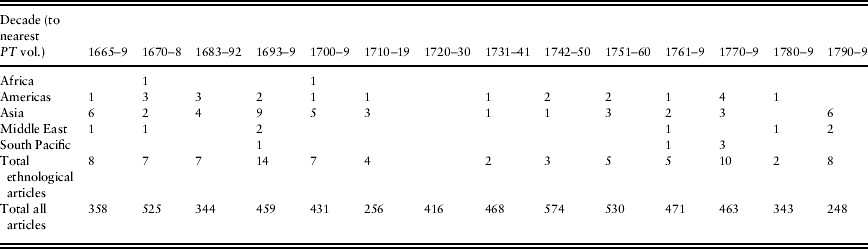
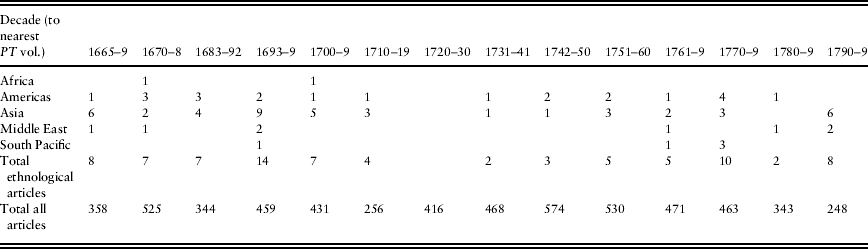
The result then was a decline in the eighteenth century in the number of papers in the Philosophical Transactions largely devoted to ethnological subjects. Drawing on the table below, there were in the period between 1665 and 1699 a total of thirty-six ethnological papers on extra-European subjects (2.1 per cent of the total papers published in this period), while from 1700 to 1750 there were a mere sixteen (0.7 per cent of the total). There was a small revival in the second half of the century. The figure for the period between 1750 and 1799 was thirty (1.5 per cent of the total), though this was still below the proportion for the period up to 1700. This small late eighteenth-century revival reflects the renewed exploration of the South Pacific and other regions which followed the end of the Seven Years War in 1763 and increasing commercial contact with Asia. Interestingly, articles on Asian subjects loomed largest throughout the entire period from 1665 to 1799, both because of trading contacts and because of the number of reports sent back by the Jesuits, particularly on China.
Extra-European ethnologically related articles in the Philosophical Transactions, 1665–1799
A partial exception to this general trend was the study of race, a topic that became ever more heated and controversial over the course of the eighteenth century, in large part because of the debates about the slave trade.Footnote 132 In the first place, race was relevant to classification because it raised the issue of whether the human species was one or many, and what status should be attributed to racial differences. This was not a debate that appears to have loomed large within the Royal Society itself, perhaps because it was too divisive or because it involved dangerous questioning of the traditional Christian view that all human beings were of ‘one blood’. But race could be discussed in limited ways with recourse to experimental data to determine the validity of the dominant theoretical construct, namely that race was the outcome of climatic variation. This was an issue frequently addressed within the Royal Society from soon after its foundation. In 1675 Martin Lister drew on observations from Barbados to argue that the colour of the blood of those of black African descent indicated that their skin colour was not a product of the climate, especially as those ‘that live in the same Clime and heat with them, have as florid Blood as those that are in a cold Latitude’.Footnote 133 That industrious late seventeenth-century reporter on the natural history of Virginia, John Clayton, questioned whether skin colour could be explained in terms of climate, given that American Indians and African Americans lived on similar latitudes.Footnote 134 But others took a contrary view. It was argued in 1682 that ‘Europeans by continuing to inhabit in Africa have been found to turn black, and that blacks in England after a few generations become white’.Footnote 135
The fullest treatment of the subject was in a 1744–5 paper by John Mitchell MD of Virginia, entitled ‘An Essay upon the Causes of Different Colours of People in Different Climates’. This was originally intended for a prize competition offered by the Bordeaux Academy. The paper set out to refute the view, most influentially advanced by Malpighi, that black skin colour could be explained in physiological rather than climatic terms.Footnote 136 In so doing, Mitchell argued that both science and Scripture supported the proposition that all human beings were of the same species: ‘there is not so great, unnatural, and unaccountable a Difference between Negroes and white people on account of their Colours’.Footnote 137 Another American MD, James Bate of Maryland, was more uncertain about how far skin colour was physiologically based, using a case study of an African American woman whose skin changed colour. In publishing the case in the Philosophical Transactions of 1759–60 he used almost Baconian language to deny that he was ‘endeavouring to establish a favourite hypothesis’. He claimed he sought only to ‘confine myself to a simple narration of such facts, as may prevent mistakes, or obviate difficulties, arising in the investigation of this difficult piece of physical history’. But in so doing he followed in the wake of Boyle by presenting a theoretically informed natural history, for he questioned both the theories that black colour could be explained by the effects of bile and also the action of heat. He did, however, invite his readers to suggest further experiments which he would ‘be glad to execute’.Footnote 138
However, such ventures into physical anthropology were rare in England. The field was largely to be developed in Germany under the tutelage of Johann Blumenbach in the setting of the medical faculty of the innovative University of Göttingen.Footnote 139 With its institutional base of gentlemanly amateurs, the Royal Society was a less conducive environment for such studies.Footnote 140 The lack of such a theoretically based approach to the study of human society meant that it tended to languish, even by comparison with other branches of natural history. These latter could at least be more readily combined with the great enterprise of neatly docketing away the manifold productions of nature in the systems of classification that loomed so large in the late eighteenth century. The study of humankind that the early Royal Society had considered an integral part of the large enterprise of natural history tended to be overshadowed as natural history itself changed character. With the rise of experimental philosophy, the domain of natural history was gradually reduced.
What remained were largely the more descriptive accounts of the animate and inanimate world. But these were transformed by the rise of classifactory systems and, by the late eighteenth century, claims that natural history could venture into the realm of causes once reserved for natural philosophy by approaching explanation in historical rather than mechanistic terms.Footnote 141 Such historically based approaches to the ‘Science of Man’ began to make an impact in Scotland, France and Germany.Footnote 142 However, they did not mesh too readily with the culture of the Royal Society, with its emphasis on experiment or classification. There the study of human society remained for some time in the traditional mould of a descriptive ‘history’. Its accumulation of colourful detail and cumbersome artefacts seemed too redolent of an earlier form of natural history to be embraced with scientific enthusiasm. The rise of the study of human society as a scientific discipline in the form of anthropology was to be a feature of the nineteenth century, when the specialist societies challenged the Royal Society's traditional oversight over all of nature. Bodies such as the Ethnological Society of London (founded 1843) were to provide a more congenial setting for the evolutionary theoretical frameworks that gave this new discipline the scientific status it had once enjoyed in the older Baconian understanding of ‘natural history’.