Seeds dispersed and deposited by wind, animals and other dispersal agents are a fundamental component of natural forest succession, plant regeneration and population maintenance, aside from increasing a population's genetic pool in tropical ecosystems (Henry & Jouard Reference HENRY and JOUARD2007, Muscarella & Fleming Reference MUSCARELLA and FLEMING2007, Wilson & Traveset Reference WILSON, TRAVESET and Fenner2000). Frugivorous bats and birds are ideal vectors for long-distance seed dispersal; therefore, studies of the food habits of frugivores and the specific identities of the dispersers are essential for understanding ecological patterns and processes in tropical environments. Studies related to succession processes, the frequency, number and composition of seeds dispersed by animals are essential in order to generate new data and hypotheses, consequently the method and quality of obtaining data are important.
The first studies regarding food habits were achieved by killing the animals and exploring stomach contents (bats: Arata et al. Reference ARATA, VAUGHN and THOMAS1967, Fleming et al. Reference FLEMING, HOOPER and WILSON1972; birds: McAtee Reference MCATEE1912, White & Stiles Reference WHITE and STILES1990). As the science progressed, the survival of dispersers became more important, hence researchers started looking at faecal samples instead. Conventionally, the method for collecting seeds from bat and bird faeces has been to place the animal in a cotton or canvas bag or a container and to wait 30–60 min until the individual discharges gut contents or regurgitates seeds (Bonaccorso & Humphrey Reference BONACCORSO, HUMPHREY, Chadwick and Sutton1984, Charles-Dominique Reference CHARLES-DOMINIQUE1991, Fleming Reference FLEMING1988, Gorchov et al. Reference GORCHOV, CORNEJO, ASCORRA and JARAMILLO1995, Palmeirim et al. Reference PALMEIRIM, GORCHOV and STOLESON1989). Recent studies of seed dispersal by bats continue to use this method (Griscom et al. Reference GRISCOM, KALKO and ASHTON2007, Kelm et al. Reference KELM, WIESNER and VON HELVERSEN2008, Mello et al. Reference MELLO, KALKO and SILVA2008, Olea-Wagner et al. Reference OLEA-WAGNER, LORENZO, NARANJO, ORTIZ and LEÓN-PANIAGUA2007); some studies kept bats for 2–4 h to obtain faecal samples (Bianconi et al. Reference BIANCONI, MIKICH, TEIXEIRA and MAIA2007, Estrada-Villegas et al. Reference ESTRADA-VILLEGAS, PÉREZ-TORRES and STEVENSON2007, Lopez & Vaughan Reference LOPEZ and VAUGHAN2004, Lou & Yurrita Reference LOU and YURRITA2005). In the case of birds, in order to evaluate seed dispersal, researchers spent 10 min searching for faeces from plant leaves and leaf litter at each bird-sampling site (Lozada et al. Reference LOZADA, DE KONING, MARCHÉ, KLEINA and TSCHARNTKE2007); or have collected faeces containing seeds from an area in transects 5 m wide by 5 km long (Nishi & Tsuyuzaki Reference NISHI and TSUYUZAKI2004); or seed rain is studied without knowing the identity of the disperser and assuming the taxa, bats or birds, simply by splitting schedules between day and night (Debussche & Isenmann Reference DEBUSSCHE and ISENMANN1994, Galindo-González et al. Reference GALINDO-GONZÁLEZ, GUEVARA and SOSA2000, Holl Reference HOLL1998, McDonnell & Stiles Reference MCDONNELL and STILES1983, Medellín & Gaona Reference MEDELLÍN and GAONA1999).
In addition, considering that some bats are extremely sensitive when manipulated and some individuals may be lactating females with an infant waiting for a meal, or a mother searching for food for their pups, it is important to considerably reduce the time of animal manipulation in order to obtain faecal samples with seeds, without trading the quality of obtained data. It is also an important task to reduce the time researchers invest in seeking for faeces. Since 1995 we have been using a different technique to obtain seeds from bat faeces with very high success and short animal manipulation time (Galindo-González et al. Reference GALINDO-GONZÁLEZ, GUEVARA and SOSA2000, unpubl. data); under each mist net we place a strip of plastic sheet (1–1.2 m wide) on which to collect faeces dropped while the bats are entangled in the net. We started using this method after observing seeds stuck in the net just below the entangled bat, or we found seeds directly under it on the ground.
Taking into account that ecological studies related to frugivory and seed dispersal increase year by year, we feel this method will be of use to many bat and bird researchers. Until now we are aware only of three studies using this technique (Galindo-González et al. Reference GALINDO-GONZÁLEZ, GUEVARA and SOSA2000, Phua & Corlett Reference PHUA and CORLETT1989, Sato et al. Reference SATO, PASSOS and NOGUEIRA2008), even though it was mentioned years ago (Thomas Reference THOMAS and Kunz1988). Our aim is to demonstrate an improved technique to collect seeds dispersed by mist-netting bats and highlight the impact of using this method compared with the traditional one. We address three questions: (1) Are faecal samples more abundant using the cotton-bag method or the plastic-sheets method? (2) Which of the two sampling methods collects more seeds? (3) Which sampling method obtains the highest species richness with the same sampling effort?
We conducted our field work at two different localities: Centro de Investigaciones Costeras La Mancha in the tropical semideciduous forest (TSF), on the central coast of Veracruz, Mexico (19°36′N, 96° 22′W, altitude < 30 m); and a cloud forest (CF) in a fragmented landscape at San Andrés Tlalnehuayocan, Veracruz, Mexico (19°30′N, 97°00′W; average elevation 1476 m asl). We used mist-nets (9 × 2.5 m) to capture frugivorous bats; eight mist-nets were set up at ground level, in paired arrangements and when possible in a T or L shape. During October 2007, each locality was visited on four nights, each separated by 1 wk, and sampled over 4 h (20h00–24h00). The total sampled effort at each netting locality was 2880 m2 h (Straube & Bianconi Reference STRAUBE and BIANCONI2002). We applied two treatments (plastic sheets and cotton bags) to each captured bat (frugivorous and nectarivorous) in order to collect seeds. All bats were subjected for 0–30 min to the plastic-sheet treatment (nets were checked every 30 min), and 30–45 min to the cotton-bag treatment. Under each net we placed a plastic sheet (9 × 1 m) to collect faeces dropped while frugivorous bats were entangled in the net. When a frugivore was captured, we examined the plastic underneath, searching for faeces with seeds; seeds were separated from the faecal material and placed in small cellophane bags. Bats were identified using field guides (LaVal & Rodríguez-H Reference LAVAL and RODRIGUEZ-H.2002, Medellín et al. Reference MEDELLÍN, ARITA and SÁNCHEZ1997) and placed in individual cotton bags; later each bag was meticulously searched for more seeds. We recorded each seed collected by each method. Seeds were dried, counted and identified (morphospecies) under a stereoscopic microscope with the aid of our reference seed collection. We conducted a binomial proportion comparison (Chi-square test) for the number of faecal samples obtained from each treatment, using bats as replicates. Seed numbers obtained from each faecal sample were not normally distributed, so we used a Wilcoxon signed-rank test to differentiate which treatment collected more seeds (Zar Reference ZAR1999). Finally, we generated rarefaction species curves for seed morphospecies for each locality (TSF and CF) with 100 randomizations with the Jackknife 1 algorithm, which employs the number of species that occur only in a single sample (Magurran Reference MAGURRAN2004), to evaluate which method obtains the highest species richness with the same sampling effort. We used individual bats as the sample unit for this analysis. All statistics were carried out in R Project for Statistical Computing (URL http://www.r-project.org) or EstimateS® (Version 8.0 Persistent URL: http://viceroy.eeb.uconn.edu/estimates).
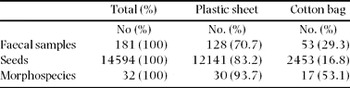
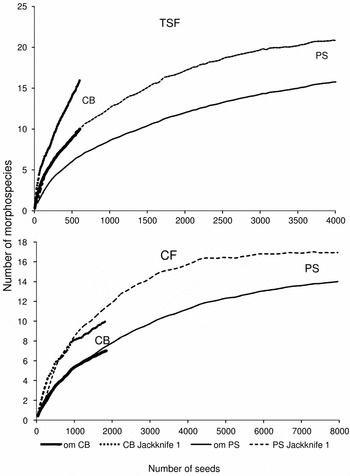
We captured a total of 332 bats, of which 303 were frugivorous (nine species), and 16 individuals were frugivorous-nectarivorous (two species). We obtained a total of 181 faecal samples with 14594 seeds and 32 morphospecies (Table 1). As we expected, the proportion of faecal samples collected with the plastic-sheet method was significantly higher (χ2 = 42.3; df = 1; P < 0.0001) than the cotton-bag method. The number of seeds collected with the plastic-sheet method also was significantly higher (V = 930; P < 0.0001) than the cotton-bag method. The morphospecies accumulation curves (Figure 1) show the cotton bags to accumulate morphospecies at a similar initial rate (CF), if not higher (TSF), than the plastic sheets, but the many more seeds collected from the sheets meant that for a reasonable sample size of bat captures the plastic sheets accumulated seed of more species. Collecting methods were also sensitive to the sampling of unique morphospecies: 17 were exclusively collected by one method, 15 from the plastic sheets, while only two were exclusively obtained from the cotton bags, and 15 species were shared between the two methods.
Number of faecal samples, seeds and seed morphospecies collected with two different techniques (plastic sheet under mist-net and cotton bag); Number (No.) and percentage (in parentheses) are given. The total of morphospecies is not the summation of plastic sheet and cotton bag data, because in some cases the morphospecies are the same.

Morphospecies accumulation curves from each locality: Tropical Semideciduous Forest (TSF) and Cloud Forest (CF). Continuous lines shows the observed morphospecies collected from cotton bags (om CB; thick lines) and from plastic sheet (om PS; thin lines). Dashed lines show the number of morphospecies estimated by the Jackknife 1 model for plastic sheets (PS Jackknife 1) and dotted lines the number of morphospecies estimated by Jackknife 1 model for cotton bags (CB Jackknife 1). Note that the difference in the total number of collected morphospecies is because the plastic-sheet method collects more seeds with the same sampling effort (99 bats for TSF and 50 for CF).

Our results show the effectiveness of our plastic-sheet method in collecting seeds dispersed by bats. The total collected faecal samples, the total number of seeds, and also the collected seed morphospecies were more abundant in the plastic-sheet method than in the traditional cotton bag. Seeds usually reside in the bat's gut for 15–40 min (Bonaccorso & Gush Reference BONACCORSO and GUSH1987, Fleming Reference FLEMING1988, Galindo-González Reference GALINDO-GONZÁLEZ1998). If bats have seeds in their lower intestines, they defecate in the first few minutes (if not seconds) after they are entangled in the net. On several occasions while untangling a bat from the net, a second bat hit the net, and in less than 30 s the bat voided its gut load. Our results validate this statement, since plastic sheets collected significantly more seeds (83.2%) than cotton bags (16.8%), also R. A. Medellín (pers. comm.) occasionally has observed the same pattern. Hence, if researchers visit the nets every 30 min, there is a high probability that the bat has already discharged the seeds. If no plastics are set under the nets, then researchers are losing valuable data on the ground (Table 1).
It is important to consider that if a bat discharges seeds when in the net, obviously there is less probability that the same bat leaves seeds inside the cotton bag (only 16.6% bats did so, n = 319), and if it does, there will always be fewer seeds than if they were recovered from under the bat in the net, even though the bat may be kept for hours. Mello et al. (Reference MELLO, KALKO and SILVA2008) captured 333 Sturnira lilium collecting 77 faecal samples with seeds (23% success) keeping the bats in cotton bags for at least 1 h. We captured 319 frugivorous and frugivore-nectarivorous bats and collected 181 faecal samples with the plastic-sheet method (56.7% success). In addition, this technique is less harmful to individuals. If we consider the possibility of capturing lactating females, weak or young bats or bats captured early without food in their stomach, the time the bat is captive and under stress could be critical for its survival. Using the plastic-sheet method, researchers may liberate the bat immediately after untangling it from the net and identifying the species. Furthermore, the plastic-sheet technique is in accordance with the general guidelines for use and handling wild mammal species in research (Gannon et al. Reference GANNON and SIKES2007).
Using the plastic-sheet technique bat researchers may obtain more data with less time invested. If the collected seeds will be used for further experiments (e.g. viability, germination), it is important to collect as many seeds as possible to conduct experiments. Moreover, if the cotton-bag method is used to analyse food habits of a bat species, the results could be underestimated because of the reduced records; e.g. we captured a total of 16 frugivore-nectarivorous bats (two spp., Glossophaga soricina and Leptonycteris curasoae), of these, only two individuals (one of each species) left faecal samples, both were taken from the plastic sheet.
We think that the only limitation of using the plastic-sheet instead the cotton bag is the possible confusion when two or more bats are caught relatively close-by in the net. During several years of field work on different ecosystems we have used the plastic sheets to collect bat droppings (accounting for a total of 1730 frugivorous bats collected, and 929 faecal samples). Since we visit mist-nets every 30 min, two bats got entangled in the net next to each other on only a small number of occasions, making it possible to mistake the origin of the droppings on the plastic sheet. However, we were always able to identify the individual that produced the scats by looking for seed remains on the bat and net, by the colour or type of seeds on the plastic sheet or by the vertical position under the bat. If researchers visit the nets every 30 min or less the possibility of finding two or more bats entangled next to each other and getting the two seed samples mixed up is considerably reduced. Additionally, researchers always have the possibility to discard the few confusing samples.
Using plastic sheets to collect seeds from frugivorous bat scats have several clear benefits over the old cotton-bag method: (1) it allows collection of significantly more seeds and scats than using cotton bags, (2) more seed morphospecies are caught than using bags, (3) it drastically simplifies and shortens the handling time of individual bats, likely reducing bat stress, and (4) it requires much less paraphernalia than keeping individual bags or containers for each captured bat which need to be thoroughly washed between netting nights. A plastic sheet will only require a quick (but comprehensive) wipe. All these benefits are also relevant to bird studies.
ACKNOWLEDGEMENTS
We thank T. Cano, A. Castro-Luna, R. Flores-Peredo, A. Galindo, M. Miranda, J. A. Pensado, F. Rodríguez, A. Tauro and M. Vela-Vargas for their enthusiastic help in the field. We received valuable comments and suggestions from Diana Pérez-Staples, Vinicio J. Sosa, Rodrigo A. Medellín, Luis F. Aguirre and two anonymous reviewers. This study was partially funded by Instituto de Biotecnología y Ecología Aplicada (INBIOTECA) Universidad Veracruzana, PROMEP Cuerpo Académico UVER-CA-173, and Naproptiava.