“Of course, when you're a woman and you're combative, they say you're an Iron Lady. Let me tell you”—and she snaps to like a crossbow after it has flung its arrow—“if you hadn't got a spine which was strong and firm, and a will which was strong and firm, [you] would never have got through.”
—Margaret Thatcher, quoted by Gail Sheehy in Vanity Fair, 1989There is a complicated relationship between the gender of political leaders and their behavior in interstate conflicts.Footnote 1 On the one hand, women generally espouse more pacifist opinions than men.Footnote 2 On the other, gender bias and gender-based stereotypes create different strategic environments for male and female leaders, potentially pressuring female executives to prove their toughness in the male-dominated domains of interstate conflict and national security. This observation can help us understand why, despite the dovish bent of women in the general public, female leaders may behave similarly to their male counterpartsFootnote 3 or even pursue more hawkish foreign policies, like increased defense spending.Footnote 4
This is not, however, the only explanation. Gendered differences in the types of individuals who self-select into candidacy for political office also impact foreign policy choices at the international level. Running for office is costlier for women than for men, both materially and psychologically. Women are less likely to be recruited, may face perceived or real gender bias at the polls, and often place a lower relative value on holding office.Footnote 5 Research also documents greater competition aversion, on average, among women, which leads them to avoid competitive situations like elections, regardless of their actual quality or chance of success.Footnote 6 Faced with steeper costs to candidacy, only women with a strong intrinsic drive to win—a high “nonmonetary value of winning”—choose to enter elections. This same trait subsequently affects choices in intergroup conflicts, leading them to dedicate more resources to the pursuit of victory than the average woman prefers and also, when the selection effect is strong enough, more than the average male elected leader.
In contrast to earlier scholarship, we raise the possibility that some female leaders choose to dedicate more resources to defense policy or war because they are individually predisposed to do so. This refocuses attention on the preferences and beliefs of female leaders themselves. Biographers of these individuals, including Margaret Thatcher, Indira Gandhi, and Golda Meir, often point to their “unshakeable convictions.”Footnote 7 Such leaders are perhaps the least likely to be pushed into either conforming to stereotypes or engaging in costly counter-stereotype behavior if doing so does not reflect their beliefs about appropriate conflict behavior.
To be clear, this does not negate the role of gender bias at the domestic or international level. In more sexist societies, where the gap in candidacy costs for men and women is greater, the selection effect is stronger, such that only women with more extreme preferences choose to run for office. It is also possible that gender stereotypes push female leaders to act more hawkishly at the international level than they would otherwise. In such cases, gendered selection exacerbates this tendency to fight harder.
Identifying the effect of leader gender in observational studies is difficult because leader gender is not randomly assigned.Footnote 8 In a call for more micro-level evidence linking gender and conflict, Cohen and Karim note that endogeneity concerns make analyzing the theoretical mechanisms particularly difficult.Footnote 9 The list of female leaders is also frustratingly short, which raises the possibility that specific leaders or situations have an outsized influence on estimates.Footnote 10 Furthermore, selection mechanisms of any kind are difficult to isolate in observational studies because we rarely have comparable data about the key features of people who do and do not eventually become leaders.
To address these concerns, we turn to a controlled laboratory setting. Participants played contest games in which they chose how much costly effort to expend in zero-sum competitions. Contest games have natural parallels to interstate conflicts, in which each side can spend more on defense and armaments to increase their chances of winning a war.Footnote 11 Participants first played as individuals in one-on-one contests. They later played in groups that endogenously elected their leaders. Participants decided whether to run for election, wrote short campaign messages, and voted for their preferred candidates. The winning candidate played a contest game on behalf of their group against the leader of another group. Participants were anonymous throughout and groups were shuffled frequently, minimizing the role of gender stereotyping in both the election and contest games.
In our experiment, on average, women chose to allocate fewer resources than men in individual contests. For both men and women, only those with higher nonmonetary values for winning contests ran for and won elections to represent their groups. However, this selection effect was substantially stronger for women than for men. As a result, female elected leaders chose to invest more resources in intergroup contests than male elected leaders. This selection effect was not attributable solely to the addition of group representation, or selection on other characteristics like risk preferences or confidence.
We acknowledge the caution needed in drawing inferences about leaders and conflict from laboratory studies. In this case, however, the advantages of a laboratory study outweigh the disadvantages. Not only are we able to measure key attributes of both leaders and nonleaders, but we can also minimize the gendered aspects of the strategic environment. This is not possible in the real world, where the gender of candidates and leaders is necessarily known. We would also note that recent analysis of over 100 paired experiments on political elites and mass publics found minimal gaps between the two groups.Footnote 12 Following Renshon, Lee, and Tingley, we therefore view the evidence presented here as “part of larger bodies of evidence compiled from different data sources and different research designs.”Footnote 13
We are not the first to speculate about the international implications of gendered selection dynamics. For instance, Enloe questioned whether female leaders are outliers with respect to conflict behavior who—according to Margaret Thatcher, quoted earlier—“got through.”Footnote 14 In a call for future research over twenty-five years later, Reiter raised the question of “whether the conflict attitudes of women elected to office represent the conflict attitudes of all women or are instead outliers.”Footnote 15 Our study answers these calls and provides direct evidence of the importance of electoral selection for subsequent conflict behavior. By specifying the traits driving both selection into candidacy and leader choices, we also develop a theoretical framework for better understanding the relationship between democratic electoral dynamics and patterns of international behavior.
Gender, Self-Selection, and War
On average, women hold more pacifist preferences than men. A recent meta-analysis of seventeen survey experiments finds that female respondents are less supportive of the use of force in every included study.Footnote 16 Analyzing over 900 American public opinion survey questions covering twenty-four use-of-force cases from 1982 to 2013, Eichenberg finds that women are almost always less supportive of using force, although there is important variation in effect size.Footnote 17 That study also shows that the difference between men and women's opinions on the use of force generally persists, in a cross-national examination of sixty-two countries.Footnote 18 These findings underpin the claim that political leaders are more restrained after the expansion of women's suffrage, since they have to account for the more pacifist preferences of female constituents.Footnote 19
However, such findings do not entail that female leaders pursue more peaceful policies than their male counterparts. Indeed, some research finds that female leaders spend more on defense, are involved in more violent interstate disputes, and initiate more international conflicts.Footnote 20 While definitive evaluations of this claim are complicated by the paucity of female leaders in the data,Footnote 21 the evidence seems—at a minimum—to refute the claim that the actions of female leaders clearly reflect the less hawkish preferences of the average woman.Footnote 22
The most prominent explanations for the disconnect between the conflict preferences of female citizens and the choices of female executives emphasize gender bias in how female leaders are treated. Female leaders must compensate for stereotypes of women as weak by choosing policies that counteract that stereotype. Pressure can come from voters, whose biases push women to “prove themselves.” For instance, Blair and Schwartz use survey experiments to show that respondents are less approving of conciliatory policies when taken by female, rather than male, leaders.Footnote 23 Post and Sen argue that stereotypes held by opposing leaders also matter.Footnote 24 Female leaders are perceived as less resolved, so when they are the challenger in an interstate dispute, the target is more likely to reciprocate the dispute, ultimately resulting in higher hostility levels. In this view, female leaders behave more aggressively in conflict situations than they would choose to in the absence of a gendered strategic environment.
We propose an alternative mechanism that also explains the divergence between the preferences of female citizens and the actions of female leaders. The democratic leader-selection process results in female leaders who value winning more than the average person does and therefore invest more in winning any interstate conflicts that arise once elected. The two mechanisms are not mutually exclusive. Some female leaders may be acting on their true preferences, while others respond to stereotypes. Stereotypes might also push women who already value winning more than the general female population to behave even more aggressively in the pursuit of victory. In either case, ignoring the role of selection causes us to overestimate the effect of stereotypes on the behavior of female leaders.
Why might women who value winning highly be overrepresented at the level of executive office? To answer this, we draw on the robust literature on gender and democratic elections. This literature points to a variety of institutional, cultural, and psychological reasons that running for office is less attractive, in general, for women than men.
Some studies emphasize psychological differences in how men and women perceive competition. Niederle and Vesterlund and a large body of subsequent literature document a greater competition aversion among women, since “the prospect of engaging in a future competition may cause women to anticipate a psychic cost and deter them from tournaments.”Footnote 25 At their core, elections are competitions: they are zero-sum contests that only one candidate can win. Laboratory research also finds that women are less likely to self-select into candidacy for election, even if they are equally or more qualified than men.Footnote 26 Likewise, Preece and Stoddard find that priming women about the competitive nature of elections decreases their likelihood of seeking additional information about candidacy, while having no significant effect on men.Footnote 27 These psychological differences clearly impact how women and men decide whether or not to run for office, but they are far from the only influential factors. Women may also face higher material costs to candidacy. For example, women are less likely to be recruited, placing a greater onus on them to proactively seek out electoral opportunities.Footnote 28 Voters may be less likely to vote for female candidates than male candidates of the same quality.Footnote 29 The net value of office may also be lower for women than men. Women continue to face greater competing demands—notably, familial and professional—on their time,Footnote 30 so they must give up more to hold office. Concerns about gender bias in politics may also make holding office less attractive to women.
These factors combine to make running for office systematically more costly for women. Lower rates of candidacy among women in the real world reflect this fact. It also implies that women who overcome these higher candidacy costs may systematically differ from those who do not.
A second theoretical component, also from the experimental literature, helps us understand this difference. People of all genders vary in how much they enjoy winning a contest, above and beyond any direct, monetary rewards.Footnote 31 We call this the nonmonetary value of winning (NMVW). Although it refers to winning, this term can also capture any additional sting from losing. Unlike many factors that affect the desirability of becoming an electoral candidate, the NMVW influences both the decision to enter an electoral contest and how individuals behave after winning. A higher NMVW makes entering an electoral contest more attractive and increases the marginal benefit of spending more or exerting greater effort to ensure victory in subsequent contests.
Together, the gender gap in candidacy costs and heterogeneity in NMVW explain why female leaders may invest more resources in pursuing victory than their male counterparts, despite women being more pacifist in general. Elections themselves are a type of contest that is costly to enter. Potential candidates of both genders must value winning enough to justify paying those costs. If there is a gap in candidacy costs, with women paying more, then the threshold for running—the minimum value of winning necessary to justify the cost—is also higher for women. This screens out women with low NMVW from leadership. Women's higher costs of pursuing election mean this screening mechanism is stronger for women than for men. Women with high NMVW also devote more resources to win competitions and conflicts after their election, reflecting the fact that they continue to highly value winning. Men's lower barriers to entry result in the pool of males running for office having a wider range of NMVW than the pool of potential female leaders.
Societal context influences the strength of gendered selection by affecting how much more costly entering an election is for women than men. Where a gender gap in candidacy costs exists, female leaders invest more in winning conflicts than would the average female citizen. Where the gender gap in candidacy costs is large enough to overcome the difference between the average societal conflict preferences of men versus women, they may even do so at higher levels than male leaders.
In some cases, politics may be so male-dominated that even women with exceptionally high NMVW rarely choose to run and, if they do, they are not elected. In such societies, potential female leaders may require more than just a high NMVW to obtain office. For instance, Baturo and Gray demonstrate that female leaders are particularly likely to be part of a political family in contexts where women's suffrage is relatively new; that is, before female participation in politics becomes normalized.Footnote 32 Even so, many wives and daughters of male political leaders do not pursue office. Political connections make running more attractive—or, perhaps, possible—but it still takes a high NMVW to overcome the barriers to entry in male-dominated societies.
Previous scholarship has argued that societal equality and female empowerment have a direct pacifying effect on interstate conflict behavior.Footnote 33 Societal equality can also moderate the relationship between leader gender and conflict by weakening the degree to which leader selection mechanisms are gendered. In more equal societies, the candidacy considerations faced by women more closely resemble those faced by men, causing more women to run for political office and shrinking the observed difference in leader behavior across genders, at the international level. Consistent with this, Koch and Fulton find that the percentage of women in legislatures moderates the (positive) effect of female chief executives on defense spending.Footnote 34
Gendered selection helps explain both the choices female leaders make when preparing for future conflicts and their investment in ongoing ones. Since the likelihood of winning a conflict depends, at least in part, on the level of preparation, gendered selection means that female leaders spend more on defense in times of both war and peace than the average female citizen would prefer. In line with this, Imamverdiyeva and Shea find that female executives spent roughly the same on defense as carefully constructed synthetic (male) control observations, despite the aforementioned differences in preferences between the broader pool of men and women.Footnote 35 Koch and Fulton find that countries with female executives actually spend more on defense than those with male executives.Footnote 36 There is also evidence that female leaders fight harder than male leaders once a conflict begins. Post and Sen show that, conditional on initiating a crisis, hostility levels are higher for women than men,Footnote 37 and Caprioli and Boyer find the severity of violence within a crisis is greater for states with female chief executives.Footnote 38
A corollary to this is that women with higher NMVW may also be more likely to win elections. Just as they invest more in winning intergroup conflicts once elected, a higher NMVW results in greater effort spent in pursuit of electoral victory. However, we do not want to overstate this. An individual's NMVW does not, in itself, affect their attractiveness to voters in a predictable way. Furthermore, while some elections may be won or lost based on such efforts, this is unlikely in higher-stakes races.
We combine these observations to formulate a general hypothesis.
Hypothesis Individuals with higher nonmonetary values for winning contests are more likely to run for office, win elections, and exert more costly effort to win conflicts while in office. This relationship is stronger for women than men.
This hypothesis emphasizes the intensive margin of conflict: that is, the amount of resources expended to win it. This is distinct from the extensive margin: that is, whether to start a conflict. The intensive margin is an extremely important aspect of foreign policy. Prominent works studying the effect of leaders and elites on foreign policy emphasize decisions beyond the extensive margin, like the degree of escalation in major warsFootnote 39 or whether to pursue transformation of the target's domestic institutions.Footnote 40 Defense spending, even when financed with debt, has direct, consequential welfare effects because it can trade off with other welfare-enhancing social expenditures.Footnote 41
Just as gendered electoral selection increases how hard female leaders fight at the intensive margin, it also pushes conflict initiation rates for women upward. Selection at the electoral stage implies that female leaders have, on average, higher NMVW than the average woman in society. This makes conflict more attractive to female leaders by increasing both the value of victory and its likelihood. The stronger the gender gap in candidacy costs, the more likely it is that conflict initiation is more attractive to female leaders than their male counterparts.
However, it is difficult to make a crisp prediction about the observable relationship between gender and conflict initiation. Many factors enter into this calculation. For example, Schwartz and Blair show that survey respondents punish female leaders more harshly for backing down from threats, which—like having a high NMVW—increases the net value of conflict.Footnote 42 They argue this could either reduce conflict by facilitating stronger signals of resolve from female leaders, or encourage adventurism and thus make it harder for a female leader to de-escalate. Similarly, Reiter and Wolford show that incorporating a private benefit from defeating a female-led opponent, or a private cost of losing to one, can either increase or decrease the probability of starting a war.Footnote 43 In other words, gender also influences the actions of opponents in conflict situations.Footnote 44 Some gender-specific factors push female leaders toward conflict—for example, the incentive to counter stereotypes—while others push them away from conflict—for example, conflict aversion. Thus, while gendered selection increases the expected value of conflict to female leaders relative to what it would be in the absence of such selection, we cannot definitively say that female leaders will initiate conflict more frequently than male leaders.
The closest related observational study to ours is from Imamverdiyeva and Shea.Footnote 45 They use synthetic controls to demonstrate that male and female leaders have similar levels of military spending, which they argue is evidence of nonrandom selection and/or stereotype-driven decisions by women. They then examine lame duck female leaders, who are arguably less constrained by voter stereotypes. While the number of cases is small, they conclude that they cannot rule out the possibility that selection contributes to the similarity between male and female leaders. Our research leverages the laboratory setting to provide more definitive evidence of selection's role.
Empirical Design
We recruited 162 participants for ten sessions of our game from Amazon's Mechanical Turk in December 2019. Participants played in real time. In each session, about fourteen participants played one-on-one and intergroup lottery contest games. Lottery contest games model conflict in a tractable, understandable way.Footnote 46 As in war, players decide how much to spend in pursuit of a zero-sum prize. In each round, players started with an endowment of 1,000 points that they could spend to buy up to 1,000 lottery tickets. Players kept any points they did not spend on tickets. Each player's likelihood of winning the contest was the number of tickets they bought divided by the total number of tickets everyone bought. The value of the prize varied each round, generally from 1,225 to 2,715 points. The winner of the contest received the prize.Footnote 47
At the start of each session, we randomly paired respondents in each of twelve rounds to play one-on-one contests. Participants were not identified, and pairs were reshuffled every round. After each round, participants saw the number of tickets purchased by each player, the outcome, and their payoffs. We call this stage the Individual Contest Game (ICG).
Later, in what we call the Democratic Selection Game (DSG), participants were randomly placed into either the “blue group” or the “orange group.”Footnote 48 Group members remained anonymous and without any gender identifiers. We reshuffled groups every other round. In each round, groups chose their leaders via a democratic election. Participants first decided whether to run for election, which entailed a fixed cost of thirty-five points. Candidates in the election wrote short campaign messages that were shown to their group members. Participants then voted for their group leader.Footnote 49 The winning candidate received a 245-point bonus, which could not be used in the contest. This protocol reflects two key features of real-world elections: participants must self-select into running; and there is enough communication between candidates to make vote choice meaningful.
The two elected group leaders then played a contest game against one another, on behalf of their groups. The leaders chose how many tickets each group member would buy, which was subtracted from each group member's endowment. If their group won the contest, each group member, including the leader, received the prize amount. In other words, the group won or lost together, and leaders could not discriminate between group members for either ticket purchases or the distribution of winnings. In terms of expected utility, leaders’ decisions in the DSG were identical to those they made as individuals in the ICG.
Comparing the ICG and DSG helps us overcome an important obstacle in studying selection: the need to observe the decisions of participants who do and do not eventually become leaders. While some innovative research designs address this challenge,Footnote 50 it is not practical in most observational studies. Participants’ ICG behavior provides data about how they played individual contests, allowing us to see whether certain types of participants select into candidacy and win elections, and whether this varies with gender.
We purposefully ensured participant gender was unknown throughout. This abstraction from reality helps isolate the effect of selection. Earlier studies argue that the decision to run in an election has higher psychological costs for women. Our protocol relies on this difference to avoid artificially manipulating the cost of entry for women versus men. Importantly, the cost associated with competition aversion exists irrespective of whether gender is known.
By not revealing leader gender, we minimize the direct effects of stereotypes on behavior. Of course, even understanding that one's gender will not be revealed does not remove all the effects of gender bias. Internalized stereotypes might lead female leaders to act as though they have something to prove, even if they know their gender is unknown to others. There is no way to remove this effect entirely. However, anonymity allows us to get as close as possible to this ideal, rendering female leaders “freer” to make choices that reflect their actual preferences.
Measuring the Nonmonetary Value of Winning
We use two measures of NMVW. First, we estimate each participant's NMVW based on how their behavior in the ICG compares to the Nash prediction of ticket purchases. For two, identical, risk-neutral participants, the Nash prediction for the number of tickets purchased, T, as a function of the prize value, p, and any nonmonetary value to winning, v, is:  $T = {{p + v} \over 4}$. An estimate of the NMVW is therefore given by v = 4T − p.Footnote 51 By participant, we calculate the average value of v from the ICG rounds and call this their “Nash NMVW.”
Second, we use the average number of tickets purchased in the ICG rounds. An individual with a higher NMVW purchases more tickets than an individual with a lower NMVW. This measure thus reflects the quantity of interest, even if it does not directly measure it, and has the advantage of not using Nash equilibrium strategies as a benchmark. In practice, the results are very similar for both measures.
Empirical Results
Gender Differences in Leader Behavior
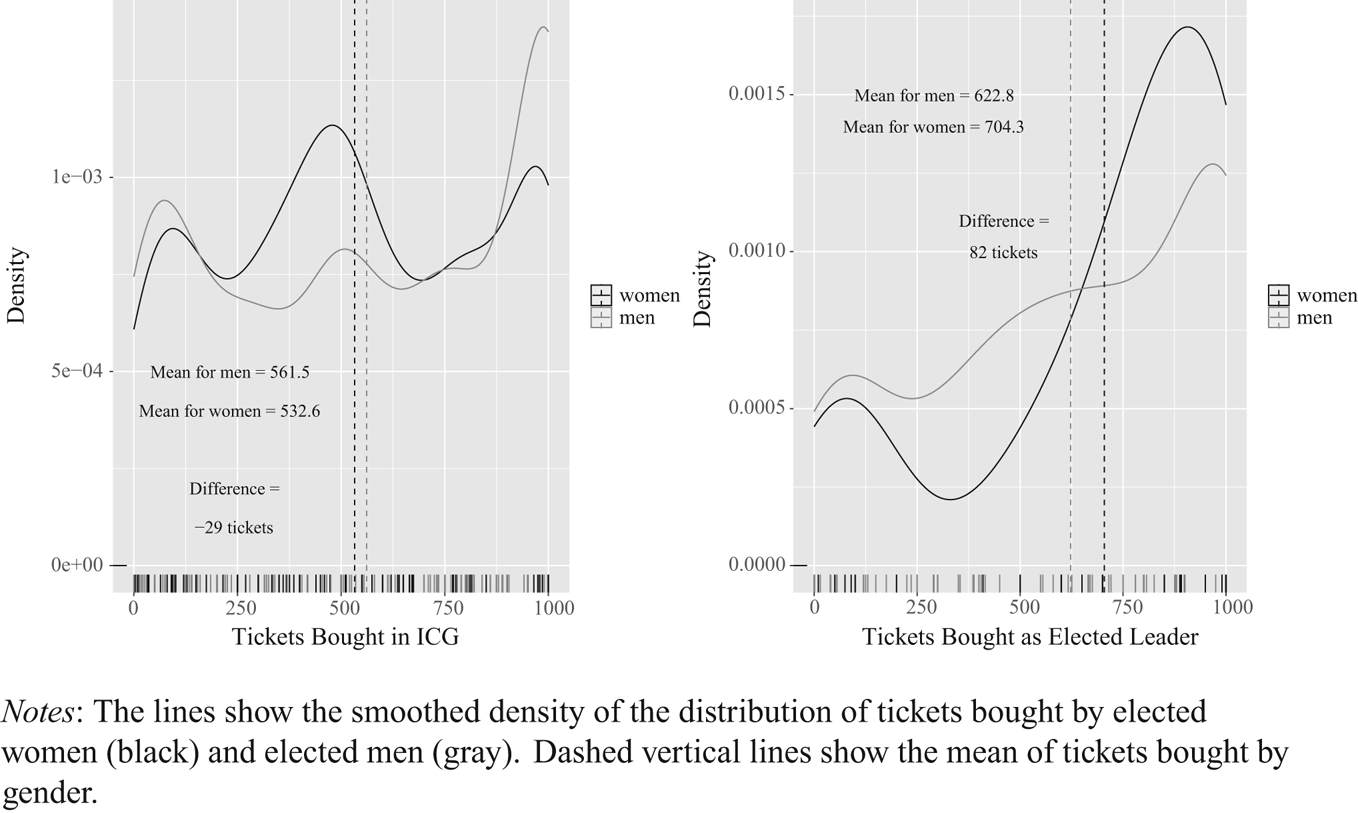
Elected female leaders spent substantially more than male leaders, despite purchasing fewer tickets in the ICG. The left panel of Figure 1 shows the distribution by gender of the tickets purchased in the ICG. Women purchased approximately twenty-nine fewer tickets, on average. They were also less likely to purchase the maximum 1,000 tickets.
Distribution of tickets bought in the Individual Contest Game (left) and Democratic Selection Game (right), by gender

The right panel of Figure 1 shows the same distribution for the tickets elected leaders bought in intergroup contests, split by gender. Female elected leaders purchased, on average, eighty-two more tickets per round than male leaders. This difference is over 8 percent of the total budget available. Female leaders were also more likely to purchase the maximum number of tickets. These differences are statistically significant and robust to a wide array of regression specifications.Footnote 52
The variance of the distribution of ticket purchases in the ICG was also greater for men than for women. If the variance were higher for women, then female leaders might purchase more, even in the absence of a gendered selection dynamic. However, this was not the case in our data.Footnote 53
Evidence of the Selection Effect
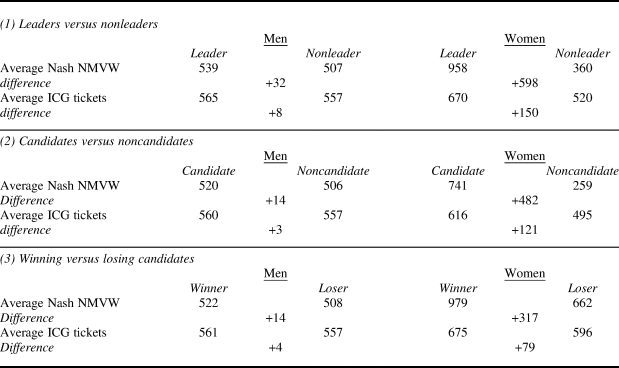
Leaders of both genders had higher NMVW than nonleaders, but female leaders had especially high NMVW, and the difference in ICG behavior for leaders versus nonleaders is much larger for women than for men. The top section of Table 1 compares the NMVW measures of elected leaders with those who were not elected, averaged across all DSG rounds and split by gender.Footnote 54 For both measures, female leaders have much higher NMVW than male leaders. The women who eventually became leaders bought over 100 tickets more, on average, than the men who eventually became leaders. This aligns with our expectation that only women who highly value winning choose to run in elections. If women pay a higher psychological cost to run, then the minimum NMVW necessary to justify running is higher for women than men.
Gender differences in the nonmonetary value of winning

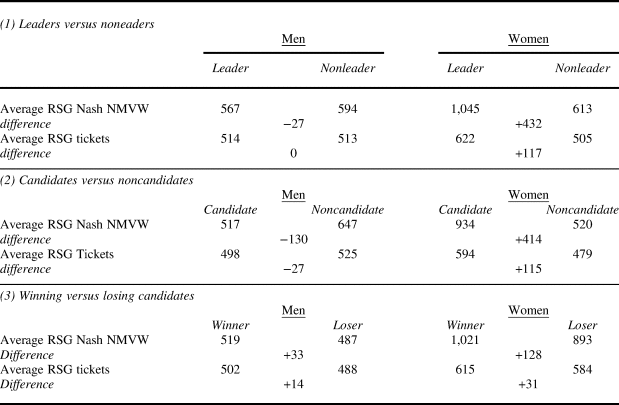
Note: Part 3 excludes candidates who ran unopposed.
The top section of Table 1 also shows that there are positive, but small, differences between men who eventually become leaders and those who do not. Male leaders had a Nash NMVW that was thirty-two points higher, and on average they purchased eight more tickets per round in the ICG than male nonleaders. The differences are much larger for women. Female leaders had a Nash NMVW that was 598 points higher and on average purchased 150 more tickets in the ICG than women who never became leaders. In short, the degree of sorting is starkly different for men and women.
The second section of Table 1 shows that self-selection into candidacy explains the largest part of the gap between the NMVW of female leaders and nonleaders. Among men, there are only small differences between those who become candidates and those who do not. Male candidates had an average Nash NMVW just fourteen points higher than male noncandidates and bought only three more tickets (560 versus 557). Among women, however, the differences are again striking. Women who ran for elections had an average Nash NMVW 482 points higher and purchased an average of 121 more tickets in the ICG than women who did not choose to run (616 versus 495).
Finally, women with higher NMVW were also more likely to win elections, conditional on candidacy, and this effect was stronger for women than men (bottom of Table 1). Election-winning men were very similar to losing male candidates; differences for women were much larger. Winning female candidates had a Nash NMVW 317 points higher and purchased an average of seventy-nine more tickets per round in the ICG. Since gender was not revealed during elections, this difference in success is attributable to differences in campaigns, analyzed more later.
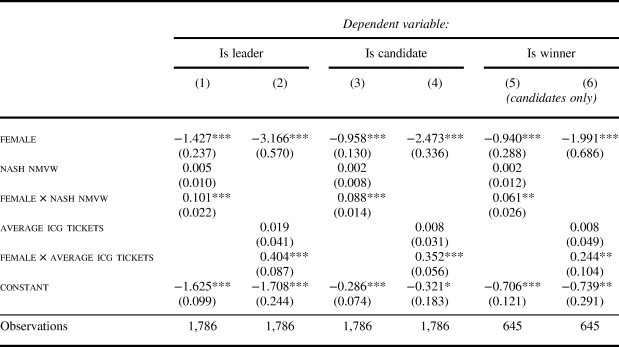
All of these differences are statistically significant. The first two columns of Table 2 show estimates from a logistic regression where the dependent variable is an indicator for whether a participant was leader in a particular round of the DSG. The independent variables are the NMVW measures and also those measures interacted with an indicator for women. In columns 3 and 4, we do the same using an indicator for whether a participant self-selected into candidacy. In columns 5 and 6, we do the same using an indicator for whether a candidate won election. Women were less likely to become leaders or candidates, as evidenced by the negative coefficient for the female indicator variable. And in each model the interaction term is substantively and statistically significant: NMVW has a stronger positive effect on the probability of being a leader, candidate, and winner for women than for men.Footnote 55
Effect of NMVW on leadership and candidacy, by gender

Notes: Models (5) and (6) exclude unopposed candidates. *p < .10; **p < .05; ***p < .01.
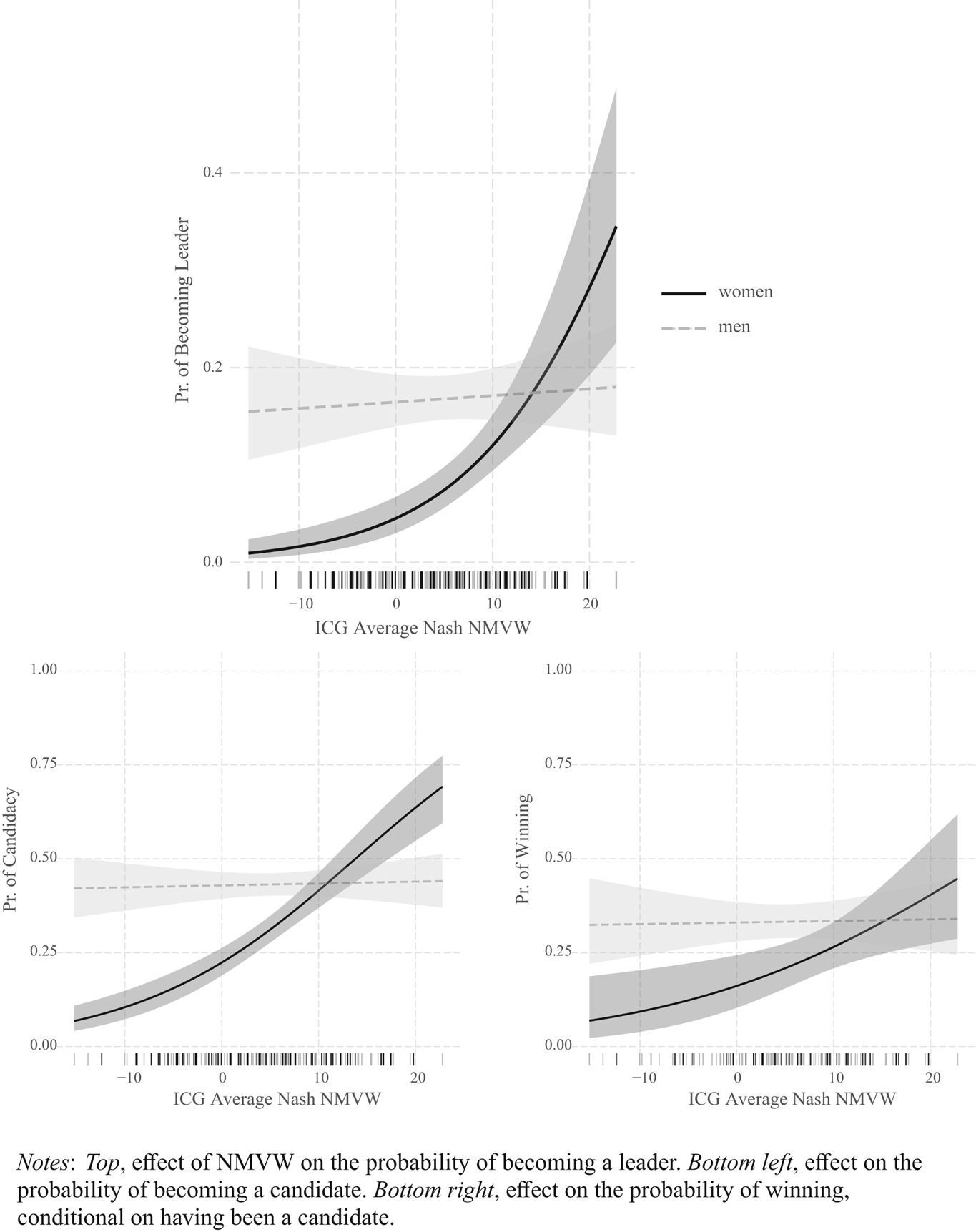
Figure 2 shows the estimated effects visually.Footnote 56 The results are consistent and striking. Only women with the the highest NMVW run for and win office at rates comparable to men. They then invest more resources in intergroup competitions.
Predicted effects of Nash NMVW, by gender

Gender and Campaign Strategies
Selection into candidacy by high-NMVW women explains much of the differences in leader behavior, but higher-NMVW women were also more likely to win elections. We posit that women with higher NMVW invest more resources—here, time and effort—at the campaign stage and are subsequently more likely to be elected. In the real world, effort may only have a marginal effect on election outcomes. However, this finding provides further evidence that our NMVW measures capture meaningful differences across individuals, with multiple implications for observable behavior.
Campaign message length is a reasonable proxy for effort.Footnote 57 Writing longer messages takes more time and cognitive energy. Mechanical Turk participants, in particular, prioritize task speed to maximize their wages per hour. Browser extensions help Turkers scrape for higher-paying, shorter tasks, with links to reviews showing the task's pay per hour.
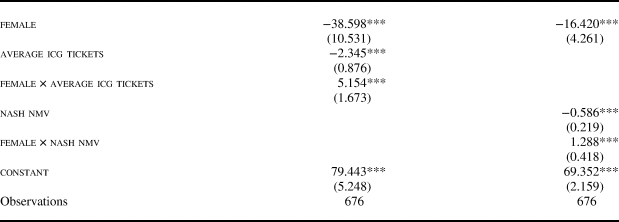
Table 3 shows results from regressing message length on our NMVW measures, an indicator for female candidates, and their interaction. Women with higher NMVW wrote substantially longer messages, which was not the case for men. Importantly, longer messages were more successful. An additional fifty characters raised a candidate's probability of winning by approximately 13 percent.Footnote 58
Length of campaign messages, by effort and gender

Notes: ICG ticket averages are in hundreds of tickets. *p < .10; **p < .05; ***p < .01.
Message quality or persuasiveness is also likely to increase with the effort put into crafting a message. Measuring this, however, is highly subjective. It is further complicated by the fact that participants chose a wide range of electoral appeals and that even messages with similar content can vary in their persuasiveness.
In Appendix E, we demonstrate that higher-NMVW women likely crafted higher-quality messages—even when accounting for message length and content. This pattern does not appear for men. We coded whether each message fit into ten qualitative categories. We then regressed whether a person won election on their gender and NMVW, controlling for message length and content category. Among women, a higher NMVW was still associated with a greater probability of winning. This suggests that higher-NMVW women did not simply write certain message types; they wrote better messages, controlling for these categories. Likewise, they not only wrote longer messages than low-NMVW women; they also wrote better ones. These findings are much weaker for men.
Alternative Explanations
Groups
The ICG and DSG differ in two ways. The DSG has a leader making a choice on behalf of her group, and that leader is chosen via election. It adds both groups and endogenous leader selection.Footnote 59 An additional part of our protocol helps establish that the presence of groups alone does not explain the observed patterns in the DSG.Footnote 60
Between the ICG and the DSG, we put players into groups of the same size as the DSG, and we randomly selected each group's leader. As in the DSG, the randomly selected leader chose how many tickets each group member would buy, making it strategically identical to both the ICG and DSG, from the leader's perspective. This random selection game (RSG) had twelve rounds and used the same sequence of prize values. Comparing data from the RSG and the DSG allows us to isolate the effect of elections from the effect of becoming a group leader.
The distribution of NMVW, calculated from players’ RSG choices, was similar for men and women. Table 4 replicates Table 1, using RSG data to calculate NMVW and the average number of tickets purchased. Women who would later become elected leaders in the DSG were much higher on both measures than eventual male leaders. Selection effects were again more stark for women. Men who did and did not become elected leaders differed only slightly in their RSG choices. But women who eventually became elected leaders purchased more tickets in the RSG, compared to women who were not eventually elected, and compared to all men and even to male leaders. The main difference when using the RSG data to measure NMVW is that the selection effects for women are even more heavily driven by candidacy decisions, rather than the likelihood of winning election. Appendix F.1 replicates the rest of the main analysis using RSG measures.
Differences in NMVW, by gender, using data from the random selection game

Risk Aversion
It could also be that selection on risk preferences, not NMVW, influences DSG behavior. This would be true if only the most risk-tolerant women select into candidacy and subsequently purchase additional tickets.Footnote 61 The theoretical relationship between risk aversion and ticket purchases in contest games is also complex, although empirically, more risk-averse individuals tend to purchase fewer tickets.Footnote 62
We can provide suggestive evidence that selection on NMVW is important, even controlling for risk preferences. Without a direct measure of risk aversion, it is difficult to classify individuals based on their decisions in our game. To create an individual-level measure of risk aversion, we leverage the fact that as the prize increases, risk-acceptant participants are more enticed to gamble compared to risk-averse participants. As the prize value increases, the marginal increase in ticket purchases should be higher among more risk-tolerant participants.Footnote 63 Higher prize values have a smaller marginal effect on risk-averse individuals.
In the ICG we included two rounds in which the prize was worth only 275 or 280 points. The next-highest prize values are 1,225 and 1,235. For each participant, we calculated the average increase in ticket purchases between ICG rounds when the prize was 275 or 280 versus when the prize was 1,225 or 1,235. When we included this measure of risk aversion in our regression analyses, the main results were unchanged.Footnote 64 Controlling for risk aversion, women with higher average NMVW and/or ICG ticket purchases are more likely to select into candidacy and become leaders. This effect is still stronger for women than men.
Ultimately, selection on both NMVW and risk aversion imply that certain women are more likely to choose candidacy and to make a stronger effort in subsequent contests. Selection on either trait has a similar effect on conflict decisions. Evidence from our experiment points to selection on NMVW, but analysis with more direct measures of risk aversion could give a more nuanced answer.
Confidence and Learning
It is also possible that participants self-select based on confidence, which might also differ by gender. The underlying task in our game is strategic: payoffs depend on the choices of both players, even though they have a stochastic element. Players might gain confidence as they play—by observing their own payoffs and/or by learning about the play of others—in ways that could differ across genders.
First, receiving more points gives participants positive information about their performance relative to others. Winning more points in the ICG might increase a participant's confidence in their decision making. We calculated the average ICG payoff for each player. Participants who became leaders in the DSG tended to have higher ICG payoffs than nonleaders. However, these differences were slightly larger for men than for women. The pattern is similar for candidates versus noncandidates and for winning versus losing candidates. Selection effects based on ICG payoffs were thus weaker for women than men.
Second, participants might gain confidence as they learn about the behavior of others. Generally, players in contest games purchase fewer tickets over time, which is usually attributed to learning.Footnote 65 It could be that eventual female leaders did not decrease their purchases to the same degree as men and women who were never leaders. But this was not the case. Trends in ticket purchases were similar across men and women, and did not vary systematically by candidate or leader status.Footnote 66
Conclusion
To lead a democratic country, one must first win office. The electoral gauntlet is not for the faint of heart. Women face particularly high costs of candidacy. As a result, the very attributes that impel women to run for office also make them more willing to spend resources on subsequent contests and conflicts. In line with this, we found that female elected leaders invested more than their male counterparts did in costly contests in a controlled laboratory setting. The women who chose to run and eventually won elections were also the women who most highly valued winning for winning's sake. This pattern was not nearly as stark for men. These gendered patterns arose despite our minimizing explicit gender bias and stereotyping by keeping participants and their genders anonymous.
The implication is that we should not attribute the decisions of female leaders solely to the constraints placed on them by their environment. While sexism, stereotypes, and gender-neutral strategic considerations undoubtedly shape the choices of female leaders, their decisions also reflect their held and/or learned preferences and beliefs. Writing about Meir, Gandhi, and Thatcher, Steinberg argues that “as important as the singular effects of gender are on leadership behavior, they should not be overstated … The numerous aspects/patterns of the personalities developed through [the three leaders’] earlier life experiences were carried into the prime ministerial office and translated into their particular leadership styles.”Footnote 67 Biographies of these leaders are replete with anecdotes illustrating their intense drive to win.
While scholars have speculated that selection mechanisms play a role in the choices of female leaders, our research establishes microfoundations for these arguments. We go beyond saying that female leaders are not representative of the general population, specifying the dimensions that are driving both nonrandom selection and leader decisions. We identify differences in psychological and material candidacy costs across genders as the driving force behind gendered selection. If this difference declines with time, then we may see female leaders whose actions more closely align with the preferences of their (female) constituents. Until then, female leaders will continue to be outliers with respect to conflict preferences and behavior.
We see at least two avenues for future research. First, we would like to examine the sensitivity of leader behavior to changes in the gender gap in candidacy costs at the domestic level. As mentioned, there is some observational evidence that female representation moderates the behavior of female executives. A laboratory study would allow us to identify the mechanism behind this observation. For instance, following Preece and Stoddard, we could prime candidates about the competitive nature of elections.Footnote 68 To the extent that this increases the cost of candidacy more among women than men, it should exacerbate the gender gap at the intergroup contest stage.
Second, we focused on gendered electoral selection. However, elections are not the only channels through which individuals obtain positions of influence. The most obvious comparison is with authoritarian leaders, where we anticipate the combination of (often) patriarchal norms and particularly fierce competition for leadership positions to further strengthen selection effects. Even within democracies, however, there is interesting variation in selection procedures. For example, Bashevkin examines foreign policy leaders, including US secretaries of state Hillary Clinton and Condoleezza Rice, noting that their “patterns of assertive behavior … pre-date[d] recruitment to senior posts, suggesting that the repertoires of foreign policy leaders [were] in place before they [reached] executive office.”Footnote 69 Appointment to such positions may be partially shielded from public scrutiny and electoral biases. But theirs is still a competitive gauntlet, as candidates jockey for appointments. As with elections, there may be a gender gap in how costly it is to put oneself forward for prominent positions. Barnes and O'Brien demonstrate that internal politics and the external security situation affect the likelihood of women being appointed to defense ministries.Footnote 70 Future work could help uncover whether gendered selection procedures also affect the behavior of those holding key unelected positions.
Data Availability Statement
Replication files for this research note may be found at <https://doi.org/10.7910/DVN/IVK3AG>.
Supplementary Material
Supplementary material for this research note is available at <https://doi.org/10.1017/S0020818324000249>.
Acknowledgments
We thank Subhasish Chowdhury, Seowoo Chung, Dayna Judge, Heather Ondercin, Kai Ou, Dani Reiter, Patrick Shea, Dan Smith, Scott Wolford, and Shanuki Tillekeratne for helpful comments. Peter Chereson provided excellent research assistance. We benefited from feedback at the Brown University Watson Institute Security Workshop and the Columbia University International Politics Seminar. Steffen Beverborg provided excellent programming help from SoPHIE. We also thank the Alexander and Diviya Magaro Peer Pre-review Program at the Institute for Quantitative Social Science. This research was approved by the Harvard University Area Institutional Review Board.