INTRODUCTION
Several new deep-water chondrichthyans have been described from the north-east Atlantic in recent years (Iglésias et al., Reference Iglésias, Nakaya and Stehmann2004; Stehmann et al., Reference Stehmann, Séret, Costa and Baro2008; Luchetti et al., Reference Luchetti, Iglesias and Sellos2011). In some cases, records are restricted to certain areas, suggesting that species are endemic to these areas, while in other cases the limited numbers of records makes it impossible to define their distribution. Most of these species are not commercially important, and so they are discarded from commercial fisheries. However, onboard observers in certain fisheries or dedicated scientific surveys studying deep-water areas, including potential Marine Protected Areas (MPAs) have provided more information on the fauna inhabiting deep water ecosystems.
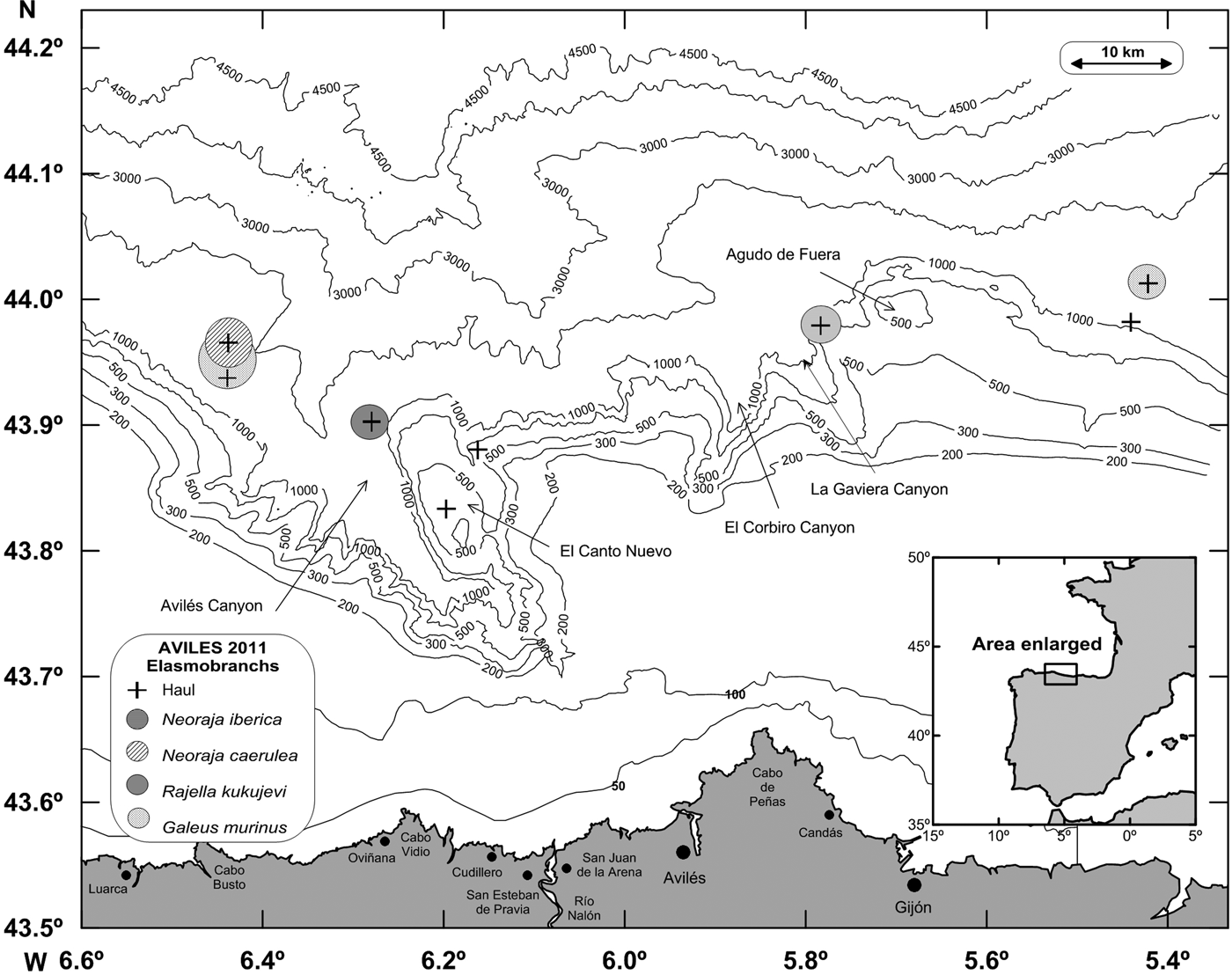
A multidisciplinary survey was carried out in the Cantabrian Sea (southern Bay of Biscay) in May 2011 within the INDEMARES project. The main objective of this project was to contribute to the protection and sustainable use of the biodiversity in Spanish seas by identifying valuable areas for the Natura 2000 network. One of the proposed areas, the Avilés Canyon System, is located 12 km offshore at 6°W longitude, and covers a depth-range from 150 m near the continental shelf to 4750 m at the abyssal plain of the Bay of Biscay (Figure 1). The Avilés Canyon System is a complex, structurally controlled system of canyons and valleys comprising three main canyons of different morphostructural character. These are, from east to west, La Gaviera canyon, El Corbiro canyon and Avilés canyon. The system also includes two geomorphologic structures: El Agudo de Fuera rocky outcrop and El Canto Nuevo marginal shelf. The near continental shelf is generally narrow and features rocky outcrops of different relief and morphologies and a near horizontal surface corresponding to sedimentary areas with unconsolidated sediment cover or heavily eroded basement surfaces. The strong currents on the shelf are responsible for the limited sedimentary cover of the area. More information about the geomorphology of the Avilés Canyon System is found in Gomez-Ballesteros et al. (in press).
The study area and the spatial distribution of the new species recorded in the Avilés Canyon System.

Avilés Canyon System is a deep-water ecosystem of great interest within a highly productive area characterized by poleward currents in winter and equatorward currents in spring/summer (Ruiz-Villarreal et al., Reference Ruiz-Villareal, Coelho, Díaz del Río and Nogueira2004; Gil, Reference Gil2008), remarkable phytoplankton blooms, as observed in other canyons (Gonzalez-Quiros et al., Reference González-Quirós, Cabal, Álvarez-Marques and Isla2003), and a diverse benthic community (Louzao et al., Reference Louzao, Anadón, Arrontes, Álvarez-Claudio, Fuente, Ocharan, Anadón and Acuña2010). Increased primary production is associated with the shelf break and the topography of the canyon, resulting in upwelling events, especially in summer (González-Quirós et al., Reference González-Quirós, Cabal, Álvarez-Marques and Isla2003; Ruiz-Villarreal et al., Reference Ruiz-Villareal, Coelho, Díaz del Río and Nogueira2004). Important local fisheries target hake, blue whiting, anglerfish, megrim, mackerel and horse mackerel (Punzon & Gancedo, Reference Punzón and Gancedo1998; Castro et al., Reference Castro, Marín, Costas, Abad, Punzon, Pereiro and Vázquez2011).
The objective of this study was to present data of some deep-water chondrichthyans caught for the first time in the Cantabrian Sea (southern Bay of Biscay) and discuss the similarities found between two skates of the genus Neoraja (Rajidae) caught in this area, Neoraja iberica Stehmann, Séret, Costa and Baro, Reference Stehmann, Séret, Costa and Baro2008 and Neoraja caerulea (Stehmann, Reference Stehmann1976), based on genetic and morphological results.
Molecular tools, and DNA barcoding in particular, have proven to be very useful not only for phylogenetic and phylogeographic studies but also for identifying cryptic species and species complexes (Herbert et al., Reference Hebert, Cywinska, Ball and DeWaard2003; Moura et al., Reference Moura, Silva, Figueiredo and Neves2008; Ward et al., Reference Ward, Holmes, William, White and Last2008; Iglésias et al., Reference Iglésias, Toulhoat and Sellos2009; Serra-Pereira et al., Reference Serra-Pereira, Moura, Griffiths, Gordo and Figueiredo2011; Dugdeon et al., Reference Dudgeon, Blower, Broderick, Giles, Holmes, Kashiwagi, Kruck, Morgan, Tillett and Ovenden2012; White & Last, Reference White and Last2012). Although these techniques are widely used they have some limitations, and therefore the integration of both genetic and morphological studies is recommended (Tinti et al., Reference Tinti, Ungaro, Pasolini, De Panfilis, Garoia, Guarniero, Sabelli, Marano and Piccinetti2003; White & Last, Reference White and Last2012), especially if reliable features to aid field identification are to be identified.
MATERIALS AND METHODS
All the chondricthyes reported here were caught during the survey INDEMARES-AVILES 0511 using a bottom trawl net (GOG-73) with a mesh size of 10 mm and a haul duration of 30 min, which is the standard sampling gear used in the MEDITS surveys (Bertrand et al., Reference Bertrand, Gil de Sola, Papaconstantinou, Relini, Souplet, Abelló, Bertrand, Gil de Sola, Papaconstantinou, Relini and Souplet2002). A total of seven hauls were performed in the Avilés Canyon System at depths of 400–1650 m (Figure 1). Mean depth refers to the average between the depth recorded at the start of the tow, when the gear contacts the sea floor and at the end of the tow when the gear leaves the sea floor. Depth-range refers to the minimum and maximum depth recorded in these points. Species were identified according to several texts (Compagno, Reference Compagno1984; Whitehead et al., Reference Whitehead, Bauchot, Hureau, Nielsen and Tortonese1984; Quéro et al., Reference Quéro, Porché and Vayne2003; Iglésias, Reference Iglésias2011). Morphometric measurements followed Compagno (Reference Compagno1984) and Last et al. (Reference Last, White, Pogonoski, Gledhill, Last, White, Pogonoski and Gledhill2008). All measurements were made point to point to the nearest mm. Values are expressed as a percentage of the total length (LT), from the tip of the snout to the tip of the caudal fin.
Similarity between morphometric characters was calculated using the Bray–Curtis index (Clarke & Warwick, Reference Clarke and Warwick1994) and the resulting dendrogram was obtained with the group average clustering algorithm using the PRIMER software. Species typifying similarities and dissimilarities among different clusters were determined using the SIMPER routine. The non-parametric Kolmogorov–Smirnov test at the 5% significance level was applied to determine the differences between the main morphometric measurements.
Total genomic DNA was extracted from ethanol-preserved muscle tissue using the FENOSALT method (Pérez & Presa, Reference Pérez, Presa and Estévez2011). A 657 bp fragment of the COI locus was amplified and sequenced using the primer pair FishF2 and FishR2 (Ward et al., Reference Ward, Zemlak, Innes, Last and Hebert2005). Amplifications were carried out in a Mastercycler thermocycler gradient (Eppendorf). The PCR program consisted of 5 min at 95°C, then 35 cycles of 95°C for 30 s, 50°C for 60 s, 72°C for 1 min and a final extension of 10 min at 72°C. Each PCR reaction had a total volume of 20 μL, containing between 10 and 20 ng of purified DNA, 2 μL of 10X NH4 Reaction Buffer (160 mM (NH4)2SO4, 670 mM Tris–HCl, pH 8.8), 0.16 μL of 100 mM mix dNTPs (Bioline), 1.5 mM of MgCl2, 15 pmol of each primer, and 1 U of BioTaq DNA polymerase (Bioline). PCR products were cleaned before the sequencing reaction using Exo-Sap (USB) according to the manufacturer's protocol. The purified fragments were directly sequenced on the two DNA strands with the same primer pair used for PCR amplification. Sequencing was performed in an ABI Prism 3100 capilar sequencer using the BigDye Terminator Cycle Sequencing Standard (Applied Biosystems).
Identifications were made using: (i) Basic Local Alignment Search Tool (BLAST, Zhang et al., Reference Zhang, Schwartz, Wagner and Miller2000) available in GenBank, and; (ii) the identification engine provided in the Barcode of Life Data Systems (BOLD). Evolutionary analyses were conducted using MEGA5 (Tamura et al., Reference Tamura, Peterson, Peterson, Stecher, Nei and Kumar2011). The phylogenetic tree was inferred using the neighbour-joining method (Saitou & Nei, Reference Saitou and Nei1987) and the maximum likelihood method based on the Hasegawa-Kishino–Yano model (Hasegawa-Kishino et al., Reference Hasegawa, Kishino and Yano1985). In both cases, the bootstrap consensus trees were inferred from 500 replicates (Felsenstein, Reference Felsenstein1985). HKY + G was the model with the lowest Bayesian information criterion (BIC), and it was selected to describe the substitution pattern using MEGA5 (Tamura et al., Reference Tamura, Peterson, Peterson, Stecher, Nei and Kumar2011).
Sediment (grain size, organic content, redox) and infauna data were also recorded for the sampling areas using a mega box corer. The dredge sampled a 0.175 m2 area and penetrated 15–20 cm into the sediment. Particle size analysis of sediments was performed by a combination of dry sieving and sedimentation techniques (Buchanan, Reference Buchanan, Holme and McIntyre1984). Sediment characteristics include mean particle size (Q50), sorting coefficient (So), weight percentage of gravel and coarse sands (>500 µm), medium and fine sands (62–500 µm), and silt (<62 µm). Organic matter (OM) in the sediment was estimated as weight loss of dried (100°C, 24 h) samples after combustion (500°C, 24 h).
RESULTS
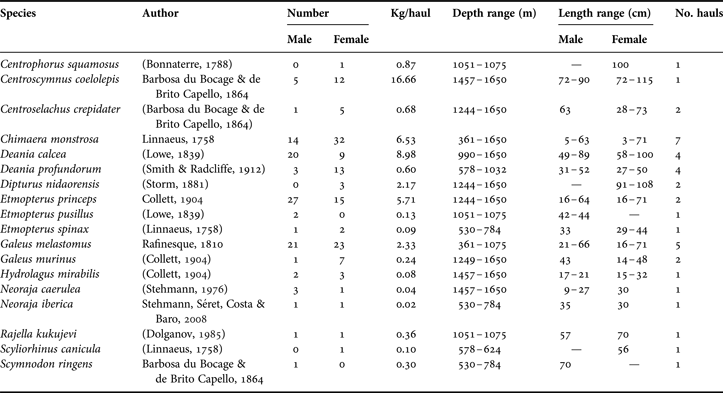
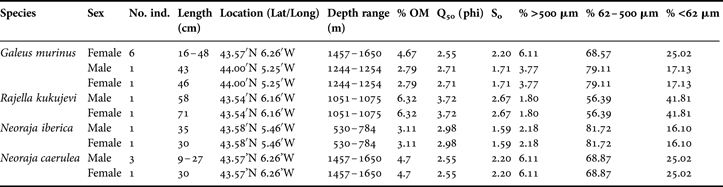
During this survey a total of 17 chondrichthyan species were caught (Table 1). The most abundant species in terms of biomass were Centroscymnus coelolepis Barbosa du Bocage & de Brito Capello, 1864, Deania calcea (Lowe, 1839) and Chimaera monstrosa Linnaeus, 1758 while in terms of the total number of specimens observed, C. monstrosa, Galeus melastomus (Rafinesque, 1810) and Etmopterus princeps Collett, Reference Collett1904 were the most numerous. The following species were recorded for the first time in this area (Table 2).
Total number and mean biomass of chondricthyan species caught in the Avilés Canyon System during the INDEMARES-AVILES 0511 survey. No. hauls refers to the number of hauls in which the species was caught (Ntotal = 7).
Summary data of the chondrichthyan species recorded for the first time in the Cantabrian Sea, and sediment characteristics in each respective position. % OM, percentage of organic matter; Q50, mean particle diameter; So, sorting coefficient; weight percentage of gravel and coarse sands (>500 µm), medium-fine sands (62–500 µm) and silt (<62 µm).
Mouse catshark Galeus murinus (Collett, Reference Collett1904) (Figure 2A): a total of eight specimens were caught in two hauls at mean depths of 1554 and 1249 m, respectively (Figure 1) on opposite sides (east/west) of the study area at a distance of 111 km from each other. In both cases the sediments comprised medium and fine sand, as the highest proportion of the sediment was between 62 and 500 μm. However, in the deepest haul, located in the west of the canyon, the percentage of organic matter and the sorting coefficient was comparatively higher (Table 2). Six female specimens (16–48 cm LT) were caught in this haul, with two further specimens (a 43 cm male and a 46 cm female) caught on the east side of the canyon at a mean depth of 1249 m.
New records of some deep-water chondrichthyan species caught in the Cantabrian Sea: (A) Galeus murinus; (B) Rajella kukujevi; (C) Neoraja iberica; (D) Neoraja caerulea.
Mid-Atlantic skate Rajella kukujevi (Dolganov, Reference Dolganov1985) (Figure 2B): two specimens (a 57.5 cm male and a 70.0 cm female) were caught at one station at 1063 m mean depth. The sediment consisted of silt and very fine sand with a high percentage of organic matter (6.32%) and a relatively large sorting coefficient, indicating that grain sizes were mixed.
Iberian pygmy skate Neoraja iberica Stehmann, Séret, Costa and Baro, Reference Stehmann, Séret, Costa and Baro2008 (Figure 2C): two specimens (a 30.0 cm female and 35.2 cm male) were caught at one station (mean depth 657 m). The sea floor at this site consisted of fine sand containing 3.11% organic matter with a moderate size selection coefficient.
Blue pygmy skate Neoraja caerulea (Stehmann, Reference Stehmann1976) (Figure 2D): four specimens (a 30.1 cm female and three males of 9.6, 23.4 and 27.5 cm) were caught at one site (mean depth 1554 m) in the deepest haul where G. murinus was caught (see above).
Genetic results
The genetic analysis corroborated the identification of specimens of R. kukujevi and G. murinus. The DNA sequences obtained showed 100% similarity to those of Rajella kukujevi deposited by other authors in the Barcode of Life Data Systems (BOLD) and 100% maximum identity (Rajiformes sp. BOLD: AAA4360 voucher RA001134) using the Basic Local Alignment Search Tool (BLAST; Zhang et al., Reference Zhang, Schwartz, Wagner and Miller2000) available in GenBank. Comparisons were made using the complete sequence obtained (657 bp). DNA sequences of Galeus murinus showed 99.84% similarity to those available in the BOLD system and 91.0% (Carcharhiniformes sp. BOLD: AAA9550 voucher S000008) with the data from GenBank (BLAST).
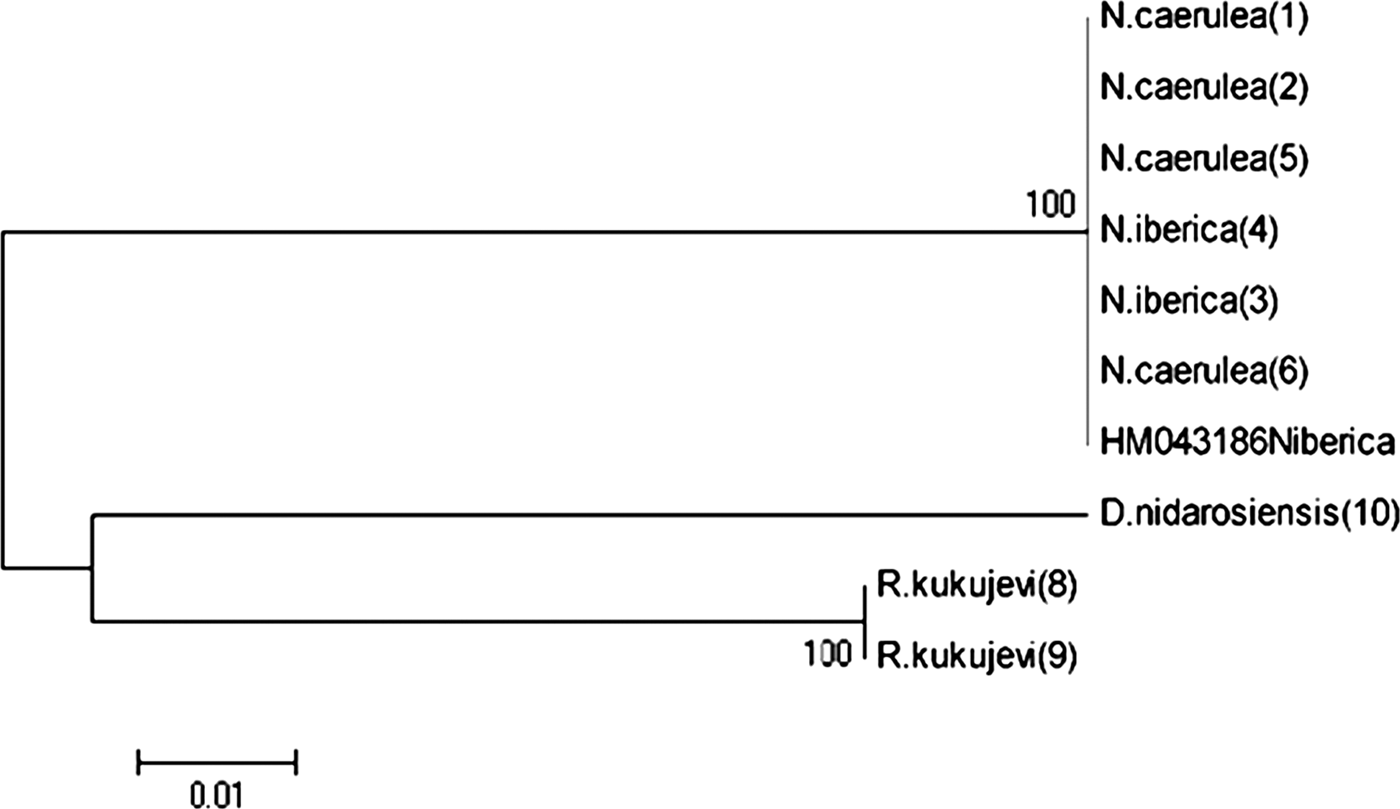
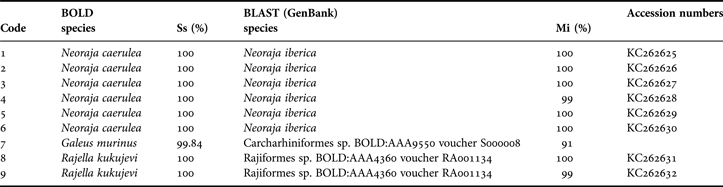
The DNA sequences of the two Neoraja species were identical in all the specimens analysed (Table 3 and Figure 3). Therefore, new tissue samples were extracted and all analyses were repeated (including DNA extraction and purification, PCR amplification and sequencing) in order to confirm the DNA sequences and reject the hypothesis of a possible contamination of samples. The nucleotide sequences of each specimen were deposited in the GenBank database and the respective accession numbers were provided (Table 3). Due to the similarity found between the DNA sequences of each species, the name given to these species has been provisionally Neoraja complex.
Molecular phylogenetic analysis by the neighbor-joining method (Saitou & Nei, Reference Saitou and Nei1987). Bootstrap values (%) are shown next to the branches.
Results obtained in BOLD and GenBank (BLAST) database. Ss, specimen similarity, Mi, maximum identity, and the respective GenBank Accession numbers.
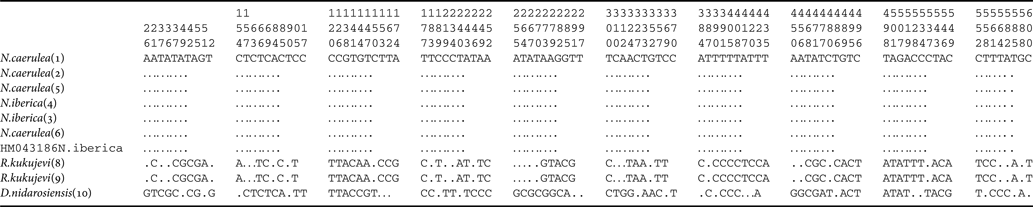
The optimal neighbour-joining tree with the sum of branch length = 0.18665371 is shown in Figure 3. The percentage of replicate trees in which the associated taxa clustered together in the bootstrap test (1000 replicates) is shown next to the branches (Felsenstein, Reference Felsenstein1985). The tree is drawn to scale, with branch lengths in the same units as those of the evolutionary distances used to infer the phylogenetic tree. The evolutionary distances were computed using the maximum composite likelihood method (Tamura et al., Reference Tamura, Nei and Kumar2004). The analysis involved 10 nucleotide sequences. All positions containing gaps and missing data were eliminated. The final dataset was composed of a total of 600 positions and 98 variable sites (see Table 4). Identical topology was obtained using the maximum likelihood method.
MEGA software alignment, only variable sites.
Morphometric results
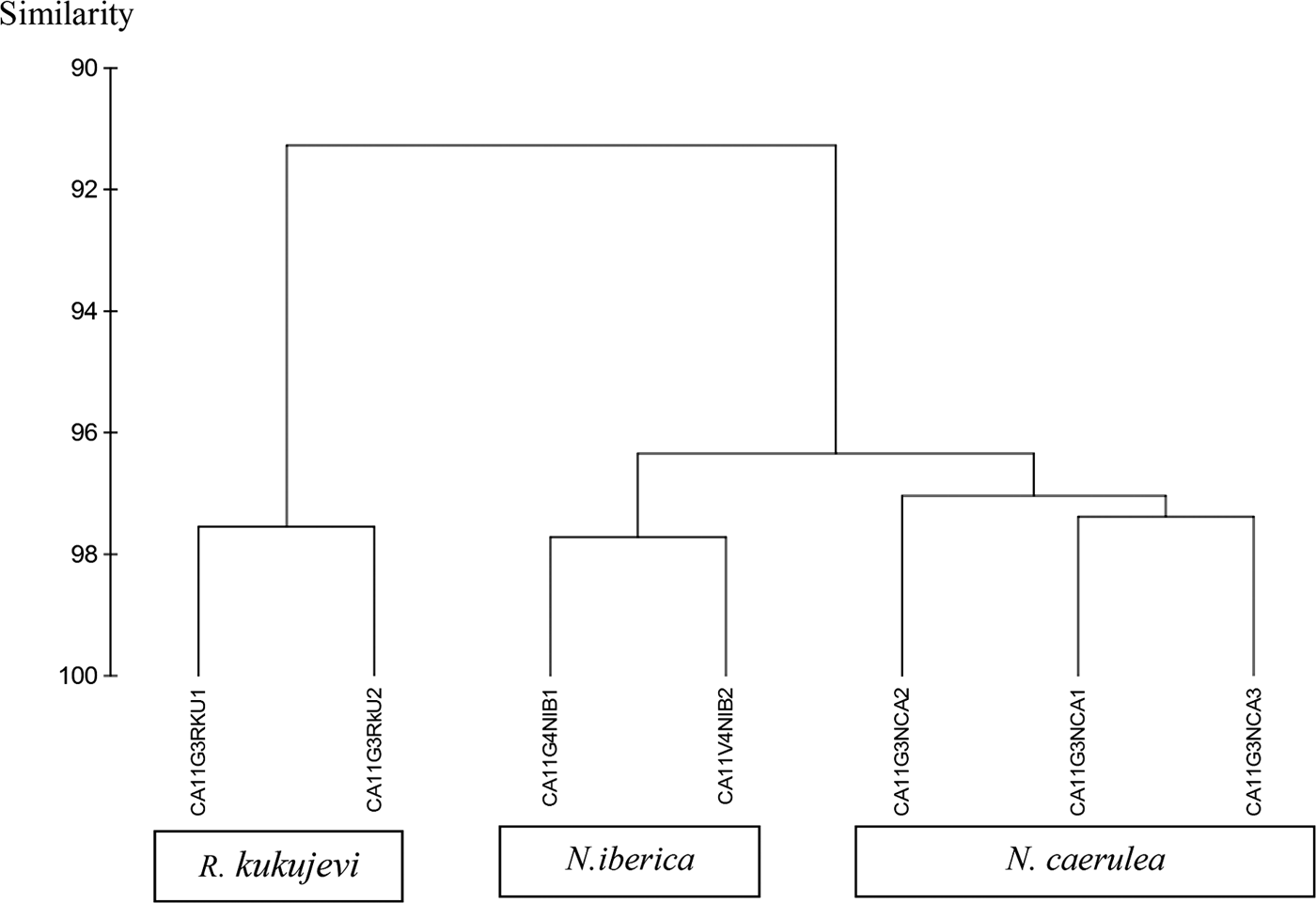
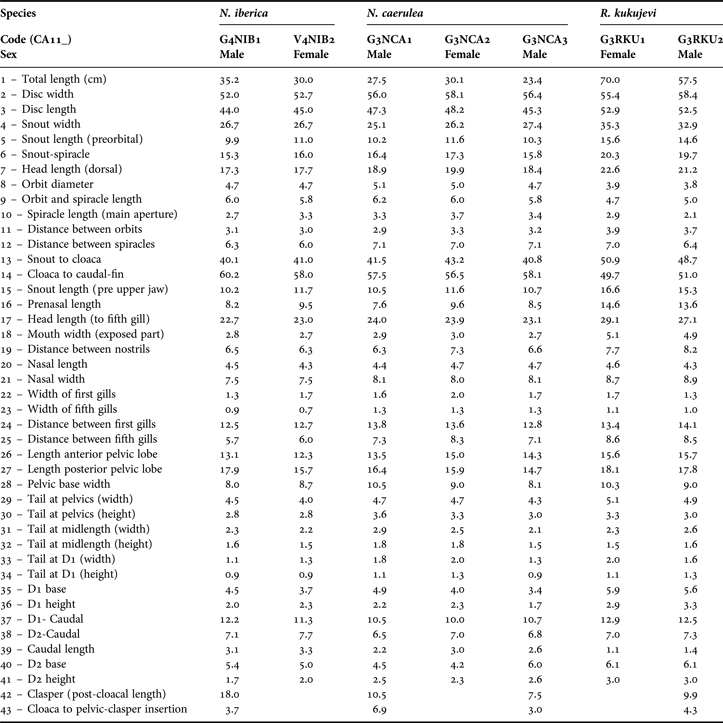
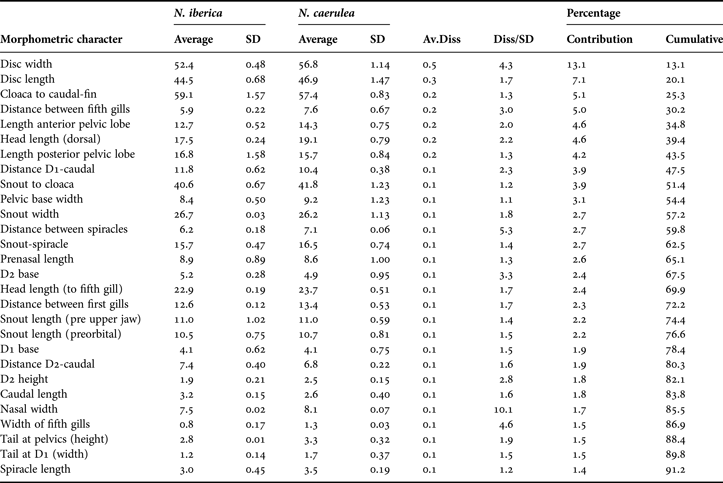
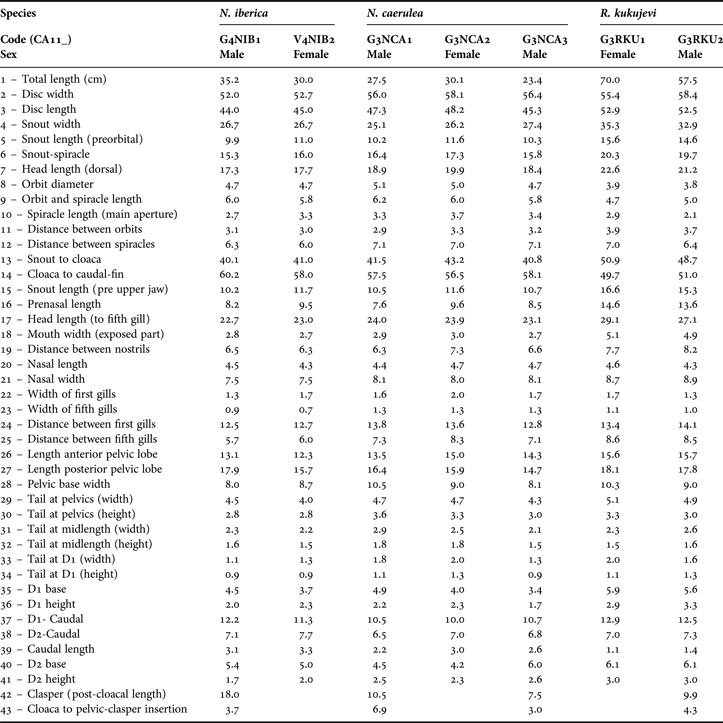
Morphometric measurements of the three rajid species are shown in Table 5. The smallest specimen of N. caerulea (9.6 cm) was not used in comparative analyses mainly due to the difficulty involved in taking precise measurements and also to prevent possible dissimilarities due to potential ontogenetic changes. Cluster analysis clearly identified three groups that corresponded to the species sampled (Figure 4). The average dissimilarity between R. kukujevi and Neoraja group was 9.70%, while between the two Neoraja species the average dissimilarity was 3.66%. The major morphometric characters that contributed to this dissimilarity are shown in Table 6. The most significant characteristics were the disc width (13.1%) followed by disc length (7.1%). A preliminary analysis using the non-parametric Kolmogorov–Smirnov test did not reveal any significant differences among the first ten selected characters (Table 6). However due to the low sample size (N 1 = 2, N 2 = 3) these results should not be considered decisive.
Cluster of similarity between the Rajidae species found in Avilés Canyon System based on morphometric characters. Codes refer to specimens data described in Table 5.
Morphometric measurements of the Rajidae species caught in Avilés Canyon System (Cantabrian Sea) during INDEMARES 2011 survey. Values are expressed as percentage of total length (LT), except total length.
Dissimilarity index (average 3.66 %) between groups of Neorajas and morphometric characters that contributed more to the difference found among them. Results expressed as percentage of total length (LT).
DISCUSSION
The knowledge on the biology and geographical distribution of deep-water skates in the North Atlantic is limited because several deep-water species have only been discovered relatively recently. Furthermore some records are restricted to certain areas and only a few individuals of these species have been recorded, which is the case of Rajella kukujevi, Neoraja iberica and Neoraja caerulea, (Figure 5).
Geographical distribution of the above species based on published records (Froese & Pauly, Reference Froese and Pauly2010). A few records of Galeus murinus below 36°N (see text) have not been represented here. The red rectangle shows the area where these four species have been recorded for the first time in the Cantabrian Sea.
The mouse catshark Galeus murinus was originally described by Collett in 1904 as Pristiurus murinus. Authors later recognized Pristiurus as a junior synonym of Galeus. The first specimen, an immature female of 22 cm, was caught at a depth of 1100–1300 m, at a location 93 miles north-west of the Hebrides Islands. Since then, Galeus murinus has been noted to be fairly common. In recent years it has been found to be more widespread in the north-east Atlantic than previously thought (Anonymous, 2000), occurring from western Iceland, Faroe Islands, north-west Scotland, Ireland, France (two records at 46°N 10°W) and as far south as the Western Sahara (four records, one at 20°43′N 17°71′W, 280 m depth and three at 24°–25°N 6°–6.6°W, 1000–1265 m) (Anonymous, 2001). These records from the southern Bay of Biscay confirm the southern range and broad distribution of this species. Half of the specimens caught were close to the maximum observed size of 49.1 cm (Iglésias et al., unpublished data). Magnusson et al. (Reference Magnússon, Magnússon and Jakobsdóttir2000) reported that the species reached 85 cm; however, this maximum size as well as the maximum depth reported by these authors (656–1731 m) needs to be revised because there could have been taxonomic confusion with other species (IUCN, 2009). Compagno et al. (Reference Compagno, Dando and Fowler2005) provisionally estimated the maximum depth as 1250 m, thus the current records extend the bathymetric range to 1457–1650 m (deepest haul). Regarding the water masses at this location the presence of Labrador Sea Water characterized by a deep salinity minimum is noteworthy (Lavin et al., Reference Lavín, Valdés, Sánchez, Abaunza, Forest, Boucher, Lazure, Jegou, Robinson and Brink2006).
Rajella kukujevi was described for the first time by Dolganov (Reference Dolganov1985) based on a specimen caught on the Faraday Seamount (northern part of the Mid-Atlantic Ridge). It has recently been found elsewhere in the North Atlantic: the Mid-Atlantic Ridge, Iceland, Ireland and the Faroe Islands (Clarke, Reference Clarke2000; Kukuev, Reference Kukuev2002; Orlov et al., Reference Orlov, Cotton and Byrkjedal2006; Orlov & Cotton, Reference Orlov and Cotton2011). It has been found at depths between 775 and 1500 m, but it is most commonly recorded at depths greater than 1000 m (Gibson et al., Reference Gibson, Valenti, Fordham and Fowler2008). It was recently recorded close to this area, which extended the known distribution range of this species in the north-east Atlantic towards the south (Rodríguez-Cabello et al., Reference Rodríguez-Cabello, Arronte, Sánchez and Pérez2012). These captures along with other recent records of this species in the north-east Atlantic do not support the hypothesis that R. kukujevi is endemic to the North Atlantic Ridge (Kukuev, Reference Kukuev2002). Like N. iberica these specimens were caught in the MOW layer (González-Pola personal communication), which suggests that this species could occur in other geographical areas with similar environmental features.
Neoraja iberica was first recorded and described by Stehmann et al. (Reference Stehmann, Séret, Costa and Baro2008) from southern Portuguese waters and the Gulf of Cádiz (southern Spain). The description was based on 50 specimens representing all size-classes of the two sexes. The maximum total length recorded was 31.6 cm for females and 32.7 cm for males, and depths ranged from 172– 670 m. Therefore, the present study extends its known northern distribution limits (to northern Spain), bathymetric range (530–784 m) and maximum length (male 35.2 cm). The fact that the water masses where this species was caught corresponded to the MOW could explain this northern distribution and potential occurrences in higher latitudes. The fate of the MOW once it flows out of the Strait of Gibraltar into the Bay of Biscay and further north is uncertain and there is some controversy. However, according to a study by Iorga & Lozier (Reference Iorga and Lozier1999) a continuous signal of Mediterranean Water is tracked northward to 50°20′N into the Rockall Trough and over to Iceland–Scotland. Whether this could have some influence on the distribution range of this species needs to be explored.
Stehmann (Reference Stehmann1976) originally described N. caerulea in the genus Breviraja. The geographical distribution of this species is not well known. It was previously considered to be relatively rare and possibly endemic to the north-east Atlantic (Iceland, Rockall Trough, north-west Ireland). However, further records from the Mid-Atlantic Ridge and Bay of Biscay (Stehmann & Burkel, Reference Stehmann, Bürkel, Whitehead, Bauchot, Hureau, Nielsen and Tortonese1984; Quéro et al., Reference Quéro, Porché and Vayne2003) have expanded its known distribution range. It is commonly found at depths of 600–1260 m. Thus, the present records extend its known bathymetric range (1554 m).
According to external appearance and colour patterns (Figure 2C,D), the N. caerulea and N. iberica specimens seem to belong to different species; however, the similarity percentage obtained (97%) based on morphological characters is rather high. These similarities were also reported by Stehmann et al. (Reference Stehmann, Séret, Costa and Baro2008), who included two further congeners, N. stehmanni and N. africana, in their description. As stated by these authors these species resemble each other in several external aspects, such as their general shape, squamation, morphometric proportions, tooth row counts and internal meristics, as well as their scapulocoracoids and pelvic girdles, as demonstrated by McEachran & Compagno (Reference McEachran and Compagno1982).
However, DNA sequences obtained for the two species were identical (Table 3, Figure 3). Similar results were obtained by Serra-Pereira et al. (Reference Serra-Pereira, Moura, Griffiths, Gordo and Figueiredo2011), who suggested the possible synonymy between the two taxa. The low number of specimens caught made it impossible to draw any firm conclusions about the morphometric measurements. The fact that specimens of both sexes belonging to each species were examined indicated that the morphological differences found were probably not due to gender or size. Thus, these results suggest that it could be a case of morphological divergence. This is not so uncommon and can occur among populations living in different habitats with environmental variables that act as potential selective forces responsible for adaptation to divergent habitats (Collin & Fumagalli, Reference Collin and Fumagalli2011). In the present study the two species were recorded at different depths and environmental conditions separated by a distance of 64.8 km.
The application of molecular genetics to study sharks, skates and rays has considerably increased recently, particularly for studies focused on the identification, conservation or fisheries management of elasmobranch species (see references in Tinti et al., Reference Tinti, Ungaro, Pasolini, De Panfilis, Garoia, Guarniero, Sabelli, Marano and Piccinetti2003; Serra-Pereira et al, Reference Serra-Pereira, Moura, Griffiths, Gordo and Figueiredo2011; Vélez-Zuazo & Argnarsson, Reference Vélez-Zuazo and Agnarsson2011; Dudgeon et al., Reference Dudgeon, Blower, Broderick, Giles, Holmes, Kashiwagi, Kruck, Morgan, Tillett and Ovenden2012). Although there is an increasing number of molecular studies that aim to identify cryptic species and species complex issues (Tinti et al., Reference Tinti, Ungaro, Pasolini, De Panfilis, Garoia, Guarniero, Sabelli, Marano and Piccinetti2003; Ward et al., Reference Ward, Holmes, William, White and Last2008; Iglésias et al., Reference Iglésias, Toulhoat and Sellos2009; Straube et al., Reference Straube, Kriwet and Schliewen2011; Dudgeon et al., Reference Dudgeon, Blower, Broderick, Giles, Holmes, Kashiwagi, Kruck, Morgan, Tillett and Ovenden2012), few studies have found elasmobranch species that have similar DNA sequences but also showing morphological divergence. One similar case was recently described by Serra-Pereira et al. (Reference Serra-Pereira, Moura, Griffiths, Gordo and Figueiredo2011) regarding two species of Raja, R. clavata and R. maderensis. The similarity between these two species in the BOLD database was 99.69% and the phylogenetic analysis failed to separate these taxa into different clades. The authors stated that the most probable hypothesis to explain these results is that R. maderensis was simply a different morphotype of R. clavata. The case of Neoraja species may be similar. Clarifying the taxonomic situation will require further studies with other molecular markers and more individuals sampled to validate N. iberica as a distinct species. In addition, the fact that all the species of the genus Neoraja appear to have localized and rather limited distributions should be explored in order to test the hypothesis of allopatric speciation in this clade.
ACKNOWLEDGEMENTS
This study was made possible thanks to the invaluable work of all the participants in the INDEMARES-AVILES 0511 survey and the crew of the RV ‘Vizconde de Eza’ (SGPM). Thanks to INDEMARES benthic team (Santiago Parra, Antia Lourido and Juan Fernández) for providing data on the type of sediment and to Cesar González-Pola for his helpful comments on water masses and environmental data. The authors are very much indebted to Dr Jim Ellis for his valuable comments on the first version of the manuscript.
FINANCIAL SUPPORT
This work has been supported by the EU-project ‘LIFE+ INDEMARES’ (07/NAT/E/ 000732) and the project ‘DEEPCON’ (CGL2010-16690) funded by the Spanish Ministry of Science and Innovation (MICINN).