Introduction
The burden of infection and immune dysregulation in infants with CHD
Over 1 million infants worldwide are born each year with CHD and receive cardiopulmonary bypass for surgical correction. Reference Zimmerman, Smith and Sable1 The burden of infection is high in these children, including before surgery. In the developed world, a substantial portion of children with CHD is hospitalised with lower respiratory tract infections and bacteraemia preoperatively, with a significantly elevated risk of mortality. Reference MacDonald, Hall, Suffin, Alexson, Harris and Manning2 Children with CHD are also susceptible to acquisition of and death from infections postoperatively. Reference Wheeler and Wong3 Infection risk is concentrated in infants, with 8–9% of infants under 6 months experiencing a serious postoperative infection. Reference Kansy, Jacobs and Pastuszko4 The increased risk of infection in children with CHD is multifactorial and incompletely understood. Many children with CHD have genetic syndromes that affect immune function. Reference Pierpont, Brueckner and Chung5 In children without known syndromes, neutrophil functional capacity is altered Reference Parikh, Bharucha, Kandar and Kshirsagar6 and T-cell maturation is delayed, with greater delays in maturation associated with increased hospitalisation for infection. Reference Davey, Elder and Cloutier7
Immune paralysis is depletion and decreased function of immune cells in both the innate and adaptive immune systems. Reference Mithal, Arshad, Swigart, Khanolkar, Ahmed and Coates8,Reference Hall, Greathouse, Thakkar, Sribnick and Muszynski9 Cardiopulmonary bypass and cardiac surgery are significant inflammatory insults with significant immune activation Reference Bronicki and Hall10,Reference Tárnok and Schneider11 and subsequent immune paralysis. Reference Tárnok and Schneider11 Children with immune paralysis after cardiac surgery have an increased risk of postoperative infection and death. Reference Cornell, Sun and Hall12
Infant development of the intestinal microbiome and its role in immune function
The intestinal microbiome plays a central role in development and maintenance of immune function. Reference Thaiss, Zmora, Levy and Elinav13 In healthy infants, the gut microbiome is established at birth. Over the first two years of life, the composition of the intestinal microbiome is dynamic, Reference Bäckhed, Roswall and Peng14 and stabilises in early childhood. Reference Ronan, Yeasin and Claud15 The microorganisms that eventually colonise the intestine have diverse immunologic effects. These effects are mediated by production of small molecule metabolites with distant effects and direct stimulation of immune effector cells by microorganisms. Reference Kim16,Reference Zhang, Zhang, Liao, Zhang and Tang17 While the composition of the microbiome is variable between individuals, there is a core set of immunologic functions that are typically maintained by diverse bacteria in different individuals. Reference Bäckhed, Roswall and Peng14
The intestinal microbiome and the immune system develop concurrently in infants, with the microbiome promoting maturation of the immune system and the immune system altering the microbiome. Reference Zhang, Zhang, Liao, Zhang and Tang17 Short-chain fatty acids produced by bacteria in the large intestine, particularly butyrate, maintain epithelial barrier function Reference Kelly, Zheng and Campbell18 and directly stimulate immune effector cells. Reference Nastasi, Candela and Bonefeld19 Butyrate-producing anaerobes also protect against intestinal overgrowth of pathogenic microorganisms by altering the microenvironment. Reference Byndloss, Olsan and Rivera-Chávez20 Intestinal microorganisms exist in a symbiotic balance with the immune system. In neonates, local differentiation and adaptation of T cells are dependent on microbial by-products and microbial ligand-T cell interaction. Reference Constantinides, Link and Tamoutounour21–Reference Ansaldo, Farley and Belkaid23 In infants, normal immune development is characterised by an initial monocyte expansion, followed by a gradual increase in memory regulatory T cells (Tregs) and subsequent T cell expansion. Reference Henrick, Rodriguez and Lakshmikanth24 This cycle of immune activation and tolerance is partially modulated by bacteria in the Bifidobacterium genera, commensal anaerobes that dominate the microbiome in most breastfed infants. Reference Henrick, Rodriguez and Lakshmikanth24 Infants without Bifidobacterium have increased pro-inflammatory cytokines and immune cell populations and immune dysregulation. Reference Henrick, Rodriguez and Lakshmikanth24 Other microbes promote the normal maturation of both innate and adaptive immunity through interactions with immature T cells, including bacteria from the Bacteroides, Enterobacterales, Proteus, and Klebsiella orders. Reference Ansaldo, Farley and Belkaid25 Many other interactions between the developing immune system and the microbiota are similarly important.
Clinical data demonstrating the relationship between the intestinal microbiome and immune dysregulation in other disease states
Data from patients with cancer and inflammatory bowel disease suggest the therapeutic role of microbiome manipulation in diseases of immune dysregulation. In adults with melanoma, response to immune checkpoint-inhibitor immunotherapy is dependent on composition of the intestinal microbiome, Reference Matson, Fessler and Bao26 and dietary interventions Reference Spencer, McQuade and Gopalakrishnan27 and faecal microbiota transplants Reference Baruch, Youngster and Ben-Betzalel28 change individual responsiveness to immunotherapy. Similarly, faecal microbiota transplants can induce remission in children with ulcerative colitis. Reference Pai, Popov and Hill29 In critically ill adults with sepsis, body temperature trajectory, a marker of immune activation, predicts mortality, and temperature trajectory is determined by the composition of the intestinal microbiome. Reference Bongers, Chanderraj and Woods30 The use of selective decontamination of the digestive tract (enteral administration of antibiotics without anti-anaerobic activity and targeted towards pathogenic and resistant organisms) in mechanically ventilated adults has also been associated with a reduction in mortality, positive blood cultures, and antimicrobial-resistant organisms. Reference Boschert and Broadfield31
Data suggesting a link between composition of the intestinal microbiome and outcomes in infants after cardiopulmonary bypass
A small placebo-controlled pilot study Reference Umenai, Shime, Asahara, Nomoto and Itoi32 demonstrated safety and feasibility of preoperative administration of probiotics (Bifidobacterium breve) to 21 neonates undergoing planned cardiac surgery. While the study was not powered to detect clinical outcomes, there was a trend towards reduced length of stay and time to goal feeds in the intervention group. A randomised controlled trial Reference Dilli, Aydin, Zenciroglu, Özyazici, Beken and Okumus33 administered a synbiotic (Bifidobacterium lactis plus inulin) to infants with cyanotic CHD preoperatively. In this single-centre trial, patients who received the synbiotic had decreased mortality, feeding intolerance, necrotising enterocolitis, sepsis, and duration of total parenteral nutrition. Infants with CHD have a substantially different microbiome than infants without CHD. Reference Salomon, Ericsson and Price34,Reference Liu, Lu, Shao, Zhang, Tu and Chen35 This is particularly pronounced in those with cyanotic defects Reference Liu, Lu, Shao, Zhang, Tu and Chen35 or critical defects requiring repair in the first month of life due to prolonged hypoxia and variable haemodynamics with altered blood flow to the intestine. Reference Huang, Lu and Zeng36
Multiple trials have reported association between intestinal epithelial barrier dysfunction Reference Salomon, Ericsson and Price34 , metabolomic derangements Reference Simonato, Fochi and Vedovelli37–Reference Davidson, Pfeifer and Frank39 , and altered microbiome composition in infants after cardiac surgery. Epithelial barrier dysfunction is a frequent complication of cardiopulmonary bypass Reference Salomon, Ericsson and Price34,Reference Pathan, Burmester and Adamovic40 and is associated with endotoxemia, changes in the intestinal microbiome, increased inflammation, and prolonged ICU length of stay. Reference Pathan, Burmester and Adamovic40 Besides dysregulation in short-chain fatty acid production, there are multiple metabolic pathways that are deranged in infants after cardiopulmonary bypass and predict mortality and ICU length of stay. Reference Davidson, Pfeifer and Frank39
Objectives of the scoping review
There are significant data about the relationship between the microbiome and immune dysregulation in many disease states, including critically ill patients. Additionally, there are known substantial functional changes in the microbiome in children with CHD after cardiopulmonary bypass. Given the frequent immune dysregulation and high risk of secondary infection in these children, we performed a comprehensive scoping review of the existing data on the relationship between microbiome composition and immune function in infants with CHD after cardiopulmonary bypass. We included studies of infants with CHD with any measure of intestinal microbiome composition and immune function. We followed the guidelines set forth in the Preferred Reporting Items for Systematic reviews and Meta-Analyses Extension for Scoping Reviews. Reference Tricco, Lillie and Zarin41
Materials and method
We designed a search with the assistance of a medical librarian and conducted a systematic search across four databases (PubMed, Cumulative Index to Nursing and Allied Health Literature, Cochrane Library, and Scopus) using Medical Subject Heading terms related to the intestinal microbiome, CHD, immune function, and infants and children. The review protocol was not publicly registered prior to conducting the search. We included all prospective studies evaluating the composition of the intestinal microbiome and any measure of immune function in infants with CHD undergoing cardiac surgery with cardiopulmonary bypass. No time limits were set. We limited the results to English-language studies conducted in humans. Studies were screened by title and abstract to select appropriate studies for full-text review. Relevant review articles (e.g., regarding immune dysfunction after cardiopulmonary bypass in children or describing intestinal microbiome composition in children with CHD) were also reviewed to identify any missing relevant articles that were not identified during the primary search. References from the articles that were identified in the primary search were also reviewed for relevant articles. The search was executed most recently on June 3rd, 2024. Please see Supplemental File 1 for Medical Subject Heading terms used in the search strategy. All selected Medical Subject Heading terms were searched throughout the title and abstract.
Selection of sources of evidence
Sources of evidence were screened in the primary databases by title and abstract evaluation by the first author (AP). After identification of an article as possibly relevant, full-text review was conducted by the first author. Articles that measured both a marker of immune function and the intestinal microbiome were included. Dr Prout developed the charting instrument and charted the data independently. Investigators were not contacted due to complete reporting in primary articles. The data items selected include the type and method of microbiome and immune analysis, the patient population, any clinical information, any intervention undertaken, and a summary of the main findings. No simplifications or assumptions were made due to the low number of articles identified. Similarly, no critical appraisal or data synthesis was performed.
Results
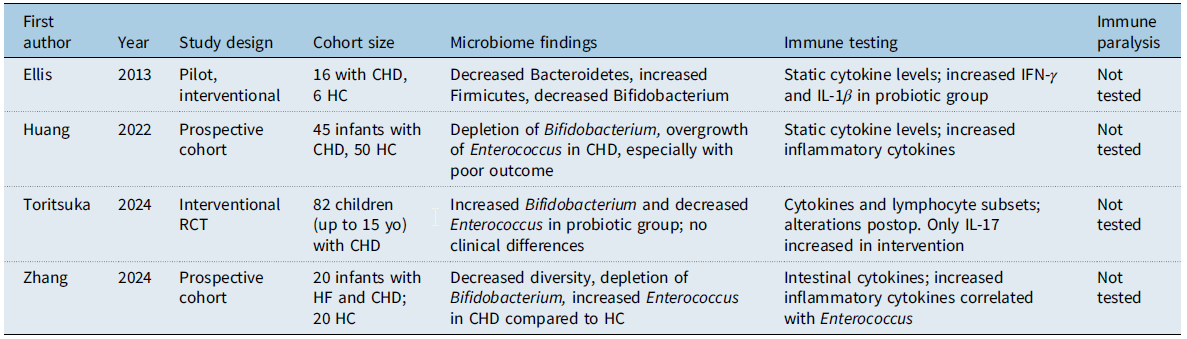
The results of the primary search are shown in Figure 1. Most articles were able to be excluded after title and abstract screening due to not being relevant, not measuring immune function, or not including children. After screening, four articles were identified that described both intestinal microbiome composition and a marker of immune function in infants undergoing cardiac surgery with cardiopulmonary bypass. Reference Huang, Lu and Zeng36,Reference Ellis, Bokulich and Kalanetra42–Reference Toritsuka, Aoki and Higashida44 The primary results of the included studies are summarised in Table 1, with detailed results included in narrative form.
Search strategy results across four primary databases.

Summary of studies included in the scoping review

Abbreviations: CHD = congenital heart disease; HC = healthy controls.
Summary of results
A pilot study in 2013 Reference Ellis, Bokulich and Kalanetra42 administered probiotics (Bifidobacterium longum ssp infantis) to eight infants with CHD preoperatively, with eight infants with CHD receiving a placebo. This study used 16S sequencing for microbiome analysis at the phyla level of classification and also compared infants with CHD to six healthy control infants without CHD. There were differences in microbiome composition between infants with CHD and healthy controls. However, there was no significant difference in the intestinal microbiome of infants with CHD between placebo and treatment groups. Those who received probiotics had a transient elevation in IFN-γ and IL-1β.
A more recent study from 2022 Reference Huang, Lu and Zeng36 described paired faecal samples in 45 neonates with CHD undergoing planned cardiopulmonary bypass and 50 healthy controls, using deep metagenomic sequencing for identification of bacterial species and genetic characteristics, virome analysis, and bacteriophage analysis, in addition to extensive metabolomic and cytokine profiling after cardiac surgery with cardiopulmonary bypass. There were substantial differences in overall bacterial composition between children with CHD and healthy control infants, primarily characterised by decreased Bifidobacterium species and increased Enterococcus species in infants with CHD. Infants with CHD also had differences in their intestinal viral and phage species compared to healthy controls, particularly among Enterococcus phages, many of which included antibiotic resistance genes and other virulence factors. Metabolomic analysis of this cohort also revealed substantively increased serum concentration of multiple pro-inflammatory metabolites in those with CHD, and decreased utilisation of human milk oligosaccharides. Among infants with CHD, those with adverse complications postoperatively had significant differences in the composition of their intestinal microbiome compared to those without postoperative complications. Children with CHD who had a poor postoperative outcome had increased inflammatory cytokines and serum markers of intestinal permeability, as well as Enterococcus species overgrowth. There was no difference in standard clinical risk factors for adverse outcomes (surgical complexity, cardiopulmonary bypass time, etc.) between the groups with a poor and good postoperative outcome.
Another recent study Reference Zhang, Chen, Zhou, Lei, Chen and Cao43 enrolled twenty infants with heart failure due to CHD with left-to-right shunting, and analysed 16S intestinal microbiome sequencing and intestinal cytokines. Compared to twenty healthy age- and sex-matched infants, those with heart failure had significantly lower bacterial diversity, with decreased Bifidobacterium species, overgrowth of Enterococcus species, and significantly increased intestinal inflammatory cytokines. The severity of heart failure was directly correlated with the degree of elevation of intestinal inflammatory cytokines.
A recent randomised controlled trial Reference Toritsuka, Aoki and Higashida44 randomised 82 children (0–15 years old) who were scheduled for heart surgery with cardiopulmonary bypass to receive Bifidobacterium breve or placebo three times a day for 7 days preoperatively and measured faecal microbiota, bacteria in blood using reverse transcription polymerase chain reaction (RT-PCR), markers of intestinal permeability, lymphocyte subsets, and plasma cytokines at three-time points (3h, 2d, and 7d) postoperatively. Patients with single ventricle physiology were excluded. Faecal microbiota were measured using 16S sequencing. The intervention group had substantive changes in their postoperative intestinal microbiota, with increased Bifidobacterium breve and decreased Enterococcus and Clostridioides difficile species, with changes in bacterial composition persistent at 7 days postoperatively. There was no difference in bacteria detected in the blood by RT-PCR between the control and intervention groups, and there was not a significant difference in intestinal permeability or most cytokines measured. Notably, the intervention group had a significantly elevated IL-17 concentration. IL-17, which is produced by Th17 cells, plays a significant role in induction and regulation of the innate immune response, Reference Li, Wei and Xu45 and its production is partially mediated by the stimulation of Th17 cells by Bifidobacterium species in the intestinal microbiome. Reference Ivanov, Atarashi and Manel46,Reference Ivanov, Frutos Rde and Manel47 No clinical differences were observed between intervention and control groups.
Discussion
Summary of evidence
There are robust data about the role of the intestinal microbiome in immune regulation in many diseases, as well as about the high risk of infection and immune dysfunction in children with CHD after cardiopulmonary bypass. There are significant known alterations in the microbiome before and after surgical repair in these children. However, there is limited research analysing the association between composition of the intestinal microbiome and immune function in children with CHD, and no data about the relationship between immune paralysis and the microbiome in this population. Consistently across studies, including those that did not test immune function, the intestinal microbiome is structurally and functionally different in children with CHD compared to otherwise healthy children. Reference Salomon, Ericsson and Price34,Reference Huang, Lu and Zeng36,Reference Ellis, Bokulich and Kalanetra42–Reference Toritsuka, Aoki and Higashida44 In the most detailed analysis and the only reported study that used metagenomics to describe bacterial, viral, and phage composition at the species level, Reference Huang, Lu and Zeng36 specific features of the intestinal microbiome in infants with CHD appeared to be related to adverse outcomes after cardiopulmonary bypass. This relationship was mediated by metabolic derangements and pro-inflammatory and immunosuppressive cytokines in those with adverse outcomes. Similarly, infants with heart failure related to CHD had specific features of their intestinal microbiome with worsened intestinal inflammation that was directly correlated with severity of heart failure. Reference Zhang, Chen, Zhou, Lei, Chen and Cao43 The common microbiome features in both studies that were associated with adverse outcomes were depletion of Bifidobacterium species and overgrowth of Enterococcus species.
The interventional trials that have trialled targeted microbiome therapeutics in children with CHD have largely been single-centre Reference Dilli, Aydin, Zenciroglu, Özyazici, Beken and Okumus33,Reference Toritsuka, Aoki and Higashida44 or pilot studies Reference Umenai, Shime, Asahara, Nomoto and Itoi32 in a heterogenous population of infants, children, and adolescents, not all of whom are at high risk of infection postoperatively. Notably, when synbiotic therapy was trialled in infants with cyanotic CHD, Reference Dilli, Aydin, Zenciroglu, Özyazici, Beken and Okumus33 they had reduced postoperative sepsis and mortality. This study did not measure immune function, and so was not included in the scoping review. The largest interventional trial included in this review studied children from 0–15 years old and excluded those with single ventricle physiology (the highest-risk population for acquisition of and mortality from perioperative infection), with an overall expected postoperative infection rate of 3%. Reference Toritsuka, Aoki and Higashida44
Given the provocative single-centre data suggesting that specific compositions of the intestinal microbiome are related to adverse outcomes postoperatively in children with CHD Reference Salomon, Ericsson and Price34,Reference Huang, Lu and Zeng36,Reference Zhang, Chen, Zhou, Lei, Chen and Cao43 and the promising single-centre interventional data previously described, Reference Dilli, Aydin, Zenciroglu, Özyazici, Beken and Okumus33 large-scale multi-centre observational trials should target identification of infants with CHD at high risk for postoperative infection based on microbiome and immune profiling. Identification of specific features of the intestinal microbiome that are associated with clinically relevant immune dysregulation in this population would enable a precision clinical trial testing targeted microbiome modulation in patients with alterations in the intestinal microbiome causing immune dysfunction preoperatively and postoperatively. Given the epidemiology of postoperative infection, this trial should target infants at the highest risk of developing postoperative infection and experiencing adverse consequences.
Limitations
The primary limitation of this scoping review is the paucity of data in the field, leading to a low number of articles that were eligible for inclusion. There is extremely limited data linking immune function to the microbiome in infants with CHD. While we attempted to identify all relevant articles in collaboration with an experienced medical librarian, and conducted detailed review of identified articles and review articles, it is possible that not all research reports were identified. This review was also limited by a single-author review of the literature. However, despite an extremely broad search strategy, no articles that were questionably related to the topic were identified. This scoping review was not pre-registered prior to conducting the research. Despite lack of registration, the search strategy was designed by a medical librarian and was followed as designed. Additionally, the search was limited to English-language articles, which may have missed some relevant articles with English-language abstracts. Scoping reviews targeted to a particular topic are not intended to replace systematic reviews. The study of the microbiome is a rapidly emerging and changing field, and it is likely that further investigators will continue to add to our knowledge on this and related topics in the coming years.
Conclusions
There are limited studies describing changes in the intestinal microbiome, immune function, and clinical outcome in children with CHD. The data that exist suggest that specific changes in the intestinal microbiome predispose to postoperative complications by contributing to immune dysregulation. Findings from single-centre studies should be corroborated in multi-centre observational trials, and, if found to be predictive, should be used to support targeted precision trials of microbiome therapeutics in children with CHD preparing to undergo heart surgery. This has the potential to reduce disability and death from infection in these vulnerable children.
Supplementary material
The supplementary material for this article can be found at https://doi.org/10.1017/S1047951125000332.
Acknowledgements
Rebecca Hill Renirie, MLIS, designed the search strategy for the scoping review.
Financial support
Dr Prout received support for research related to this article from the National Institute of Child Health and Development (NICHD) via the Pediatric Critical Care and Trauma Scientist Development Program K12 award. Dr Dickson’s institution received support for co-authorship of this article from the National Heart, Lung and Blood Institute (NHLBI) via K24HL159247.
Competing interests
All authors declare no relevant conflicts of interest.