In light of the ongoing Ebola outbreak and epidemic in West Africa, it is of urgent concern to examine the state of disaster preparedness and response activities in the region, for the purposes of assessing processes and programs to determine actions necessary to mitigate future disease outbreaks.Reference Aliyu 1 The recent internationally accepted Sendai Framework for Disaster Risk Reduction highlights the need for improving disaster planning processes in developing countries, due in no small part to these countries’ disproportionate share of mortality and morbidity in disasters of all types. 2 , 3 United Nations officials have gone so far as to state that “disaster preparedness in Africa is woefully inadequate.” 4 The concept of “health security,” or protection from health threats, has recently been recognized as one of the most critical international security issues—as highlighted by the recent Ebola outbreak.Reference Heymann, Chen and Takemi 5 Given the devastating impact on the health care workforce in affected countries, the need for international assistance is all the more urgent.Reference Cranmer, Aschkenasy and Wildes 6
In the past several years, the US Department of Defense’s Africa Command Disaster Preparedness Program (DPP), implemented by the Center for Global Health Engagement (CGHE), has held a series of events to promote and strengthen disaster preparedness among 17 countries across Africa. 7 , 8 The DPP focuses on the promotion of stability, security, and enhancement of partner nations’ capacity to plan for and respond to disasters through education, training, planning, and evaluation exercises. The program builds meaningful and sustainable relationships with partner nation government agencies, including the military, who play key roles in the event of a disaster, working in collaboration with other governmental, nongovernmental, and international organizations to provide essential services such as security, logistics, communications, and health care to affected populations.Reference Morton and Burnham 9 The DPP is executed via a strategic “whole of government” approach and fosters synchronization of national- and regional-level preparedness activities and response planning.
One DPP-partner country, the Republic of Senegal, has participated in several recent exercises and activities, to include a national-level Disaster Preparedness and Response Exercise, which was held June 2-4, 2014, in Dakar, Senegal. The goal of the exercise was to assist the Republic of Senegal in familiarizing and validating the roles and responsibilities within 3 existing plans, the National Pandemic Influenza Preparedness and Response Plan, the Armed Forces of Senegal Pandemic Contingency Plan, and the Military Assistance to Civil Authorities (MACA) Disaster Contingency Plan, as well as to revise and update their previously developed National Disaster Management Strategic Work Plan for building future disaster response capacity.
This tabletop exercise was designed to assist participants in identifying shortfalls and gaps in existing plans, policies, and procedures and to provide recommendations for building national and regional disaster management capacity. Other objectives included facilitating participant understanding of the roles and limitations of national and international nongovernmental stakeholders in the management of a disaster, promoting interoperability, and enhancing the capacity of the government to respond to disasters and assisting in developing a “whole of society” approach to disaster response, including pandemics and other hazards. The exercise agenda concluded with an after-action review to assess the effectiveness of the exercise in terms of both process and outcome.
Event Description
The tabletop exercise began on June 2, 2014, and was designed to examine the challenges associated with the Senegalese government’s response to multiple disaster events, including a global influenza pandemic. Participants included organizational leaders who were likely to have a significant role in pandemic response operations, such as the Ministry of Interior, Ministry of Health and Social Action, other relevant government ministries, the Senegalese Armed Forces, nongovernmental organizations, and other international and regional organizations.
The exercise was a 2.5-day scenario-driven event incorporating a myriad of complex and challenging injects designed to elicit response from the participants’ and expose gaps in existing plans, policies, and procedures. The scenario focused on an influenza outbreak that began in South Africa and progressed to a global pandemic, which severely impacted the Republic of Senegal. While responding to this major pandemic event, participants were also required to respond to other concurrent disaster events, further complicating an already difficult situation. Participants were instructed to utilize their existing national plans, policies, and procedures to guide their response actions.
Participants were divided into 5 working groups (Operations, Health, Communications, Logistics, and Security), each of which was tasked with developing response actions to scenario changes or “injects” as appropriate for their functional areas and to coordinate, as needed, with other groups. On the evening of Thursday, June 5, all 60 participants received a copy of the event survey questionnaire. Upon conclusion of the event on Friday, June 6, completed surveys were returned by 37 participants (61%). This exercise and survey were reviewed by the Johns Hopkins Medicine Institutional Review Board and determined to be “Not Research/Quality Improvement.” As a result, the findings and data from this exercise should not be construed as research findings.
Results
Participant Perceptions
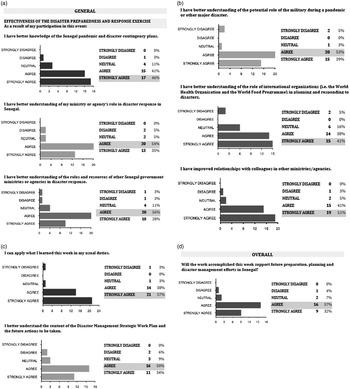
Following completion of the exercise, 86% of the survey respondents agreed or strongly agreed they had a better knowledge of the Senegal pandemic and disaster contingency plans (Figure 1A). A total of 89% of the respondents agreed or strongly agreed that they had a better understanding of their ministry’s or agency’s role in disaster response. A total of 84% of respondents agreed or strongly agreed that they had a better understanding of the roles and resources of other Senegal government ministries or agencies during a disaster response. A total of 92% of respondents had a better understanding of the potential role of the military during a pandemic, and 79% of participants had a better understanding of the role of international organizations (ie, the World Health Organization and the World Food Program) in planning and responding to disasters (Figure 1B). A total of 92% felt they had improved relationships with colleagues in other ministries and agencies. Overall, 89% felt that the work accomplished during the exercise would support future planning, preparation, and disaster management efforts in Senegal (Figure 1C,D). Participants also generated ideas for improvement of the disaster management system in Senegal through a formal “gap analysis” conducted after the exercise.
(A-D). Participant Evaluation Summary: Senegal Disaster Preparedness and Response Exercise.

Gap Analysis
On the final day of the tabletop exercise, participants conducted a gap analysis based on their experiences and observations over the course of the exercise with a focus on identifying areas to be sustained and areas to be improved. In reviewing areas to be sustained, the participants agreed that the existence of the newly developed military and civilian multi-hazard and pandemic plans were extremely beneficial to define roles and responsibilities for management of these types of disaster events. The plans also assisted in defining specific actions to be taken in response to a major disaster event. Participants generally agreed that communication and coordination between stakeholders was key to a successful exercise.
In addition to these general comments, participants identified major gaps and shortfalls requiring attention. Recommendations were made to address these deficiencies and to improve future responses to a pandemic or disaster event.
Education and Awareness of Key Government Leaders
Some participants believed additional effort should be made to educate key governmental leaders about disaster management to increase their awareness of disaster management requirements and shortfalls. This additional knowledge was considered critical to ensuring adequate resourcing of disaster management preparedness and response efforts.
Recommendation: The Ministry of Interior should consider establishing a process to periodically update key government leaders about disaster management requirements and shortfalls.
Need to Improve “Subnational” Disaster Management Capability
Participants identified the need for an effective disaster management structure and capability at levels below the national-level government. Participants did not believe the current disaster management committee structure at the subnational level was sufficient to address the challenges of a major disaster. The general opinion was that the need exists for trained personnel and a local structure to provide local support of the disaster response activities of national-level ministries and agencies.
Recommendation: The Directorate of Civil Protection within the Ministry of Interior should lead an inter-ministerial effort to explore the establishment of appropriate subnational disaster management capability to provide local support of national disaster response operations.
Need for Additional Sectorial Planning
Participants were extremely knowledgeable in their areas of expertise but expressed concern that each sector involved in disaster preparedness and response did not have its own disaster management plan. The only exception was the military, which has 2 newly developed disaster plans, a pandemic contingency plan and a MACA plan. These military sectorial plans were seen as a model for additional planning that should be accomplished in other societal sectors, including health, communications, and logistics. Participants further identified the need for these sectorial plans to be sufficiently detailed to establish policies and procedures for specific disaster response issues, such as the management of population movements (refugees and internally displaced persons) caused by a major disaster event.
Recommendation: Plans should be developed for key stakeholder sectors, similar to the Armed Forces Pandemic Contingency Plan and MACA Disaster Contingency Plan. In addition to sectorial planning at the national level, participants also recommended that appropriate operational-level planning be accomplished at subnational levels of government.
Improvement of Health Care Disaster Capability
The health group identified several areas needing additional focus and improvement including resilience within the health sector, procurement of additional staff, better staff training, and acquisition of additional supplies and equipment. Although they identified health care capability as a critical shortfall, participants expressed concern over the high cost of medical training, supplies, and equipment, which would inhibit rapid improvement.
Recommendation: The Ministry of Health and Social Action should establish a task force to identify disaster-related health care requirements and develop an action plan to address these requirements.
Role of the Military Needs Additional Clarity
Disaster managers within the operations group identified a need to clarify the roles of the Senegalese Armed Forces during disaster response operations, including the need to ensure these roles are captured in appropriate documentation and that they are adequately resourced.
Recommendation: The Ministry of Interior should coordinate with the Senegalese Armed Forces to identify the exact requirements civil authorities expect of the military during a major disaster event, their ability to perform these tasks, and any resource shortfalls that must be addressed to provide adequate response capability. In addition, these roles should be properly captured in appropriate disaster plans, policies, and procedures.
Lack of Equipment and Supplies
Participants identified the lack of stockpiled equipment and supplies for disaster response, which would inhibit disaster response. They opined that an assessment of required equipment and supplies should be conducted and, where applicable, these items should be procured and stored for use in future disaster situations. This was identified as being particularly important for disasters that are global in nature (such as in a pandemic), since it would be difficult to procure these items during the disaster owing to increased global demand. These items include personal protective equipment, pharmaceuticals, food, water, and other commodities that would be required during a major disaster. It was pointed out that some items may have a short shelf life and thus might not be appropriate for stockpiling.
Recommendation: The Ministry of Interior should lead an effort by Senegalese authorities to assess disaster-related resource requirements, working with experts from appropriate nongovernmental organizations, the United Nations, and other sources to identify and then procure the necessary commodities to create an adequate stockpile for use in future disaster situations.
Financial Resourcing of Disaster Preparedness and Response
Participants in several groups identified a need to better resource disaster preparedness and response activities, including a dedicated budget for disaster preparedness and response and possible establishment of a “disaster fund” to provide rapid funding of disaster response operations during “no notice” disasters. In addition, identifying sources of resourcing and better management of external resource support from international donors was also identified as a key requirement.
Recommendation: As noted in the National Republic of Senegal Pandemic Influenza Preparedness and Response Plan, the Ministry of Interior (Directorate of Civil Protection) is responsible for coordinating with all other disaster stakeholders to solicit and manage resources for disaster preparedness and response activities. The Ministry of Interior should therefore develop an appropriate proposal to obtain adequate disaster preparedness and response funding and should develop procedural documents for fund management.
Need Focus on Anticipated Logistics Requirements
Participants within the logistics group expressed concern that although the newly developed disaster and pandemic plans have improved the identification of tasks to be performed and the responsibilities of various stakeholders, there is still a need to better identify specific disaster response requirements. Many areas of concern were identified, including security for convoys, port security, logistics transportation, warehousing, and other issues that impact logistics response.
Recommendation: The Ministry of Interior should lead an effort to establish a logistics “task force” to identify disaster-related logistics issues and requirements and develop an “action plan” to address these requirements.
Other Observations From Participants
Many participants felt that the current pandemic plan was flexible and had been successfully implemented in recent disaster events. Participants also stated that there is a strong core group of disaster professionals in Senegal but that disaster communications were hampered by a lack of modern technology in the communications sector. In the logistics sector, there was a lack of logistics “databases” to identify available resources and also a need to identify better procedures for rapid emergency funding of disaster response. Participants noted that there needs to be a better methodology to outline when to activate the disaster plan and better articulation of the border management agency’s role in the national plan.
Discussion
The exercise was characterized as very successful by the participants, with positive feedback for both process and outcome. The success of the exercise was widely attributed to the participation of a wide variety of participants representing the “whole of government,” all of whom share responsibility for a response to a severe pandemic or other disaster event in Senegal. The division of participants into the 5 functional groups proved to be very effective in identifying response actions and providing participants with an appreciation for the command, control, and coordination challenges inherent in responding to a major disaster event. One of the participant recommendations, to build subnational and local disaster capabilities, has often been identified as a critical component of disaster preparedness capacity-building in the literature.Reference Waugh and Streib 10 - Reference Plough, Fielding and Chandra 14 Some of the other participant recommendations, such as concerns with regard to logistical supply chains and financing mechanisms, have been formally assessed in the subsequent West African Disaster Preparedness Initiative, or WADPI, which took place in 2015 and will be discussed in future reports. Additionally, given that the exercise concluded about 1 month before the first Ebola case in Senegal, it may have served as a useful preparation tool for the nation’s response to the outbreak; 15 indeed, it is worthwhile to note that the Senegalese government used their pandemic plan as a framework for their response to the Ebola crisis.
Overall, the willing engagement of all participants and the application of their experience were critical to the success of this exercise and to the identification of the plans, policies, and procedures critical to guide a national response to a disaster event. The recommendations resulting from the exercise were also captured and incorporated in the discussion during the Disaster Management Strategic Work Plan review sessions that followed the exercise and have served to inform and modify disaster management policies nationwide.
It can be argued that such exercises as the one conducted in Senegal are one component in an overall strategy for global health capacity-building,Reference Walsh, Craddock and Gulley 16 - 25 helping to build networks between key actors in the public health and other government sectors which are easily activated in the case of disasters. This exercise may arguably provide a model for how disaster preparedness and response can be improved in developing countries. Further, the benefits of utilizing a “whole of government” approach to disaster preparedness, rather than focusing on individual sectors such as the health sector, has been recently advocated by the United Nations, the World Food Program, and other various international and national governmental organizations in the disaster literature.Reference Licina 26 - Reference Gilman, Wright and Clifford Lane 30
It can also be argued that a single exercise is not a sufficient or sustainable strategy for improving preparedness, particularly in an entire country, given the complexity of garnering participation and cooperation of numerous sectors of the government. Further, disaster experts assert that such exercises should be part of an overall strategic exercise program, which is based upon constantly updated disaster plans and risk assessments.Reference Burton and Chiginsky 31 To this end, this exercise is but one part of a multipronged strategy originating in 2008, with continuous Department of Defense preparedness exercises and training activities since that time, to focus on preparedness and capacity-building in Senegal and other regions of Africa. This exercise, and the entire DPP have recently evolved into WADPI, which has throughout 2015 involved 12 African nations in continued disaster management education and exercises in the aftermath of the unprecedented Ebola epidemic. Further discussion about the activities and effectiveness of WADPI will be provided in subsequent reports.
Many CGHE project staff assigned to conduct this Senegal preparedness exercise have had, as a result, extensive experience working on the continent, immersing themselves in the local cultures. Whenever possible, African facilitators have been used to conduct and lead training activities. Training and exercise activities were conducted in French or were communicated with immediate availability of French translators on site with headsets to ensure comprehension by all participants. Two dedicated CGHE team members were in charge of planning and coordinating the logistics involved in organizing this exercise and other similar conferences throughout Africa as a part of the DPP and WADPI exercises for the past several years. As a result, they have gained significant experience in working with our African partners to make these activities truly successful. A “continent representative” has been employed by CGHE for the past several years to inject cultural considerations required for all activities conducted by project staff. Some dedicated DPP project staff members have lived on the continent for years at a time conducting this and other preparedness activities. As a result, the programming provided by this and literally dozens of other exercises has attempted to take into account culturally respectful, long-term, and appropriate methods of engaging with our Senegalese partners and with our numerous other partner nations.
In current discussions with key Senegalese disaster experts, some of the main achievements in the time since this exercise include the creation of an autonomous national agency of Civil Protection. The current Directorate of Civil Protection is housed within the Ministry of Interior; however, the government of Senegal is working to establish a separate disaster management agency per the recent Economic Community of West African States (ECOWAS) mandate. The physical infrastructure has now been completed for the new national Emergency Operations Centre. The Directorate of Civil Protection is now seeking external support to outfit the center with the necessary equipment. Since the exercise, Senegal has developed a draft decree repealing and replacing the current ORSEC Plan (their national disaster plan) with one that takes into account all phases of a disaster (preparedness, response, mitigation, and recovery). The government of Senegal also plans to repeal and replace the decree that established the National Risk Reduction platform in order to improve its functionality.
Limitations
This brief report was not conducted as a formal research investigation but rather was an analysis of quality improvement findings from a disaster drill or exercise. Thus, the results of this report should not be construed as those from a formal research study but as a quality improvement activity. The lessons learned from the Senegal exercise are one example of findings that can be derived from disaster drills and exercises in developing countries but may or may not be generalizable to other similar situations.
Some authors have criticized the involvement of militaries or security agendas in communicable disease assistance measures, arguing that such efforts interfere or dominate what should be a purely humanitarian action.Reference Calain and Abu Sa’Da 32 Acknowledging this point, and also appreciating the necessity of “humanitarian space” when dictated by international law, one may also note that security interests have driven global health engagement for decades. Even the World Health Organization and Médecins Sans Frontières (MSF) have acknowledged that security interests may have a significant role to play in preventing and managing future epidemics—while carefully following the dictates of international law and treaties.Reference Calain 33 , 34
Conclusion
Given the success of the Republic of Senegal Disaster Preparedness and Response Exercise, DPP methods have been adapted to provide similar support to Ebola-affected nations across Africa to further increase regional capacity to response to infectious disease and other disaster threats within the region. By utilizing a “whole of government” strategy, and collaborating with Senegal and other partner nations throughout the process, DPP exercises and their successor, WADPI, have served to strengthen overall preparedness and response, as well as build public health capacity, among some of the world’s most vulnerable populations. Further, they are in direct support of internationally recognized goals outlined in the Sendai Framework for Disaster Risk Reduction and the 5-year Strategic Roadmap for Senegal outlined by the Global Health Security Agenda. 35
Funding
Overseas Humanitarian Disaster and Civic Aid Funding.