Identifying the instar of insect larvae allows the description of age distributions in populations. Assessing the climatic suitability of new habitats, predicting spread potential, quantifying stage-dependent mortality, and calibrating phenology and population models all require the ability to assign instar to field-collected larvae (e.g., Régnière et al. Reference Reid2012). The efficacy of many control methods depends on their application coinciding with certain life stages and knowledge of the distribution of instars within a population over time is required to develop and apply phenology and population models.
The mountain pine beetle (MPB) Dendroctonus ponderosae Hopkins (Coleoptera: Curculionidae) is a native, eruptive bark beetle that attacks most species of pine (Pinus Linnaeus (Pinaceae)) in western North America. A recent epidemic in British Columbia (BC), Canada killed ~53% of the mature pine in the province and affected over 17 million ha of forested land between 1999 and 2011 (Walton Reference Walton2012). During this recent outbreak, the beetle significantly expanded its range when it crossed the Rocky Mountains in northern BC; the beetle now appears to be established in northeastern BC and northcentral Alberta (AB), Canada where populations had not been reported previously (Safranyik et al. Reference Safranyik and Linton2010; Bleiker et al. Reference Bleiker, O’Brien, Smith and Carroll2011). Mountain pine beetle now threatens to spread eastward across Canada’s boreal forest.
A common, useful metric to determine the instar of immature insects is the size of their sclerotised head capsules, which remain relatively constant between moults, but increase in size with each instar (Daly Reference Flaherty, Régnière and Sweeney1985). Mountain pine beetle has four instars (Reid Reference Safranyik and Carroll1962; Amman and Cole Reference Bentz, Bracewell, Mock and Pfrender1983; Safranyik and Carroll Reference Safranyik, Carroll, Régnière, Langor, Riel and Peter2006). Cut-points for each instar may be determined by visually identifying the lowest frequency class between the peaks on a histogram or by least-squares nonlinear regression (e.g., Logan et al. Reference Régnière, Powell, Bentz and Nealis1998). However, these methods require large numbers of head-capsule width measurements to construct a frequency distribution and depend on the user to select appropriate frequency classes.
In this paper, we assess larval size using head-capsule widths for MPB from two regions in the historic range in BC and from the recently expanded range in northern AB. We use a maximum likelihood approach (Flaherty et al. Reference Hutchinson and Tongring2012) to determine MPB larval instar and provide cut-points that can be used to classify field-collected larvae throughout most the of the range of the beetle in Canada.
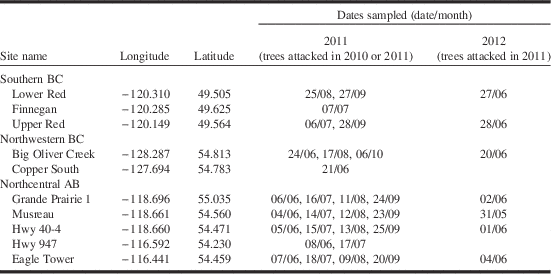
Mountain pine beetle head capsules from larvae collected in three regions were measured: southern BC, northwestern BC, and from the beetle’s recently expanded range in northern AB east of the Rocky Mountains (Table 1). Larvae were sampled from 6–12 trees at each site at each sample time. Trees attacked in 2010 were sampled in the spring of 2011 and trees attacked in the summer of 2011 were sampled in the summer and fall of 2011 and again in the spring of 2012 (Table 1). Sample trees were lodgepole pine Pinus contorta var. latifolia Engelmann at field sites in BC and jack pine (P. banksiana Lambert)×lodgepole pine hybrids or backcrosses in AB with lodgepole pine being the recurrent parent in the region (Critchfield Reference Daly1985).
Location of field sites and dates when mountain pine beetle life stages were sampled in Canada.

Sites in northwestern and southern British Columbia (BC) were within the beetle’s historic range and sites in northcentral Alberta (AB) were in the recently expanded range of the beetle east of the Rocky Mountains.
A gas-powered hole saw was used to cut 10 cm diameter bark pucks between 0.5 and 2.0 m above ground on the bole of sample trees. Most sample trees were mass-attacked by beetles with successful attacks occurring around the entire circumference of the tree, but at sites with low beetle populations, a few samples trees were strip-attacked, with successful attacks around only a portion of the bole (Bleiker et al. Reference Bleiker and Six2014). Pucks were cut from the north (NW to NE) and south (SW to SE) aspects of mass-attacked trees and from the mid-point (±22°) of the successfully attacked portion of the bole on strip-attacked trees. A minimum of two pucks were sampled from each aspect if they contained <10 live individuals (eggs, larvae, pupae, and/or adults) and additional pucks were sampled until 10 or more individuals were found or a total of seven pucks had been sampled. Larvae were extracted immediately from the pucks and stored in 70% ethanol until processed in the laboratory. Head capsules were measured at the widest point in the dorsal–ventral view at 40 times magnification using an ocular micrometer on dissecting microscopes. Precision of the microscopes was 0.023 and 0.025 mm.
We estimated the means, μ
ij
and variances,
 $\sigma _{{ij}}^{2} $
of head-capsule widths for each instar (i=1,2,3,4) and region (j=1,2,3) assuming a normal distribution. This represents 24 unknowns (12 means, 12 variances). A total of 4375 measurements were made, of which n
1=1324 came from southern BC, n
2=275 from northwestern BC, and n
3=2776 from northern AB. The number in each instar in each regional sample is not known, but the total number from each region is known. Once the number in each of the first three instars is determined, the number of fourth instars in each region is set by
 $n_{{4j}} =n_{j} {\minus}\mathop{\sum}\nolimits_{i=1}^3 {n_{{ij}} } $
. Thus, three instar numbers from each region are free to vary, and become nine unknowns to be estimated.
The probability of observing a width w in the sample is calculated from the weighted average probability distribution of the head-capsule width within a random sample of 4375 larvae with the same regional composition as ours:
 $$p(w)={{\mathop{\sum}\limits_i {\mathop{\sum}\limits_j {n_{{ij}} {\mathop{\rm N}\nolimits} \left( {\mu _{{ij}} ,\sigma _{{ij}}^{2} } \right)} } } \over {4375}}$$
where
 $$N\left( {\mu _{{ij}} ,\sigma _{{ij}}^{2} } \right)={1 \over {\sqrt {2\pi \sigma _{{ij}}^{2} } }}e^{{{\minus}{{\left( {w{\minus}\mu _{{ij}} } \right)^{2} } \over {2\sigma _{{ij}}^{2} }}}} $$
is the normal distribution with mean μ
ij
and variance
 $\sigma _{{ij}}^{2} $
.
The objective of the analysis is to estimate the means μ
ij
and variances
 $\sigma _{{ij}}^{2} $
of head capsules (by instar and region). This was done with Procedure NLMIXED of SAS 9.2 minimising:
 $${\rm NLL}={\minus}\mathop{\sum}\limits_{j=1}^{4375} {{\mathop{\rm Ln}\nolimits} \left[ {p(w_{j} ,{\bf A})} \right]} $$
where p(w j , A) is the likelihood of each observation j and A the set of parameters to estimate (9 n’s, 12 μ’s, and 12σ 2’s).
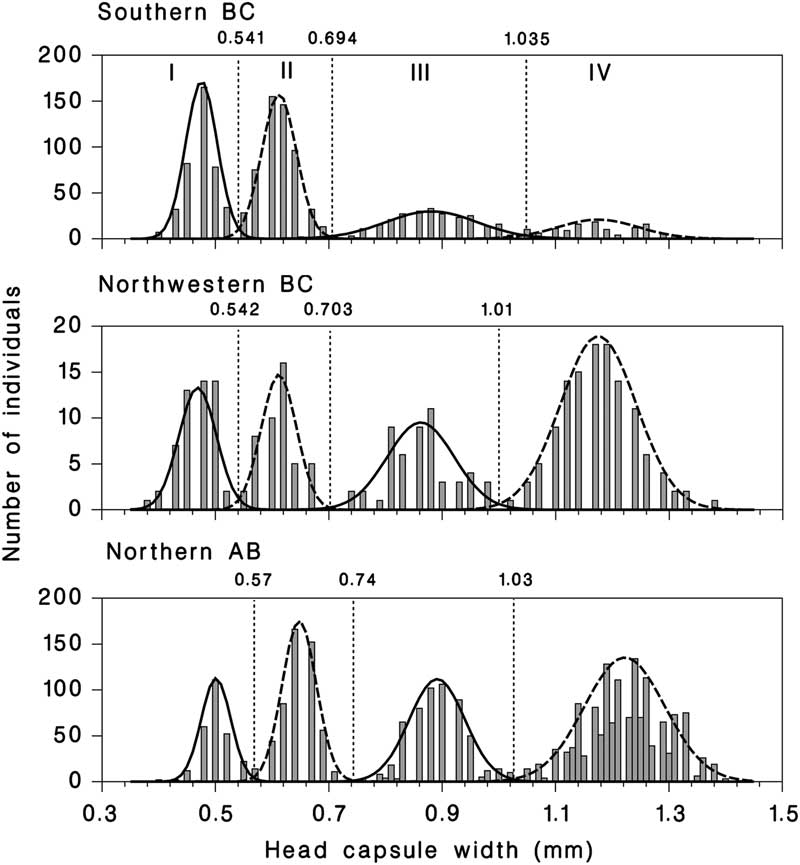
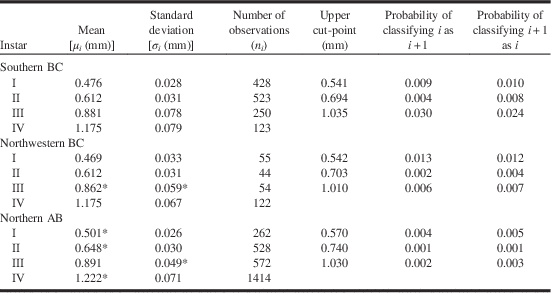
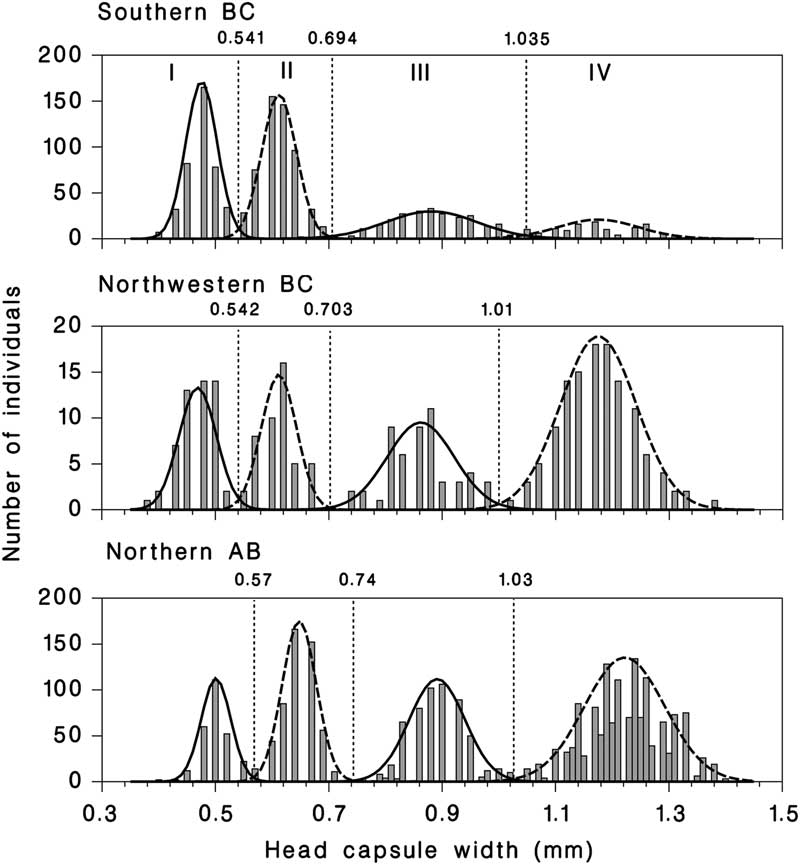
To test for differences in means and variances within instar, larvae from southern BC were used as a reference (i.e., μ 2j =μ 1j +Δμ 2j , μ 3j =μ 1j +Δμ 3j , σ 2j =σ 1j +Δσ 2j , and σ 3j =σ 1j +Δσ 3j ); a significant difference is found whenever Δμ ij ≠0 or Δσ ij ≠0 (Table 2). Figure 1 shows histograms of the head-capsule width observations, overlaid on the estimated head-capsule distribution of the four instars (lines), for each region. From the means and variances obtained with this method, head-capsule width cut-points between successive instars and the probabilities of misclassification were determined (Flaherty et al. Reference Hutchinson and Tongring2012).
Frequency distribution histogram of observed mountain pine beetle head-capsule widths sampled at sites in southern British Columbia (BC), northwestern BC, and northern Alberta (AB), Canada. The estimated head-capsule distribution of the four instars is overlaid (lines). Sites in BC are within the historic range of the beetle and sites in AB are within the recently expanded range.
Parameter estimates describing the head-capsule widths of the four instars of mountain pine beetle in southern British Columbia (BC), northwestern BC, and northcentral Alberta (AB).

*Means significantly different from same instar in southern BC (P<0.001).
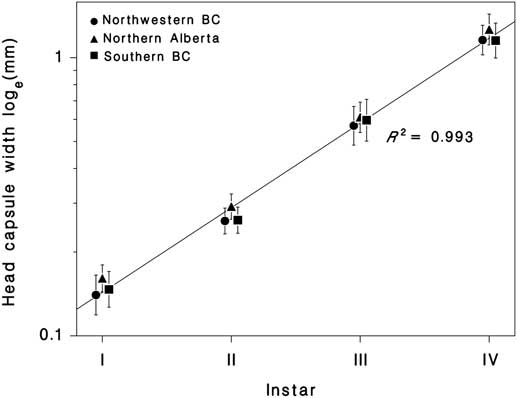
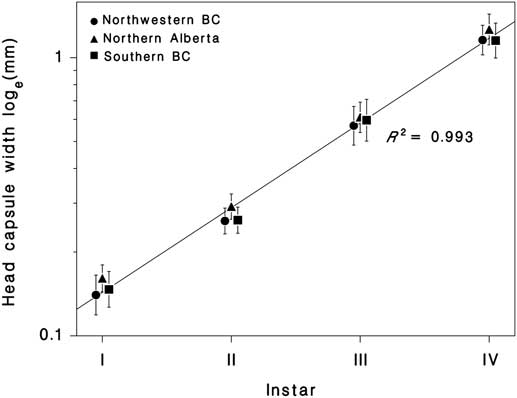
The mean head-capsule widths obtained from this algorithm obey the Brooks-Dyar’s rule, which states that the log of head-capsule width increases linearly with instar (R 2=0.995; Fig. 2; Hutchinson and Tongring Reference Langor, Spence and Pohl1984). There were no significant differences among regions in either intercept (F(2,6)=1.1; P=0.393) or slope (F(2,6)=0.13; P=0.878) in this linear relationship.
A regression showing the geometric progression in the size (loge[head-capsule width]) of mountain pine beetle larvae consistent with the Brooks-Dyar rule (see text) for populations sampled in southern British Columbia (BC), northwestern BC, and northcentral Alberta, Canada.
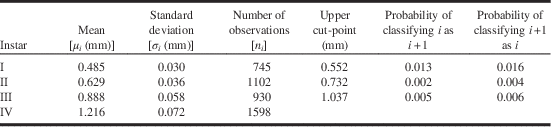
Larvae from northern AB had significantly wider head capsules than larvae from southern BC in the first, second, and fourth instars. Third instars collected from northern BC were significantly smaller than those from southern BC, but no differences were found in the other instars (Table 2). Factors such as competition, fungal associates, host species and quality, and growing season temperatures and length have been shown to affect MPB size (Amman Reference Amman1982; Amman and Cole Reference Bentz, Bracewell, Mock and Pfrender1983; Safranyik and Linton Reference Walton1983; Langor et al. Reference Logan, Bentz, Vandygriff and Turner1990; Cerezke Reference Critchfield1995; Bentz et al. Reference Bleiker, Carroll and Smith2001, Reference Bentz, Logan and Vandygriff2011; Bleiker and Six Reference Cerezke2007). However, the size differences in this study were very small and probably of little consequence for the purpose of instar determination in field samples. A final set of parameter values was obtained by pooling all head-capsule measurements without regional distinction. The probability of misclassifying instars was low (Table 3).
Parameter estimates describing the head-capsule widths of the four instars of mountain pine beetle in Canada.

The cut-points reported here (Table 3) are suitable for classifying individual larvae from field populations of MPB from lodgepole or lodgepole×jack pine hosts throughout most of the beetle’s range in western Canada.
Acknowledgements
The authors thank G. Smith, B. Tomm, M. O’Brien, E. Braithwaite, V. Waring, J. Weber, R. Heron, K. White, E. Havard, N. Humphries, K. Hogg, J. Simpson, D. Lejour, and C. Kay for assistance in the field or laboratory. They also thank V. Nealis, B. Van Hezewijk, C. MacQuarrie, and an anonymous individual for reviewing the manuscript. This research was supported by Foothills Research Institute; the provinces of Alberta, Saskatchewan, Manitoba, and Ontario through the Spray Efficacy Research Group International and Forest Protection Limited; and the Canadian Forest Service, Natural Resources Canada.