The fact that fifteen of the nineteen terrorists who attacked the World Trade Center and the Pentagon on 11 September 2001 were Saudi citizens inevitably raised serious questions about the social conditions that have produced such violent personalities capable of the mass taking of innocent lives and devastating an entire city, if not a nation. Answers were quick to come by, as the U.S. media pointed to the Saudi culture. Charges were made that the youth were brainwashed by the most extremist school in Islam, namely, Wahhabism. The Saudi educational institutions were also blamed for promoting anti-Semitism, anti-Western attitudes, and intolerance of other religions. Saudi society was also condemned for having a corrupt and backward political system. Naturally, in this land of intolerance and authoritarianism, resorting to violence by its inhabitants became a foregone conclusion.1
See, for example, Robert Baer, Sleeping with the Devil: How Washington Sold Our Soul for Saudi Crude (New York: Crown, 2003); Stephen Schwartz, The Two Faces of Islam: The Houses of Sa'ud from Tradition to Terror (New York: Doubleday, 2002); Dore Gold, Hatred's Kingdom: How Saudi Arabia Supports the New Global Terrorism (Washington, D.C.: Regnery, 2003).
Recent scholarly studies have provided a more balanced picture of the cultural forces operating in the kingdom. However, there is little knowledge of how Saudis view the significant issues facing their society. We fill this void by analyzing the value orientations of Saudi citizens toward such key issues as the form of government, religion, religious tolerance, gender relations, marriage, and Western culture, using the findings of the values survey that was carried out in the kingdom in 2003. We also use the results of similar values surveys in Egypt, Iran, Jordan, and the United States to assess the similarities and differences in value orientations between Saudi citizens and the public of these countries.
Furthermore, focusing on such key organizing principles of the kingdom as religion, gender, and politics, we try to explain religiosity and attitudes toward women and democracy. What are the major factors that affect the religiosity of the Saudi public? What is the connection between religiosity and gender? To what extent does gender affect variations in daily prayer and mosque attendance? How does one explain attitudes toward polygamy and the norm of wife obedience? Does education promote religiosity? Is there a connection between religiosity and attitudes toward gender inequality? How are variations in attitudes toward democracy related to variations in other attitudes and nonattitudinal characteristics of the respondents? Finally, are the extant sociological generalizations that are based on the experiences of the West applicable to Saudi society?
In drawing from sociological models to explain the worldviews of Saudis, we pay particular attention to Saudi Arabia's specific national and historical context. We depart from the modernization perspective that presumes societies as instances of a universal process of modernization, secularization, and value generalization. We also abandon the postulate that people's culture is shaped by their society's location in the hierarchically organized structure of the world capitalist system and the external dictates of the world economy (although we concede that the rentier economy to a degree has shaped the public's worldviews). Although we use general variables to explain Saudis' value orientations, the linkages among these variables are interpreted in terms of the country's specific historical context in which these variables are embedded.
STATE FORMATION, ECONOMIC DEVELOPMENT, AND CULTURAL CHANGE
The incorporation of the disparate regions of the Hijaz, Asir, Hasa, and Najd into the unified Kingdom of Saudi Arabia in 1932 resulted in the emergence of a new political community shaped by the military and religious alliance that in the span of thirty years (1902–32) brought Abd al-Aziz ibn Abd al-Rahman al-Saudi, the founder of the kingdom, to power. Key in the success of al-Saud was not only the effectiveness of the ikhwān tribal warriors who supported him and a favorable international environment, but also his alliance with the Wahhabi movement whose muṭawwa

a volunteers played a crucial role in legitimizing his rule, domesticating the population in the name of Islam and enforcing Saudi authority under the guise of a vigorous program to convert the people of Arabia to “true” Islam.
2Madawi al-Rasheed, A History of Saudi Arabia (Cambridge: Cambridge University Press, 2002), 8; Gwenn Okruhlik, “Networks of Dissent: Islamism and Reform in Saudi Arabia,” Current History (January 2002): 23.
In this process, the material foundations, institutional constructs, and ideational system of the autonomous nomadic tribes, the tribal armies, the guilds, and the smaller merchants who were instrumental in al Saud's success but later became antithetical to administrative centralization and the formation of national markets were destroyed. Instead, a business–government coalition between the Hijazi commercial elites and the Nejdi rulers was formed. The 1970s oil boom freed the government from the political constraints that naturally come with taxation and set the stage for another major shift in the state–society relations. The state's new spending, favoring the Nejdi commercial interests, precipitated the decline of the traditional merchant class. As a result, many old Hijazi merchant families disappeared into the ranks of retailers. The decline in the importance of the Jeddah Chamber of Commerce and the rise of the Riyadh chamber reflected the dissolution of the 1960s pact between the state and the traditional commercial elite. Each shift in state–class/group relations resulted in narrowing of the social basis of the state.3
Kiren Aziz Chaudhry, The Price of Wealth: Economies and Institutions in the Middle East (Ithaca, N.Y.: Cornell University Press, 1997), 99, 131–32, 134–35, 159–60.
Parallel with the changes in state–society relations were such structural changes as the state's bureaucratic expansion, occupational differentiation, sedentarization of tribes, urbanization, demographic growth, and impressive rates of economic development, which was made possible by the availability of vast petrodollars. The speed of change was particularly striking in the last decades of the 20th century. The kingdom's population of 5 million in 1974 jumped to 12 million in 1992,4
Rayed Krimly, “The Political Economy of Adjusted Priorities: Declining Oil Revenues and Saudi Fiscal Policies,” Middle East Journal 53 (Spring 1999): 258.
International Crisis Group (ICG), Can Saudi Arabia Reform Itself? ICG Middle East Report no. 28, 14 July 2004, 10.
Krimly, “Political Economy,” 258–59.
Daryl Champion, The Paradoxical Kingdom: Saudi Arabia and the Momentum of Reform (New York: Columbia University Press, 2003), 111.
Krimly, “Political Economy,” 263, table 2.
Champion, Paradoxical Kingdom, 79.
These structural changes coupled with the vulnerability of the single-commodity export economy to fluctuations in oil prices and demands in the world market,
10For data on fluctuations in export earnings that contributed to a sharp increase or decrease in economic activities and GDP growth, see ibid., 80, table 3.1.
The oil boom also increased income inequality, particularly in agriculture, where 82 percent of private land was held by 16.2 percent of the landowning population, making Saudi Arabia's one of the most inequitable land tenure systems in the world: see Chaudhry, Price of Wealth, 156, 176.
Although they constitute 58 percent of the university graduates in Saudi Arabia, women make up only 5 percent of the labor force: see Anthony H. Cordesman, Saudi Arabia Enters the Twenty-First Century (Westport, Conn.: Praeger, 2003), 175–76.
i minority.
13R. Hrair Dekmejian, “The Rise of Political Islamism in Saudi Arabia,” Middle East Journal 48 (Fall 1994): 627–43; idem, “The Liberal Impulse in Saudi Arabia,” Middle East Journal 57 (Summer 2003): 400–13; Madawi al-Rasheed, “The Shi'a of Saudi Arabia: A Minority in Search of Cultural Authenticity,” British Journal of Middle Eastern Studies 25, 1 (1998): 121–38; ICG, Can Saudi Arabia Reform Itself? 9–15; Okruhlik, “Networks of Dissent,” 26.
The regime responded to these developments by first attempting to coach and coopt Islamic activists. Following the 1979 Mecca incident, where Muslim militants led by Juhaiman al-Utaibi forcibly took control of the sacred mosque,14
Okruhlik, “Networks of Dissent,” 23
Ibid.; Michael Prokop, “Saudi Arabia: The Politics of Education,” International Affairs 79, 1 ( 2003): 78.
ICG, Can Saudi Arabia Reform Itself? 7; Dekmejian, “Rise of Political Islamism,” 638.
Mamoun Fandy, “Cyber Resistance: Saudi Opposition between Globalization and Localization,” Comparative Studies of Society and History 41, 1 (1999): 140; ICG, Can Saudi Arabia Reform Itself? 16, 25; R. Hrair Dekmejian, “Saudi Arabia's Consultative Council,” Middle East Journal 52, 2 (1998): 204–18; Aharon Layish, “Saudi Arabian Legal Reform as a Mechanism to Moderate Wahhabi Doctrine,” Journal of the American Oriental Society 107 (April–June 1987): 279–92.
These events are indicative of the changes that were transpiring in the kingdom, but we know precious little about how Saudis view these changes. How religious are Saudis compared to the citizens of other Islamic countries? Is there considerable support for the conservative religious establishment? Are women more religious than men in the kingdom? In what terms, religious or nationalist, do Saudi citizens define their identity? What are the attitudes of Saudis toward religious authorities, gender relations, marriage, and democracy?
VALUES SURVEYS IN EGYPT, IRAN, JORDAN, AND SAUDI ARABIA
Comprehensive values surveys of national representative samples of 3,000 Egyptian, 2,532 Iranian, 1,224 Jordanian, and 1,526 Saudi adults were carried out in 2001–03.18
The surveys were conducted under the supervision of Abdul Hamid Abdul Latif, Ain Shams University, Cairo; Taghi Azadarmaki, University of Tehran; Mustafa Hamarneh and Fares al-Braizat, University of Jordan, Amman; and Tony Proudian, Pan Arab Research Center, Jeddah.
The principal investigators for the U.S. values survey, carried out in late 1999 and early 2000, were Ronald Inglehart and Virginia Hodgkinson. See also Ronald Inglehart, Miguel Basanez, Jaime Diez-Medrano, Loek Halman, and Ruud Luijkx, ed., Human Beliefs and Values: A Cross-Cultural Sourcebook Based on the 1999–2002 Values Surveys (Mexico City: Siglo, 2004).
The Pan Arab Research Center carried out the survey in Saudi Arabia using a multistage probability sampling procedure. The sample included 1,026 Saudi citizens and 500 foreign residents and equal number of men and women. The respondents were selected randomly from the northern, southern, central, eastern, and western regions, including Jeddah, Taif, Makkah, Riyadh, Qassim, Hail, Dammam/Khobar, Abha/Khamis, and al-Madinah. The households were the final sampling units, from which respondents were randomly selected. In terms of age, 29 percent were 15–24 years old, 29 percent were 25–34, 27 percent were 35–44, 11 percent were 45–54, and 4 percent were 55 or older. The majority of the respondents identified themselves as members of either the upper middle class (48 percent) or the lower middle class (34 percent); the rest identified themselves as upper class (10 percent) or working or lower class (8 percent). In terms of education, 80 percent of the respondents had less than a university education whereas 20 percent had a university education.
One of the objectives of these comparative values surveys was to understand the value orientations of the Islamic publics toward some of the same sociopolitical and cultural issues that were also points of contention and debate among Muslim intellectual leaders in the modern period. Included among these issues were (1) the role of religion in society; (2) the social status of women; (3) form of government; and (4) national identity; and (5) the relationship with the outside world, most notably, the Western countries.20
See Mansoor Moaddel, Islamic Modernism, Nationalism, and Fundamentalism: Episode and Discourse (Chicago: University of Chicago Press, 2005). See also Albert Hourani, Arabic Thought in the Liberal Age (1798–1939) (Cambridge: Cambridge University Press, 1983); Hamid Enayat, Modern Islamic Political Thought (London: Macmillan, 1982); Hisham Sharabi, Arab Intellectuals and the West (Baltimore: Johns Hopkins University Press, 1970); Issa Boullata, Trends and Issues in Contemporary Arab Thought (Albany: State University of New York Press, 1990); Abdallah Laroui, The Crisis of Arab Intellectuals (Los Angeles: University of California Press, 1976).
Religion and Religiosity
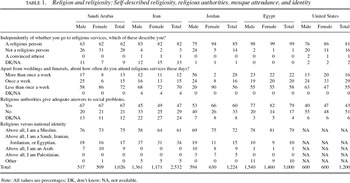
Religious beliefs are widespread among the respondents in all four countries. Among Saudis, 99 percent said that they were Muslim and 1 percent said they were Christian or Hindu. Among Egyptians, 94 percent said they were Muslim, and 6 percent said they were Christian. These figures for Jordan were 95 percent and 5 percent, and for Iran they were 97 percent and 1 percent, respectively. At least 94 percent of all respondents said that they believed in all of the following: God, life after death, the existence of the soul, heaven, and hell. Fully 90 percent of Saudi citizens said that religion was very important in their lives, as did 97 percent of Egyptians, 96 percent of Jordanians, and 79 percent of Iranians.
Although the Islamic publics are unanimous in terms of these basic religious beliefs, they display variations in terms of self-described religiosity, participation in religious services, attachment to religious or national identity, and attitudes toward religious authorities. On many of these measures, the Saudi public appears to be less religious than either Egyptians or Jordanians.
Self-Described Religiosity
According to Table 1, a lower percentage of Saudis (62 percent) described themselves as religious than Iranians (82 percent), Jordanians (85 percent), Egyptians (98 percent), or even Americans (81 percent). There may be cross-national differences in the meaning of being religious. In the United States, in particular, there is a strong tradition of religious pluralism and the meaning of religiosity varies across diverse groups in the country. As a result, Americans may have a different conception of religiosity and lower emotional attachments to religious beliefs than the Islamic publics. The extent to which the yardstick of religiosity in the kingdom is different from that in the other Islamic countries is hard to tell. However, the magnitude of the difference in self-described religiosity between Saudis, on the one hand, and Iranians, Jordanians, and Egyptians, on the other hand, is significant and thus warrants a reexamination of the prevalent perception of Saudi Arabia as a very conservative and religious society.

In terms of gender differences, if we consider 5 percent difference as significant, except in Jordan and the United States, men and women do not differ significantly in self-described religiosity. In Jordan, a much higher percentage of female respondents (94 percent) described themselves as religious than male respondents (75 percent). These figures for the United States were 86 percent and 76 percent, respectively.
Participation in Religious Services Versus Daily Prayers
Mosque attendance in Saudi Arabia in comparison with other countries further reinforces the conclusion that Saudis are not necessarily more religious than the publics of other Islamic countries. Only 13 percent of Saudi citizens indicated that they attended mosques more than once a week. This figure was 12 percent for Iranians, 28 percent for Jordanians, and 22 percent for Egyptians. As this Table 1 shows, both Iranian and Saudi publics did not attend mosques as often as the citizens of the other two Islamic countries. Among Americans, 16 percent indicated that they attended church more than once per week.
There are gender differences in mosque attendance cross-nationally. In Saudi Arabia and Jordan, mosque attendance was significantly higher among men than among women. That is, 17 percent of men and 8 percent of women in Saudi Arabia and 56 percent of men and 2 percent of women in Jordan indicated that they attended mosques more than once a week. For Egypt and Iran, there was no significant gender difference; for the United States, once again, significantly more women (20 percent) than men (13 percent) attended church more than once a week.
Considering daily prayer, Saudis were more religious than Iranians. About 87 percent of the Saudi public indicated that they perform the five daily prayers, whereas this figure for Iranians dropped to 48 percent. This question was not included in the Egyptian and Jordanian surveys. If religiosity is measured in terms of daily prayer, women were more religious than men in Saudi Arabia, as 82 percent of men and 92 percent of women indicated that they prayed five times daily. For Iranians, these figures were 49 percent and 46 percent, respectively. Therefore, there is no significant gender difference among them (not shown in Table 1).
Attitudes Toward Religious Authorities
A large percentage of the Islamic publics affirmed that religious authorities adequately responded to people's spiritual needs, moral problems, family needs, and social problems. For example, in reference to social problems, religious authorities enjoyed the greatest support among Egyptians, as 79 percent indicated that these authorities respond adequately to social problems. This figure for the Saudi, Jordanian, Iranian, and American publics were 67 percent, 60 percent, 47 percent, and 43 percent, respectively. There was no significant gender difference in attitudes toward religious authorities in Saudi Arabia and Iran. However, there were such differences in Jordan (66 percent of women versus 53 percent of men), Egypt (82 percent of women versus 77 percent of men), and in the United States (47 percent of women versus 40 percent of men). Here again, 5 percent or more difference is considered significant.
Religious Versus National Identity
Saudis consider religion as the most important element of their identity. In terms of adherence to territorial nationalism, however, they are more nationalist than Egyptians, as nationalist as Jordanians, and less nationalist than Iranians: 75 percent of Saudis defined themselves as Muslims above all; whereas 17 percent defined themselves as Saudis above all, compared with 61 percent and 34 percent for Iranians; 72 percent and 15 percent for Jordanians; and 79 percent and 10 percent for Egyptians, respectively. It is noteworthy that Arab identity among the three Arab countries is weak. Less than 9 percent of the Saudi and Jordanian publics defined themselves as Arabs above all, but this figure for Egyptians was only 1 percent. It thus appears that after religion, territorial nationalism is the distant second most important component of identity for the publics of these countries.
There are some variations in identity among men and women. While more female than male respondents for Iran (64 percent versus 58 percent), Jordan (75 percent versus 69 percent), and Egypt (81 percent versus 78 percent) defined themselves as Muslims above all, in Saudi Arabia, it was just the opposite: more men than women (76 percent versus 73 percent) defined themselves as such. The gender difference for Egypt and Saudi Arabia, however, is not significant.
In self-described religiosity, mosque attendance, and to some extent identity, Saudis are less religious than Egyptians or Jordanians. They are more like Iranians than their Arab counterparts. This is astonishing given that the kingdom is officially a religious state, the Islamic way of life is rigorously enforced by the religious police, school curricula are heavily loaded with religious education, and Wahhabi thought has maintained a strong grip on religious institutions.21
Prokop, “Saudi Arabia,” 79–81; Eleanor Abdella Doumato, “Manning the Barricades: Islam According to Saudi Arabia's School Texts,” Middle East Journal 57 (Spring 2003): 230–47.
Roger Finke and Rodney Stark, “Religious Economies and Sacred Canopies,” American Sociological Review 53 (1988): 41–49, L. R. Iannaccone, “The Consequences of Religious Market Structure: Adam Smith and the Economics of Religion,” Rationality Sociology 3, 2 (1991): 156–77; William Sim Bainbridge, “Social Influence and Religious Pluralism,” Advances in Group Processes 12 (1995): 1–18.
Furthermore, considering gender differences in religiosity among the five countries, we can conclude that, among the U.S. public, women tend to be consistently more religious than men in terms of self-described religiosity, participation in religious services, and attitudes toward religious authorities. In contrast, among the four Islamic countries, gender differences do not follow a consistent pattern. Gender differences are both specific to the country and depend on the question asked. However, the notion that women are generally more religious than men, although perhaps true in the United States, is not supported by the findings from these four Islamic countries.
Attitudes Toward Democracy
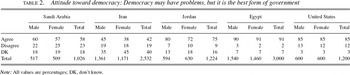
The survey questionnaire carried several items to measure the respondents' attitudes toward democracy. One of these items refers to democracy as an ideal system of government. Among the Saudi respondents, despite the rejection of democracy by both the Saudi rulers and clerics, a clear majority expressed favorable attitudes toward democracy, as 58 percent espoused the view that democracy is the best form of government, compared with 23 percent who disagreed. These figures were 42 percent and 19 percent for Iran; 75 percent and 9 percent for Jordan; 91 percent and 2 percent for Egypt; and 85 percent and 12 percent for the United States.
The findings also show that except for Egypt, Saudi Arabia, and the United States, there are significant gender differences in attitudes toward democracy among the Iranian (45 percent of men versus 38 percent of women) and Jordanian (80 percent of men versus 72 percent of women) publics. We may thus conclude that there is either no gender difference in attitudes toward democracy or a significantly higher number of men than women favor democracy (Table 2).

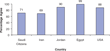
A relatively large percentage of “don't knows” on the issue of democracy may be indicative of people's lack of knowledge about democracy and that opinions toward democracy may shift in one way or another, if or when these people form opinions. It may also be the case that people were afraid to express their opinion. This is true in Saudi Arabia and Iran, where 18 percent of the respondents said they did not know and 40 percent refused to answer. Officially, the Jordanian and Egyptian governments adhere to democracy. The respondents in these two countries might have felt less intimidated than those in Saudi Arabia and Iran. Considering only those who expressed opinions on this issue, then an overwhelming majority of the respondents in all the countries are in favor of democracy: 71 percent of Saudis, 69 percent of Iranians, 89 percent of Jordanians, 99 percent of Egyptians, and 88 percent of Americans (Figure 1).

Democracy is the best form of government. [A color version of this figure can be viewed online at www.journals.cambridge.org]
Attitudes Toward Women
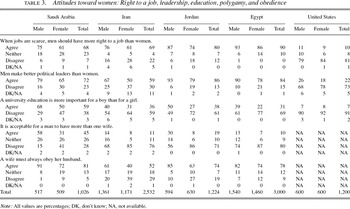
On gender relations, our findings displayed a cultural gap between the U.S. and Islamic publics. The latter held biased attitudes toward women, whereas Americans had a predominantly egalitarian view of gender relations. Only 7 percent of Saudis disagreed with the statement, “When jobs are scarce, men should have more right to a job than women.” This figure was 22 percent for Iranians, 12 percent for Jordanians, and almost 0 percent for Egyptians, but for Americans it was 81 percent. On political leadership, 23 percent of Saudis disagreed with the statements, “Men make better political leaders than women do.” This figure was higher for Iranians (30 percent), and lower for Jordanians (13 percent) and Egyptians (15 percent). For Americans, in contrast, the figure was 73 percent. On university education, a smaller of percentage of Saudis (38 percent) disagreed with the statement, “A university education is more important for a boy than for a girl,” than Iranians (59 percent), Jordanians (61 percent), or Egyptians (69 percent). The figure for Americans, in contrast, was 91 percent (Table 3).

On polygamy and obedience, the attitudes of the Saudi public were conservative and unfavorable to women. Only 28 percent of Saudis disagreed with polygamy in contrast with 80 percent of Egyptians, 71 percent of Jordanians, and 76 percent of Iranians. This does not mean that a majority of Saudis agreed with polygamy: 45 percent indicated that it was acceptable for a man to have more than one wife, while 26 percent neither agreed nor disagreed. These figures were 11 percent and 11 percent for Iran, 19 percent and 10 percent for Jordan, and 10 percent and 9 percent for Egypt. Likewise, on obedience, fully 81 percent of the Saudi respondents agreed that a wife must always obey her husband, compared with 52 percent of Iranians, 74 percent of Jordanians, and 78 percent of Egyptians. Only 5 percent of Saudi citizens disagreed with this statement, compared with 29 percent of Iranians, 19 percent of Jordanians, and 9 percent of Egyptians.
On all of the five gender-related questions, there were significant differences between the Islamic and the U.S. publics. There were also significant differences between men and women in all of the Islamic countries. Thus, the cultural fault line that separates the U.S. and Islamic publics may run through the cultural landscape of the four Islamic countries, as well.
We can conclude that (1) the cultural gap between the U.S. and Islamic publics is on issues related to gender equality and treatment of women, although all five countries have similar orientations in religiosity and attitudes toward democracy; (2) in the United States, women are more religious than men, but in Islamic countries this is not necessarily the case; (3) there are major differences between men and women on gender-related issues across all four Islamic countries; and (4) there is no majority support for polygamy, and Iranians, Jordanians, and Egyptians overwhelmingly reject the institution altogether.
Attitudes Toward Women, Children, Work, and Marriage
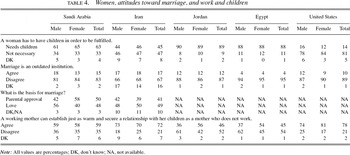
In addition to religiosity, political attitudes, and attitudes toward women, conservatism can also be measured in terms of attitudes toward marriage and gender roles (Table 4). A traditionalist perspective may consider that having children is a woman's primary source of fulfillment. If this is the case, then Saudi citizens are far less traditionalist than either Jordanians or Egyptians. Among Saudis, 33 percent did not consider it necessarily the case that a woman needs to have children in order to feel satisfied, compared with 47 percent of Iranians, 9 percent of Jordanians, 12 percent of Egyptians, and 81 percent of Americans. Likewise, in terms of attitudes toward marriage, a higher percentage of Saudis and Iranians were critical of the institution of marriage than the publics of other countries, as 15 percent of Saudis and 17 percent of Iranians considered marriage an outdated institution, compared with 12 percent of Jordanians, 4 percent of Egyptians, and 10 percent of Americans. On these measures, there is no significant gender difference.

To be sure, for Americans the statement that marriage is an outdated institution probably implies a preference for cohabitation and raising children out of wedlock. For Saudis and Iranians, however, it probably means disapproval of the current practice of marriage. In Saudi Arabia, getting married, including the mahr (dower paid by the groom to the bride) and festivities and the provision of the basic necessities to start and maintain a household, are quite expensive. In Friday sermons, preachers repeatedly discuss the extravagant cost involved in getting married. Charities are organized exclusively to help people who cannot afford marriage. And almost every bank in the kingdom provides loans for marriage. It is common to read in the newspapers that an increasing number of people are getting married late or are in no position to marry. To curb the growing cost of marriage, the government recently capped the upper limit of mahr to SR 30,000. The Saudis' critical attitude toward marriage may thus reflect their dismay at the prevalent situation rather than a negative attitude toward the institution per se.
On the question of the basis for marriage, parental approval or love, the findings of the surveys indicate that Saudis are not as conservative as one might think. About 50 percent of Saudi citizens said that marriage should be based on parental consent, and 48 percent indicated that it should be based on love. For Iran, these figures were 41 percent and 49 percent, respectively. These findings are amazing, given that both countries are officially based on gender segregation and male domination. Particularly in Saudi Arabia, where there has been no state feminism from above and the mixing of the sexes is prohibited, the fact that almost 50 percent of the respondents prefer marriage to be based on love may be indicative of the existence of a fairly strong desire for social reforms among the public. How can people fall in love without meeting one another at some public place, interacting with one another for some time, and coming into some physical, emotional, and intellectual contact? Although it is not clear how Saudis would answer this question, we may speculate that those who prefer love to be the basis for marriage also prefer the modification or even elimination of the current institution of gender segregation. However, in Saudi Arabia, men were more supportive of love as the basis for marriage than women; in Iran, the difference was not significant.
There are also variations in attitudes toward traditional gender roles. An answer to the question of whether “a working mother can establish just as warm and secure a relationship with her children as a mother who does not work” may have different interpretations, depending on the social context. In the United States, where men and women have equal rights, working outside the home may be a matter of one's choice. In the Islamic Middle East, where women are often discouraged to participate in public activities, attitudes against women's work may well be indicative of conservatism. If this is true, then Saudi citizens appear to be less conservative than Egyptians or Jordanians but more conservative than Iranians: 59 percent of Saudis agreed that a working mother can establish as warm and secure a relationship with her children as a mother who does not work outside the home, compared with 78 percent of Americans, 72 percent of Iranians, 46 percent of Jordanians, and 45 percent of Egyptians. There was no significant gender difference for Saudis (59 percent of men versus 58 percent of women) and Iranians (73 percent of men versus 70 percent of women). There were significant gender differences among Jordanians (36 percent of men versus 56 percent of women), Egyptians (37 percent of men versus 54 percent of women), and Americans (74 percent of men versus 81 percent of women).
DETERMINANTS OF RELIGIOSITY AND ATTITUDES TOWARD WOMEN AND DEMOCRACY
Religion, women, and democracy are among the most contested categories in the intellectual debates about the future of the kingdom. There are, however, variations among Saudis in religiosity and attitudes toward women and democracy. These variations may be a function of factors specific to each respondent, variations in socialization, alternative lifestyles and cultural outlooks, and the respondents' location in the social hierarchy. While it may not be possible to measure all of these factors in survey research, we focus on some of the key social attributes and beliefs of the respondents in order to explain these variations.
Determinants of Religiosity
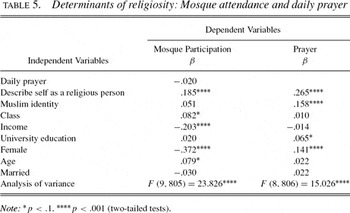
Religiosity can be defined in varied ways, including the degree of one's adherence to religious beliefs, how such beliefs shape one's identity or affect daily activities, and the extent of participation in religious rituals, such as attending religious services at the mosques or performing daily prayers. Performance of rituals, however, may be a better indicator of religiosity than beliefs. Presuming that ritualistic practices presuppose beliefs but beliefs do not necessarily lead to such practices, we use two indicators of religious rituals as measures of religiosity: participation in mosque services (mosque attendance) and daily prayer:

The determinants of religiosity may include such factors as one's definition of self as religious (self-described religiosity), identification with religion (above all Muslim), age, education, gender, social class, income, and marital status. To explain the social determinants of religiosity, two statistical models are advanced. In the first model mosque attendance is the dependent variable and in the second model daily prayer.
Education, gender, marital status, identity, and self-described religiosity are measured as dummy variables (education: 0 = below university education, 1 = university education; gender: 0 = female, 1 = male; marital status: 0 = married, 1 = single, widowed, or separated23
In the sample, 564 (55 percent) were married, 29 (3 percent) were divorced, 10 (1 percent) were separated, 15 (1.5 percent) were widowed, and 408 (40 percent) were single.

Model II is

The results of regression analysis are reported in Table 5. In Model I, self-described religiosity, class, and age have positive effects, whereas income and female status have negative effects on mosque attendance. That is, describing themselves as religious people, members of the upper classes, lower income groups, men, and older people attend mosques more often than those who describe themselves as not religious people, members of the lower classes, higher income groups, women, and younger people. Given that Saudi society discourages the participation of women in public functions, it is natural that women attend religious services significantly less frequently than men. Daily prayer, however, is positively affected by self-described religiosity, Muslim identity, university education, and female gender.

That university education has no significant effect on mosque attendance and a weak effect on daily prayer may modify the validity of the critics of the Saudi educational institutions as promoting conservatism, and at one remove, extremism. Although our data cannot assess the quality and the orientation of the institutions of higher learning in the kingdom, and it may well be the case that they were organized to promote a conformist, or even intolerant, culture, they do not have the effect of making people more religious. In contrast, it can be stated that university education does not make Saudis less religious either.
Gender is the only nonattitudinal variable having strong effects on both prayer and mosque attendance. On mosque attendance, only income has a strong negative effect, while class and age have weak positive effects. On prayer, only education has a weak positive effect. Thus, if we define mosque attendance as the public side of religion and prayer as the private side, then there appears to be two different unrelated religious orders in Saudi Arabia. On the public side, religion is the realm of men. On the private side, it is primarily the realm of women.24
For similar views, see Eleanor Abdella Doumato, Getting God's Ear: Women, Islam and Healing in Saudi Arabia and Gulf (New York: Columbia University Press, 2000).
Determinants of Attitudes Toward Women
People's value orientations toward gender relations cover a wide range of topics. Tables 3 and 4 present people's attitudes toward women and work outside the home, university education, political leadership, and the family. These orientations are interrelated. For example, where a woman has the opportunity to earn a university degree and obtain employment outside the home, she has more resources to change the nature of power relations in the family to her favor. She may question the norm of wife obedience and reject the institution of polygamy. Alternatively, a familial context that promotes egalitarianism may also encourage women to obtain a university education and seek employment outside the home.
Because the family is the immediate context of early gender socialization, explaining attitudes toward polygamy and wife obedience is important. This is so because such attitudes may give legitimacy to the practice of polygamy and the institution of male domination in the family. Understanding the social determinants of these attitudes provides insights into the social structure of Saudi society and the process of cultural change.
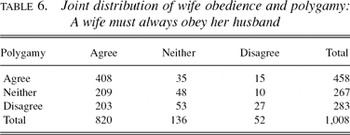
We propose that variations in these attitudes may be related to variations in the respondents' age, gender, education, class, income, marital status, and religiosity. We also propose a causal relationship between attitudes toward polygamy and attitudes toward wife obedience. Although there are degrees of reciprocal causations between these two variables, we propose that there is a higher likelihood that the belief in polygamy presupposes the belief in wife obedience than vice versa. This may be true because, among Saudi citizens, attitudes in favor of wife obedience were much more widespread than attitudes in favor of polygamy. According to Table 3, 81 percent of Saudi citizens believe that a wife must always obey her husband whereas 45 percent agree with polygamy. Furthermore, considering the joint distribution of these two variables in Table 6, the probability (prob.) that a randomly selected individual from the sample believes in wife obedience (obed.) given that that individual already believes in polygamy (polyg.) is .89:

However, the probability that a person believes in polygamy given that that person believes in wife obedience is .50:

The corollary of this argument also holds. That is, the probability that a person disagrees with wife obedience given that the person disagrees with polygamy is .095:

In contrast, the probability that a person disagrees with polygamy given that that person disagrees with wife obedience is .52:

Based on these propositions, we test two statistical models. Model I is

Model II is


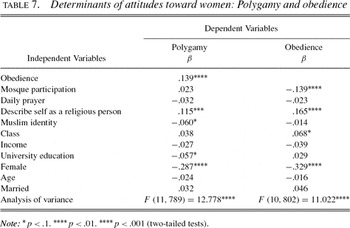
The regression results for both models are reported in Table 7. In Model I, obedience, self-described religiosity, Muslim identity, university education, and gender have significant effects on attitudes toward polygamy. Obedience and self-described religiosity have positive effects on attitudes toward polygamy, while Muslim identity, university education, and female gender have negative effects. Income, class, age, mosque attendance, and daily prayer have no significant effect on attitudes toward polygamy.

In Model II, self-described religiosity and class have positive effects on attitudes in favor of wife obedience, while mosque attendance and female gender have negative effects. Other factors like daily prayer, Muslim identity, income, university education, age, and marital status have no significant effect on attitudes toward wife obedience.
One of the most interesting findings of both models is that, except for self-described religiosity, other indicators of religiosity have no positive effect on the attitudes that promote gender hierarchy. Muslim identity has a negative effect on polygamy, while mosque attendance has a strong negative effect on wife obedience. These findings raise questions about the connection between the attitudes in favor of gender hierarchy and religiosity in the kingdom.
Determinants of Attitudes Toward Democracy
The existence of considerable support for democracy among the Saudi public is enigmatic, given that the country's religious and political orders rest on views that are inimical to the formation of a democratic form of government. Furthermore, unlike other Middle Eastern countries, the kingdom has no prior historical experience of secularism and liberal nationalism. To explain how a large section of Saudi citizens arrived at democracy as an ideal form of government, we first try to identify and operationalize the variables that are proposed in the literature as causal factors shaping the individual's attitudes toward democracy. Using the least square regression techniques, we then test the significance of each of these variables in explaining the respondents' attitudes toward democracy as an ideal form of government.
Private Ownership
Scholars have long debated the relations of the institutionalization of private property to the rise of democracy. The signing of the Magna Carta by King John of England in 1215, although an attempt by the nobility to control the king's power of taxation, is considered the beginning of political pluralism and democracy in that country. Over the years, this event is believed to have given rise to the intellectual and institutional foundation for the development of democracy and the rule of law. Other social scientists have further stressed the connection between capitalism and freedom.25
Milton Friedman, Capitalism and Freedom (Chicago: University of Chicago Press, 2002).
See, for example, Peter Evans, Dependent Development: The Alliance of Multinational State and Local Capital in Brazil (Princeton, N.J.: Princeton University Press, 1979); Barrie Hendersen, “Chilean State after the Coup,” Socialist Registers (1977): 171–241; Guillermo O'Donnell, “Reflections on the Pattern of Change in the Bureaucratic-Authoritarian State,” Latin American Research Review 13, 1 (1978): 3–38.
Although this article cannot settle this debate, we presume that the relationship between attitudes toward private property and democracy depends on the nature and the public standing of the property owning classes as well as the state's role in the economy. If the state heavily intervenes in the economy to serve the interests of the ruling elite and high-ranking bureaucrats, we may propose that the movement for democratic change is associated with the demand for privatization. Conversely, if the state is aligned with the property owning classes, the demand for democratic change may also be associated with critical attitudes toward these classes. As a result, the idea of privatization may have little appeal to the supporters of democracy.
We consider two factors in assessing the relationship between private property and democracy. One is attitudes toward private property in contradistinction to government ownership. The other refers to the effect of social class on democracy, which will be discussed later. To examine the significance of attitudes toward private property in fostering attitudes toward democracy, two items in the survey questionnaire are selected for analysis. The first tabs the respondents' stand in favor of private ownership or government ownership:

Because democracy entails taming the state and given the Saudi state's extensive control of the economy, we propose that attitudes in favor of democracy are promoted by the desire to relax the state's control of business and industry and expand private ownership. That is, the more a person favors private ownership of business and industry, the more that person tends to agree with democracy as the best form of government. Second, to ensure that favorable attitudes toward private ownership are not confounded by poor state performance, the respondents' assessment of the public sector performance is included in the analysis. This variable may also independently shape the public's political views. Frederick Weil, for example, analyzed the effect of people's subjective assessment of the economy on political support and discovered that “performance positively affects political confidence but not support for democracy.”27
Frederick D. Weil, “The Sources and Structure of Legitimation in Western Democracies: A Consolidated Model Tested with Time-Series Data in Six Countries since World War II,” American Sociological Review 54 (1989): 694.

Tolerance
The development of democracy is linked to citizens' tolerance of alternative viewpoints. Tolerance is necessary for a stable and sustained functioning of political pluralism, where diverse viewpoints are publicly expressed and debated without the outbreak of serious destabilizing conflict. Citizens' intolerance, by contrast, is inimical to democracy because it constrains individual political liberty and promotes conformist culture. Tolerance of other groups promotes the democratic principle of majority rule and minority rights.28
James L. Gibson, “The Political Consequences of Intolerance: Cultural Conformity and Political Freedom,” American Political Science Review 86 (June 1992): 338–56.
ICG, Can Saudi Arabia Reform Itself? 21–22; Okruhlik, “Networks of Dissent,” 26.
Prokop, “Saudi Arabia,” 79–81.
Tolerance is measured in such a variety of ways as one's attitudes toward Jews and members of other religious groups, communists, immigrants, and homosexuals with respect to whether members of these groups should be allowed to hold office, and as tolerance of least-liked groups for individual respondents.31
For discussions of these measures, see James L. Gibson, “Alternative Measures of Political Tolerance: Must Tolerance Be ‘Least-Liked’?” American Journal of Political Science 36 (May 1992): 560–77; John L. Sullivan, George E. Marcus, Stanley Feldman, and James E. Piereson, “The Sources of Political Tolerance: A Multivariate Analysis,” American Political Science Review 75 (March 1981): 92–106.
There was little variation in the responses to the homosexuality question. Eighty-six percent marked “1,” and 6 percent marked “2” on a 10-point scale (“1” meaning “never justifiable,” and “10” meaning always justifiable).
Religious tolerance is important because the religious institutions in the kingdom are monopolized by the Wahhabi school, whose founder did not even recognize Shi
ism, one of the two main sects in Islam. The Shi
is in Saudi Arabia are treated less favorably than they are in many other Persian Gulf states.
33On the treatment of Shi
is in the kingdom, see Graham E. Fuller, The Arab Shi'a: The Forgotten Muslims (New York: St. Martin's Press, 1999); Michael Scott Doran, “The Saudi Paradox,” Foreign Affairs 83 (January–February 2004): 35–51; al-Rasheed, “The Shi'a of Saudi Arabia,” 121–38; Prokop, “Saudi Arabia,” 81.
It has been argued that approval of divorce may lie at the core of value transition in the direction of modernity and political democracy: see Pippa Norris and Ronald Inglehart, “Islamic Culture and Democracy: Testing the ‘Clash of Civilizations’ Thesis,” in Human Values and Social Change: Findings from the Values Surveys, ed. Ronald Inglehart (Leiden: E.J. Brill, 2002), 18.
In addition to the data showing a negative correlation between approval of divorce and support for polygamy (r=−.1, p<.001), a study in Saudi Arabia concluded that the practice of polygamy is the principal cause of divorce in the kingdom: see BBC News, 30 April 2001, available at: news.bbc.co.uk/1/hi/world/middle_east/1304886.stm.

Western Culture
To what extent are prodemocracy attitudes affected by the seriousness of the Western cultural threats facing the nation in the public perception? In what way does this perception shape their attitudes toward democracy? The past experience of liberal nationalism in Islamic countries displayed an affinity between the support for democracy and favorable attitudes toward the West. Muslim intellectual leaders in such diverse countries as Algeria, Egypt, India, Iran, and Syria around the turn of the 20th century considered it appropriate to emulate the Western model of democracy and constitutionalism. Nowadays, the West enjoys little popularity in Islamic countries. Values surveys in Egypt, Iran, and Jordan, however, indicated that critical attitudes toward the West are inversely related to the ruling regime's orientation toward Western countries. In Iran, where the state has an avowedly anti-Western orientation, the public appears to be much less concerned with Western cultural invasion than either the Egyptian or Jordanian public, where the ruling regimes are American allies.36
See Mansoor Moaddel and Taghi Azadarmaki, “The Worldviews of Islamic Publics: The Cases of Egypt, Iran, and Jordan,” in Inglehart, Human Values and Social Change, 69–90.
A similar logic might be applicable to Saudi Arabia. Given that the kingdom does not recognize democracy, the supporters of democracy are naturally in the opposition.37
By pushing forward the idea of the formation of a constitutional monarchy as the only way for the kingdom to establish political stability and defeat extremism, some of the prodemocracy groups may portray themselves as the regime's stronger supporters. Nevertheless, there is no denying that the regime considers these groups a threat. For example, the group of reformers who were involved in preparing the petition calling for a constitutional monarchy were summoned to a stormy meeting with the interior minister, Prince Nayef, during which they were reprimanded and, in some cases, threatened with prison sentences. A few weeks later, Crown Prince Abdullah delivered a speech that mixed support for gradual change with a thinly veiled warning to more activist reformers. In March 2004, the regime went a step further, arresting a dozen proreform activists: ICG, Can Saudi Arabia Reform Itself? 18.
Every country faces a number of regional and international problems. To what extent do you consider cultural invasion by the West to be (1) very important (very serious), (2) important,(3) somewhat important, (4) least important, or (5) not an important problem?
Laws According to the People's Wishes Versus the Shari a
How do attitudes toward making laws according to the people's wishes and attitudes toward the shari
a relate to democracy? The modernization theory considers the separation of religion and the state not only an inevitable outcome of modernity, but also a precondition for the development of democratic rule making. Rooted in the Europe-centered rationalist school, to which belonged Thomas Hobbes, Voltaire, David Hume, James Mill, Jeremy Bentham, and J. S. Mill, among others, this theory is part of the notion of a universal history of social evolution in which religion was to wither away as society moved through the evolutionary process, fueled by progress in science and technology. This perspective is further systemized in different manners in the works of Durkheim, Marx, Weber, and, later in the mid-20th century, Parsons. From this perspective it follows that the modern democratic individual prefers lawmaking based on the people's choices and the separation of religion and politics. The followers of the modernization theory in Islamic countries have argued that because the shari
a laws are “discovered” or “recognized” by religious scholars and not enacted by the people's representatives, they are therefore inimical to democracy.
38See Nadav Safran, Egypt in Search of Political Community (Cambridge, Mass.: Harvard University Press, 1961).
In the 1970s, researchers began to question the modernization theory, arguing that it applies only to the experience of the West39
John R. Gillis, “Political Decay and European Revolution, 1789–1848,” World Politics 22 (1970): 344–70.
Elbaki Hermassi, “Toward a Comparative Study of Revolutions,” Comparative Studies in Society and History 18 (1976): 211–35.
Charles Tilly, “Does Modernization Breed Revolution?” Comparative Politics 5 (1973): 425–27.
For a discussion of the debates on colonial history, see Gyan Prakash, “Subaltern Studies as Postcolonial Criticism,” American Historical Review 99 (December 1994): 1475–90; Florencia E. Mallon, “The Promise and Dilemma of Subaltern Studies: Perspectives from Latin American History,” American Historical Review 99 (December 1994): 1491–515; and Frederick Cooper, “Conflict and Connection: Rethinking Colonial African History,” American Historical Review 99 (December, 1994): 1516-45. See also Timothy Mitchell, Colonising Egypt (Cambridge: Cambridge University Press, 1988).
Hourani, Arabic Thought, 139–40; Hadi Hairi, Shi'ism and Constitutionalism in Iran (Leiden: E. J. Brill, 1977).
We argue that the relationship between religion and democracy in the Islamic world is historically contingent, depending on the ulama's relationship with the ruling regime. When they were tied to an authoritarian regime, the democratic movement tended to display distinctly anticlerical and secularist attitudes, as was the case in late 19th-century Iran and Turkey. The experience of the democratic movement in Saudi Arabia may parallel these cases, where the Muslim clerics are allied with the regime and oppose democracy. Thus, within the specific historical context of Saudi Arabia, where the conservative religious establishment purportedly defends the shari
a and the status quo, we can propose (1) a negative relationship between attitudes toward the shari
a and attitudes toward democracy; and (2) a positive relationship between attitudes toward laws according to the people's wishes and attitudes toward democracy.
Two questions measure the respondents' assessments of a good government—one that makes laws according to people's wishes or one that implements the shari
a only.
Which of these traits is (1) very important, (2) important, (3) somewhat important, (4) least important, or (5) not important for a good government to have?
1. Make laws according to the people's wishes
2. Implement only the laws of the shari
a
Religiosity
In the Saudi context, religiosity may indicate adherence to traditional values that are unfavorable to democracy. We use all four of the indicators of religiosity (mosque attendance, daily prayer, self-described religiosity, and Muslim identity) to assess their effects on attitudes toward democracy.
One may argue that mosque attendance subjects the individual to the conservative preaching of the clergy, reinforcing the belief in the supremacy of the religious laws over all other laws. Likewise, daily prayers would strengthen a person's attachment to religiously sanctioned values and norms. Finally, self-described religiosity and Muslim identity may be indicative of adherence to conservative religious values that are contrary to the alternative principle of organizing one's political community. All four of these measures, we thus propose, have negative effects on attitudes toward democracy.
Education
Modern education may promote favorable attitudes toward democracy insofar as it enhances people's awareness of the world's cultural diversity, the temporal nature of scientific discoveries, and the limits of the monolithic discourse promoted by religious institutions—all encouraging tolerance of alternative viewpoints and pluralism. Thus, the higher is one's education, the more favorable is one's attitude toward democracy.
Social Class
The effects of social class on democracy may vary according to social and historical context. Members of upper classes have easier access to education than lower classes. Through travel or involvement in modern activities, they are also exposed to cultural diversity and become familiar with democratic ideas. At the same time, wealthy individuals may benefit from the existing regime, and democracy may undermine their interests. This is especially true under the Saudi rentier economy, where ties to the ruling elites are keys to economic success.
The effects of class may also be a function of the way this variable is measured. In this study, we measure class in terms of the respondents' self-assigned class membership and monthly household income.
Age, Gender, and Marital Status
The variables of age, gender, and marital status are also included in the analysis in order to assess intergenerational, gender, and marriage effects on attitudes toward democracy.
Model
We use these variables to formulate a statistical model on democracy—attitudes toward Western culture, privatization, public-sector performance, tolerance, laws according to the people's wishes, shari
a, mosque attendance, daily prayer, self-described religiosity, Muslim identity, class, income, education, gender, marital status, and age.

Findings
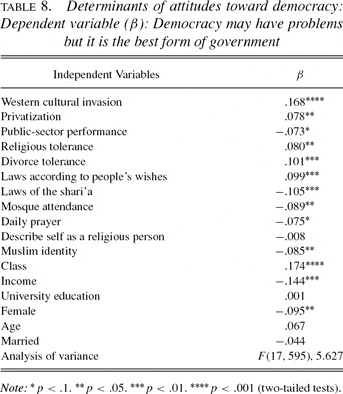
Table 8 shows the results of the regression model. Except for self-described religiosity, education, age, and marital status, all other variables have significant effects on attitudes toward democracy.44
About 18 percent of the responses to the question of democracy were “don't know” and thus excluded from analysis. To assess whether this exclusion affected the validity of the findings, we created a weight variable as an inverse function of the predicted probability of the responses to the question of democracy. The predicted probability was obtained by creating a dummy variable: “don't knows” were coded as “0,” and other responses were coded as “1.” Then, using binary logistic regression technique, this dummy variable was regressed on all of the independent variables to assess whether the characteristics of the respondents affected the likelihood of responding. Each case was then automatically given a predicted value, and the weight variable was calculated as an inverse function of these predicted values. The results of the regression analysis using the weight variable were not significantly different from the results not using the weight variable. Therefore, “don't knows” did not significantly affect the findings.

Attitudes toward privatization and public-sector performance also have significant effects on attitudes toward democracy. People who favor the expansion of private ownership of business and industry in opposition to government ownership tend to favor democracy. Likewise, people who give a poor mark to public-sector performance favor democracy. That is, the prodemocracy attitude is critical of the government not simply because it is authoritarian but also because of its poor performance. Both measures of tolerance (religious tolerance and tolerance of divorce) are also positively connected to attitudes in favor of democracy.
Support for making laws according to the people's wishes has a positive effect on attitudes toward democracy, while support for implementing the shari
a has a negative effect. Except for self-described religiosity, all of the other three indicators of religiosity have negative effects on attitudes toward democracy. These findings are remarkable within the religious and political context of Saudi Arabia. Because four of the five religion-related variables (support for the shari
a, mosque attendance, daily prayer, and Muslim identity) have negative effects on attitudes toward democracy, one may conclude that religion in the kingdom is a conservative and counterdemocratic force.
The effects of class and monthly household income on attitudes toward democracy are contradictory. Whereas self-rated class membership has a positive effect on democracy—that is, the higher one's self-reported class background, the more favorable one's attitudes toward democracy—monthly household income has negative effects on democracy. That is, people with higher incomes tend to have less favorable attitudes toward democracy than people with lower incomes. The positive effect of class on democracy may be indicative of the emergence of a new (subjectively defined) influential class, whose members are dissatisfied with the government. This conclusion is reinforced considering that about 80 percent of the respondents from the upper classes agree that democracy is the best form of government, whereas this figure is about 71 percent for those who identify themselves as members of the middle class, 61 percent for the working class, and 40 percent for the lower class. The effect of income on attitudes toward democracy is negative. This may be a consequence of the Saudi rentier economy. According to the rentier economy model, a country's reliance on substantial external rent in the form of the sale of oil, transit charges (Suez Canal), tourism, or remittance funds (Jordan) has far reaching political, social, and cultural outcomes. One such outcome is that the work–reward nexus is not the key feature of economic activities and accumulation of wealth, where wealth is the end result of the individual involvement in a long, risky, and organized production process. Wealth is rather accidental, a windfall gain, or situational, where citizenship becomes a source of economic benefit. To acquire wealth requires different types of subjective orientation, which Hazem Beblawi calls “rentier mentality” and “rentier ethics.” Noneconomic criteria, such as ties to the ruling elite, are the key determinants of income. Rentierism thus reinforces the state's tribal origins, because it regenerates the tribal hierarchy consisting of varying layers of beneficiaries with the ruling elite on top, in an effective position of buying loyalty through their redistributive power. As the state is not dependent on taxation, there is far less demand for political participation.45
Hazem Beblawi and Giacomo Luciani, ed., The Rentier State (London: Croom Helm, 1987).
Our findings also show that men are more supportive of democracy than women. Although women may benefit considerably from democratization of Saudi Arabia, the current gender difference may be indicative of either women having a relatively lower level of political awareness, being discouraged to participate in the public political debate as a result of the rigid system of gender segregation, or having little interest in a democracy that is dominated by men. With the increasing involvement of women in the public demand for democratic change, we may expect a change in this relationship. Finally, that university education has no significant effect on attitudes toward democracy can be interpreted differently. On the one hand, it is consistent with the view that the Saudi educational institutions have failed to promote democratic ideas because of their anti-Western biases, fear about dealing with non-Muslims, and lack of appreciation of the varieties of schools of thought in Islam.46
See Doumato, “Manning the Barricades,” 230–47.
CONCLUSIONS
The foregoing analysis displays a picture of the world view of the Saudi public that is different from the view of the society portrayed by the action of militant Islamic groups. Although by Western standards Saudi Arabia is a conservative society, compared with other Islamic countries like Egypt and Jordan, Saudis are not as conservative as one might expect. In fact, they are less religious than either Egyptians or Jordanians. In terms of their attitudes toward marriage, almost half of Saudis prefer love, rather than parental approval, as the basis for marriage. A larger percentage of Saudis than either Egyptians or Jordanians considers marriage to be an outdated institution. On such issues as those related to religiosity, marriage, women, and work and children, Saudis are closer to Iranians than to Egyptian or Jordanian Arabs. The similarities between Saudi and Iranian citizens in terms of religiosity and their differences from Egyptians or Jordanians may indicate the effect of the state's culture on people's attitudes. It appears that the religiosity of the Iranian and Saudi states have made the publics of these societies less religious instead of making them more so.
Mosque attendance and daily prayer have multiple determinations. However, except for the strong positive effects of self-described religiosity, these two variables are affected by different sets of factors. On mosque attendance, male gender has a strong positive effect and income a strong negative effect, while class and age have weak positive effects. On daily prayer, female gender and Muslim identity have strong positive effects, while education has a weak positive effect. Because male gender is the only nonattitudinal variable that has a strong positive effect on mosque attendance and female gender has a strong positive effect on daily prayer, and because mosque attendance is the public side of religious ritual and daily prayer is the private side, gender is the crucial line dividing the public from private spheres of religious activities in Saudi society. Likewise, nonattitudinal factors have no strong effect on attitudes toward polygamy and wife obedience: only university education has a weak negative effect on attitudes toward polygamy, class has a weak positive effect on wife obedience, and indicators of religion have inconsistent effects on these variables. Again, gender is the only nonattitudinal variable that strongly affects attitudes toward gender hierarchy.
Our findings on the determinants of attitudes toward democracy are consistent with the extant sociological generalizations. Insofar as these attitudes are connected positively to attitudes toward privatization, negatively to attitudes toward public-sector performance, and positively to tolerance and attitudes toward making laws according to the people's wishes, our findings are consistent with some of the sociological generalizations that also relate the development of Western democracy to the rise of the free enterprise system, tolerance, and rational (secular) lawmaking. We may also interpret the inverse relationship between religious variables (attitudes toward the shari
a, mosque attendance, daily prayer, and Muslim identity) and democracy as qualified support for the secularization thesis on the conflict between religion and democracy.
These similarities, however, do not mean that Saudi Arabia represents an instance of the democratic path that has already been traversed by the West. Almost all of the sociological determinants of attitudes toward democracy specified in this paper make sense within the country's specific historical context. That favorable attitudes toward democracy are connected to favorable attitudes toward privatization is not because the rise of private property or privatization inherently generates democratic attitudes. It is because, for the Saudi public, both the state (i.e., the realm of politics) and the lion's share of the country's national economy are monopolized by the nonresponsive and authoritarian ruling family. Naturally, we may expect that the desire for privatization, which means dismantling the economic monopoly of the ruling family, promotes attitudes toward democracy, which means limiting the political power of the ruling regime. Furthermore, since the state is authoritarian, critical attitudes toward public-sector performance may also dictate attitudes in favor of democracy. If the state was based on a constitutional monarchy, in which the members of the economically dominant classes had a monopoly over the parliament, which was the case in Egypt in the 1930s and 1940s and Syria in the late 1940s and 1950s, critical attitudes toward the state's economic performance would go hand in hand with critical attitudes toward parliamentary politics, giving rise to various antidemocratic supranationalist ideologies.47
Israel Gershoni and James P. Jankowski, Redefining the Egyptian Nation, 1930–1945 (Cambridge: Cambridge University Press, 1995); Philip S. Khoury, Syria and the French Mandate: The Politics of Arab Nationalism, 1920–1945 (Princeton, N.J.: Princeton University Press, 1987).
Likewise, that attitudes toward democracy are inversely connected to religiosity and to attitudes toward the shari
a should not be interpreted as meaning that religion is inherently undemocratic and therefore must decline for democracy to rise. These linkages exist because of the state–cleric alliance that has dominated the country. These clerics have displayed considerable ruthlessness in suppressing dissent, repressing religious minorities, and blocking any change in the culture that might undermine their institutional power. It is thus natural to expect favorable attitudes toward democracy correlating inversely with attitudes toward the shari
a and religiosity. In fact, there are also historical precedents showing the rise of liberal constitutional and anticlerical ideas in opposition to the state–religious alliances that were dominant in society. The rise of anticlerical constitutionalism in late 19th- and early 20th-century Iran was in response to the monarch–ulama alliance, and the rise of the liberal Arabist ideas in Syria around the same general period was due to Sultan Abdülhamid's pan Islamic despotism.
48For an analysis of the Iranian Constitutional Revolution, see Mongol Bayat, Iran's First Revolution: Shi'ism and the Constitutional Revolution of 1905–1909 (Oxford: Oxford University Press, 1991): Janet Afary, The Iranian Constitutional Revolution, 1906–1911 (New York: Columbia University Press, 1996). For analyses of Arabism and Arab nationalism, see Adeed Dawisha, Arab Nationalism in the Twentieth Century: From Triumph to Despair (Princeton, N.J.: Princeton University Press, 2003); Rashid Khalidi, Lisa Anderson, Muhammad Muslih, and Reeva S. Simon, ed., The Origins of Arab Nationalism (New York: Columbia University Press, 1991); Eliezer Tauber, The Emergence of the Arab Movements (London: Frank Cass, 1993); Zeine N. Zeine, The Emergence of Arab Nationalism (Delmar, N.Y.: Caravan Books, 1973); Philip S. Khoury, Urban Notables and Arab Nationalism: The Politics of Damascus 1860–1920 (Cambridge: Cambridge University Press, 1983); George Antonius, The Arab Awakening: The Story of the Arab National Movement (London: Hamish Hamilton, 1961); C. Ernest Dawn, From Ottomanism to Arabism: Essay on the Origins of Arab Nationalism (Chicago: University of Illinois Press, 1973); Sylvia G. Haim, ed., Arab Nationalism: An Anthology (Berkeley: University of California Press, 1962).
Democratic movements in the Islamic Middle East in the first half of the 20th century had generally a pro-Western orientation. The Saudi case appears to be departing from this historical pattern, as those who are concerned with Western cultural invasion also tend to be more in favor of democracy. This last finding can be explained in terms of Western support for the unpopular Saudi government. Furthermore, although the positive effects of class on democracy is consistent with historical experiences of liberal-nationalist movement in countries like Egypt and Syria, where merchants and landowners tended to favor parliamentary politics, the negative connection between income and attitudes toward democracy in Saudi Arabia may be due to the effect of the rentier economy because those in high-income brackets may benefit from the policies of the rentier state and thus become less favorable to democratic change.
Although the actual development of favorable attitudes toward democracy and democratic movements are shaped by the specific national historical contexts within which they are embedded, there is one element that may universally give rise to democratic movement: the human desire and struggle for empowerment to control the socioeconomic and cultural environment. For the Saudi to become empowered, it seems, there must be more tolerance in their society, less involvement of the regime and the religious police in their lives, more laws according to their wishes, and less dictating from the West.
Author's note. This study was supported by three grants from the National Science Foundation (SES-0242861, SES-0097282, SES-0139908), a grant from the Ford Foundation, and a grant from the Bank of Sweden Tercentenary Foundation. Comments by Kristine Ajrouch, Alethea Helbig, Robert Robinson, and three anonymous reviewers for IJMES, as well as the assistance of Mari Nukii are gratefully acknowledged.