Introduction
In recent years, there has been growing interest in the relationship between nicotine dependence (ND) and mental disorders. Studies from three main areas have found a strong link between ND and mental disorders. First, several studies among adults in the community (Goodwin & Hamilton, Reference Goodwin and Hamilton2002; Grant et al. Reference Breslau, Novak and Kessler2004b; Breslau et al. Reference Breslau, Novak and Kessler2004; Doescher et al. Reference Doescher, Jackson, Jerant and Hart2006) have shown links between mental disorders and ND. Second, data from clinical settings also show high rates of cigarette use and ND among patients seeking treatment for anxiety, depression, and other serious mental disorders (Glassman et al. Reference Glassman, Helzer, Covey, Cottler, Stetner, Tipp and Johnson1990, Reference Glassman, Covey, Stetner and Rivelli2001; Covey, Reference Covey1999; Williams & Ziedonis, Reference Williams and Ziedonis2004; Covey et al. Reference Covey, Bomback and Yan2006). Third, results from previous clinical studies have further suggested that co-morbid depression and anxiety disorders may be uniquely linked with ND by hindering smoking cessation efforts (Williams & Ziedonis, Reference Williams and Ziedonis2004) and associated with increased symptoms of nicotine withdrawal, compared with those without depression and anxiety disorders (Covey, Reference Covey1999; Glassman et al. Reference Glassman, Covey, Stetner and Rivelli2001). In addition, some studies have shown evidence of specificity in the link between ND and mental disorders.
Specifically, studies to date have consistently shown that among anxiety disorders, the strongest links exist between ND and panic attacks and panic disorder (Breslau & Klein, Reference Breslau and Klein1999; Isensee et al. Reference Isensee, Wittchen, Stein, Hofler and Lieb2003), although the reason for these associations is not clear. One hypothesis is that the co-morbidity arises because of respiratory abnormalities involved in both cigarette smoking (i.e. damage to the respiratory system that results from cigarette use) and panic (i.e. dyspnea and other respiratory symptoms associated with panic attacks). Another hypothesis is that smoking contributes to maladaptive emotionally salient experiences (i.e. nicotine withdrawal) and emotion regulation strategies (i.e. smoking to cope reflexively with emotional distress); both of these factors are associated with increased risk of panic above and beyond the variance attributed to ND, smoking rate and medical illness (Zvolensky & Bernstein, Reference Zvolensky and Bernstein2005; Gregor et al. Reference Gregor, Zvolensky, Bernstein, Marshall and Yartz2007). However, although studies have examined a range of mental disorders in terms of specificity in relation to ND, the mode of administration, or type of ND, has not yet been examined. Furthermore, while a number of studies have examined links between use of smokeless tobacco (UST) and mental health problems among adolescents (Rouse, Reference Rouse1989; Coogan et al. Reference Coogan, Geller and Adams2000; Tercyak & Audrain, Reference Tercyak and Audrain2002), the relationship between UST or UST-ND and mental disorders has remained largely unexamined in adults.
Although the prevalence of UST has increased in recent years (Burns et al. Reference Burns, Cummings and Hoffman1998; Baker et al. Reference Baker, Ainsworth, Dye, Crammer, Thun, Hoffmann, Repace, Henningfield, Slade, Pinney, Shanks, Burns, Connolly and Shopland2000) and evidence to date consistently suggests a link between UST and mental health problems, little is known about this link in the community relative to available knowledge on cigarette smoking and co-morbid mental disorders. In particular, although studies have shown relationships between cigarette smoking and a wide range of mental disorders (e.g. Grant et al. Reference Grant, Stinson, Dawson, Chou, Dufour, Compton, Pickering and Kaplan2004b), with the exception of substance use disorders the association between UST and the full range of mental disorders has not been examined (Rouse, Reference Rouse1989). In addition, the relative strength of the associations between non-dependent UST and mental disorders and non-dependent cigarette use and mental disorders has not been investigated. If the link between ND and mental disorders is due purely to the neurotoxic effects of nicotine on the brain, then the link between ND and mental disorders among those with UST-ND should be largely equivalent to the link between mental disorders and cigarette smoking-ND. Understanding the prevalence of mental health problems among these smokers has considerable public health significance in terms of identifying the public health parameters of this problem. In addition, given previous studies showing that both mental disorders (Eaton & Keyl, Reference Eaton and Keyl1990; Lorant et al. Reference Lorant, Deliège, Eaton, Robert, Philippot and Ansseau2003) and cigarette smoking (Barbeau et al. Reference Barbeau, Krieger and Soobader2004) are more common among various demographic segments of the population, and most commonly concentrated among vulnerable populations (e.g. lower socio-economic status, younger), it is important to understand whether and to what degree demographic differences may play a role in the relationships between mental disorders and various types of tobacco use on a population level.
The current study attempted to fill these gaps by answering four main questions in a representative sample of adults in the USA. First, the study examined whether there is an association between mode of administration of tobacco and odds of major mood, anxiety, and substance disorders among adults with ND. Second, the study investigated whether there is an association between mode of administration of tobacco and odds of mental disorders among adults without a diagnosis of ND. Third, the study examined whether the association between mode of administration of nicotine and mental disorders is specific to some mental disorders and not others. Fourth, the study investigated whether the link between mental disorders and ND, through either mode of administration, is explained by differences in demographic characteristics. We hypothesized that ND would be associated with an increased likelihood of mental disorders, regardless of the mode of administration. We also predicted that demographic characteristics would explain much of this relationship as previous studies have identified factors such as low school achievement, poor relationships with family, and low household income to be associated with an increased likelihood of nicotine use and dependence and with mental disorders (Rouse, Reference Rouse1989; Eaton & Keyl, Reference Eaton and Keyl1990; Wells et al. Reference Wells, Tien, Garrison and Eaton1994; Ellickson et al. Reference Ellickson, McGuigan and Klein2001; Juon et al. Reference Juon, Ensminger and Sydnor2002; Conwell et al. Reference Conwell, O'Callaghan, Andersen, Bor, Najman and Williams2003; Lorant et al. Reference Lorant, Deliège, Eaton, Robert, Philippot and Ansseau2003; Barbeau et al. Reference Barbeau, Krieger and Soobader2004).
Method
Sample
The sample was drawn from participants in the 2001–2002 National Epidemiologic Survey of Alcohol and Related Conditions (NESARC), a nationally representative US survey of 43093 civilian non-institutionalized participants aged ⩾18 years, sampled cross-sectionally. Details of the sampling frame are described elsewhere (Compton et al. Reference Compton, Grant, Colliver, Glantz and Stinson2004; Grant et al. Reference Grant, Stinson, Dawson, Chou, Dufour, Compton, Pickering and Kaplan2004b, c). The National Institute on Alcohol Abuse and Alcoholism (NIAAA) sponsored the study and supervised the fieldwork, conducted by the US Bureau of the Census. Young adults, Hispanics, and African-Americans were oversampled, and the study achieved an overall response rate of 81%. To adjust for non-response and selection probability, the sample was weighted and adjusted to reflect the US population from the 2000 Decennial Census in terms of age, race, sex and ethnicity. The research protocol, including informed consent procedures, received full ethical review and approval from the US Census Bureau and the US Office of Management and Budget. Detailed descriptions of the demographics of this sample can be found elsewhere (Grant et al. Reference Grant, Moore and Kaplan2003b; Hasin & Grant, Reference Hasin, Goodwin, Stinson and Grant2005; Hasin et al. Reference Hasin, Goodwin, Stinson and Grant2005).
Interviewers, training, and field quality control
Interviewing was conducted by 1800 professional interviewers from the Census Bureau using computer-assisted software with built-in skip, logic and consistency checks. All interviewers had experience with other national health-related surveys with an average of 5 years' experience, and were further trained for 10 days under the direction of NIAAA. Verification of the interviewers was conducted by regional supervisors who recontacted a random 10% of all respondents for quality control purposes. In addition, a randomly selected subset of respondents was reinterviewed with one to three complete sections of the Alcohol Use Disorder and Associated Disabilities Interview Schedule – DSM-IV (AUDADIS-IV). This served as a test–retest reliability study of NESARC measures (Grant et al. Reference Grant, Dawson and Hasin2001). In the few cases when accuracy was uncertain, the data were discarded and a supervising interviewer repeated the interview.
Measures
Diagnoses were assessed with the NIAAA AUDADIS-IV (Grant et al. Reference Grant, Dawson and Hasin2001). This instrument was specifically designed for experienced lay interviewers and was developed to advance measurement of substance use and mental disorders in large-scale surveys.
Tobacco use
Respondents were considered to have ever used cigarettes if they had smoked ⩾100 cigarettes during their lifetime, and included in these analyses were those who had additionally used cigarettes at least once in the past year (n=9913). Respondents were considered to have ever used smokeless tobacco if they had used chewing tobacco products or snuff products at least 20 times, and included in these analyses were those who had additionally used smokeless tobacco at least once in the past year (n=1058). To examine only the effect of UST and cigarettes, past-year pipe users (n=215), past-year cigar users (n=1119) and those who had used both cigarettes and smokeless tobacco in the past year (n=377) were removed from the analysis (total n=1542 due to overlap among those categories), leaving a final sample size of 41551. The test–retest reliability of the nicotine use variables and other AUDADIS-IV nicotine use measures (e.g. frequency and duration of use) were excellent, with interclass correlation coefficients of 0.83–0.84 (Grant et al. Reference Grant, Dawson, Stinson, Chou, Kay and Pickering2003a).
Nicotine dependence (ND)
Assessment of problem use is based on the unique characteristics of ND as distinct from other substances. To that end, the AUDADIS-IV used an extensive list of over 40 questions to assess ND, and obtains extensive information on time-frames of nicotine use and dependence. Diagnoses were indicated according to the DSM-IV. A respondent needed at least three out of seven criteria indicated to be diagnosed with ND (APA, 1994). Criteria for ND include: (1) need more nicotine to achieve desired effect; (2) meets criteria for nicotine withdrawal syndromes; (3) using tobacco more than intended; (4) persistent desire or unsuccessful efforts to cut down on nicotine use; (5) great deal of time spent using tobacco (e.g. chain smoking); (6) giving up activities in favor of nicotine use; (7) continued use despite recurrent physical or psychological problems likely to have been caused by nicotine use. Nicotine withdrawal was assessed as a syndrome as described by the DSM-IV based on daily use of nicotine as well as meeting at least four of eight symptoms upon cessation of nicotine use, including depressed mood, insomnia, irritability, anxiety, difficulty concentrating, restlessness, decreased heart rate, and increased appetite. Time-frames for diagnosis included the previous 12-month period and prior to the previous 12-month period.
The reliability and validity of the ND diagnosis was assessed by a random subsample of 347 respondents who were reinterviewed with the ND module up to 10 weeks after the initial appraisal (Grant et al. Reference Grant, Moore and Kaplan2003b). The procedures used were similar to those used in the German National Health Interview and Examination Survey (Schmitz et al. Reference Schmitz, Kruse and Kugler2003). The reliability of the previous 12-month (i.e. current) diagnosis was good (κ=0.63). A series of linear regression analyses was also used to validate the diagnoses by examining the association between ND and Short-Form 12v2 (an often used measure of generic quality of life that generates 10 component and profile scores assessing various dimensions of physical and mental disability) physical disability scores (Ware et al. Reference Ware, Kosinkski, Turner-Bowker and Gandek2002).
Mental disorders
Seven Axis I psychiatric disorders were assessed in the AUDADIS-IV using DSM-IV criteria. Diagnoses are made in two time-frames: the past 12 months and prior to the past 12 months. For the present analyses, current diagnoses (past 12-month) were used. Two mood disorders (major depression, and bipolar disorder) and four anxiety disorders [social phobia, specific phobia, generalized anxiety disorder (GAD), and panic disorder] were diagnosed. Dysthymia was excluded because cell sizes for specific analyses were too small. The reliability and validity of the psychiatric disorder diagnoses have been well documented, and more detailed information can be found elsewhere (Grant et al. Reference Grant, Hasin, Chou, Stinson and Dawson2004a, Reference Grant, Stinson, Dawson, Chou, Dufour, Compton, Pickering and Kaplanb; Hasin et al. Reference Hasin, Goodwin, Stinson and Grant2005).
Statistical analyses
Analyses were conducted using SUDAAN Version 9.01 to derive standard errors that account for the complex sampling scheme of the dataset (SUDAAN, 2002). Weighted percentages were obtained to describe the prevalence of mental disorders among UST and cigarette users with and without ND. Odds ratios (ORs) were derived from logistic regressions to establish the association between current tobacco status (predictor) and current (past 12-month) mental disorders. Demographic control variables included age (defined categorically as 18–29, 30–44, 45–64, and ⩾65 years), sex, ethnicity (defined as White, Black, American Indian/Alaska Native, Asian/Native Hawaiian/Pacific Islander, Hispanic), marital status (defined as married, widowed/separated/divorced), education (defined as less than high school/high school diploma/GED, above high school), and income [defined as personal income (in US$) <19 999, 20 000–34 999, 35 000–69 999, and ⩾70 000]. Clinical control variables included any mood disorder, any anxiety disorder, any personality disorder, or any non-nicotine substance disorder and were included in the model based on the outcome variable of interest. Quantity of tobacco used was also controlled in statistical models, as individuals with ND are more likely to use more nicotine products compared to tobacco users without ND. For comparison across substance, the quartiles of tobacco use quantities was calculated among users of cigarettes and UST separately. Users of cigarettes were categorized based on quartile of use compared to other cigarette users, and users of UST were categorized similarly compared to other UST users.
Results
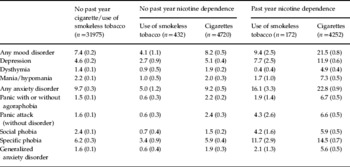
Table 1 shows the prevalence of mental disorders among those without any cigarette or UST in the past year, and among those in each group with and without ND. In general, those with ND (either smokers or UST) had a higher prevalence of mental disorders than those without ND or those without any tobacco use. UST without ND had a lower prevalence of all mood and anxiety disorders compared to those without any tobacco use, but a higher prevalence of alcohol disorders, drug abuse, and antisocial personality disorder. We used multivariable logistic models to test these associations statistically.
Prevalence of past 12-month psychiatric disorders among those in distinct past 12-month smoking/use of smokeless tobacco groupsFootnote a

a A total of 1542 respondents with past-year cigar or pipe use, or who both smoked cigarettes and chewed, were removed from analysis.
Association between UST, cigarette use, and mood disorders (past 12 months)
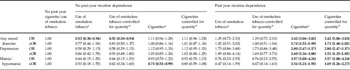
Among adults without current ND (past 12 months), UST was associated with a decreased likelihood of any mood disorder and cigarette use was associated with decreased odds of mania/hypomania. After adjusting for demographics, co-morbid mental disorders and quantity of tobacco used, there were no significant associations between UST or cigarette use and mood disorders (Table 2). There was no significant association between UST and mood disorders. Among those with ND, there was no significant association between UST and any mental disorders. Use of cigarettes was significantly associated with all mood disorders among adults with ND. These associations remained significant albeit attenuated after adjusting for demographics, mental disorders, and quantity of cigarettes consumed.
Odds of past 12-month mood disorder predicted by past 12-month smoking/use of smokeless tobacco status

OR, Odds ratio; aOR, adjusted odds ratio.
Bold values indicate p<0.05. Values in parentheses are 95% confidence intervals.
a Adjusted for age, sex, ethnicity, marital status, education, income, any substance disorder, any personality disorder, any anxiety disorder, and any other specific mood disorder other than that being tested in the model.
b Adjusted for age, sex, ethnicity, marital status, education, income, any substance disorder, any personality disorder, any anxiety disorder, any other specific mood disorder and quantity (categorized by quartiles) other than that being tested in the model.
Association between UST, cigarette use, and anxiety disorders (past 12 months)
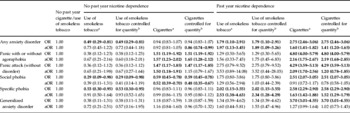
Among those with ND, UST was associated with a significantly increased likelihood of any anxiety disorder and specific phobia, compared with no UST or cigarettes (Table 3). These associations remained statistically significant after adjusting for differences in demographic characteristics, co-morbid mental disorders, and quantity used. Nicotine-dependent cigarette use was associated with all anxiety disorders in the unadjusted models, although after adjustment for demographics and co-morbid mental disorders only, the association between nicotine-dependent cigarette use and social phobia and GAD were no longer statistically significant. After further adjustment for quantity, the association between cigarette use and panic attacks was no longer significant.
Odds of past 12-month anxiety disorder predicted by past 12-month smoking/use of smokeless tobacco status

OR, Odds ratio; aOR, adjusted odds ratio.
Bold values indicate p<0.05. Values in parentheses are 95% confidence intervals.
a Adjusted for age, sex, ethnicity, marital status, education, income, any substance disorder, any personality disorder, any anxiety disorder, and any other specific mood disorder other than that being tested in the model.
b Adjusted for age, sex, ethnicity, marital status, education, income, any substance disorder, any personality disorder, any anxiety disorder, any other specific mood disorder and quantity (categorized by quartiles) other than that being tested in the model.
Among adults without current ND, UST was not significantly associated with any mental disorders after adjustment (Table 3). Cigarette use was associated with panic disorder in unadjusted and adjusted models. Cigarette use was associated with increased odds of panic attacks, but this link was no longer significant after adjusting for quantity.
Discussion
First, our findings suggest that nicotine-dependent UST is associated with a subset of mental disorders, specifically any anxiety disorder and with current specific phobia, whereas nicotine-dependent cigarette use appears to be strongly linked with a wide range of both mood and anxiety disorders. Second, the study suggests that cigarette use, in the absence of ND, is associated with increased likelihood of panic disorder, and that UST in the absence of ND is not associated with any mental disorders. Third, the links between UST, cigarette use and mental disorders do not seem to be strongly influenced by differences in demographic characteristics. To our knowledge, this is the first study to demonstrate a distinction in mode of administration of nicotine in association with mental disorders. As such, our results suggest that it is not necessarily ND per se that is associated with mental disorders, but ND through cigarette smoking. These data also importantly suggest that, even in the absence of ND, cigarette smoking is associated with some, but not all, mental disorders; specifically panic disorder.
These data provide new information on the link between nicotine use, ND, and mental disorders among adults in the community by examining the role of mode of administration in this link. Previous results showing an association between cigarette use and mood disorders have examined this relationship using measures of cigarette smoking that have not distinguished between the presence or absence of ND (Goodwin & Hamilton, Reference Goodwin and Hamilton2002; Grant et al. Reference Grant, Hasin, Chou, Stinson and Dawson2004a). These previous studies have shown associations between cigarette smoking and most mental disorders, yet our results suggest that this association is driven primarily by cigarette smoking among those with ND, and is far more limited in terms of links with non-dependent cigarette use and dependent and non-dependent UST.
The discrepancy in the link between ND, cigarette smoking, UST and mood disorders suggests that the specific chemical effects of nicotine consumption is not the mechanism through which mood disorders are linked. Our finding that adjustment for quantity of tobacco use had little impact on the majority of these relationships further strengthens this point. Previous studies have suggested that it is conceivable that neurobiological effects of nicotine on the brain, particularly desensitization of the reward pathway by overstimulation of nicotinic receptors, may lead to the onset of mood disorders and major depression in particular (Goldstein & Volkow, Reference Goldstein and Volkow2002; Weinberger et al. Reference Weinberger, Sacco and George2006). Nicotinic receptors are members of the cholinergic receptor family, such as dopamine and serotonin (Salin-Pascual et al. Reference Salin-Pascual, Alcocer-Castillejos and Alejo-Galarza2003). This overstimulation has major effects at a cellular level because the body compensates by reducing the number of receptors available; in particular, dopamine receptors (Czermak et al. Reference Czermak, Lehofer, Wagner, Prietl, Gorkiewicz, Lemonis, Rohrhofer, Legl, Schauenstein and Liebmann2004). It has been hypothesized that the high rate of depression among smokers is due to the reduction in these dopamine receptors, as it has been suggested that nicotine has an antidepressant effect (Cardenas et al. Reference Cardenas, Tremblay, Naranjo, Herrmann, Zack and Busto2002). Nicotine addiction occurs because nicotine is needed to maintain the normal stimulation of the postsynaptic cells. It remains unclear whether smokers with depression smoke to avoid mood worsening or to avoid adverse mood changes brought on by nicotine abstinence; however, our data do not provide support for either of these theories (Cardenas et al. Reference Cardenas, Tremblay, Naranjo, Herrmann, Zack and Busto2002). If it were the case that the neurotoxic effects of nicotine led to mood disorders, then the strength of the links between UST and mood disorders, and cigarette smoking and mood disorders among those with ND should be closer in magnitude, and adjustment for quantity used in each domain should have an impact. The data are not able to explain the mechanism of this link, but the association appears to be specifically related to dependent cigarette smoking. This association could be due to biological/physical reasons, such as decreased dopamine receptors or the desire to curb withdrawal symptoms (Jain, Reference Jain2003; Khurana et al. Reference Khurana, Batra, Patkar and Leone2003; Czermak et al. Reference Czermak, Lehofer, Wagner, Prietl, Gorkiewicz, Lemonis, Rohrhofer, Legl, Schauenstein and Liebmann2004), or social reasons, such as having peers who smoke or a socio-economic disadvantage (West & Sweeting, Reference West and Sweeting1994; Mitchell & West, Reference Mitchell and West1996; Tucker et al. Reference Tucker, Ellickson and Klein2002; Barbeau et al. Reference Barbeau, Krieger and Soobader2004), but, at this point, it is only possible to speculate on why this might be the case. One additional possibility is that there is a dose-dependent relationship between exposure to nicotine and mental disorders and that this explains the discrepancy in the association between non-dependent and dependent cigarette smoking and mental disorders, although this explanation would not account for the discrepancy in results for nicotine-dependent cigarette smoking versus nicotine-dependent UST. However, the only relationship significantly affected by the quantity of tobacco consumed was the association between dependent and non-dependent cigarette use and panic attacks (in the absence of panic disorder), which was no longer significant after adjusting for quantity. As such, there may be exposure to other toxins that occurs through cigarette smoking, and is dose related, that increases the risk of mental disorders. The potential toxins involved here may include ammonia, nitrogen oxides, formaldehyde, acetone, hydrogen cyanide, mercury, and trace metals (Baker et al. Reference Baker, Pereira da Silva and Smith2004), among others, and these need to be studied further for their potential impact on mental health. These toxins may be specific to cigarette use, not to any use of tobacco. It is also possible that the impact of heavy, chronic cigarette smoking (e.g. in dependence) on specific physical functions/aspects of health may help to explain the discrepancy between UST dependence and cigarette dependence and mental disorders. For instance, it may be that decreased respiratory function is associated with mental health problems, independent of the cause of respiratory impairment, as has been shown in a previous population-based study (Goodwin et al. Reference Goodwin, Chuang, Simuro, Davies and Pine2006). If this were the case, it could partially explain the specificity found here, suggesting that other potential physical consequences of dependent cigarette smoking may underlie the observed association between cigarette smoking and mental disorders. There are data to suggest that respiratory abnormalities may reflect vulnerability to panic attacks and panic disorder (Dilsaver, Reference Dilsaver1987; Pohl et al. Reference Pohl, Yeragani, Balon, Lycaki and McBride1992; Breslau & Klein, Reference Breslau and Klein1999; Johnson et al. Reference Johnson, Cohen, Pine, Klein, Kasen and Brook2000). This possibility that suboptimal respiratory function may be associated with greater anxiety and poorer mental health is consistent with the suffocation alarm hypothesis linking panic with breathing/respiratory issues. The finding that quantity of cigarettes smoked seemed to be specific to panic attacks adds further weight to the potential importance of this area. Future work in this domain may benefit from testing hypotheses from contemporary perspectives of ND that have begun to explicitly recognize the motivational bases for use (Baker et al. Reference Baker, Japuntich, Hogle, McCarthy and Curtin2006). Here, emerging work suggests that the specific motives for use may hold promise in terms of better understanding associations with psychological functioning (Gregor et al. Reference Gregor, Zvolensky, Bernstein, Marshall and Yartz2007).
Limitations and directions for future investigations should be noted. First, the cross-sectional design of this study does not permit causal conclusions regarding the direction of the observed associations. Future prospective work using longitudinal data and laboratory studies could be useful next steps for work directed at isolating the role of the method of nicotine administration in terms of its association with mental disorders. Second, the use of the AUDADIS-IV excludes psychotic disorders such as schizophrenia and post-traumatic stress disorder (PTSD), both of which are linked with high rates of tobacco use, other substance use and other mental disorders (Hughes et al. Reference Hughes, Hatsukami, Mitchell and Dahlgren1986; Reiger et al. Reference Regier, Farmer, Rae, Locke, Keith, Judd and Goodwin1990; Kessler et al. Reference Kessler, Sonnega, Bromet and Nelson1995; Cosoff & Hafner Reference Cosoff and Hafner1998; Lasser et al. Reference Lasser, Boyd, Woolhandler, Himmelstein, McCormick and Bor2000; Creamer et al. Reference Creamer, Burgess and McFarlane2001; Breslau et al. Reference Breslau, Novak and Kessler2004; Feldner et al. Reference Feldner, Babson and Zvolensky2007). As such, further investigation of these associations within studies that include data on PTSD, and have assessed life events and exposure to trauma and adverse life events, may be useful in adding to our understanding. Third, although these results are generalizable to the adult US population, it is not clear whether they are applicable internationally, especially because various cultural and economic factors affecting tobacco use can vary substantially by region. Future studies in various countries examining this issue are necessary, especially in regions where tobacco use is growing rapidly, as in China (Yang et al. Reference Yang, Ma, Chen, Zhang, Samet, Taylor and Becker2001) and developing countries (Tominaga, Reference Tominaga1986; Gajalakshmi et al. Reference Gajalakshmi, Jha, Ranson, Nguyen, Jha and Chaloupka2000). Fourth, the small cell sizes in some of the UST analyses may have limited statistical power and therefore confidence in the results of a number of specific analyses. As such, replication of these results in future studies would be useful.
The present findings highlight the relationships that exist between tobacco use and mental health problems, but show that these may be influenced by mode of administration. To date, work has focused largely on examining the main effects between tobacco use and psychopathology without regard to administration. Future investigations could usefully build upon such work by attempting more advanced tests focused on mediating and moderating processes in such linkages. For instance, variation in the effect of tobacco mode of administration on mental disorders over time by birth cohort would provide useful information as the shifting prevalence of cigarette smoking and UST by age group may reflect better public understanding of the dangers of tobacco use. A particular area of previously neglected consideration is the role of other toxins in cigarettes and their potential impact on mental, as well as physical, health. And finally, given the observed associations in this and other related studies (Goodwin & Hamilton, Reference Goodwin and Hamilton2002; Grant et al. Reference Grant, Moore and Kaplan2003b; Breslau et al. Reference Breslau, Novak and Kessler2004; McClernon et al. Reference McClernon, Hiott, Westman, Rose and Levin2006), greater degrees of clinical attention could be directed at addressing tobacco use in the context of treatment for anxiety and mood disorders.
Acknowledgements
This work was supported by grant 1 R01 DA20896 to Dr Goodwin, and grants 1 R01 DA018734-01A1, R03 DA16307-01 and 1 R21 DA016227-01 awarded to Dr Zvolensky by the National Institute on Drug Abuse (NIDA). This work was also supported by grant K23MH64736 from the National Institute on Mental Health to Dr Goodwin.
Declaration of Interest
None.