INTRODUCTION
The Jenyns's sprat, Ramnogaster arcuata (Clupeidae) is a small pelagic species that inhabits coastal and estuarine waters along the south-western Atlantic (Whitehead, Reference Whitehead1985). Although other species of the Ramnogaster genus live in freshwater environments, such as those of the Río de la Plata basin (e.g. R. melanostoma), R. arcuata apparently does not penetrate into river waters (Whitehead, Reference Whitehead1985). This species occurs from southern Brazil (Patos Lagoon, 32°S) to the Beagle Channel (54° 50′S, Whitehead, Reference Whitehead1985). Vieira & Castello (Reference Vieira, Castello and Seelinger1997) reported it as an estuarine-resident fish in the Patos Lagoon. Along the Argentine coast it has been reported in the Río de la Plata (35°S, Cousseau, Reference Cousseau and Yáñez-Arancibia1985), in Mar Chiquita coastal lagoon (37° 40′S, Cousseau et al., Reference Cousseau, Díaz de Astarloa, Figueroa and Iribarne2001), Bahía Blanca (39°S, López Cazorla, Reference Lopez Cazorla, Piccolo and Hoffmeyer2004) and Bahía Suárez, on the Patagonian coast (49° 30′S, Cousseau, Reference Cousseau1982). Post-larvae and juveniles were observed in the coastal waters of southern Patagonia (near the mouth of Coig River 51°S, and off San Sebastián Bay 53°S) during late spring (Ehrlich et al., Reference Ehrlich, Sanchez, Ciechomski, Machinandiarena and Pájaro1999). In the Río de la Plata estuary, R. arcuata is a species with scarce commercial importance that exhibits a small biomass but it is very frequent, occurring in the mixohaline region (Cousseau, Reference Cousseau and Yáñez-Arancibia1985; Mianzan et al., 2001).
The Río de la Plata, located between 35°–36° 20′S and 55°–57° 20′W, discharges into the Atlantic Ocean a mean runoff of 22,000 m3 s−1 (Framiñan & Brown, Reference Framiñan and Brown1996), generating one of the most important estuarine environments in South America. The estuary is a highly productive area, which sustains important artisan and coastal fisheries in Uruguay and Argentina. The primary production ranges between medium and elevated, with minimum values in winter (CARP, 1989), and zooplankton shows a maximum peak of abundance during spring–summer (Viñas et al., Reference Viñas, Ramírez and Mianzan1994).
The estuary is characterized by marked horizontal and vertical salinity gradients. Fresher, and therefore lighter, water flows out of the estuary in the surface layer and a deeper flow brings water from the sea into the estuary forming a ‘salt wedge’ (i.e. Mann & Lazier, Reference Mann and Lazier1996). The convergence of water masses and the strong picnoclines at the head of the salt wedge produce the accumulation and retention of plankton, and also debris (Mianzan et al., Reference Mianzan, Lasta, Acha, Guerrero, Macchi, Bremec, Seeliger and Kjerfve2001; Acha et al., Reference Acha, Mianzan, Iribarne, Gagliardini, Lasta and Daleo2003).
The most common nekton life history in estuaries involves spawning of planktonic eggs in the sea, and recruitment to estuaries as post-larvae or juveniles (Dando, Reference Dando, Potts and Wootton1984; Day et al., Reference Day, Hall, Kemp and Yáñez-Arancibia1989). Estuaries are often nursery grounds for juvenile fish. Because of the net seaward movement of estuarine waters, export of eggs and larvae from the estuaries seems to be the major problem for estuarine spawners (Boehlert & Mundy, Reference Boehlert and Mundy1988). In the Río de la Plata, however, it has been documented that several fish spawn planktonic eggs inside the estuary, most of them near the ecotone between the estuary and the river, and during the spring and summer months (Macchi et al., Reference Macchi, Acha and Lasta1996; Acha et al., Reference Acha, Mianzan, Lasta and Guerrero1999; Acha & Macchi, Reference Acha and Macchi2000; Macchi et al., Reference Macchi, Acha and Lasta2002, Reference Macchi, Acha and Militelli2003; Militelli & Macchi, Reference Militelli and Macchi2004).
The reproductive biology of the Jenyns's sprat is largely unknown. Using macroscopic and histological analysis of ovaries, we established the location of reproductive areas of this species and analysed for the first time the pattern of oocyte development and estimated fecundity and spawning frequency. Moreover, oceanographic characteristics of the spawning ground were also described.
MATERIALS AND METHODS
Sampling
Biological samples and oceanographic data were collected from two research cruises of the National Institute of Research and Development (INIDEP), carried out in June 1998 and June 1999. The sampling area was located in the Río de la Plata estuary in a bathymetric range of 7–30 m depths. All females collected (108 in June 1998 and 220 in June 1999) were measured to the nearest centimetre (total length, TL), weighed to the nearest gram (total weight, TW) and fixed in 10% neutral buffer formalin. In the laboratory, ovaries were weighed (GW) and a portion of tissue was removed from the centre of each gonad, dehydrated in methanol, cleared in xilol and embedded in paraffin. Sections were cut at approximately 5 µm thick and stained with Harris's haematoxylin followed by eosin counterstain.
Histological classification of ovaries was based on the stage of oocyte development and the occurrence of postovulatory follicles (POFs) according to Hunter & Goldberg (Reference Hunter and Goldberg1980).
During both surveys oceanographic sampling was performed by using a CTD (conductivity–temperature–depth profiler) in different oceanographic stations. Spatial distribution of bottom salinity and temperature were analysed by means of isolines.
In addition, information on monthly occurrence of this species in the estuary was analysed, which was obtained from different INIDEP research cruises performed during the last ten years.
Oocyte diameter frequency distribution and estimation of spawning frequency
Gravid ovaries (with hydrated oocytes) were selected to determinate the oocyte diameter frequency distribution. Oocyte samples (N = 500) were removed after fixation and the longest axis of each oocyte measured with an ocular micrometer.
Spawning frequency was estimated by the incidence of females with POFs, following the method described by Hunter & Goldberg (Reference Hunter and Goldberg1980) for Engraulis mordax, these fish were induced to spawn at 15°C (Leong, Reference Leong1971).
Because it was not possible to validate the POF age of R. arcuata, we decided to estimate a daily spawning proportion by using a mean percentage of POF in different degradation stages, as was described for other species (Macchi et al., Reference Macchi, Acha and Lasta1996; Pájaro et al., Reference Pájaro, Macchi and Sánchez1997; Macchi & Acha, Reference Macchi and Acha2000; Macchi et al., Reference Macchi, Acha and Militelli2003; Militelli & Macchi, Reference Militelli and Macchi2004).
Fecundity estimation
Batch fecundity (number of oocytes released per spawning) was estimated gravimetrically with the hydrated oocyte method on fixed ovarian samples (Hunter & Macewicz, Reference Hunter, Macewicz and Lasker1985), using only ovaries showing no evidence of recent spawning (i.e. no new POFs). This variable was determined for 40 females (24 from 1998 and 16 from 1999). Three pieces of ovary of approximately 0.1 g each one were sampled from the anterior, middle and posterior section of each gonad and weighed (±0.1 mg), and the number of hydrated oocytes counted. Batch fecundity was the product of the mean of hydrated oocytes per unit of ovarian weight and total ovarian weight. The relationships of batch fecundity to total length and to total weight (ovary free) were described using simple linear regression (Draper & Smith, Reference Draper and Smith1981).
Relative fecundity (number of hydrated oocytes per gram of ovary-free body weight) was calculated as the batch fecundity divided by female weight (without ovaries).
Oocyte dry weight
Gravid ovaries (N = 40) were selected to determine the oocyte dry weight (DW). Hydrated oocytes (N = 100 of each female) were removed and rinsed in distilled water, dried for 24 h at 60°C and weighed (±0.1 mg). Significance of the relationships DW vs TL and DW vs TW (ovary free) was evaluated using linear regression analysis (Draper & Smith, Reference Draper and Smith1981).
RESULTS
Spawning site and oceanographic variables
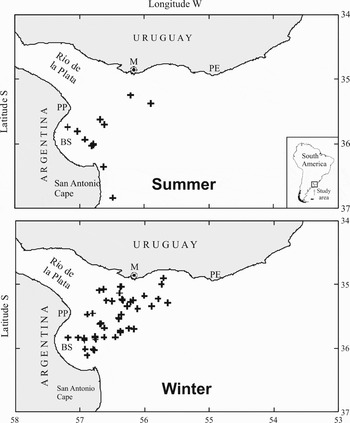
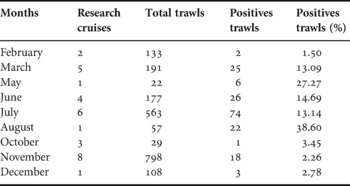
Historic information collected from different research surveys carried out in the Río de la Plata and adjacent waters between 1993 and 2004 showed the presence of R. arcuata mainly in winter months (May–August) (Table 1; Figure 1). The highest percentage of positive trawls was observed in August (38.6%), and the lowest were detected between November and February, during the summer months (1.5–2.78%). In addition to this diminishing of occurrence a displacement of R. arcuata specimens toward the southern area was observed.
Ramnogaster arcuata occurrence during different research cruises carried out during summer and winter, between 1993 and 2004 in the Río de la Plata estuary.

Ramnogaster arcuata occurrence in several research cruises carried out in the Río de la Plata and adjacent waters from 1993 to 2004.

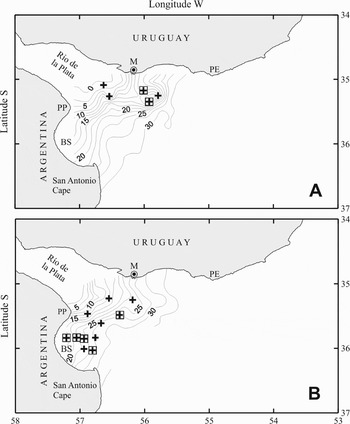
During June 1998 the Jenyns's sprat was found in bottom salinity ranges between 2.5 and 15 psu, but in 1999 this species was observed in waters with higher salinity values (between 15 and 27.5 psu), mainly in the Samborombón Bay. In general, spawning females were located near the bottom salinity front (Figure 2) in a thermal range of 12–14°C.
Bottom salinity isolines in the Río de la Plata estuary during (A) June 1998 and (B) June 1999. Crosses show spawning females of Ramnogaster arcuata and squares with a cross the trawls that were sampled for this analysis. (M) Montevideo; (PE) Punta del Este; (PP) Punta Piedras; (BS) Samborombón Bay.

Oocyte diameter distribution and spawning frequency
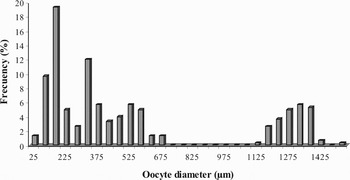
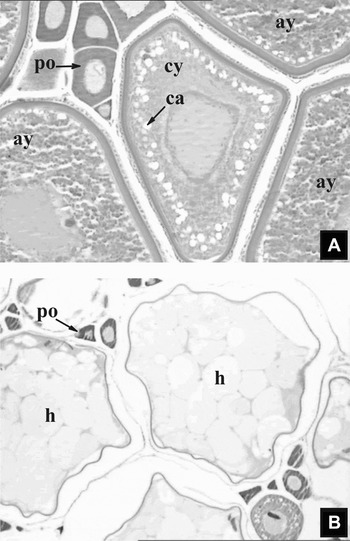
Most of the females collected during June 1998 and 1999 were in the spawning stage. The histological analysis and oocyte diameter distribution in gravid ovaries (with hydrated oocytes) of R. arcuata showed five groups of oocytes (Figure 3). The first four groups (between 25 and 725 µm) are continuous and were composed of primary growth oocytes, cortical alveolus stage, early yolked oocytes and advanced yolked oocytes (Figure 4A). The largest group corresponded to the hydrated oocytes measuring from 1125 to 1525 µm (Figure 4B). This continuous distribution from primary growth oocytes to advanced yolked oocytes could indicate a constant recruitment of pre-vitellogenic oocytes to the yolked group during the reproductive season.
Oocyte diameter distribution in gravid ovaries (with hydrated oocytes) of Ramnogaster arcuata (N = 500).

(A) Ovary in intermediate maturation, it is composed of primary growth oocytes (po), early yolked oocytes (ey) with cortical alveolus (ca) and advanced yolked (ay) oocytes; and (B) gravid ovary with hydrated oocytes (h). This continuous distribution from primary growth oocytes to advanced yolked oocytes is a characteristic pattern in multiple spawning. A, 10×; B, 4×.

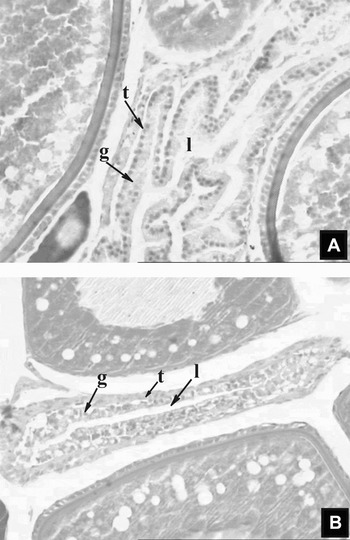
Because of the low number of samples obtained in 1998, spawning frequency was estimated only on females collected during 1999 (N = 220). The mean percentage of mature females with day-1 and day-2 POFs was 17.35%, equivalent to a spawning interval of about 6 d (Table 2). In our description, the day-1 POF has an irregular convoluted shape; the granulosa cells are aligned, and many folds and the lumen are clearly visible (Figure 5A). A day-2 POF shows a degenerative process, the linear appearance of the granulosa cell is not distinct and the lumen becomes reduced (Figure 5B).
(A) Day-1 postovulatory follicle; and (B) day-2 postovulatory follicle. t, theca cells; g, granulosa cells; l, lumen. A, 10×; B, 10×.

Number of reproductively active females of Ramnogaster arcuata sampled during June 1999 with hydrated oocytes and without postovulatory follicles (POFs) (Hyd), and POFs in different phases of reabsorption.

Fecundity
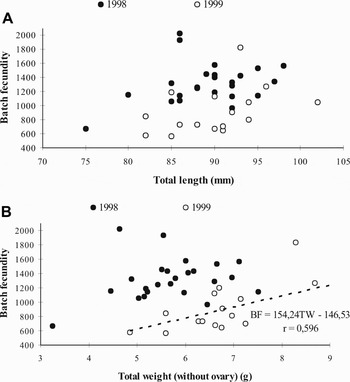
Batch fecundity (BF) estimated for females caught in June 1998 ranged from 669 to 2026 hydrated oocytes for individuals between 75 to 98 mm TL, with a mean value of 1321 (±290) hydrated oocytes. During June 1999 BF ranged from 570 (82 mm TL) to 1830 (102 mm TL) hydrated oocytes with a mean value of 919 (±328) oocytes. No significant relationships (P > 0.05) between BF vs TL and BF vs TW (without ovary) were obtained from samples collected in 1998. The data from 1999 did not show significant relationships between BF vs TL (P > 0.05), but the BF was fitted to a linear function of ovary-free body weight (P < 0.01) (Figure 6A & B).
Batch fecundity of Ramnogaster arcuata as a function of (A) total length and (B) total weight (without ovary) for 1998 (N = 24) and 1999 (dashed line) (N = 16).

Relative fecundity (RF) in 1998 ranged from 150 to 437 hydrated oocytes per female gram (ovary-free), with a mean value of 235 ± 59 hydrated oocytes; while in 1999 RF ranged from 109 to 286 hydrated oocytes with a mean of 155 ± 49 hydrated oocytes. Similar to that observed for BF, in 1999 the RF values were significantly lower (P < 0.0001) than those estimated in the previous year. Both in 1998 and in 1999 RF did not show a significant relationship with female size (P > 0.05).
Oocyte dry weight
Oocyte dried weight (DW) did not show a significant relationship with female size (P > 0.05) for both years. On the other hand, mean DW estimated for 100 hydrated oocytes in 1999 (5.30 mg) was significantly higher (P < 0.001) than that obtained for 1998 (4.56 mg).
DISCUSSION
Analysis of the R. arcuata spatial distribution, based on historical data from research cruises in the region, showed that most incidence of this species occurs during winter months in the open and low salinity waters of the Río de la Plata estuary. Scarce occurrence of R. arcuata in catches during spring and summer could be a consequence of migration toward the southern area or a displacement to shallow waters and tidal creeks around Samborombón Bay and the Uruguayan coast.
The high incidence of gravid females in June has shown spawning of R. arcuata during winter, with reproductive ground in the open waters of the estuary. Spawning takes place near the maximum horizontal salinity gradient, in coincidence with the bottom salinity front. This pattern is similar to that described for other species of the estuary, such as Micropogonias furnieri (whitemouth croaker) and Brevoortia aurea (Brazilian menhaden) (Macchi et al., Reference Macchi, Acha and Lasta1996; Acha et al., Reference Acha, Mianzan, Lasta and Guerrero1999; Acha & Macchi, Reference Acha and Macchi2000). It has been suggested that spawning in the salinity front would aid in avoiding exportation of the eggs and early larvae from the estuary, due to the putative retention generated by the water masses convergence near the head of the saltwedge. Moreover, recent outcomes from a numerical simulation model show that retentive properties of the estuary would be a consequence of estuarine response to natural wind variability acting over bathymetric features (Simionato et al., Reference Simionato, Berasategui, Meccia, Acha and Mianzan2006). Spawning site selection by R. arcuata could be explained by both arguments.
The distinctive feature of R. arcuata reproductive strategy is its spawning in winter, because all the species known to reproduce inside the estuary are spring–summer spawners, such as the whitemouth croaker Micropogonias furnieri (Macchi et al., Reference Macchi, Acha and Lasta1996; Acha et al., Reference Acha, Mianzan, Lasta and Guerrero1999), the Brazilian menhaden Brevoortia aurea (Acha & Macchi, Reference Acha and Macchi2000; Macchi & Acha, Reference Macchi and Acha2000), the black drum Pogonias cromis (Macchi et al., Reference Macchi, Acha and Lasta2002) and the king weakfish Macrodon ancylodon (Militelli & Macchi, Reference Militelli and Macchi2004). In fact, the thermal range in the area during spawning was about 10°C lower than those reported for spring–summer spawners in the same place. The results suggest that conditions of biological productivity and larval retention observed in the inner estuary during spring–summer remain in winter, at least at an extent that allows R. arcuata reproduction.
Both the distribution of oocyte diameter and the microscopic analysis of mature ovaries of Jenyns's sprat, show the continuous development of different oocyte batches from the primary growth stage till the beginning of hydration. This characteristic, joined to the detection of POF in mature ovaries, suggests that R. arcuata is a batch spawner with indeterminate annual fecundity (Hunter et al., Reference Hunter, Macewicz, Lo and Kimbrell1992). This spawning pattern has been reported for the other species that reproduce in the Río de la Plata, as mentioned above.
Spawning frequency estimated by the average of day 1 and day 2 POFs was 17.35%, which suggests that a female spawns once every six days. Validation of the postovulatory follicles was done following the method described by Hunter & Goldberg (Reference Hunter and Goldberg1980) for Engraulis mordax, which was induced to spawn at 15°C, this temperature being similar to that registered for the Jenyns's sprat spawning area (12–14°C). Nevertheless, this value should be considered a preliminary estimation because it was based on few data collected during a short sampling period. The spawning frequency was similar to that calculated for other fish in this area, being eight days for Brevoortia aurea (Macchi & Acha, Reference Macchi and Acha2000), between three and four days for M. furnieri and from three to seven days, for P. cromis (Macchi et al., Reference Macchi, Acha and Lasta2002, Reference Macchi, Acha and Militelli2003). Batch fecundity for R. arcuata ranged between 570 and 2026 hydrated oocytes and no significant relationship was observed between this variable and the female size, but BF was fitted to a linear model in relationship with TW (without ovary) in 1999. Because of the species' small size, BF values were very low compared with those estimated for other cupleoids of the Río de la Plata such as Brevoortia aurea (20,000 to 130,000 hydrated oocytes, Macchi & Acha, Reference Macchi and Acha2000). Nevertheless, RF in R. arcuata was more than twice that estimated for B. aurea (60 to 212 oocytes g−1, Macchi & Acha, Reference Macchi and Acha2000). Both batch and relative fecundity in 1999 were lower than in 1998; this difference in the number of hydrated oocytes between years may be explained by variations in its dry weight. The comparison between years demonstrated that eggs produced in 1999 were heavier than in 1998, which could compensate in part for the lower values of fecundity found in that year.
The dry weight of 100 hydrated oocytes ranged between 3.9 and 6.3 mg, and no significant relationship with female size was observed. Values of oocyte dry weight were significantly higher than those obtained for other species of the Río de la Plata area such as Pogonias cromis (3.24–4.24 mg), Macrodon ancylodon (3.3–5.1 mg), Micropogonias furnieri (1.92–2.60 mg) and B. aurea (2.75–4.36 mg). In general, big eggs possess a great quantity of yolk giving more total energy for growth and development before the larva needs exogenous nutrition, resulting in a big larva (Fuiman & Werner, Reference Fuiman and Werner2002). Little increases in size give apparent benefits in terms of flexibility at the moment of starting exogenous feeding. Some authors have proposed a connection between larval size and plankton production cycles (Bagenal, Reference Bagenal1971; McEvoy & McEvoy, Reference McEvoy and McEvoy1991). They mention that in the beginning of spring zooplankton is scarce, and larvae would obtain their food mainly from the copepods that have survived to winter, therefore the bigger larvae with more endogen feed should have better survival chances. Larvae of the Jenyns's sprat have not been studied, but high energy content of the eggs could aid in improving larval survival during wintertime, when the lowest productivity is expected in this estuary.
On the other hand, some authors have proposed that water temperature could be the main factor influencing egg size, e.g. species that inhabit cold waters have in general larger eggs (Daoulas & Economou, Reference Daoulas and Economou1986; Christiansen et al., Reference Christiansen, Fevolden, Karamushko and Karamushko1997). Moreover, Margalef (Reference Margalef1967) said that temperature frequently limits the reproductive season in a mode that is associated with the geographical origin. In this way, when species that live in boreal and cold seas move southwards they reproduce in winter, while species with a meridional origin moving northwards reproduce in summer. Therefore, it is possible that the winter reproductive pattern observed in Jenyns's sprat may be associated with an evolutionary origin in cold waters, taking into account that its geographical distribution reaches high latitudes such as those of the Beagle Channel (54° 50′S, Whitehead, Reference Whitehead1985). Moreover, R. arcuata could have adopted a winter reproductive strategy in order to avoid predation or feeding competition during the early life stages, and taking advantage of the productivity and retention of the estuarine system still present during the cold months.
ACKNOWLEDGEMENTS
This research was conducted within the INIDEP's Coastal Project. We express our gratitude to H. Christiansen and T. Carlé for the preparation of histological sections. This is INIDEP contribution No. 1478.