In 1920, the French scientific mission in Morocco was consolidated under the authority of The Institute of Advanced Moroccan Studies (Institut des Hautes Etudes Marocaines). Reflecting the importance of indigenous languages as objects of study in this imperial arena, a specialist in Arabic was selected as the agency's first director. The honor was bestowed on Louis Brunot, whose inaugural address emphasized “the scientific, political, and social interest of Moroccan dialectology.”Footnote 1 The pivotal role of linguistic study in colonial research was to be expressed consistently in the Institute's administrative structure, which across numerous organizational changes over the ensuing decades always included departments devoted to the study of Morocco's native languages.
One strand of colonial dialectology in Morocco focused on the forms of Arabic spoken by Jews. Glossed as “Judeo-Arabic,” collected through ethnographic methods, captured on the written page, submitted to sociological analysis, and subjected to historical contextualization, the Jewish dialects of North Africa had already attracted the attention of colonial researchers in Tunisia and Algeria.Footnote 2 Indeed, when Louis Brunot insisted on the importance of dialectology in the French Protectorate's scientific mission, Judeo-Arabic may not have been far from his mind: it was the new director himself who spearheaded the study of the Jewish dialects in Morocco.
Brunot's approach to Judeo-Arabic presented many of the major taxonomic postulates and methodological maneuvers by which languages in the colonies were made into conventional objects of dialectological study. In order to fit comfortably within this purview, Judeo-Arabic had to conform to certain governing ideas within dialectology as a scientific field that had emerged over the course of the nineteenth and early twentieth centuries in contrast with linguistics. Whereas the latter was increasingly focused on discovering the universal features of language as a human phenomenon, the former identified differentiated language communities and catalogued their distinctive ways of speaking. Developed and applied in both Europe and its colonies, certain dialectological axioms informed Brunot's program of study. First, dialects were taken to be wholly spoken languages, as contrasted with both classical written languages and modern vernacular ones. Second, a dialect was typically presented as a variant or version of other associated dialects, whose possible derivation from a classical written language did not threaten their irreducible orality in the present. Third, dialects were intimately connected with differentiated populations whose very identity might be so determined in linguistic terms.Footnote 3
The relative stability and salience of these operational ideas was not set in any given instance. Yet, colonial dialectology was always a science of sociolinguistic difference with two mutually constituting objects of inquiry: indigenous dialects and the native populations that spoke them. What I aim to demonstrate here is that Brunot and his colleagues treated Judeo-Arabic simultaneously as an oral dialect that bore many of the generic traits attributed to indigenous languages and as a specifically Jewish idiom that situated its speakers distinctively in colonial social hierarchies. An inquiry into the colonial study of Jewish language in Morocco can therefore extend our appreciation of how, in Joseph Errington's programmatic terms, linguistics had “collateral uses … such that language difference could become a resource—like gender, race, and class—for figuring and naturalizing inequality in the colonial milieu.”Footnote 4 While the dichotomy between orality and literacy in the construction of colonial hierarchies of language has come under productive historical and ethnographic scrutiny in recent decades, less attention has been given to the precise representational mechanics by which so-called native languages were convincingly denuded of writing. Correspondingly, the diverse and often contradictory discursive effects of descriptive linguistic projects that claimed to be transcribing spoken language for the first time have yet to be fully explored.Footnote 5
Along with other Moroccan dialects, Judeo-Arabic was represented as an exclusively spoken one and so located at a retarded evolutionary stage. Judeo-Arabic posed a particular challenge, however, since the Jewish dialect had a robust existence as a textual vernacular, written in the Hebrew script, which had circulated for centuries and found renewed vitality with the revival of Jewish printing presses in North Africa beginning in the nineteenth century.Footnote 6 Sustaining the portrait of Judeo-Arabic orality, therefore, required the neutralization of Jewish literacy and the discounting of Judeo-Arabic writing in Morocco. In this regard, the colonial study of Judeo-Arabic exemplifies the intricate exertions required to persuasively accomplish what Judith Irvine and Susan Gal have identified as the process of erasure, in this case of writing and reading practices, in transforming complex language situations into matrices of clear sociolinguistic identity.Footnote 7
At the same time, colonial dialectology contributed to the positioning of Jews as a differentiated social category, endowed with specific language abilities, attitudes, and affinities. Contrasting with claims about the irrevocable link between language and identity among most natives in Morocco, Jews were viewed as preternatural polyglots without a fixed linguistic identity or an authentic language of their own. Whereas other Arabic and Berber dialects in Morocco were supposed to be cemented to their speaking populations,Footnote 8 it was the natural progression of Jews away from Judeo-Arabic to French that came to be emphasized in colonial dialectology. Jewish linguistic difference referred, therefore, not primarily to the distinctiveness of their Arabic dialect but rather to their eagerness, ability, and opportunity to escape it. At odds with a colonial ideology that elsewhere aimed to exploit linguistic difference as it was putatively found, Judeo-Arabic dialectology in Morocco focused equally on the process of language shift in which the possible Jewish attraction to modern Hebrew, with its Zionist implications, was barely recognized against the overwhelming pull of a Francophone future. Figuring Jews as especially susceptible to the French civilizing mission (mission civilizatrice), the study of Jewish language in Morocco contributed to the colonial construction of Jews as an interstitial social category whose difference from other natives might be exaggerated and whose distance from the colonizer could be moderated.Footnote 9
The harnessing of linguistic differences to categorize and mobilize colonial subjects entailed erasures as well. Indeed, the same form of Hebraic writing that might call into question the evolutionary inferiority of Judeo-Arabic could also suggest two competing modes of Jewish affiliation that threatened colonial projects of social classification within the native milieu. Expunged from the dialectological record, for example, was the possibility that the Hebrew script might index Jewish affection for a dialect whose spoken expression was largely shared with Muslim neighbors. At the same time, erasing the vernacular's Hebraic orthography drew attention away from a channel of potential affinity with Zionist projects that figured Jewish difference in terms that competed with French colonial interests. Not far from view, therefore, were all of the tensions and anxieties around those linguistic and social differences that could not, in fact, be easily assimilated into the categories of colonial rule.Footnote 10
It is difficult, in this situation, to locate an overarching linguistic ideology that conditioned French colonial dialectology or to identify ideas about language that were applied uniformly across native populations. Moroccan dialectology was not merely the predetermined application of established ideas about the relationship between language, mentality, society, and identity. Rather, what the descriptive study of Judeo-Arabic in Morocco reveals is that colonial dialectology was built from a tactical assemblage of competing ideas about possible relationships between languages, social categories, and imagined speakers.
JUDEO-ARABIC AND THE ERASURE OF WRITING
It had been recognized much earlier in the period of European global expansion that knowledge of local languages was necessary for communication with those natives who were to be made into colonial subjects, Christians, and collaborators.Footnote 11 As Bernard Cohn put the matter, command of native languages allowed them to become languages of command for the gathering of intelligence, the dissemination of regulations, the schooling of natives, and the spreading of the gospels.Footnote 12 In occupied Morocco (1912–1956), as elsewhere, one practical outcome of linguistic study was the publication of study guides, manuals, dictionaries, and phrase books for use by administrative interpreters, military officers, bureaucratic functionaries, teachers, industrialists, and other colonists. Brunot himself contributed directly to this endeavor and oversaw its broad coverage over Morocco's two main language groups, Arabic and Berber.Footnote 13
The production of knowledge about local languages also became a cornerstone of scientific efforts to understand the native population in ways that extended beyond the pragmatics of administrative control and missionary communication. Brunot and his colleagues approached native dialects as rich sociocultural phenomena whose formal features, semantic content, and demographic distribution betrayed much about the nature of Moroccan culture, the structure of its society, and the evolutionary level at which it was located.Footnote 14 The idea that a spoken language reflected both the cultural essence and developmental stage of a people had a genealogy that, since the Enlightenment, had stressed the culturally formative diversity of human languages and their arrangement in mutually reinforcing hierarchies of complexity, rationality, and literacy. Nineteenth-century theories of language channeled this theoretical impulse in new nationalistic directions, including the increasing codification of written vernaculars as a foundation for ethnolinguistic unity that was simultaneously being worked out in Europe and its colonies.Footnote 15 When Brunot first described his program for Moroccan dialectology in the early twentieth century, he quoted one French heir to this tradition, Ernest Renan, to make the point that “the spirit of each peoples and its language are related in the most direct way.”Footnote 16
The portrait of native languages that emerged in Moroccan dialectology also overlapped with a wider set of conceptual hierarchies that provided moral and practical justification of the colonial enterprise. By the nineteenth century, certain European philosophical and anthropological discourses had converged to identify writing as the ultimate achievement in the development of language.Footnote 17 As elsewhere in the European colonies, the absence of authentic forms of indigenous writing was taken as an index of the evolutionary backwardness of peoples who had not attained literacy as a hallmark of civilization. Accordingly, Judeo-Arabic would be situated alongside the other Moroccan dialects on the oral side of the literate divide.
Yet, when the French established formal control over Morocco in 1912, the country's Jewish population had long been situated within cosmopolitan networks of literacy that operated throughout the Mediterranean basin and beyond.Footnote 18 For centuries, written Judeo-Arabic had functioned alongside Hebrew as a medium of philosophical speculation, rabbinic regulation, hagiographic narrative, jurisprudential opinion, legal judgment, personal correspondence, commercial transaction, liturgical composition, and communal governance. Rather than operating as mutually exclusive and quarantined languages, Judeo-Arabic and Hebrew were interpenetrating idioms that shared overlapping vocabularies, comparable grammatical structures, and a common orthographic expression in the Hebrew script. After the introduction of mechanical printing in Morocco, and especially during the colonial period, Moroccan presses produced Judeo-Arabic texts in forms as diverse as newspapers, poetic broadsides, liturgical pamphlets, community announcements, and ritual treatises. Fez and Casablanca took their place alongside Tunis and Algiers as important hubs of Judeo-Arabic publishing in the region.Footnote 19
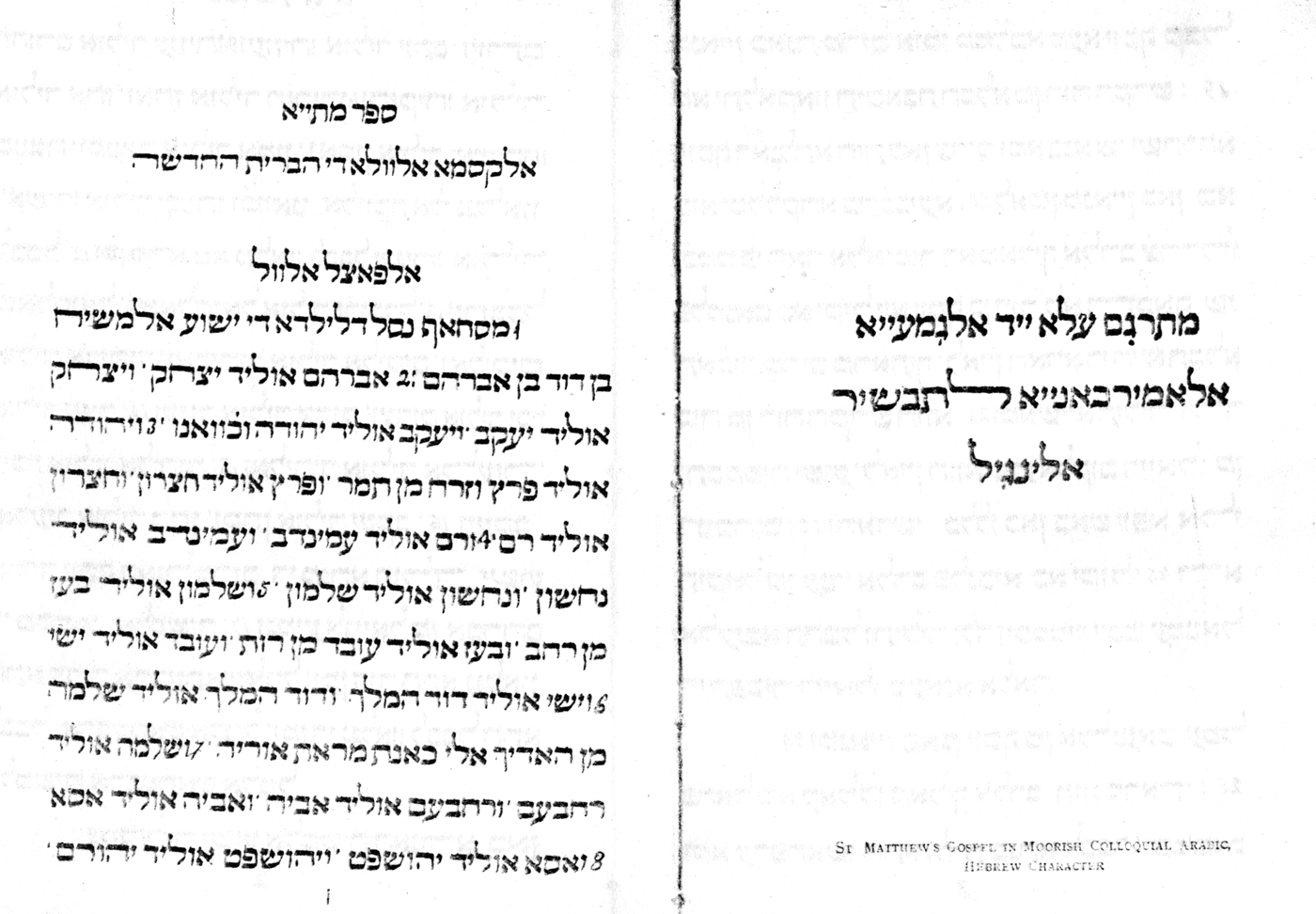
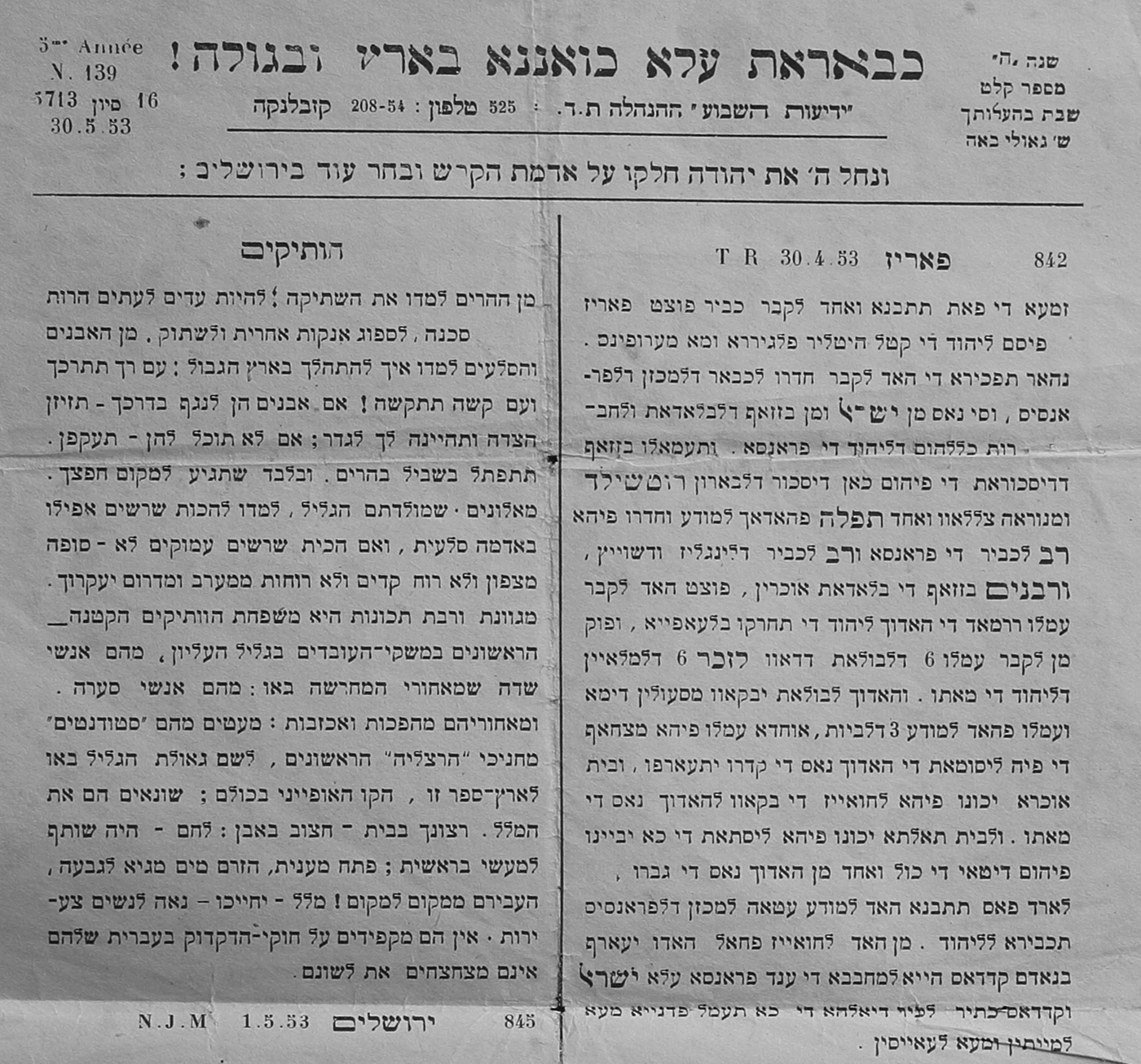
Jewish textual practices in colonial Morocco were evident to at least two external interests: Christian missionaries who translated the gospels into Judeo-Arabic, and Zionist agents who distributed newsletters in the local Jewish vernacular. Following the orthographic conventions that governed Judeo-Arabic as a written language, these evangelical and political tracts were printed in the Hebrew script in a manner that presumed a Jewish reading public and exploited the material significance of writing as a cultural form. For example, when the Evangelical Society of Britain translated the Book of Matthew into Moroccan Judeo-Arabic, the calligraphic Hebrew lettering mimicked the style found in handwritten Torah scrolls (see figure 1).Footnote 20 In a text that begins by tracing the descent of Jesus back through the Davidic lineage, the scribal orthography thus reinforced the gospel's narrative continuity with the Hebrew bible. Later in the colonial period, Zionist publications were printed in a common North African typeface used in a variety of genres—including compilations of liturgical poetry and collections of hagiographic narratives—that hearkened to biblical and liturgical themes of Jewish destiny in the Holy Land (see figure 2).Footnote 21 Despite their different aims, both the evangelical and Zionist projects exploited the robust textual culture in Moroccan Judeo-Arabic and attended to the meaning of its orthographic form.
Translation of the Gospel of Matthew into Moroccan Judeo-Arabic, 1920. Source: St. Matthew's Gospel in Moorish Colloquial Arabic (London: British and Foreign Bible Society, 1920), cover.

Zionist Newspaper in Moroccan Judeo-Arabic, 1953. Source: Khbarat ‘ala Khwana b-Eretz u-b-geulah (Casablanca: Qeren qayyemet le-Yisrael, May 30, 1953), 1. Archive: The Rabat Genizah Collection, serial no 0807, housed at the Museum of Moroccan Judaism, Casablanca, Morocco.
In contrast, when colonial dialectologists turned their attention to Jewish languages in Morocco, Judeo-Arabic writing and its associated practices of literacy were systematically erased. To be sure, literacy in Moroccan Judeo-Arabic was always distributed unevenly across lines of gender, schooling, and profession. Likewise, Judeo-Arabic writing and publishing in the region were limited by both shifting economies of rabbinic prestige, in which Hebrew was a common though never exclusive currency, and the restricted ability of entrepreneurs to sustain broader reading publics as markets for printed books, periodicals, and newspapers. Yet, the historically continuous reach of Judeo-Arabic writing meant that colonial efforts to sustain the impression of pure orality required an extended set of selective oversights, methodological contrivances, and orthographic transformations. The contours of this project were established by Brunot and his colleague, Elie Malka, in a series of articles and monographs which appeared during the 1930s, culminating with Textes Judéo-Arabes de Fès and its companion volume Glossaire Judéos-Arabe de Fès.Footnote 22 Consistent with European conventions applied to the study of spoken dialects, Brunot and Malka make clear that the edited “texts” are transcriptions of oral communication collected through ethnographic interviews and observation rather than reproductions of Judeo-Arabic manuscripts.
The Act of Erasure
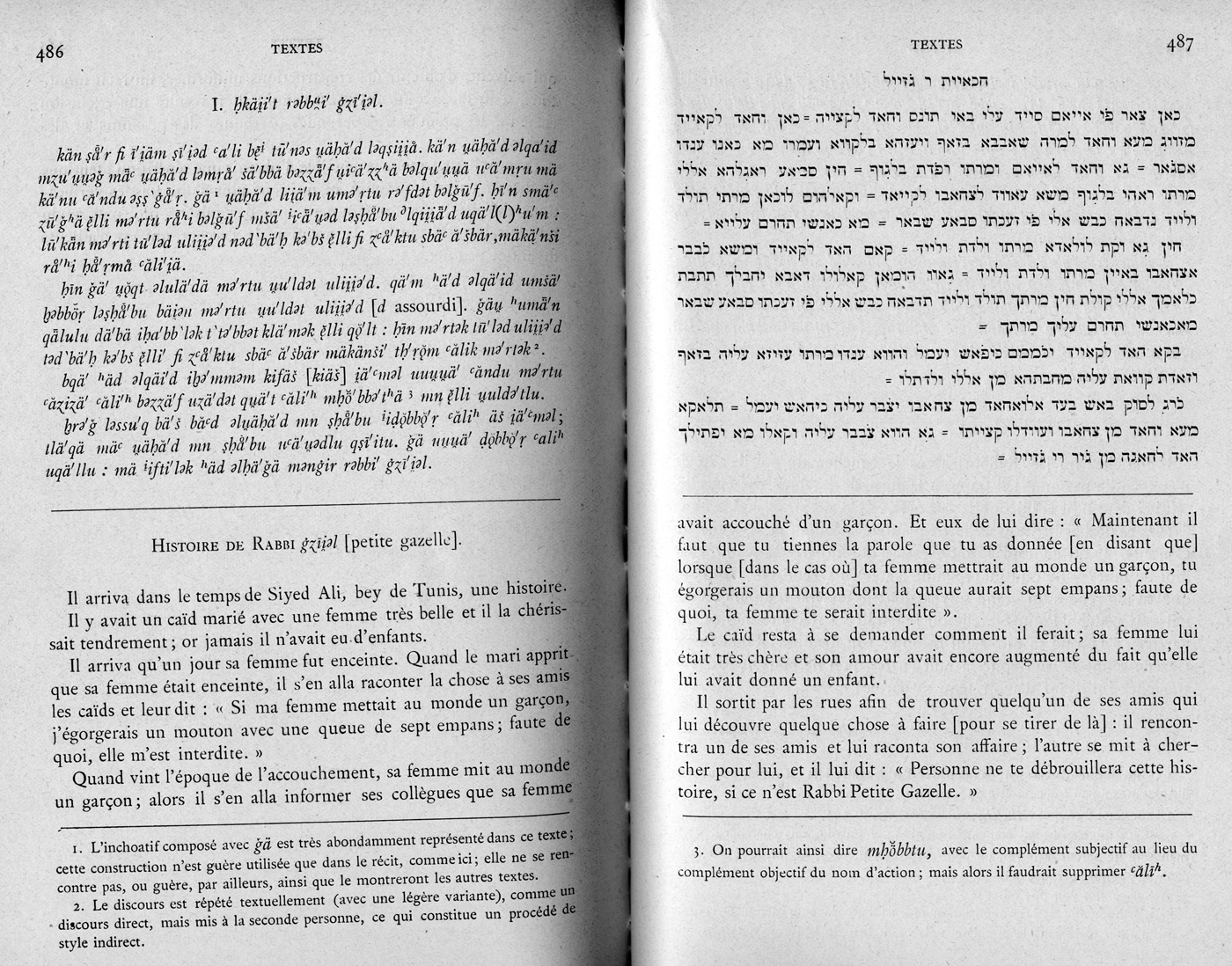
Even without accounting for Brunot's life-long attention to Moroccan languages, Elie Malka's status as a native speaker of the Jewish dialect offers enough evidence to surmise that Judeo-Arabic writing was well known to the authors. Any doubt is removed by considering that the foundational French studies of Judeo-Arabic in North Africa, on which Brunot and Malka rely as guiding models, explicitly noted that writing was the main feature that distinguished Jewish dialects from Muslim ones. Marcel Cohen had this to say in his 1912 pioneering work, Le Parler Arabe des Juifs d'Alger: “An important difference between the spoken language of the Algerian Jew (just as the other spoken Jewish languages of North Africa) and the spoken languages of the Muslim population, is that [Judeo-Arabic] is written, and written with a non-Arabic script.”Footnote 23 Furthermore, Cohen went on to enumerate the wide range of Judeo-Arabic manuscript and print genres in circulation, including personal correspondence, religious books, collections of children's stories, broadsides, songs, poems, periodicals, and newspapers. He acknowledged the value of these sources for the study of the dialect's morphology, vocabulary, and syntax, included the local rules for inscribing Arabic in the Hebrew alphabet, and provided a sample text printed in the original Hebrew letters alongside a Latin transcription (see figure 3).
Judeo-Arabic transcriptions (Hebrew and Latin), translation, and annotation by Marcel Cohen, 1912. Source: Marcel Cohen, Le Parler Arabe des Juifs D'alger (Paris: Librairie Ancienne H. Champion Éditeur, 1912), 486–87.
Although Cohen alluded to the empirical imperative and methodological utility of noting the existence of Judeo-Arabic writing, he ultimately argued that such an accounting should not overshadow recognition that literacy was fundamentally extrinsic to the spoken dialect. Rehearsing familiar colonial ideas, Cohen commented on the phonological inflexibility of the Hebrew writing system, which could not capture variations in pronunciation as accurately as the more scientifically rigorous system of Latin transcription.Footnote 24 Furthermore, the marginal status of writing appeared self-evident in both quantitative terms and qualitative terms. Curiously at odds with his own digest of numerous Judeo-Arabic genres across multiple registers, Cohen suggests that the production and readership of Judeo-Arabic literature was limited to a male religious elite. By implication, the writing itself tended toward a rabbinic register that favored the inclusion of Hebrew words not commonly used in the spoken dialect. “For all these reasons,” Cohen concludes, “knowledge about the Jewish language of Algiers must be from oral information.”Footnote 25 In this vein, he advocated for recording the speech of women and children, whose categorical illiteracy made them ideal research subjects of a dialect that he deemed to be essentially oral.
Cohen's dismissal of writing as an integral facet of the spoken language would be sustained in Moroccan dialectology. Brunot and Malka went further, however, giving no attention whatsoever to the existence of Judeo-Arabic literature. In Moroccan dialectology, Judeo-Arabic writing was not catalogued and sequestered; it was suppressed from the linguistic portrait entirely. That this methodological discrepancy did not trouble Brunot and Malka, despite their acknowledgement of Cohen's influence, reflected a more dogmatic expression of a shared disavowal of textual practices as significant phenomena in the study of North African dialects. Accordingly, Brunot and Malka also drew on the Latin-based system of transliteration, which in the absence of Hebrew transcription made writing appear foreign to the dialect. One effect of this suppression of writing was to reinforce the status of Judeo-Arabic as a native dialect whose uncompromised orality placed it on par with its Arabic and Berber counterparts, which likewise were typically rendered in the Latin script by colonial dialectologists.
The effort to locate Judeo-Arabic in the native linguistic landscape was further realized through a transcriptional strategy that had been avoided by Cohen. Insofar as the Jewish idiom was a version of Arabic, the customary script of the language from which the dialect was derived presented a second orthographic choice upon which Brunot and Malka eventually settled. In his early studies of Moroccan Arabic, Brunot did not hesitate to use the Arabic alphabet in transcribing oral texts. From the start, however, Brunot cautioned that the Arabic orthographic medium might imply too close a connection between the classical language and the spoken dialects, whose pronunciation, vocabulary, and grammar differed significantly from the standard. Cognizant that the written language of Islam had the potential to serve as a unifying symbol for the predominantly Muslim population and thus as a vehicle of anti-imperial solidarity, colonial dialectologists increasingly refrained from using the Arabic alphabet. Over the course of the colonial period, Brunot's transcription strategies would change to reflect greater insistence on the radical dichotomy between the spoken dialects and the written language. Toward the end of the Protectorate era, Brunot summarized this trend in the preface to his textbook of Moroccan Arabic: “We have clearly cut off all relations with classical Arabic…. We begin by banishing the Arabic script that was created for an ancient, oriental language.”Footnote 26
Following transcriptional methods that had been applied elsewhere in Europe and its colonies, Latin letters were adopted and adapted to develop a system of transcription that could, by the author's estimation, more accurately capture the phonetic nuances of the spoken dialect and be more immediately accessible to the cadres of French administrators, officers, and colons who required basic skills to communicate with the natives. Beyond absolving Francophone students of the need to learn an apparently torturous Oriental alphabet, the Romanization of the dialect suggested that mastery of local languages did not require full submission to native language forms.Footnote 27 Reflecting the broader political ideology of the Protectorate, Latin transcriptional strategies aimed towards the recording and maintenance of native cultural forms in terms that simultaneously marked French presence and domination. At the same time, the idea that Latin should supplant Arabic as the best orthographic form for representing the North African dialects helped to construct the difference between a universal language of the enlightenment, which might mediate an objective linguistic science, and the parochial limitations of Arabic, whose conceptual shortcomings appeared to carry into its inflexible alphabet. Promoted for its unique capacity to capture the entire phonetic range across all languages, Latin's alphabetic universalism graphically represented a hierarchy between dialects that could only be submitted to representation and language systems that could represent both themselves and others.Footnote 28
Yet, when Brunot and Malka turned their attention to the Jewish dialect, the Arabic script retained pride of place alongside Latin transcriptions. Whereas the use of an Arabic script potentially indexed a dangerously close association between the dialects and the written language of Islam among Muslims, Brunot and Malka's application of it to the Jewish language had entirely different implications. Ethnoreligious antipathy between Jews and Muslims within Moroccan society appeared so assured in colonial history and ethnology that there was little fear that Jews would identify with the written language of Islam. As such, rendering the Jewish dialect in the Arabic script situated the Jews and their language in the native landscape without appearing to be a viable vehicle for vernacular unity that might crosscut ethnic and religious divisions. Rather than implicating practices of Islamic literacy among Muslims, use of the Arabic script for transcribing the Jewish dialect further misdirected attention from Hebraic writing practices among Jews.
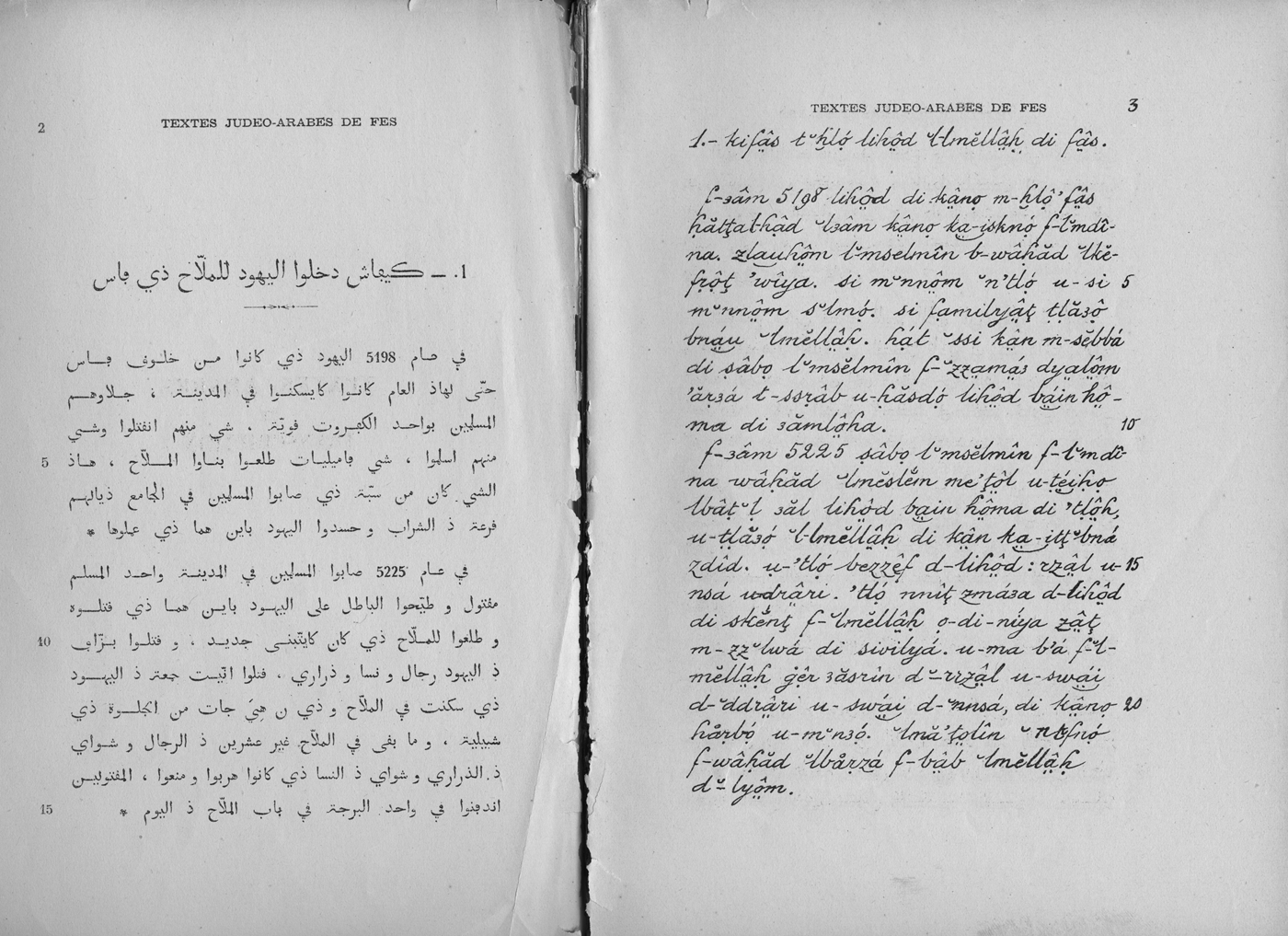
The full constellation of transcriptional transformations to which Brunot and Malka eventually submitted Judeo-Arabic included methods that were applied, in various combinations, to native dialects in colonial domains throughout North Africa. Textes Judéo-Arabes de Fès offers the most complete diagram. Each of the volume's forty-two oral specimens undergoes four conversions. First, the spoken text is transcribed in the Arabic script. On facing pages, the Arabic is transliterated into Latin characters (see figure 4). Two semantic transformations follow these two orthographic ones. French translations of each text appear in the second part of the book. Finally, the full significance of each selection is exposed only in the footnotes that provide ethnographic and historical insight into the text's contents. Each conversion enacts a hierarchy of languages by denying a wide array of literate practices that pertained to Judeo-Arabic.
Arabic and Latin transcriptions from Textes Judéo-Arabes de Fès, 1939. Source: Louis Brunot and Elie Malka, Textes Judéo-Arabes de Fès: Textes, Transcription, Traduction, Annotée (Rabat: Ecole du Livre, 1939), 2–3.
As noted, Arabic transcriptions render Judeo-Arabic writing practices invisible by displacing a Hebrew script that had served this purpose for centuries. Following established patterns in Moroccan dialectology, the printed words are partially normalized to conform with classical Arabic morphology and phonology, despite the author's attention to the peculiarities of Moroccan Jewish pronunciation.Footnote 29 This initial transcription thereby performs the unifying impulse in colonial linguistics to treat native dialects as having no genuine or entirely suitable written form. The Latin transliterations double the impression that only an external system of writing could be applied to the dialect and, at the same time, index the asymmetrical scientific capacity of occidental languages over oriental ones. In contrast to the Arabic transcriptions, the Latin replications hew more closely to the spoken pronunciation, capturing shifted consonants, shortened vowels, and distinctive morphological forms.Footnote 30 Taken together, the two transcriptional modes demonstrate an orthographic virtuosity that suggests the authors' defining monopoly over writing.
The French versions of each text invoke an entire apparatus of translation through which communication with and control over the natives passed, with the inequality of linguistic exchange in full view. As a matter of control over linguistic labor, this situation continued the relationship that Stephen Greenblatt has observed with respect to earlier colonial contexts: “What Europeans had that was crucial was not writing but translators.”Footnote 31 Moreover, whereas the French language claims sufficient semantic richness to incorporate all the meanings carried by the dialect, the possibility of a reciprocal relationship is foreclosed. The ample footnotes that accompany each selection portend a totalizing knowledge—more capacious than what any single native speaker could possess—of the linguistic nuances, historical details, religious beliefs, and social institutions whose systematic documentation could only be accomplished by colonial scholars. The analytical commentary is rife with citations to a bibliography of works drawn exclusively from the cannon of colonial scholarship, which constituted the self-referential modes of knowledge production that have been, by now, meticulously documented as a defining feature of Orientalism.Footnote 32 In the end, the oral texts appear as raw data whose full significance can only be grasped by colonial scientists in command of the literatures they themselves produced.
One overall effect of putting Judeo-Arabic through these transformational paces is that the language appears to succumb to textualization only after painstaking effort. As I have been stressing, this reduction of Judeo-Arabic to a single channel of oral communication recapitulates the predisposition in colonial linguists to comprehend native languages as spoken dialects. The case of Judeo-Arabic helps us to appreciate the methodological and rhetorical lengths to which such representation can, and often must, go to sustain the fiction of indigenous orality. Structured into the methods of transcription found in Textes Judéo-Arabes de Fès, this discursive work is carried out further in the volume's organization and the authors' analysis of the individual selections. The chapters are arranged as an inclusive record of local Jewish history, society, and religious practice. Shifting indiscriminately between consideration of linguistic form, semantic content, and pragmatic context, the authors conspicuously dodge myriad opportunities to recognize interpenetrating practices of Judeo-Arabic literacy.
The Work of Erasure
By handling the texts as equivalent specimens of spoken language, subjected to a modular process of transcription and analysis, Brunot and Malka collapse a wide range of genres whose relationship to writing varied significantly. Only a small fraction of chapters refer to communicative practices without obvious textual interpolations. Not surprisingly, these selections (e.g., “Dispute among Women,” “The Language of Children”) hone in on those demographics whose categorical illiteracy stood for the dialect's unequivocal orality. Other selections that ostensibly refer to entirely spoken genres had, in fact, written counterparts. Brunot and Malka introduce the selection entitled “The Little Story (ḥădíuţa)” as follows: “Old women, mothers, grandmothers and aunts are the ones who tell these stories to little children when they are going to bed.”Footnote 33 Yet, alongside these oral texts, numerous genres of storytelling found simultaneous expression in Judeo-Arabic writing, among these: joke books, stories of “miracle and wonder” (‘jib u-ghrib), and tales of the famous trickster, Jeḥa. Selections on “Curses,” “Blessings,” and “Bewitchment” found their written counterparts in Judeo-Arabic pamphlets, guidebooks, and amulets related to fortunetelling (goralot), good fortune (shemirah), and magic (šḥur).Footnote 34
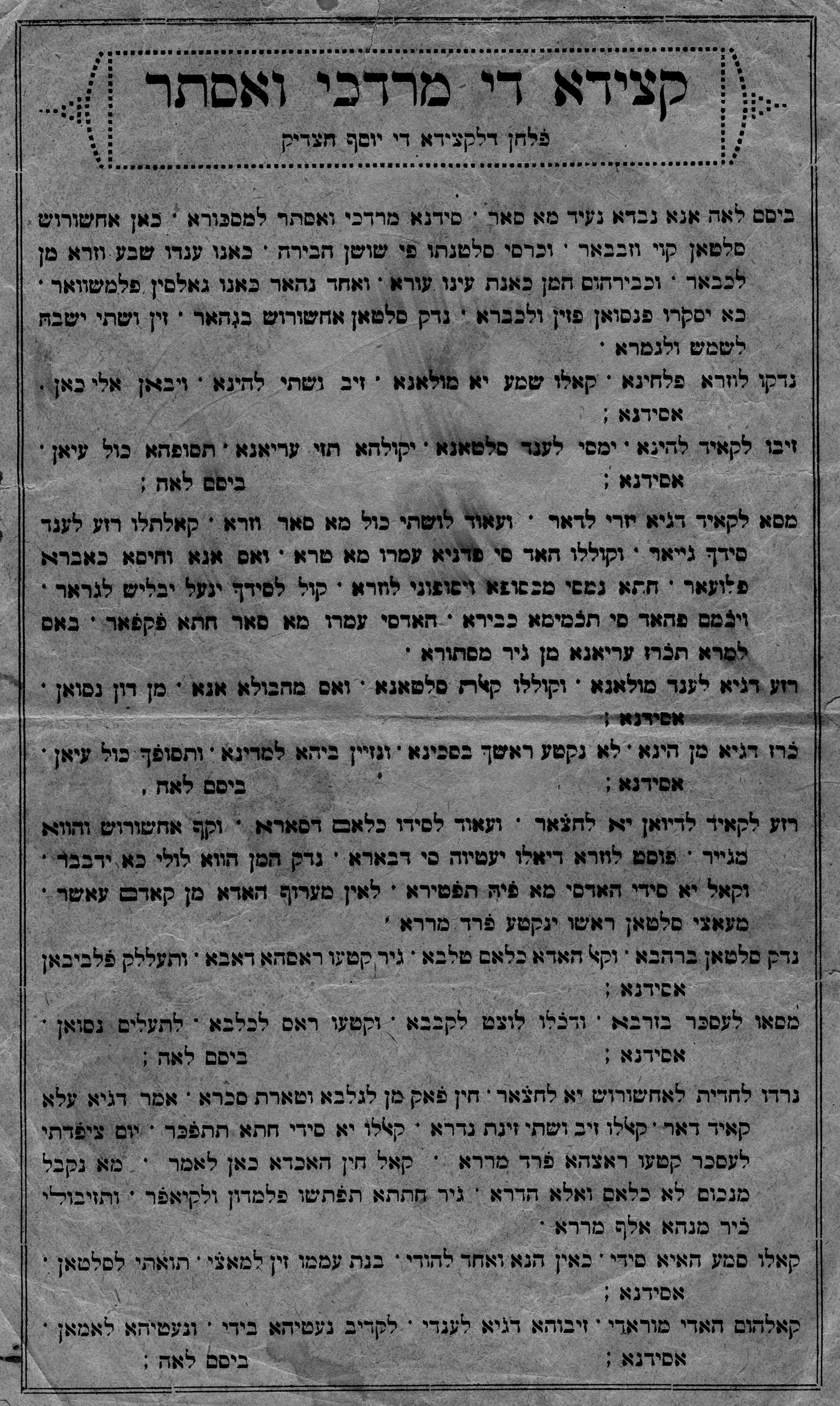
A different kind of association between spoken and written language escapes observation in the several chapters that record folksongs. The items appear interspersed among transcriptions of interviews about the context of their performance and related ritual events: “Wedding Songs” follows a narrative description of “Weddings” while “Mother's Songs for Children” follows a narrative description of “The Circumcision.” One effect of this arrangement, which returns to women and children as emblematic informants, is that Judeo-Arabic usage appears to be restricted to speech in all communicative acts: the orality of folksongs as a speech genre extends by default to the descriptive narratives, making them generic examples of spoken language rather than artifacts of the research process. Yet, by juxtaposing these oral songs with the narratives about the context of their performance, Brunot and Malka point inadvertently to evidence of Judeo-Arabic writing that both commented upon and circulated within Jewish ritual activities. On one hand, the nineteenth and early twentieth centuries saw the publication of Judeo-Arabic guides to proper Judaic practice, in a genre known as dinim. On the other, popular liturgical broadsheets and booklets, such as the Passover Haggadah, included both canonical prayers and Judeo-Arabic compositions arranged according to lifecycle ritual (circumcision, marriage, death) and the festival calendar (see figure 5). A similar elision of writing appears in texts describing the Jewish community's socio-religious institutions, including schools, synagogues, rabbinic courts, and pietistic brotherhoods. While Brunot and Malka grant some recognition to Hebrew literacy in these contexts, they characteristically avoid reference to corresponding forms of Judeo-Arabic writing that operated in the same spheres. Judeo-Arabic translations of the Torah, in the genre known as sharḥ, served as texts in religious schools. Synagogue doors were posted with public announcements, written in the Jewish vernacular, relating to community associations, events, and affairs. Judeo-Arabic writing was common in the printing of raffle tickets for fundraising events and the issuing of receipts for charitable donations.Footnote 35
Hymn for festival of Purim in Moroccan Judeo-Arabic. Early twentieth century. Source: Qṣida di Mordekhai u-Ester. (Rabat: Abraham Bohbot, no date), 1. Archive: The Rabat Genizah Collection, serial no 0400, housed at the Museum of Moroccan Judaism, Casablanca, Morocco.
The extent to which Judeo-Arabic writing was expunged from the linguistic record is perhaps most conspicuous given what is, in hindsight, the ironic inclusion of several letters of correspondence.Footnote 36 Conceding the obvious fact that the letters were written by native Jews themselves, Brunot and Malka are nevertheless able to turn the epistolary genre into yet another demonstration of the dialect's orality. Allowing for the existence of personal correspondence reflected broader trends in colonial linguistics wherein native writing, when it was not entirely ignored, was recognized primarily in non-serious, ephemeral, and popular genres that did not disrupt the overall portrait of indigenous languages as essentially oral idioms.Footnote 37 In this vein, Brunot and Malka note that the letters reproduce the formulaic salutations, naturalistic metaphors, colloquial diminutives, prophylactic idioms, superstitious adjurations, and rhetorical hyperboles that mark Judeo-Arabic as an oral language. As a methodological matter, their observation that two of the letters were dictated by women to male scribes contributes to a linguistic portrait in which literacy appears to be a professional exception rather than a popular rule. Bypassing the Hebrew script that would have been the original orthographic medium in which the letters were written, Brunot and Malka immediately submit them to the same set of Arabic and Latin transformations applied to all their samples.
As I have been arguing, the omission of Judeo-Arabic's Hebraic orthography was productive for colonial discourses invested in the idea of indigenous orality. In this regard, close attention to the methodological conceits, rhetorical ploys, and theoretical claims that characterized the study of Jewish dialect can contribute to an appreciation of how native orality was not merely observed, but rather overdetermined as an object of representation. If I have belabored the point, it has been precisely to illustrate that any obviousness that accrued to the representation itself was as much the effect of colonial language ideologies as it was a reflection of native language practices.
A second set of ideas about the relationship between native dialects and their speakers points in an utterly opposed direction, stressing not the unified orality of Moroccans but rather the distinguishing role of Judeo-Arabic and the socio-religious difference it represented. At stake in this dialectic between generic orality and specific identity is how categories of social difference were fabricated and managed in the colonial milieu. If Jews were indigenous by virtue of a categorical orality they shared with Arabs and Berbers, they were also natives of a particular kind, whose difference had long been manufactured in the metropole and whose strategic placement within the colonial endeavor was an ongoing and fraught project.
JEWS AND THE LANGUAGES OF COLONIAL DIFFERENTIATION
When Brunot first laid out his plan for Moroccan dialectology, he envisioned a collaborative scientific endeavor that would include native workers in the capture and study of spoken languages. Eschewing colonial patterns that earlier and elsewhere concealed the role of native informants in the collection of ethnographic data, Brunot chose rather to foreground their incorporation as agents in the research process: “In linguistics as in other sciences, individual and egotistical work is becoming more and more difficult and inefficient…. In our time, it is necessary to work in well-organized teams, to share the task in order to move quickly. This does not mean that the workers must remain anonymous and lose the moral benefits of their contributions, far from it.”Footnote 38 One impulse behind such an approach was the idea that modern scholarship must transcend the parochial identities of its practioners and invite all those willing and able to embrace the scientific spirit. A second message was that the inclusion of native speakers in the research team guaranteed the validity of the linguistic data. Brunot's commitment to this collaborative approach, at once democratic and authenticating, was realized in his extension of “moral benefits” to native contributors who were recognized in his publications as assistants, contributors, and co-authors.Footnote 39
Collaboration had other obvious implications in the colonial context. Insofar as it reflected the selective cultivation of natives trained in occidental forms of knowledge production, language, and administration, collaboration demonstrated the colonial power to selectively reform indigenous subjects, channel their interests, appropriate their labor, and exploit their capacity to deliver authentic cultural information. As a native speaker of Judeo-Arabic, Elie Malka filled this role in studies of the Jewish dialect. Credentialed by The Institute of Advanced Moroccan Studies, employed as a chief interpreter for the Protectorate administration, ethnographer of Jewish rites, and author of a French-Arabic lexicon for government officials, Malka's career exemplified patterns of imperial scholarship that relied on local informants to provide access to indigenous culture and to establish the reliability of its colonial representation.
As a Jew, moreover, Malka represented a social category that was taken as unassailable proof of deep and irresolvable fissures within Moroccan society. At the broadest level, dialectology focused on the major distinction between Arabic and Berber languages, each with its own vocabulary, grammar, geographic scope, and ethnic distribution. Unlike other colonial contexts in which a native lingua franca was promoted as an administrative efficiency, French policy in Morocco discouraged the functioning of Arabic in this capacity. Colonial dialectologists did their part by providing evidence that Morocco's dialects were too diverse and its speaking populations too divided to be united around a single language. “The central authority,” Brunot wrote in the first decade of the Protectorate, “was always too weak to narrowly group all Moroccans in a homogenous social mass consequently speaking a single language; the independence of the tribes, the internal wars, the absence of communication routes, and different ethnic factors all contributed to maintaining the variety of the dialects.”Footnote 40 In sum, Moroccan dialectologists captured and exploited the linguistic heterogeneity of the colonized populations as a hedge against the emergence of a unified national identity that might be directed against the French occupation.
In the Jewish case, however, it was a flexible rather than a fixed relationship between this segment of the indigenous population and its language that was taken as the hallmark of ethno-linguistic identity. Rather than being defined exclusively by their native dialect, whose borders did not clearly distinguish them from the Arab-Muslim population, Jewish linguistic difference was figured in relationship to three languages with which the population might be affiliated: Arabic, Hebrew, and French.
A Dialect No Longer Indispensible
“More accurate, but also more cumbersome,” readers are advised in the preface to Textes Judéo-Arabes de Fès, “would have been a title such as: ‘Arabic texts from the spoken language of the Jews of Fez.’”Footnote 41 Beyond naturalizing orality as an essential feature of the dialect and a diagnostic attribute of its carrying community, the alternative title suggested a shared linguistic identity that linked Jews and Muslims as speakers of historically related dialects. And, although the absence of a natural written form appeared to define all versions of the spoken language equally, the implications for colonial understandings of the alternative Arabic dialects varied significantly.
The selection of Fez as a representative site for the study of Judeo-Arabic was significant in establishing the dialect's defining relationship to other versions of Arabic spoken by both Jews and Muslims. By choosing an urban dialect associated with this dominant Moroccan city, historically home to one of North Africa's largest and most prominent Jewish populations, Brunot and Malka felt justified in claiming that the forms of speech documented in Fez were emulated by Jewish speakers elsewhere.Footnote 42 Indeed, Brunot and Malka go so far as to forward the remarkable hypothesis that the Jewish dialect of Fez represented the most archaic form of Arabic as it originally diffused into Morocco's earliest Islamic city.Footnote 43 Bestowing this historical status on Judeo-Arabic did more than provide theoretical justification for the privileged inclusion of the dialect in studies of Moroccan Arabic. By making contemporary Jews the most authentic heirs to Arabic in Morocco, the authors vacated Muslims from a formative relationship with a language whose potential to symbolically unite the colonized population was legitimately feared by the French. Propagated alongside the idea that the Moroccan population included vast segments of monolingual Berber speakers, with no natural linguistic connection to Arabic, the assertion of Judeo-Arabic's foundational antiquity further displaced Arabs from any potential claim to represent unified national aspirations. Claiming that the Jewish dialect of Fes presented the most authentic linguistic legacy of Arabic's penetration into Morocco had particular import at a time when Muslim Fasis were instrumental in the Arab resistance against the French protectorate.Footnote 44
At the same time that Brunot and Malka speculated, “it is as though the Jews of Fez never spoke any previous language,”Footnote 45 they also claimed that the dialect was a foreign imposition of Muslims upon Jews. Undisturbed by the paradoxical claim that Judeo-Arabic both preceded the Muslim dialects in Morocco and was an effect of them, Brunot and Malka wrote:
Broadly speaking, until the installation of the Protectorate and even since, the vast majority of Moroccan Jews (Juifs marocaines) speak an Arabic dialect, a fact that is explained by the necessity of living and doing business with Arabic speaking Muslims, their lords and masters (seigneurs et maîtres). From the linguistic point of view, the only one we consider here, the Jewish minority (minorité Israelite) was forcibly absorbed by the Muslim majority. It is obvious, in such conditions that the spoken language of the Jews would remain more conservative than their political masters….Footnote 46
From this perspective, the fidelity of Judeo-Arabic to its archaic origins appears as evidence of enforced Jewish difference, expressed as feudal domination, which extended into the colonial present. Linguistic stasis appears to be a natural effect of political subordination, variables which together position Jews as differentiated exemplars of a Moroccan society rife with social hierarchies and caught in an unchanging past. In terms homologous with broader colonial characterizations of Moroccan society as an object of strategic control, Brunot and Malka call our attention to the “resistant and conservative” essence of Judeo-Arabic, even as they emphasize the point that it is “ready to submit to all exterior influences.”Footnote 47 The administrative logic of the Protectorate, which emphasized targeted changes laid over ostensibly preexisting Moroccan traditions and social divisions, could not be summarized more efficiently.
Following from an insistence that Judeo-Arabic resulted from the imposition of the Islamic language on a dominated minority, Jewish attitudes toward their dialect were seen to reflect religious alienation as well as political disenfranchisement: “No deep sentiment attaches [the Jews] to a language that is not particular to their social and religious group. In their eyes … this is the dialect of Muslims, from whom they feel strangers; it appears to [the Jews] too closely aligned with a liturgical language and religion that is not their own…. Without any regret, [the Jews of Morocco] are abandoning a dialect no longer indispensible to them and that recalls an era of humiliation, to say the least.”Footnote 48
The theme of humiliation to which the authors refer is taken up immediately in the first chapters, which attend to Fez's mellah, or Jewish quarter. Relying on a translation with wide currency throughout colonial literature, Brunot and Malka gloss the term as ghetto, invoking a comparison between Jewish difference in Morocco and medieval European institutions relegated to a superseded past. The opening chapters sandwich the history of the mellah between an inglorious beginning at one end and a violent twentieth century event at the other. The first selection records the Jewish recollection of unjust murder accusations, libelous allegations of polluting mosques with wine, and maltreatment at the hands of Muslim overlords. Recounting the pillage of the mellah in 1912, the second selection bookends the historical account with the ransacking of the Jewish quarter at the hands of thugs from outlying tribal areas. Representing the internal chaos of Moroccan society, the fragility of its monarchy, and the oppression of its religious minority, the event had provided ex post facto evidence that foreign intervention was necessary to stabilize a country on the verge of collapse. Recapitulating liberal strands of colonial ethnography and historiography, this condemnation of precolonial society positioned the French protectorate as an ethical response to the dire circumstances of Morocco's politically subordinate populations, figured here in linguistic terms.Footnote 49
This situation helps to account for the fact that the Arabic script played an increasingly prominent role in the colonial documentation of Judeo-Arabic at the same time that the orthography was being phased out in the study of other Moroccan dialects. The divergent transcriptional strategies applied to the dialects can only be understood in the context of a representational politics that sought to differentiate social categories based not only on the dialects they spoke, but also on the historical, sociological, and affective associations between ethno-religious groups and their oral languages. From this perspective, the Arabic script suggested anything but an unmitigated identity between the Arabic dialects spoken by Jews and Muslims. Harnessing the defining pursuit of dialectology, that is the documentation of popular linguistic difference, Brunot and Malka's use of the Arabic script indexed a historical context in which an entire set of social and political relationships alienated Jews from their Muslim language and its cultural environment.
Highlighting the Jewish dialect's Arabic foundations, therefore, served the double purpose of disturbing Muslim claims to the language at its historical arrival in the Islamic far west while also providing the opportunity to emphasize Jewish historical alienation from the dialect. In this view, Jews were overwhelmingly and understandably attracted to the opportunity to escape from their native dialect. It was projected, by consequence, that Jewish estrangement from their dialect and the Muslim community it represented would stifle Jewish incorporation into the Arabic identity of the dominant Moroccan nationalist movements.Footnote 50 Brunot and Malka present their work in typical colonial terms as an effort to salvage for posterity one dying but illustrative vestige of Morocco's Arabic past in the face of the welcome advance of an alternative linguistic future. Cognizant that Hebrew and French might compete as languages of that future, Brunot and Malka considered each respectively.
A Language Once Properly Their Own
Making only passing reference to Hebrew as it operated in elite, male domains, Brunot and Malka relegate the language to the margins of Jewish life in Morocco. As I have suggested, their unacknowledged banishment of the Hebrew script from the colonial documentation of Judeo-Arabic removed evidence of a more complex relationship between the languages. Indeed, Brunot and Malka's own recognition that Judeo-Arabic included an extensive set of Hebrew words drawn from the lexicon of Jewish canonical writings and practices (e.g., torah, Talmud, kabbalah, tefilah) underscores the hybrid nature of an Arabic dialect written in the Hebrew script and suffused with Judaic significance.Footnote 51 Likewise, the extensive use of Hebrew letters to write religious poetry in Judeo-Arabic betrays Brunot and Malka's claim that no sincere Jewish affiliation could be developed with a dialect that was “too closely aligned with a liturgical language and religion that is not their own.”Footnote 52 The poetic genre known as matruz, in which verses alternate between Judeo-Arabic and Hebrew, provides one glaring counterpoint to an image of linguistic segregation that denied the interpenetration of the two languages. Indeed, it was precisely because of such interpenetrations (realized at orthographic, lexical, liturgical, and narrative levels) that Judeo-Arabic in fact operated for Jews as a liturgical language that was decidedly their own.Footnote 53
The absence of any broader accounting of Hebrew is also consistent with Brunot and Malka's bypassing of the modern geography of Hebrew publishing in which Morocco was located. The scope of Hebrew publishing during the colonial period included rabbinic, liturgical, and devotional texts, which made their way from Europe to North Africa and were printed in Morocco itself. The token references of such works in Textes Judéo-Arabes de Fès only confirm Brunot and Malka's view: having been written in the classical language of the antique Jewish past, Hebrew writing appears properly quarantined within the religious realm. Absent is any reference to either the Hebrew language newspapers that had been making their way from Europe to Morocco since the nineteenth century or to the emergence of modern Hebrew literature in Europe, North Africa, and the Middle East.Footnote 54 Aside from tainting the image of parochial orality with the prospect of literary cosmopolitanism, such texts were organs of a Jewish nationalism that was significantly at odds with the French colonial project in Morocco.
Granting limited foothold to Hebrew in the Moroccan Jewish past, Brunot and Malka fleetingly contend with the language as it potentially disrupted the unfolding colonial present. These are the first words of Textes Judéo-Arabes de Fès: “One might be led to think that there exists one Jewish language, just as there exists one Jewish civilization, one Jewish religion, and one Jewish ethnic group. The Jews speak all kinds of languages, even in Morocco, and one that was once properly [qui leur a été propre, jadis] their own is today only being revived artificially in Palestine.”Footnote 55 Formulated in this opening gambit is an ideology that distills post-enlightenment ideas about the proper relationship between Jews and language. On display is the characteristically ambivalent inclusion of Jews in the liberal project, both set apart by essential differences and ready subjects of assimilation. Language, here, emerges as a fulcrum of the liberal contradiction between the singularity of Jewish difference and the possibility that Jews might nevertheless enter universal history. On the one hand, Brunot and Malka foreground the existence of Jewish parochial difference (one Jewish civilization) in terms that recapitulate the frames of Christian Europe (one Jewish religion) and that bear the traces of racialized otherness (one Jewish ethnic group).Footnote 56 On the other, the idea of Jewish linguistic openness to “all kinds of language” suggests an ability to overcome attachment to restrictive traditions. Recognizing certain aspects of Jewish difference in terms that reflected the logic of liberal minoritization, the acceptable limits of Jewish difference are set at the boundary of language. In this sense, Brunot and Malka sustain the enlightenment notion that Jewish linguistic homelessness is a precondition for Jewish enlightenment in its most universalistic aspects.Footnote 57
While the diasporic condition of Jews appeared to provide the grounds for a certain linguistic cosmopolitanism, it was also invoked to exclude the Jews from legitimate access to an opposing trajectory of modern sociopolitical identity: the destiny of peoplehood to be fully realized in a nation-state with its own modern vernacular language. While declining to name, and so recognize, the aspirant Jewish national language, Brunot and Malka make oblique reference to Hebrew by alluding to the Zionist project in Palestine. Brunot and Malka reject Hebrew as a modern Jewish language on two counts. As the language of the Jewish past (“a language once properly their own”), Hebrew indexed the antiquated political autonomy and geographic rootedness of a long superseded biblical polity as well as the scholastic religious traditions from which modern Jews were to be properly emancipated.Footnote 58 As the vehicle of twentieth-century Jewish nationalism, Hebrew was unnaturally transposed (“revived artificially”) from its sacred moorings into a popular vernacular. Claiming that Moroccan Jews were easily leaving behind Arabic as a mother tongue from which they were alienated, Brunot and Malka presented Hebrew as neither an authentic alternative nor an attractive choice.Footnote 59
In colonial Morocco, Hebrew posed more than a discursive threat to liberal ideas about improper routes of modern linguistic transformation among Jews. Prior to its appearance in North Africa, the Zionist response to the Jewish Question had already been an affront to liberal models of Jewish belonging in Europe. As a threatening exaggeration of Jewish political difference, Zionism amplified Jewishness in unapologetically nationalist terms and, as a consequence, flamed anti-Semitic fears of Jewish sedition. The extension of the Zionist movement to the French colonies, likewise, offered an alternative vision of a national Jewish future that would vie for the loyalty of Jewish colonial subjects. The implication that Hebrew would find no fertile ground in Morocco anticipated the failure of Zionist organizing and, perhaps, already registered the fear that it might succeed.Footnote 60
Yet Brunot and Malka's approach to Hebrew did not simply export metropolitan rejection of Zionism to the colonies. In fact, while they were summarily dismissing the language as atavistic and inauthentic, liberal Jews and their allies in France were seeking accommodations between Zionism and French republicanism.Footnote 61 In Morocco, Zionism posed a threat to the stability of the entire colonial order. Protectorate officials worried that Zionist activity and public sympathizing among Moroccan Jews could stir a variety of dangerous Arab reactions. By the time Textes Judéo-Arabes de Fès was published, Moroccan Jews were caught in the bind of declaring either support for the burgeoning anti-colonial cause or loyalty to the colonial regime. Brunot and Malka's pessimistic characterization of Jewish attitudes toward their own Arabic language suggests the side of history on which the authors situated the Jews. Colonial administrators were concerned that Jews who supported the Zionist enterprise could become targets of retaliation by Moroccan nationalists who were sympathetic to the plight of their Arab compatriots facing Jewish colonization of Palestine. As colonial policy inserted and exploited a wedge between Jews and Muslims, which works like Textes Judéo-Arabes de Fès helped to naturalize, the administration attempted to contain violent outbreaks between the groups. Beyond disrupting the public order which the Protectorate installed itself to protect, Arab attacks against Jews could provide tinder for the explosion of a more general rebellion against the colonial regime itself. Potentially representing both colonial collaboration in North Africa and colonial activity in Palestine, Moroccan Jews as Zionists could be potent symbols of Arab subjugation under European imperialism.Footnote 62
It is not surprising, then, that the administrative censure of Zionist activity in colonial Morocco was accompanied by Brunot and Malka's erasure of the movement and its signature language. Neither the authors nor their edited Judeo-Arabic interlocutors make reference to the incipient efforts of Zionist organizers, the existence of Zionist clubs, or the instruction of modern Hebrew in Moroccan Jewish schools. In this regard, the strategy of Arabic transcription does more than reinforce arguments about the preeminent place of Judeo-Arabic within Moroccan dialectology and the foreignness of writing to indigenous speakers. Writing in Arabic rendered the orthography of the Jewish national language invisible to the reading eye. As we have seen, the common orthography of the Moroccan Jewish dialect and modern Hebrew would not be overlooked by the Jewish Agency, which from 1950 to 1956 published a Zionist newspaper in Judeo-Arabic. Reflecting the practical necessity of communicating with the local population, the use of this written language also carried the message that the orthographic continuity between the two languages might be extended to a set of other historical, political, and religious continuities that could draw Moroccan Jews to the Zionist project.
The Language of a Great Civilization
Brunot and Malka suggest a different set of historical possibilities for the relationship between language and the sociopolitical identity of Jews in the unfolding colonial present, accentuating metropolitan ideas that Western observers had applied in Morocco since before the installation of the French protectorate. Towards the end of the nineteenth century, for instance, British chronicler Budgett Meakin wrote: “As in other countries, the Jews of Morocco have shown themselves to be apt linguists, ever ready to master French or English in addition to their mother tongues.”Footnote 63 The idea that Moroccan Jews would easily move from Arabic to European languages, rather than to another Semitic one, was sustained by various European notions about the relationship between Jews, their language, and their future. According to established stereotypes, Jews were model polyglots able to master numerous languages quickly and command them simultaneously. Such characterizations located Jewish linguistic difference in two opposing European discourses, both of which found expression in the colonies as well. The first observed the nimble jumping between languages as evidence of innate Jewish cleverness, the fickleness of the Jewish personality, the disturbing uprootedness of Jewish populations in the age of emerging nation-states, and the absence of an authentic language that Jews might, as a nation, call their own. The second reframed Jewish linguistic aptitude, flexibility, and openness as an indication of the rightful, and even exemplary, place of Jews in the enlightenment project. The ability of Jews to free themselves from the languages of their past demonstrated a capacity for emancipation from the parochial constraints of tradition and susceptibility to the unfettered, rational, and liberating universalism promised by the enlightenment and sustained by its representative European languages.Footnote 64
Brunot and Malka locate Jewish difference in Morocco on the historical cusp between the feudal and modern. French colonial management of the transition from racialized Juif to emancipated Israélite was framed self-consciously in terms of earlier North African precedents.Footnote 65 Although the Protectorate administration distanced itself from the Algerian model, wherein Jewish emancipation was realized in the collective granting of French citizenship, Brunot and Malka advocated a corollary liberal view of cultural and linguistic emancipation with regard to the place of Moroccan Jews in the imperial project.Footnote 66 Precolonial histories of Jewish cosmopolitanism and francophone Jewish schooling in Morocco contributed to the making of a modernized Jewish elite that could mediate, linguistically and otherwise, between the Protectorate and the indigenous population it administered. The historical elements that shaped this situation are well known. Longstanding Jewish commercial, diplomatic, and intellectual networks across the Mediterranean had previously been exploited by the Moroccan sultanate.Footnote 67 Similar networks of confessional affiliation provided opportunities for European powers as they displaced the authority of the Sharifian monarchy over its Jewish subjects. Taking off in the nineteenth century, the protégé system, under which a small minority of Moroccan subjects were placed under the legal protection of foreign embassies, and the granting of European commercial concessions represented two channels by which Jews were disproportionately remade, if only partially, into occidental subjects.Footnote 68 At the same time that European states and capitalists were finding Moroccan Jews useful in their expansionist endeavors, Jews in England and France began acting on a self-assigned moral responsibility toward their North African coreligionists. This impulse found its most enduring expression in the work of the Paris-based Alliance Israélite Universelle (AIU), whose network of francophone Jewish schools in Morocco attempted to redress what appeared to be the evolutionary lag between Jewish emancipation in the metropole and Jewish backwardness in North Africa and other colonial domains.Footnote 69 Brunot and Malka's sympathy for this project, articulated throughout their collaboration, is summarized in the dedication of Textes Judéo-Arabes de Fès: “To Mr. Y. D. Semach: Delegate of the Alliance Israélite Universelle in Morocco.”
The educational project of the AIU comported well enough with shifting colonial priorities to remain unhindered, if not always actively supported, by the Third Republic and eventually the French Protectorate in Morocco.Footnote 70 Under the leadership of the Protectorate's first resident general, Marshal Lyautey, the colonial model of governance in Morocco largely rejected the ideal of a civilizing mission applied to Moroccan society as a whole. The French administration was to work by keeping the Moroccan political order nominally intact, discovering and aggravating social fissures (e.g., urban/rural, Arab/Berber, Jewish/Muslim) while channeling and crystallizing “traditional” social hierarchies in a modern, bureaucratic apparatus. The AIU's extension of the civilizing mission to Moroccan Jews did not fundamentally disrupt this model of governance. To the contrary, the AIU reinforced the colonial view of Moroccan social fragmentation, in which particular segments of the native population were attributed with characteristic features (mentalities, talents, legal systems, religious beliefs, languages, etc.) and subjected to differentiated and differentiating policies.Footnote 71
It is in this context that we can better understand Eli Malka's role in colonial dialectology. Representing one position assigned to Jews as figures of the colonial imagination and allotted to them by agents of the colonial administration, Malka served as an ideal intermediary between the indigenous society into which he had been born and the Francophone milieu into which he had been educated. Again, Malka's involvement with the French scientific mission extended beyond his role in Judeo-Arabic dialectology and provided evidence of the claim, voiced together with Brunot, that, “The Jews … are enthusiastically adopting the language of a great civilization which allows them to actively participate, with great advantage, in the life of the West.”Footnote 72
Brunot and Malka situate this linguistic shift in a much wider set of reformations projected upon these ambivalently elevated colonial subjects. The following passage encapsulates their view of the situation in a vivid sartorial tableau:
It is important to note that this linguistic revolution is accompanied by an equally radical revolution of mores. Whether boy or girl, every child taught in school leaves behind their traditional clothing. Every young woman who in her youth dressed in the black apron worn by young students of the Alliance Israélite refuses to hide her hair beneath a scarf. Every young man who knows how to speak French refuses to wear the black skullcap…. It has become almost certain that it will not be long before the Jews of Morocco, if they do not cease to speak Arabic completely, will at least consider it only as a linguistic accessory.Footnote 73
What more exemplary statement can there be of the semioticly rich interpolation of Jewish speakers as differentiated colonial subject in the narrative of a civilizing mission? The Jewish turn toward French (“this linguistic revolution”) appears as an index of (“is accompanied by”) a more extensive set of colonial reformations (“an equally radical revolution of mores”). More specifically, this association is established through a set of homologies that link the languages standing on either side of the colonial divide to transformations of Jewish dress. On the one side: Arabic, the stultifying language of the orient; the veil, symbol of the tyranny against women; and the black skullcap, whose color represented the restrictions placed upon Jews as feudal subjects and whose dutiful wearing signaled forms of premodern piety that hindered the development of a rationalistic spirit. On the other: French, the learning of which is associated with the refusal to submit to Muslim tyranny and unthinking religious obedience; the black apron, which invokes the orderliness and moral discipline of modern education; the naked head, which interiorizes religious identity and enacts freedom from bodily forms of piety and the superstitious mentality so implied. These metonymic associations between language and clothing come together in a final metaphor. Arabic appears, at last, to be a “linguistic accessory” as expendable to the Jews as were the forms of traditional clothing being left behind.
So is summarized one dominant trend in colonial understandings of the distinctive place of Jews in the Moroccan sociolinguistic landscape. Brunot and Malka locate Jewish linguistic difference not in the native vernacular itself, whose formal features and characteristic orality seem to be largely shared by the Arabic-speaking population. What differentiated Jews, rather, were the selectively observed relationships between them and their possible languages. Alienated from their indigenous dialect, endowed with superior linguistic capacities, and attached to no genuine language of their own, Jews were imagined to be distinctively predisposed towards French. Yet, the metaphor works only by contravening other ideas about the relationship between Jews and their languages. No longer characterized by the capacity for linguistic pluralism, Jews are destined and required to make a choice: one cannot “wear” and “refuse to wear” the skullcap at the same time. The idea of monolingualism, so engrained in the language politics that separated Arabs and Berbers, now extends to the Jews, albeit in a different historical register: oriented toward the future rather than rooted in the ongoing past. Moreover, initial recognition of the formative role that colonial education (“every child taught in school”) played in the projected transition is left behind in ensuing metaphors, which deflect attention from the fitful, coercive, and ambivalent facets of colonial schooling to the idealized choices of free-willed subjects.Footnote 74 The turn toward French appears, in the end, as the inevitable culmination of Jewish linguistic difference in Morocco.
ALONG THE ARCHIVAL GRAIN: COLONIAL DIALECTOLOGY AND ITS FUTURES
In the same year that Brunot and Malka published their companion glossary to Textes Judéo-Arabes de Fès, the uncertain promise of enlightened Jewish difference in colonial Morocco was traumatically challenged. With the defeat of France in 1940, the Protectorate became an arm of the Vichy administration in North Africa. Even prior to these events, Jewish “emancipation” in Morocco was a limited ideal whose linguistic realization was counterbalanced by a reluctance to employ Jews in the Protectorate regime, alter their legal status as subjects of the Moroccan sultan, or grant them citizenship on the Algerian model. If the figure of Elie Malka represented possibilities of liberal Jewish advancement, in all those material and moral senses that had discernable advantage for French rule and its ideologies of beneficence, his role in the colonial administration was an exception in a regime that largely excluded Jews.Footnote 75 In this regard, Malka's situation was less an expression of the status of Jews as privileged intermediaries in the colonial regime than it was an extension of corollary strategies of co-opting elites from Arab and Berber populations as well.Footnote 76 The institution of discriminatory laws in Vichy Morocco, whereby Jews were removed from official service and barred from the liberal professions, neither aroused the collective ire of French administrators or settlers, nor did it threaten the function of government bureaucracies.Footnote 77 This was not, presumably, what Brunot and Malka foresaw when they wrote of “the great advantage” that accrued to Moroccan Jews by participating in the language and life of the West.
There is little reason to question Brunot's sincerity, even less Malka's, regarding their belief in the emancipatory power of the French language. As I have tried to show, their collaborations represented a shared liberal agenda, with its characteristic views of linguistic and political progress, whose presumed sociological scope within the indigenous population and precise application to native dialects was not determined beforehand. My intention has been to trace how colonial linguistics constituted its dual objects of inquiry, indigenous dialects and the native populations that spoke them, and so contributed to the manufacture of categorical social differences upon which colonial epistemologies and policies depended. The case of Judeo-Arabic is apposite, in the end, not primarily because of the extent to which Jews potentially slid across the categories that distinguished Europeans from their colonized others. As I have alluded to, all kinds of “natives” potentially confounded those categories in ways that could alternatively bolster colonial vectors of differentiation and threaten them; all kinds of “natives” could be situated as intermediaries by virtue of various ethnographic fictions, historical speculations, and linguistic portraits.Footnote 78 What the colonial study of Judeo-Arabic reveals, rather, is how such differences were held together though shifting assemblages of premises, deductions, and conclusions whose articulations were being creatively worked out, and not merely expressed, in the labor of colonial research.
In this regard, I have explored some implications of Ann Laura Stoler's call to write “along the archival grain.” Colonial dialectology was most certainly an archival endeavor as an identifiable textual corpus produced for, authorized under, circulated within, and conserved by the colonial state apparatus. Rather than taking for granted the “predictable stories with predictable plots,” as Stoler warns against, I have examined the dialectological praxis through which they were created, sustained, and potentially vulnerable.Footnote 79 Stoler's point is not, I take it, that we should entirely dismiss the relative stability of colonial hegemonies in their various political, administrative, and epistemological aspects. There is much in the colonial study of Judeo-Arabic that should ring familiar to contemporary students of modern European empire. Colonial linguists represented Judeo-Arabic in terms of the overarching distinction between colonizers and colonized. Brunot and his colleagues treated Judeo-Arabic as a spoken dialect that was diagnostic of the linguistic hierarchy between the written languages of Europe and the oral languages of North Africa. At the same time that colonial linguists studied Judeo-Arabic as evidence of the backwardness of Moroccan society as a whole, they emphasized the specificity of the historical, religious, and affective relationships between Jews and their dialect as compared with Muslim variants. I have been arguing, in sum, that colonial linguists were able to make Judeo-Arabic represent both the oriental homogeneity of Moroccan civilization, as differentiated from the literate West, and the exploitable distinction of Jews within Moroccan society. Each of these opposing claims appears predictable only after the fact and in the sense that they reflected intersecting discourses of Jewish difference in Europe and colonial differentiation in North Africa that were being deployed simultaneously in numerous other colonial contexts, though never in precisely the same way. Beyond that, the uncomfortable coincidence of the Vichy inauguration and Brunot and Malka's prediction that the Jewish uptake of French demonstrated their progressive inclusion in the advance of civilization is only one tragic twist that puts into question, now as then, confidence in the grand narratives of colonialism. In this sense, as Stoler emphasizes, writing along the grain of the colonial archive requires an attention to both its deep grooves and its internal contradictions.
Extending this approach to include the archive of dialectology allows us to consider how colonial conventions were formed both within and outside the immediate scope of historical narratives, plots, and scripts.Footnote 80 The study of native dialects certainly contributed to speculative histories that authorized categories of indigenous social difference. The conventional colonial depiction of Judeo-Arabic as a uniquely spoken language, however, was accomplished not primarily by narrative means but rather by methodological, organizational, and graphic ones. The explicit, axiomatic statements that Brunot and his colleagues made about the hermetic orality of Judeo-Arabic, and native dialects more generally, are relatively brief. They were cemented in the scientific archive as the result of an entire ensemble of research strategies, transcriptional methods, and alphabetic choices. Tracing the archival grain, in this case, requires attending to the exacting mechanics through which spoken language was captured, transformed, and arranged as written text. Performing the advanced literacy of the colonial researcher and representing orality of the native in a single move, the “spoken texts” produced as written artifacts seemed to transparently register one hierarchical axis upon which the colonial endeavor was premised. As I have stressed, crucial to the production of colonial knowledge about Judeo-Arabic was the erasure of its written dimensions. What more vivid linguistic example can there be of “the selective winnowing and reduction” that characterizes colonial knowledge production, to which Stoler also draws our attention?Footnote 81
Yet, it will not have escaped notice that I am sympathetic to the tradition of writing against the grain of the imperial conventions of dialectology. I have hinted at the agency of Judeo-Arabic speakers as literate, linguistically creative, cosmopolitan, and vernacular-national subjects, as opposed to categorically non-literate, stagnant, isolated, and minority ones. Though commonplace in venues like this one, such recuperation remains necessary in a world where colonial epistemologies have not loosened their grip. The point of such an endeavor is not primarily to demonstrate the biases of colonial research, still less to assert the uselessness of its findings. The first point is itself banal unless wedded to a fuller inquiry about the multiple and shifting subjectivities of the agents of colonial dialectology. Such an inquiry, for example, would explore the extent to which Malka's commitment to ideas about Judeo-Arabic orality emerged dialogically at the collusive intersection between occidental ideologies of language evolution and Judaic ideologies that reified hierarchies of written and oral language in their own way. The second point overlooks the incontrovertible documentary value of the corpus and would be an insult to critical historiographic practice.Footnote 82 Moreover, Brunot and Malka's demographic predictions were correct insofar as they foresaw the demise of Judeo-Arabic and enduring importance of the French language among Moroccan Jews worldwide, even as the authors' acceptance of an evolutionary telos both mistook the mechanism and precluded consideration of the incipient nexus between Moroccan Jewish emigration, Zionism, and the Hebrew language. Rather, writing against the grain is motivated here by the observation that colonial authors themselves were often cognizant of counterpoints, contradictions, and ill-fitting evidence. The trail that led me to Marcel Cohen's reserved acknowledgement of Judeo-Arabic writing began in the footnotes of Textes Judéo-Arabes de Fès itself. The example of personal correspondence included within the volume pushes against the otherwise flawless portrait of Judeo-Arabic orality. The ethnographic scope of the transcribed oral texts calls forth, at nearly every turn, the very forms of Judeo-Arabic textuality which dialectology expunged. Writing along the colonial grain often requires writing against it at the same time, not only to give voice (or here, more aptly, writing) to the represented, however problematically, but also to better appreciate the tensions of representation in the archive itself.
Finally, it is worth considering the extent to which colonial categories have continued to reappear in the analytical vocabularies of subsequent approaches to Judeo-Arabic. Following Irvine and Gal, a next step would be to examine how “early representations of sociolinguistic phenomena influenced later representations and even contributed to shaping the sociolinguistic scene itself.”Footnote 83 In the second half of the twentieth century, the pioneering scholarship of Haim Zafrani brought the written expression of Moroccan Judeo-Arabic to the fore. Ensuing generations of scholars in Morocco and its postcolonial diaspora, especially in Israel and France, have expanded the study of the dialect in productive directions. The myriad genres of Judeo-Arabic writing—religious and secular, medieval and modern, poetic and expository—are now objects of extensive linguistic and folkloric research. Yet, the very categories of “oral” and “written” as bounded and stable forms, along with a set of the presumed relationships between them, remain for the most part uncritically ensconced in the literature on the language practices of Moroccan Jews. “One cannot escape the impression,” Zafrani wrote in his path-breaking study of Judeo-Arabic composition in Morocco, “that there exists a divorce between the written Hebrew and the oral dialect.”Footnote 84 While of significant ethnolinguistic value, subsequent research “concerned, with the other half, so to speak of the linguistic picture—the living daily language, the language of speech and thought” has continued to define itself in contrast to written language.Footnote 85 Recent attention to the influence of oral language on written texts recognizes the interactions between the two without, however, fully examining the ideologies, institutions, and practices through which Judeo-Arabic has operated across the literate divide.Footnote 86 What remains to be explored, borrowing terms used by Jonathan Boyarin to help initiate what has emerged as a fertile program of comparative inquiry, are the ways that Judeo-Arabic “orality and textuality, far from being opposite poles, interact in complex, multidimensional ways.”Footnote 87 Privileging neither the spoken language nor its written form as the natural medium of Judeo-Arabic, and more significantly suspending any a priori agreement about the difference or boundaries between them, such an exploration might begin with close readings of the very texts that dialectologists like Brunot and Malka created.