A strange malaise seems to have afflicted multiple characters of Russian fiction in the 1960s–70s. Its main symptoms were sensations of weakness and fragility, pangs of uncertainty and doubt. Characters seemed physically, intellectually, and morally exhausted, as if worn down by the longstanding mandate—handed down by the socialist-realist tradition, and still enforced by the overbearing fatherland—to evince resolve, confidence, and masculine courage, as befit denizens of a (however stagnant) Cold War superpower. This weakness, however, was more than just the lassitude of living under conditions of high Brezhnevism; it was also a sort of code that allowed the like-minded to recognize and feel a kinship with one another. The photographer Dmitrii Konrad certainly saw it as such, in reading Andrei Bitov's novel Pushkinskii dom (The Pushkin House): “The protagonist was close to me in his internal organization, a kind of indefiniteness, softness [miagkost΄], not to say spinelessness [miagkotelost΄].”Footnote 1 In his notebooks, Venedikt Erofeev recognizes the selfsame trait as a symptom of the prose of his generation: “‘milksops’ [khliupiki], ‘whiners’ [nytiki], ‘infantile youths,’ ‘star boys.’ The piercing prose of questioning.”Footnote 2 Notably, Erofeev follows this list of critics’ disparagements of contemporary Russian characters with a succinct, approving interpretation of the phenomenon. In his cult novel Moskva-Petushki, I will argue here, Erofeev subjects this symptomatic weakness, which he himself cultivates, to a fuller consideration, engaging in a “piercing questioning” of its pros and cons. Erofeev's novelistic interrogation of late-Soviet weakness, rather than unreserved engagement in it, allows him to simultaneously share in and deviate from the secret code.Footnote 3
Epic or Tragedy?
Moskva-Petushki (translated into English as Moscow to the End of the Line, Moscow Stations, or Moscow Circles) was written in 1970, but published in Russia only in 1989 in the journal Trezvost΄ i kul΄tura (Sobriety and Culture). Its first Soviet publishers, that is, saw it, or at least sought to frame it, as an anti-alcoholism pamphlet. But the author must have had a different genre, or, rather, several of them, in mind.Footnote 4 The novel's subtitle or genre designation, Poema (An Epic Poem), announces a certain affinity with an illustrious predecessor—another prose work that refers to itself as a poema and features a journey: Gogol's Dead Souls. In the dedication, moreover, Erofeev calls his poem “tragic.”Footnote 5 Over time, however, the work's epic aspirations have been recognized, while its tragic elements have been somewhat muted in criticism.Footnote 6 Since the fall of the Soviet Union, Moskva-Petushki has attained cult status as the first Russian postmodern novel and provoked a surge of interpretations ranging from political to metaphysical, from religious to existentialist.
Most interpretations engage the myth of the author, which is understandable, insofar as the protagonist (whom I will call as he calls himself, Venichka) shares a name and a great number of autobiographical details with his creator.Footnote 7 As myths usually do, the Erofeev legend cloaks the author, and by extension the protagonist of what Eduard Vlasov calls his “immortal poem,”Footnote 8 in deeply heroic tones: he is a sober drunk and a holy fool, who expresses his resistance to Marxism-Leninism, and to other violent metanarratives of the twentieth century as well, via his inspired, antisocial drinking and his postmodern drifting through various quotations, mixing of discourses high and low, and celebration of chance and paradox.Footnote 9 More often than not, contradictory elements of Erofeev's narrative are analyzed as befitting a consistently postmodernist worldview. That is, Erofeev is alleged to eschew all certainty, coherence, or order—former virtues long since compromised by twentieth-century experience—in favor of disorder.Footnote 10 Or, Erofeev's poema is said to counter a now negatively coded energy, which has fueled wars and revolutions, with the less-culpable entropy.Footnote 11
I do not disagree with these influential interpretations, but in what follows I will attempt to propose a less holistic reading, taking as a starting point the consideration that, at some point mid-narrative, there occurs in Moskva-Petushki a change of perspective. Laura Beraha notes this significant switch in her description of the poem's “inherently paradoxical picaresque dynamic”: “It is this relentless, self-annihilating momentum that is invoked to embrace Erofeev's potpourri of genres, and then turned back on itself to expose and exploit the absences latent in the rogue, his world and his entire narrative project.”Footnote 12 Mark Lipovetsky pinpoints the key shift at the poem's end:
From this point of view, drinking as a chain of ruptures in consciousness and existence and intoxication as a regular arrhythmic plunging into the dark and chaos together form the poem's narrative and the hero's ragged being as a consistent meaning of approaching God. The paradox of Moskva-Petushki consists in the fact that the entire finale—after Venichka has missed his stop at Petushki—reads as an insistent refutation of the apophatic cognizance of God, superimposed on “altered” evangelical scenes and the chain of “renunciation of thyself and all things.”Footnote 13
According to this multilayered argument, Venichka the trickster attempts to resist the culture of late-Soviet cynicism by recourse to cynicism's counterpoint or further development (borrowed by Lipovetsky from Peter Sloterdijk) of kynicism. This ethics demands the hero's perpetual discursive metamorphoses, which allow him to resist conscription into any grand narratives or stable social truths, while at the same time to subscribe to the eternal, inherently valuable “self-generating Logos,” what Lipovetsky calls “a shared notion of the sacred.”Footnote 14 Lipovetsky argues, however, that the sphere of the sacred, the divine Logos, of which Erofeev is a prophet, in the end fails to offer an exit from universal cynicism, cruelty, and violence.
This interpretation is compelling and cogent, but I would nevertheless propose also examining the mid-narrative shift toward the tragic from a different angle. In Lipovetsky's reading, the poema's tragedy resides in the “absence of an alternative to cynicism on earth or in heaven, in society and in consciousness: this is the testimony inscribed into the tragic finale of Moskva-Petushki.”Footnote 15 Offering a sophisticated reading of the poema's instantiation of the tragic, this interpretation appears to me wanting in one respect: it transfers the burden of responsibility for the tragic end from the hero to the world around him. In this regard, it is similar to the “classic” comic interpretations of the book, wherein Venichka's feats are lionized, his fiascos excused or ignored. If Venichka is portrayed, indeed, as an uncompromising adept of chaos or an obdurate prophet of entropy, his failure to reach Petushki at the end of the poema must be explained with reference to the insuperable chaos of the world, or at least of Soviet realiia, and the hopelessness of the human condition. These explanations appear to me perceptive yet partial. The narrative's transition to the tragic, the catastrophe of its finale, suggests the possibility that Erofeev uses the novel not only to propose, but also question a particular worldview, which I define as an ethics of weakness and discuss in detail below.Footnote 16 Suffice it to say here, this worldview was characteristic of the intelligentsia of Erofeev's generation, and was cultivated in contradistinction to mainstream Soviet ideology, which foregrounded heroism and activeness. I interpret the poema, not as an apologia of this worldview, but an exploration of its strengths and weaknesses. In this sense, the poema represents a philosophical tract, probing the idea that Venichka may have somewhere committed an error in judgment.Footnote 17
According to the classical Aristotelian definition of tragedy, events are only tragic if they occur due to a character's error (hamartia): “misfortune is brought about not by vice or depravity, but by some error or frailty.”Footnote 18 In Aristotelian terms, if a bad turn of events is caused by external forces, then it does not constitute a tragedy, but a mere misadventure. Tragedy requires some fatal gap between a character's intentions and actions. Might it be that Venichka's essential weakness is in fact that selfsame Aristotelian “frailty” that leads to tragedy?
Two Diverging Journeys
It is no secret that Venedikt Erofeev was an ardent admirer of the Russian religious philosopher Vasilii Rozanov. Erofeev's notebooks of the 1960s are peppered with Rozanov's proclamations on every facet of life, from literature to Jews to the downfall of European civilization. But one thought that keeps recurring, clothed in various formulas, is a call for solitude. In most cases, Erofeev either shortens or modifies the quotations to befit his own temperament and personal philosophy. For example, Rozanov's “Flee the crowd [tolpy begai], or pass it warily by” is truncated by Erofeev into “Pass warily by the crowd.”Footnote 19 Rozanov's “Solitude is the best guardian of the soul.Out of solitude comes everything—out of solitude comes strength, out of solitude comes purity” is shortened to “Solitude is the best guardian of the soul. Out of solitude comes everything.”Footnote 20 Importantly, Erofeev here discards “strength,” “purity,” and the energetic quickness implicit in the act of “fleeing,” and retains only solitude.
Likewise, Rozanov's dictum that the people around you “diminish rather than enrich your soul” is both recorded in Erofeev's notebooks and finds its way, in a reworked form, into Moskva-Petushki.Footnote 21 Venichka, the protagonist of the poema, argues with himself: “Do I really need your crowd? Are your people really necessary? Take the Redeemer even, who to his own Mother said, What art thou to me? And, indeed, what do these vain and repellent creatures have to do with me?”Footnote 22 This statement is curious, considering that the disavowal of all ties with humanity, and the implicit identification of his journey's aim with a search for something loftier than some “mere” connection with people, directly contradict the apparent aim of the journey to Petushki, which is to visit his sweetheart and his sickly son. The central conflict of Moskva-Petushki, I believe, exists in the juxtaposition of the two journeys: journey no. 1—the openly apparent journey—is to take the protagonist toward Petushki, where his loved ones reside; journey no. 2, the underlying one, leads toward self-discovery via alcoholic seclusion.Footnote 23 Venichka attempts to accomplish the two journeys simultaneously, and in the end fails—but not because of the vicissitudes of Soviet life; nor owing to the postmodern condition in general, nor God's inconstancy, nor the perils of alcoholism. Venichka fails because, at the end of the poema and of his life—he dies an untimely death—the philosophical position that salvation can be found in solitude proves unsustainable.
The travesty-like mingling of all discourses that cancel each other out supports the idea that Venichka does not prescribe any of them. However, his avoidance bespeaks not a postmodern desire to celebrate the death of the author, but rather, to the contrary, the urge to establish oneself as a subject. Venichka believes he can, and should, establish his subjecthood by separating himself from others, through seclusion and intemperate individualism. Intoxication in the poem is a form of spiritual seclusion, of finding oneself through a process of vypadaniia, a “falling out” of all social systems. In the end, however, this radical freedom from all affiliations leads to his disorientation. This loss of direction takes him away from the potential salvation that might be located in Petushki or (more generally) reside in other human beings.
Ann Komaromi perceptively pinpoints the lack of interpersonal connection as the poema's central menace. “[Erofeev] went further than Aksenov or Bitov in showing how vulnerable such individual subjectivity remains without the response that would validate it.”Footnote 24 Detecting Venichka's “need for interpersonal response” and diagnosing his solipsism as an existential threat, she ascribes the breakdown of communication to environmental conditions, that is, the particular underground existence of samizdat writers.
I would emphasize, however, that Venichka does not only desire human communication, he also rejects it. It is not just that late-Soviet conditions have hopelessly complicated potential communion with other people; the rejection of others is inscribed in Erofeev and Venichka's shared worldview. My contention, then, is that the poema dramatizes Venichka's failed quest to reach salvation via weakness of the will and the solitude it affords. What follows is an attempt to prove that Erofeev's “firm uncertainty” (tverdaia neuverennost΄) extends to Venichka's most cherished and sought-after state, that is, aloneness.Footnote 25
Solitude and Weak Thought
Doubt rather than truth is both the engine and the outcome of Venichka's immoderate meditations. Perhaps the most succinct encapsulation of Venichka's relation to truth is this: “I'm not saying that now the truth is known to me, or that I've approached it close up. Not at all. But I've gotten close enough to it so that it's convenient to look it over.”Footnote 26 Here Venichka assumes a position conducive to contemplation, marked by both proximity to truth and distance from it.
This admittedly partial access to “truth,” or at times its complete substitution with the “bitter mishmash” that Venichka carries in himself, is what the Italian philosopher Gianni Vattimo calls “weak thought.”Footnote 27 Vattimo perceives an ethics of weakness in the turn from metaphysics to hermeneutics, in the arrival at an understanding that no assertion of fundamental, total knowledge can be made. This ethical choice of weak thought—thought that acknowledges its own limits and contingent nature—constitutes a response to the violence of absolute, truth-claiming metaphysical systems. It represents an attempt to construct a new subject-position, not according to the parameters of power and knowledge, but rather of weakness and interpretation.
One way to sustain a subjectivity weakly, with no recourse to power or violence is through negation.Footnote 28 Both Erofeev the author and Venichka the protagonist attempt to affirm their authentic selves via the radical non-affiliation with any discourse or agenda. Alcohol functions not as a path to enlightenment, but rather as a path to the perpetuation of this weakened condition, this state of neutrality.
In 1990, Erofeev gave an interview to Leonid Prudovsky for the journal Kontinent (an émigré publication at the time; after the fall of the Soviet Union it was briefly published in Russia). Throughout the interview, Prudovsky keeps trying to get Erofeev to express his non-conformism in the form of some sustained political stance, but Erofeev insistently refuses to turn his “weak” persona into that of a fighter or dissident. To the leading question of whether he was one of the bullies or the bullied in school, he answers that he was “neutral and assiduously observant.”Footnote 29 The interviewer then asks to what extent it was possible to sustain such neutrality; Erofeev responds: “It was possible to find such a position, and I managed to find this diminutive and very convenient position of observer. And I took it. Perhaps it was not a very lofty position, but who gives a crap about loftiness?”Footnote 30 As the interview moves on to cover the more mature period of Erofeev's biography, the author sticks to his position of non-belonging, rejecting any association of his life or work with political dissidence. The height of this stance comes as Erofeev makes the shocking assertion that he has a mutually loving relationship with Soviet powerFootnote 31:
Erofeev, what about our dear Soviet power—how great was its sudden love for you when you became world-famous?
It took no notice of me at all. I love my power.Footnote 32
What do you love about it?
Everything.
Do you love it for letting you be and not throwing you in prison?
I especially love it for that. I am ready to love my power for everything.
And what do you love most about it: its lips or its acts, the way it talks or the way it walks?Footnote 33
I love everything about it. You can discuss my power if you want—be my fucking guest. [Eto vam vol΄no rassuzhdat΄ o moei vlasti, ebena mat΄.] You can fool around if you want. But I don't fool around. I love my power, and no one loves their power as much, not one asshole loves their power as much I love mine.Footnote 34
Erofeev might seem to be engaging in irony or epatage. But as Mikhail Epstein argues, Erofeev's complex performance here is characterized rather by anti-irony, a stance Epstein ascribes to Erofeev's oeuvre generally.Footnote 35 According to Epstein, by transforming irony into its opposite, Erofeev arrives at a new level of seriousness. In my view, the indefiniteness of this anti-ironic seriousness makes relating to it difficult; as Epstein concedes: “[Erofeev's] intonations cannot be engaged with [ego intonatsii nel΄zia angazhirovat΄].”Footnote 36
The uniqueness of the vague position Erofeev seeks to occupy—a position that it would be impossible to coopt—lies in his unwillingness to ascribe some higher purpose to his own negation.Footnote 37 Such lofty purpose would be, to Erofeev, the kind of license that turns into licentiousness. In this view, any cause becomes a passport to violence, which Erofeev attempts to avoid it at all costs. As he writes in one of his notebooks: “[T]he most frequently repeated formulas in Nazi declarations are the love of fatherland, the love of nation, the love of nature, simplicity.”Footnote 38 Erofeev's cultivation of himself via negation becomes especially pronounced here: what the Nazis did, he would not do.Footnote 39 As against the Nazis’ extolling of the virtue of simplicity, Erofeev insists on making himself complex. Eschewing such Nazi-valorized concepts as “duty” and “responsibility,” he would focus on cultivation of the self.
Erofeev approvingly culls quotations from various religious and philosophical sources on the worthwhileness of renouncing the life of action and duty, concentrating rather on the self. Reading the twelfth-century abbot St. Bernard of Clairvaux, Erofeev expresses admiration for his advice that “your first and last thought should be you, yourself; your only thought should be your salvation,”Footnote 40 which he connects with a similar sentiment by the same theologian: “If you take an attentive look at yourself, you will be surprised that you could have thought about anything else.”Footnote 41
In light of this focus on self-cultivation, we might return to the book's dedication, which, as noted, labels Moskva-Petushki “tragic.” This dedication is addressed to Erofeev's friend Vadim Tikhonov, whom in his notebook he describes thus: “V. Tikhonov has no heart, no mind, no constancy, no idea; he possesses only individuality.”Footnote 42 The word “individuality” commonly connotes certain “remarkable” or even “admirable” qualities, but to Erofeev it seems to signal, rather, just distinctness. Tikhonov, that is, was just irreplaceably who he was and not, for instance, a person as schematized in the ideological filter of socialist realism. No wonder, then, that the poema is dedicated to him: it is devoted, in general, to the exploration of this kind of individuality—the sheer contingency of a particular person.Footnote 43 In Moskva-Petushki, the hero of this poema, Venichka, sums up Erofeev's cultivation of individuality—via, as described above, the avoidance of cooptation or implication in any cause or affiliation—in the following terms:
Oh, if only the whole world, if everyone were like I am now, placid and timorous and never sure about anything, not sure of himself nor of the seriousness of his position under the heavens—oh, how good it could be. No enthusiasts, no feats of valor, nothing obsessive! Just universal chicken-heartedness [vseobshchee malodushie]. I'd agree to live on the earth for an eternity if they'd show me first a corner where there's not always room for valor.Footnote 44
This line, of course, can be read as specifically anti-Soviet, polemicizing as it does directly against the beloved aphorism of Soviet school children, “there is always room for valor,” borrowed from the father of socialist realism Maksim Gor΄kii's story Starukha Izergil΄ (Old Izergil, 1895). But despite its demonstrably anti-Soviet tonality, this passage does much more than just poke fun at Soviet values.Footnote 45 It succinctly formulates a philosophical position that Erofeev is committed to, and for which his antihero Venichka serves as a mouthpiece.
Getting Wasted, or Voluntary Disempowerment
Venichka advocates extreme weakness—in his own words, “chicken-heartedness,”—as a precondition for perfection. Notably, just at the moment when he is about to explain how to get around the one obstacle to this state of sublime timorousness (this obstacle being the natural impetus to activity/action), he is interrupted by three persons in white (presumably staff of the Kursk Station restaurant): “‘Universal chicken-heartedness.’ Indeed, this is a panacea, this is the predicate to sublime perfection. And as for nature's activist inclinations‘Who's getting sherry here?’”Footnote 46 The placement of this question about the sherry (whose realistic motivation is that those intending to remove a rowdy patron are identifying him by his latest drink order) appears to give a clue as to Venichka's solution to the problem of “natural activist inclinations”: sherry is needed precisely to suppress such inclinations, lest one become active, and fail to attain that longed-for state of chicken-heartedness.
Besides being a source of inspiration and reflection, booze is an excellent instrument for the cultivation of weakness.Footnote 47 Both in the poem and in his notebooks, Erofeev obsessively enumerates all the physical manifestations of weakness and its accompanying “complex of the lack of initiative” that so appeals to him: “the head is lost, the nerves are shattered, the hands are tied, the heart is broken, the vital signs are low.”Footnote 48 The perfection of alcohol as an agent of weakness lies precisely in its association with passivity. To drink is not a choice; it is choice's very opposite—weakness of the will. In Russia, it is doubly so, since as Venichka himself concedes, everyone drinks: “This circle, this vicious circle of existence, it has me by the balls. I've only got to read a good book and I can't figure out who drinks for what reasons. The dregs looking up or the bigwigs looking down.”Footnote 49 If one were keen to stand out or engage in the performance of holy foolishness, then drinking, in Venichka's milieu, would hardly suit such purposes.Footnote 50 Rather, drinking is a compulsion that allows him to assume his characteristic position of negation passively. Even his individuality, that is, has to be acquired without his initiative or will.
In his exclusivity and nihilism, Venichka differs crucially from others marked by ostensibly the same traits—Ivan Turgenev's Bazarov, for example, or a typical Byronic hero. The nihilism of Bazarov, or the active defiance and arrogance of the Byronic heroes, are counterposed by the passivity of Venichka, who believes that he is greatly misunderstood when his coworkers compare his infrequent visitations of the bathroom facilities to Manfred and Cain's deliberate establishment of their superior exclusivity: “It works out like this, we are nothing but gnats and scoundrels and you are Cain and Manfred.”Footnote 51 Byron's self-appointed outcasts like Cain and Manfred are strong personalities; in particular, the strength of their defiance of norms (from the heavenly to the social) is measured by their readiness to violate the sixth commandment. Unlike them, or the closer-to-home Raskolnikov, who hoped to prove via murder his status as a Napoleon rather than some kind of a gnat, Venichka does not seek such lethal superiority; it is imposed upon him from without. He does not want to prove anything to anyone, least of all any kinship with such homicidal rebels as Cain or Manfred. Repeatedly compared to these Byronic characters by his dorm-mates, he rejects the association every time, clarifying that “this absence of the deed,” as they call it, is not, in his case, an exhibition of extreme will power, but rather a product of his sense of shame. It's not that he wills himself not to, it's just that he can't. This is why he says he is being not simply misunderstood, but, rather, understood “antinomially”: his shame is being mistaken for pride.Footnote 52And yet, his dorm-mates are on to something: while his delicacy and sensitivity are not intended to elevate him above the rest, they certainly stem from his need for privacy, for separation from others, or as he calls it, for the “infinite extension of the sphere of the intimate.”Footnote 53
In this—in Venichka's quest for an exit from the spheres of the mundane, the vulgar and banal, from the life of politics or commerce, from the life shared with others—alcohol allows him to portray his exclusivity and individuality as stemming from weakness rather than strength: “I am sick in my soul.Everything that you speak of, everything that occupies your time, is forever alien to me. While that which occupies me, I'll not say a word about.”Footnote 54 Venichka's separation and alienation is complete: not only does he refuse to understand anyone else's concerns, but he is unwilling or even unable to communicate his own. (More on Venichka's self-association with muteness below.) Crucially, this absolute freedom from others is achieved weakly, passively, without his initiative. And this weakness of will contains not only an aesthetic potential (as a source of inspiration), but also an ethical one. Like his author, Venichka believes that, whether evinced by the vulgar majority or by willful mavericks, strength leads to violence; Venichka's extreme individuality and drunken non-participation represent an attempt to devise an ethics of weakness, encapsulated in the following passage:
And so I solemnly announce that, till the end of my days, I shall not undertake anything the like of my sad brush with eminence. I'll remain below and from below I'll spit on their social ladder. To climb up it, you've got to be a heathenish, thick-skinned bastard, a pervert, forged out of pure steel from head to foot. Which I am not.Footnote 55
This passage makes clear the dialectic of Venichka's weakness: he does not choose to be weak; he is born that way. Hardly forged from steel (a possible reference to Stalin), he assents to his weakness (“I solemnly announce,” “I'll remain below”). This double passivity is presented as an ethical choice. Simply to be weak is one thing, but to accept it without a fight is leave-taking.
The Motif of Dying Children
And yet, right after Venichka reaches his nadir (or per his code, perhaps his apex) of weakness at Orekhovo-Zuevo station, he has a dream that allegorizes his voluntary disempowerment and highlights its ethical ambiguity. It is at Orekhovo-Zuevo that Venichka is clearly at his ultimate weakest: exceedingly drunk, he comes to the edge of consciousness, which coincides with a quite literal loss of autonomy (as the tide of passengers leaving the train carry him out with them) and loss of direction.Footnote 56 Right after this unfortunate episode, the narrative departs from any parameters of verisimilitude, and Venichka enters a realm of phantasmagoria. The door to this other plane of existence is marked by a revolution, or rather, a dream of it. This dream offers a dramatization of the acquisition and relinquishment of power that had taken place earlier—when Venichka was fired from his job as the foreman of a crew of cable-fitters—and repeats his ascendance and fall. This time, in the dream, Venichka finds himself elected president, declares his power to be absolute; but upon the sudden demise of his prime minister, he immediately steps down from his high position. From this course of events, his resignation might seem to be ethically motivated: in his striving for power, that is, he had supported the revolutionary cause, which demands sacrifices, but the piteous sight of the very first victim shakes him as if from a pernicious spell.
This neat coding of the withdrawal from action as ethical, however, is complicated by Pres. Venichka's resignation speech, in which he compares himself to Pontius Pilate—a reference that rather associates retreat from action with betrayal:
Delegates. If I should ever have any children, I'll hang on their wall a portrait of the Procurator of Judea, Pontius Pilate, so that they will grow up neat and clean. Procurator Pontius Pilate standing there washing his hands—that's the right kind of portrait. Such am I also: I stand here and wash my hands. I joined you simply because I was dead drunk .Like Pontius Pilate I'll wash my hands, and before your eyes, drink up all the rest of the Rossiiskaya. Yes. I trample on my authority—I leave you.Footnote 57
Here, Venichka aptly plays with the traditional metaphor of “washing one's hands” to mean evading responsibility, associating his own vaunted delicacy and fastidiousness with an act of betrayal. On the one hand, this dream-renunciation of action or authority is presented as an attempt to abstain from bloodshed and avoid the trappings of vanity; on the other, the comparison with the ethically detached “neatness” of Pontius Pilate makes Venichka's ethical chicken-heartedness appear less ethical. What is more, in this dramatic leave-taking (Erofeev's quintessential philosophical position), Venichka forgets that he already has a child. Whether born of the urge to use an eloquent trope, or just of drunken forgetfulness—in this case they are one and the same—Venichka's denial of paternity coincides with Pontius Pilate's act of renunciation. This image of a potential portrait of Pontius Pilate at the ultimate moment of disengagement from ethics, which will hang on a potential wall of Venichka's potential children, serves as an apt metaphor of Venichka's abandonment of his actual son.
From this moment on, Venichka's way to Petushki seems to be forever lost, and the angels who had assisted him on his way prior to the Orekhovo-Zuevo station turn into furies. The angels’ peculiar switch from benevolence to malice should be considered in light of the fact that they had been associated, early in the narrative, with Venichka's loved ones, urging him on his way to his son: “It was the angels who reminded me about the goodies, because I bought them for the ones who are themselves like angels.”Footnote 58
Once Venichka loses his way and starts moving backwards, vengeful spirits haunt him all the way back to Moscow. And along with them, Venichka begins to be haunted by thoughts of guilt. When accosted by the furies, he attempts to appease them by asserting, somewhat without conviction, that “no one is guilty.”Footnote 59 Then a mysterious woman in black accuses him, in effect, of abandonment: “Right at the door she stopped, turned her husky, cracked, tear-stained face toward me and cried, I hate you, Andrei Mikhailovich!”Footnote 60 As Eduard Vlasov explains, Andrei Mikhailovich was the name and patronymic of Kurbsky, at first a friend, then a political opponent of Ivan the Terrible; Kurbsky's wife had reason to hate him, as he went into exile without her.Footnote 61 This allusion to a historical episode of abandonment places Venichka in the role of deserter.
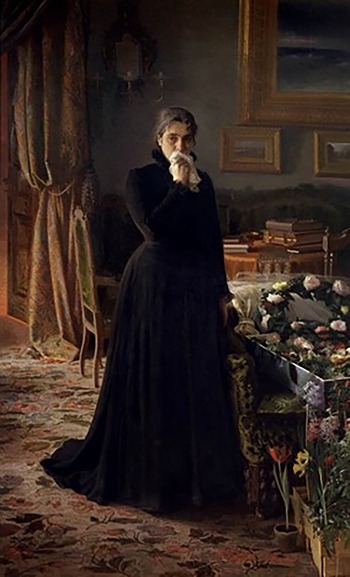
The mysterious woman's blaming of Venichka for her misery is strikingly at odds with his own perception of their relationship. This is, in fact, the second of Venichka's uncharacteristically affinitive envisionings of a woman in black. The first such instance comes earlier in the poema, when he compares his own sense of grief, which renders everything else in life meaningless, to that depicted in Ivan Kramskoi's painting Neuteshnoe gore (Inconsolable Grief; Figure 1). Centering on a woman in an austere black dress who covers her mouth with a handkerchief, the painting places the viewer into a situation in which communion with the bereaved is both called for and obviated.Footnote 62 The viewer cannot share in the woman's grief. Any attempt at consolation is forestalled, both by the painting's title and by the woman's positioning as she occupies the center of this dark room and looks past the viewer.
Ivan Kramskoi, Inconsolable Grief, 1884

When Venichka first mentions the painting, it is with the intention of suggesting that the woman's seclusion (a falling-out from the rules of mundane reality in which the rest of humanity resides) is temporary, while his is a permanent state of exception—a kind of existential abandonment:
For instance, do you know Kramskoi's painting, Inconsolable Grief? Well, of course, you've seen it. Imagine that some cat or other has just knocked on the floor some kind of, oh, phial of Sevres porcelain belonging to the grief-stricken princess or young noblewoman, or that it has torn into shreds some priceless peignoir or other. Would she be storming around, or flailing about with her hands? Of course not, because all that would have been nonsense to her, because for a day or three, she is “more elevated” than any kind of peignoir or cat or Sevres porcelain.Footnote 63
Importantly, mourning in this view is marked by Venichka's favored passivity (no “storming” or “flailing about”). Venichka's listeners here are invited to bear witness to the inexpressible without sharing in it, while he himself is in a privileged position: he shares with the woman her inconsolable grief.
Upon the reappearance of a woman in black (who might be the same woman in black, in any case an echo of the first)—the above-mentioned Mrs. Kurbsky—Venichka again attempts to create a sense of identification with her, but she resists this communion. Rather, she identifies him as the cause of her grief, and rejects his desire for connection on the basis of shared experience, exposing him, in the process, as a doer—an actor rather than a passive receptacle. Whereas the first woman in black appears as a metaphor, the second seems to have migrated from the world of art to haunt Venichka's drunken dreams. As a product of his delirium, she suggests the possibility of his own doubt. Could he be expressing here the fear that perhaps his passive disengagement, which was supposed to have enabled him to avoid violence, has somehow rather caused suffering, and thereby constituted an act of cruelty, or even just an act?
Kramskoi painted Inconsolable Grief soon after the deaths of his two young sons. Relatedly, sick or dying children represent a constant if subtle leitmotif in Moskva-Petushki. First appearing in the initial stretch of Venichka's journey, the motif is introduced here somewhat incongruously, via an intertextual analogy. This occurs as Venichka contemplates the specifics and worthwhileness of his latest binge, eventually concluding that such questions are unanswerable, just like a certain unsolved historical mystery: “I just calculated that from Chekhov Street to this hallway I drank up six rubles—but where and what and in what sequence, to good or evil purpose? This nobody knows and, now, nobody will ever know. Just as we don't know to this day whether Tsar Boris killed Tsarevich Dmitri or the other way around.”Footnote 64 The paradox mentioned seems to be a reference to Modest Mussorgsky's opera Boris Godunov, based on Aleksandr Pushkin's eponymous drama. In act one, Godunov is alleged to have ordered the assassination of ten-year-old Tsarevich Dmitrii, the son of Ivan the Terrible, in order to seize the throne; in the last act, Boris himself dies, having been tormented by incessant visitations of the dead child's apparition. Early in Moskva-Petushki, mention of this historical riddle might appear jocular, especially in the context of Venichka's musing on the unknowability of his own alcohol consumption; but in retrospect, reference to this reciprocal killing is revealed as entirely serious: this was, indeed, a somber reflection on the moral unknowability of one's actions. That is, as the reader reaches the end of the poema, and the angels turn into demons, Venichka perceives a reciprocity between his desertion of his loved ones and their own cruel abandonment of him. This dynamic suggests that, contrary to Venichka's earlier-expressed belief, one does not gain oneself through separation from others, but rather perishes.
There are multiple allusions to the abandonment and death of children in the text, but perhaps the most extended discussion on the subject appears in Venichka's conversation with the angels about his son. Tellingly, when the angels reproach him for his binging, Venichka misinterprets their concern, thinking they merely want him to be happy. But the angels correct him, explaining that, in watching over him, they are acting on behalf of his little boy:
No, we are not silly, we are only afraid that once again you won't get there.
“Won't get there? I won't get to Petushki? To her? To my shameless Tsaritsa with eyes like clouds? You're really funny.”
No, we are not funny, we are afraid you won't get to him and he won't get any nuts.Footnote 65
Here Venichka's unaccountability reaches its peak. He justifies his previous absences with reference to his all-conquering “limpness,” then vows to reach the boy, “if only I don't croak, killed by fate.”Footnote 66 The angels see right through this obvious attempt to “pass the buck” of his own irresponsibility onto the workings of destiny. “‘The poor kid,’ the angels sighed.”Footnote 67 Mustering one last attempt to nudge Venichka toward his son as a potential source of contentment, they remind him that he has not smiled the whole day; and he indeed smiles upon remembering his son's smile, this reflection of one smile in the other standing as Venichka's only moment of transcendence of his perpetual narcissism and solipsism, the only moment of the hero's unfreedom from human connection.
Remembering his sickly son, who tends to get better the minute he sees his father, Venichka starts praying to God to preserve his son from any calamities or accidents, ending the prayer with “And if he should get sick, let him start getting better the minute he sees me.”Footnote 68 The murder at the end of the book, we are given to understand, will thus claim one more victim, Venichka's son (since, never again seeing his father, he will be deprived of this remedy).
The last thing Venichka sees before his death is the letter Ю (Iu, or Ju in linguistic transcription), which may signify, not just his own demise, but also his absence in the life of others, specifically his son. The letter Ю has previously been associated in the poema with Venichka's son: it has been a source of pride to Venichka that a three-year old knows and can write such a difficult letter. In fact, aside from the boy's sickliness, this early feat of literacy is the only thing we know about him.
The Letter Ю
The significance of the letter Ю in the poem has received some critical attention. Vlasov adduces two interpretations, the first of which—advanced separately by Liubov΄ Liubchikova and Igor΄ Avdiev—holds that this letter encodes the name of the woman for whom Erofeev the author felt an unremitting and tormenting love, Iuliia Runova. According to a second contention, Ю stands for the Russian verb “to love,” insofar as its first-person singular form лЮблЮ features this letter twice.Footnote 69 This latter interpretation has been advanced by Svetlana Gaiser-Shnitman, who goes on to suggest that the boy, who “loves his father as himself,” embodies the Christian ideal.Footnote 70 The first interpretation, referencing Venichka's tormenting love, does not explain the significance of the child's notable ability to recognize and write Ю. The second interpretation's association of love with the son seems productive, but the letter's trembling suspension at the moment of Venichka's death calls for further elaboration.
The least satisfying of interpretations of Venichka's final agony, meanwhile, are those that attempt to connect it to his capacity for love. In a religious reading, Venichka's demise becomes a final act of kenosis for the sake of the world, a Christ-like self-sacrifice as an expression of enormous love for humanity.Footnote 71 But to read Venichka's self-imposed torment so Golgothically would be to ignore his explicit misanthropy, his rejection of valor, his yearning for solitude and freedom from accountability, and his feelings of guilt.
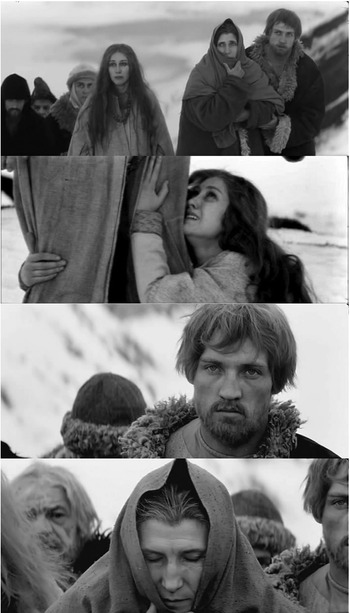
If, however, for argument's sake we read Venichka as indeed inviting his own death for the sake of humanity, then the behavior of the furies and angry angels can be understood only according to a reading of Christ proposed by Tarkovski's Andrei Rublev in the eponymous film that came out in 1966 (not long before Erofeev's composition of his poema). In the section of the film titled “The Passion According to Andrei,” the great medieval painter of icons and religious frescos contradicts his misanthropic teacher Theophanes and argues that empathy for humanity is integral to an artist's vocation. To prove it, he offers, uncharacteristically for a monk, a rendition of Christ's passion from the subjective standpoint of the people who loved him and felt left behind by his after all voluntary death:
Jesus comes from God, in other words, he's almighty. So if he died on the cross, it must have been preordained. Both his crucifixion and death were God's doing. And this should have caused people to hate him—not the people who crucified him, but the people who loved him, especially if they were with him at the time. For they loved him as a human being, and he abandoned them of his own free will; it was unfair, even cruel of him.
Scandalized by Rublev's judgment of Christ's behavior as callous, Theophanes responds: “Do you realize what you are saying? For these words, you'll be packed off to the North to touch up icons.”
But the camera sides with Rublev. As we hear his “sacrilegious” words, we see Golgotha, transposed to a snowy Russian landscape, a pensive yet determined Russian Christ in peasant garb, and his distraught and uncomprehending followers. The camera chooses to focus on their pain, rather than on Christ's torment, at one point even dipping to the level of a kneeling Mary Magdalene as she tries to cling to the legs of her departing Lord. Staying with her, the camera bears witness as Christ's leg briskly shakes off her grasp, as if to demonstrate the cruelty of which Rublev speaks (Figure 2).Footnote 72
Stills from “The Passion According to Andrei, 1406,” Andrei Rublev, dir. Andrei Tarkovski, 1966

It is noteworthy that Venichka, just like Rublev, addresses Christ's separation from people, including, as mentioned above, his rebuke of his own mother Mary; but the inflection is different. Venichka presents this cruelty as worthy of emulation. The angels, however, see it differently. If Erofeev's Venichka is indeed performing an act of martyrdom, then the angels, much like Tarkovski's Rublev, assume a human viewpoint on his actions, siding rather with the loved ones he leaves behind. This martyr, moreover, in his anguished dreams after Orekhovo-Zuevo, appears to have internalized the position of his loved ones, channeling and mirroring their sense of abandonment.Footnote 73 When he realizes that he has lost his way, he feels, not independent and fulfilled, but lonely and incomplete.
In light of these considerations, it would be inconsistent to read the bloody dispersal of the letter Ю in positive terms, as a manifestation of the hero's all-conquering love or a promise of resurrection. Quite the opposite: the quivering of the letter (as if about to dissolve or explode) suggests a certain insolvency, a tragic failure. It might perhaps refer to that one important thought which the protagonist has been chasing, striving to articulate, and which will now remain forever unformed.
If we perform, moreover, a sort of “archaeological dig” in Russian poetry, we discover alternative origins for Venichka's letter Ю, which might clarify its momentous reappearance at the end of the poem. As attested by his notebooks, Erofeev was prodigiously erudite. In the late 1960s, moreover, he was working on compiling an anthology of Russian poetry. The significance of this letter in the Russian poetic canon might thus have been familiar to him.Footnote 74
The lyrical life of Ю—and in particular, the ascription to it of synesthetic properties—may perhaps begin with Mikhail Lermontov's metapoetic “A Fairy-Tale for Children” (Skazka dlia detei, 1839–41), in which the poet detects a certain moisture in words rhyming with the -ю ending:
Я без ума от тройственных созвучий
И влажных рифм—как например на ю. Footnote 75
Ю then reappears, in all its dampness and fluidity, in Konstantin Bal΄mont's Poeziia kak volshebstvo (Poetry as Sorcery, 1916), where it is described and seemingly etymologized as “climbing like ivy, flowing in a stream”: Ю—вьющееся как плющ, и льющееся в струю (emphasis mine, JV).Footnote 76
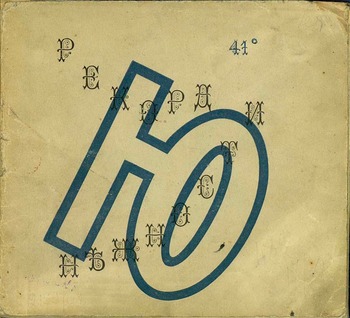
But this letter's greatest attendants were the futurists. In a little book entitled Rekord nezhnosti: Zhitie Il΄i Zdanevicha (The Record of Tenderness: The Life of Ilya Zdanevich, 1919), which features the letter Ю on its cover (Figure 3), Igor Terentiev continues the association of the letter Ю with softness, tenderness, and fluidity, for his part adding femininity to this pantheon. Terentiev first remarks on the pernicious absence of femininity and fluidity in his fellow futurist Zdanevich's poem Ianko: “There's not a single woman there, not a single ‘ьо’ [a not phonic but almost pictographic approximation of Ю, JV]—not a drop of moisture.” He goes on to describe how Zdanevich attempted to compensate for this lack, remedying it with “a compress made out of a woman” in his next work “Asel naprakat” (A Donkey for Hire). This “feminine compress” consists of the overabundant use of the letter Ю, with which Zdanevich, in Terentiev's opinion, sets a record of amorousness and tenderness:
Все неприлично любовные слова в беспричинном восторге юлят, ются, вокают, сяют, преслюняя самого юснаго поэта Велемира Хлебникова: напЯляя клЮсь яслюслЯйка вбильЕ пиизЯти.Footnote 77
The 1919 cover of Igor Terentiev's The Record of Tenderness: The Life of Ilya Zdanevych

Here, the interaction of the letters Ю and Я are suggestive of the erotic relations between a woman and a man.
Vasilii Kamenskii's Ego-moia biografiia velikogo futurista (His-My Biography of a Great Futurist, 1918) devotes a whole section to the letter Ю. To Kamenskii, Ю exemplifies the unity of form and content inherent to all letters: “Every letter is a strictly individual world, whose symbolic concentration gives us an exact definition of its inner and outer essence. For example, Ю.” Kamensky then adduces a poem titled “Ю” from his collection Devushki bosikom (Barefoot Girls, 1917) to illustrate this acme of individuality, completeness, and unity, of which the erotic union between the letters Ю and Я serve as a metaphorFootnote 78 :
Ю
Юночка
Юная
юно
юнится
юнами юность
В июне юня.
Ю—крыловейная лейная
Ю—розоутрая рая
Ю—невеста Ста Песен.
Ю и Я.
The poem begins with Ю, and ends with Ю и Я, or “Ю and I.” Individuality is thus complemented by unity with and completion via the Other. Since the Ю of the poem stands for womanhood, Я must represent the poet as an icon of masculinity.
What must have made Ю special for the futurists, who were interested both in a letter's sound and in the semantic significance of its form, is that in formal or visual terms, Ю instantiates the harmonious coexistence celebrated in Kamenskii's poem. The letter's shape—much like the union of the two sounds it stands for, a consonant (j) and a vowel (u),Footnote 79—epitomizes the connection of opposites: a man (the phallic I) and a woman (the labial O); a one (1) and a zero (0), which could stand for God and the universe in its potential; and finally, a line and a circle, of which the former, per the theory of Andrei Belyi, symbolizes a human life (a string of temporal moments), while the latter symbolizes eternity, existence as a whole.Footnote 80 The combination of both in the letter Ю is akin to Belyi's spiral, that is, the reconciliation of а human life with eternity, of the I with Being—a form of transcendence.Footnote 81
With this poetic reconnaissance in view, we could conclude that Venichka's final Ю emblematizes neither his erotic nor his kenotic love (although both elements of eros and agape are encapsulated in it), but rather a vision of supreme harmony. And the trembling dispersal of the letter in Venichka's eyes signifies the disintegration of this vision.Footnote 82
But what does all of this have to do with Venichka's son, who has mastered the letter in infancy? To answer this question, we might return to Kamensky's above-cited poem that begins with Ю and ends with Я. Kamensky can bring the two letters together so seamlessly because, not only is Я the first-person pronoun, it is also the last letter of the alphabet, while Ю is the penultimate letter. In Kamensky's poem, this closeness to Ю is what leads him to the discovery of his Я, to its manifestation in the end. If we read both these works as journeys toward Я—Я being the journey's “last stop,” its destination—then Kamensky does indeed reach it via Ю, but Erofeev's poema never quite gets there.
The poema's premature ending on the imperfect vision of the quivering, blood-soaked penultimate Ю rather than a final Я brings to mind one more futurist work, the ego-futurist Vasilisk Gnedov's Smert΄ iskusstvu (Death to Art, 1913). Constructed of fifteen poemas, Gnedov's masterpiece is generically similar to Moskva-Petushki. The fourteenth, penultimate poema famously consists of just one letter—Ю, while the fifteenth, last one, entitled “Poema kontsa” (A Poem of the End), contains no words at all, thereby signaling the end of language, speech, and art. Just like Venichka, ego-futurists were seekers after self-definition, the realization of their ego, their Я. In Gnedov's case, where Я should have been, there is silence, which relates it to the end of Erofeev's poema.Footnote 83 Perhaps muteness is the point. Perhaps silence is the very realization of Gnedov's ego, the separation of the self from social reality conditioned by language being the precondition of individual existence. Venichka might have wanted to believe this, to espouse his final association with muteness—his killers’ stabbing of him through or near his voice box—as the ultimate declaration of individuality.
But the very tragedy of Venichka's journey may lie precisely in the unsustainability of this freedom. The very centrality of the letter Ю, as the emblem of Venichka's connection with his son,Footnote 84 as the emblem of wholeness and harmony, suggests that in this potential debate between the cubo-futurist Kamenskii and the ego-futurist Gnedov on the relationship between the ego and its Others, Erofeev might have sided with Kamenskii. To judge from the counterexample of Venichka, that is, one's self-realization is predicated on the intrinsic union with you/Ю. Despite his protagonist's self-associations with muteness (at the outset and the very end of the journey), Erofeev's text, unlike Gnedov's, contains a whole host of words, perhaps exposing yet another of Venichka's weaknesses: the compulsion to speak, as well as the impossibility of the existence of I in a state of complete isolation.