Introduction
Trematode parasites are important faunal components in the intertidal zone, as they are capable of influencing several aspects of their host's life history, including survival and reproductive function, as well as the abundance and population structure of their hosts (e.g. Lauckner, Reference Lauckner and Kinne1980). Temporal and spatial variation in the recruitment of parasites to host populations may result from a variety of biotic factors, such as their host behaviour, population density and susceptibility to infection (e.g. Kuris & Lafferty, Reference Kuris and Lafferty1994; Studer & Poulin, Reference Studer and Poulin2012). Abiotic factors, such as habitat temperature, may also favour or limit parasite recruitment (Thieltges et al., Reference Thieltges, Fredensborg and Poulin2009; Studer & Poulin, Reference Studer and Poulin2012). Previous studies reported that eutrophication from sewage pollution could have positive effects on the abundance of parasites (e.g. Lafferty, Reference Lafferty1997; Blanar et al., Reference Blanar, Munkittrick, Houlahan, Maclatchy and Marcogliese2009).
The intertidal zone of rocky shores supports a rich fauna of invertebrates and birds, thus promoting the development of complex digenean life cycles. Trematode life cycles typically include two intermediate hosts, where the first is usually a snail and is highly specific (Lauckner, Reference Lauckner and Kinne1980) and a vertebrate is the definitive host. The trematode Maritrema madrynense uses the pulmonate snails Siphonaria lessonii and Siphonaria lateralis as first intermediate hosts, the crab Cyrtograpsus altimanus and the isopod Exosphaeroma sp. as second intermediate hosts and the kelp gull Larus dominicanus as definitive host (Alda & Martorelli, Reference Alda and Martorelli2009; Diaz & Cremonte, Reference Diaz and Cremonte2010; Gilardoni et al., Reference Gilardoni, Etchegoin, Diaz, Ituarte and Cremonte2011). Siphonariid gastropods act as the first intermediate host of two additional trematode species, a hemiuroid and a schistosomatid (Alda & Martorelli, Reference Alda and Martorelli2009; Gilardoni et al., Reference Gilardoni, Etchegoin, Diaz, Ituarte and Cremonte2011), and are also hosts of a haplosporidian protozoan species, Haplosporidium patagon (Ituarte et al., Reference Ituarte, Bagnato, Siddall and Cremonte2014).
The aim of this study was to determine whether host characteristics (density and size) and environmental factors (tidal level, sewage pollution, temperature, abundance of birds) promote or restrict the transmission of trematodes that parasitize two intertidal pulmonate snails, S. lessonii and S. lateralis. The study was conducted at two contrasting intertidal sites along the Patagonian coast of Argentina.
Materials and methods
Snail collection and examination
Two sampling sites with contrasting physical characteristics were selected along the intertidal rocky shore at Puerto Deseado (47°45′S, 65°55′W). Site 1 was located in the upper level of the intertidal zonal and was characterized by a high level of stress. It was exposed to a higher degree of hydrodynamic forcing (wave action) and desiccation, and more prolonged exposure to ultraviolet (UV) radiation (about 10 h/day). This site was also exposed to a sewage outfall from fish-processing plants which discharge directly on to the rocky intertidal, thus leading to nutrient enrichment and more eutrophic conditions. Site 2 was located in the lower level of the intertidal, and is thus representative of a lower level of stress, including shorter exposure to UV radiation (~2 h/day). Although the two sites are only about 700 m apart, site 2 is located upstream from the sewage discharge point and is thus not directly exposed to sewage pollution. To determine the level of sewage pollution at site 1, and to test if site 2 is also affected by sewage pollution, water samples were collected in September 2014 at each site. Nutrient concentrations (ammonium, nitrite + nitrate, and phosphate) were measured in September 2014 in duplicate, and biological oxygen demand (BOD), salinity, dissolved oxygen and pH were determined without replication. Daily variations in seawater and air temperatures were recorded with dataloggers (Thermochron® iButton® device (DS1921G), Maxim Integrated, California, USA). Two dataloggers, protected in plastic capsules to avoid wetting during immersion, were deployed at each site and set to record temperatures every 60 min. Maximum, minimum and mean monthly temperatures were calculated at each site from records obtained between May 2013 and January 2014.
To characterize the potential availability of definitive hosts that can affect the transmission of M. madrynense, two or three shorebird censuses were performed at each sampling site during low tides. Observations of all shorebirds present at each sampling were made using binoculars. To date, only the kelp gull L. dominicanus has been confirmed as a definitive host of M. madrynense (Diaz & Cremonte, Reference Diaz and Cremonte2010). However, given that trematode specificity for its definitive hosts is generally low, the numbers of all types of birds were determined in this study (including grebes, cormorants, ducks, oystercatchers, plovers and other gulls). The abundances of total shorebirds and, in particular, that of kelp gulls, were calculated by averaging the number of the observations made at each site.
Specimens of S. lessonii and S. lateralis were collected bimonthly during the lowest tides at the two sites from December 2012 to November 2014. Eight 25 × 25 cm quadrats were placed randomly at each of the two sampling sites and all individuals inside each quadrat were collected manually. The density of the two host species was calculated as the number of individuals/m2. Additionally, due to the low density of S. lessonii, 50 specimens of this species were collected at each site to allow assessment of the population dynamics of parasite infections. It was not necessary to collect additional specimens of S. lateralis because the density of this species was relatively high, and thus the number of snails collected from eight quadrats was sufficient to undertake the study of the dynamics of parasite infection.
The specimens collected were transported to the laboratory, measured (with calipers with a precision of 0.1 mm), and weighed (total body wet weight, wet weight of drained soft tissue and shell wet weight). Trematodes were detected under a stereoscopic microscope. The visceral mass of all specimens was inspected and, in dubious cases, microscopic squashes of the digestive gland and gonad tissues were used to further screen for parasites. The prevalence of infection was calculated following Bush et al. (Reference Bush, Lafferty, Lotz and Shostak1997), and the infection intensity was calculated according to Studer & Poulin (Reference Studer and Poulin2012) as the percentage of the overall wet weight of the gastropod (including shell weight) that consisted of parasite tissue. For this purpose, gastropods of similar size (13–16 mm) infected with sporocysts of M. madrynense and Hemiuroidea fam. gen. et sp. were used. The proportion of hosts with sporocysts of M. madrynense containing cercariae, and that of hosts with sporocysts containing metacercariae, were also calculated by observing ten randomly selected sporocysts under the light microscope.
Data analysis
Several models were proposed to study the relationship of prevalence and intensity of infection in relation to gastropod characteristics (shell length and density) and environmental factors (site, season and year). For this purpose, Generalized Linear Models (GLMs) (McCullagh & Nelder, Reference McCullagh and Nelder1989) were used. In the case of over-dispersed data, the GLM was corrected following Crawley (Reference Crawley2007). Akaike's information criterion (AIC) was used to determine the best model for the analysed data (Burnham & Anderson, Reference Burnham and Anderson2002). The step function in the R program was used to select the best model (Venables & Ripley, Reference Venables and Ripley2002), a function that compares all possible models and selects the one with the lowest AIC. Additionally, a Spearman correlation test was performed to evaluate the relationship between the prevalence of M. madrynense and the abundance of birds. Double infections (M. madrynense and Hemiuroidea fam. gen. et sp.) were examined by comparing observed frequencies and randomly expected frequencies using a heterogeneity test (G) (Sokal & Rohlf, Reference Sokal and Rohlf1981). All statistical analyses were performed using R (R Development Core Team, 2012).
Results
Characterization of sampling sites
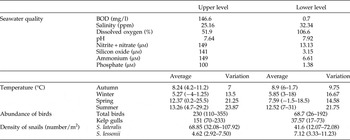
Site 1 was characterized by higher values of total biological oxygen demand (BOD) and nutrients (nitrite + nitrate, silicon oxide, ammonium, phosphate), and by lower values of salinity and dissolved oxygen. At both sampling sites, the mean monthly temperatures showed a linear increase from the winter to the summer (table 1). At site 1, the amplitude of the seasonal temperature variation (maximum − minimum temperature values) showed a gradual and linear increase from the autumn to the summer. This high intertidal site is therefore characterized by more prolonged periods of air exposure (up to 10 h), and thus higher ultraviolet (UV) radiation and desiccation. At site 2, the amplitude of the seasonal temperature variation does not show such a clear pattern, it is more moderate from the winter to the spring, and temperature shows an increase in summer (table 1). More prolonged immersion likely results in more stable environmental conditions at this site. The abundance of birds was significantly different between the two sites, with a greater number of total birds and L. dominicanus recorded at site 1 (tables 1, 2). Seasonality in the abundance of birds was observed: at both sites, as fewer birds were recorded in winter compared to the other seasons.
Mean values of seawater physico-chemical characteristics at the upper and lower intertidal levels of both sampling sites together with the abundance of birds and density of the snail hosts Siphonaria lateralis and S. lessonii; ranges are given in parentheses.

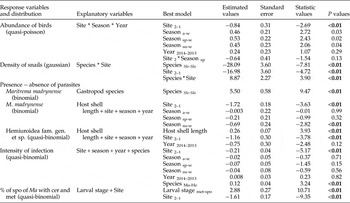
The relationship between infection levels of Maritrema madrynense (Ma) and Hemiuroidea fam. gen. et sp. (He) in the snail species Siphonaria lateralis (Sla) and S. lessonii (Sle) together with selected biotic and physical factors using Generalized Linear Models (GLMs); autumn (a), spring (sp), su (summer), w (winter), sporocysts (spo), cercariae (cer), metacercariae (mer) and significant P values are shown in bold.

* Indicates an interaction factor; + indicates an additive factor.
Parasitological survey of the host species
The GLM analysis indicated that S. lateralis had a significantly higher density than S. lessonii at both study sites. The dominant gastropod species, S. lateralis, had a significantly higher density at site 1 than 2, whereas S. lessonii showed a higher density at site 2 (tables 1, 2).
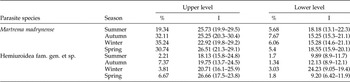
Siphonaria lessonii was found to be parasitized by the trematode M. madrynense (Microphallidae) and by the Hemiuroidea fam. gen. et sp., whereas only the microphallid species was found in S. lateralis. Despite the fact that both pulmonate snail species co-occurred at both study sites, the identified larval trematode parasites (sporocysts with cercariae and/or metacercariae of M. madrynense and sporocysts with cercariae of Hemiuroidea fam. gen. et sp.) differentially affected the two host species. A total of 3422 specimens of S. lateralis were inspected and only three were found to be parasitized by M. madrynense. In contrast, a total of 1560 specimens of S. lessonii were inspected and 324 were found to be parasitized, 269 by M. madrynense and 55 by Hemiuroidea fam. gen. et sp. The GLM analysis indicated that the prevalence of M. madrynense was significantly lower in S. lateralis than in S. lessonii (table 2). The Hemiuroidea fam. gen. et sp. was only found in S. lessonii (prevalence = 3.52%). Given the low prevalence of infection in S. lateralis, the results that follow will deal only with findings in S. lessonii. The overall prevalence of M. madrynense and Hemiuroidea fam. gen. et sp. infecting S. lessonii was higher at site 1 than at site 2 (table 3). Analysis by GLM indicated that the presence/absence of M. madrynense did not vary significantly with shell length of the host, but this relationship was positive and significant in Hemiuroidea fam. gen. et sp. (table 2). The latter was found parasitizing S. lessonii specimens between 11 and 19 mm in length. The highest prevalence values (3.7%) were recorded in the larger specimens (>17 mm length).
Mean values of the prevalence (%) and infection intensity (I) (%) of Maritrema madrynense and Hemiuroidea fam. gen. et sp. in S. lessonii at upper and lower intertidal levels of both sampling sites; ranges are given in parentheses.

With respect to the seasonality of infection, GLM analysis indicated that the presence/absence of M. madrynense varied significantly throughout the year; the austral summer was the season in which the lowest number of parasitized specimens was found (tables 2, 3). The GLM analysis also indicated that the presence/absence of Hemiuroidea fam. gen. et sp. did not vary significantly with season.
On average, 20.29 ± 4.88% (standard error) (n = 144) of the total weight of parasitized specimens of S. lessonii corresponded to M. madrynense tissues (table 3). This percentage in gastropod hosts did not differ significantly among seasons, but significant differences were observed between sampling sites, higher infection intensity at site 1 (tables 2, 3). The parasite Hemiuroidea fam. gen. et sp. contributed on average 19.55 ± 6.8% (n = 41) of the total weight of S. lessonii. The percentage of tissue occupied by Hemiuroidea fam. gen. et sp. was thus significantly lower than that occupied by M. madrynense (tables 2, 3).
The GLM analysis indicated that a higher percentage of specimens parasitized by sporocysts of M. madrynense contained only metacercarie and a much lower proportion was observed housing sporocysts with cercariae (table 2). At site 1 more specimens were found parasitized by sporocysts with metacercariae than at site 2 (94% vs. 89%, respectively).
The Spearman correlation coefficient showed a positive relationship between bird abundance and prevalence of M. madrynense (r s = 0.84, P < 0.01). Double infections (M. madrynense + Hemiuroidea fam. gen. et sp.) were observed in S. lessonii with a very low prevalence (0.002%). Prevalence of double infections was lower than that expected to occur randomly (G = 4.05, P < 0.05).
Discussion
The overall prevalence of M. madrynense was 17.37% in S. lessonii and only 0.09% in S. lateralis; the overall prevalence of Hemiuroidea fam. gen. et sp. was 3.52% in S. lessonii but S. lateralis was not found to be infected by this digenean. The same pattern was reported by Di Giorgio et al. (Reference Di Giorgio, Gilardoni and Ituarte2014) for the protozoan Haplosporidium patagon (Haplosporida), which also exhibited a higher prevalence in S. lessonii (3.78%) than in S. lateralis (0.13%). Results of the present study indicated that the parasites M. madrynense and Hemiuroidea fam. gen. et sp. have a high host specificity. Strong specificity of a digenean species for its first intermediate host has been reported in a number of previous studies (Lauckner, Reference Lauckner and Kinne1980; Galaktionov & Dobrovolskij, Reference Galaktionov and Dobrovolskij2003). Maintenance of strict host specificity by parasites when several closely related host species occur sympatrically is poorly understood (Donald et al., Reference Donald, Kennedy, Poulin and Spencer2004). In the present study M. madrynense was found to be capable of parasitizing both sympatric host species, yet a very low prevalence was recorded in the case of S. lateralis. It is noteworthy that, a priori, it is expected that the encounter probability of the parasite and host is much greater in the case of S. lateralis because its density is markedly higher than that of S. lessonii (55.13 vs. 5.87 individuals/m2). Indeed, it is possible that the low densities of S. lessonii observed in the present study can be explained by the fact that the parasite causes castration in this snail species (Di Giorgio et al., unpublished data) and also has the potential to reduce the host's physiological condition, thereby increasing the snail population's vulnerability to predation (Minchella & Loverde, Reference Minchella and Loverde1981), or increasing mortalities by eliciting physiological stress (Lafferty, Reference Lafferty1993; Thomas et al., Reference Thomas, Renaud, Rousset, Cezilly and Meeus1995).
Based on host density data determined in the present study, S. lessonii occurs at a lower density at site 1, a more eutrophic site affected by sewage-derived nutrients, than site 2. This finding agrees with the results of Tablado et al. (Reference Tablado, López Gappa and Magaldi1994), who reported lower densities of S. lessonii in populations affected by disrupted environmental conditions due to sewage pollution. Despite the lower density of S. lessonii at site 1, the prevalence of infection of both digeneans was higher at site 1 than at site 2. The high nutrient values measured at site 1 are associated in the present study with the higher prevalence of infection by M. madrynense and Hemiuroidea fam. gen. et sp. at this site. Poulin (Reference Poulin1992), Lafferty (Reference Lafferty1997) and Blanar et al. (Reference Blanar, Munkittrick, Houlahan, Maclatchy and Marcogliese2009) reported that eutrophication had a positive effect on the abundance of parasites. At the same time, the more eutrophic site appears to attract a larger number of birds (Gandini & Frere, Reference Gandini and Frere1998). In the present study, the average abundance of total birds was 230 at site 1 vs. 69 at site 2. The kelp gull was also more abundant at the eutrophic site (151 vs. 38 at sites 1 and 2, respectively). This may be another possible explanation for the higher parasitic prevalence at the more eutrophic site.
Several previous studies reported that parasite populations are strongly influenced by the distribution and abundance of their definitive hosts (Smith, Reference Smith2001; Hechinger & Lafferty, Reference Hechinger and Lafferty2005). Hoff (Reference Hoff1941) found that higher values of infection prevalence by Cryptocotyle lingua in the limpet, Littorina littorea, were related to the high abundance of gulls observed feeding in the area. Few studies, however, provide robust documentation of the existence of a direct link between bird abundance and parasite spatial heterogeneity (Smith, Reference Smith2001; Hechinger & Lafferty, Reference Hechinger and Lafferty2005; Fredensborg et al., Reference Fredensborg, Mouritsen and Poulin2006). In the present study, a strong positive correlation was found between bird abundance and the prevalence of M. madrynense. In the case of Hemiuroidea fam. gen. et sp., the definitive hosts are fish (Gibson et al., Reference Gibson, Jones and Bray2002). The highest prevalence of this parasite was found at site 1, located in the upper intertidal zone. Studies of the trematode life cycle, as well as the ecology and behaviour of the second intermediate and definitive hosts, are necessary to better understand the spatial distribution of this hemiuroid parasite.
The trematode M. madrynense was found parasitizing the digestive gland and the gonad of the false limpet S. lessonii, and showed a higher percentage of individuals with sporocysts containing only metacercariae than of those with sporocysts containing cercariae. This finding may indicate that shortening of the M. madrynense life cycle is possible when it uses S. lessonii as both a first and second intermediate host. A comparison between sites in the present study showed a higher percentage of gastropods parasitized by sporocysts containing metacercariae at site 1 than at site 2. Usually, both abbreviated and three-host life cycles are observed in a single parasite population. This is interpreted as a transmission strategy in response to a diversity of biotic factors (such as the presence or absence of a definitive host) (Holton, Reference Holton1984), or abiotic factors (extreme environmental conditions, e.g. low temperatures) that could restrict transmission by affecting the free-living larval stage (Skirnisson & Galaktionov, Reference Skirnisson and Galaktionov2002), aerial exposure, salinity extremes and hydrodynamic forcing (Lagrue & Poulin, Reference Lagrue and Poulin2007). In the present study, the higher percentage of metacercariae at site 1 could be explained by the high level of stress, including the wide temperature variation, experienced at this site. Under these stressful conditions, an abbreviated life cycle would represent a selective advantage and adaptive response for the parasite.
The prevalence of double infections (M. madrynense + Hemiuroidea fam. gen. et sp.) was lower than that expected to occur randomly. This could be due to the fact that the presence of a given parasite species limits the entry of another parasite species, or may be because both occupy the same tissue (gonad and digestive gland) in their host. In the present study, a positive correlation was found between the prevalence of infection of Hemiurioidea fam. gen. et sp. and the size of the host. An increase in parasite prevalence with the size of gastropod hosts was also reported by Al-kandari et al. (Reference Al-kandari, Abdul-Salam and Meakins2000, Reference Al-kandari, Abdul-Salam, Moussa and Sreelatha2007) and Fredensborg et al. (Reference Fredensborg, Mouritsen and Poulin2005), possibly due to the fact that larger individuals, assumed to be older, were exposed to infective larvae (miracidia) for a longer time. Furthermore, Skirnisson et al. (Reference Skirnisson, Galaktionov and Kozminsky2004) reported that large gastropods offer more space and nutrients for the parasite.
Different seasonal patterns in the prevalence and abundance of trematodes in molluscs have been documented previously (Kube et al., Reference Kube, Kube and Bick2002; Fermer et al., Reference Fermer, Culloty, Kelly and O'Riordan2009). In this study, the prevalence of infection of M. madrynense was minimal during summer, when temperatures recorded at both sites were the highest (29°C and 31°C at sites 1 and 2, respectively), coinciding with a wider temperature range. Prinz et al. (Reference Prinz, Kelly, O'Riordan and Culloty2010) reported a peak in the prevalence of trematode Echinostephilla patellae in the intertidal gastropod Patella vulgata during the austral autumn, coinciding with an increase in the abundance of birds. In our study, bird abundance showed no seasonal pattern of variation. Variation of mean monthly temperatures differed among seasons, however, as it was markedly higher in summer than during the rest of the year. This may explain the lower prevalence of infection in summer, as a wide range of monthly temperatures could negatively affect egg hatching and the survival of miracidia that infect the first host. Furthermore, a definite seasonal pattern of infection was not detected in previous studies (Cannon, Reference Cannon1979; Taskinen et al., Reference Taskinen, Valtonen and Mäkelä1994; Muñoz et al., Reference Muñoz, Torres, Valdés and Rodríguez2013). Similarly, in the present study there was no evidence of a seasonal pattern in the prevalence of Hemiuroidea fam. gen. et sp. in the study area.
Parasite biomass is known to be related to host size, energy availability, season and habitat characteristics (Hechinger & Lafferty, Reference Hechinger and Lafferty2005; Kuris et al., Reference Kuris, Hechinger, Shaw, Whitney, Aguirre-Macedo, Boch, Dobson, Dunham, Fredensborg, Huspeni, Lorda, Mababa, Mancini, Mora, Pickering, Talhouk, Torchin and Lafferty2008). In this study the digenean parasites occupied a relatively large percentage of the overall weight of the gastropod host (up to 26.66%). Furthermore, the percentage of tissues occupied by each parasite species differed between sampling sites, such that infection intensity was higher in the upper intertidal than in the lower intertidal. This intra-specific variation may be associated with the more eutrophic conditions and thus the greater food availability (algal biomass) for these siphonariid gastropods at site 1. The trematode M. madrynense was also found to occupy a greater percentage of host tissues than Hemiuroidea fam. gen. et sp. Similarly, intra-specific variation was observed between two study sites in a parasite–host system including larval trematodes and the gastropod C. californica by Hechinger et al. (Reference Hechinger, Lafferty, Mancini, Warner and Kuris2009). These authors demonstrated that the relative body mass of parasite and host can vary inter-specifically, both with taxonomic family and the type of host tissue affected.
Acknowledgements
All authors are members of Consejo Nacional de Investigaciones Científicas y Técnicas (CONICET). The authors thank Dra. Titina Zapata, from the Centro de Investigaciones, Universidad de la Patagonia Austral at Puerto Deseado, for kindly allowing access to laboratory facilities, the Prefectura Naval Argentina, Puerto Deseado, for their help with sampling and the Laboratory of Chemical Oceanography and Water Pollution for performing chemical analyses of water samples. Editing services were provided by Dr Monica Bricelj, techMar research Inc., New York, USA.
Financial support
This study was funded by Agencia Nacional de Promoción Científica y Tecnológica (PICT 2010-0730 and PICT 2013-1702) and the Professional Association of Diving Instructors (PADI) Foundation.
Conflict of interest
None.