Introduction
Water vapor in a heating atmosphere engages strongly with solid reactions such as thermal decomposition,Reference MacIntire and Stansel1–Reference Kozawa3 crystallization,Reference Wagstaff and Richards4–Reference Tatsuoka and Koga7 and powder synthesis,Reference Hayashi, Ishizu, Kikuchi, Okada and Otsuka8,Reference Ubaldini, Buscaglia, Uliana, Costa and Ferretti9 in particular, at high partial pressures, which differs from reactions in air. Recently, our group reported that solid-state reactions in a water vapor atmosphere of 0.1 MPa (1 atm) can produce calcium silicatesReference Kozawa, Onda and Yanagisawa10,Reference Kozawa, Yanagisawa, Yoshida, Onda and Suzuki11 and perovskite compoundsReference Kozawa, Onda and Yanagisawa12–Reference Kozawa, Yanagisawa and Suzuki14 at lower temperatures than in air. Further investigation of the synthesis of Li(Ni,Mn)2O4, which is used as a low-cost cathode material for lithium-ion batteries, revealed the potential for rapid grain growth by water vapor, which made the spherical shape of the precursor particles impossible to maintain.Reference Kozawa, Yanagisawa, Murakami and Naito15,Reference Kozawa, Hirobe, Uehara and Naito16 We believe that this water vapor-assisted grain growth can be applied to a pressureless sintering process that allows for densification of powder compacts by reducing the pores that exist between particles.
Several pioneering studies have pointed out that water molecules, which remain between oxide particles after the thermal decomposition of hydroxides and basic carbonates, can trigger subsequent neck formation. To clarify the mechanism of this action, the initial sintering of alkaline-earth oxide powders such as MgO and CaO was investigated under heating conditions without residual water molecules.Reference Anderson and Morgan17–Reference Ito, Fujita, Watanabe and Tokuda20 Despite the introduction of a negligible amount of water vapor into the atmosphere, the specific surface area decreased rapidly with increasing temperature as compared with the initial sintering in a vacuum. For oxides with strong ionic bonds such as MgO, oxygen deficiencies generated by water vapor adsorption at high temperature are known to facilitate ion diffusion in the solid. Meanwhile, in the case of SiO2 and TiO2, the diffusion of temporary hydroxy groups formed on the surface M–O–M bonds (M = metal ion) plays a dominant role in the acceleration of sintering.Reference MacKenzie21 A model in which the specific surface area decreases in the presence of water vapor has been proposed for the initial sintering of submicrometer titania (TiO2) anatase powder.Reference Hébrard, Nortier, Pijolat and Soustelle22 According to the model, the rate-determining step is the surface diffusion of hydroxy groups, and no geometrical assumption is required. Consequently, an increase in the grain growth rate is expected under a high partial pressure of water vapor. Nevertheless, most of the previously published studies of sintering in water vapor focused on the initial step of loosely packed powders at low partial pressures. The development of a sintering process for compact powders in 0.1 MPa water vapor can allow for the production of ceramics with high densities at a low temperature with potentially new functionalization of large grains within ceramics.
This paper is divided into two parts: (i) the sintering of TiO2 compacts using submicrometer powders in air and water vapor atmospheres and (ii) thermal treatments of powders using isotopically labeled water vapor. Grain growth was drastically accelerated by water vapor, as compared with that during sintering in air, yielding sintered compacts with a maximum density of 99.3% and an average grain size of 181 µm. The incorporation of oxygen from water vapor was confirmed by the oxygen isotope analysis, reinforcing the conclusion that the sintering mechanism is based on the formation of hydroxy groups. Since grain boundary density or concentration is decreased by the water vapor-assisted grain growth, the manufacturing of single crystal-like ceramics can potentially be accomplished through a simple and conventional pressureless sintering process and without any additives.
Experimental
Commercially available TiO2 powder (rutile form, 99.9%, Wako Pure Chemical Industries, Osaka, Japan) was used in this study. This raw powder included a small amount of the anatase phase, and hence a preheating at 1000 °C for 2 h in air was conducted to eliminate the effect of the anatase–rutile phase transformation on sintering.Reference Mazaheri, Razavi Hesabi and Sadrnezhaad23 Then, the calcined powder was milled for 1 h in ethanol using a planetary ball mill (Fritsch, Pulverisette 5, Idar-Oberstein, Germany) with ZrO2 pot (80 cm3) and beads (ϕ 1 mm). The resulting slurry was dried at 60 °C and crushed again with an agate mortar. The treated TiO2 powder was mixed with a 1 mass% solution of polyvinyl alcohol (Wako Pure Chemical Industries) as a binder (a mixture of the solvents glycerin, ethanol, and water). After drying and crushing, this TiO2 powder was pressed for 3 min at a pressure of 100 MPa to obtain pellets (8 mm in diameter, 1.2 mm in thickness). The average bulk density was 56.6%, calculated from the pellet dimensions.
The sintering of the TiO2 pellets was conducted using a tubular furnace equipped with an evaporator. The pellets were placed on a Pt mesh within an Al2O3 boat and inserted into the furnace. First, the pellets were slowly heated in air at a rate of 1 °C/min up to 800 °C to burn off the binder. From 800 °C up to the desired sintering temperature, the heating rate was changed to 3 °C/min, and then the sintering was conducted at 1200–1400 °C for 4 h in air and water vapor. The water vapor environment was achieved as follows: when the temperature of the furnace reached 800 °C, deionized water was pumped into the evaporator, which was heated to over 300 °C, at a flow rate of 2 mL/min. The generated water vapor was directly introduced into the furnace without a carrier gas and allowed to flow until the end of the holding time at each sintering temperature. After stopping the introduction of water vapor, the samples were cooled down in the furnace in air. Therefore, the TiO2 pellets were exposed to water vapor from 800 °C to the end of the sintering time. Since the outlet of this furnace was in an open state, the pressure of water vapor was held at 0.1 MPa.
The crystalline phase of the sample was identified by powder X-ray diffraction (XRD, Rigaku, Ultima IV, Tokyo, Japan) using Cu Kα radiation at 40 kV–20 mA. The N2 adsorption measurements (Quantachrome, NOVA 1200, Boynton Beach, Florida) were performed at −196 °C to determine the specific surface area of the powder, which was calculated by the three-point BET method. The particle size distribution of the raw powder was determined by employing the laser diffraction/scattering method (Shimadzu, SALD-7100, Kyoto, Japan). The powder was dispersed in a 0.2 mass% sodium hexametaphosphate solution using an ultrasonic homogenizer. The final density of the sintered pellets was determined by the Archimedes method using distilled water as the displacement fluid as follows:
 $$\rho = {{{m_{\rm{a}}} \cdot {\rho _{\rm{w}}}} / {\left( {{m_{\rm{a}}} - {m_{\rm{w}}}} \right)\quad ,}}$$
where ρ and ρw are the densities of pellet and water at measured temperatures, respectively, and m a and m w are the weights of pellet measured in air and water, respectively. Prior to the measurement in water, the pellets were immersed for 1 h. The average density was calculated from several pellets. The microstructure of the samples was observed using an optical microscope (Yashima Optical, TBR-1, Tokyo, Japan) after thermal etching of polished sections. The thermal etching was conducted for 30 min in air at temperatures of 50 °C lower than each sintering temperature. The grain size on the observed surface was measured by the linear intercept method using a conversion factor of 1.776,Reference Mendelson24 and the average size was calculated from measurements of 300 grains.
The surface reaction of water vapor on TiO2 particles was investigated using isotopically labeled water (H218O, a low-enriched product of ∼10 at.%, Taiyo Nippon Sanso, Tokyo, Japan) to verify the incorporation of oxygen from water vapor. The rutile TiO2 powder, not the pellet, was calcined at 700–1000 °C for 10 and 30 min in H218O vapor. The flow rate of H218O was 0.5 mL/min. After pelletizing the calcined TiO2 powder, the 18O isotopic concentration was analyzed by secondary ion mass spectroscopy using a quadrupole mass spectrometer (SIMS, ATOMIKA, SIMS4000, Munich, Germany) in a vacuum chamber with a base pressure of ∼10−12 MPa. O2+ ions were used as the primary ion with an acceleration energy of 8 keV and used to irradiate the sample. The evolved negative ions, 16O− and 18O−, were analyzed as the secondary ions. The 18O isotopic concentration was calculated from the secondary ion intensities as follows:
 $${{\rm{C}}_{^{18}{\rm{O}}}} = {{{{\rm{I}}_{^{18}{\rm{O}}}}} / {\left( {{{\rm{I}}_{^{16}{\rm{O}}}} + {{\rm{I}}_{^{18}{\rm{O}}}}} \right)}}\quad .$$
Results and Discussion
Characterization of raw TiO2 powder
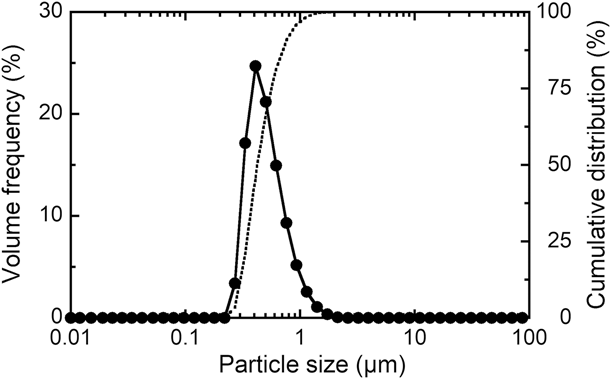
We first investigated the properties of the TiO2 powder after preheating and ball milling. The anatase phase initially present in the raw powder was fully transformed to the rutile phase, as confirmed by the XRD analysis. Figure 1 shows the particle size distribution of the TiO2 powder. The median size (d 50) was 0.46 µm, revealing submicrometer particles. Moreover, the d 10 and d 90 values, which can be used to estimate a distribution width, were found to be 0.30 and 0.89 µm, respectively. The specific surface area of this powder was 5.6 m2/g, which corresponds to an equivalent particle size of 0.25 µm and is in agreement with the above sizes. These results indicate that the prepared TiO2 powder consists of submicrometer particles with a narrow particle size distribution.
Particle size distribution of the raw TiO2 powder.

Sintering behavior
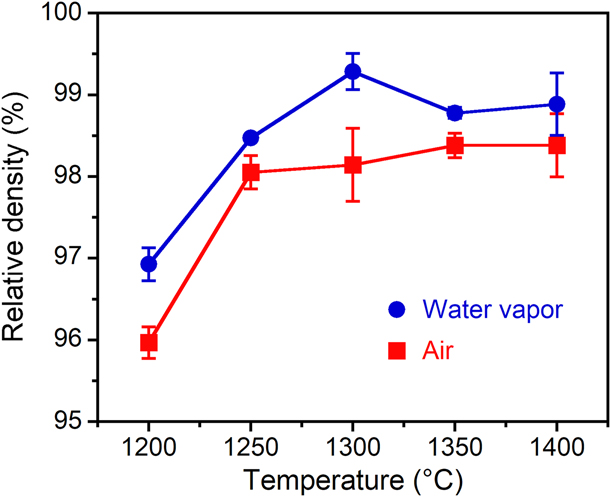
The sintering of the TiO2 pellets was conducted in air and water vapor. Figure 2 shows the relative densities of the TiO2 ceramics obtained in both atmospheres, where the theoretical density was assumed to be 4.25 g/cm3. Densification up to 96% was achieved at 1200 °C in air. However, after reaching ∼98% at 1250 °C, the relative densities were nearly flat until 1400 °C. By contrast, the densities after sintering in water vapor were higher than the densities after sintering in air at all sintering temperatures, and a maximum density of 99.3% was attained at 1300 °C. Although the density decreased at 1350 °C, TiO2 ceramics with densities of ∼99% were obtained by sintering in water vapor.
Relative density of the TiO2 ceramics sintered in air and water vapor.

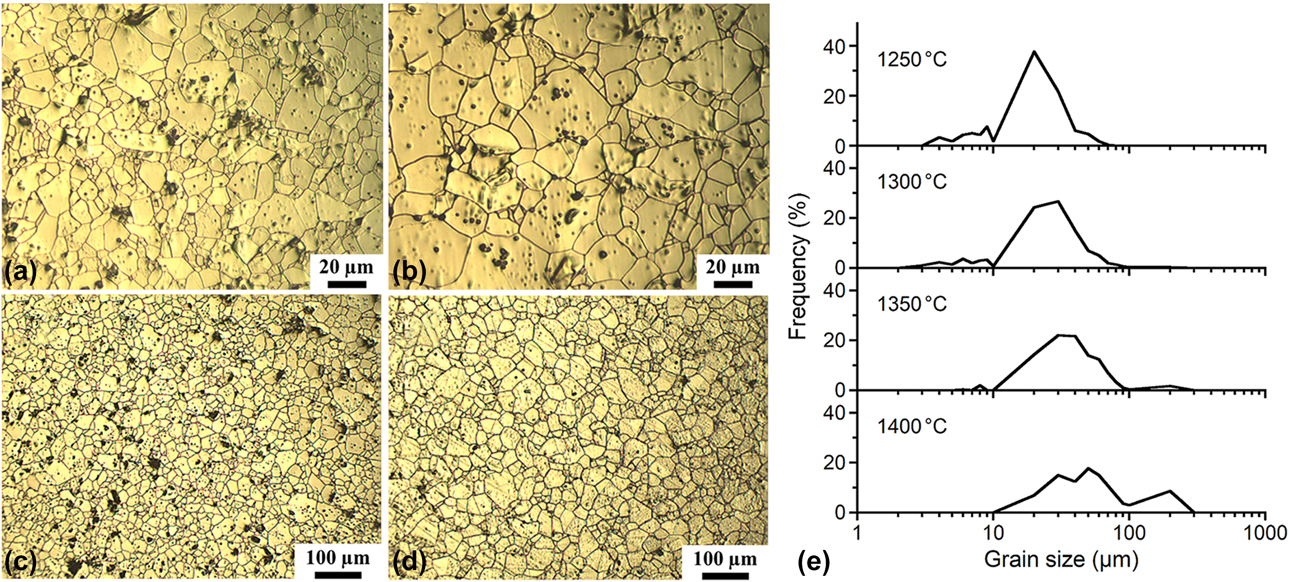
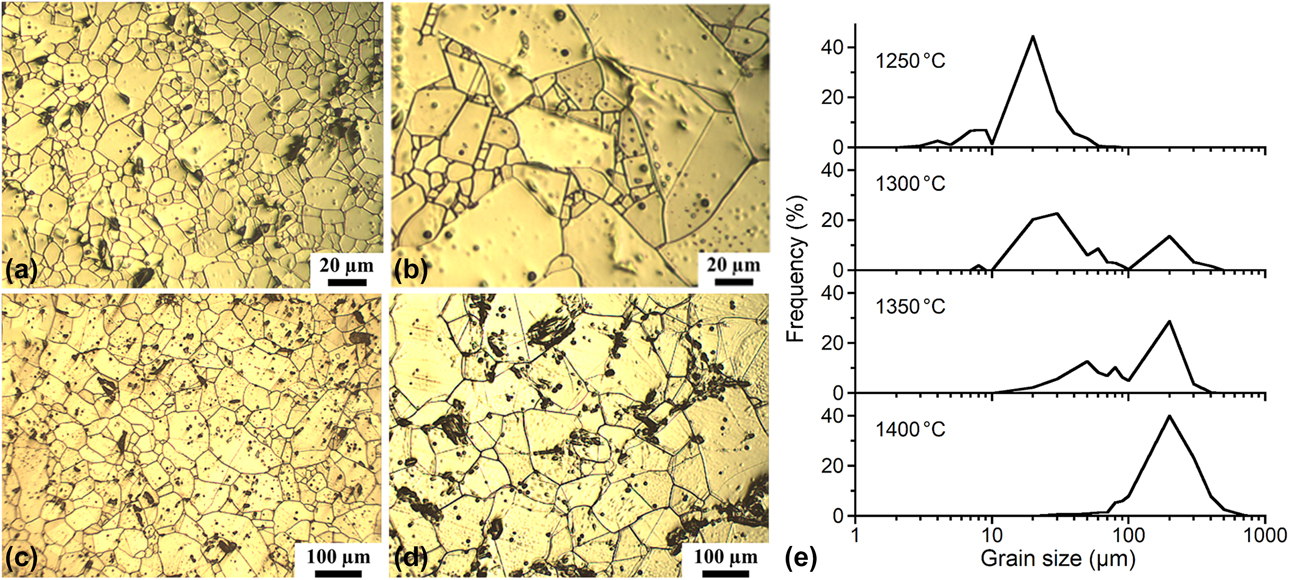
Subsequently, we observed the microstructure of the obtained TiO2 ceramics using an optical microscope. Figures 3 and 4 show the etched surfaces and grain size distributions of TiO2 ceramics sintered at 1250–1400 °C in each atmosphere. On optical micrographs, black spots or areas indicate the residual pores. After sintering in air, the distribution profiles of grain size at 1250 and 1300 °C were almost same. However, the peak top of this distribution was shifted to a larger size. Small grains under 10 µm became incorporated into larger surrounding grains. Many pores can be observed in the grains [Fig. 3(b)]. At 1350 °C, TiO2 grains grow over 10 µm in size, and pores exist not only in the grains but also in the vicinity of the grain boundaries [Fig. 3(c)]. Further increasing the sintering temperature was found to assist the grain growth of TiO2, and conclusively, grains over 100 µm in size appeared at 1400 °C. Despite such constant growth, the size of many TiO2 grains did not exceed 100 µm. These observations suggest that grain growth in air occurs gradually. On the other hand, in a water vapor atmosphere, the growth behavior differs greatly from that in air. Although the microstructure and the grain size distribution after sintering at 1250 °C in water vapor were almost same as those in air, rapid grain growth over 100 µm happened at 1300 °C [Fig. 4(b)]. Small grains are encircled by the larger irregularly grown grains, and thereby a bimodal distribution is developed in the product. The number of grains under 100 µm decreased with increasing sintering temperature. Accordingly, it is presumed that the temporary drop in density at 1350 °C is due to an increase in closed pores with the disappearance of small grains after the rapid grain growth. After sintering at 1400 °C, most TiO2 grains then grew beyond 100 µm. Water vapor dramatically accelerates the grain growth of TiO2.
(a–d) Microstructures and (e) grain size distributions of the thermally etched surface of TiO2 ceramics obtained in air at (a) 1250 °C, (b) 1300 °C, (c) 1350 °C, and (d) 1400 °C.

(a–d) Microstructures and (e) grain size distributions of the thermally etched surface of TiO2 ceramics obtained in water vapor at (a) 1250 °C, (b) 1300 °C, (c) 1350 °C, and (d) 1400 °C.

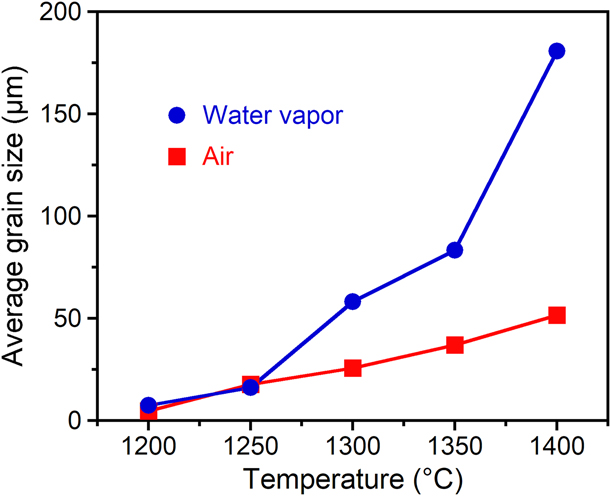
Figure 5 shows the average grain size of the TiO2 ceramics sintered in both atmospheres. Linear grain growth was observed in air, while a rapid increase in grain sizes occurred from 1300 °C in water vapor. From the initial TiO2 powder with a grain size of ∼0.5 µm, the average grain sizes after sintering in air and water vapor at 1400 °C reached 51 and 181 µm, respectively.
Average grain size of the TiO2 ceramics after sintering at 1200–1400 °C in air and water vapor.

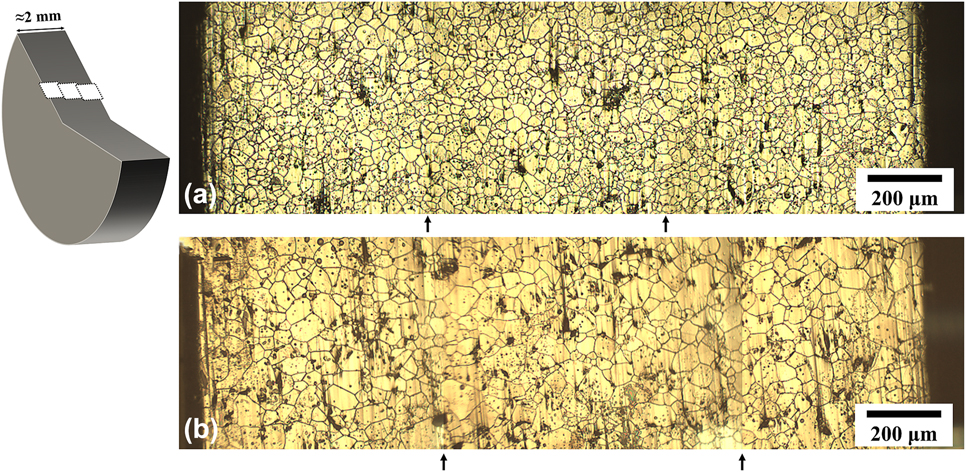
To clarify whether water vapor acts not only on the surface but also on the inside of the TiO2 compacts, sintering at 1400 °C was carried out using the powder compacts in which the thickness was doubled (∼2.5 mm). After sintering, the product was cut in the depth direction, polished, and thermally etched in air. Figure 6 shows the microstructures in the depth direction of the products sintered in air and water vapor. Both are dense ceramics and no differences in grain sizes between the surface and the inside were observed. The grains larger than 100 µm observed at the surface after sintering in water vapor [Fig. 4(d)] were distributed over the entire region. Although the inside of the TiO2 compact is not in contact with the surrounding atmosphere, grains were found to grow sufficiently in water vapor.
Microstructures of the inside of dense TiO2 ceramics sintered at 1400 °C in (a) air and (b) water vapor. Arrows show the boundary where three pictures are superimposed.

Incorporation of water vapor
In a water vapor atmosphere, the sintering of TiO2 was accelerated, and consequently, significant grain growth was observed. Water vapor plays a role in promoting particle bonding by forming hydroxy groups on the surface and introducing lattice defects associated with their surface diffusion. At high temperatures, water vapor reacts with a TiO2 surface to produce transient hydroxy groups as followsReference MacKenzie21:
 $${\rm{Ti}} – {\rm{O}} – {\rm{Ti}} + {{\rm{H}}_{\rm{2}}}{{\rm{O}}^ * } \to {\rm{Ti}} – {\rm{OH}} + {\rm{H}}{{\rm{O}}^ * } – {\rm{Ti}}\quad .$$
Water molecules also adsorb onto oxygen vacancies on the surface and the formation of hydroxy groups stabilize them. When these surface hydroxy groups desorb again, an exchange reaction with oxygen atoms from the TiO2 is expected.
 $${\rm{Ti}} – {\rm{OH}} + {\rm{H}}{{\rm{O}}^ * } – {\rm{Ti}} \to {\rm{Ti}} – {{\rm{O}}^ * } – {\rm{Ti}} + {{\rm{H}}_2}{\rm{O}}\quad .$$
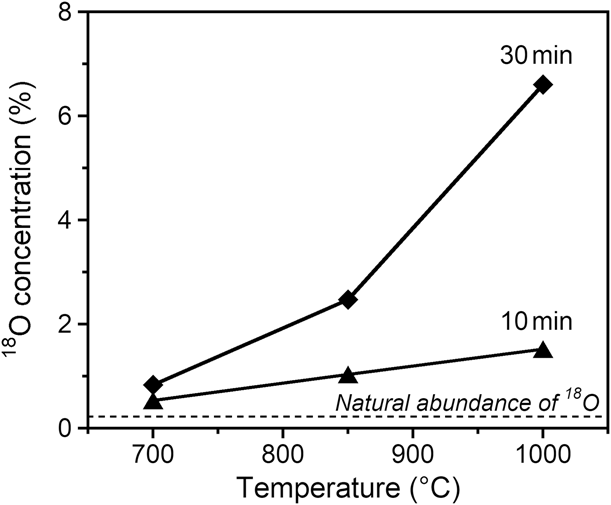
Hence, we verified this exchange reaction at relatively low temperatures by using an oxygen isotope as a tracer.Reference Rigo, Rochet, Agius and Straboni25 Figure 7 shows the 18O concentration of products after heating the TiO2 powder at 700–1000 °C for 10 and 30 min by flowing H218O vapor. Compared with the natural abundance of 18O (0.2%), its concentration was high in all products, and its value increased as the heating temperature was increased. Furthermore, we confirmed that the oxygen exchange reaction takes place with increasing heating time. These results confirm that the number of water vapor adsorption sites increases at high temperatures, and the incorporation of water molecules into the TiO2 lattice proceeds over long-time heating. Water vapor already interacts with the surface of TiO2 particles at low temperatures.
Concentration of 18O in the TiO2 powder obtained by calcination in H218O vapor.

The hydroxy groups formed by the dissociation of water vapor diffuse into the crystal lattice in the form of O2−, OH−, or H+.Reference Duong, Limarga and Clarke26,Reference Angle, Morgan and Mecartney27 Mass transport from the surface to the interior of the particle becomes active in the presence of water vapor. Furthermore, dehydration reactions between hydroxy groups formed on neighboring particles can result in particle bonding. This dehydration reaction can be accelerated by intermediate hydrogen bonds formed with water vapor in the atmosphere. Previously, our group has proposed a hydrogen bond-mediated crystallization mechanism of anatase from amorphous titania under hydrothermal conditions.Reference Yanagisawa and Ovenstone28 Since the hydroxy groups do not remain in the product after heating,Reference Kozawa, Yanagisawa, Murakami and Naito15 water vapor at high temperature acts as a catalyst to promote its growth inside and outside the grain. As shown in Fig. 6, the grain growth occurred homogeneously even in the thick pellet. Although there has the potential of entrapment of water vapor in the closed pores during the heating-up process from 800 °C, mass transport via the formation of hydroxyl groups allows water vapor to escape toward the outside. If the heating rate is slowed down or the sintering time is further prolonged, a disappearance of closed pores may be achieved.
However, mass transport within the solid that water vapor accelerates is limited. The further plausible mechanism to reinforce water vapor-assisted grain growth is a gas-phase transport. Under high partial pressures of water vapor such as 0.1 MPa in this study, many metals form volatile hydroxides or oxyhydroxides.Reference Kozawa, Onda and Yanagisawa12,Reference Kozawa, Onda and Yanagisawa13 The titanium oxyhydroxide, TiO(OH)2, is one of the potential gaseous products formed by the interaction of solid TiO2 and water vapor.Reference Shao, Zhang, Chen, Lu and Zhou29,Reference Nguyen, Bauschlicher, Myers, Jacobson and Opila30 Mass transport through the gas phase, even if its vapor pressure is low, plays a role in promoting sintering. Other metal oxides also form significant partial pressure of volatile hydroxide species.Reference Jacobson, Myers, Opila and Copland31 Therefore, this water vapor-assisted grain growth should be effective not only for TiO2 but also for most oxides.
Conclusion
In summary, we developed a pressureless sintering process using water vapor to achieve the production of dense ceramics with large grains at lower temperatures than sintering in air. The submicrometer TiO2 particles grew to an average size of 181 µm after sintering at 1400 °C in water vapor, whereas the size of particles sintered in air was 51 µm. A dense TiO2 ceramic with a relative density of over 99% was obtained only by introducing water vapor. Based on a possible surface reaction, the incorporation of oxygen from water vapor was confirmed by using H218O vapor. This incorporation of water vapor realized homogeneous grain growth on the surface and inside even for the thick pellet. The formation of hydroxy groups at high temperatures leads to the activation of mass transport within the grains and at the surface. Since water vapor can escape from the closed pores to the outside through ion diffusions in the form of O2−, OH−, or H+, even the traditional sintering process might lead to a significant decrease of closed pores without using special equipment, heating profile, and additives. Accordingly, this water vapor-assisted grain growth can enable the production of single crystal-like ceramics by a conventional pressureless sintering process and become a new route for developing functional materials.
Acknowledgments
This work was supported by the JSPS KAKENHI Grant Nos. 11J10693 and 24655195. The authors thank Dr. Yayoi Tanaka (Nagoya Institute of Technology) for the SIMS analysis.