During the past 15 years, the incidence of Clostridium difficile infection (CDI) has increased dramatically in association with emergence of the BI/NAP1/027 epidemic strain.Reference Lessa, Mu and Bamberg 1 The increase in CDI incidence has occurred in all age groups, but the elderly have been disproportionately affected, and long-term care facilities (LTCFs) have borne a significant proportion of the increasing burden of CDI.Reference Guerrero, Nerandzic, Jury, Chang, Jump and Donskey 2 – Reference Hunter, Mu and Dumyati 4 In a recent national surveillance study, an estimated 36% of healthcare-facility–associated CDI cases in the United States had their onset in LTCFs versus 37% in hospitals.Reference Lessa, Mu and Bamberg 1 Moreover, many patients diagnosed with CDI in hospitals are discharged to LTCFs.Reference Kazakova, Ware and Baughman 5 Asymptomatic carriage of toxigenic C. difficile is common among LTCF residents.Reference Riggs, Sethi, Zabarsky, Eckstein, Jump and Donskey 6 , Reference Jinno, Kundrapu, Guerrero, Jury, Nerandzic and Donskey 7 In an outbreak setting in a LTCF, residents with asymptomatic carriage outnumbered those with CDI by a factor of 7 to 1.Reference Riggs, Sethi, Zabarsky, Eckstein, Jump and Donskey 6
Despite evidence that CDI and asymptomatic carriage of C. difficile are common in LTCFs, current infection control strategies for CDI focus primarily on the acute-care setting for several reasons.Reference Dubberke, Carling and Carrico 8 First, control measures for CDI, including contact precautions and enhanced environmental cleaning, may be viewed as contrary to the goal of providing a home-like environment for LTCF residents. Second, LTCFs have relatively few resources to devote to infection prevention and limited access to infection control expertise.Reference Roup, Roche and Pass 9 Third, many LTCF-associated CDI cases occur within 1 month after hospital discharge, suggesting acquisition of C. difficile in the hospital.Reference Guerrero, Nerandzic, Jury, Chang, Jump and Donskey 2 – Reference Hunter, Mu and Dumyati 4 , Reference Mylotte 10 , Reference Kim, Toy and Muder 11 Finally, although evidence that asymptomatic carriers may contribute to transmission in hospitals is mounting,Reference Curry, Muto, Schlackman, Pasculle, Shutt, Marsh and Harrison 12 – Reference Blixt, Gradel and Homann 14 it has not been demonstrated that LTCF residents with asymptomatic carriage are an important source of transmission.
In previous studies, we demonstrated that asymptomatic carriage of toxigenic C. difficile is common in the LTCF affiliated with the Cleveland VA hospital.Reference Guerrero, Nerandzic, Jury, Chang, Jump and Donskey 2 , Reference Riggs, Sethi, Zabarsky, Eckstein, Jump and Donskey 6 , Reference Jinno, Kundrapu, Guerrero, Jury, Nerandzic and Donskey 7 , Reference Donskey, Sunkesula and Jencson 15 – Reference Ponnada, Guerrero, Jury, Nerandzic, Cadnum, Alam and Donskey 17 Carriers with high burden of C. difficile in stool were more likely to have skin and/or environmental shedding, suggesting that this subset of carriers might pose a relatively high risk for transmission.Reference Donskey, Sunkesula and Jencson 15 Here, we tested the hypothesis that LTCF residents with CDI or asymptomatic carriage of toxigenic strains are an important source of transmission. Given the high frequency of interfacility transfer between LTCFs and hospitals, we examined transmission both in the LTCF and in the hospital during acute-care admissions.
Methods
Setting
The Louis Stokes Cleveland VA Medical Center includes a 215-bed hospital and an adjacent 150-bed LTCF. The affiliated LTCF receives approximately half of the hospitalized patients that are discharged to long-term care, with the remainder being transferred to community LTCFs. The incidences of healthcare facility-associated CDI in the hospital and LTCF during the study were 8 and 2 cases per 10,000 patient days, respectively. A commercial polymerase chain reaction (PCR) assay (Xpert C. difficile, Cepheid, Sunnyvale, CA) was used for CDI diagnostic testing. Infection control measures for CDI for the hospital and LTCF included contact precautions for patients with orders for CDI testing, continuation of contact precautions until at least 2 days after completion of CDI treatment, and use of bleach for daily and postdischarge CDI room disinfection. A fluorescent marker method was used in both facilities to monitor and provide feedback on thoroughness of daily and postdischarge cleaning of CDI rooms.Reference Sitzlar, Deshpande, Fertelli, Kundrapu, Sethi and Donskey 18
Participants and procedures
Between March 1, 2012, and August 31, 2012, we conducted a prospective cohort study to determine the role of LTCF residents with CDI or asymptomatic carriage in transmission of toxigenic C. difficile strains. Beginning February 16, 2012, current residents and new admissions to the LTCF with no diarrhea were screened to detect asymptomatic carriage of toxigenic C. difficile. The participants were primarily from 3 LTCF wards, including 2 wards with a mix of residential and postacute residents and a spinal cord injury rehabilitation ward. A smaller group of residents was enrolled from a dementia ward; residents with advanced dementia were excluded. Consenting subjects had perirectal, groin, skin (chest and abdomen), and environment (bed rail, bedside table, call button, telephone) cultures collected within 24 hours of admission or upon enrollment, every 2 weeks for the first month, and then monthly during their LTCF stay. Because detection of C. difficile on a single occasion can represent transient “pass through” of spores rather than true colonization,Reference Donskey, Kundrapu and Deshpande 19 we defined patients with detection of the same restriction endonuclease analysis (REA) type of toxigenic C. difficile on 2 or more occasions as persistent carriers.
All stool specimens of LTCF residents and hospitalized patients diagnosed with CDI between March 1, 2012, and August 31, 2012, were collected from the Microbiology Laboratory and cultured for toxigenic C. difficile. Healthcare-associated CDI was defined as the presence of diarrhea (≥3 unformed stools in 24 hours) and a positive PCR assay (Xpert C. difficile, Cepheid, Sunnyvale, CA) on stool specimens collected more than 3 days after admission or within 4 weeks of discharge to the community. Healthcare-associated CDI cases were classified as LTCF associated or hospital associated if the diagnosis was based on stool specimens collected more than 3 days after admission to the LTCF or hospital, respectively. Medical record review was conducted to obtain information on demographics, medical conditions, medications, prior CDI, and ward location. The research protocol was approved by the Louis Stokes Cleveland VA Medical Center Institutional Review Board.
Microbiology and molecular typing
Perirectal swabs and stool specimens were cultured as described previously.Reference Sitzlar, Deshpande, Fertelli, Kundrapu, Sethi and Donskey 18 The number of C. difficile colonies per swab was counted. Restriction endonuclease analysis was performed for all isolates.Reference Clabots, Johnson and Bettin 20 For a subset of isolates that were linked based on REA typing with or without ward exposure, whole-genome sequencing (WGS) was performed. DNA was extracted using the Zymo Fungal/Bacteria DNA MicroPrep kit (Zymo Research, Irvine, CA). Libraries were prepared using the NEBNext Ultra DNA library prep kit for Illumina (New England BioLabs, Ipswich, MA), and paired-end reads (2×250 bp) were generated using the Illumina MiSeq reagent kit version 2 and MiSeq instrument (Illumina, San Diego, CA). Dynamic trimming was performed with SolexaQA++ version 3·1·2 software on all reads to meet or exceed 99.9% probability that the nucleotides were properly identified.Reference Cox, Peterson and Biggs 21 Reads were assembled with an interative de Bruijn algorithm (IDBA version 1·1·2 software).Reference Peng, Leung, Yiu and Chin 22 The core sequences among these isolates were extracted from an alignment made using progressiveMauve version 2·4·0 software and the results were filtered using ClonalFrameML version 1.21 software before a PhyML version 3·0 tree was constructed.Reference Darling, Mau and Perna 23 – Reference Guindon, Dufayard, Lefort, Anisimova, Hordijk and Gascuel 25 Data were archived at the National Center for Biotechnology Information under project number PRJNA296517.
Epidemiologic and statistical analysis
Epidemiologic relationships were determined based on WGS analysis and ward- or facility-level contact identified through tracking of patient movement. Donor and recipient isolates that differed by ≤2 single-nucleotide polymorphisms (SNPs) were considered genetically related.Reference Guindon, Dufayard, Lefort, Anisimova, Hordijk and Gascuel 25 Donor and recipient isolates differing by 3–4 SNPs were considered possibly genetically related. Ward location was used to categorize possible transmission routes: (1) ward transmission (ie, recipient shared ward exposure with a putative donor either simultaneously or within 30 days of discharge of the putative donor); (2) nonward transmission (ie, recipient and donor in facility simultaneously or within 30 days of discharge of the putative donor but with no shared time on a ward). To be considered a donor, asymptomatic carriage or CDI must have been documented prior to the onset of CDI in the recipient. If multiple potential donors were identified for a recipient case, only 1 transmission event was recorded and the potential donor with the least SNP differences (eg, 0 SNP differences chosen over 2 SNP differences) and the greatest ward contact was selected as the most likely donor.
The primary outcome was healthcare-associated CDI linked to transmission of toxigenic C. difficile based on WGS and ward- or facility-level contact. We determined the proportions of CDI cases linked to LTCF asymptomatic carriers, LTCF-associated CDI cases, and hospital-associated CDI cases. Data were analyzed using SPSS version 10.0 software (SPSS, Chicago, IL).
Results
A total of 201 LTCF residents were screened for asymptomatic carriage of toxigenic C. difficile. Those screened included 69 of 98 residents (70·4%) of the 3 primary study wards at the beginning of the study, 109 of 148 new admissions (73·6%) to the 3 primary study wards, and 23 subjects from the dementia unit with mild dementia. Of the 201 LTCF residents screened, 29 (14·4%) were identified as asymptomatic carriers of toxigenic C. difficile. Table 1 shows the baseline characteristics of the asymptomatic carriers and events that occurred during the study. Of the 29 asymptomatic carriers, 21 (72·4%) had received antibiotics within the 3 months prior to their first positive culture and 4 (13·8%) had prior CDI within 90 days. An additional 4 patients had a remote history of CDI between 6 months and 5 years before enrollment. Furthermore, 2 asymptomatic carriers (6·9%) were diagnosed with CDI during the study; neither had a prior history of CDI. Also, 11 carriers (37·9%) were transferred to the hospital 1 or more times during the study period (range, 1–6 transfers), and 18 carriers (62·1%) received antibiotics while in the LTCF.
Baseline Characteristics of the 29 Long-Term Care Facility Residents with Asymptomatic Carriage of Toxigenic Clostridium difficile and Events During the Study

NOTE. CDI, Clostridium difficile infection; MRSA, methicillin-resistant Staphylococcus aureus; LTCF, long-term care facility.
a Unless otherwise specified.
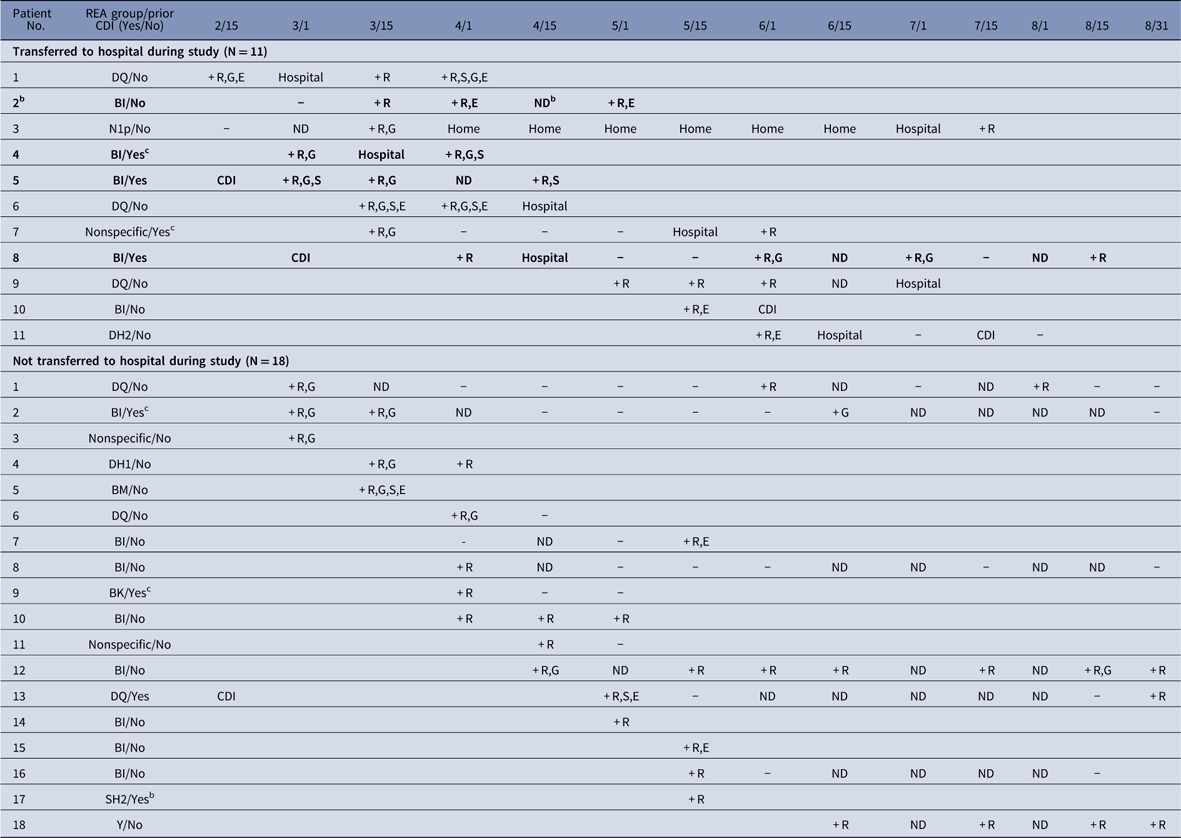
Table 2 provides a summary of the culture results for the 29 asymptomatic carriers, stratified by those who were or were not transferred to the hospital. Moreover, 26 carriers (89·7%) had positive cultures at the time of LTCF admission or at the time the first culture was collected, and 3 carriers (10·3%) had initial negative cultures followed by a positive culture. Of the 29 carriers, 17 (58·6%) had >25 colonies of C. difficile recovered from the swab cultures on 1 or more occasions. In addition, 21 carriers (72·4%) had positive cultures of their groin, skin, and/or environment for toxigenic C. difficile on ≥1 occasion, and 18 carriers (85·7%) were defined as persistent carriers based on detection of the same REA type of toxigenic C. difficile on 2 or more occasions. The rows of the 4 carriers linked to transmission are shown in bold type.
Culture Results for the 29 Long-Term Care Facility (LTCF) Residents with Asymptomatic Carriage of Toxigenic Clostridium difficile, Stratified by Those with ≥1 Transfer to the Hospital versus No TransfersFootnote a

NOTE. ND, not done; +, positive culture from 1 or more sites; −, negative cultures from all sites; R, perirectal; S, skin culture of chest and abdomen; G, groin; E, environment; CDI, C. difficile infection.
a ND: Not done indicates that the perirectal swab culture was not collected during that 2-week period despite the LTCF resident being in the facility. Cultures were collected on enrollment, every 2 weeks for the first month, and then monthly.
b Bold rows indicate the 4 asymptomatic carriers linked to 1 or more transmission events based on whole-genome sequencing analysis.
c The prior episode of CDI was diagnosed more than 90 days prior to enrollment.
During the study, 37 primary (ie, nonrecurrent) healthcare-associated CDI cases were diagnosed, including 26 hospital-associated cases (70%) and 11 LTCF-associated cases (30%). Of the 37 patients with healthcare-associated CDI, 35 (94·6%) were male. In addition, 22 of the hospital-associated cases had their onset in the hospital, and 4 had their onset in the community after discharge. Furthermore, 4 (15·4%) of the hospital-associated CDI cases were transferred to the study LTCF during treatment, and 3 (11·5%) were transferred to non-VA LTCFs.
Table 3 provides an overview of the REA typing results for the 29 asymptomatic carriers and the 37 CDI cases. The overall distribution of REA groups was similar for carriers and CDI cases. For both carriers and CDI cases, the most common REA group was the BI epidemic strain. The second most common REA group was DQ, a newly recognized binary toxin-positive strain related to, but distinct from, the epidemic REA BI strain.Reference Johnson, Petrella and Siddiqui 27 Of the 18 carriers with toxigenic C. difficile detected on >1 occasion, 15 (83·3%) had strains with the same REA type for each isolate tested.
Distribution of Restriction Endonuclease Analysis Types for 37 Healthcare-Associated Clostridium difficile Infection Cases and 29 Long-Term Care Facility Residents With Asymptomatic Carriage of Toxigenic C. difficile Footnote a

NOTE. REA, restriction endonuclease analysis.
a Asymptomatic carriers were detected by rectal screening of current residents and new admissions to the long-term care facility between February 16, 2012, and August 31, 2012; C. difficile cases included those diagnosed between March 1, 2012, and August 31, 2012.
b Data are no. (%) of patients, unless otherwise specified.
Figure 1 provides an overview of the analysis of potential transmission events. Based on REA grouping and ward exposure, 12 of the 37 healthcare-associated CDI cases (32·4%) were potentially linked to LTCF asymptomatic carriers and 4 (10·8%) were potentially linked to LTCF CDI cases. However, based on WGS analysis with 0–2 SNP differences (indicating transmission events), only 4 of the 16 potential ward transmissions (25%) were deemed true transmissions. Furthermore, 3 additional putative transmissions that were non–ward based were identified based on 0–2 SNP differences on WGS and concurrent stays on separate hospital or LTCF wards. Thus, 7 of the 37 CDI cases (18·9%) were linked to LTCF residents with LTCF-associated CDI or asymptomatic carriage based on ward or nonward healthcare-facility exposure and WGS results, including 3 of 26 hospital-associated CDI cases (11·5%) and 4 of 11 LTCF-associated CDI cases (36·4%). Of the 7 transmissions linked to LTCF residents, 5 (71·4%) were linked to asymptomatic carriers, and 2 (28·6%) were linked to to CDI cases. All transmissions were of epidemic BI strains. During the study period, no incident hospital-associated CDI cases were linked to other hospital-associated CDI cases.
Overview of the potential transmission events linked to long-term care facility (LTCF) residents with asymptomatic carriage of toxigenic Clostridium difficile (A) or C. difficile Infection (CDI) (B) based on restriction endonuclease analysis (REA) typing and ward exposure and by whole genome sequence (WGS) analysis. By WGS analysis, 5 potential transmission events were linked to LTCF residents with asymptomatic carriage of toxigenic C. difficile and 2 were linked to LTCF residents with CDI. *, 3 putative transmissions based on 0–2 SNP differences on WGS and concurrent stays in the hospital or LTCF but with no shared ward exposure.

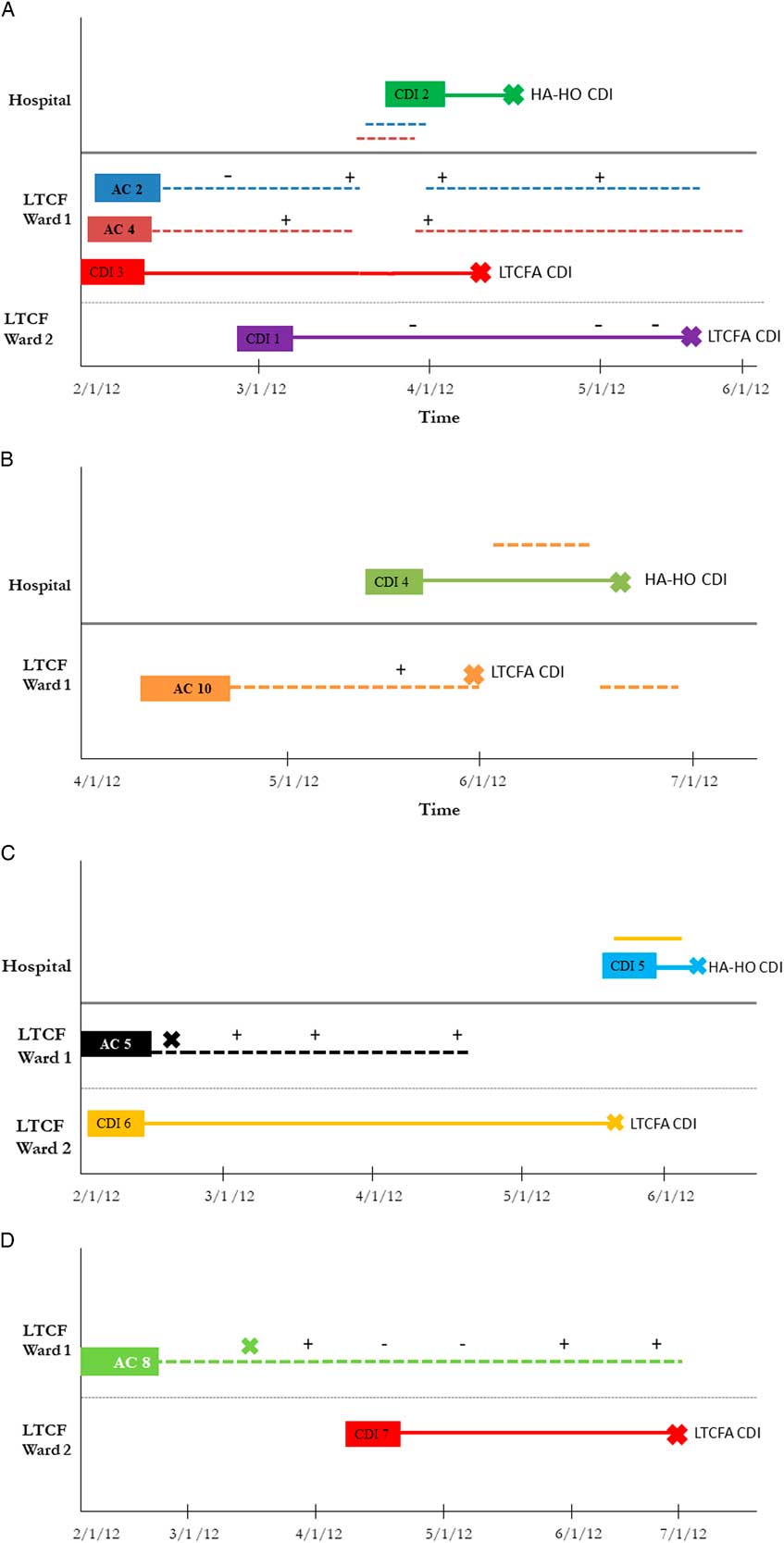
Figure 2 provides LTCF and hospital ward locations of the donor LTCF asymptomatic carriers or CDI cases and the linked recipient CDI cases for each putative transmission. The 5 transmissions linked to asymptomatic carriers were attributed to 4 carriers. Furthermore, 2 of the carriers linked to transmission events were colonized with identical (ie, 0 SNP differences) REA BI group 1 strains (Fig. 2A); thus, either carrier was considered a potential source. Each of the carriers linked to transmission was a persistent carrier with >25 colonies of C. difficile recovered from perirectal swab cultures and positive groin, skin, and/or environmental cultures on 1 or more occasions (Table 2). Of 4 carriers linked to transmission, 3 (75%) had previous CDI: 2 carriers had had CDI within the past 90 days, and 1 carrier had had CDI 6 years prior to the transmission event.
Long-term care facility (LTCF) and hospital locations of the donor LTCF asymptomatic carriers of toxigenic Clostridium difficile (AC) or C. difficile infection (CDI) cases and the linked recipient CDI cases for each putative transmission based on whole genome sequence (WGS) analysis. (A) Transmission by 2 asymptomatic carriers of identical (ie, 0 SNP differences) C. difficile isolates (AC 2 and AC 4) to 3 CDI cases (CDI 1, CDI 2, and CDI 3). CDI cases 2 and 3 shared ward exposure with the donors, but CDI case 1 did not. (B) Transmission by a LTCF-associated CDI case to a healthcare-associated, hospital onset case (CDI 4) with shared ward exposure. The LTCF-associated CDI case was identified as an asymptomatic carrier (AC 10) 1 week prior to the onset of CDI. (C) Transmission by an asymptomatic carrier (AC 5) to a LTCF-associated CDI case (CDI 6) with no ward exposure with subsequent hospital ward-based transmission from CDI 6 to CDI 5 (healthcare-associated, hospital-onset CDI). (D) Transmission by an asymptomatic carrier (AC 8) to a LTCF-associated CDI case (CDI 7) with no shared ward exposure. NOTE. Asymptomatic carriers are represented by hatched lines and CDI cases by solid lines. Abbreviations: REA, restriction endonuclease analysis; SNP, single-nucleotide polymorphism; HA-HO, hospital acquired-hospital-onset; LTCFA, long-term care facility–associated CDI case; +, positive perirectal culture for toxigenic C. difficile; −, negative perirectal culture for toxigenic C. difficile; X, CDI diagnosis.

In addition to the 7 putative transmissions based on 2 or fewer SNP differences, 3 possible transmission events were based on 4 SNP differences between donor and recipient strains. Among them, 2 of the putative donors carried epidemic BI strains and 1 carried the binary toxin-positive DQ strain. Only 1 of the 3 possible transmission events involved direct ward exposure.
Discussion
In a Veterans Affairs hospital and its affiliated LTCF, we found that 19% of healthcare-associated CDI cases were linked to LTCF residents with asymptomatic carriage of toxigenic C. difficile or LTCF-associated CDI. The epidemic BI strain was the most common strain type recovered from CDI cases and asymptomatic carriers, and this strain accounted for all transmission events. These results suggest that LTCF residents with asymptomatic carriage of C. difficile or CDI may contribute substantially to transmission in LTCFs and in hospitals during acute-care admissions.
Although 19% of healthcare-associated CDI cases could be linked to LTCF residents, the source of the remaining 81% of cases is unknown. Based on REA typing and ward exposures, approximately one-third of hospital-associated CDI cases were potentially linked to other hospital-associated cases. However, none of these potential linkages met criteria for transmission based on WGS analysis. In addition, no nonward-based linkages were identified between hospital-associated CDI cases. Our results are consistent with other recent studies that demonstrated that a minority of hospital-associated CDI cases may be linked to other hospital-associated cases based on highly discriminatory molecular typing methods such as WGS.Reference Eyre, Cule and Wilson 26 Notably, the lack of transmission by CDI cases in the study facility occurred in the context of intensive efforts to improve environmental disinfection and a C. difficile stewardship initiative that included isolation of patients with suspected CDI.Reference Ponnada, Guerrero, Jury, Nerandzic, Cadnum, Alam and Donskey 17 , Reference Guerrero, Becker and Eckstein 28
Asymptomatic carriers in the hospital are a potential source of transmission that was not accounted for in our study because we did not screen for asymptomatic carriage in the hospital. In a previous culture survey in our facility, only 6% of hospitalized patients with asymptomatic carriage of toxigenic C. difficile were LTCF residents.Reference Jury, Tomas, Kundrapu, Sitzlar and Donskey 29 Several recent studies that have suggested that asymptomatic carriers may be an underappreciated source of transmission.Reference Curry, Muto, Schlackman, Pasculle, Shutt, Marsh and Harrison 12 – Reference Blixt, Gradel and Homann 14 Curry et alReference Curry, Muto, Schlackman, Pasculle, Shutt, Marsh and Harrison 12 reported that incident CDI cases in a tertiary-care hospital were linked as frequently to asymptomatic carriers as to symptomatic CDI cases. Longtin et alReference Longtin, Paquet-Bolduc and Gilca 13 reported that a hospital-based intervention involving detection and isolation of C. difficile carriers was associated with a significant decrease in the incidence of healthcare-associated CDI. Neither of these studies reported the proportions of carriers that were transferred from LTCFs.
A novel aspect of our study is that we included an assessment of the potential for transmission by asymptomatic carriers based on the burden of carriage and the presence of skin and/or environmental shedding.Reference Donskey, Sunkesula and Jencson 15 All 4 of the carriers linked to transmission had a relatively high burden of carriage (ie, >25 colonies per perirectal swab) and groin, skin, and/or environmental shedding, suggesting that such carriers may present the greatest risk for transmission. In addition, 2 of the carriers linked to transmission had recent CDI with continued asymptomatic shedding of spores after treatment and one had been diagnosed with CDI 6 years prior to the study. We have previously demonstrated that asymptomatic shedding of spores is common after CDI treatment.Reference Jinno, Kundrapu, Guerrero, Jury, Nerandzic and Donskey 7 , Reference Sethi, Al-Nassir and Nerandzic 16
In this study, 3 putative transmissions linked to LTCF residents occurred in the absence of ward exposure. For each transmission, the donor was an LTCF resident with asymptomatic carriage and the recipient was an LTCF resident on a separate ward who developed LTCF-associated CDI. Other investigators have also reported that many transmissions identified using highly discriminatory molecular typing methods are nonward based. Curry et al.Reference Curry, Muto, Schlackman, Pasculle, Shutt, Marsh and Harrison 12 found that more than half of transmissions linked to asymptomatic carriers and to CDI cases had no shared ward exposure. Eyre et alReference Eyre, Cule and Wilson 26 reported that 9% of transmissions based on WGS occurred in patients who shared time in the hospital but were never on the same ward. Such nonward transmissions might occur due to staff members working on multiple wards or direct or indirect contact between patients or LTCF residents.
Our study has several limitations. The study population was predominantly male, and the epidemic BI strain was the most common strain type recovered. Additional studies are needed in other settings. Our results may underestimate the importance of LTCF residents in transmission because not all eligible LTCF residents were enrolled and LTCF residents transferred from community facilities were not included in the study. As noted previously, our results also underestimate the contribution of asymptomatic carriers to transmission in the hospital because we did not screen for asymptomatic carriage in the hospital. Finally, we isolated and performed molecular typing for only 1 colony of C. difficile per culture; therefore, we cannot exclude the possibility that multiple strains were present. Mixed infection with >1 C. difficile strain is not uncommon in stool specimens of patients with CDI.Reference Eyre, Walker and Griffiths 30
In conclusion, our findings suggest that LTCF residents with asymptomatic carriage of C. difficile or CDI may contribute substantially to transmission in a LTCF and in the affiliated hospital during acute-care admissions. These findings have broad implications for control of C. difficile because interfacility transfer of CDI patients occurs frequently among LTCFs and hospitals.Reference Datta, Brown and Nguyen 31 Moreover, LTCF residents have been linked to local and regional dissemination of other healthcare-associated pathogens, including multidrug-resistant gram-negative bacilli, vancomycin-resistant enterococci, and methicillin-resistant Staphylococcus aureus.Reference Wiener, Quinn, Bradford, Goering, Nathan, Bush and Weinstein 32 – Reference Brodrick, Raven and Harrison 37 Greater emphasis on infection control measures and antimicrobial stewardship in LTCFs is needed, and these efforts should focus on LTCF residents during hospital admissions.
Acknowledgements
The funding agencies had no role in the design and execution of the study; collection, analysis, and interpretation of the data; or preparation or review of the manuscript. The findings and conclusions in this report are those of the authors and do not necessarily represent the official position of the Centers for Disease Control and Prevention or Department of Veterans Affairs.
Financial support
This work was supported by the Centers for Disease Control and Prevention and the Department of Veterans Affairs.
Conflicts of interest
C.J.D. has received research funding from EcoLab, Clorox, GOJO and Altapure and serves on an advisory board for Synthetic Biologics. D.N.G. holds patents and technology for the treatment and prevention of CDI, and is a consultant for Sanofi Pasteur, Merck, DaVolterra, MGB, Rebiotix and Actelion and holds a research grant from Seres Therapeutics. All other authors report no potential conflicts.