Introduction
Tanzanian beauty pageants are wildly popular, and unlike their American counterparts, they are strictly urban affairs. The events draw stylish crowds who come as much for the titillation of competition as for the chance to see and be seen. Audiences also enjoy pageants as opportunities to observe performances by some of the nation’s most renowned musicians, dance troupes, and comedians. The mood at these nighttime, typically outdoor, events is lively and festive, with thumping dance and hip-hop music – Tanzanian, Congolese, or American – filling the air between segments. For the masses who are not able to attend, newspaper coverage is extensive, including pages of color photographs and discussion of minute details in the days and weeks following.
Despite the global spread of pageants from the United States and Great Britain since World War II (Cohen & Wilk 1996), and with them the spread of certain aspects of Western format and standards for judgment, pageants worldwide remain deeply local (Cohen, Wilk, & Stoeltje 1996, Schulz Reference Schulz2000, Besnier Reference Besnier2002). Beauty pageants are events in which value judgments of all kinds are central to determining a winner. Judgments about how she should dress, smile, and wave, about the color and condition of her skin, teeth, and hair, about the shape of her body and the way she moves it, all go into decisions about who should be crowned. These decisions, while often informed by international standards, are never appropriated wholesale but instead must make local sense to contestants, judges, and audiences alike. Perhaps few things are more local than ideas about how a contestant should speak onstage, and which languages or registers are appropriate for the context and manifest a suitable contestant and possible winner. Not only should a beauty queen look a certain way, but she should speak a certain way as well.
In this article I discuss the construction of Tanzanian beauty queens and how this construction is based to a substantial extent on ideologies about language use.Footnote 1 In particular, a contestant’s ability to speak English onstage marks her as a member of an educated elite, a desirable quality for moving up through the pageant hierarchy to Miss Tanzania and ultimately to Miss World. Yet access to standard English in Tanzania is highly restricted, leaving most contestants, like most Tanzanians, with limited competence. Pageant-savvy contestants, aware of the preference for English over Swahili onstage, are able to “fake it” by memorizing self-introductions and responses in advance, relying on what English they have learned in school and elsewhere. Contestants’ “faking it” is usually successful, owing in part to an emphasis on achieving linguistic purity, with a deemphasis of grammatical standardness, in these contexts. It is only when they move up the pageant hierarchy and away from their hometowns that they may be “found out” as linguistic phonies.
Thus, this study will highlight the emergent nature of what it means to “speak a language” (Blommaert, Collins & Slembrouck Reference Blommaert, Collins and Slembrouck2005) for contestants who are able to manipulate fragmentary English knowledge in order to present themselves in the most positive light. But it will also point to the limits of such tactics as one attempts to rise through the ranks. In Tanzania, English is not only indexical of elite status, it is also often necessary for achieving such status. It is a system that reproduces dramatic inequalities in Tanzania, inequalities that are played out on the pageant stage (cf. Besnier Reference Besnier2002). This dimension of inequality underscores the discussion throughout this article, as it is a primary factor in facilitating or constraining the success of would-be beauty queens, both within and outside pageants.
Tanzanian Beauty Pageants
Despite their popularity, Tanzanian pageants are also controversial. In 1967, Tanzania held its first national beauty contest and sent the winner to the Miss World competition in London. Within months, however, the government had banned the events. In Tanzania’s fervor to create a socialist state that was economically, politically, and culturally independent from the West, bans were issued on products and practices considered to be Western, including tight pants, skin-lightening creams, soul music, and pornography (Ivaska Reference Ivaska2002). Unlike other bans, the one on beauty pageants stuck until 1994, when political tides had shifted and the country had begun to move toward an open economy.
For many Tanzanians today, pageants still go against a sense of what it means to be a Tanzanian woman, in particular a view in which ample figures are valued and modesty of dress remains a cornerstone. Contestants are widely considered to be malaya ‘prostitutes,’ because people wonder who else would appear in front of strangers with so little clothing, and how else they would be able to afford such finery.Footnote 2 If not prostitutes, contestants are at least thought to suffer from utovu wa nidhamu ‘lack of good behavior’. During pageant season, newspapers thrive on tales of contestants’ utovu wa nidhamu, with headlines such as “We don’t want prostitutes as Miss Tanzania,” “Beauty queen accused of assault in accident,” and “Miss Arusha, where is my baby you were pregnant with?”Footnote 3
Contestants are willing to open themselves up to these criticisms for a variety of reasons. They stand to win prizes, ranging from cash to televisions to scholarships at local tourism schools. Many contestants enjoy the attention, even if it means some of it will be negative. But for most, pageants offer the hope to escape from life-as-usual, a life of limited opportunities. Newspapers remind their readers of the glamorous lives of former beauty queens, with modeling contracts in South Africa, positions as goodwill ambassadors, and for Miss Tanzania 2000, Jacqueline Ntuyabaliwe, a successful career as a pop musician. As I will argue later, the hopes that so many young women put into these competitions are dashed, not just because statistically it is so difficult to succeed, but also because the deck is already stacked in favor of a certain kind of contestant, one who is already a member of the country’s small elite.
Orienting Ideas
Language competencies
Several studies in the past decade and a half have considered the meaningfulness of language competencies that are fragmented or less than fluent. In Ben Rampton’s (Reference Rampton1995:298) landmark work on interethnic youth communication, he describes language crossing as occurring when “speakers … briefly adopted codes which they didn’t have full and easy access to.” The youths in his study could not in any way be considered fluent in the “crossing” code, yet they are able to mobilize “foreign” linguistic material in creative and socially meaningful ways. In another body of literature, the focus is on dominant social groups coopting stereotyped fragments of minority languages or varieties (Hill Reference Hill, Schieffelin, Woolard and Kroskrity1998, Mesthrie Reference Mesthrie2002, Barrett Reference Barrett2006). These “mock languages” are often employed for humor, as directives, or to mark oneself as tolerant of difference, yet they also typically work to perpetuate racial stereotypes and enact subjugation. The power differential is inverted in studies of immigrants’ use of the majority language. Very often, immigrants speak majority languages in ways that are deemed incompetent by the host population (e.g., Arnaut Reference Arnaut2005). Yet despite these evaluations, the immigrants are able to use a range of registers of these languages for effective, if sometimes subversive, communication (e.g., Jaspers Reference Jaspers2005).
In the present study, beauty contestants’ use of “incomplete” English is comparable in some ways to immigrants’ language use. Unlike users of mock languages and crossers, but like immigrants speaking the language of the majority, contestants have sometimes rather robust knowledge of the target language. While they may “fake it” onstage, contestants’ use of English is not stereotypic, in that they attempt to express a broad range of ideas using a wide variety of linguistic material. Also like immigrants, who in many cases have a commitment to the majority language as the key to opportunity in their new homeland, contestants have some ownership of English. Along with Swahili, English is the co-official language of Tanzania; it is taught in elementary school and is the medium of instruction after that; it is also the official language of high courts and is used in elite commerce as well. If contestants – and Tanzanians more generally – do not fully “own” English, their elite institutions certainly do.
In most cases, as I will describe, contestants’ use of “incomplete” English succeeds as English; audiences and judges consider it to be complete, and it often helps in achieving the crown. But just as contestants successfully mobilize “fake” English, these same contestants may find that as they ascend the pageant hierarchy toward the Miss Tanzania pageant and move away from their provincial cities to the capital, Dar es Salaam, what constitutes “speaking English” becomes more normative. Contestants who were successful at lower-level competitions find that their limited English skills are no longer as effective in helping to secure the title, with preference instead given to elite contestants who have had the opportunity to obtain a higher education and hence speak English well. That, linguistically speaking, many Tanzanians find themselves comparable to immigrants in their own country in terms of their access to the language of opportunity is a problem that I will address briefly below.
Audiences and indexical non-congruence
While contestants are pageants’ raison d’être, the events are made up of ensemble casts including masters of ceremonies, performers, special guests, and judges. Crucial in shaping the events are audiences. Folklore and performance studies (e.g., Hymes Reference Hymes, Ben-Amos and Goldstein1975, Duranti & Brenneis Reference Duranti and Brenneis1986) and work on conversational structure (e.g., Goodwin Reference Goodwin1986) have demonstrated the importance of the role of the audience in co-constructing the events they observe or listen to. Scholarship on African oral and popular culture has likewise highlighted the role of audiences as a key constituent of performances themselves (Barber Reference Barber1997, Finnegan Reference Finnegan2007).
In the present case, audiences – enthusiastic, loud, and honest, often with the aid of inexpensive beer and wine – contribute greatly to the events. These are not crowds gathered to appreciate high art or some other serious spectacle, and they are at least as entertained by mistakes as by flawless performances. Audiences may react to the physicality of contestants, showing approval or disapproval of a dress, hairstyle, or walk. At other times, they react to the content of contestants’ speeches, as when a contestant blamed not being able to continue her education on her father’s poverty and was then ridiculed for making such an inappropriate statement. From time to time, audiences give feedback on the linguistic form of contestants’ speeches. If a contestant speaks for too long, audiences heckle her off the stage. If she mumbles or make certain kinds of grammatical mistakes, they may sneer. And when audiences react, contestants adjust their own behavior. Contestants are trained to pause and smile when audiences cheer approvingly,Footnote 4 while in the case of negative reactions, they may become rattled, continuing to tumble into disgrace.
Several studies (e.g., Haney Reference Haney2003, Errington Reference Errington and Kroskrity2000) have explored ways in which audiences offer the analyst insight into local conceptions of what is good, bad, beautiful, ignorant, and so forth, and how these judgments are linked with perceptions about language use. Here, Agha’s (Reference Agha2007) notion of indexicalnon-congruence is useful in examining how audiences evince these local conceptions. Indexical non-congruence occurs when there is a perceived mismatch between signs, linguistic or otherwise. While indexical congruence is presupposed, indexical non-congruence can be performed by speakers in order to achieve certain effects, or, as in many of the examples below, it can be the inadvertent result of a speaker’s failed attempt to self-project as a certain kind of person. In the beauty pageants discussed here, contestants aim to present themselves as worthy title holders, a status that is enacted through a wide range of co-occurring signs, from dress and bodily comportment to aspects of speech and gesture. When these signs are congruent, contestants are successful in projecting themselves as desired. When the signs are non-congruent, contestants fail to present themselves effectively, which can result not only in pageant failure but also in public humiliation.
Furthermore, any determination of non-congruence is necessarily linked to the social domain of evaluators (Agha Reference Agha2007). What one audience (social domain) may find laudable, another may find laughable. The data presented here thus reflect geographic as well as social hierarchies in Tanzania both reaching their pinnacle in Dar es Salaam.
Sitings of language ideologies
Language ideologies lie behind these judgments of what counts as correct language use, serving as a link between language practice and evaluations of the speaker’s goodness, status, authenticity, and the like (Gal Reference Gal, Schieffelin, Woolard and Kroskrity1998). A key question, with implications for methodological as well as analytical approaches to language ideology, concerns the distinction between implicit and explicit sitings of ideologies (e.g., Philips Reference Philips1992). At issue is the idea that the kinds of data linguists can employ emerge from the degree to which ideologies are seen as falling within the scope of speakers’ consciousness. If ideologies are seen as largely naturalized, then the linguist must look to implicit data, in patternings of language structure and use. On the other hand, if language ideologies are considered to fall within speakers’ awareness, then the researcher can also consider explicit characterizations of registers and ways of speaking. Some scholars (e.g., Kroskrity Reference Kroskrity, Schieffelin, Woolard and Kroskrity1998) emphasize the former, while others (e.g., Briggs Reference Briggs, Schieffelin, Woolard and Kroskrity1998) maintain the importance of the latter; still other scholars employ both the explicit and the implicit (e.g., Hirsch Reference Hirsch1998, Spitulnik Reference Spitulnik, Schieffelin, Woolard and Kroskrity1998, Eisenlohr Reference Eisenlohr2004).
Here I follow Agha Reference Agha2007, who presents ideologies as discoverable from the necessary integration of various kinds of data of varying degrees of explicitness and implicitness, all of which are, crucially, overtly perceivable through metapragmatic activity. Yet since what language users characterize explicitly is always socially mediated, explicit data, though a useful entrée into the investigation, must be calibrated vis-à-vis other evidence. Likewise, the analyst must consider implicit evidence in light of explicit evidence, without which the specific properties of the object of investigation will remain unidentified.
Furthermore, the need for this integration reflects the fact that language users are able to identify or characterize some aspects of language more readily than others (cf. Silverstein Reference Silverstein and Lucy1993). Agha (Reference Agha2007:149) outlines three perspectives that users employ simultaneously in socially “locating” their interlocutors. Moving from most to least explicit, speakers are able, from a repertoire perspective, to describe many, but not all, linguistic features of registers. From an utterance perspective, speakers can construe specific utterances, in context, according to relevant interpretive schemas, yet they find it difficult to characterize the potential entailing effects of registers in different contexts. From a sociohistorical perspective, speakers are typically unable to describe the ways in which registers acquire and shift their social significance over time and in relation to other social domains and registers. Yet each of these perspectives is individually incomplete and cannot be studied in isolation.
The data included here are of several kinds: explicit metapragmatic talk excerpted from interviews and conversations that describe appropriate language use in beauty pageants; metasemiotic reactions from audiences and newspaper reportage that indicate indexical non-congruence of linguistic and other signs; and implicit data derived from analysis of the connections between code choice and pageant success and the regimentation of register use. Juxtaposing different kinds of evidence will expose ideological contradictions that are connected to a decades-old national struggle over the role of language in constituting Tanzanian identity, and to newer conceptions of language use in an increasingly globalized Tanzania.
Education, English and Pageant Success
The Miss Tanzania committee requires that competitors at all levels meet some basic standards. They must be 24 years old or younger, single, tall (the recommended height is 5 feet 9 inches, or 172.5 centimeters) and slim, childless, and have completed at least a Form 4 education (approximately Grade 10). In addition to the official requirements, healthy teeth and clear skin are also highly valued. In reality, these standards are often relaxed at the local level in order to have a sufficient number of competitors, because stigmatization of the events can deter many young women. Some requirements are more overlooked than others; for example, while short contestants appear (and succeed) with relative frequency, one rarely sees heavy contestants. In particular, pageant organizers comment that the biggest challenge is finding contestants who meet the educational requirement, and some admit to relaxing this rule.
This is not to say that education does not matter. Education is highly valued in Tanzania, as in many other parts of Africa, to the extent that it is commonly seen as a panacea for society’s and individuals’ problems, even when jobs for graduates are limited (Vavrus Reference Vavrus2003). In pageants, scholarships are among the prizes for winners, and contestants frequently include their level of education in their self-introductions. In one such instance at a mid-level competition, a contestant made an unfortunate blunder that caught her in the middle of a lie aimed at aggrandizing her educational background:
(1) C, Contestant; A, Audience.
1 C: Habari za jioni mabibi na mabwana/
‘Good evening ladies and gentlemen’
2 Kwa jina naitwa Beatrice David,
‘My name is Beatrice David’
3 Nimeitimu kidato cha nne,
‘I have completed Form Four’
4 Nasubiri matokeo//
‘I’m waiting for the results’
5 A: HHHHHHHHHHHHHHHHHH
HHHHHHHHHHHHHHHHHHHHHHHhhhhhhhh [11 sec]
6: C: Nina umri wa miaka kumi na nane,
‘I am eighteen years old’
7 Ni Miss Manyara,
‘I am Miss Manyara’
8 Vazi langu limebuniwa na Gulamali/
‘My outfit was designed by Gulamali’
9 Karibuni//
‘Welcome’
In this humiliating moment, the contestant made the mistake of claiming she was awaiting her results from the national Form Four exam (line 4). But as most of the audience knew, exam results had been made public the previous week. Had the contestant actually been awaiting such important news, she would have been well aware that results had already been released. It was a mistake the audience found riotously funny (line 5), because it not only revealed her as a phony, but it also indicated just how uneducated she really was, since she did not even follow the announcement of this widely anticipated news.
The contestant miscalculated in another way: by not speaking English. Although, as I will discuss below, Swahili is the unmarked choice in competitions, English gives contestants a favorable edge. Most contestants, like most Tanzanians, are not able to speak fluent English, as standard English is acquired primarily through higher education, and receiving an education beyond primary school is difficult. School fees, the existence of limited slots for students in secondary school, and the need for children to help at home lead to abysmally low numbers of students attending secondary school or university (Vavrus Reference Vavrus2003). The challenges for girls are even greater, owing to factors such as preference in families for educating boys and sexual harassment while in school (Stambach Reference Stambach2000, Vavrus Reference Vavrus2003).
The Form Four educational baseline should ensure that contestants have had approximately 11 years’ exposure to English in school, the last four of which would have been conducted with English as the medium of instruction in most classes, and so one might expect contestants to be strong in English. The reality of the situation is, however, quite different. In addition to the issue of contestants and organizers flouting the educational requirements, serious concerns have been raised in Tanzania about the English-medium policy, including the lack of teachers’ competence in English (e.g., Roy-Campbell & Qorro Reference Roy-Campbell and Qorro1997, Neke Reference Neke2002). Students are not leaving school with a high competence in English, and most contestants I interviewed were not able to speak English fluently. The relatively rare ability to speak English well therefore immediately sets one apart as a member of the small elite who has had the opportunity to pursue a higher education. While educational background is important for pageant success, language use is the most salient indicator of that education.
At the same time, it is not true that contestants do not know any English. In addition to whatever expertise in standard English contestants have acquired through years of formal education, other registers of English are in broad circulation in Tanzania, available through informal learning environments.Footnote 5 Contestants, like urban youth across the country, devour American music and devote themselves to memorizing the lyrics, which are published in entertainment newspapers. These popular newspapers themselves often employ a wide range of English-language material, in contrast to news-oriented Swahili-language papers, which aim toward pure Swahili (Billings Reference Billings2006). Street and business signs frequently use English (Blommaert Reference Blommaert2005), as do some local television ads and programs. In all of these informal contexts, it is inconsequential to consumers that the English is nonstandard; instead, English provides rich indexical and referential tools that supplement Swahili. Contestants’ casual speech exhibits some of this knowledge, with idiosyncratic English loans, underlined below, a characteristic of their conversational register:
(2) Kwa hiyo ndio maana nikaenda kushiriki na kweli nikashinda nikawa thewinner.
‘That’s why I just went and tried and I won, I was the winner.’
(3) Nilikuwa kwenye camp nilijua nitashinda kwa hiyo nilikuwa yaani na confidence…
‘When I was at the camp I knew that I would win, I mean I had confidence… .’
(4) Kuwa mrembo unatakiwa uwe na experience usiogope…
‘To be a beautiful woman you must have experience, you can’t be afraid.’
Ultimately, as I will discuss below, it is this knowledge of English that, although not fluent or “complete,” allows many contestants to succeed as beauty queens.
Maksi Ni Moja ‘The Score is the same’: Swahili and English as Equal?
Over the course of a pageant, contestants have one or two opportunities to speak onstage. The first chance comes near the beginning of the competition during the “creative wear” (vazi la ubunifu) segment, in which each contestant takes the stage dressed in an outfit of original design.Footnote 6 While onstage, she delivers a brief self-introduction, including name, age, educational background, and hobbies. Following the “beach wear” (vazi la ufukweni) and “evening wear” (vazi la jioni) segments and interspersed with guest performances, the top five finalists are announced and have a second chance to speak, during the question-and-answer (Q&A) session. In this segment, each contestant responds to a question on a pertinent social issue, such as AIDS, education, or poverty.
The master of ceremonies (MC) begins each question by asking the contestant about language use: Ungependa kutumia lugha gani, Kiswahili au Kiingereza? ‘Which language would you like to use, Swahili or English?’ The contestant responds either in English or Swahili, and then the MC asks the actual question in whichever language the contestant chooses. This metalinguistic query indicates two aspects of language ideology in Tanzania. First, it highlights the public invisibility of local ethnic languages,Footnote 7 in the way that Spitulnik (Reference Spitulnik, Schieffelin, Woolard and Kroskrity1998:166) points to for language use at Radio Zambia, where “the code [or codes] chosen indexes the codes not chosen.” Like most African countries, Tanzania is home to tremendous linguistic diversity, with some 127 languages documented (Gordon Reference Gordon2005). Nonetheless, there was not a single instance of a local ethnic language used by any pageant participant across the fieldwork data, except for very infrequent artistic contexts (Billings Reference Billings2006). Reasons for this invisibility include a practical need for a shared code and the possibly waning use of some local ethnic languages (Mekacha Reference Mekacha1993), but an important component is the historical construction of these languages as private codes of the home and village (Blommaert Reference Blommaert1999), ideologically removed from public life through the semiotic process of erasure (Irvine & Gal Reference Irvine, Gal and Kroskrity2000). Yet this ideology is so taken for granted that no one would think of pointing it out onstage; contestants would not consider using a local ethnic language in this formal, public, and urban context any more than they would when giving an oral report in school. It is therefore only inadvertently that the question rules out these languages.
Instead, the question serves to highlight a second aspect of language ideology in Tanzania, according to which Swahili and English are configured in an egalitarian relationship, a kind of “separate but equal” framework, within the public sphere. In asking contestants to choose between Swahili and English, the MC constructs the two languages as parallel choices of identical value, either of which will serve the contestants well. In contrast to the more implicit ideology of local ethnic languages as private codes, the ideology of Swahili–English equality is something people talk about readily. In interviews, pageant participants insisted that a contestant’s choice between Swahili and English is personal and bears no consequence.Footnote 8 Gloria, competing in a zonal-level competition, encapsulates the vision of linguistic equality with the phrase maksi ni moja ‘the score is the same’:
(5) Ukiongea Kiswahili na ukiongea Kiingereza maksi ni moja kwa hiyo ni uamuzi wako uongee Kiswahili au English. Lakini ukiongea Kiingereza maksi ni ile ile, kwa hiyo mimi napenda sana kuongea Kiswahili.
‘If you speak Swahili or if you speak English, the score is the same, so it is your choice whether to speak in Swahili or English. But if you speak English the score is just the same [as if you speak Swahili], so I really prefer to speak Swahili.’
Yet this ideology of equality is not borne out in the pageant data. Although most contestants used Swahili onstage – 108 out of 153 recorded instances of onstage speaking by contestants were in Swahili – winners overwhelmingly spoke English. In the eight pageants considered here, six first-place finishers spoke English in their self-introductions. In contrast, English was used by only two second-, third-, and fourth-place finishers, respectively. Likewise, six of eight pageant winners spoke English in their Q&A sessions, as opposed to only three second- and third-place finishers, and two fourth-place finishers. Audience reactions lend further support to the observation that language choice is, despite discourses to the contrary, a value-laden aspect of the competition, and that English sets the speaker apart from her Swahili-speaking opponents. When a contestant announces in the Q&A segment that she will use English, audiences often react positively by cheering the contestant on. In contrast, a contestant who announces her intention to speak Swahili receives no audience response, as that language is expected and unremarkable. It becomes clear then that English and Swahili are not equal, and that the vision of maksi ni moja does not hold up. For ambitious beauty pageant contestants, English is undeniably better.
Faking it: Language Purity, Non-standard English, And Pageant Success
While denying the advantage of speaking English over Swahili, contestants state that what matters instead is that one speak well, whichever language one chooses. Contestants expressed repeatedly the importance of their speaking during the competitions in a way that is free of kuchanganya ‘mixing’ – that is, speaking Swahili without English, or English without Swahili. Like standing up straight and smiling, this was an aspect of their performance of which contestants were very aware. A successful contestant explained her view of why one should avoid mixing:
(6) Unatakiwa ukiongea Kiswahili uongee Kiswahili fasaha kinachoeleweka na kama ukiongea Kiingereza uongee Kiingereza fasaha kinachoeleka…
‘If you want to speak Swahili you have to speak a pure Swahili that is understandable, and if you speak English you have to speak pure English that is understandable…’
Her choice of terminology to describe this way of speaking is significant. Instead of using sanifu ‘standard,’ she describes the target register as fasaha ‘(stylistically) pure’. Although the two terms are similar, sanifu emphasizes normativity over purity, while fasaha emphasizes purity over normativity. As is characteristic of pure registers cross-linguistically (e.g., Kroskrity Reference Kroskrity, Schieffelin, Woolard and Kroskrity1998, Álvarez-Cáccamo Reference Álvarez-Cáccamo1993), achieving this purity is considered difficult, especially in Swahili, and Blommaert (Reference Blommaert and Eastman1992:61) notes that even for university faculty, “[s]peaking ‘pure’ Swahili seems to require special attention and effort.” Contestants confirm the difficulty of ufasaha and use it to explain their language choices:
(7) …yaani ndio naweza kuexpress zaidi kama nikiongea kwa Kiswahili…kwa hiyo saa nyingine watu wanauliza swali halafu nikaanza kutafuta maneno yaani kutengeneza sentesi iwe straight halafu niongee nisiwe nimechanganya vitu. Lakini kwa Kiingereza niko free zaidi na ninaweza kujieleza vizuri zaidi
‘. . . that is, I can express myself more [in English] than if I speak in Swahili [during pageants]…That’s why sometimes people ask me questions then I start to look for the words, I mean, to make a sentence be straight [‘correct’], then I speak and hope I don’t mix things up. But with English I am more free and I can explain myself much better.’
For this contestant, as for many others, speaking “purely” is presented as a matter of referential transparency; mixing is seen to lead to unintelligibility. In particular, the contestant is referring to expectations for formal, public speech, as taught in school. In less formal, conversational settings, speaking Swahili without substantial English borrowings is not only difficult but also sometimes undesirable (see Higgins Reference Higgins2007). This contestant’s conversational register is sprinkled with idiosyncratic English borrowings – kuexpress ‘to express’, straight ‘straight; correct’, and free. But once a contestant takes the stage, she must shift to a formal, pure register, whether it is in English or Swahili. This contestant, who is not a fluent English speaker, articulates her choice of English as one that allows her to be more ‘free’. This explanation addresses the difficulty of speaking pure Swahili, yet it also likely masks more strategic reasons for choosing that language.
Overall, contestants are adept at this aspect of “speaking well,” with instances of codeswitching, in English or Swahili, relatively rare. They are able to use a pure register onstage that is very different from their conversational registers used in private communication. Speaking well also means speaking confidently but without arrogance, speaking for long enough but not too long while using an appropriate volume, and pausing for audience applause. As the next section will show, although contestants’ belief in maksi ni moja is not supported by pageant results, their emphasis on “speaking well” is.
Because questions for the Q&A session are frequently distributed in advance, some contestants are able to rely on memorization in order to fake their way through in English. The result is often statements with grammatical and lexical oddities, delivered in a stilted style. Usually, however, this linguistic posturing works. Contestants who choose to use English onstage consistently win over those who do not, even when, as is often the case, their English is not fluent or standard.
The following contestant response at a pageant in the northern city of Arusha illustrates the successful use of English by someone who, as confirmed by my interviews and interactions, was not a fluent English speaker. The contestant had already won a regional (mkoa) competition and would go on to win this zonal (kanda) level event, and would also place highly at the Miss Tanzania pageant later in the season. The contestant was asked, “If you could change anything in your life, what would it be and why? Explain.” She answered:
(8) Thank you for your good question. If I have to change anything in my life, I would have like to change the position of being sexually abused. Sexually abused are the most people who are forgot in the society and those people are even mostly abandoned in our society. They just see them like they are not the normal person, they just leave them like they don’t have the real courage, but I want the society to see that they are the people like others and what happened in their lives [cheers], and what happened in their lives, they didn’t plan it. It just happened like a mistake. So I would like the society to take them, to give them the courage, to make them see that what happened, it happened, to them to make them focus on their future and forget the past. That is all to understand. Thank you so much.
The response is full of grammatical, lexical, and pragmatic oddities, yet the contestant delivered it in a poised and confident manner, and it “counted” as a good response. No one seemed to notice the deviation from standard English, or the fact that the contestant awkwardly forced her prepared English response to fit the question she was asked.
What the contestant did right, linguistically, was to speak purely. Here as in other competitions, it is the focus on ufasaha rather than usanifu that leads audiences and judges to interpret many English responses as good. Especially at lower-level, provincial competitions, judges – typically local businesspeople and politicians – may not be fluent English speakers, and the same can be said of audiences. Often there are two MCs, one of whom has the role of translating English into Swahili for the majority who do not understand English. To these people, a contestant who seems to speak English well, with the right trappings and no obvious Swahili mixing, has spoken English well. English then becomes as much a tool for indexing the speaker as the kind of person who speaks English – a learned elite – as for communicating referential content.
But using English does not miraculously lead one to victory regardless of all other factors. Competing against the contestant above were two others who spoke English, both more fluently than the contestant who won. Of these two, one of them was eliminated before making it into the top five. Although her English was strong, she made the mistake of speaking for far too long in her self-introduction, until she was booed off the stage with “Stop, stop, basi (‘enough’)!” This mistake indicated the contestant as arrogant and lacking in poise, and hence unqualified to advance. The second English speaker made it into the final five but suffered from the opposite affliction; while her English was good, focus groups commented on her lack of confidence, signified by the way she tilted her head to the side and down when she spoke, rather than holding it high. She also wore an outlandish outfit during the creative wear segment that prompted giggles from the audience. The winning contestant had other qualifications: She was tall, trim, and poised, and she delivered a politically trendy response addressing sexual awareness and education. She did not, however, stand out from other, Swahili-speaking contestants, apart from her use of English. When considering the patterns of success across pageants, then, it is not the case that English use is a free ticket to victory; rather, it gives one a substantial edge. However, at higher levels of competition, it may become a requisite for the crown.
The Pageant Hierarchy and Rising Standards: Spontaneity and Purity
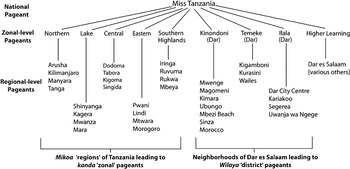
On occasion contestants are unable to sustain the illusion of speaking English and the outcome is disastrous, especially as one ascends the pageant hierarchy. Since their reinstatement in 1994, pageants have expanded to occur annually in almost every region of the country,Footnote 9 and a hierarchical structure divides competition into three major levels – nation (taifa), zone (kanda), and region (mkoa) (Figure 1). The top three winners of each regional competition progress to a zonal-level event, and the top three of each zonal-level competition continue to the national event. Dar es Salaam, the cultural and economic capital, is treated specially; it is technically a mkoa – Tanzania’s primary geopolitical unit – but each of its three districts, Kinondoni, Temeke, and Ilala, counts as a kanda, sending their top three finishers directly to the Miss Tanzania competition. Furthermore, these three districts are further subdivided into subdistricts, each of which holds its own competition.
Miss Tanzania national pageant hierarchy.

This special categorization of Dar es Salaam reflects the city’s strong influence on the pageant world, a result of the fact that it is, more than just the nation’s biggest city, the epicenter of the country, where Tanzania’s social and cultural capital is most concentrated. Many people believe that contestants from “Dar” are preferred as Miss Tanzania, a suspicion confirmed by the fact that the majority of winners of the national crown have indeed been from the capital. Even the lower-level pageants in Dar take on a much higher profile than those elsewhere in the country. Competition there is stiff; Dar is home to far more secondary and post-secondary schools than anywhere else, and its people tend to be more mobile, worldly, and open to beauty pageants. Judges at these events, and especially at the national competition, are also more prominent, including the CEOs of corporations, senior government ministers, and popular entertainers. The audiences become more status-conscious, with exorbitant admission prices at the Miss Tanzania event (ten times the ticket price of lower-level competitions), self-selecting for an elite group. At most competitions a contestant’s shortcomings in standard English are not noticed, but in Dar es Salaam, and especially at the Miss Tanzania competition, the chance of being found out as a linguistic phony increases significantly.
Consider the following passage, taken from one of the three prestigious zonal-level competitions in Dar es Salaam. The excerpt begins just after the contestant has announced her intention to use English for her response.
(9) M, master of ceremonies; C, contestant ; A, audience; A1, individual audience member.
1 M: Aiysha/ If you were given a chance to change one thing in
2 your life, what would it be and why/explain//
3 C: Thank you judge for your good question/
4 If I were given the chance .. to change one thing in my life,
5 I would like to change- .. I would like to be .. uh .. Miss World,
6 because .. =no Tanzanian lady … at <2> at <2> at this moment
7 A: =HHHHHHHHHHHHHHHHHHHHHHHHHHHH
8 C: == =achieved the Miss World/ and that would give=me enable ..
9 A: =HHHHHHHHHHHHhhhhhhhhhhhhhhhhhhhh=
10 C: ==to .. fight with HIV AIDS {[ey´dis]} = in ( )//
11 A1: =AIDS{[ey´dis]}HHHH
12 hoo = hoo hoo hoo=
13 A: =HHHHHHHHH=HHHHHHH=HHHHHHhhhhhhhhhh
14 M: =Asante sana=
‘Thank you very much’
15 <3>
16 C: [turns to walk off stage, normal procedure following response]
In this excerpt, there are two points at which the audience erupts into derisive laughter, and both of these concern the contestant’s perceived lack of linguistic expertise. The first eruption (lines 7, 9) is triggered by the contestant’s attempt to reframe the question – If you were given the chance to change one thing in your life, what would it be and why? – into another one for which she had likely already rehearsed the answer. This shift occurs in the middle of line 5, when the contestant repeats the question (line 4) at the beginning of the response, but in line 5 stops herself: I would like to change- is then reworked into I would like to be .. uh… The contestant has thus clumsily recast the question to which she is responding into another common pageant question, something like “What would you do if you were to become Miss World?” The pageant-savvy audience sees through her flimsy effort to insert a memorized response to a different question into the answer slot. In attempting to present herself as a fluent standard English speaker, the contestant has instead, through her inability to answer spontaneously, indexed herself as a linguistic phony. Recall, however, that it is a strategy that worked for the contestant in the Arusha competition described above.
Just after the laughter and hooting dissipate (line 9) the contestant makes another mistake, this time shattering the illusion of ufasaha that is so important to onstage speech. In line 10, she pronounces AIDS with an epenthetic vowel – [ey´diz] – upon which one member of the audience mimics the pronunciation and then falls into a fit of laughter and derisive noises (lines 11, 12), obscuring the contestant’s last words. The isolated reaction is immediately followed by a more general audience outburst of uproarious laughter and hoots (line 13). The MC mercifully draws the segment to a close, and the contestant walks off stage according to custom.
Upon first glance, the reaction to this pronunciation is surprising. Throughout this response, grammatical oddities, such as give me enable (line 8) and fight with (line 10 – a calque from Swahili kupigana na ‘to fight with’) – as well as awkward pauses (e.g., lines 4 and 5), passed without comment from the audience, while the mispronunciation of AIDS was hugely salient to the crowd. This particular feature – an interconsonantal epenthetic [i] – is a very common, typically unremarkable characteristic of English spoken in East Africa, resulting from the preference to avoid consonant clusters in Swahili. In fact, in this same contest, another contestant made a similar “mistake,” pronouncing guests as [gϵst´iz]. As we might expect, the pronunciation received no reaction at all. So why, then, does [ey´diz], but not [gϵst´iz] nor other, grammatical peculiarities, evoke such a strong reaction?
The reason is that, unlike guests, AIDS (and HIV/AIDS) functioned here as a register shibboleth (Silverstein Reference Silverstein2003). It is a word that is frequently used in urban Swahili, in lieu of the standard Swahili word Ukimwi, and even when speaking Swahili, the term is normally pronounced approximately as it is in standard English – [eydz] not [ey´diz]. In mispronouncing the word, the contestant broke the frame of ufasaha not by lexical but rather by phonetic interference, by importing a Swahili pronunciation into a particularly salient English word. Furthermore, AIDS refers not only to an immense social problem, but also to a politically fashionable social agenda. Talking openly about AIDS is progressive in Tanzania and stands in contrast to the more traditional approach of suppressing discussion of it (Setel Reference Setel1999). The contestant’s failure to produce the accepted pronunciation of this well-known word thus both foregrounded to the audience her discomfort with English and also suggested to them that her interest in the disease was disingenuous (had it been authentic, surely she would be able to say the word right!).
Both audience outbursts, then, were fueled by the same comedic ineptitude and fraud. The contestant tried to dupe the crowd into believing, through use of English, that she was an educated and progressive elite, but instead she succeeded only in indexing herself as the opposite: averagely undereducated, not to mention foolish. It is an interpretation that is really Dar-specific, as these same kinds of mistakes occur frequently at pageants throughout the country yet go completely unnoticed.
“I Am Very Good at Explaining Myself, Especially in English”: The Humiliation of a Linguistic Phony
The final set of examples depicts a dramatic event that took place during the Q&A portion of the 2003 Miss Tanzania competition in Dar es Salaam. They illustrate the stratified nature of language use and evaluation, the high value placed on English, and the lengths to which speakers will go to present themselves as English speakers. They also bring home the idea that language use is critical in these pageants, even surpassing a contestant’s looks in importance.
The incident is centered around Nargis Mohammed,Footnote 10 a top-five contestant who was already well known for starring in a popular music video.Footnote 11 She had earlier in the season been crowned Miss Ilala 2003, a Dar es Salaam zonal-level title bearing the highest profile of all the sub-national competitions. She was loved by Tanzanians and was widely believed to be the contest’s front-runner. Many attributed the fact that in the end she did not secure the crown to her failure to perform well linguistically. From the beginning of the exclusive event, Nargis was the picture of pageant success. Cheers erupted from the audience each time she appeared on stage with her striking confidence and warm smile. After being named in the top five, Nargis was called onto stage for her Q&A. Dressed in a sparkling, spaghetti-strapped, midnight blue evening gown, hair pulled into a loose bun garnished with a giant blue flower, she sat in the designated chair and bantered with the interviewer, in Swahili, with an ease unmatched by her competitors. It seemed a foregone conclusion that Nargis Mohammed would become Miss Tanzania later that night.
Following her announcement, met with cheers, that she would answer her question in English, the interviewer, a former Miss Tanzania herself, asked Nargis, “In the recent budget, Tanzania has embarked on campaign [sic] to remove poverty. Tell us in your view, what should be done to remove the poverty.” In the following passage, one can see the contestant’s repeated and ultimately unsuccessful attempts to establish and regain a verbal foothold in what is clearly a memorized speech, given in a language with which she is deeply uncomfortable. Arrows indicate each time the contestant restarts her answer.
(10) C, contestant; A, audience; M, master of ceremonies.
1 C: Thank you for the question// Good evening ladies and gentlemen/
2 First of all .. it has to be clear to the mind of people … that …
3 poverty is not just about not having money/ but it’s all
4 about .. lack of food, shelter, social isolation =
5 A: =xxxxxx
6 C: ==to the
7 access- social isolation, to the access of- =
8 A: =xxxxx
9 C: ==to the access
10 of health services and security, powerlessness, and
11 hopelessness//
12 If we empower our people with capital services, soc- eh social
13 c- social services, human services, we have no doubt to fight/
14 we have no- .. sorry/ sorry/ sorry/=
15 A: =HHHHHHHHHHHHHHHH
16 HHHHHHHHHHHHHHH=HHHHHHHHHHHHHHHHHH
17 M: =It’s OK/ We need your silence/
18 =We need your silence//=
19 A: == =HHHHHHHHHHHHH=HHHHHHHHhhhhhhhhhhhhh
→ 20 C: First of all … first of all .. the people has to know that .. poverty
21 is not all about not having money/=
22 A: =HHHHHHHHHhhhhhhhhh
23 C: ==but it’s all about lack of food, shelter um social isolation,
24 access to health services … um=
25 A: =HHHHHHHHHHHHHHHHH
26 HHHHHHH=HHHHHHHHHHHHHHHHHHH=HHHHHHH
27 M: =Samahani tunaomba utulivu wenu/=
‘Sorry we ask for your calm’
28 A: ==HHHHHHHHHHHHHHHHH=HHHHHHHHHHHHHHHH
29 = [music comes in to cue ending] =
30 M: =Tunaomba utulivu wenu ili mshiriki aweze kujibu swali lake/ ‘We need your calm so the contestant can answer her question’
31 A: ==hhhhhhhhhhhhhhhhhhh=hhhhhhhhhh
32 M: =Nargis, can you go on?
→ 33 C: <3> First of all=
34 A: =HHHHHHHHHHHHHHHHHHHHHHHHHH
35 C: =it has to be clear to the mind of people that
36 poverty is not all about not having money/ but it’s all about
37 lack of food, shelter, clothing, and .. lack of social isolation,
38 access … to soc- to health services/ Thank you//
39 A :==HHHHHHHHHHHHHHHHHHHHHHHHHHHHHHHHH
40 [music cued, contestant stands up and is escorted off stage]
In this passage, Nargis struggles from the start to deliver her prepared answer. While she manages to get the farthest in her first attempt, she shows signs of confusion as early as line 2, where she pauses markedly after people and then again after the next word, that. Two lines later (line 4), she pauses again following about but then is received by a wave of approving applause (line 5), based on the politically chic content of her response. It is this positive reaction, though, that distracts her and triggers her first significant trouble (line 7), in what turns out to be access to health services… (lines 9–10). Nargis continues briefly on track, but then in line 14, she breaks the frame of the Q&A by acknowledging her confusion with Sorry, sorry, sorry.
This gaffe triggers several seconds of unbridled cacophony, during which the former Miss Tanzania in charge of the session calms down the audience. Nargis resumes the Q&A frame and starts speaking again, this time with her trademark smile and confidence gone. By the end of the second line of the contestant’s reprise (line 21), the audience realizes that Nargis has simply restarted, virtually word for word, the answer she began in her first attempt. The contestant struggles through the noise and humiliation, but by the time Nargis reaches line 24, the screams of laughter and rolls of applause are deafening, and the contestant stops once again.
Eventually, the former Miss Tanzania tries yet again to calm the audience down (line 27). Her use of Swahili rather than the agreed-upon English of the Q&A frame emphasizes the severity of the circumstances; she must speak Swahili to ensure comprehension and to assert disciplinary authority. Although the music is cued to end the segment (line 29), the former Miss Tanzania nonetheless offers Nargis another shot at completing her answer (line 32: Nargis, can you go on?), highlighting a disconnect between the producers’ and the former Miss Tanzania’s appraisals of what should happen next.
Following a significant pause that seems to indicate her uncertainty about continuing, Nargis resumes her response again (line 33). As in the second attempt, Nargis reproduces her speech virtually word for word from the beginning, even repeating a mistake: access to health services (line 38), a phrase she struggled with in her first attempt as well (line 7), and the same phrase at which she abandoned her second attempt (line 24). Finally, with the crowd out of control, Nargis gives up with a closing Thank you, clearly not having finished (compare with lines 10–13), and she swiftly leaves the stage. The announcers then briefly address the fiasco: That was a very hard round, and Most of the people – if you were up here-. That’s competition, and that’s the way things go. Following several entertainment segments and special awards, Nargis received third place in the competition.
In the days following the event, the media covered the incident extensively and ferociously. Newspaper reports commented that while Nargis had been the front-runner, “she failed because of her limited ability to answer the questions eloquently” and cost her first place (Dimba September 7–13, 2003).Footnote 12 In the following passage, a journalist reports Nargis’s own perception of “why she failed to answer the question”:
(11) When she explained why she failed to answer the question in the Miss Tanzania competition, she said that even she herself is surprised and she doesn’t know why she failed. “I still cannot believe I failed to express myself that much, I am very good at expressing myself, especially in English, but I really don’t know why I failed,” explained the artist.
She disagreed with some of the peoples’ opinions that she was reciting the answer and that that was the reason why even when she repeated them three times she still wasn’t able to reach the end of her sentence. “I didn’t recite it. Can you recite six questions?…” (Mwanamke September 18–24, 2003)
In this report, Nargis inadvertently confirms both the significance of English in these competitions and the likelihood that it was due to her inexperience with English that she did not succeed in delivering her answer: “Mimi ni mzuri katika kujieleza hasa kwa Kiingereza…” ‘I am very good at expressing myself, especially in English…’. Her insistence that it was not due to her insufficient English skills unfortunately implicates just that as the culprit. Furthermore, Nargis offers the rhetorical question “hivi wewe unaweza kukariri maswali sita” ‘Can you memorize six questions?’ as support for her claim that she did not memorize the answers, but this challenge backfires; she clearly was not able to memorize six questions and answers, a fact that nonetheless did not keep her from trying. Indeed, to the audience, Nargis looked very foolish, not only for having memorized her answer in advance and for having been twice unable to resume the answer at the point where she stopped in the first attempt, but in addition for having made these failures in English. Nargis was found out as a linguistic phony, an instance of indexical non-congruence made all the more delightful to the audience because of her celebrity.
Now let us compare Nargis’s response with another, delivered by contestant Sylvia Bahame just minutes before Nargis’s speech. At that time Sylvia was a law student at the University of Dar es Salaam, and by the end of the evening she would be crowned the national champion. She was asked, “Is woman’s role different from man’s? Explain.”Footnote 13 Sylvia, who spent a portion of her education attending English-language international schools in the Middle East, delivered her response in a startlingly fluent, non-Tanzanian variety of English:
(12) C, contestant; A, audience.
1 C: Thank you very much/
2 Good evening ladies and gentlemen, judges/
3 I would say that indeed a woman’s role in the society is very
4 different from that of a man’s role/
5 First of all women are predisposed to bearing children/=
6 A: =xxxxxxx
7 C: Therefore this means that automatically they have certain rights
8 and responsibilities that are different from those of men//
9 Secondly, I would say that women that work have a higher work
10 load than that of men, because first of all, there’s a certain mis-
11 misconception in most societies that women’s role is to simply
12 work, cook, and tend to the family, and if this is so, then
13 women who work have their work load doubled//=
14 A: =xxxxxxxxxx
15 C: Therefore at the end of the day they are not fully appreciated/
16 Thank you//
In addition to certain non-local phonological features, such as the American post-vocalic [r], Sylvia also used a refined vocabulary, including predisposed and bearing (line 5) and misconception (lines 10–11). She employed with ease expressions such as if this is so (line 12), have their workload doubled (line 13), and at the end of the day (line 15), as well as several syntactically difficult constructions, including those/that of man/men (lines 4 and 8). By all accounts, Sylvia spoke a register of English that in addition to being pure and standard was also stylishly globalized (and hence highly exportable). It is no coincidence that she won the national crown and would advance to the Miss World competition in China later that fall. Her competitor Nargis received third place and a local modeling contract.
The events of the Miss Tanzania 2003 pageant gain even more significance when seen in light of the contestants’ physical characteristics. Nargis was widely considered to be exceptionally attractive, not tall but trim and shapely with a sweet face, whereas Sylvia’s appearance, including a slightly stocky build and prominent front teeth, was characterized in a less than complimentary way by newspaper coverage and pageant fans alike. One well-known pageant organizer described Sylvia to me as “a bit chunky for Miss Tanzania.” Sylvia’s greatest asset as Miss Tanzania, then, was not her physical attributes but rather her linguistic ones.
Conclusion
This article has attempted to link language ideologies with multilingual strategies. In most cases, contestants produce a wonderfully appropriate and indexically powerful register of English, even though their linguistic abilities might, in other contexts and by other evaluators, be perceived as deficient. This observation supports Blommaert and co-authors’ (2005) argument that the very notion of “bilingualism” or “multilingualism” should be reframed into one of truncated multilingualism, so that “full competence in different languages” is not the concern, but rather “linguistic competencies which are organized topically, on the basis of domains or specific activities” (2005:4). This perspective helps to recast what has been labeled as, for example, “broken English” or manifestations of “language attrition,” as viable modes of communication within certain contexts.
Yet even in the face of this communicative viability, it is clear that on a broader social scale, and even within the ranks of the pageant system itself, ways of speaking are not equal and are hierarchically arranged. Once a contestant reaches the Miss Tanzania competition, her fragmentary, if pure, English will not be good enough, and only a contestant who can speak standard and fluent English will remain in the running. It is not just that she is at the pageant pinnacle, but also that she is in Dar es Salaam, a city that, in comparison with the rest of the country, is considered to be a place of opportunity, global connectedness, and education, and hence a center of English.
The competing language ideologies seen here – one of language equality and the other of English superiority – are historically contingent as well as subject to reinterpretation and revision (cf. Spitulnik Reference Spitulnik, Schieffelin, Woolard and Kroskrity1998). In the years leading up to and following Tanzanian independence from Great Britain, scholars dedicated themselves to “developing” Swahili in order to ready it for replacing English in higher institutions (Whiteley Reference Whiteley1969). Tanzanians were eager to use an indigenous rather than colonial language in many public domains, and the government wanted gradually to extend it to more elite institutions, especially secondary school and the university. But for a variety of ideological and practical reasons, the complete switch to Swahili never occurred, and in the past fifteen years attitudes toward English have shifted (Blommaert Reference Blommaert1999). Today, while Swahili is still emblematic of Tanzanian independence and distinctiveness, English represents not colonial oppression but rather education, success, and opportunity, as well as a connection to the rest of East Africa and the world. Pageant participants’ expression of the ideology of equality between these two languages is still, then, about asserting the goodness and viability of Swahili. The MC’s “English or Swahili” question posed to contestants seeks to construct Swahili as not just a language used for informal communication, but one that can stand alongside English in all sorts of formal, public, and high-level communicative settings. This ideology of equality is, however, at odds with other findings from this study. Not only do contestants go to great lengths to use English rather than Swahili onstage, but judges and audiences alike may even reward them for it. The ideology casting English as superior to Swahili cannot therefore be said to be completely implicit; yet because people are reluctant to voice this preference, it is only through observation of implicit manifestations that it becomes visible. Ultimately, the professed equality remains in some ways elusive. While Swahili dominates in daily communication and in many public fora, it becomes sidelined in favor of English in elite institutions such as education, as well as in globalized or outward-looking settings such as beauty pageants.
Scholars have shown that the consequences of language ideologies for people’s lives can be dramatic and devastating, from public disgrace over marital disputes (Briggs Reference Briggs and Briggs1996, Hirsch Reference Hirsch1998) to the threat of losing one’s life or liberty (Haviland Reference Haviland2003). The consequences of language ideologies in Tanzanian beauty pageants are in contrast relatively trivial, but they are grounded in those of broader society and have wide-ranging effects on contestants’ lives outside of competition. Limited access to standard English bars otherwise talented, educated, and hardworking Tanzanians from realizing their dreams, even though much of the day-to-day communication among the educated middle class is more likely to occur in a variety of Swahili deeply mixed with English rather than in standard English alone (Blommaert Reference Blommaert1999, Higgins Reference Higgins2007). While it is the educational system that constrains access to standard English in Tanzania, it is not education itself that prevents upward mobility for many. Highly coveted service positions such as bank teller, travel agent, or hotel desk staff often require knowledge of standard English, but not necessarily a high level of education. Furthermore, educational degrees can be and often are faked, but there are serious limits, as we have seen, to the extent to which one can fake language competence. Tanzanians complain that Ugandans and Kenyans, who are more likely to speak English fluently by virtue of their wider access to the language, are often are able to acquire jobs in Tanzania that equally or more educated Tanzanians cannot.
These challenges have profound effects on the lives of many of the young women I came to know during my fieldwork in Tanzania. Grace,Footnote 14 for example, is a young Tanzanian women in her mid-twenties who had been a successful beauty contestant and whose goal was to become a tour guide or a receptionist at an upscale hotel. When she started competing in pageants, she had just quit school after finishing Form Five. Her education gave her a solid grasp of English grammar and vocabulary, but not fluency. She was able to use her “fake” English onstage to achieve the top rank at both a regional and zonal competition, and she placed at the Miss Tanzania competition. Through her pageant success she won cash as well as a scholarship to a local tourism school, where she took courses in computer skills, tourism, and English. Grace finished her course work in a year and was placed at an elite resort near a game reserve in northern Tanzania. Upon her arrival at the hotel, the manager assigned her to a position as a cleaning woman rather than to her expected position as a receptionist, and told her that if she improved her English, he would consider promoting her. After several months of this work, and with virtually no chance to improve her English speaking skills, she abandoned the job and, having saved a little money, returned to the tourism school to work on her English some more. Now, more than two years later, she still has not secured the position she wants and is selling used clothes to help support herself and her family. Having completed more education than over 93% of the Tanzanian population (United Republic of Tanzania 2005), Grace is stuck without a career, with few prospects, and is finding herself too old to continue putting her hopes into beauty contests. The limits on her ability to achieve pageant success have been mirrored in her difficulties in securing satisfying and sustaining employment. They are linked with Tanzania’s language and educational policies and with language ideologies that perpetuate sharp social inequalities, all exacerbated by emerging norms for communication in English in an ever more globally oriented Tanzania.
Appendix: Transcription conventions
General transcription conventions were adapted from Gumperz & Berenz Reference Gumperz, Berenz, Edwards and Lampert1993. Laughter and applause transcription conventions were adapted from Clayman Reference Clayman1992.
.. pause of less than .5 second
… pause of greater than .5 second (unless precisely timed)
<2> pause, precise unit of time (2 second pause)
, slight rise, as in listing intonation (more is expected)
/ slight fall
// final fall
? rising intonation
- truncation (self-interruption)
= overlap
== latching of utterance to speaker’s previous one
{[ ]} non-lexical phenomena that overlay the lexical stretch
[ ] transcription notes
( ) unintelligible
hhhh quiet audience laughter
HHHH loud audience laughter
xxxx quiet audience applause
XXXX loud audience applause
hoo audience hoots, often rhythmic, and used in critique of the person onstage