


Introduction
Carrots are known to be highly susceptible to weed competition. If weeds are not controlled, yield losses are reported to range from 50% to 100% (Jensen et al. Reference Jensen, Doohan and Specht2004; Swanton et al. Reference Swanton, O’Sullivan and Robinson2010). For example, Williams and Boydston (Reference Williams and Boydston2006) found that a volunteer potato (Solanum tuberosum L.) density of only 0.13 m−1 could reduce carrot yield by 10%. Weed management in carrots has relied primarily upon the use of linuron, which can be applied PRE or POST (Bell et al. Reference Bell, Boutwell, Ogbuchiekwe and McGiffen2000). In Ontario, more than 38% of the registered herbicide treatments in carrots include linuron (OMAFRA 2018). The future of linuron for weed control in carrots is uncertain because of ongoing government reassessment of older herbicides and resistance that has developed in pigweed species.
The Pest Management Regulatory Agency (PMRA) Re-evaluation Program was launched in 2001 to reassess 401 active ingredients registered before 1995 (Government of Canada 2009). The aim of this program was to evaluate old products with modern scientific standards to ensure the latest health and environmental criteria were met. The reevaluations were to be carried out on all products, including linuron, on a 15-yr cycle. Herbicides that did not meet the latest scientific standards would be discontinued.
Linuron resistance in Ontario, Canada, was first reported in 1999 for Powell amaranth (Amaranthus powellii S Watson) and in 2001 for redroot pigweed (Amaranthus retroflexus L.) (Dumont et al. Reference Dumont, Letarte and Tardif2016; Heap Reference Heap2018). In a survey of the major carrot-growing regions in Ontario, 42 out of 47 (89%) pigweed species populations tested positive for linuron resistance (Davis Reference Davis2014). Linuron is known to compete with plastoquinone, binding at the QB site in the D1 protein of the photosystem II (PSII) complex (Bowyer et al. Reference Bowyer, Camilleri and Vermaas1991). Linuron-resistant pigweed species have a target-site mutation resulting from the modification of the D1 protein. The most common cause of resistance was conferred by a Val-219-Ile mutation; the second most common mutation was conferred by a Phe-274-Val mutation (Davis Reference Davis2014). Linuron-resistant pigweed species were also found to be cross-resistant to diuron and monolinuron. Low-level resistance to atrazine, prometryn, metribuzin, bromoxynil, and bentazon, all of which are PSII inhibitors, has also been noted (Dumont et al. Reference Dumont, Letarte and Tardif2016).
Recognizing that linuron may be discontinued as a result of the PMRA review and that resistant pigweed species likely will continue to spread, we initiated experiments to develop a linuron-free weed management strategy. This strategy involved testing PRE herbicides and the determination of the biologically effective dose of selected POST herbicides for pigweed species seedling control under field conditions. The biologically effective dose for each of the herbicides used in this study was predetermined in controlled experimental studies before the initiation of field studies. For this study, we hypothesized that an optimum dose of selected herbicides could be identified that would not adversely affect crop emergence and that would also provide control of pigweed species seedlings, resulting in optimum carrot yield.
Materials and Methods
Field trials were conducted in 2016 and 2017 at the University of Guelph Muck Crop Research Station located near Kettleby, ON, Canada (44.02° N, 79.35° W). The muck soil contained 63% organic matter with a pH of 7.1. The pigweed population at the site of the research trials consisted of redroot and Powell amaranth, but redroot pigweed dominated the population. A distinction between the species was not made, and they will henceforth be referred to as “pigweed species.”
In 2016, two separate trials were established and seeded with carrots on May 20 and June 16. In 2017, the initial planting of carrots was compromised by heavy rainfall. As a result, this trial was replanted into a newly established site on July 6. The trial area was spring tilled using a disk, followed by an application of fertilizer and two passes with a cultivator. On each planting date, three rows of carrots were direct seeded into raised beds spaced approximately 86 cm apart at a density of approximately 66 to 82 seeds m–1 using a Stanhay Precision Seeder (Stanhay Webb, Bourne, UK). Each plot consisted of two carrot beds, each of which was 5 m long. In 2016, carrot cultivars ‘Cellobunch’ and ‘Belgrado’ were planted in two separate trials, whereas in 2017, only Cellobunch was planted. Fertility management and disease and insect control were conducted in accordance with best management practices as described in the Ontario Ministry of Agriculture vegetable production and vegetable crop protection guidelines (OMAFRA 2010, 2014).
Before the establishment of these field trials, growth-room studies were conducted from 2012 to 2015 to determine crop selectivity and the biologically effective dose for the control of pigweed species seedlings (unpublished data). The biologically effective dose was defined as the herbicide dose required to achieve greater than 90% control of pigweed seedlings in the 2- to 3-leaf stage of development. As a result of these studies, several herbicides were selected. Information on the herbicides selected, including formulation, application timing, dose, and manufacturer, are listed in Table 1.
Herbicide formulation, application timing, dose, and manufacturer for each herbicide tested in 2016 and 2017 at the Muck Crop Research Station located near Kettleby, ON, Canada.

a POST A, applied at the 2- to 3-leaf stage of the carrots; POST B, applied (as required) as new weeds emerge, e.g., after a rainfall event giving rise to a flush of newly emerged weed; PRE, applied just after planting; PRE/POST, applied before carrot emergence, but after weeds had emerged.
b A dash (—) indicates no trade name available.
c The field rates of Blazer, Cadet, Reflex and Goal are 600, 6, 140 and 240 g ai ha−1. The remaining herbicides are used at doses matching their recommended field rates.
Herbicide treatment combinations and carrot planting, treatment application, and harvest dates for this study are listed in Tables 2 and 3. All herbicide treatments were applied with a compressed-air backpack sprayer with a three-tip boom calibrated to deliver 200 L ha−1 at 207 kPa through flat-fan TeeJet® XR8002 nozzles (TeeJet Technologies, Springfield, IL, USA) spaced 50 cm apart. The boom height was maintained at approximately 46 cm above the ground or crop canopy at a walking speed of approximately 3.6 km h−1 during all herbicide applications. Every replicate of each trial included a weedy and a weed-free check. The weed-free check was kept weed-free by hand weeding. In addition to the herbicide treatments, interrow cultivation occurred on August 17 in 2016 and August 9 in 2017 for each trial to control weeds between the beds.
Herbicide treatment combinations for carrot field trials completed in 2016 and 2017 at the Muck Crop Research Station located near Kettleby, ON, Canada.a

a POST A, applied at the 2- to 3-leaf stage of the carrots; POST B, applied (as required) as new weeds emerge, e.g., after a rainfall event giving rise to a flush of newly emerged weed; PRE, applied just after planting; PRE/POST, applied before carrot emergence, but after weeds had emerged.
Summary of carrot planting, herbicide application, and harvest dates at the Muck Crop Research Station near Kettleby, ON, Canada in 2016 and 2017.a

a POST A, applied at the 2- to 3-leaf stage of the carrots; POST B, applied (as required) as new weeds emerge, e.g., after a rainfall event giving rise to a flush of newly emerged weed; PRE, applied just after planting; PRE/POST, applied before carrot emergence, but after weeds had emerged.
b A dash (—) indicates a spraying that was not completed. In 2016, the carrots emerged earlier than expected; therefore, spraying was not completed. In 2017, a second POST B application was not necessary.
Carrot seedling emergence counts were recorded from a 30-cm length of carrot row from each of the two carrots beds and then converted to number of carrots seedlings per meter of row before analysis. Pigweed control ratings were recorded at 14, 28, and 56 d after emergence (DAE). Weed control was visually rated as a percent of control compared with the weedy check; 100% indicating complete weed control and 0% indicating no control. At 56 d after crop emergence, the surviving pigweeds were harvested manually from a 0.25-m2 section from each of the two carrot beds per plot, placed in paper bags, and dried at 80 C until the weight remained constant. Due to the structure of the high organic matter soil, it was possible for entire pigweed plants to be pulled from the soil and the roots and shoots placed in paper bags to be dried and weighed. On October 11 and 15 in 2016 and on October 10 in 2017 carrots were harvested manually (pulled from the ground and shoot removed) from 1.16 m from each of the two beds per plot and then combined for analysis (n=64). The carrots were graded into three size categories by diameter at the collar: oversized (>4.4 cm), packaging size (2.0 cm to 4.4 cm), and culls (carrots <2.0 cm in diameter, carrots shorter than 10 cm, and forked or split carrots). Insect or disease damage on carrots was disregarded while grading. Oversized and packaging carrot weights were combined and denoted as marketable yield (in Mg ha−1) before statistical analysis.
Trials were established as a randomized complete block design with each treatment replicated four times. Treatment analysis included the weed-free but not the untreated all season weedy check. All data were analyzed in Statistical Analysis Software (v. 9.4, SAS Institute, Cary, NC, USA). A mixed-model analysis was completed using PROC GLIMMIX. Initial statistical analysis revealed a significant difference between years and location, so data were not pooled. Variance was partitioned into fixed effects of treatment and random effect of block. Least-squares means estimates for each parameter were generated and compared using the Tukey test (P ≤ 0.05). The P-value for visual pigweed control ratings was set at ≤ 0.01, as a P-value of 0.01 lowers the acceptance that the results are due to chance. Because visual pigweed ratings were subjective, there was more variability in the data, and a lower P-value helps manage this variability. The pairwise comparisons were converted to letter codes using the pdmix800.sas macro. A residual analysis was also completed to ensure error was random, homogenous, and randomly distributed. Percent visual pigweed control values were transformed into the decimal scale, where 0% was set to 0.0001 and 100% control was set to 0.9999. A beta distribution with a logit link function was used for visual pigweed control ratings completed at 14, 28, and 56 DAE. A lognormal distribution with an identity link function was used in the analysis of pigweed dry weight. Lognormal data were back-transformed for presentation purposes. A Gaussian distribution with an identity link function was used in the analysis of carrot seedling emergence and yields.
To determine the seasonal emergence pattern of pigweed species, a square meter of untreated soil (no herbicide applied) was established adjacent to one of the field trials in 2016. Each week, beginning on June 7 and ending on September 8, emerged pigweed seedlings were counted and recorded. Pigweed emergence counts per square meter were then plotted against growing degree days (GDD) beginning on the date of carrot planting, which was May 20.
The seasonal growth and development pattern of carrots was monitored in a separate trial established in 2016. Carrots were planted as described previously. Weeds were controlled with a standard treatment of linuron applied both PRE and POST according to weed control recommendations from the Ontario Ministry of Agriculture (OMAFRA 2015). Ten carrots were sampled randomly from an area eight carrot beds wide by 5-m long, starting on June 15 and continuing every week until carrots were harvested on October 15. On each individual plant, the root and shoot were separated, cleaned, and dried at 80 C to a constant weight. The average shoot and root weights were then plotted against GDD (base temperature for carrots set at 5 C as described in Swanton et al. [Reference Swanton, O’Sullivan and Robinson2010]).
Results and Discussion
Carrot seedling emergence was affected in 2017 by PRE treatments of carfentrazone-ethyl or fomesafen. This effect was different from results recorded in 2016, likely due to differing weather patterns. In 2016, the growing season was hot and dry with no observed emergence issues for any of the treatments (Tables 4 and 5). This result was comparable to those in studies conducted on carrots by Ogbuchiekwe et al. (Reference Ogbuchiekwe, McGiffen, Nunez and Fennimore2004), who suggested that carrots readily tolerated carfentrazone-ethyl applied as a PRE treatment. In 2017, however, carrot emergence was reduced from approximately 59 seedlings m−1 (weed-free check) to counts as low as 2 seedlings m−1 for treatments including carfentrazone-ethyl or fomesafen (Table 6). In 2017, a light rainfall of 3 mm had occurred within 24 h of fomesafen application. A heavy rainfall of approximately 36 mm, however, occurred within 48 h after application of carfentrazone-ethyl. At this time, the carrot seed coat had cracked and the primary root was growing, but the carrots had not yet emerged above the soil. Injury from carfentrazone-ethyl is known to be enhanced under conditions of high soil moisture content (Anonymous 2016; Crespo et al. Reference Crespo, MacRae, Alves, Jacoby and Kelly2013). Thompson and Nissen (Reference Thompson and Nissen2002) also observed that the risk of crop injury caused by carfentrazone-ethyl was enhanced in such crops as corn (Zea mays L.), soybeans [Glycine max (L.) Merr.], and wheat (Triticum aestivum L.) in a wet year compared with a dry year. Fomesafen was also reported to reduce cucumber (Cucumis sativus L.) emergence and cause greater leaf injury when heavy rainfall occurred shortly after the herbicide treatment was applied (Peachey et al. Reference Peachey, Doohan and Koch2012).
Carrot seedling emergence, pigweed species control, and yield of carrots planted May 20, 2016, at the Muck Crop Research Station near Kettleby, ON, Canada.a

a Means followed by the same letter in a column are not significantly different according to least-squares means estimates generated and compared using a Tukey test.
b POST A, applied at the 2- to 3-leaf stage of the carrots; POST B, applied (as required) as new weeds emerge, e.g., after a rainfall event giving rise to a flush of newly emerged weeds; PRE, applied just after planting; PRE/POST, applied before carrot emergence, but after weeds had emerged.
c A P-value of ≤ 0.05 was used for statistical decisions.
d A P-value of ≤ 0.01 was used for statistical decisions on visual pigweed control ratings.
e DAE, days after emergence.
Carrot seedling emergence, pigweed species control, and yield of carrots planted June 16, 2016, at the Muck Crop Research Station near Kettleby, ON, Canada. a

a Means followed by the same letter in a column are not significantly different according to least-squares means estimates generated and compared using a Tukey test.
b POST A, applied at the 2- to 3-leaf stage of the carrots; POST B, applied (as required) as new weeds emerge, e.g., after a rainfall event giving rise to a flush of newly emerged weeds; PRE, applied just after planting; PRE/POST, applied before carrot emergence, but after weeds had emerged.
c A P-value of ≤ 0.05 was used for statistical decisions.
d A P-value of ≤ 0.01 was used for statistical decisions on visual pigweed control ratings.
e DAE, days after emergence.
Carrot seedling emergence, pigweed species control, and yield of carrots planted July 6, 2017, at the Muck Crop Research Station near Kettleby, ON, Canada. a

a Means followed by the same letter in a column are not significantly different according to least-squares means estimates generated and compared using a Tukey test.
b POST A, applied at the 2- to 3-leaf stage of the carrots; POST B, applied (as required) as new weeds emerge, e.g., after a rainfall event giving rise to a flush of newly emerged weeds; PRE, applied just after planting; PRE/POST, applied before carrot emergence, but after weeds had emerged.
c A P-value of ≤ 0.05 was used for statistical decisions.
d A P-value of ≤ 0.01 was used for statistical decisions on visual pigweed control ratings.
e DAE, days after emergence.
Pigweed species were controlled with selected PRE and POST treatments. Treatments that included prometryn and pendimethalin or S-metolachlor (PRE), glufosinate (PRE/POST), pyroxasulfone and metribuzin (POST A), and finally, acifluorfen and oxyfluorfen, with or without fluthiacet-methyl (POST B), controlled pigweed seedlings throughout the growing season while protecting yield. For example, at 56 d after carrot emergence, visual control ratings of pigweed for the May 20 and June 16 planting dates in 2016 ranged from 73% to 100% control when compared with the weedy check (Tables 4 and 5). In 2017, these same herbicide treatments again resulted in excellent control of pigweed seedlings (Table 6). Control was greater than 99% for all treatments at 56 DAE. Notably, the biologically effective dose of the POST herbicides oxyfluorfen, fluthiacet-methyl, acifluorfen, and fomesafen achieved excellent crop selectivity and commercially acceptable pigweed seedling control under field conditions.
Uncontrolled pigweed populations dramatically reduced carrot yields in 2016 and 2017. In 2016, carrot yields in the weedy check were reduced 22-fold and 80-fold compared with the weed-free check for planting dates of May 20 and June 16. In 2016, the average yield of the weedy check was 0.86 kg ha−1, and in 2017, the average was 0.04 kg ha−1. When pigweed seedlings were controlled with a combination of PRE and POST herbicides, marketable carrot yields did not differ from yields for the weed-free check. For example, in 2016, no significant differences in yield were observed for all herbicide treatments compared with the weed-free check for either planting date (Tables 4 and 5). Marketable carrot yield, however, was found to be lower for treatments including carfentrazone-ethyl or fomesafen for the later planting in 2017 (Table 6), as a result of reduced carrot seedling emergence. In addition, a treatment of bicyclopyrone also produced a lower yield than the weed-free check. There was no increase in the proportion of culled versus marketable carrots for any of the treatments over the 2 years (unpublished data). Yields were lower than average in 2017 as a result of the late planting date and adverse weather conditions persisting throughout the growing season.
This study demonstrated clearly that an alternative linuron-free weed management strategy for carrots can be developed. The combination of PRE herbicides and, notably, the role of the biologically effective dose of selected POST herbicides for the control of pigweed seedlings, provided options for excellent crop selectivity and carrot yields. Timing of the POST treatments was critical to the success of this approach for two reasons. First, the biologically effective dose determined for use in this study was effective only at the early pigweed seedling stage of growth. Second, pigweed seedlings emerged throughout the growing season, thus requiring repeated POST treatments in order to maintain control. In 2016, pigweed emergence began to rapidly increase at 463 GDD (corresponding to June 22) and peaked at 691 GDD (corresponding to July 7) (Figure 1). POST herbicide treatments were applied on June 22 and July 4 and 11 to control these emerging pigweed seedlings.
Pigweed seedling emergence counts per square meter associated with growing degree days (GDD) for the May 20 carrot planting in 2016 at the Muck Crop Research Station near Kettleby, ON, Canada. GDD were calculated using a base temperature of 5 C. The bracket indicates the critical weed-free period of carrots (CP).
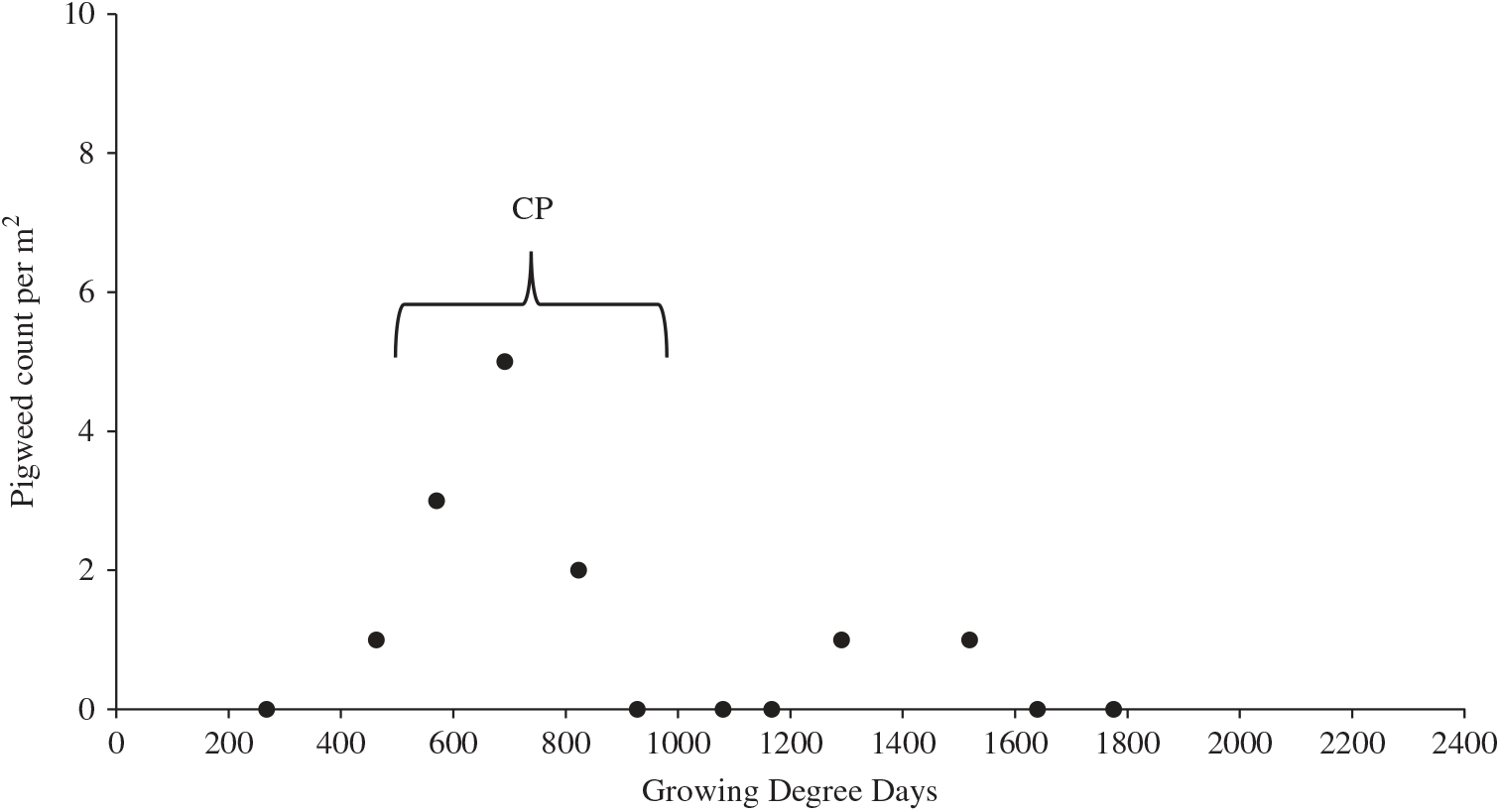
Timing of the herbicide treatments was also critical in order to keep the carrots weed-free during the critical period for weed control. Swanton et al. (Reference Swanton, O’Sullivan and Robinson2010) found that the critical weed-free period extended from 450 to 930 GDD, depending on planting date. This time period corresponded with the time of rapid shoot and root dry weight accumulation. During this time, for example, carrot root weight increased from 0.0356 g at 463 GDD to 3.338 g at 927 GDD (unpublished data). Likewise, pigweed seedling emergence peaked during the critical weed-free period in the weed quadrat (Figure 1). At peak emergence, there were 5 pigweed seedlings m−2, which equates to 50,000 pigweed seedlings ha−1. A determining factor of yield loss is the period of time between weed and crop emergence and the weed density (Kropff Reference Kropff1988). Timely weed control was key during the critical weed-free period to optimize carrot yields, especially because pigweed emergence peaked during this time.
In summary, PRE treatments of prometryn, pendimethalin, S-metolachlor, or glufosinate followed by metribuzin and pyroxasulfone applied POST were found to demonstrate excellent crop selectivity and control of pigweed seedlings when applied at the appropriate dose. POST treatments of fomesafen, acifluorfen, oxyfluorfen, and fluthiacet-methyl are herbicides not normally considered to be applicable for weed control in carrots. The requirement for repeated POST herbicide treatments reported in this study is typical of current weed management programs on high organic matter soils. This strategy of exploring the potential of the biologically effective dose for these selected herbicides proved successful for the control of pigweed seedlings in this study. The key to success with this linuron-free weed management strategy is timing. To ensure control of pigweed seedlings, these herbicide treatments must be applied shortly after pigweed seedling emergence. In addition, carfentrazone-ethyl and fomesafen applied before crop emergence were found to result in significant reduction in carrot emergence in the wet year of 2017. In conclusion, this study supports our hypothesis: optimum carrot yield can be achieved if the dose of selected herbicides can be lowered to demonstrate crop selectivity and pigweed seedling control.
Acknowledgments
Acknowledgment must be made to the funding partners of this research, including Fresh Vegetable Growers of Ontario, Bradford Co-operative and Growers, and Ontario Ministry of Agriculture, Food and Rural Affairs. Thank you to François Tardif and Darren Robinson for serving on the advisory committee. A special thank you to Shawn Janse and the staff at the Muck Crop Research Station and Matt Sheppard from Bradford Co-operative. No conflict of interest has been declared.



