Introduction
Figs (Ficus, Moraceae) are one of the most ecologically significant plant genera in tropical and subtropical ecosystems, comprising approximately 750–800 species of trees, shrubs, and hemiepiphytes distributed across all tropical continents (Berg, Reference Berg1989; Herre et al., Reference Herre, Jandér and Machado2008). These plants exhibit a remarkable co-evolutionary relationship with fig wasps (Agaonidae) that evolved over 70 million years ago, resulting in extreme specialization where each fig species typically associates with one or few specific pollinator species (Cruaud et al., Reference Cruaud, Rønsted, Chantarasuwan, Chou, Clement, Couloux, Cousins, Genson, Harrison, Hanson, Hossaert-McKey, Jabbour-Zahab, Jousselin, Kerdelhué, Kjellberg, Lopez-Vaamonde, Peebles, Peng, Pereira, Schramm, Ubaidillah, van Noort, Weiblen, Yang, Yodpinyanee, Libeskind-Hadas, Cook, Rasplus and Savolainen2012; Yang et al., Reference Yang, Machado, Dang, Peng, Yang, Zhang and Liao2015). Beyond their unique reproductive biology involving sanctions against non-pollinating wasps through selective fruit abortion of syconia that fail to contain pollinated flowers, figs display distinctive phenological patterns characterized by within-tree synchrony but between-tree asynchrony, ensuring continuous fruit availability at the population level throughout the year (Herre, Reference Herre, Jandér and Machado2008; Janzen, Reference Janzen1979). This asynchronous fruiting strategy, combined with large crop sizes, easily digestible fruit pulp, exceptionally high calcium content relative to other tropical fruits, and low secondary compound concentrations, positions figs as potentially critical resources for tropical frugivore communities, providing food for at least 10% of all bird species and 16% of all mammal species globally (Lambert and Marshall, Reference Lambert and Marshall1991; O’Brien et al., Reference O’Brien, Kinnaird, Dierenfeld, Conklin-Brittain, Wrangham and Silver1998; Shanahan et al., Reference Shanahan, So, Compton and Corlett2001).
The ecological importance of figs extends across diverse vertebrate taxa, with over 1,274 bird and mammal species documented as fig consumers across 92 families, alongside numerous reptiles and even fish species (Herre et al., Reference Herre, Jandér and Machado2008; Shanahan et al., Reference Shanahan, So, Compton and Corlett2001). Figs support not only frugivores through fruit provisioning but also insectivorous species through the predictable emergence of fig wasps, functioning as “insect hotels” that enhance local biodiversity (Mackay et al., Reference Mackay, Gross and Rossetto2018). Among non-human primates, figs serve various dietary roles ranging from preferred foods to critical fallback resources during periods of fruit scarcity, with consumption patterns varying by species, habitat, and season (e.g., Kinnaird et al., Reference Kinnaird, O’Brien, Dew and Bouble2005; Parr et al., Reference Parr, Melin and Fedigan2011; Watts et al., Reference Watts, Potts, Lwanga and Mitani2012). Asian apes exemplify heavy fig reliance, with gibbon population densities directly correlating with fig tree density, and some populations deriving over 40% of their annual diet from figs during fruit-scarce periods (Clink et al., Reference Clink, Dillis, Feilen, Beaudrot and Marshall2017; Marshall and Leighton, Reference Marshall, Leighton, Hohmann, Robbins and Boesch2006). African great apes similarly depend on figs, with some chimpanzee (Pan troglodytes) communities achieving three-fold higher densities where productive fig species occur (Watts et al., Reference Watts, Potts, Lwanga and Mitani2012). Among platyrrhine primates, Peruvian spider monkeys (Ateles chamek) may allocate up to 50% of their feeding time to figs even when other fruits are available (Felton et al., Reference Felton, Felton, Wood and Lindenmayer2008). This multi-trophic support, combined with evidence that fig loss triggers cascading local extinctions and that fig presence enables persistence in disturbed habitats, reinforces their proposed status as keystone resources (Gautier-Hion and Michaloud, Reference Gautier-Hion and Michaloud1989; Terborgh, Reference Terborgh and Soulé1986).
Howlers (Alouatta spp.) exhibit exceptional reliance on figs (Estrada, Reference Estrada1984; Milton, Reference Milton1980). Across their range from Mexico to Argentina, howlers consistently incorporate figs as dietary staples, with some populations devoting more than half of their feeding time to fig species, far exceeding consumption of other plant genera (e.g., Cristóbal-Azkarate and Arroyo-Rodríguez, Reference Cristóbal-Azkarate and Arroyo-Rodríguez2007; Giraldo et al., Reference Giraldo, Gómez-Posada, Martínez and Kattan2007; Rivera and Calmé, Reference Rivera, Calmé, Estrada, Garber, Pavelka and Luecke2006). This dependence persists even in disturbed habitats, largely due to the reliability of fig resources when other fruit trees are absent or decline (e.g., Bolt et al., Reference Bolt, Russell and Schreier2021; Chaves and Bicca-Marques, Reference Chaves and Bicca-Marques2013; Dátillo et al., Reference Dáttilo, Serio-Silva, Chapman and Rico-Gray2014; Estrada et al., Reference Estrada, Juan-Solano, Martínez and Coates-Estrada1999; Serio-Silva et al., Reference Serio-Silva, Rico-Gray, Hernández-Salazar and Espinosa-Gómez2002; Silver et al., Reference Silver, Ostro, Yeager and Horwich1998). Beyond ripe fruits, howlers extensively utilize young fig leaves as crucial protein sources, with fig foliage providing high nutritional quality (Milton, Reference Milton1979; Silver et al., Reference Silver, Ostro, Yeager and Dierenfeld2000). The combination of relatively continuous fruit availability, nutritious young leaves, large crop sizes, and persistence in disturbed habitats makes figs indispensable for the survival of howlers, particularly in seasonal environments where they may constitute the only available fruit during extended dry periods (Chapman, Reference Chapman1988; Estrada, Reference Estrada1984).
Despite extensive documentation of fig importance for howlers, the specific mechanisms underlying this relationship in their habitats have been rarely examined, with multiple non-mutually exclusive hypotheses proposed but rarely tested with long-term empirical data. The ongoing climate crisis adds urgency to understanding these mechanisms, as temperature increases of just 3°C could drastically reduce fig wasp survival, potentially disrupting this mutualism and cascading across dependent frugivore communities (Jevanandam et al., Reference Jevanandam, Goh and Corlett2013). Here we address this knowledge gap by testing five mechanistic hypotheses using a 10-year phenological monitoring of the habitat of a mantled howler (A. palliata) population. If individual fig trees fruit out of phase with conspecifics, fruit would be available continuously rather than in synchronized pulses; we thus test whether figs are important due to (H1) asynchronous fruiting providing temporally reliable resources (Altmann et al., Reference Altmann1989; Bronstein et al., Reference Bronstein, Gouyon, Gliddon, Kjellberg and Michaloud1990). Resources that prevent food availability from falling below critical thresholds during scarcity periods are essential for population persistence; we test whether figs serve as (H2) keystone resources that buffer community-wide food shortages (Shanahan et al., Reference Shanahan, So, Compton and Corlett2001; Terborgh, Reference Terborgh and Soulé1986). Species with low year-to-year variance in fruit production provide predictable resources that allow consumers to develop stable foraging strategies; we evaluate whether figs exhibit (H3) bet-hedging through reduced inter-annual fruiting variance (Lambert and Marshall, Reference Lambert and Marshall1991; Windsor et al., Reference Windsor, Morrison, Estribi and de Leon1989). Resources that peak when others decline can sustain frugivores through lean periods; we test whether figs show (H4) temporal complementarity with other plant resources (Patel, Reference Patel1997). Finally, species capable of producing multiple crops per year offer more frequent feeding opportunities than single-crop species; we assess whether figs exhibit (H5) multiple annual fruiting cycles providing frequent resource pulses (Shanahan et al., Reference Shanahan, So, Compton and Corlett2001).
Methods
Ethical statement
Research protocols were approved by the Secretaria de Medio Ambiente y Recursos Naturales (permits SGPA/DGVS/03293/10, SGPA/DGVS/10637/11, SGPA/DGVS/04999/14, SGPA/DGVS/0381/17, SGPA/DGVS/13528/19, and SGPA/DGVS/04015/21) and adhered to the legal requirements of the Mexican law (NOM-059-SEMARNAT-2010).
Study site
We conducted our study at La Flor de Catemaco (18°26’43’’ N, 95°02’49’’ W) within the Los Tuxtlas region in Veracruz (Mexico). This site is a 165-ha ranch that mainly produces ornamental palms in the shade of a 100-ha continuous lowland tropical high evergreen rain forest. Parts of the forest floor and understory are disturbed by the palm plantations, but the canopy and emergent strata correspond to mature forest, both in terms of tree structure and composition (Bongers et al., Reference Bongers, Popma, Meave del Castillo and Carabias1988). Forest area remained stable throughout the study. The climate is tropical, with mean annual rainfall of 2,600 mm and mean ambient temperature of 26 ºC. We have been studying mantled howlers at La Flor de Catemaco since they were translocated in 2002 and 2004 (Dias et al., Reference Dias, Rangel-Negrín, Coyohua-Fuentes and Canales-Espinosa2023) and have reported Ficus spp. as an important food resource for this population (e.g., Reynoso-Cruz et al., Reference Reynoso-Cruz, Rangel-Negrín, Coyohua-Fuentes, Canales-Espinosa and Dias2016; Shedden-González and Rodríguez-Luna, Reference Shedden-González and Rodríguez-Luna2010). During the period of the study presented here (January 2012 to December 2021), mantled howlers allocated 77% of their feeding time (n = 861 hours) to 11 fig species: F. americana, F.aurea, F. colubrinae, F. eugeniifolia, F. insipida, F. maxima, F. obtusifolia, F. ovalis, F. rzedowskiana, F. tuerckheimii, and F. yoponensis (Dias and Rangel-Negrín, unpubl. data).
Tree sampling
As part of the long-term monitoring of mantled howlers at La Flor de Catemaco, we initiated a plant phenology sampling program in 2012. We randomly established twenty 50-m transects and identified the four trees with DBH ≥ 10 cm nearest to each 10 m of the transect, resulting in 24 sampling trees per transect and a total of 480 sampling trees. All sampled trees were located ≥80 m from the forest edge. From January 2012 to December 2021, the same observer sampled all trees every Monday for the abundance of young and mature leaves, unripe and ripe fruits, and flowers using the following abundance scores: 0 = none, 1 = 1–25%, 2 = 26–50%, 3 = 51–75%, 4 = 76–100%. Abundance scores represented the proportion of the tree’s potential bearing area that was occupied by each phenophase.
For this study, we focused on the phenological patterns of all fig species identified along the transects (F. aurea, F. ovalis, and F. yoponensis) as well as five other tree species that have been reported as important for mantled howlers at Los Tuxtlas (Cristóbal-Azkarate and Arroyo-Rodríguez, Reference Cristóbal-Azkarate and Arroyo-Rodríguez2007): Albizia purpusii (a primary Mimosaceae species), Brosimum alicastrum (a primary Moraceae species), Bursera simaruba (a non-secondary light demanding Burseraceae species), Cecropia obtusifilia (a secondary Cecropiaceae species), and Spondias radlkoferi (a non-secondary light demanding Anacardiaceae species). These five species are part of the diet of howlers at La Flor de Catemaco (Rangel-Negrín and Dias, Reference Rangel-Negrín and Dias2026) and accounted for 13% of their feeding time. We collected data from 10 trees from each tree taxa, except for Cecropia obtusifolia, for which only seven individuals were present in the transects. During the 10-year period we collected phenological data for the 57 focal trees in 491 weeks, resulting in 27,987 abundance records.
Data analysis
For data analysis we combined data from the three sampled fig species given the frequently revised and unstable taxonomy of the genus, which complicates species-level comparisons across studies. We focused on the phenological patterns of fruits and young leaves, which are the main food items of mantled howlers (Dias and Rangel-Negrín, Reference Dias, Rangel-Negrín, Kowalewski, Garber, Cortés-Ortiz, Urbani and Youlatos2015).
H1: Asynchrony hypothesis
To test whether figs showed lower intraspecific synchrony than non-fig species, we calculated phenological synchrony for each species. First, to account for temporal autocorrelation inherent in phenological time series, we detrended each individual tree’s phenological data. For each tree, we fitted a linear model with phenological score as the response variable and time (week number) as the predictor. We then used the residuals from these models, adding back the mean phenological score to maintain the original scale. These detrended values preserve short-term phenological variation while removing long-term temporal trends (Iler et al., Reference Iler, Inouye, Schmidt and Høye2017). Using the detrended phenological data, we calculated all pairwise Spearman correlation coefficients between individual trees within each species for young leaves, unripe fruits, and ripe fruits separately. Synchrony was defined as the mean of all pairwise correlations within a species, with lower values indicating greater asynchrony and thus more temporally reliable resources (Polansky and Boesch, Reference Polansky and Boesch2013). We compared fig synchrony to the mean synchrony of all non-fig species using permutation tests (n = 1,000 iterations). For each iteration, we randomly assigned the “fig” label to one of the six species and calculated the difference between this randomly designated species and the mean of the remaining five species. We calculated statistical significance as the proportion of permuted differences less than or equal to the observed difference, providing a one-tailed test of whether figs exhibited lower intrataxonomic synchrony. We calculated confidence intervals (95%) from the distribution of pairwise correlations within each species.
H2: Keystone hypothesis
To test whether figs function as a keystone resource that prevents food scarcity for howlers, we quantified weekly resource availability as the mean phenological score (0–4 scale) for each food type across all monitored individuals within each species. We applied differential weighting factors to account for both the nutritional value for howlers and their dietary preferences following established nutritional ecology frameworks (Espinoza-Gómez et al., Reference Espinosa-Gómez, Gómez-Rosales, Wallis, Canales-Espinosa and Hernández-Salazar2013; Milton, Reference Milton1979; Lambert, Reference Lambert, Campbell, Fuentes, MacKinnon, Bearder and Stumpf2011; Righini et al., Reference Righini, Garber and Rothman2017). Ripe fruits received a weight of 1.0 based on their high simple sugar content and preferential selection. Unripe fruits were weighted at 0.8, reflecting their regular consumption and intermediate nutritional value between ripe fruits and leaves. Young leaves received a weight of 0.6, consistent with their role as protein-rich fallback foods that require longer gut retention time.
We defined a critical resource threshold as the 10th percentile of observed weighted resource availability (6.046 weighted phenological score units, hereafter “resource units”), following approaches used in primate nutritional stress studies (Harrison and Marshall Reference Harrison and Marshall2011; Knott Reference Knott1998). This threshold represents resource conditions that occur with sufficient regularity to potentially impact population dynamics while excluding extreme outliers. For each of the 491 monitoring weeks, we calculated total weighted resource availability under two scenarios: with all species present and with figs excluded. Rescue events were identified as weeks when community resources would fall below the critical threshold without figs but remained above it with figs present. For each recue event, we recorded detailed information including temporal occurrence, resource levels under both scenarios, deficit prevented, and fig contributions by resource type. We used a paired t-test to compare resource availability between scenarios.
H3: Bet-hedging hypothesis
We tested the bet-hedging hypothesis by examining interannual variance in fruiting success across the six focal tree taxa. For each individual tree, we calculated annual fruiting output by summing all fruit phenological scores recorded from 2012 to 2021. To quantify temporal variability in fruiting for each tree, we calculated the coefficient of variation across years, which provides a standardized measure of dispersion that accounts for differences in mean fruiting levels among species. We compared interannual variance in fruiting among species using two complementary approaches. First, we applied Levene’s test for homogeneity of variances to assess whether the six taxa exhibited significantly different levels of variance in annual fruiting success. Second, we conducted pairwise variance comparisons between figs and each of the five other species using F-tests for equality of variances (i.e., variance ratio tests).
H4: Complementarity hypothesis
To test whether fig phenology complements other tree species by providing resources during periods of scarcity, we aggregated phenological data at the community level. We classified tree species into two groups, fig species and non-fig species (Brosimum alicastrum, Cecropia obtusifolia, Bursera simaruba, Albizia purpusii, and Spondias radlkoferi). For each week across the 491-week monitoring period, we calculated the mean phenological score for fig trees and separately for all non-fig trees combined, creating parallel time series for each resource type (young leaves, unripe fruits, and ripe fruits). We quantified the temporal relationship between fig and non-fig phenology using Pearson correlation coefficients. We additionally identified complementarity periods as weeks when fig phenological scores exceeded their median value while non-fig scores fell below their median value, calculating the proportion of weeks exhibiting this pattern for each resource type.
H5: Multiple cropping hypothesis
We defined a fruiting cycle as a discrete reproductive event during which a tree transitioned from an absence of fruit (both unripe and ripe fruit scores of zero) to the presence of fruit (either unripe or ripe fruit scores greater than zero), maintained fruit production for one or more consecutive weeks, and subsequently returned to an absence of fruit. To avoid counting brief sampling gaps or minor fluctuations in fruit visibility as separate cycles, we applied a minimum threshold of three consecutive weeks without fruit to demarcate the end of one cycle and the potential beginning of another (Milton et al., Reference Milton, Windsor, Morrison and Estribi1982). We counted only complete fruiting cycles, defined as those in which trees produced at least one observation with ripe fruit (score > 0), to ensure that we quantified reproductive events that could contribute to seed dispersal. We then calculated the number of complete fruiting cycles for each individual tree in each calendar year (2012–2021). This approach generated annual fruiting frequencies that accounted for interannual variation in reproductive output. Trees that did not complete at least one full fruiting cycle in a given year received a frequency of zero for that year. We created size classes for all trees based on diameter at breast height (DBH), dividing trees into tertiles (small, medium and large) to control for potential size effects on reproductive capacity, as larger trees fruit more frequently than smaller trees (Milton et al., Reference Milton, Windsor, Morrison and Estribi1982). Preliminary analysis revealed substantial overdispersion in annual fruiting frequency (variance-to-mean ratio = 6.07), so we used negative binomial models to test this hypothesis. All models included tree identity as a random effect to account for repeated measurements of the same individuals across years, and DBH as a continuous covariate to control for tree size effects on fruiting frequency.
Our primary model (Model 1) compared fruiting frequencies between fig and all non-fig species combined using a binary predictor variable. This model directly tested whether figs produce more fruiting cycles per year than other tree species. A secondary model (Model 2) included species identity as a six-level categorical predictor to examine variation among individual species and to test specific contrasts between figs and each non-fig species separately. For Model 2, we conducted all pairwise species comparisons using Tukey’s adjustment for multiple comparisons, and we performed planned contrasts comparing figs to each of the other species. All models complied with statistical assumptions.
Results
H1: Asynchrony hypothesis
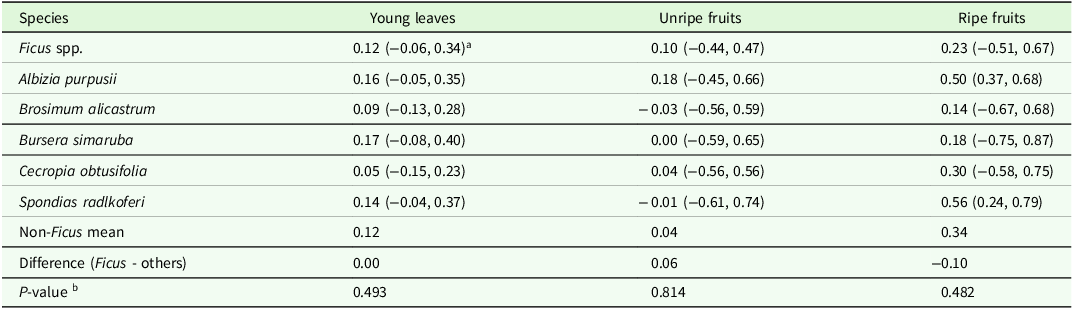
Synchrony values varied considerably across species and phenophases (Table 1). For young leaves, all species showed low synchrony (range: 0.048–0.174), with figs displaying intermediate values (0.124). Unripe fruits showed the lowest overall synchrony, with two species (Brosimum alicastrum and Spondias radlkoferi) exhibiting negative values, indicating inverse correlations between some tree pairs. Figs showed intermediate synchrony (0.095) for this phenophase. Ripe fruits displayed the widest range of synchrony values (0.143-0.561), with figs (0.233) ranking third-lowest among the six species.
Intraspecific phenological synchrony (mean pairwise Spearman correlations) for six tree taxa important in the diet of mantled howlers

a Values show detrended synchrony with 95% confidence intervals in parentheses. Lower values indicate greater asynchrony.
b One-tailed permutation test (n = 1,000) testing whether Ficus synchrony < non-Ficus synchrony.
Comparing figs to pooled non-fig species revealed no statistically significant differences for any phenophase. Figs showed identical synchrony to non-fig species for young leaves (0.124 vs 0.123; difference = 0.002, p = 0.489), higher synchrony for unripe fruits (0.095 vs 0.038; difference = 0.057, p = 0.813), and lower synchrony for ripe fruits (0.233 vs 0.335; difference = −0.102, p = 0.480). All confidence intervals were wide, frequently spanning from negative to positive values, indicating high within-species variability in pairwise correlations.
H2: Keystone hypothesis
Community resource composition averaged 67.3% young leaves, 22.8% unripe fruits, and 10.0% ripe fruits based on weighted phenological scores. In the absence of figs, 121 weeks (24.6%) would have fallen below the critical resource threshold of 6.046 weighted units. With figs present, only 49 weeks (10.0%) fell below this threshold, representing a 59.5% reduction in the duration of resource scarcity (Figure 1). This yielded 72 rescue events (14.7% of all monitored weeks) when fig presence directly prevented community resources from falling below critical levels (Table S1, Figure S1). During rescue events, figs contributed an average of 20.0% of total weighted community resources despite representing only one of six monitored taxa. Resource-specific contributions during these critical periods were 21.7% for ripe fruits, 25.4% for unripe fruits, and 17.3% for young leaves (Figure S2). Mean resource availability with figs present was 1.38 units for ripe fruits, 3.25 units for unripe fruits, and 7.73 units for young leaves, compared to 1.08, 2.52, and 6.04 units respectively without figs.
Time series of weighted resource availability by year showing scenarios with figs (green areas and lines) and without figs (orange areas and lines). Green shading and points indicate weeks when figs prevented resources from falling below the critical threshold (red dashed line at 6.046 units).

The highest frequency of rescue events occurred during January (12 events), February (13 events), and March (12 events; Figure S3). October through December showed the lowest rescue frequency (2–3 events per month). Annual variation in rescue events ranged from 4 events (2012) to 10 events (2017), with no notable temporal trend across the study period (mean = 7.2 events per year, SE = 0.60).
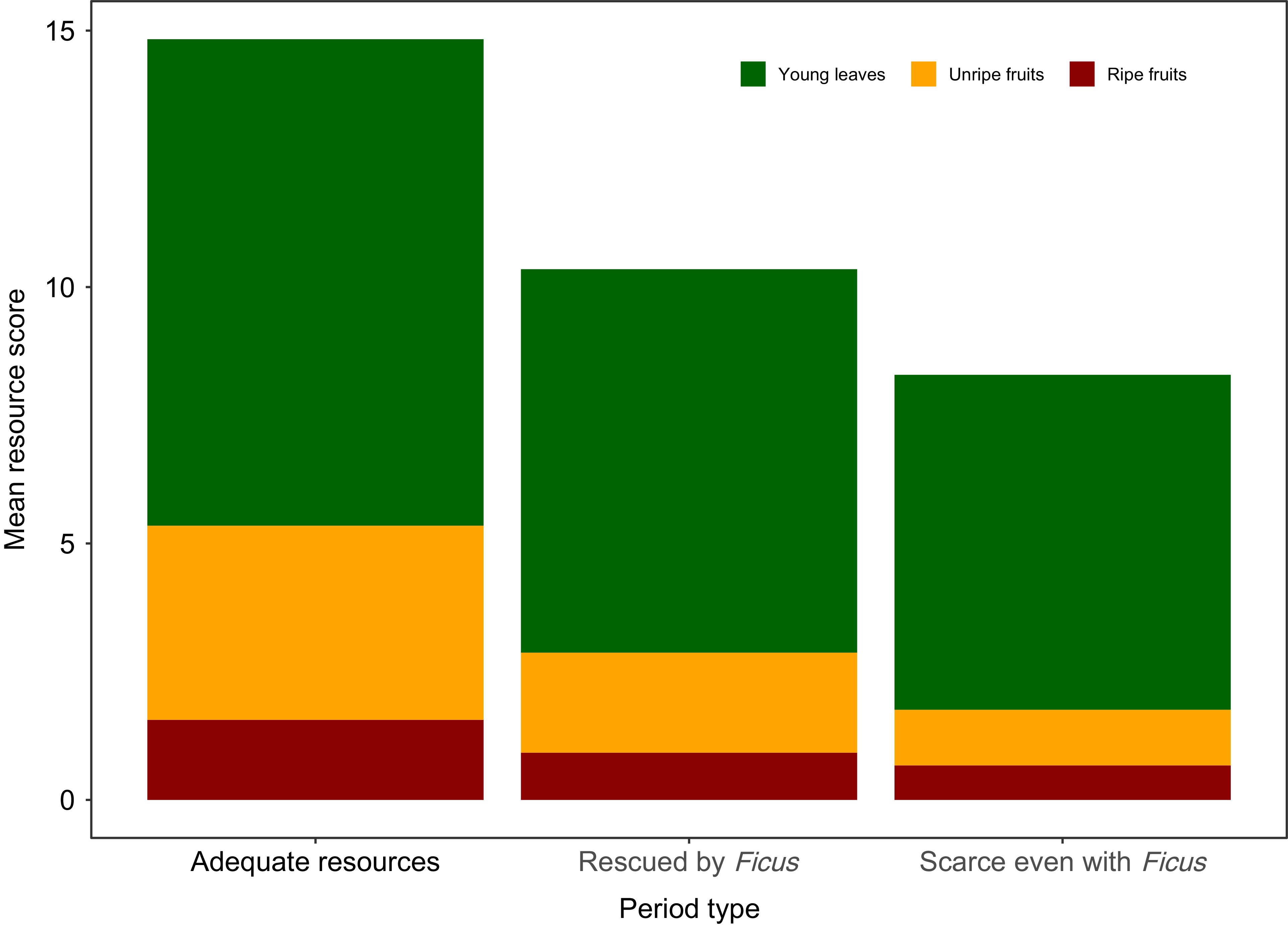
Resource composition analysis across different availability scenarios revealed distinct patterns. During adequate resource periods (mean weighted resources = 14.9 units), all food types were abundant (Figure 2). During rescue periods when figs prevented scarcity (mean = 10.5 units), resources would have averaged only 8.0 units without figs. During persistent scarcity periods that occurred despite fig presence (mean = 8.3 units), even fig contributions were insufficient to maintain resources above critical thresholds. Differences in resource availability between scenarios were significant (mean difference = 1.80 units, t = 46.6, df = 490, p < 0.001). The composite Keystone Species Index value was 18.59, integrating rescue frequency (14.7%), mean resource contribution during scarcity (18.8%), and proportional reduction in scarcity duration (59.5%).
Mean resource composition during different scarcity conditions showing the contribution of young leaves (green), unripe fruits (orange), and ripe fruits (red) to total community resources.

H3: Bet-hedging hypothesis
Annual fruiting data encompassed 100 tree-years for Albizia purpusii, Brosimum alicastrum, Bursera simaruba, Ficus spp., and Spondias radlkoferi, and 70 tree-years for Cecropia obtusifolia. Mean annual ripe fruit scores ranged from 7.92 in Spondias radlkoferi to 14.6 in figs, with standard deviations varying substantially among taxa (Table S2). Coefficient of variation in annual fruiting differed significantly among the six taxa (Levene’s test: F 5,564 = 4.9, p < 0.001). Albizia purpusii exhibited the lowest mean coefficient of variation at 58.1%, followed by figs at 66.4%, Brosimum alicastrum at 67.9%, Cecropia obtusifolia at 70.4%, Spondias radlkoferi at 78.7%, and Bursera simaruba at 91.2% (Figure S4).
Pairwise variance comparisons between figs and other taxa revealed that figs exhibited significantly higher interannual variance in ripe fruit production than four of the five comparison species. Specifically, figs showed greater variance than Bursera simabura (F 99,99 = 1.8, p = 0.006), Brosimum alicastrum (F 99,99 = 2.3, p < 0.001), Cecropia obtusifolia (F 99,69 = 2.2, p < 0.001), and Spondias radlkoferi (F 99,99 = 2.8, p < 0.001; Figure 3). The comparison between figs and Albizia purpusii did not reveal a significant difference in variance (F 99,99 = 0.8, p = 0.155). Temporal patterns in annual fruiting revealed considerable year-to-year fluctuation in all taxa, with no consistent directional trends across the 10-year monitoring period (Figure S5).
Distribution of annual fruit production across six tree taxa from 2012 to 2021. Boxplots show the variation in total annual fruit scores. each point represents one tree-year observation. Box boundaries indicate the first and third quartiles, the horizontal line within each box represents the median, and whiskers extend to 1.5 times the interquartile range. Plant taxa are ordered along the x-axis by median annual fruiting score. The width of the distribution and spread of points illustrate the absolute interannual variance in fruiting for each taxa. Sample sizes are 100 tree-years for all taxa except Cecropia obtusifolia, with 70 tree-years.

H4: Complementarity hypothesis
Fig phenology showed significant positive correlations with non-fig species across all three resource types. Young leaves exhibited the strongest synchrony between fig and non-fig taxa (r = 0.71, 95% CI = 0.66–0.75, p < 0.001), indicating that leaf flush occurred simultaneously across taxa groups. Unripe fruits showed a moderate positive correlation (r = 0.41, 95% CI = 0.33–0.48, p < 0.001), while ripe fruits displayed weak but significant positive correlation (r = 0.17, 95% CI = 0.08–0.25, p < 0.001). Analysis of complementarity periods revealed that fig production rarely coincided with non-fig scarcity (Figure 4). Only 9.2% of weeks (45 of 491) showed high fig young leaf production during low non-fig production. For unripe fruits, this pattern occurred in 18.3% of weeks (90 of 491), and for ripe fruits in 22.4% of weeks (110 of 491).
Quadrant analysis of resource availability patterns between fig and non-fig tree taxa. Each panel displays the relationship between weekly mean phenological scores for figs and five non-fig species (Brosimum alicastrum, Cecropia obtusifolia, Bursera simaruba, Albizia purpusii, and Spondias radlkoferi) across 491 weeks of monitoring for (a) young leaves, (b) unripe fruits, and (c) ripe fruits. Dashed lines represent median thresholds that partition the data into four quadrants representing distinct resource availability scenarios. Points are colored according to their quadrant position: complementarity (red) indicates weeks when fig production was high while non-fig production was low; synchrony (blue) indicates weeks when both species groups exhibited high production; alternative resources (orange) indicates weeks when non-fig production was high while fig production was low; and both scarce (gray) indicates weeks when both groups exhibited low production.

H5: Multiple cropping hypothesis
Over the 10-year study period, 530 tree-year observations (90%) included at least one complete fruiting cycle, while 40 (7%) showed no fruiting activity. The overall mean fruiting frequency across all taxa was 2.31 ± 1.29 (SD) cycles per year (range: 1–7 cycles). Mean annual fruiting frequencies by taxa ranged from 2.08 cycles per year (Spondias radlkoferi) to 2.51 in figs (Table S5).
Fruiting frequency did not differ significantly between fig and non-fig taxa (β = −0.018, SE = 0.159, z = −0.1, p = 0.908). After controlling for tree size, the estimated marginal mean for figs was 2.17 cycles per year (95% CI: 1.65–2.85), while non-fig taxa averaged 2.13 cycles per year (95% CI: 1.92–2.36). The ratio of non-fig to fig fruiting frequencies was 0.982 (SE = 0.156, z = −0.1, p = 0.908), indicating that non-fig species produced 98.2% as many fruiting cycles as figs. The effect of tree size (DBH) on fruiting frequency was positive but non-significant (β = 0.002, SE = 0.001, z = 1.4, p = 0.172).
When taxa were analyzed separately, estimated marginal means ranged from 1.93 cycles per year for Bursera simaruba and Spondias radkoferi to 2.34 cycles per year for Albizia purpusii, with figs producing 2.16 cycles per year. All pairwise species comparisons using Tukey-adjusted tests yielded non-significant differences (all p > 0.05; Table S3). Planned contrasts comparing figs to each non-fig species individually, similarly revealed no significant differences (Table S4).
Discussion
Our 10-year phenological monitoring revealed that among the five mechanistic hypotheses proposed to explain the importance of figs for howlers, only the keystone hypothesis received strong empirical support. Figs prevented the plant community from falling below critical resource thresholds in 72 weeks across the study period, reducing the duration of potential food scarcity by nearly 60% and contributing disproportionately to resource availability during these critical periods. Contrary to expectations, we found no evidence that figs exhibited lower phenological synchrony, reduced interannual fruiting variance, complementary fruiting patterns, or more frequent fruiting cycles compared to other important food trees. These results suggest that the ecological importance of figs for howlers derives not from unique phenological patterns per se, but rather from their reliable contribution of substantial resources during periods when community-wide food availability would otherwise fall below critical thresholds necessary for howler population persistence, a pattern consistent with keystone resource dynamics documented across tropical regions but notably absent in some African forests where low fig densities prevent this buffering function (Gautier-Hion and Michaloud, Reference Gautier-Hion and Michaloud1989).
The strong support for the keystone hypothesis aligns with theoretical predictions about keystone resources in seasonal tropical forests and empirical observations of fig-frugivore relationships across biogeographic regions (Peres, Reference Peres2000; Terborgh, Reference Terborgh and Soulé1986). The finding that fig presence provided 72 rescue events provides mechanistic evidence for the keystone concept, demonstrating that figs contribute disproportionately to resource availability specifically during periods of scarcity rather than simply providing abundant resources overall (Power et al., Reference Power, Tilman, Estes, Menge, Bond, Mills, Daily, Castilla, Lubchenco and Paine1996). The temporal concentration of rescue events during January-March corresponds to the dry season in Los Tuxtlas when most tree species have ceased fruiting (Dunn et al., Reference Dunn, Cristóbal-Azkarate and Veà2010), consistent with patterns documented for other frugivores including Bornean white-bearded gibbons (Hylobates albibarbis) whose population densities directly correlate with fig tree density and chimpanzees where fig presence can triple community sizes (Marshall and Leighton, Reference Marshall, Leighton, Hohmann, Robbins and Boesch2006; Watts et al., Reference Watts, Potts, Lwanga and Mitani2012).
Importantly, the keystone function of figs extends beyond direct frugivore support to include insectivorous species that exploit predictable fig wasp emergences, with some sites documenting twice as many insect-eating as fruit-eating bird species at fruiting figs, suggesting our focus on fruit and leaf resources may underestimate the full ecological impact of fig trees as multi-trophic “resource islands” (Mackay et al., Reference Mackay, Gross and Rossetto2018). This multi-dimensional resource provisioning, combined with figs’ persistence in disturbed habitats where howlers often occur, underscores their conservation importance for maintaining biodiversity in human-modified landscapes where fruit resources from primary tree species may have been eliminated (Arroyo-Rodríguez and Dias, Reference Arroyo-Rodríguez and Dias2010).
The lack of support for the asynchrony hypothesis contrasts with conventional assumptions about fig phenology (Altmann et al., Reference Altmann1989; Bronstein et al., Reference Bronstein, Gouyon, Gliddon, Kjellberg and Michaloud1990) but aligns with evidence that phenological patterns vary geographically and ecologically (Bain et al., Reference Bain, Chou, Tzeng, Ho, Chiang, Chen, Chio, Li, Yang, Kjellberg and Hossaert-McKey2014; Harrison and Yamamura, Reference Harrison and Yamamura2003). The observed intermediate synchrony values for figs may reflect a balance between the benefits of asynchronous fruiting for maintaining pollinator populations and the advantages of responding to shared environmental cues such as rainfall patterns (Polansky and Boesch, Reference Polansky and Boesch2013). In dioecious fig species found elsewhere, sex-based phenological strategies allow male trees to fruit continuously to maintain wasp populations while female trees time fruiting for optimal seed dispersal conditions, a sophisticated temporal partitioning not present in the monoecious fig species we sampled but highlighting the diversity of phenological strategies within the genus (Spencer et al., Reference Spencer, Weiblen and Flick1996; Yang et al., Reference Yang, Machado, Dang, Peng, Yang, Zhang and Liao2015). Furthermore, the increasing threat of climate change to fig-wasp mutualisms may already be disrupting traditional phenological patterns and could explain deviations from expected asynchrony (Jevanandam et al., Reference Jevanandam, Goh and Corlett2013). Because fig wasps have extremely short adult lifespans (1–2 days), even moderate temperature increases of 3°C can markedly reduce their activity period and dispersal capacity, potentially leading to pollination failure and reduced fig production (Jevanandam et al., Reference Jevanandam, Goh and Corlett2013; van Kolfschoten et al., Reference van Kolfschoten, Dück, Lind and Jandér2022). Such disruptions would directly diminish the keystone resource base that sustains howler populations and other tropical frugivores. Future studies should therefore examine individual fig species separately rather than pooling them, as species-specific phenological strategies may be masked when treating figs as a single functional group (though the frequently revised taxonomy of figs may complicate cross-study comparisons).
Similarly unexpected were our findings regarding bet-hedging, complementarity, and multiple cropping hypotheses, which revealed that figs exhibited higher rather than lower interannual variance, positive rather than negative correlations with other species’ phenology, and equivalent rather than elevated fruiting frequencies. The higher variance in fig fruiting contradicts bet-hedging predictions but may reflect their ability to respond opportunistically to favorable conditions with massive fruit crops while reducing output during periods of environmental stress (Harrison and Shanahan, Reference Harrison, Shanahan, Roubik, Sakai and Hamid Karim2005). The positive phenological correlations between figs and other taxa suggest shared responses to environmental drivers such as rainfall and temperature, challenging the complementarity hypothesis but potentially reflecting the overriding influence of strong seasonal signals in our study region (Hamann, Reference Hamann2004; van Schaik et al., Reference van Schaik, Terborgh and Wright1993). The absence of differences in fruiting frequency may be partly explained by our pooling of multiple fig species with potentially different reproductive strategies, as some fig species fruit continuously whereas others exhibit pronounced seasonal peaks (Milton et al., Reference Milton, Windsor, Morrison and Estribi1982). These results collectively highlight that fig importance for howlers cannot be reduced to simple phenological uniqueness but instead emerges from a complex interaction of factors including crop size, nutritional quality, spatial distribution, and persistence in disturbed habitats; dimensions not captured by temporal patterns alone.
These results have direct implications for the conservation of howlers and tropical forest management, particularly given that some howler populations devote more than half of their feeding time to figs and depend on them for persistence in disturbed forests (Cristóbal-Azkarate and Arroyo-Rodríguez, Reference Cristóbal-Azkarate and Arroyo-Rodríguez2007). The demonstrated keystone function of figs argues for their explicit protection in conservation planning, including restrictions on commercial fig timber harvesting which poses an emerging threat to frugivore communities, and their inclusion in forest restoration projects where they can serve as recruitment foci for seed-dispersing animals. Future research should investigate species-specific patterns within figs, examine the role of spatial distribution and individual tree characteristics in resource provisioning, quantify the nutritional contribution of young fig leaves that provide crucial protein for howlers, and model the impacts of various climate change scenarios on fig-howler interactions (Milton, Reference Milton1980; Righini et al., Reference Righini, Garber and Rothman2017). Future work should also integrate these phenological findings with detailed dietary data to confirm that howler consumption increases during the scarcity periods when figs rescue resource availability. Additionally, studies should examine whether the keystone function we documented extends to other ecosystem services such as supporting insectivore communities and facilitating forest regeneration (Mackay et al., Reference Mackay, Gross and Rossetto2018).
More broadly, understanding the multifaceted fig-animal relationships becomes increasingly urgent as tropical forests face unprecedented anthropogenic pressures, with the fate of howlers and countless other species potentially hinging on our ability to identify and protect these keystone resources. Our findings derive from a single site in southeastern Mexico, and resource dynamics likely vary across forest types, climatic regimes, and fig assemblages; thus, testing these hypotheses at additional locations is essential to assess the generalizability of the keystone function we document here.
Supplementary material
To view supplementary material for this article, please visit https://doi.org/10.1017/S0266467426100431
Data availability statement
The datasets used in this study are available from the corresponding author on reasonable request.
Acknowledgements
We thank students, field assistants, lab assistants, and volunteers that were involved in data collection, as well as landowners that allowed us to study howlers in their properties, particularly to A. Coyohua Fuentes, P Cruz-Miros, A. Gómez-Martínez, M. Rayón, O. Domínguez-Pasamontes, La Flor de Catemaco and Ing. J. L. Ponce Puente. We also thank Jun Ying Lim (Associate Editor), Sebastian Montilla, and two anonymous reviewers for providing valuable comments on the manuscript. We thank D. Canales-Espinosa for his mentoring and A. Molina for her vital administrative support. A. Rangel-Negrín and P.A.D. Dias thank Mariana and Fernando for constant support and inspiration to study primate behavior.
Author contributions
ARN and PADD originally formulated the idea, developed methodology, provided project administration and funding, performed statistical analyses, and wrote the manuscript.
Financial support
This work was supported by Instituto de Neuro-etología and Posgrado en Neuroetología at Universidad Veracruzana, Secretaria de Ciencia, Humanidades, Tecnología e Innovación (SECIHTI), The Leakey Foundation, Consejo Veracruzano de Investigación Científica y Desarrollo Tecnológico, and Idea Wild.
Competing interests
The authors declare that they have no conflict of interest.