Introduction
An advanced cancer diagnosis profoundly changes the lives of patients and their families. For patients with minor children, the repercussions of this diagnosis are intensified by the forecasted or actual changes in parental roles and their impact on children. Parents with advanced cancer often experience diminished ability to perform their usual parenting duties, increased reliance on alternate caregivers, disruptions to their children's routines, distress from the possibility of premature death, and increased financial burden on their families (Schmitt et al., Reference Schmitt, Piha and Helenius2008; Northouse et al., Reference Nilsson, Maciejewski and Zhang2009; Moore et al., Reference Moore, Rauch and Baer2015; Zaider et al., Reference Zaider, Salley and Terry2015). In studies comparing similarly ill patients with and without dependents, parents with advanced cancer reported higher overall psychosocial distress, reduced health-related quality of life, and greater anxiety and depressive symptoms (Muriel et al., Reference Muriel, Moore and Baer2012; Park et al., Reference Park, Deal and Check2016). Patients with escalating symptom burden or less social support are at particularly high risk of poor psychosocial outcomes, including parenting-related distress (Park et al., Reference Park, Deal and Check2016). Given their heightened psychosocial needs, parents with advanced cancer merit special attention by their health care providers.
Cancer centers increasingly strive to deliver patient- and family-centered care to individuals with cancer. Patient-centered care promotes coordinated, integrated care between providers, patients, and their families, with the aim of addressing both patients’ physical symptoms and the psychosocial impact of their illness (Institute of Medicine, 2011). Within cancer care, oncology social workers (OSWs) are the predominant clinical workforce addressing the psychological, emotional, financial, and social needs of patients (Smith et al., Reference Smith, Walsh-Burke, Crusan, Holland and Breitbart1998; Carlson and Bultz, Reference Carlson and Bultz2003). For parents with advanced cancer, OSWs may have the additional responsibility of assessing and addressing parents’ concerns about communicating with children about life-limiting illness and death, minimizing the household impact of chronic cancer treatment, and engaging parents in legacy activities (Northouse et al., Reference Nilsson, Maciejewski and Zhang2009; Muriel et al., Reference Muriel, Moore and Baer2012; Inhestern et al., Reference Inhestern, Haller and Wlodarczyk2016; Park et al., Reference Park, Check and Song2017).
Among all clinicians who provide psychosocial care to parents with advanced cancer, multiple barriers challenge their ability to care for this population. Oncology clinicians who participated in educational interventions to support parents with advanced cancer describe clinical encounters with this population as emotionally stressful, compromised by competing clinical priorities, and complicated by the lack of training to meet parents’ needs (Semple et al., Reference Semple, McCaughan and Smith2017; Turner et al., Reference Turner, Clavarino and Yates2007b). Health care providers are often limited by a lack of standardized and routine screening for psychosocial distress, insufficient specialized resources, and inadequate training to address the complex supportive needs of parents with advanced cancer (Rauch et al., Reference Rauch, Muriel and Cassem2002; Turner et al., Reference Turner, Clavarino and Yates2007a, Reference Turner, Clavarino and Yates2007b; Zebrack et al., Reference Zebrack, Kayser and Sundstrom2015; Dencker et al., Reference Dencker, Kristiansen and Rix2018). Of note, clinicians frequently describe end-of-life conversations with advanced cancer patients as emotionally difficult (Baile et al., Reference Baile, Lenzi and Parker2002; Granek et al., Reference Granek, Krzyzanowska and Tozer2013), particularly with younger patients and those with whom they have developed close attachments (Morgans and Schapira, Reference Morgans and Schapira2015; Ethier et al., Reference Ethier, Paramsothy and You2018). Consequently, there is a risk that clinicians may inadequately address the psychosocial needs of parents with advanced cancer.
OSWs are the primary clinicians responsible for providing psychosocial care to parents with advanced cancer, yet their experiences caring for these patients are poorly understood. To address this gap, this exploratory study sought to characterize the attitudes, practice behaviors, and training experiences of OSWs caring for parents with advanced cancer.
Methods
Study design and sample
We conducted a cross-sectional survey study of OSWs assessing their experience providing clinical care for parents with advanced cancer. For this study, parents with advanced cancer were defined as adults with incurable or metastatic cancer who reside with biological, adopted, or step-child dependents less than 18 years of age.
Eligible participants were adult, English-speaking, licensed clinical social workers who practiced in oncology settings across the state of North Carolina and were affiliated with the Social Work Oncology Group of North Carolina (SWOG-NC). The survey was distributed to the 48 attendees of the 2018 SWOG-NC Annual Conference via hard copy and to SWOG-NC membership through an e-mail link (representing an additional 111 individuals). The total response rate was 67% among conference attendees and 37% among e-mail recipients. Participation in the survey was voluntary, and all survey responses were kept anonymous. Informed consent was obtained prior to start of the survey, which was approved by the University of North Carolina (UNC) at Chapel Hill Institutional Review Board.
Survey development
Survey questions were developed through a review of the existing literature, the authors’ clinical experience with advanced cancer patients, and interviews with OSWs. All questions were reviewed by a survey methodologist and subsequently pilot tested with OSWs.
Survey description
The 77-item survey was divided into five sections addressing OSW's psychosocial care of parents with advanced cancer: attitudes (inclusive of self-confidence and perceived responsibilities), practice behaviors, training experiences and needs, demographic characteristics, and open comments. The domains of psychosocial care assessed included communication support, emotional support, household support, illness and treatment decision-making support, and end-of-life planning. Response categories for attitudes were presented as statements with a four-point ordinal response scale (0 = “not at all” to 3 = “very”). For analyses, these categories were collapsed into two levels (“low” for “not at all” or “somewhat”; “high” for “moderately” or “very”). Open-ended questions asked participants to elaborate on personal experiences working with this population as well as questions about what resources they provide to families.
Data analysis
We used descriptive statistics, including percentages, means, medians, and ranges, to characterize the sample. We conducted Chi-squared tests and Fisher's exact tests to evaluate associations between demographic and self-reported practice characteristics with higher self-confidence providing clinical care for parents with advanced cancer. Pearson's correlations were calculated to determine the degree to which response categories for specific domains of practice were associated with each other. All tests were two-tailed with p-values of less than 0.05 considered statistically significant. All analyses were performed using R 3.4.4 (R Core Team, 2018).
Results
Sample characteristics
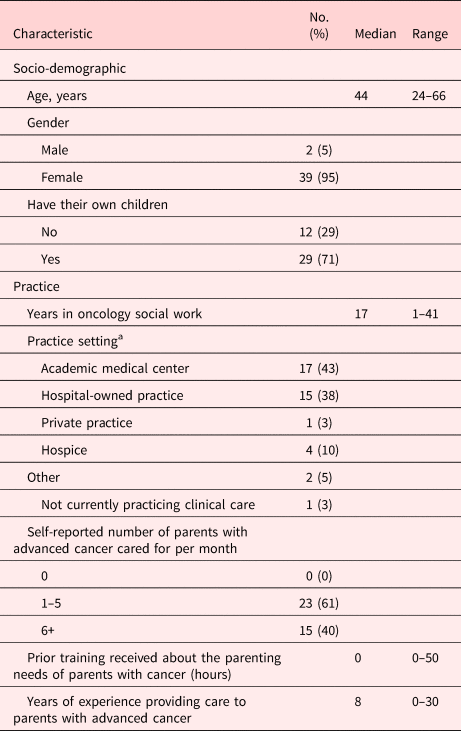
A total of 41 OSWs completed the survey. Table 1 describes their demographic characteristics. Participants were highly experienced clinicians, with a median number of 17 years spent in social work practice (range, 1–41 years). Most practiced in an academic medical center (N = 17) or hospital-owned practice setting (N = 15) and reported regularly providing care to parents with advanced cancer. All participants had a master's degree (N = 41). With the exception of one participant who no longer practiced clinically, all other participants endorsed clinical interactions with at least one parent with advanced cancer per month.
Participant characteristics (N = 41)

a N = 40.
Attitudes: Confidence providing care
There was a wide range among participants in their reported confidence providing care to parents with advanced cancer. Within individuals, confidence between the five domains of care were moderately to highly correlated (range, 0.5–0.7). Participants felt most confident providing support to co-parents (N = 31, 76% confident) and counseling patients on how to maintain household routines (N = 32, 78% confident). The majority of participants also reported confidence in counseling patients on how to discuss their illness with their children (N = 31, 76% confident).
Participants reported less confidence with support for end-of-life planning, such as counseling patients on how to communicate with their children about death (N = 22, 54% confident) and assisting parents with identifying custodians or legal guardians (N = 27, 66% confident). In open-ended responses, participants reported counseling patients on how to communicate with their children about death as the most challenging domain of practice. They described this as particularly difficult when patients were not ready to acknowledge the life-limiting nature of their illness or initiate end-of-life planning.
OSWs also reported less confidence providing care to special populations. Nearly half of the participants reported low confidence in providing care for patients who are divorced or are in the process of separating (N = 20, 50%), parents of children with disabilities (N = 20, 50%), and parents with different cultural backgrounds than their own (N = 19, 51%). Approximately a third of participants endorsed low confidence with non-traditional family structures (e.g., blended families: N = 17, 35%).
With the exception of having children themselves, demographic and practice characteristics were not related to OSWs’ confidence providing care. OSWs who were parents (N = 29, 71%) reported greater confidence helping patients communicate with their co-parents about parenting concerns (p = 0.04), helping patients provide emotional support to their children (p = 0.04), and counseling patients on communication with their children about illness (p = 0.04). The only difference by practice characteristics was greater confidence counseling parents on communicating with their children about illness among OSWs who practiced in non-academic settings (p = 0.05). Participant attitudes about the emotional difficulty of caring for parents with advanced cancer and the relative difficulty of caring for this population compared to patients without children were not associated with levels of confidence.
Attitudes: Perceived responsibilities
Participants considered nearly all assessed domains of psychosocial care to be key responsibilities of OSWs. More than half believed that OSWs should be “moderately” or “completely” responsible for providing the psychosocial clinical services listed in Table 2. The exceptions to these beliefs were in helping parents make treatment decisions for their cancer and helping parents understand their illness and prognosis. In these areas, participants reported that they were “somewhat” responsible, sharing these clinical activities with other providers. Correlations between self-reported practice activities were high and significantly associated with each other. Compared to OSWs in academic medical centers, OSWs who practiced in non-academic settings were more likely to consider themselves the primary psychosocial provider for parents with advanced cancer (p = 0.02).
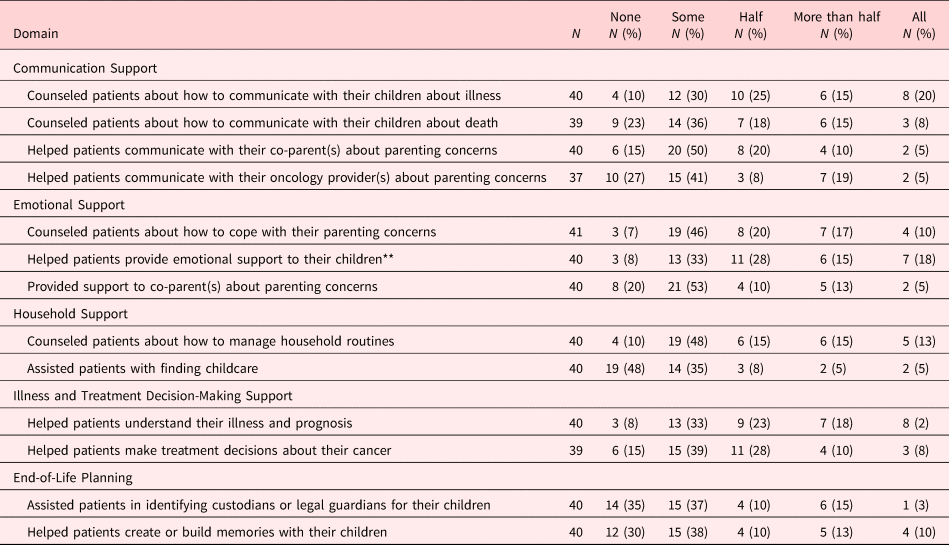
Oncology social workers’ self-reported practice behaviors related to the care of parents with advanced cancera
a Participants were asked to estimate the proportion of parents with advanced cancer for whom they provided the following services over the past year.
**N = 37.
Practice behaviors
Participants’ reports of their practice behaviors varied widely in scope and are described in Table 2. A third of OSWs endorsed assisting “more than half” or “all” of their patients with understanding their illness and prognosis (38%), communicating with their children about illness (35%), and providing emotional support to their children (33%). Half of OSWs endorsed that they do not have enough time to address the parenting concerns of this population, and over three-quarters of OSWs felt that they needed more time to sufficiently address these needs.
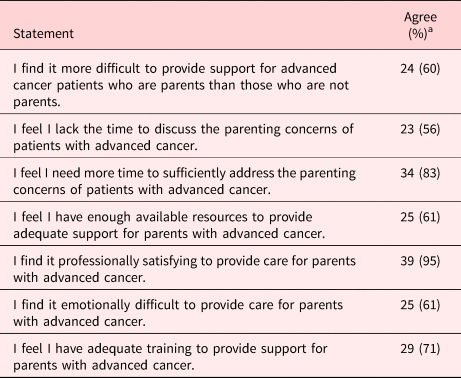
Approximately 60% of the sample reported emotional difficulty when caring for parents with advanced cancer and that providing psychosocial care for parents was more challenging than for non-parents (Table 3). Nonetheless, nearly all participants (95%) found professional satisfaction in working with this patient population.
Participant attitudes about providing psychosocial care to parents with advanced cancer (N = 41)

a “somewhat” and “strongly” agree.
Training experiences and needs
Nearly a third of participants (N = 12, 29%) reported no prior training on the psychosocial needs of parents with advanced cancer. Most OSWs (N = 29, 71%) felt that they had adequate training to provide support for parents with advanced cancer, yet interest in training opportunities was high, with 90% endorsing interest in receiving education about this topic. The majority of OSWs preferred to receive training in the form of in-person continuing education (N = 22, 73%). Less frequently endorsed training modalities were written guides for talking with parents with advanced cancer and webinars.
Discussion
Despite the emotional challenges of providing psychosocial care for parents with advanced cancer, OSWs overwhelmingly viewed their services as a highly relevant and richly rewarding area of practice. To our knowledge, this is the first study to survey practicing OSWs in the US about their attitudes and actual practice behaviors with this unique patient population. Results from this study provide valuable insight into how to improve training for OSWs to best prepare these clinicians to confidently provide high quality care for advanced cancer patients with children.
The results of this study suggest that OSWs may benefit from more educational opportunities targeting the needs of parents with advanced cancer. Existing research suggests that this patient population experiences high psychological distress related to the impact of their illness on their family (Park et al., Reference Park, Check and Song2017, Reference Park, Deal and Yopp2018), experiences greater distress than patients without dependent children (Nilsson et al., Reference Northouse, Mellon, Harden, Miller, Bowen, Croyle and Rowland2009), and desires specific support for their psychosocial needs (Turner et al., Reference Turner, Clavarino and Yates2007a). Despite the evidence of high needs, nearly a third of participants reported receiving no specific training on this population. While a high percentage of OSWs felt that they had adequate training to care for this population, participant responses also indicate that the level of engagement in additional training is likely to be high. Our sample represents a group of competent clinicians who endorse the confidence to handle challenging clinical scenarios but also recognize that there is more they can learn to better care for this population.
Existing interventions in oncology settings can help inform how educational opportunities might be structured. In general, educational interventions for oncology clinicians demonstrate improvements in both provider self-efficacy and patient outcomes (Bylund et al., Reference Bylund, Brown and Bialer2011; Otis-Green et al., Reference Otis-Green, Sidhu and Del Ferraro2014). To our knowledge, only two published education interventions about parents with cancer have been empirically tested with oncology clinicians, both of which occurred outside of the US. In the UK, an in-person intervention was developed by Semple et al. (Reference Semple, McCaughan and Smith2017) to help oncology providers elicit and respond to the communication concerns of parents with cancer (Semple et al., Reference Semple, McCaughan and Smith2017). This intervention is now being tested via web-based delivery (Semple and McCaughan, Reference Semple and McCaughan2019). In Australia, Turner et al. developed an education intervention regarding parents with advanced cancer for oncology nurses which included a self-directed learning manual addressing child development, coping, and evidence-based supportive care recommendations (Turner et al., Reference Turner, Clavarino and Yates2008). The intervention also included an in-person communication skills training that allowed nurses to simulate conversations with parents with advanced cancer (Turner et al., Reference Turner, Clavarino and Butow2009). In the US, the Massachusetts General Hospital's Parenting at A Challenging Time (PACT) Program has developed a 10-credit web-based course for psychosocial oncology clinicians which includes a session on end-of-life needs of parents with cancer (P. Rausch, personal communication, January 15, 2019). The results of this training are not currently published. To complement these resources, we envision implementing in-person educational interventions specifically targeting content areas for which OSWs in adult practice settings report less confidence. Professional organizations may be a mechanism to disseminate such training for OSWs.
Our survey results suggest two specific education areas that merit particular focus. First, OSWs endorsed lower confidence providing care to families with diverse family structures. This is compelling because OSWs will increasingly face greater complexity in family structure among patients who are parents. Analysis of the most recent U.S. Census Bureau data reveals that one in four U.S. parents are unmarried, and 20% of all U.S. children live with a single parent (Pew Research Center, 2018). Single parents are at increased risk for poor psychosocial outcomes in the face of cancer, and thus, it is imperative to improve clinical confidence in addressing their needs (Muriel et al., Reference Muriel, Moore and Baer2012). Second, OSWs can benefit from increased support addressing parents’ end-of-life concerns. Participants in this study reported greater confidence supporting parental communication about illness than they did supporting communication about the possibility of death. These difficult conversations require parents’ acknowledgement of the potential terminal nature of their illness, as well as providers’ skill in engaging patients on this topic (Willis et al., Reference Willis, Peck and Sells2001). Likewise, OSWs expressed lower confidence in helping patients identify custodians and guardians for their children. These issues are complex, time-consuming, and emotionally difficult yet may also have a tremendous impact on families.
An educational intervention alone will likely be insufficient to fully support OSWs in their care for parents with advanced cancer. Social work education has begun to include formal mentorship programs as an approach to engaging social workers in palliative and end-of-life care (Gardner et al., Reference Gardner, Gerbino and Walls2015). Such training may be beneficial for OSWs when applied to the needs of parents with advanced cancer. Additionally, while OSWs are the primary providers of psychosocial care to this patient population, psychosocial cancer care is multidisciplinary. OSWs may be able to learn from their colleagues particularly in areas in which they may not feel comfortable, such as when helping patients understand their illness and prognosis and make treatment decisions. Consultation with child life specialists or pediatric psychologists may be useful to help OSWs who primarily work with adult patients. It is important to note that family therapy services are not universally accessible to patients, and OSWs may need to provide aspects of this service themselves.
As an exploratory pilot study, this study must be contextualized within its limitations. Due to sample size limitations, results must be interpreted with caution. Further research should focus on confirming these findings to enhance the educational needs of OSWs, and we plan to confirm our results with a larger survey to enhance the generalizability of our findings. While participants reported diversity in practice settings, findings should also be weighed in light of possible selection bias, as participating OSWs may be more likely to have perceived unmet training needs than the general social work population. More granularity is also needed, as in-depth interviews and examinations of various patient-family outcomes in relation to these measures could provide a richer characterization of OSWs’ perspectives and their impact on patient care. Despite these limitations, this study is the first step toward understanding the experiences and needs of a critical group of psychosocial care providers.
Given our finding that the majority of OSWs found this work to be emotionally difficult, there is also a need to explore how OSWs engage in self-care while providing clinical care for this population. Future studies could also explore potential correlations of the experiences of OSWs to those who work in hospice care and face similarly challenging situations.
In summary, providing psychosocial care to parents with advanced cancer is a multi-faceted and emotionally challenging endeavor involving a variety of skill sets and abilities. Providing enhanced training to OSWs could improve the quality of care and outcomes of advanced cancer patients with children.
Acknowledgments
The authors wish to gratefully acknowledge the individuals who participated in this study and who gave their time to share their experiences.
Disclosures
The project described was supported by the National Institutes of Health through Grant Award Number 5K07CA218167-03. The content is solely the responsibility of the authors and does not necessarily represent the official views of the NIH. Aspects of this study were presented at the American Psychosocial Oncology Society Annual Meeting on February 28, 2019, in Atlanta, GA.